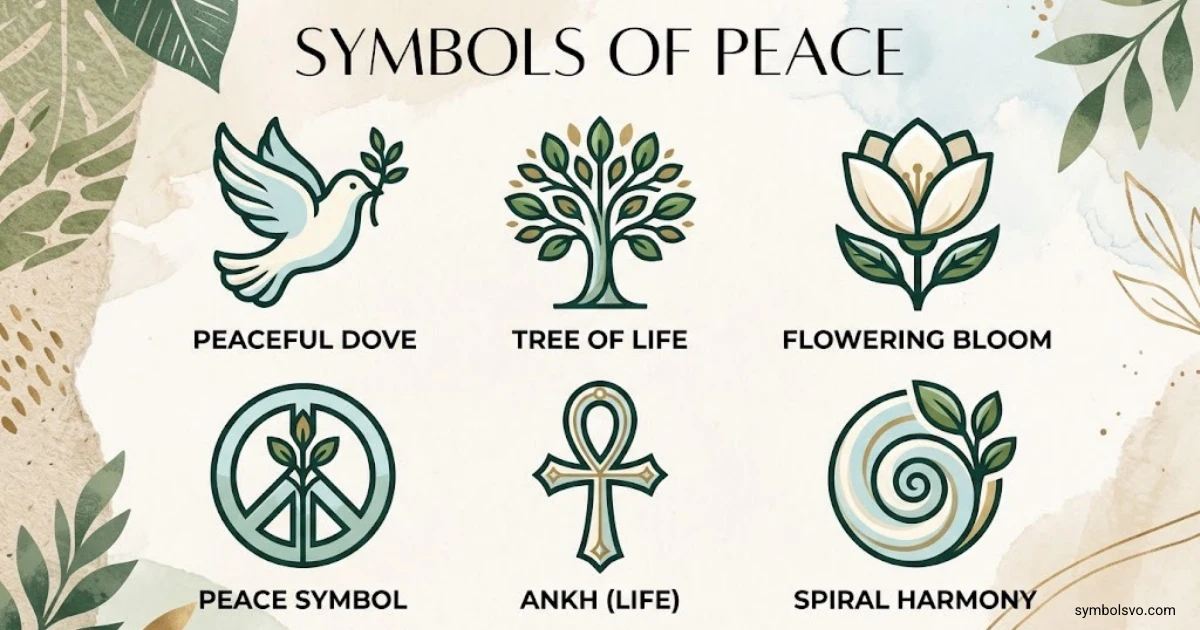
Symbols of peace communicate powerful ideas without requiring a single word. A simple circle, a white dove, or an olive branch can express hope, reconciliation, nonviolence, and the desire for a better world.
Some symbols of peace have deep historical roots, while others became widely recognized through modern peace movements, religious traditions, and cultural practices. Their meanings can also change over time. For example, the familiar peace sign began as an emblem for nuclear disarmament before becoming an international symbol of peace.
Understanding these images means looking beyond their appearance. Their origins, cultural backgrounds, and modern uses often reveal why people continue to display them in public campaigns, artwork, jewelry, tattoos, and everyday messages.
This guide explores peace symbols and their meanings, including their history, cultural significance, and practical uses. You’ll also discover how peace symbolism differs across cultures and why some symbols represent broader ideas such as love, hope, unity, and remembrance.
What Are Symbols of Peace?
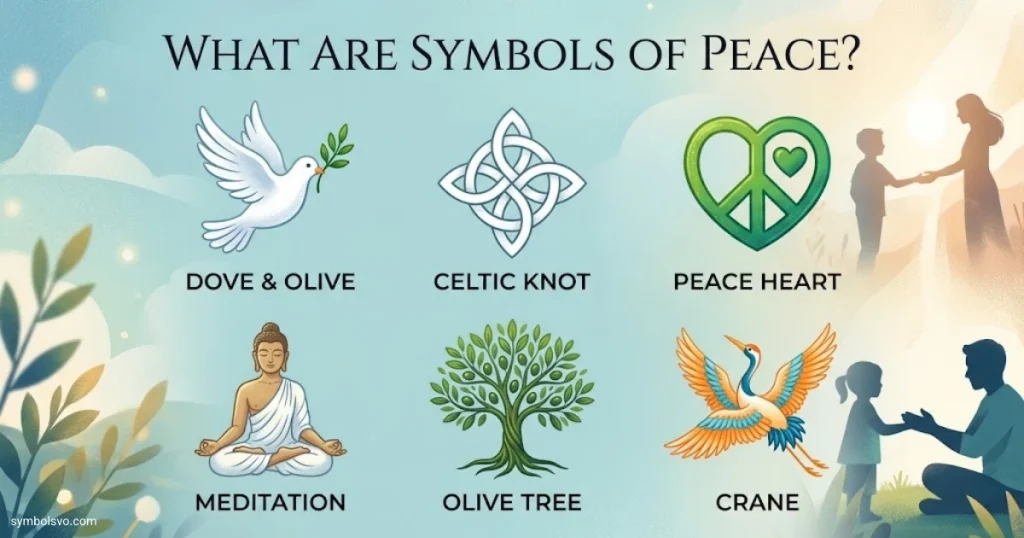
Symbols of peace are visual signs, objects, gestures, and images associated with nonviolence, harmony, reconciliation, or the end of conflict. People use them to express peaceful intentions, remember the consequences of war, or encourage cooperation between individuals and communities.
Some symbols have established historical associations. The modern peace sign, for instance, originated in the British nuclear disarmament movement in 1958. Others, such as a heart or candle, can communicate peaceful feelings without functioning as dedicated peace emblems.
Peace symbolism generally falls into several categories:
- Political symbols: Emblems associated with anti-war activism, nuclear disarmament, and peace campaigns.
- Religious symbols: Images that communicate spiritual harmony, compassion, reconciliation, or hope within particular traditions.
- Natural symbols: Animals, plants, flowers, and other elements of nature associated with peaceful ideas.
- Gestures: Hand movements that express victory, cooperation, or peaceful intentions.
- Memorial symbols: Objects and images used to remember people affected by war and promote peace.
- Artistic symbols: Combinations of shapes, colors, and images used in posters, illustrations, and public artwork.
Although many symbols have become internationally recognizable, their meanings aren’t always universal. A symbol may represent spiritual growth in one tradition and serve as a decorative image in another.
Symbols of Peace and Their Meanings
The following peace symbols with names include established historical emblems, cultural symbols, and broader visual motifs. Their meanings depend on their origins and the contexts in which people use them.
| Symbol | Main meaning | Historical or cultural context |
| Peace sign (☮) | Peace and nuclear disarmament | Modern peace activism |
| White dove | Peace and reconciliation | Biblical traditions and modern imagery |
| Olive branch | Peace and truce | Ancient Mediterranean traditions |
| Paper crane | Hope and peace | Japanese culture and peace memorials |
| White poppy | Remembrance and commitment to peace | British peace movement |
| White flag | Truce or surrender | Armed conflict |
| V-sign | Victory or peace | Modern hand gesture |
| Rainbow | Hope and unity | Context-dependent symbolism |
| Lotus flower | Spiritual growth and purity | Hinduism and Buddhism, among other traditions |
| Peace bell | International harmony | United Nations peace initiatives |
| Broken rifle | Opposition to armed conflict | Pacifist movements |
| White rose | Remembrance or peaceful intentions | Historical and artistic contexts |
| Heart | Love and compassion | Personal and cultural expression |
| Open hands | Openness and cooperation | Contemporary visual communication |
| Joined hands | Unity and solidarity | Community and peace campaigns |
| Olive wreath | Honor and victory | Ancient Greek traditions |
| Palm branch | Victory and religious significance | Ancient traditions and Christianity |
| Peace flag | Peace advocacy | Modern campaigns and public displays |
| Crane memorial | Remembrance and hope | Hiroshima peace memorials |
| Peace-themed mural | Nonviolence and social change | Public art |
| Dove with olive branch | Peace and reconciliation | Combined symbolic imagery |
| Peace sign with a heart | Love and nonviolence | Contemporary graphic design |
| Peace sign with a rainbow | Peace and unity | Contemporary visual expression |
| Candle | Hope and remembrance | Vigils and memorials |
| White flower | Remembrance or peaceful intentions | Varies by flower and culture |
One important distinction: not every item in this table is a formal or universally recognized peace emblem. Some are established historical symbols, while others communicate peaceful ideas through art and context.
The Peace Sign (☮)
The peace sign is among the most recognizable modern symbols of peace. Its circular design contains a central vertical line and two downward-slanting lines that form a distinctive shape.
British graphic designer Gerald Holtom created the symbol in 1958 for the Campaign for Nuclear Disarmament (CND). The organization wanted a clear visual emblem for its campaign against nuclear weapons.
Holtom based the design on flag semaphore, a signaling system that uses the positions of flags to represent letters. The symbol combines the semaphore letters N and D, representing nuclear disarmament, within a circle.
The design first appeared publicly during the British anti-nuclear movement’s 1958 demonstrations. It later spread internationally, particularly during the 1960s, when anti-war activists adopted it during protests against the Vietnam War.
Today, the peace sign communicates several related ideas:
- Opposition to war and nuclear weapons
- Commitment to nonviolence
- Support for peace activism
- International solidarity
- Hope for a more peaceful world
People display the symbol on clothing, jewelry, posters, accessories, and digital graphics. Its original purpose was specific, but its meaning has expanded considerably.
The White Dove
The white dove represents peace, hope, and reconciliation in many familiar forms of Western religious art and modern peace imagery. Its gentle appearance and association with flight make it a powerful visual metaphor for freedom and a peaceful future.
One important source of its symbolism appears in the biblical story of Noah. After the flood, a dove returns carrying an olive leaf, signaling that the waters have receded. This image later became closely associated with hope and the restoration of life.
The dove also appears in Christian imagery, where it can represent the Holy Spirit. In modern art, however, artists frequently use the bird to communicate peace beyond explicitly religious settings.
Pablo Picasso helped popularize the dove as a modern peace emblem through his artwork for peace campaigns after World War II.
A dove may therefore represent:
- Hope after hardship
- Reconciliation following conflict
- Peaceful intentions
- Freedom and renewal
- The possibility of a new beginning
The dove doesn’t have one exclusive origin or meaning. Its interpretation depends on the tradition, artwork, or campaign in which it appears.
The Olive Branch
The olive branch is an enduring symbol of peace, truce, and reconciliation. Its historical associations stretch back to ancient Mediterranean traditions, including ancient Greek culture.
Olive trees were valuable for their fruit and oil. Their branches also appeared in cultural and religious imagery, where they could communicate prosperity, honor, and peaceful intentions.
In the biblical story of Noah, the dove’s olive leaf signals that the floodwaters have receded. Over time, the combination of the dove and olive branch became a familiar image of restored peace.
The olive branch also appears in later Western political imagery. For example, the Great Seal of the United States depicts an eagle holding an olive branch, traditionally representing a preference for peace alongside the capacity for defense.
People commonly use olive branches in:
- Peace posters and illustrations
- Diplomatic and reconciliation imagery
- Wedding and decorative artwork
- Jewelry and tattoos
- Messages encouraging forgiveness
The branch’s lasting appeal comes from its simple message: conflict can end, and relationships can begin to heal.
The Japanese Paper Crane
The paper crane has become an internationally recognized symbol of hope and peace, especially through its association with Hiroshima and remembrance of the atomic bombing of Japan.
In Japanese culture, the crane has long been associated with longevity, good fortune, and heartfelt wishes. Folding paper cranes is part of origami, the Japanese art of paper folding.
The crane’s modern peace symbolism is closely linked to Sadako Sasaki, a young girl who developed leukemia after surviving the atomic bombing of Hiroshima as a toddler. During her illness, she folded paper cranes while hoping to recover. She died on October 25, 1955.
Her story inspired a campaign to create the Children’s Peace Monument in Hiroshima Peace Memorial Park. The monument honors children who died because of the atomic bombing and expresses a continuing wish for world peace.
Today, people from many countries send folded cranes to Hiroshima as gestures of remembrance and hope. According to Hiroshima City’s official website, around 10 million paper cranes are sent to the Children’s Peace Monument each year.
The crane can symbolize:
- Hope in difficult circumstances
- Remembrance of victims of war
- Wishes for peace
- The rejection of nuclear weapons
- Solidarity with affected communities
The White Poppy
The white poppy represents remembrance, opposition to war, and a commitment to peace. It has a specific historical connection to the British peace movement rather than serving merely as a general flower associated with tranquility.
Members of the Co-operative Women’s Guild first produced white poppies in 1933, following the First World War. Many members had lost family members or friends during the conflict. They wanted remembrance to include a clear commitment to preventing future wars.
The Peace Pledge Union now distributes white poppies as part of its remembrance campaign.
According to the organization, white poppies express three main ideas:
- Remembering all victims of war, including civilians and military personnel of every nationality
- Challenging the glorification of war and militarism
- Promoting a commitment to peace
The white poppy differs from the red poppy used in British remembrance traditions. The two carry distinct associations and can reflect different approaches to remembering war.
Because of these differences, the white poppy can be a politically meaningful symbol. Understanding its history helps explain why people may interpret it differently.
The White Flag
The white flag is traditionally associated with a request for a truce, surrender, or communication during armed conflict. Its meaning is more specific than a general expression of world peace.
A person or group displaying a white flag may be signaling a desire to stop fighting or communicate without continuing hostilities. The precise circumstances matter, and the flag should not automatically be interpreted as a permanent peace agreement.
In everyday language, the expression “raise the white flag” can also mean admitting defeat or giving up a struggle.
The white flag is therefore connected to the possibility of ending immediate conflict, but it doesn’t necessarily represent reconciliation or a lasting resolution.
The V-Sign
The V-sign is a hand gesture made by raising two fingers in a V shape. Depending on the situation, it can represent victory, peace, or a friendly greeting.
During World War II, the gesture became associated with victory. It later gained popularity as a peace gesture during anti-war demonstrations and counterculture movements.
The gesture’s meaning varies by country, hand orientation, and social context. A V-sign made with the palm facing outward may communicate a friendly or peaceful message in some places, while other orientations can be offensive in certain cultures.
This distinction matters because the V-sign is a hand gesture, not the same graphic as the circular peace sign.
The Rainbow
The rainbow can symbolize hope, unity, diversity, and the possibility of better days after hardship. Its appearance after rain makes it a natural metaphor for renewal and optimism.
In peace-themed artwork, artists sometimes use rainbows to represent cooperation between different communities or a shared hope for a peaceful future.
However, rainbow imagery has several other important associations. The rainbow flag, for example, is widely associated with LGBTQ+ pride. A rainbow may also appear in religious stories, national symbolism, or general decorative artwork.
Its meaning depends on the colors, design, and setting. It can support a message of peace, but it isn’t exclusively a peace symbol.
The Lotus Flower
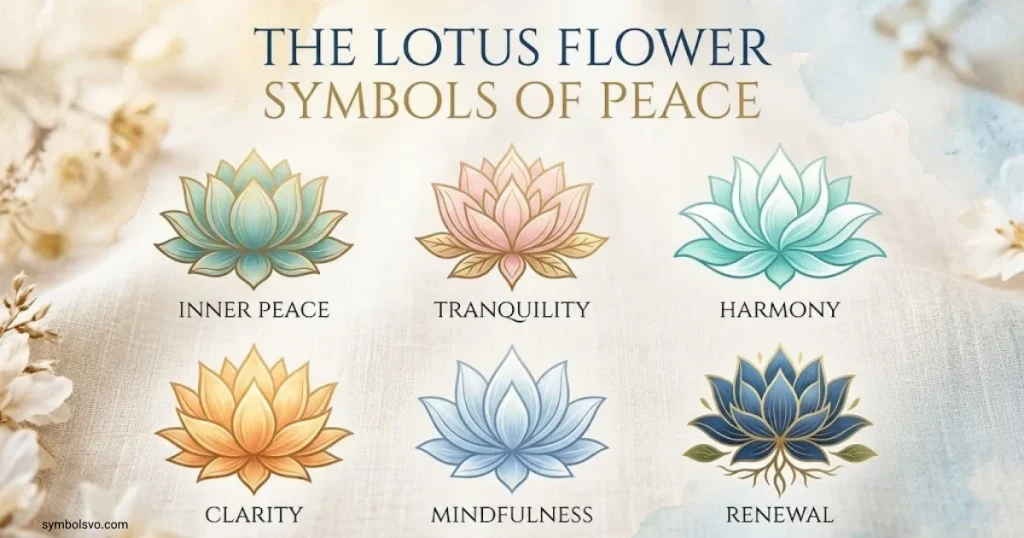
The lotus flower is associated with purity, spiritual development, and awakening in several South and East Asian traditions. It is particularly important in Hinduism and Buddhism, although its meanings vary between religious texts and artistic representations.
The lotus grows in muddy water while producing a flower that rises above the surface. This growth pattern has made it a meaningful image for spiritual development, resilience, and the possibility of rising above difficult circumstances.
In Buddhism, lotus imagery often appears in representations of enlightenment and spiritual awakening. In Hindu traditions, the lotus also appears in religious art associated with deities and ideas of purity and creation.
The lotus can therefore suggest inner peace, but it isn’t simply a universal emblem of political peace or opposition to war.
Its most appropriate meaning depends on the religious or cultural context in which it appears.
The Peace Bell
The Japanese Peace Bell at United Nations Headquarters in New York represents international harmony and the hope for world peace.
The United Nations Association of Japan presented the bell to the UN on June 8, 1954. It was cast from coins donated by delegates from 60 countries, giving the object a symbolic connection to international cooperation.
The bell is traditionally rung twice a year: on the first day of spring and on September 21, the International Day of Peace.
Its sound serves as a reminder that peace requires more than the absence of fighting. It also depends on cooperation, shared responsibility, and a willingness to resolve disputes.
The Peace Bell is a particularly useful example of how an ordinary object can become an internationally meaningful symbol through collective participation and public ceremony.
The Broken Rifle
The broken rifle is a symbol of opposition to armed violence and a commitment to pacifism. Unlike decorative symbols that suggest calm or harmony, this image directly challenges the use of weapons.
It is associated with pacifist movements, including War Resisters’ International. Its visual message is straightforward: weapons and warfare should not determine how societies resolve their conflicts.
The broken rifle can communicate:
- Opposition to armed conflict
- Commitment to nonviolence
- Rejection of militarism
- Support for peaceful conflict resolution
Its meaning is especially clear in anti-war posters and demonstrations. It represents an explicit political position rather than a general feeling of calm.
The White Rose
The white rose can represent innocence, remembrance, purity, or peaceful intentions, depending on the setting. Unlike the white poppy, it doesn’t have one universally established peace-related meaning.
The flower also has a specific historical association with the White Rose resistance group in Nazi Germany. The group, which included students and professor Kurt Huber, distributed leaflets opposing the Nazi regime during 1942 and 1943.
Its use of nonviolent resistance gives the white rose a meaningful association with conscience, courage, and opposition to oppression in that historical context.
Today, white roses may appear in memorials, ceremonies, artwork, and personal gifts. Their interpretation depends on the occasion and cultural background.
The Heart
The heart is one of the most familiar symbols of love, care, and affection. Although it isn’t a dedicated peace emblem, it often supports peace-related messages by expressing compassion and concern for other people.
A heart can communicate a desire to repair relationships, reject hatred, or treat others with kindness. When paired with a peace sign, it combines the ideas of nonviolence and love.
Common uses include:
- Peace and love illustrations
- Greeting cards and personal messages
- Jewelry and accessories
- Campaign artwork
- Tattoos expressing personal values
The heart’s connection to peace is mainly interpretive. Its central meaning remains love and affection, while its peace-related meaning often comes from the surrounding imagery or message.
Open Hands
Open hands can communicate openness, welcome, cooperation, and nonthreatening intent. Their meaning comes from familiar gestures that can suggest a willingness to help or engage with others.
Artists often use open hands in humanitarian campaigns and community artwork. The image can also suggest that people are ready to listen rather than fight.
However, hand gestures vary across cultures. An image of open hands should be interpreted according to its surrounding message rather than assumed to have one fixed meaning everywhere.
Joined Hands
Joined hands often represent unity, cooperation, solidarity, and mutual support. They can suggest that people from different backgrounds are willing to work together toward a shared goal.
Peace campaigns may use joined hands to emphasize community participation and reconciliation. The image also appears in educational materials, humanitarian projects, and artwork about friendship.
Joined hands aren’t a standardized international peace emblem. Their meaning depends on how artists or organizations use them.
The Olive Wreath
The olive wreath has historical associations with honor and victory in ancient Greek traditions. It is related to the olive branch, but its meaning isn’t identical.
In ancient Greece, olive wreaths were used to honor victors in important competitions, including the Olympic Games. The wreath therefore represents achievement and recognition as well as associations with the olive tree.
In modern peace-related artwork, olive wreath imagery may evoke harmony, goodwill, or the desire to settle disputes. However, its historical connection to victory should remain clear.
The Palm Branch
The palm branch has been associated with victory, honor, and celebration in several ancient traditions. It also holds a distinct place in Christianity.
In Christian tradition, palm branches are connected with Jesus’ entry into Jerusalem, an event commemorated on Palm Sunday. The branches represent welcome and have additional religious meanings within Christian practice.
Although palm branches can appear in peace-themed art, they are not primarily a universal peace emblem. Their interpretation depends on the historical, cultural, or religious setting.
The Peace Flag
A peace flag is a flag designed to communicate opposition to war or support for peaceful cooperation. Unlike a surrender flag, it generally expresses a broader public message rather than a request to stop fighting in a specific conflict.
There is no single flag design that represents every peace campaign worldwide. Colors, words, and emblems vary among organizations and movements.
When discussing a particular peace flag, identify the campaign or organization behind it. This helps readers understand whether the flag represents nuclear disarmament, general pacifism, international solidarity, or another specific goal.
The Crane Memorial
A crane memorial uses folded paper cranes or crane imagery to express remembrance, hope, and wishes for peace. Its modern associations are especially strong in Hiroshima.
The Children’s Peace Monument in Hiroshima Peace Memorial Park honors children who died because of the atomic bombing. Paper cranes sent by people from around the world are displayed as expressions of peace and remembrance.
The distinction between a single paper crane and a memorial made from thousands of cranes is important. The individual crane draws on Japanese cultural symbolism, while the memorial also represents collective grief, education, and international solidarity.
Peace-Themed Murals
Peace-themed murals use images, words, and colors to promote nonviolence, reconciliation, and social change. They often combine recognizable motifs, including doves, olive branches, joined hands, and peace signs.
Public murals can make peace-related messages visible in shared spaces. They may commemorate people affected by conflict, encourage dialogue between communities, or call attention to the need for peaceful solutions.
A mural isn’t a standardized symbol in itself. It is a form of public art through which artists communicate ideas about peace.
A Dove Carrying an Olive Branch
A dove carrying an olive branch combines two established motifs into a widely recognizable image of peace and reconciliation.
The dove and olive leaf appear together in the biblical story of Noah, where the returning bird signals that the floodwaters have receded. Later Western religious art and modern peace campaigns helped make this combination especially familiar.
The image often communicates hope after conflict, the restoration of relationships, and the possibility of a peaceful future.
A Peace Sign With a Heart
A peace sign combined with a heart brings together nonviolence and love. It is a modern design combination rather than an ancient emblem with a single established origin.
People use it in illustrations, greeting cards, clothing, jewelry, and personal messages. The heart adds a message of compassion or affection to the peace sign’s association with nonviolence.
The combined image works well when the intended message is both peaceful and personal.
A Peace Sign With a Rainbow
A peace sign with a rainbow combines the peace sign’s associations with nonviolence and peace activism with the rainbow’s potential meanings of hope, unity, and diversity.
Artists may use the combination in posters, campaign graphics, or decorative designs. Its meaning depends on the setting, especially because rainbow imagery also carries significant cultural and political associations of its own.
The combination can express a broad message of inclusion and peace, but it shouldn’t be treated as a separate ancient symbol.
The Candle
A candle often represents hope, remembrance, solidarity, or the desire for healing. Its use in vigils and memorial ceremonies makes it a familiar object in public expressions of grief and support.
People may light candles to remember those affected by violence, honor victims of war, or demonstrate solidarity with a community experiencing hardship.
A candle is not an official peace emblem in every context. Its symbolic meaning comes from the occasion and the message accompanying it.
The White Flower
A white flower may represent remembrance, innocence, mourning, or peaceful intentions. Its meaning depends on the particular flower and the cultural tradition in which it appears.
For example, the white poppy has a specific connection to remembrance and opposition to war. A white rose, by contrast, can carry meanings of innocence, memorialization, or peaceful intentions.
This distinction illustrates an important principle of peace symbolism: color alone doesn’t establish a symbol’s full meaning. The flower, its history, and the context all matter.
The History of the Modern Peace Sign
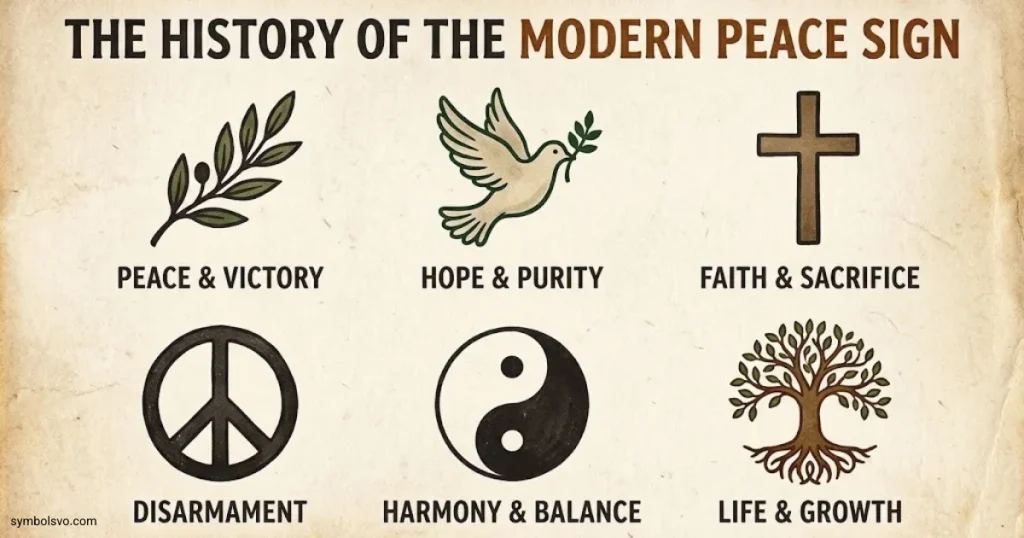
The modern peace sign deserves special attention because its origin is documented and directly connected to a major peace movement.
Who Designed the Peace Sign?
British graphic designer Gerald Holtom designed the symbol in 1958 for the Campaign for Nuclear Disarmament. The campaign was organizing demonstrations against nuclear weapons and needed a clear emblem that supporters could display.
Holtom drew on flag semaphore, combining the signals for N and D inside a circle. The letters stood for nuclear disarmament.
The design became known as the CND symbol because of its connection to the organization.
Why Was the Peace Sign Created?
The symbol emerged during a period of serious public concern about nuclear weapons. The CND sought nuclear disarmament through public campaigning and demonstrations.
A simple visual emblem helped supporters identify with the cause. People could display it on badges, banners, posters, and other materials without needing to explain the campaign in every setting.
Its design was easy to reproduce, which helped it spread through public demonstrations and everyday objects.
How Did the Peace Sign Become Internationally Recognized?
The peace sign moved beyond its original British setting during the 1960s. Activists in other countries adopted it during anti-war protests, including demonstrations opposing the Vietnam War.
As the design appeared in photographs, posters, clothing, and popular culture, its meaning expanded. It came to represent not only nuclear disarmament but also broader opposition to war and support for nonviolence.
Today, it is widely recognized as a peace emblem even by people who don’t know its original history.
What Does the Peace Sign Mean Today?
The peace sign continues to represent several connected ideas:
- Nuclear disarmament
- Opposition to war
- Peaceful protest
- Nonviolence
- International solidarity
- Hope for global peace
Its meaning depends on context, but its historical roots remain important. Understanding its origin helps explain why the symbol became so influential.
Peace Symbols Across Cultures and Religions
Peace symbolism varies across traditions. Some symbols express spiritual harmony, while others arose from political campaigns or historical events.
Peace Symbols in Ancient Greece and Rome
The olive branch and olive wreath are important examples of ancient Mediterranean symbolism. The olive branch became associated with peace and reconciliation, while the olive wreath was strongly connected with honor and victory in ancient Greek traditions.
These meanings sometimes overlap. Victory may create conditions for peace, but a symbol of victory doesn’t automatically represent nonviolence.
Peace Symbols in Japanese Culture
The crane has longstanding associations with longevity and good fortune in Japanese culture. Its connection to modern peace advocacy grew especially strong through the story of Sadako Sasaki and Hiroshima’s Children’s Peace Monument.
Paper cranes now appear in memorials, school projects, and international peace initiatives. They communicate wishes for peace while also reminding viewers of the human consequences of nuclear warfare.
Peace-Related Symbols in Hinduism and Buddhism
The lotus is a prominent symbol in both Hindu and Buddhist traditions. Its meanings include purity, spiritual development, and awakening, though interpretations differ between traditions.
The flower can represent inner peace when used in a spiritual context. However, its religious significance is broader than peace alone.
Peace Symbols in Christianity
Christian peace imagery includes the dove and olive leaf associated with Noah’s story. The palm branch carries a different significance through the account of Jesus’ entry into Jerusalem.
These images show how religious stories influence visual symbolism over centuries. They also demonstrate why related symbols shouldn’t be treated as though they all share the same origin.
Peace Symbols in Modern Social Movements
The peace sign, white poppy, and broken rifle have direct connections to modern peace activism or pacifist movements.
Each communicates a somewhat different message. The peace sign is historically associated with nuclear disarmament, the white poppy links remembrance with a commitment to peace, and the broken rifle challenges armed violence.
Understanding these distinctions gives readers a more accurate picture of how peace movements use symbols.
Symbols of Peace and Love
Symbols of peace and love combine the desire for nonviolence with care, compassion, and positive relationships.
Some combinations have recognizable historical associations. Others are contemporary artistic choices that express a personal message.
Which Symbols Represent Both Peace and Love?
The heart, dove, and olive branch are common choices for peace-themed designs. A heart paired with a peace sign can communicate love and nonviolence, while a dove carrying an olive branch combines hope with reconciliation.
These combinations work well in artwork, greeting cards, jewelry, and personal messages. Their exact meanings depend on the accompanying text and visual design.
Symbols of Inner Peace and Spiritual Harmony
The lotus is often associated with spiritual growth in Hinduism and Buddhism. Calm water, balanced shapes, and natural imagery can also represent tranquility in contemporary artwork.
Inner peace differs from political peace. The former concerns a person’s sense of calm or spiritual well-being, while the latter concerns relationships between people, communities, or nations.
Symbols of Friendship, Unity, and Reconciliation
Joined hands and open hands can express cooperation, solidarity, and a willingness to work together.
These images are especially useful in community campaigns because they emphasize relationships rather than political power. However, their meanings are interpretive and depend on their setting.
Peace Symbols in Modern Life
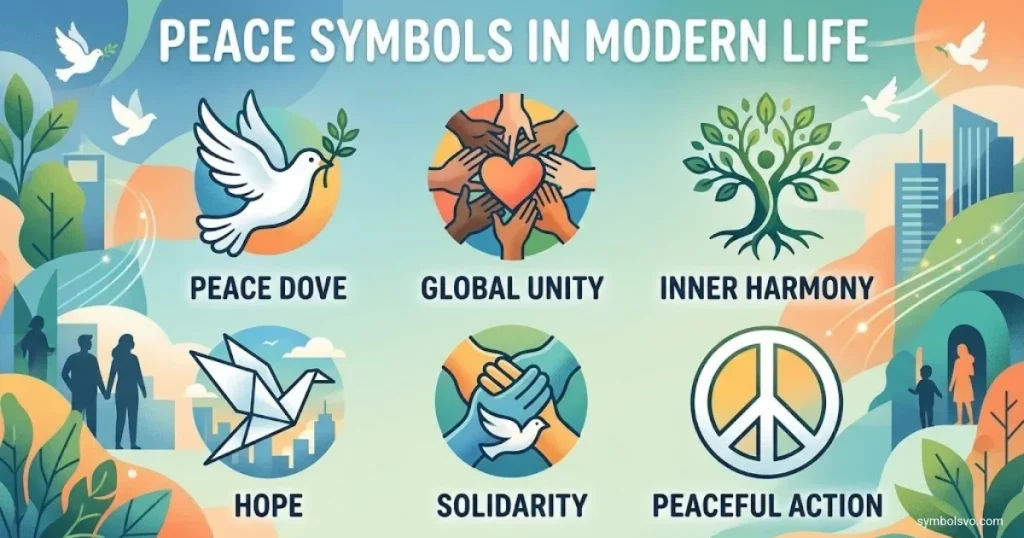
Peace symbols remain visible in public campaigns and everyday expression. Their uses have expanded as visual communication has moved into clothing, digital platforms, and personal design.
Peace Symbols in Art and Illustration
Artists often combine familiar symbols with colors, words, and other visual elements to create messages about peace.
A poster might show a dove carrying an olive branch, while a mural might combine joined hands with a message about community cooperation. These designs use recognizable imagery to make their message easier to understand.
Peace Symbols in Clothing and Jewelry
Peace-sign necklaces, bracelets, badges, and T-shirts allow people to display a symbol publicly. Depending on the context, wearing one can communicate support for peace activism, personal values, or an interest in a particular design.
The peace sign’s association with the 1960s counterculture also gives it a place in fashion history.
Peace Symbols in Tattoos
Peace tattoos allow people to express personal beliefs or commemorate meaningful experiences. Popular choices include the peace sign, dove, olive branch, and paper crane.
Before choosing a design, consider both its personal meaning and its cultural background.
| Tattoo design | Common association |
| Peace sign | Nonviolence and peace activism |
| Dove | Hope and reconciliation |
| Olive branch | Peaceful intentions |
| Paper crane | Hope and remembrance |
| Heart with peace sign | Love and nonviolence |
| Lotus flower | Spiritual growth and purity |
These meanings aren’t universal. A tattoo can carry personal significance that differs from its traditional or historical associations.
Peace Symbols in Digital Communication
The peace symbol character ☮ appears in messages, social media posts, usernames, and digital artwork.
It differs from the victory-hand emoji ✌️, which depicts a hand gesture. Although people may use the V-sign to communicate peace, it can also mean victory or serve as a casual greeting.
Other images, such as doves, hearts, and rainbows, can support peace-related messages when the context makes the intended meaning clear.
Peace Symbols in Posters, Campaigns, and Memorials
Peace campaigns use recognizable imagery to attract attention and communicate a clear message. Posters may feature the peace sign, broken rifle, or dove, while memorials may use candles, flowers, or paper cranes.
These objects help people express grief, solidarity, and hope. They can also encourage public discussion about conflict, disarmament, and peaceful ways to resolve disputes.
How to Choose a Peace Symbol for Your Purpose
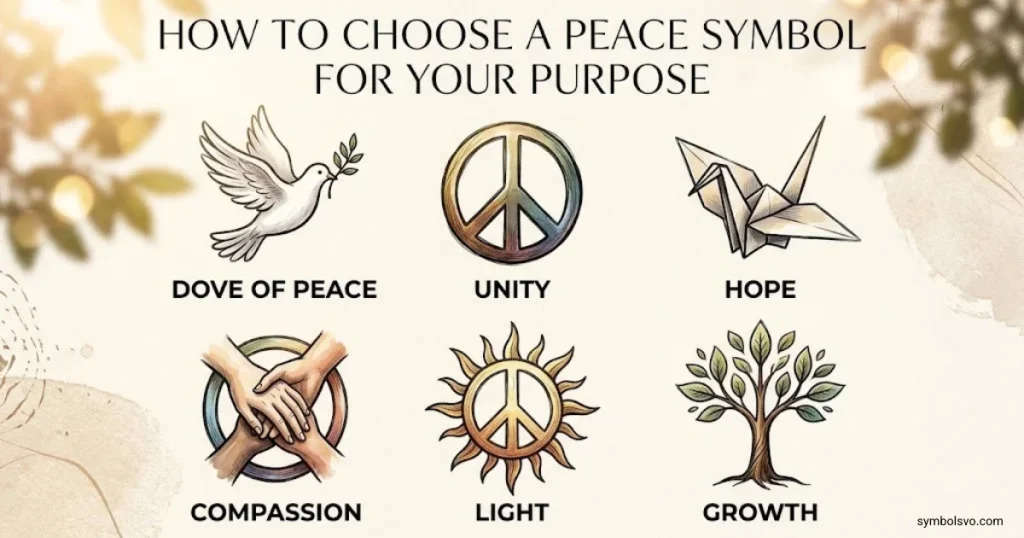
The best symbol depends on what you want to communicate. A symbol associated with nuclear disarmament may suit a peace campaign, while a lotus may better fit an artwork about spiritual growth.
For a Peace Poster or School Project
Choose a symbol with a clear history and an explanation you can verify. The peace sign, olive branch, dove, and paper crane are useful options.
Include the symbol’s name, its main meaning, and a brief note about its origin. This makes the project informative rather than merely decorative.
For a Tattoo or Piece of Jewelry
Consider the message you want the design to communicate. The peace sign has a political history, the dove often suggests reconciliation, and the lotus has specific religious and spiritual associations.
If you choose a symbol from a tradition that isn’t your own, research its meaning and cultural significance before using it.
For Social Media or a Peace Campaign
Choose imagery that your audience can understand quickly. A recognizable peace sign may work for a broad message, while a paper crane may suit a post about Hiroshima remembrance or nuclear disarmament.
Use captions to clarify the message, especially when the image has several possible interpretations.
For Educational or Commercial Artwork
Verify historical claims and identify the sources behind your design. If you use a third party’s photograph or illustration, check its licensing terms and obtain permission when required.
Accurate captions and responsible image use help make the finished work both informative and trustworthy.
Frequently Asked Questions About Symbols of Peace
What Is the Symbol of Peace?
The modern peace sign (☮) is one of the best-known symbols of peace. Gerald Holtom designed it in 1958 for the British Campaign for Nuclear Disarmament. The white dove and olive branch are also widely recognized peace symbols with separate historical associations.
What Are the Most Common Symbols of Peace?
Commonly recognized symbols include the peace sign, white dove, olive branch, paper crane, white poppy, and white flag. Their meanings differ: some represent peace activism, while others communicate hope, remembrance, reconciliation, or a request for a truce.
What Does the Peace Symbol (☮) Mean?
The peace sign originally represented nuclear disarmament. During the 1960s, anti-war movements helped expand its meaning to include nonviolence, opposition to war, and international solidarity. It is now widely recognized as a general symbol of peace.
Who Created the Modern Peace Sign?
British graphic designer Gerald Holtom created the modern peace sign in 1958 for the Campaign for Nuclear Disarmament. He based its design on semaphore signals for the letters N and D, representing nuclear disarmament, within a circle.
Why Is a Dove a Symbol of Peace?
The dove’s association with peace draws partly on the biblical story of Noah, in which a dove returns with an olive leaf after the flood. Religious art and modern peace campaigns later helped establish the bird as a familiar image of hope and reconciliation.
What Does an Olive Branch Symbolize?
An olive branch is associated with peace, truce, and reconciliation in ancient Mediterranean and later Western traditions. It also appears in the biblical story of Noah. Its meaning can vary with the artwork, culture, or historical setting.
What Does a White Poppy Represent?
The white poppy represents remembrance of all victims of war, opposition to the glorification of war, and a commitment to peace. Members of the Co-operative Women’s Guild first produced white poppies in 1933. The Peace Pledge Union continues the campaign today.
What Does a Paper Crane Symbolize?
A paper crane can represent hope, remembrance, and peace. Its modern peace associations are especially strong in Hiroshima, where folded cranes are offered at the Children’s Peace Monument in memory of children affected by the atomic bombing.
What Is the Difference Between the Peace Sign and the V-Sign?
The peace sign (☮) is a specific graphic emblem originally created for nuclear disarmament activism. The V-sign is a hand gesture that can represent victory or peace, depending on the country, hand orientation, and situation.
Which Symbols Represent Peace and Love?
The heart, dove, olive branch, and heart combined with a peace sign are common choices. These images can communicate affection, compassion, reconciliation, and nonviolence. Their precise meanings depend on their cultural and personal contexts.
Are Peace Symbols the Same Across All Cultures?
No. Some peace symbols have gained international recognition, but their meanings vary across cultures, religions, and historical periods. The lotus, for example, has important spiritual meanings in Hinduism and Buddhism that extend beyond the idea of peace.
Which Peace Symbols Are Suitable for Tattoos?
The peace sign, dove, olive branch, and paper crane are popular choices to explore. A lotus may suit a design about spiritual growth. Before selecting a tattoo, research the symbol’s historical and cultural associations and consider what it means to you.
Is There a Symbol for Inner Peace?
The lotus is associated with spiritual growth and awakening in several religious traditions. Calm water and balanced imagery can also represent tranquility in contemporary art. These are symbolic associations rather than universal definitions of inner peace.
What Is the Peace Symbol Emoji?
The character ☮ is the Unicode peace symbol. It differs from the victory-hand emoji ✌️, which depicts a V-sign. People sometimes use the hand gesture to express peace, but its meaning depends on context.
Conclusion: Why Symbols of Peace Still Matter
Symbols of peace give people a shared visual language for expressing hope, reconciliation, nonviolence, and remembrance. From the modern peace sign to the white dove and olive branch, these images help communicate ideas that can cross linguistic and national boundaries.
Their histories matter just as much as their appearance. The peace sign emerged from a campaign for nuclear disarmament, the paper crane became closely connected with Hiroshima’s remembrance traditions, and the white poppy developed through a movement linking remembrance with opposition to war.
Other images, such as hearts, candles, and joined hands, can express peaceful intentions without having one fixed historical meaning.
When you explore peace symbols and their meanings, consider where each symbol came from and how people use it today. That context turns a simple image into a more meaningful expression of peace, understanding, and shared responsibility.

I’m Nathan Holloway, a passionate researcher and writer with a deep interest in symbols, signs, and their hidden meanings. I enjoy exploring how symbols have influenced different civilizations, religions, and modern communication. Through my work, I aim to make complex historical and cultural concepts easy to understand for readers of all backgrounds. Every article I write is carefully researched to provide reliable and engaging information.
Books:
- Beyond the Symbol
- The Secret Meanings of Everyday Signs
Author 2: Grace Whitmore
Description:
My name is Grace Whitmore, and I love discovering the stories behind the world’s most fascinating symbols. I spend my time researching ancient civilizations, mythology, spiritual traditions, and modern iconography to uncover the meanings people often overlook. I believe that every symbol has a history worth telling, and I enjoy sharing that knowledge in a simple and reader-friendly way.
Books:
- Echoes of Ancient Symbols
- The Symbolic World
 Mason Ellington
 Daniel Brooks