I often see confirmation symbols in messages, apps, forms, and everyday communication, but their meanings are not always obvious. A simple check, tick, or approval mark can communicate a lot in just one small symbol.
You may have noticed different confirmation symbols and wondered what each one means or when you should use it. I’ll break them down in a simple way so you can quickly understand the differences and choose the right symbol for your needs.
Whether you are a beginner or simply looking for a quick reference, you’ll find useful meanings and practical examples here. By the end, you should feel more confident recognizing and using confirmation symbols correctly.
Confirmation Symbols And Meanings
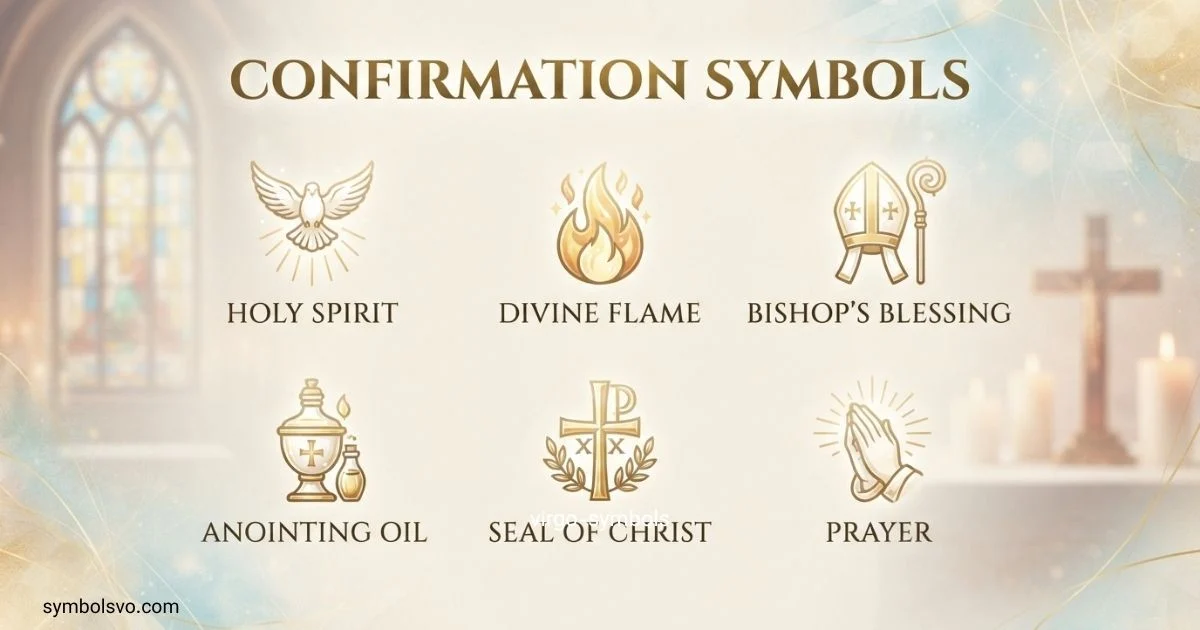
Confirmation symbols communicate different parts of Christian faith and the meaning of the rite.
Cross
✝ — Cross
The cross points to Jesus Christ, his death, and Christian salvation. It is commonly used on Confirmation cards, invitations, certificates, church artwork, and jewelry.
Dove
🕊 — Dove
The dove is one of the best-known visual representations of the Holy Spirit. Christian art often shows the dove descending from above.
Flame
🔥 — Flame
Fire or flame represents the Holy Spirit, particularly through the imagery of Pentecost. Lutheran educational resources also identify the dove and flame as symbols of the Holy Spirit.
Oil
Oil represents anointing. In Catholic Confirmation, Sacred Chrism is used to anoint the candidate. The oil is consecrated by the bishop and is associated with the gift of the Holy Spirit.
Hand
The laying on of hands is an important biblical and liturgical sign associated with invoking the Holy Spirit. In the Catholic rite, it helps express the connection between Confirmation and the gift of the Spirit.
These symbols can be combined in a single design, such as a cross surrounded by flames with a dove above it.
4 Symbols of Confirmation
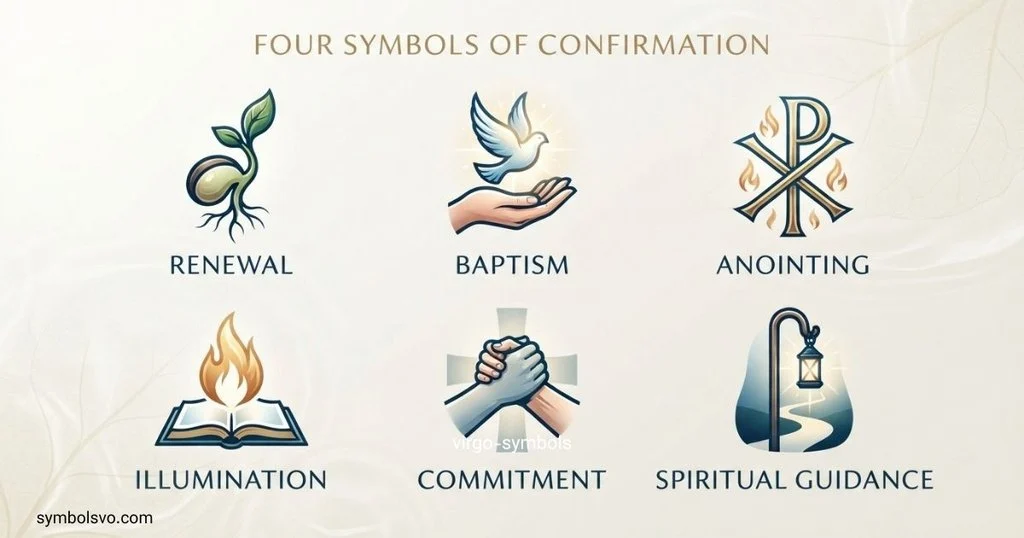
For a short and simple Confirmation design, four symbols can represent the main ideas without making the artwork crowded:
- ✝ Cross — Christ and Christian faith.
- 🕊 Dove — the Holy Spirit.
- 🔥 Flame — the Spirit’s presence and Pentecost.
- Oil/Chrism — anointing and the gift of the Holy Spirit.
This four-symbol combination works well for a Confirmation card, classroom worksheet, church poster, invitation, or simple digital graphic.
For a text-only design, you could use:
✝ 🕊 🔥 🫒
The exact appearance of emoji symbols can change across devices, so a graphic designer may prefer custom artwork when a consistent printed appearance is required.
5 Symbols of Confirmation
A five-symbol set adds the important gesture of laying on of hands:
- ✝ Cross — Christian faith and Christ.
- 🕊 Dove — Holy Spirit.
- 🔥 Flame — Pentecost and spiritual fire.
- 🫒 Oil — anointing.
- ✋ Hand — laying on of hands and prayer.
This set is useful for students learning about Confirmation because each symbol can be connected to a specific idea rather than simply decorating the page.
The Catholic rite gives particular importance to the laying on of hands and anointing with Chrism.
7 Symbols of Confirmation
There is no single universal list of exactly seven Confirmation symbols used by every Christian denomination. However, seven commonly associated symbols can provide a useful overview.
| Symbol | Meaning |
| ✝ Cross | Christ, faith, sacrifice, and Christian identity |
| 🕊 Dove | The Holy Spirit |
| 🔥 Flame | The Holy Spirit, Pentecost, spiritual power |
| 🫒 Oil | Anointing and the gift of the Holy Spirit |
| ✋ Hand | Laying on of hands and prayer |
| ⭕ Seal | Being marked or sealed in faith |
| ☩ Christian cross forms | Christian belief and devotion |
The cross is one of the most recognizable Christian symbols. The dove is closely connected with the Holy Spirit because Scripture describes the Spirit descending like a dove at Jesus’ baptism.
The flame recalls the Holy Spirit’s appearance at Pentecost. The oil is particularly important in Catholic Confirmation because the candidate is anointed with Sacred Chrism. The hand represents the biblical gesture of laying on hands and invoking the Holy Spirit.
The seal represents permanence and belonging. In Catholic teaching, Confirmation leaves an indelible spiritual character, so the idea of being sealed is especially relevant.
Catholic Confirmation Symbols
Catholic Confirmation has several important sacramental signs. The most central are the laying on of hands and anointing with Sacred Chrism. The United States Conference of Catholic Bishops explains that these signs express the reception of the Holy Spirit and the confirmed person’s mission to witness to Christ.
Other Catholic imagery can include:
- ✝ Cross — faith in Christ.
- 🕊 Dove — the Holy Spirit.
- 🔥 Flame — the Spirit and Pentecost.
- 🫒 Oil/Chrism — anointing with the Holy Spirit.
- ✋ Hand — laying on of hands.
- Seal — the lasting spiritual character associated with Confirmation.
Sacred Chrism has a special place in Catholic sacramental life. It is used for Confirmation and is also used in other rites, so it should not be confused with ordinary olive oil used for cooking or with every other holy oil.
Lutheran Confirmation Symbols
Lutheran Confirmation has a somewhat different theological and liturgical context from Roman Catholic Confirmation. In the LCMS tradition, for example, Confirmation developed as a rite associated with Christian instruction and public confession of faith.
Common Lutheran symbols can include:
- ✝ Cross or crucifix — Christ and his saving work.
- 🕊 Dove — the Holy Spirit.
- 🔥 Flame — the Holy Spirit and Pentecost.
- Bible — God’s Word and Christian instruction.
- Hand — prayer, blessing, or laying on of hands.
- Luther Rose — a distinctly Lutheran visual tradition.
The cross and crucifix are not uniquely Catholic symbols. The LCMS notes that crucifixes have a long history in Lutheran worship and devotional life.
Confirmation Symbols Images
Confirmation symbol images often combine several elements into one religious design. Common compositions include a dove above a cross, flames surrounding a cross, or a dove descending over a candidate.
Popular image concepts include:
- A white dove with rays or flames.
- A cross surrounded by seven flames.
- A cross with an open Bible.
- A hand blessing a Confirmation candidate.
- A chalice-style church design with a cross and dove.
- A simple dove-and-cross emblem.
- A Sacred Chrism vessel beside a cross.
When choosing an image, check what the individual elements are intended to represent. A dove may represent the Holy Spirit, while a dove carrying an olive branch can instead represent peace. Lutheran Christian art specifically distinguishes these different uses of dove imagery.
Confirmation Symbols Drawing
Confirmation symbols are also easy to turn into simple drawings. You do not need complicated artwork to communicate the main ideas.
Simple dove drawing
Draw a small dove facing downward. Add a few rays or curved lines around it to suggest the presence of the Holy Spirit.
Cross and flame drawing
Draw a simple cross and place three or more flame shapes around or above it. This creates a recognizable Confirmation and Pentecost theme.
Dove and cross drawing
Place a cross in the center and draw a dove above it. Add small rays between the dove and cross to connect the imagery.
Five-symbol drawing
For a school project, divide the page into five sections:
- Cross
- Dove
- Flame
- Oil
- Hand
Write the meaning below each picture. This makes the drawing both decorative and educational.
Dove Confirmation Symbols
The dove is strongly associated with the Holy Spirit in Christian symbolism. The connection comes from the Gospel accounts of Jesus’ baptism, where the Spirit is described as descending in bodily form like a dove.
A Confirmation dove may be shown:
🕊
or as a traditional illustration with the wings extended and the bird descending.
In some Christian artwork, a dove may appear with a tri-radiant nimbus, a visual sign associated with a divine Person of the Trinity. Lutheran Christian art resources specifically describe this treatment for depictions of the Holy Spirit.
For a simple digital design, the dove emoji is convenient. For formal church artwork or printing, an illustrated dove gives the designer much more control over its appearance.
Catholic Church Confirmation Symbols
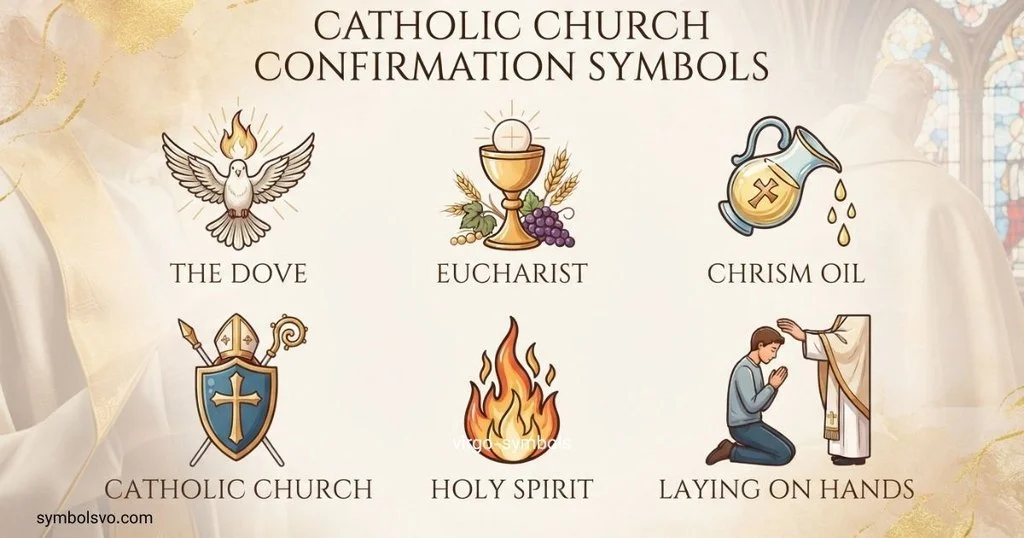
Catholic churches may use several visual elements when teaching or celebrating Confirmation. The most important sacramental signs are not merely decorative objects.
The Sacred Chrism is central because the candidate is anointed with it. The USCCB describes Chrism as a mixture of oil and perfume that is consecrated by the bishop and used for Confirmation.
The laying on of hands is another significant sign. It recalls the biblical gesture through which the gift of the Holy Spirit is invoked.
Other church imagery may include:
- ✝ Cross
- 🕊 Dove
- 🔥 Flame
- Bible
- Oil vessel
- Bishop’s hand
- Christian seal
These symbols can appear together in Confirmation booklets, banners, certificates, educational materials, and church decorations.
Holy Confirmation Symbols
The phrase “holy confirmation symbols” can refer to symbols connected with the sacred nature of Confirmation and the Holy Spirit.
Some of the most useful choices are:
✝ Cross — Christ and Christian faith.
🕊 Dove — the Holy Spirit.
🔥 Flame — spiritual fire and Pentecost.
Oil — sacred anointing.
Hand — prayer, blessing, and the invocation of the Spirit.
Bible — God’s Word and Christian formation.
The symbols do not all have the same liturgical status. Some are direct sacramental signs, while others are devotional or artistic symbols used to teach and illustrate Christian beliefs.
Confirmation Symbols Fire
🔥 — Fire
Fire is a powerful Christian symbol for the Holy Spirit. Its connection with Confirmation is especially strong because Confirmation is associated with the outpouring of the Holy Spirit, while Pentecost describes the Spirit appearing with imagery of fire.
Common visual forms include:
- 🔥 Flame
- A single stylized flame
- Several flames above a cross
- A dove surrounded by flames
- Seven flames representing the seven gifts of the Spirit in some Christian artwork
Fire should not automatically be treated as a unique “Confirmation Unicode symbol.” It is a general Unicode character that can be used to represent the Christian symbolism of spiritual fire in an appropriate context.
Roman Catholic Confirmation Symbols
Roman Catholic Confirmation symbols are closely connected with the sacramental rite.
The two central signs are laying on of hands and anointing with Sacred Chrism. The Catholic rite uses Chrism on the forehead, and the Church connects this anointing with the gift of the Holy Spirit.
Other common Roman Catholic Confirmation imagery includes the cross, dove, flame, bishop’s hand, oil vessel, and seal.
A useful Roman Catholic design might therefore show:
✝ + 🕊 + 🔥 + Chrism
The cross identifies Christ, the dove and flame point toward the Holy Spirit, and Chrism connects directly to the sacramental action.
Sacrament of Confirmation Symbols
The Sacrament of Confirmation has symbols that point to both the ritual and its spiritual meaning.
In the Roman Catholic tradition, the central sacramental signs include:
- Laying on of hands
- Anointing with Sacred Chrism
The Catholic Church explains that Confirmation strengthens the relationship between the baptized Christian and the Church and is associated with receiving the gifts of the Holy Spirit.
The symbols commonly used to illustrate these ideas include:
| Symbol | What it communicates |
| ✝ Cross | Christ and Christian faith |
| 🕊 Dove | Holy Spirit |
| 🔥 Flame | Pentecost and the Spirit |
| Oil/Chrism | Anointing |
| ✋ Hand | Laying on of hands |
| Seal | Lasting spiritual character |
| Bible | Faith and Christian teaching |
This distinction matters because not every symbol used in a Confirmation card is itself part of the sacramental rite.
Holy Spirit Confirmation Symbols
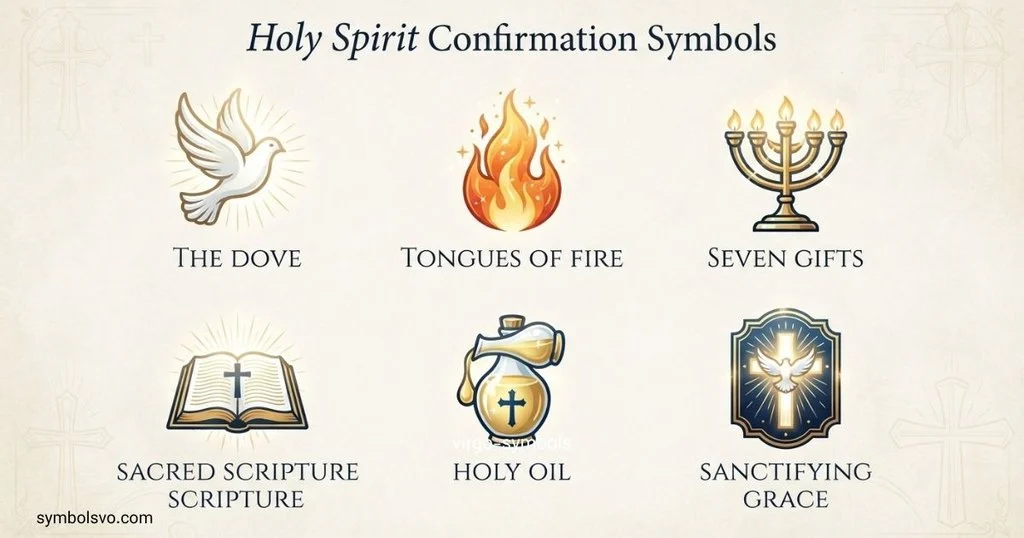
The Holy Spirit is commonly represented by the dove, flame, wind, and sometimes rays of light. Christian sources connect the dove with the Spirit at Jesus’ baptism and fire with the Spirit’s appearance at Pentecost.
For a Confirmation design, the most recognizable combinations are:
- 🕊 Dove — Holy Spirit
- 🔥 Flame — spiritual fire
- ✝ Cross — Christ
- 🕊 + 🔥 — Holy Spirit imagery
- ✝ + 🕊 — Christ and the Spirit
- ✝ + 🕊 + 🔥 — a fuller Confirmation theme
These symbols work well for cards, invitations, classroom activities, social posts, posters, and simple copy-and-paste designs.
FAQ
What is the main symbol of Confirmation?
There is not one universal symbol used by every Christian tradition. In Catholic Confirmation, the most important sacramental signs are the laying on of hands and anointing with Sacred Chrism. The dove, flame, and cross are common supporting symbols.
What does the dove symbolize in Confirmation?
The dove commonly represents the Holy Spirit. Its symbolism comes from the biblical account of Jesus’ baptism, where the Spirit is described as descending like a dove.
What does fire symbolize in Confirmation?
Fire commonly represents the Holy Spirit and recalls Pentecost. It can symbolize spiritual power, God’s presence, and the activity of the Spirit.
What does oil symbolize in Catholic Confirmation?
Sacred Chrism represents anointing and the gift of the Holy Spirit. In the Catholic rite, the candidate is anointed with Chrism on the forehead.
Can I copy and paste Confirmation symbols?
Yes. Characters such as ✝, 🕊, and 🔥 can be copied and pasted into many messages, documents, and social media posts. Their exact visual appearance can vary between devices and fonts.
Conclusion
Confirmation symbols make Christian ideas easier to recognize and remember. The cross points to Christ, the dove and flame represent the Holy Spirit, and oil and the laying on of hands have especially important connections with the Catholic sacramental rite.
The meaning of a symbol can depend on the Christian tradition and the context in which it is used. Catholic Confirmation places particular emphasis on Sacred Chrism and the laying on of hands, while Lutheran traditions may use a broader collection of Christian symbols alongside their understanding of Confirmation as a rite of faith instruction and confession.
For a simple Confirmation design, start with a cross, dove, and flame. Add oil or a hand when you want to highlight the Catholic sacramental meaning. These combinations work well for drawings, church materials, cards, certificates, and copy-and-paste digital designs.

I’m Daniel Brooks, a content creator and symbol enthusiast dedicated to researching the fascinating world of signs and symbols. I enjoy discovering the hidden meanings behind famous icons, emojis, historical emblems, and cultural symbols. Through my writing, I aim to provide trustworthy, well-researched, and reader-friendly information that helps people learn something new with every visit.
Books:
- The Complete Guide to World Symbols
- The Power of Universal Signs
 Mason Ellington
 Grace Whitmore