Brand Symbols can say a lot about a company without using a single word. I find them fascinating because a simple shape, icon, or design can instantly make you think of a familiar brand. You see these symbols everywhere, from websites and packaging to social media and storefronts.
If you want to understand how Brand Symbols work, you’re in the right place. You’ll discover what makes a symbol memorable, why businesses use them, and how they help people recognize a brand faster.
I’ll also walk you through famous examples, common mistakes, and practical ideas for creating a strong visual identity. By the end, you’ll have a clearer understanding of how the right symbol can make a brand more recognizable and meaningful.
Quick Answer
Brand symbols are distinct visual marks, emblems, or logos used by organizations to establish identity, convey core values, and foster immediate recognition. Rooted in ancient heraldry and psychological archetypes, they transform abstract corporate identities into relatable cultural icons that build deep consumer trust and emotional loyalty.
Quick Facts About Brand Symbols
| Aspect | Information |
| Origin | Ancient livestock branding, potter marks, and medieval heraldic shields. |
| Historical Significance | Evolved from basic ownership marks to trust guarantees in trade guilds. |
| Main Meaning | Visual shorthand for a company’s identity, reputation, and promise. |
| Spiritual Meaning | Modern tribal totems that provide a sense of belonging and shared ritual. |
| Cultural Importance | Shapes societal status, lifestyle ideals, and visual pop culture globally. |
| Modern Usage | Digital app icons, minimalist logos, experiential design, and social media. |
What Are Brand Symbols?
A brand symbol is more than a clever graphic design choice. At its core, it is a visual vessel designed to hold and communicate meaning instantly. The word brand itself stems from the Old Norse brandr, which means to burn. Originally, this referred to the practice of burning an ownership mark onto livestock.
Over centuries, these crude marks evolved. In the medieval era, craftsmen and trade guilds used unique stamps to guarantee quality. If a piece of pottery bore a specific mark, buyers knew it came from a master artisan.
With the advent of the Industrial Revolution, mass production separated creators from consumers. Products traveled thousands of miles to reach store shelves. To bridge this distance and build trust with wary buyers, companies needed a recognizable face. The modern brand symbol was born, changing from a simple mark of ownership into a powerful promise of quality, safety, and identity.
Deep Symbolic Meaning of Brand Symbols
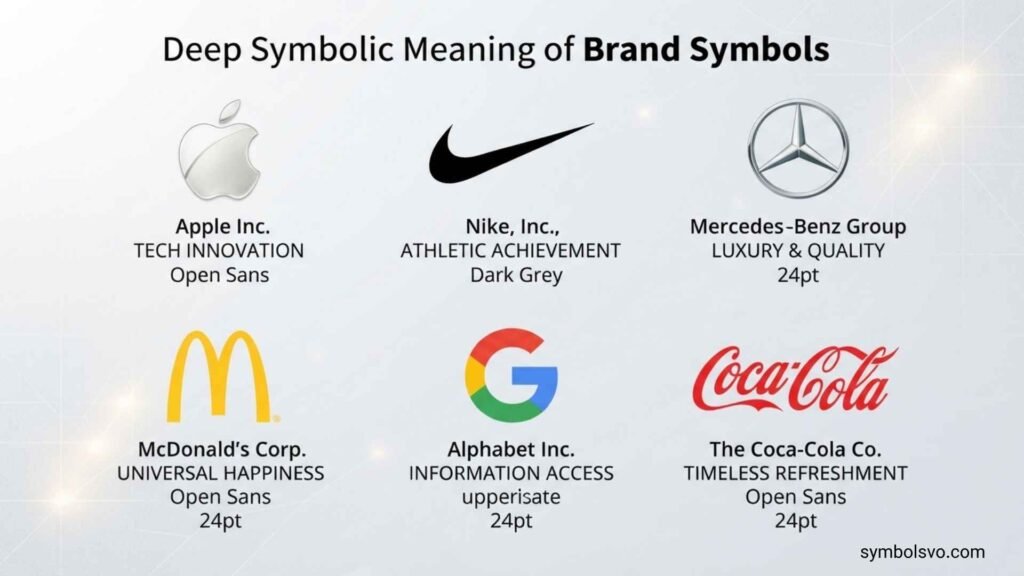
Spiritual Level
In a secular world, brand symbols have largely taken over the psychological space once occupied by ancient tribal totems. They facilitate inner transformation by allowing individuals to project their ideal selves outward. When someone adopts a symbol, they participate in a shared ritual of belonging, aligning their personal consciousness with a larger collective energy.
Psychological Level
Brand symbols function as modern psychological archetypes. Relying heavily on Jungian symbolism, successful symbols tap into universal human emotions and unconscious desires.
- The Hero: Compels us to overcome obstacles.
- The Innocent: Offers purity, safety, and simplicity.
- The Outlaw: Validates our desire for rebellion and freedom.
These symbols create an intense emotional attraction by speaking directly to our subconscious mind, long before our rational brain processes the product’s features.
Cultural Level
On a cultural level, these symbols serve as social currency. They communicate community beliefs, shared values, and traditional interpretations of success or style. Seeing a specific symbol on a person’s clothing or technology tells a story about their social alignment and worldview, serving as a silent handshake within specific communities.
Types and Variations of Brand Symbols
1. The Abstract Mark
- Visual Description: Non-representational geometric shapes and fluid lines.
- Meaning: Unlimited potential, forward movement, and conceptual freedom.
- Symbolism: Represents internal energy, breaking barriers, and modern innovation.
- Cultural Connection: Highly favored by global tech and athletic firms to bypass language barriers.
- Where It Appears: Athletic footwear, digital app interfaces, and corporate headquarters.
2. The Mascot
- Visual Description: Anthropomorphic animals, human characters, or animated objects.
- Meaning: Approachability, warmth, family values, and safety.
- Symbolism: The friendly guide, the protector of childhood joy, or the cheerful companion.
- Cultural Connection: Deeply rooted in folklore traditions where animals carry human traits.
- Where It Appears: Cereal boxes, fast-food restaurants, and sports entertainment.
3. The Emblem
- Visual Description: Intricate text or symbols enclosed within a badge, seal, or shield.
- Meaning: Heritage, institutional authority, and unyielding quality.
- Symbolism: Protection, tradition, trustworthiness, and elite status.
- Cultural Connection: Directly derived from medieval family crests and university seals.
- Where It Appears: Luxury automobiles, historic universities, and government agencies.
Brand Symbols Across Different Cultures
Ancient Egypt
Long before corporate marketing, Egyptians used sacred scarabs and the Eye of Horus as protective brand symbols. Artisans stamped these symbols onto pottery, brickwork, and amulets. It signaled divine protection and verified that the goods were crafted under royal or sacred authority.
Ancient Greece
Greek potters prominently displayed unique geometric stamps and signatures on amphorae filled with wine and olive oil. These marks told buyers exactly which region and workshop produced the goods, acting as early geographical indicators that guaranteed premium trade quality.
Roman Culture
In the bustling markets of ancient Rome, shopkeepers hung distinctive carved stone or terra cotta signs outside their storefronts. A goat symbolized a dairy shop, while an amphora indicated a wine seller. These symbols allowed a highly illiterate population to navigate commerce with total confidence.
Eastern Traditions
In Japan, the Kamon functions as a beautiful precursor to the corporate logo. Originally used to identify aristocratic families and samurai clans on the battlefield, these minimalist, nature-inspired circular symbols eventually transitioned into the business world, still serving as the foundational symbols for historic Japanese companies today.
Indigenous Traditions
Indigenous cultures worldwide used clan totems and specific rock art symbols to mark territory, trading routes, and communal resources. These symbols carried deep spiritual narratives, ensuring that any exchange of goods was grounded in mutual respect, shared history, and sacred tribal laws.
Modern Interpretations
Today, global symbols cross borders instantly, adapting their meanings to fit local cultural landscapes. A single icon can symbolize premium Western luxury in an Eastern market, while representing familiar, everyday comfort back in its country of origin.
Similar Symbols and Their Meanings
Understanding visual communication requires looking at how brand symbols relate to other historic signifiers.
| Symbol Type | Purpose | Key Focus | Lifespan |
| Brand Symbol | Commercial identity & trust | Emotional loyalty and values | Evolves with market trends |
| Family Crest | Ancestral lineage | Honor, bloodline, and land | Fixed across generations |
| Religious Icon | Spiritual devotion | Sacred narratives and faith | Eternal and unchangeable |
A common misconception is that brand symbols are entirely separate from historical iconography. In reality, they share deep psychological roots. The primary difference is that corporate symbols focus heavily on commercial trust and lifestyle alignment, whereas traditional crests focus on lineage and spiritual icons focus on the divine.
Brand Symbols in Mythology and Folklore
Many of the world’s most successful brand symbols are directly stolen from ancient myths and folklore. Designers intentionally borrow these legends to instantly inject deep, pre-established meanings into a new business.
Consider the symbol of a winged shoe or a staff entwined with serpents. These images carry thousands of years of narrative weight involving speed, travel, and healing. By adopting the goddess of victory or a protective mythological creature as a visual identity, a company bypasses decades of storytelling. They instantly inherit the trust, power, and emotional resonance that humans have associated with those stories for millennia.
Brand Symbols in Art, Pop Culture, and Design
During the mid-twentieth century, artists like Andy Warhol famously elevated everyday commercial symbols into the realm of high art. By painting soup cans and soda bottles, Warhol highlighted how deeply these commercial markers had woven themselves into the fabric of daily human life.
[ Ancient Tribal Totem ] —> [ Medieval Guild Mark ] —> [ Modern Brand Symbol ]
In contemporary pop culture, these symbols have moved far beyond billboards. They appear as central design elements in streetwear fashion, star in cinematic storylines, and are proudly worn as tattoos. When a symbol becomes a tattoo, the ultimate transformation occurs. It ceases to be an advertisement for a company and becomes a permanent part of an individual’s personal story.
Spiritual and Dream Meaning of Brand Symbols
Appearing frequently in our dreams and meditation experiences, brand symbols often surprise people with their presence. Because our subconscious minds think entirely in metaphors, seeing a highly recognizable commercial mark during sleep rarely has anything to do with shopping.
Instead, dreaming of a luxury symbol might point to a deep desire for self-worth, validation, or a need to feel special. Dreaming of a tech symbol can represent a subconscious desire for better connection, communication, or a fear of being left behind by fast-paced changes. These dreams offer useful inner messages, acting as mirrors that show where we are directing our energy and what we truly crave on a soulful level.
Positive and Negative Meanings of Brand Symbols
Every powerful symbol holds a balance of light and shadow, shifting dramatically based on personal experiences and cultural contexts.
| Positive Meaning | Negative Meaning |
| Cultivates a sense of global belonging. | Promotes harmful, excessive consumerism. |
| Guarantees reliable safety and quality. | Erases unique local cultural identities. |
| Inspires personal achievement and growth. | Creates superficial social divisions. |
| Simplifies complex choices for consumers. | Exploits subconscious human vulnerabilities. |
Why Humans Are Attracted to Brand Symbols
Our deep attraction to these markers is hardwired into human nature. The human brain is a highly evolved pattern recognition machine, constantly searching for order, predictability, and safety in a chaotic world.
Psychologically, we naturally fear the unknown. A familiar symbol acts as a visual lighthouse, offering a safe path through a sea of overwhelming choices. Furthermore, humans possess an intense, primal need for community. Because we can no longer gather in traditional tribal structures, we use shared consumer symbols to signal our values, passions, and identities to the people around us.
Modern Uses of Brand Symbols
In our current digital landscape, these symbols have adapted to fit into every corner of human life.
- Fine Jewelry & Fashion: Worn as statement pieces that display personal taste.
- Digital Interfaces: Streamlined into minimalist app icons optimized for small screens.
- Home Decor: Used on luxury goods to transform everyday living spaces into curated status statements.
- Social Media: Utilized as profile markers and digital stickers to showcase community alignment.
Interesting Facts About Brand Symbols
- The world’s oldest continuously used corporate symbol is a red triangle, registered in 1876.
- Many iconic abstract symbols were originally purchased from cash-strapped design students for less than fifty dollars.
- Neurological studies show that viewing favorite brand symbols activates the exact same brain regions as looking at photos of loved ones.
- The human brain can accurately identify a world-class brand symbol in less than one hundredth of a second.
- Certain color combinations in symbols are scientifically proven to stimulate hunger, trust, or urgency.
Frequently Asked Questions
What makes a brand symbol successful?
A successful symbol is simple, memorable, and highly versatile. It must look distinct whether it is printed on a tiny smartphone screen or displayed on a massive highway billboard, while carrying a clear emotional message.
How do brand symbols influence human behavior?
They trigger immediate subconscious associations. When you see a familiar symbol, your brain instantly recalls your past experiences, emotions, and trust levels associated with it, heavily guiding your final purchasing choice.
Can a brand symbol change over time?
Yes. Most symbols undergo careful evolution to remain modern. They generally become more minimalist over time, shedding unnecessary text and complex lines as public recognition grows.
Why do some brands use symbols instead of text?
Symbols cross international language barriers effortlessly. A well-designed visual icon can be understood instantly by someone in Tokyo, New York, or Cairo without requiring any translation.
Conclusion
Brand symbols are far more than clever tools for modern capitalism. They are the living evolution of our ancient need to communicate through visual stories. By connecting deep psychological archetypes with our daily lives, these symbols offer a sense of identity, community, and trust in an ever-changing world. The next time you glance at an icon on your phone or clothing, remember that you are participating in a rich, unbroken human tradition of visual storytelling that stretches back to the very dawn of civilization.

I’m Daniel Brooks, a content creator and symbol enthusiast dedicated to researching the fascinating world of signs and symbols. I enjoy discovering the hidden meanings behind famous icons, emojis, historical emblems, and cultural symbols. Through my writing, I aim to provide trustworthy, well-researched, and reader-friendly information that helps people learn something new with every visit.
Books:
- The Complete Guide to World Symbols
- The Power of Universal Signs
 Mason Ellington
 Grace Whitmore