
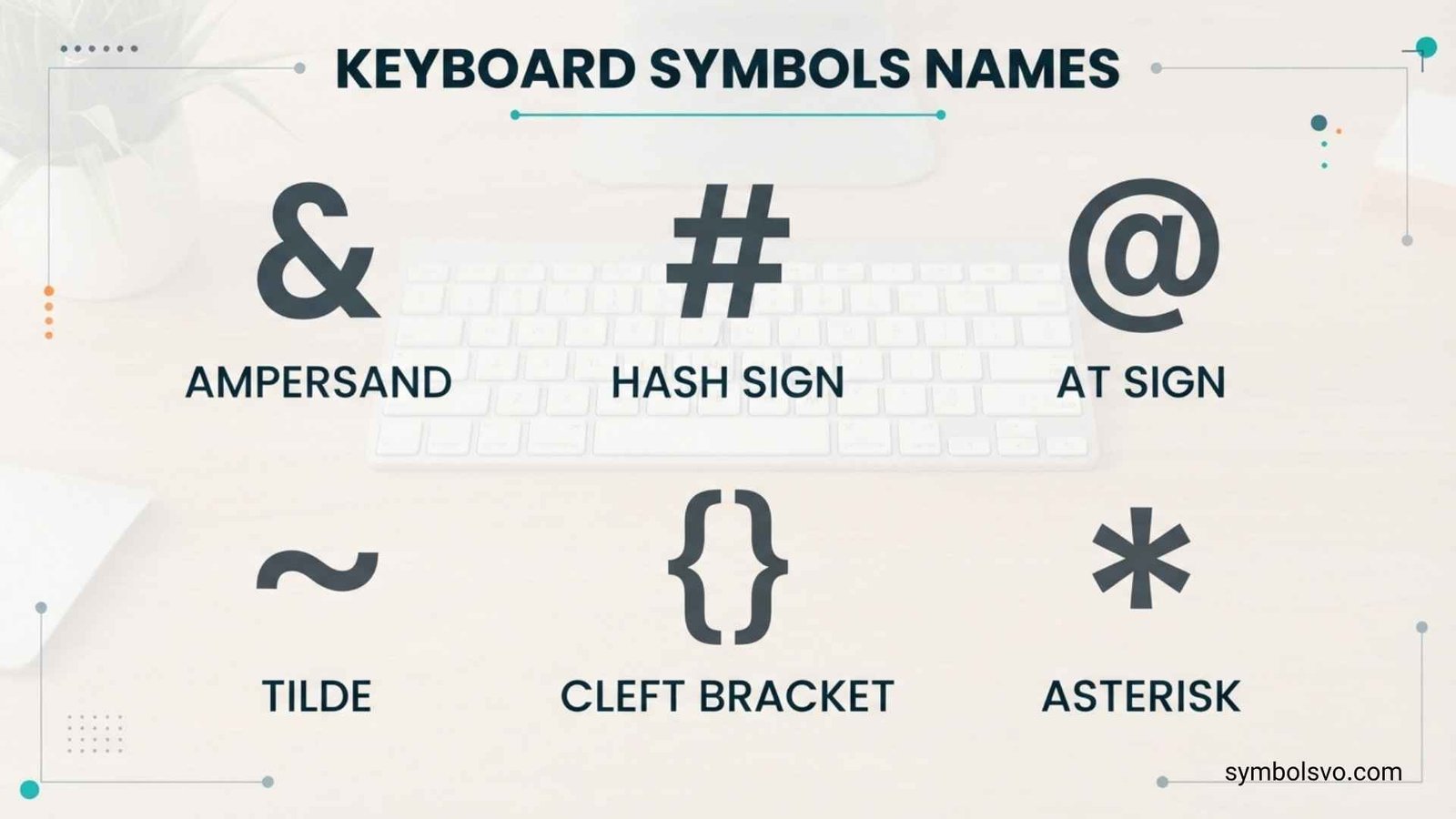
Keyboard Symbols Names can seem confusing when you see unfamiliar signs on your keyboard. I created this guide to make those symbols easy to recognize, understand, and use, so you can quickly find the one you need.
You may know symbols like @, #, $, %, and &, but do you know their correct names and uses? In this guide, you’ll discover common keyboard symbols, their names, meanings, and practical uses in simple language.
I’ll also help you identify special characters you may use for typing, coding, emails, passwords, and everyday tasks. By the end, you’ll have a clear reference for Keyboard Symbols Names without having to guess what each symbol is called.
Quick Answer
Keyboard symbols names refer to the official and colloquial designations given to non-alphanumeric characters found on computer keyboards, such as the ampersand (&), tilde (~), or asterisk (*). These terms identify specific typographic glyphs used in coding, mathematical syntax, and modern digital communication to convey precise functional or emotional meaning.
Quick Facts About Keyboard Symbols Names
| Aspect | Information |
| Origin | Ancient Roman shorthand, medieval monk transcriptions, and early bookkeeping ledgers. |
| Historical Significance | Enabled fast manual printing presses and early telegraphic data compression. |
| Main Meaning | Direct functional commands for programming and shorthand markers for daily text. |
| Spiritual Meaning | Representations of universal balances, infinite journeys, and divine protection. |
| Cultural Importance | Forms the foundation of internet culture, gaming language, and universal communication. |
| Modern Usage | Critical syntax for computer programming, financial markets, hashtags, and social media handles. |
What Are Keyboard Symbols Names?
Keyboard symbols names define the special characters flanking our alphabet on standard QWERTY layouts. While we often recognize their visual forms, their proper names tell a story of evolution over thousands of years.
Many of these symbols originated long before the advent of computers or typewriters. For instance, the ampersand began as a quick cursive blend of the letters in the Latin word et, which means and.
As manual printing presses gained popularity, typesetters needed compact shortcuts to save valuable space on wooden trays. Later, during the rise of the typewriter in the late nineteenth century, a curated selection of these business shortcuts was permanented onto physical keys. When computers emerged in the mid-twentieth century, early programmers assigned formal code names to these glyphs, turning ancient accounting and editing marks into the foundational language of global software development.
Deep Symbolic Meaning of Keyboard Symbols Names
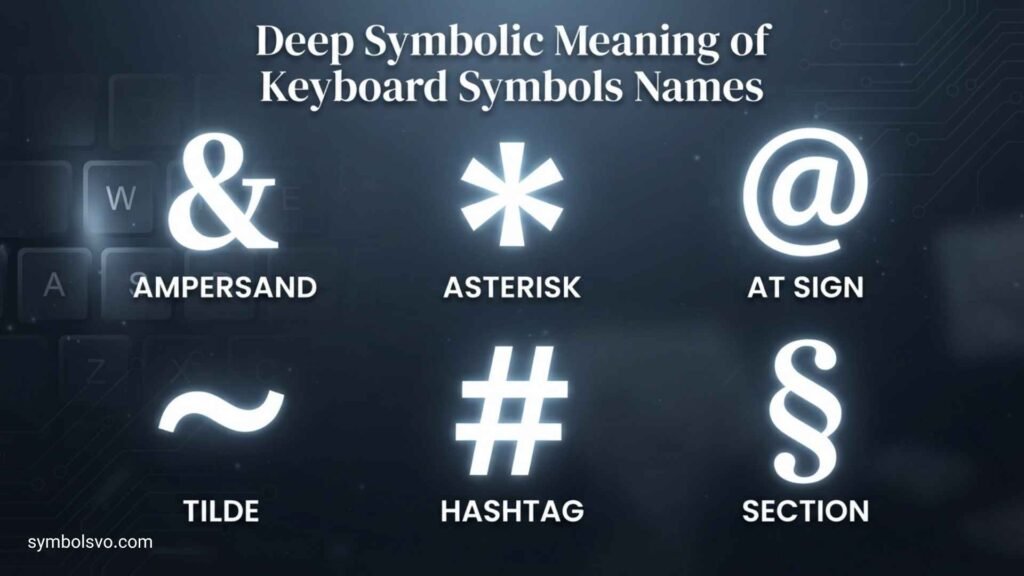
Spiritual Level
On a spiritual level, keyboard symbols function as modern, digitized sacred geometry. They facilitate inner transformation by condensing vast human concepts into single strokes. When we use specific symbols, we align our conscious intentions with ancient human patterns. The characters serve as subtle focal points that manage the flow of intent and digital energy across space and time.
Psychological Level
These typographic glyphs trigger deep psychological responses because they map directly onto universal human archetypes.
- The Asterisk (*): Acts as a spark or a guiding star, representing hidden knowledge or a point that demands immediate attention.
- The Caret (^): Functions as an upward arrow, triggering unconscious feelings of growth, progress, and rising above obstacles.
- The At Sign (@): Represents the archetype of the safe harbor, offering a designated location or a sense of personal space in a vast network.
Our minds naturally gravitate toward these visual cues because they simplify complex ideas into recognizable emotional anchors.
Cultural Level
In modern society, these names hold immense social currency. They define community beliefs and dictate our social circles online. The hashtag has transformed from a humble number sign into a rallying cry for global social movements and community building. Knowing how to use these characters properly acts as a modern literacy test, showing that a person understands the subtle codes of digital culture.
Types and Variations of Keyboard Symbols Names
1. The Ampersand (&)
- Visual Description: A flowing, looping ribbon that curves back into itself.
- Meaning: Togetherness, addition, and an ongoing connection.
- Symbolism: Represents the merging of distinct entities, unbroken partnerships, and unity.
- Cultural Connection: Historically part of the English alphabet song, where children sang and per se and, which eventually morphed into the word ampersand.
- Where It Appears: Corporate partnerships, legal firm names, and decorative typography.
2. The Tilde (~)
- Visual Description: A gentle, horizontal wave suspended in mid-air.
- Meaning: Approximation, fluidity, and informal irony.
- Symbolism: Represents changing waters, flexibility, and the space between absolute truths.
- Cultural Connection: Used in Spanish linguistics to alter the sound of the letter N, tracing back to medieval monkish scribes saving vellum paper.
- Where It Appears: Mathematical equations, early internet web directories, and text-based emotional expressions.
3. The Asterisk (*)
- Visual Description: A tiny, symmetrical star burst with five or six radiating points.
- Meaning: Correction, omission, or an open invitation to look closer.
- Symbolism: Cosmic wonder, light in darkness, and the presence of hidden fine print.
- Cultural Connection: Derived from the ancient Greek word asteriskos, meaning little star, used by library scholars to mark duplicate lines in epic poetry.
- Where It Appears: Text message corrections, search engine wildcards, and historical footnotes.
4. The Caret (^)
- Visual Description: An inverted, sharp V-shape pointing directly upward.
- Meaning: To the power of in math, or an indicator of insertions.
- Symbolism: Ambition, ascending mountains, and pointing toward higher wisdom.
- Cultural Connection: Used extensively by proofreaders since ancient Rome to show where missing text needed to be dropped in.
- Where It Appears: Computer programming logic, scientific notation, and celebratory chat room emojis.
Keyboard Symbols Names Across Different Cultures
Ancient Egypt
The concept of using compact symbols for complete phrases mirrors Egyptian hieroglyphic determinatives. Scribes utilized specific non-alphabet signs at the end of words to ensure clarity and convey hidden context, much like how programmers use symbols to define data types.
Ancient Greece
Greek scholars at the Library of Alexandria invented early typographic symbols like the asterisk and the obelus. These marks allowed critics to edit vast scrolls of literature, creating a universal standard for textual analysis and information layout.
Roman Culture
Roman merchants used quick ligatures and symbols to manage complex business trades across the empire. The ancestor of our modern percentage sign and section mark was born in these crowded Italian market stalls to track debts, laws, and shipping manifests.
Eastern Traditions
In classic Chinese and Japanese calligraphy, specific accent marks and strokes hold distinct identities. The concept of Kuten or structural punctuation symbols ensures that spiritual texts maintain their exact pacing, rhythm, and esoteric meaning when read aloud.
Indigenous Traditions
Indigenous rock painters used visual shorthand symbols to convey direction, warnings, and sacred locations. This shared community understanding parallels how modern tech cultures use punctuation to build complex code or express group feelings without words.
Modern Interpretations
Today, these characters transcend national borders. A symbol like the at sign changes its casual name across the globe, referred to as an elephant ear in one country and a little snail in another, reflecting local cultural perspectives while serving a unified digital purpose.
Similar Symbols and Their Meanings
Navigating the world of typography requires clear comparisons between keys that look remarkably similar but carry entirely different weights.
| Symbol Name | Visual Glyphs | Core Functional Purpose | Emotional Context |
| Parentheses | ( ) | Encloses non-essential thoughts | A gentle, reassuring textual whisper |
| Brackets | [ ] | Holds technical modifications | Cold, precise, and rigid containment |
| Braces | { } | Groups blocks of code together | Artistic structure and collective unity |
A common misconception is that hyphens, en dashes, and em dashes are interchangeable. On a keyboard, the single dash button serves as a hyphen for joining words, while professional design treats longer dashes as indicators of dramatic pauses or structural shifts. Understanding these boundaries ensures your writing remains clear, authoritative, and professional.
Keyboard Symbols Names in Mythology and Folklore
Many keyboard symbols hold deep roots in historical folklore. The caduceus of Hermes, with its winding snakes, mirrors the visual flow and communicative speed of the modern ampersand.
In Nordic myths, runes were often sharp, geometric shapes designed for carving into wood or stone, carrying a strong family resemblance to our pound sign or octothorpe. These ancient peoples believed that drawing a geometric intersection could trap evil spirits or seal a binding promise. When we punch these keys today, we are using structural forms that our ancestors viewed as genuine magical sigils capable of altering reality.
Keyboard Symbols Names in Art, Literature, and Pop Culture
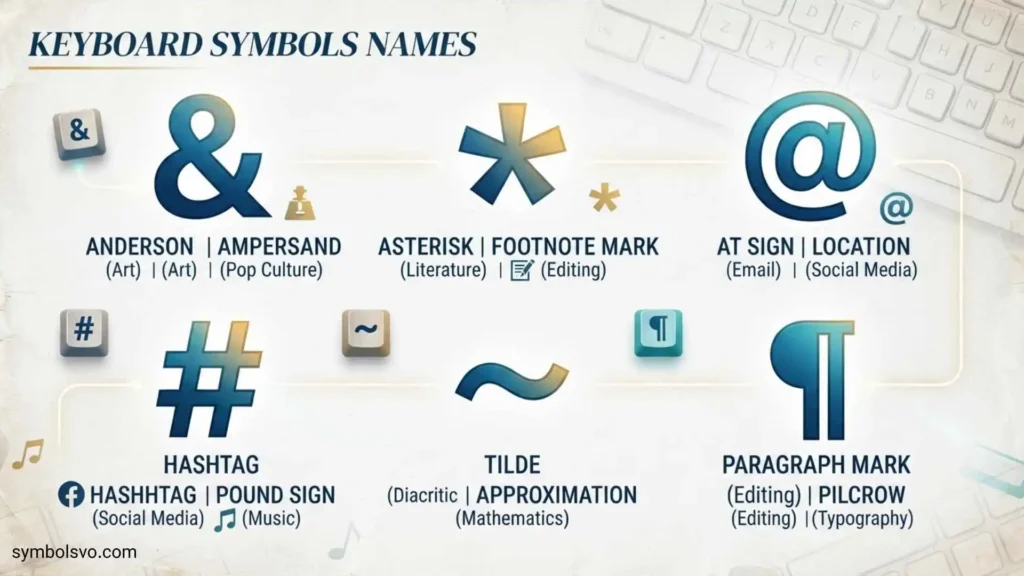
In the twentieth century, experimental poets shattered traditional writing styles by filling pages with raw keyboard punctuation. This art form proved that symbols could evoke deep feelings without formal vocabulary.
[ Ancient Stone Runes ] —> [ Typewriter Key Caps ] —> [ Digital Symbol Syntax ]
With the rise of internet relay chat, young gamers and tech enthusiasts invented leetspeak and creative emoticons. By combining colons, hyphens, and parentheses, they bypassed flat text limits to broadcast human warmth across digital spaces. Today, these symbols are central components of modern clothing design, high-end graphic branding, and personal tattoos, representing a deep love for tech and digital connectivity.
Spiritual and Dream Meaning of Keyboard Symbols Names
When keyboard characters drift into our dream world, they speak to us in the language of our subconscious mind. Because dreams rely on vivid imagery, seeing a wall of punctuation usually points to our current communication states.
Dreaming of a repetitive exclamation point might signal that your waking mind is experiencing hidden stress, urgency, or a feeling of being ignored. Conversely, seeing a field of quiet tildes suggests a need for emotional balance, relaxation, and accepting life’s natural uncertainties. These dreams serve as an inner compass, urging us to step back and look at how we process information and connect with our social circles.
Positive and Negative Meanings of Keyboard Symbols Names
Every typographic character holds a balance of light and shadow, shifting dynamically based on context and intent.
| Positive Meaning | Negative Meaning |
| Organizes thoughts for clear understanding. | Acts as a barrier to natural human speech. |
| Connects diverse ideas into unified code. | Masks real identities behind digital handles. |
| Expresses subtle emotions through emoticons. | Triggers conversational aggression or shouting. |
| Accelerates global information exchange. | Promotes fragmented attention spans. |
Why Humans Are Attracted to Keyboard Symbols Names
Our deep psychological connection to these specific keys comes down to basic human nature. The human mind is a masterful pattern recognition machine that craves order in moments of chaos.
Symbols offer an efficient mental shortcut, letting us process complex social settings or data instantly. Furthermore, we possess a deep desire to express our personalities through unique styles. Using custom combinations of keyboard symbols allows individuals to carve out personal identities, turn cold computer screens into comforting spaces, and satisfy our ancient urge for symbolic storytelling.
Modern Uses of Keyboard Symbols Names
In our contemporary digital ecosystem, these classic characters have broken out of their technical boundaries.
- Social Architecture: The octothorpe or hashtag groups millions of global conversations together under a single topic.
- Financial Coding: Currency symbols and mathematical operators guide fast-paced global markets and algorithmic trades.
- Personal Branding: The at sign serves as the universal digital front door for personal creators and global brands alike.
- Creative Tattoos: People get minimal tildes or ampersands inked on their skin to represent life’s constant changes or enduring love.
Interesting Facts About Keyboard Symbols Names
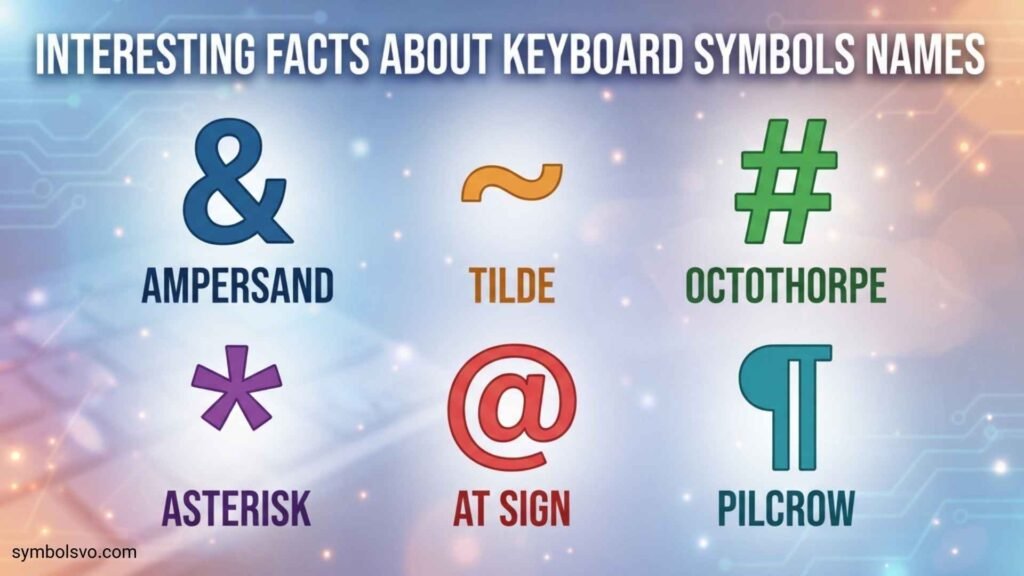
- The official technical name for the common hashtag or pound sign is the octothorpe.
- The ampersand was once counted as the twenty-seventh letter of the English alphabet in school houses.
- Early commercial typewriters lacked an exclamation point key, requiring users to type a period, backspace, and then add an apostrophe.
- The at sign was saved from total historical obscurity by computer engineer Ray Tomlinson in 1971 to route the very first network email.
- The asterisk character has been actively used in human printing since at least the second century BC.
Frequently Asked Questions
What is the real name of the hashtag symbol?
The official, scientific name for the hashtag is the octothorpe. The term was coined by telephone laboratory engineers in the mid-twentieth century when they added the key to telephone dials.
Why is the ampersand symbol called that?
Its name comes from a historical misunderstanding. School children reading the alphabet concluded with the Latin phrase and per se and, meaning and by itself, and. Over decades of fast speech, the phrase blurred into the word ampersand.
What does the tilde symbol mean in programming?
In computer programming and directory routing, the tilde often represents a user’s home folder. In mathematics and casual conversation, it indicates an approximate value or a rough estimate.
Why do keyboard symbols have different names across the world?
While their digital functions are identical, different cultures name them based on familiar everyday objects. For example, the at sign is called a monkey tail in Dutch, a pickled herring in Czech, and a small snail in Italian.
Conclusion
Keyboard symbols names are far more than simple tools for programming and typing. They represent an enduring human legacy of visual expression, linking ancient Roman scribes with the global digital networks of today. By understanding the deep history, psychological power, and cultural weight of these keys, we transform our everyday typing into a conscious act of creative storytelling. The next time you tap a symbol on your screen, remember that you are keeping a multi-millennial human tradition alive with a single touch.

 Mason Ellington
 Daniel Brooks