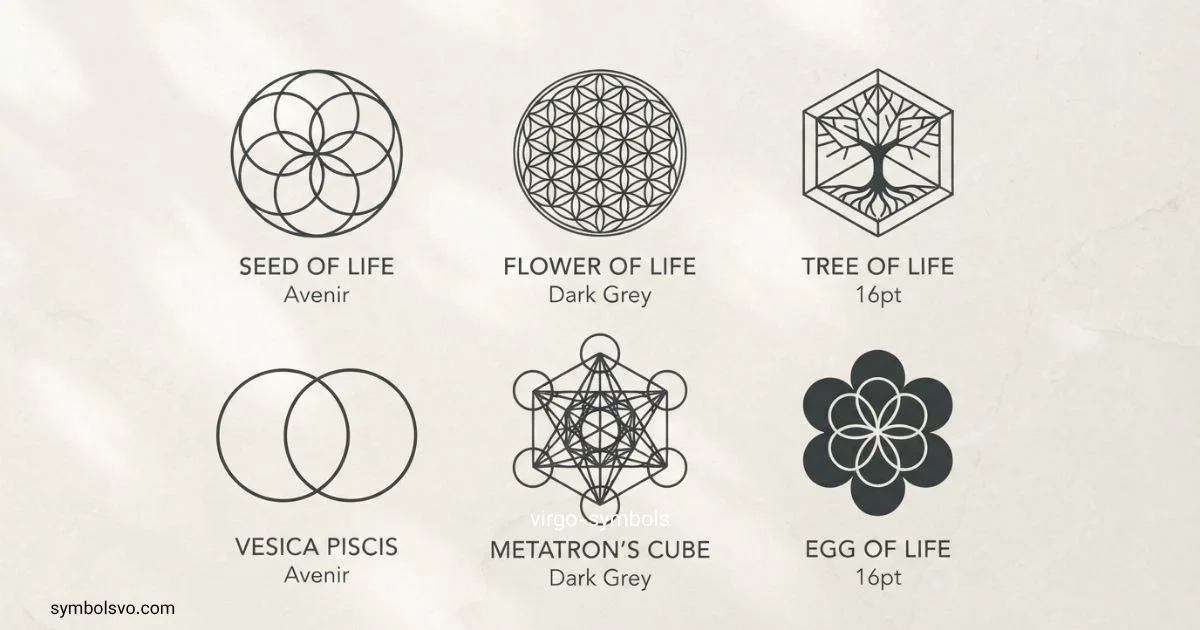
I’ve always found geometric symbols fascinating because simple shapes can communicate ideas, patterns, balance, and meaning without using a single word. You can use these symbols in text, designs, artwork, math, technology, and everyday communication.
When I started exploring geometric symbols, I discovered how much meaning can be hidden inside circles, triangles, squares, lines, and other shapes. You can copy and paste them, learn what they represent, or use them to make your content more visually interesting.
In this guide, I’ll help you explore geometric symbols in a simple and practical way. You’ll discover common shapes, their meanings, useful examples, and easy ways to copy and use them.
Geometric Symbols With Names
Geometric symbols are visual characters based on recognizable shapes. Unicode contains a dedicated Geometric Shapes block from U+25A0 to U+25FF, while related geometric characters also appear in other Unicode blocks.
Here are some useful geometric symbols you can copy:
| Symbol | Unicode name | Code point | Common use |
| ■ | Black Square | U+25A0 | Bullets, decoration, visual markers |
| □ | White Square | U+25A1 | Lists, diagrams, decorative text |
| ▪ | Black Small Square | U+25AA | Small bullets and separators |
| ▫ | White Small Square | U+25AB | Decorative lists |
| ▬ | Black Rectangle | U+25AC | Dividers and visual layouts |
| ▭ | White Rectangle | U+25AD | Diagrams and decoration |
| ▲ | Black Up-Pointing Triangle | U+25B2 | Direction, emphasis, decoration |
| △ | White Up-Pointing Triangle | U+25B3 | Diagrams and decorative text |
| ▼ | Black Down-Pointing Triangle | U+25BC | Direction and indicators |
| ▽ | White Down-Pointing Triangle | U+25BD | Diagrams and decoration |
| ◆ | Black Diamond | U+25C6 | Bullets, emphasis, decoration |
| ◇ | White Diamond | U+25C7 | Lists and decorative layouts |
| ◊ | Lozenge | U+25CA | Text and mathematical contexts |
| ● | Black Circle | U+25CF | Bullets and visual markers |
| ○ | White Circle | U+25CB | Diagrams and decoration |
| ◌ | Dotted Circle | U+25CC | Linguistic and typographic contexts |
| ◎ | Bullseye | U+25CE | Targets, diagrams, decoration |
| ◯ | Large Circle | U+25EF | Diagrams and visual design |
These are official Unicode character names, rather than invented descriptions. Unicode also distinguishes closely related shapes, so a black diamond, white diamond, lozenge, and diamond operator should not automatically be treated as the same character.
More geometric symbols to copy
You can also use these shapes in headings, notes, social posts, designs, and decorative text:
Squares: ■ □ ▪ ▫ ◼ ◻ ⬛ ⬜
Triangles: ▲ △ ▼ ▽ ◀ ◁ ▶ ▷
Diamonds: ◆ ◇ ◈ ◊ ⬥ ⬦
Circles: ● ○ ◉ ◌ ◍ ◎ ◯
Other shapes: ⬟ ⬠ ⬡ ⬢ ⯀ ⯁ ⯂ ⯃
Unicode’s related geometric collections include pentagons, hexagons, larger squares, diamonds, lozenges, and centered shapes.
Geometric Symbols And Meanings
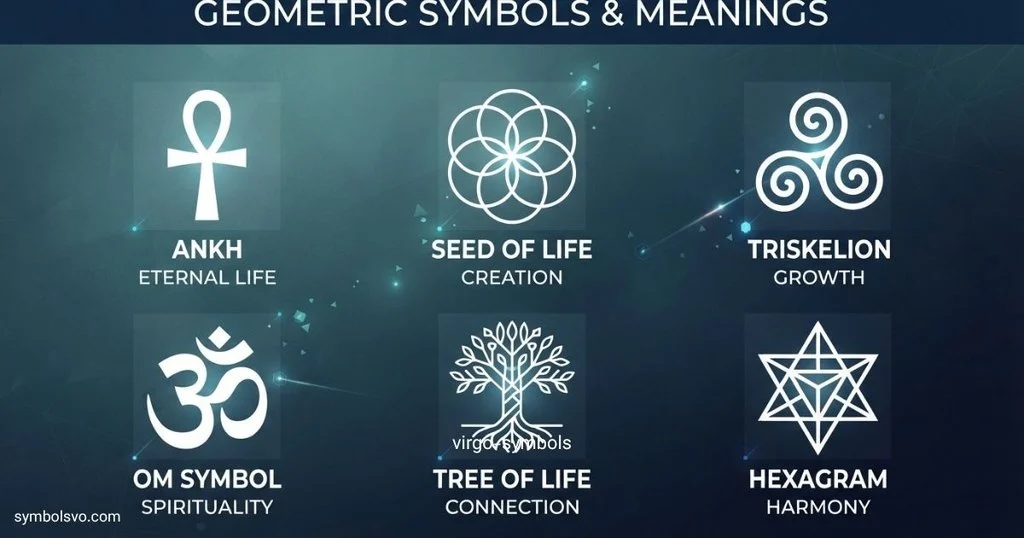
The meaning of a geometric symbol depends heavily on context. A circle used in a mathematical diagram does not necessarily carry the same meaning as a circle in a spiritual design or logo.
Some common symbolic associations include:
| Shape | Common symbolic associations | Important context |
| ○ Circle | Wholeness, continuity, unity | Meanings vary by culture and design |
| □ Square | Stability, order, structure | Also widely used simply as a geometric form |
| △ Triangle | Direction, balance, change | Orientation can affect interpretation |
| ◆ Diamond | Value, focus, emphasis | Often decorative rather than symbolic |
| ◇ Lozenge | Decoration, distinction, pattern | Technical meanings may differ |
| Hexagon | Organization, structure, natural patterns | Common in design and science |
| Spiral | Growth, movement, cycles | Meaning varies across traditions |
| Dot | Center, point, emphasis | Can be purely typographic |
A triangle, for example, can simply identify a shape in geometry. In another context, an upward triangle may be interpreted symbolically as direction or ascent. That interpretation is not a universal Unicode meaning.
The same principle applies to circles, squares, and diamonds. Unicode defines characters by their encoded identity and name; cultural symbolism comes from how people use those forms. Unicode itself notes that basic shapes are used in many mathematical texts and are also frequently used informally in other contexts.
Why context matters
Consider the symbol □. Unicode calls it WHITE SQUARE, but its use can vary. It may appear as a decorative shape, in a diagram, or as part of another notation system. Unicode records some specialized associations for particular characters, but those associations should not be treated as universal meanings.
For symbols used in cultural or spiritual contexts, it is better to identify the specific tradition instead of assigning one fixed meaning to every geometric shape.
Geometry Symbols Chart
A geometry symbols chart helps students, teachers, designers, and writers quickly recognize common mathematical shapes and notation.
Basic geometry shape chart
| Symbol | Name | What it represents |
| ○ | Circle | A round geometric figure |
| △ | Triangle | A three-sided polygon |
| □ | Square | A four-sided figure with equal sides and right angles |
| ▭ | Rectangle | A four-sided figure with four right angles |
| ◇ | Diamond shape | A diamond-like geometric form |
| ⬡ | Hexagon | A six-sided polygon |
| ⬠ | Pentagon | A five-sided polygon |
| ∠ | Angle | The space between two intersecting rays or lines |
| ⊥ | Perpendicular | Lines or segments meeting at right angles |
| ∥ | Parallel | Lines that remain the same distance apart |
| ≅ | Congruent | Same shape and size in geometry |
| ∼ | Similar | Same general shape, with corresponding proportions |
Some symbols in a geometry chart are not from the Unicode Geometric Shapes block itself. For example, mathematical operators and relation symbols are encoded in other Unicode blocks.
That distinction matters when you are looking for a symbol by Unicode name or code point. Unicode describes geometrical symbols as a collection spread across several blocks, including Geometric Shapes, Miscellaneous Technical, Miscellaneous Symbols, Miscellaneous Symbols and Arrows, and Geometric Shapes Extended.
Quick copy-and-paste geometry set
Shapes: ○ △ □ ◇ ⬡ ⬠
Angles and relations: ∠ ⊥ ∥ ≅ ∼
Common mathematical signs: × ÷ + − = ≠ ≤ ≥
These characters can be useful in notes, worksheets, presentations, digital documents, and educational content.
Simple Geometric Symbols
Simple geometric symbols are useful when you want clean visual decoration without complicated characters.
Here is a compact collection:
Circles: ● ○ ◉ ◎ ◯
Squares: ■ □ ▪ ▫ ◼ ◻
Triangles: ▲ △ ▼ ▽
Diamonds: ◆ ◇ ◈ ◊
Small shapes: ▴ ▵ ▾ ▿
Mixed shapes: ⬟ ⬠ ⬡ ⬢
Simple decorative combinations
You can combine shapes to create clean text separators:
○ ─ ○ ─ ○
◆ ◇ ◆ ◇ ◆
△ ▲ △ ▲ △
□ ■ □ ■ □
◯ • ◯ • ◯
These combinations work well for headings, dividers, short social-media text, journal pages, and decorative layouts. The exact appearance can change with the font or application being used.
Sacred Geometric Symbols
Sacred geometry refers to geometric forms and patterns that have been given religious, spiritual, philosophical, or symbolic significance in particular traditions. It is not one single universal system.
Common examples discussed in sacred-geometry contexts include:
- Circle — often associated with unity, continuity, or completeness.
- Triangle — often used to represent balance, direction, or relationships between three elements.
- Square — frequently associated with order, stability, or the material world.
- Hexagonal and repeating patterns — often used to create symmetry and interconnected designs.
- Mandala patterns — geometric arrangements used in several religious and contemplative traditions.
- Sri Yantra — a highly structured Hindu sacred diagram built from interlocking triangles.
The key point is that symbolic interpretations depend on the tradition. A geometric form does not automatically become sacred simply because it appears in a symmetrical pattern.
Sacred geometry is also different from Unicode. Unicode can encode a character such as △, but it does not encode a universal spiritual meaning for that character.
Geometric patterns and symbolism
Repeated circles, triangles, squares, and lines can create visual ideas of balance, symmetry, movement, or interconnectedness. Artists may use those qualities for spiritual or contemplative designs without claiming that the individual Unicode characters themselves have sacred meanings.
Hindu Geometric Symbols
Hindu traditions contain many geometric diagrams and patterns, particularly in religious art, temple traditions, meditation practices, and yantra designs.
One of the best-known examples is the Sri Yantra, a complex diagram made from interlocking triangles around a central point. It is important to distinguish the complete traditional diagram from ordinary Unicode triangle characters such as ▲ or △.
Other geometric forms commonly encountered in Hindu visual traditions include:
- Mandala patterns — structured circular or square compositions.
- Yantras — geometric diagrams associated with particular religious practices and traditions.
- Triangles — used in different combinations and orientations within yantric designs.
- Lotus-based geometric layouts — recurring in religious art and diagrammatic compositions.
- Concentric circles — used to organize visual space in some diagrams.
A plain triangle should not automatically be labeled as a Hindu symbol. The surrounding design, tradition, text, and context are important when identifying a religious symbol.
Spiritual Geometric Symbols
Spiritual geometric symbols are often used to express ideas such as balance, unity, transformation, interconnectedness, or inner reflection.
Popular examples include:
| Symbol or form | Common spiritual association |
| Circle | Unity or completeness |
| Triangle | Balance or transformation |
| Spiral | Growth or movement |
| Mandala | Structured meditation or contemplation |
| Interlocking circles | Connection or unity |
| Hexagonal patterns | Harmony and repeating structure |
| Concentric circles | Layers, focus, or inward movement |
These meanings are best understood as associations, not universal definitions. A spiral in one spiritual community may have a different interpretation in another.
For digital writing, you can use simple shapes such as ○ △ ◇ ◎ to create a spiritual-looking layout. However, using a geometric character does not reproduce the full cultural or religious meaning of a traditional diagram.
Geometric Symbols Tattoo
Geometric tattoos use lines, shapes, symmetry, repetition, and carefully arranged patterns to create a visual design. Popular approaches include minimalist triangles, circles, mandala-inspired arrangements, symmetrical linework, polygons, and repeating patterns.
Common geometric tattoo ideas include:
- Triangle designs for a clean, structured appearance.
- Circle designs for symmetry and continuity.
- Mandala-inspired patterns for detailed radial layouts.
- Geometric animals made from polygons and straight lines.
- Repeating diamonds for decorative pattern work.
- Sacred-geometry-inspired designs based on complex symmetry.
- Minimalist shapes using one or two basic forms.
A tattoo’s meaning should be treated as personal or culturally specific. A triangle does not have one fixed meaning everywhere, and a geometric pattern borrowed from a particular community may have cultural significance beyond its appearance.
For that reason, anyone using a traditional symbol as tattoo inspiration should learn about its cultural context rather than assuming that a visually attractive pattern has the same meaning across cultures.
Amazigh Berber Geometric Symbols Tattoos Patterns
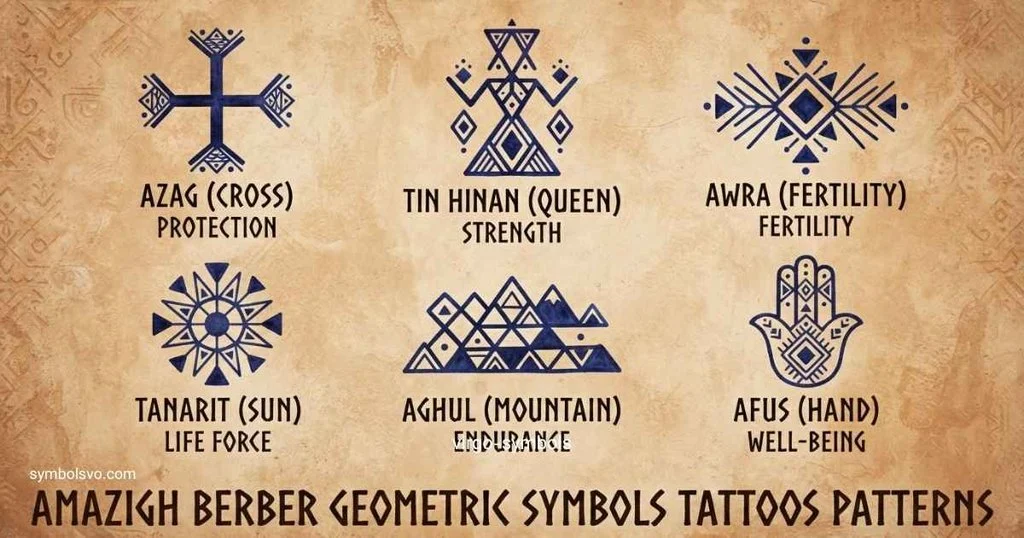
Amazigh, also commonly called Berber, artistic traditions include strong geometric patterning in textiles, pottery, jewelry, body decoration, and other visual arts. Museum collections document recurring geometric motifs such as diamonds, triangles, lines, and symmetrical arrangements in North African decorative traditions.
Historical research also documents tattooing as part of some Amazigh women’s artistic and identity traditions. Scholarship on Amazigh art in Morocco describes tattoos, clothing, textiles, and jewelry as visual expressions of identity.
Common Amazigh-inspired geometric forms
You may encounter patterns based on:
- Diamonds — often repeated in textile and decorative designs.
- Triangles — used in borders and repeating compositions.
- Zigzags — create rhythm and movement.
- Cross-like forms — appear in some regional designs.
- Parallel lines — used to structure larger patterns.
- Concentric or nested shapes — create visual depth.
- Symmetrical motifs — help establish balance within a composition.
It is important not to assign one universal meaning to every Amazigh geometric motif. Meanings can vary by region, community, object, period, and artistic context.
The relationship between Amazigh geometric motifs and tattoo traditions is also complex. Museum and scholarly sources document tattoos and geometric decoration, but individual motifs should not automatically be interpreted as having one fixed meaning.
Lascaux Geometric Symbols
Lascaux is famous for its prehistoric cave art, including animal figures, engravings, and abstract or geometric signs. The Lascaux International Centre describes hundreds of abstract signs among the works represented in the cave, including hook-, cross-, and quadrangular-shaped signs.
These signs are especially interesting because many of them do not have meanings that can be established with certainty.
Examples of geometric forms at Lascaux
Documented abstract signs include forms described as:
- Dots or groups of dots
- Lines
- Hooks
- Cross-like forms
- Quadrangular shapes
- Other repeated abstract marks
Researchers can describe what a sign looks like without necessarily knowing what it meant to the people who created it.
That distinction is important. It is tempting to assign modern symbolic meanings to prehistoric marks, but archaeological interpretation requires evidence. A geometric sign from Lascaux should therefore not automatically be called a religious symbol, alphabet character, or mathematical symbol.
The Lascaux site itself reports more than 400 abstract signs among the reproduced works, showing that geometric and other non-figurative marks form a significant part of the cave’s visual record.
Geometric Symbols Engineering Drawing
In engineering, geometric symbols can have precise technical meanings. This is very different from decorative geometric symbols used in social media or art.
A major system is Geometric Dimensioning and Tolerancing (GD&T). ASME Y14.5 provides standardized rules, definitions, symbols, and practices for stating and interpreting GD&T on engineering drawings and related digital product definitions.
Common GD&T characteristic symbols
Some frequently encountered geometric characteristics include:
| Characteristic | Common symbol | What it controls |
| Straightness | ⏤ | Form of a line or surface |
| Flatness | ▱ | Form of a surface |
| Circularity | ○ | Roundness of a feature |
| Cylindricity | ⌭ | Cylindrical form |
| Parallelism | ∥ | Orientation relative to a datum |
| Perpendicularity | ⊥ | 90-degree orientation |
| Angularity | ∠ | Specified angular orientation |
| Position | ⌖ | Location of a feature |
| Profile of a line | ⌒ | Profile of a line |
| Profile of a surface | ⌓ | Profile of a surface |
| Circular runout | ↗ | Variation during rotation |
| Total runout | ↗↗ | Overall surface variation during rotation |
Note: Engineering symbols should be read according to the applicable drawing standard and its rules. Unicode characters that look similar are not necessarily substitutes for official GD&T symbols.
GD&T is used to communicate design intent and help manufacturing and inspection teams understand requirements for form, orientation, location, and related characteristics.
Why engineering symbols are different
A decorative triangle can simply be a triangle. A geometric control symbol on an engineering drawing can impose a specific requirement on a manufactured feature.
That is why engineers should use the correct drafting standard rather than choosing a visually similar Unicode character.
How to Insert Geometric Symbols in Excel
You can insert geometric symbols in Microsoft Excel in several ways. The exact menu appearance can vary between Excel versions and operating systems.
Method 1: Use the Symbol command
- Open your Excel worksheet.
- Select the cell where you want the symbol.
- Open the Insert tab.
- Select Symbol.
- Choose a font that contains the required character.
- Browse or search for the symbol.
- Select Insert.
For simple characters, you can also copy them directly from a reliable symbol source and paste them into a cell.
For example:
■ □ ▲ △ ◆ ◇ ● ○ ⬡ ⬠
Method 2: Copy and paste
Copy the character you need and paste it into Excel:
Black square: ■
White square: □
Black triangle: ▲
White triangle: △
Black diamond: ◆
White diamond: ◇
Black circle: ●
White circle: ○
The displayed shape depends partly on font support. If a particular character does not display correctly, try a font with broader Unicode coverage.
Method 3: Use Unicode input
On systems that support Unicode character entry, you can enter a character using its code point and then convert it according to the operating system’s input method.
For example:
- ■ = U+25A0
- □ = U+25A1
- ▲ = U+25B2
- △ = U+25B3
- ◆ = U+25C6
- ◇ = U+25C7
- ● = U+25CF
- ○ = U+25CB
These code points correspond to the official Unicode names in the Geometric Shapes block.
Method 4: Use formulas when appropriate
If you need to generate a character programmatically in Excel, the UNICHAR function can return a Unicode character from a numeric code point.
For example:
=UNICHAR(9632)
returns:
■
Similarly:
=UNICHAR(9650)
returns:
▲
This approach is useful when a worksheet needs to generate symbols automatically from numeric data.
FAQ
What are geometric symbols?
Geometric symbols are characters or visual forms based on shapes such as circles, squares, triangles, rectangles, diamonds, and polygons. They are used in mathematics, design, engineering, writing, art, and cultural traditions.
What is the Unicode code for a geometric symbol?
There is no single Unicode code for all geometric symbols. For example, ■ is U+25A0, ▲ is U+25B2, and ● is U+25CF. Unicode’s Geometric Shapes block spans U+25A0 through U+25FF.
What is the most common geometric shape symbol?
There is no single officially designated “most common” geometric symbol. Circles, squares, triangles, and diamonds are among the most recognizable and widely used geometric forms.
Can I copy and paste geometric symbols?
Yes. Characters such as ■ □ ▲ △ ◆ ◇ ● ○ ⬡ ⬠ can be copied and pasted into many applications, although their appearance can depend on font and software support.
Do geometric symbols always have symbolic meanings?
No. Some are simply geometric or typographic characters. Others acquire meanings through mathematics, engineering, religion, art, or culture. The context determines how a symbol should be interpreted.
Conclusion
Geometric symbols connect simple visual shapes with many different forms of communication. A circle, triangle, square, or diamond can function as a Unicode character, mathematical notation, engineering control, decorative element, cultural motif, or part of a larger symbolic design.
For everyday digital use, Unicode provides a practical collection of copy-and-paste geometric characters with standardized names and code points. For technical subjects such as engineering, however, visually similar characters should not be treated as interchangeable with standardized drawing symbols.
The most useful approach is to identify both the shape and the context. That helps you choose the correct Unicode character for text, understand a geometry chart, recognize engineering notation, research historical signs, or discuss cultural patterns without assigning unsupported meanings.

I’m Nathan Holloway, a passionate researcher and writer with a deep interest in symbols, signs, and their hidden meanings. I enjoy exploring how symbols have influenced different civilizations, religions, and modern communication. Through my work, I aim to make complex historical and cultural concepts easy to understand for readers of all backgrounds. Every article I write is carefully researched to provide reliable and engaging information.
Books:
- Beyond the Symbol
- The Secret Meanings of Everyday Signs
Author 2: Grace Whitmore
Description:
My name is Grace Whitmore, and I love discovering the stories behind the world’s most fascinating symbols. I spend my time researching ancient civilizations, mythology, spiritual traditions, and modern iconography to uncover the meanings people often overlook. I believe that every symbol has a history worth telling, and I enjoy sharing that knowledge in a simple and reader-friendly way.
Books:
- Echoes of Ancient Symbols
- The Symbolic World
 Mason Ellington
 Grace Whitmore
 Daniel Brooks