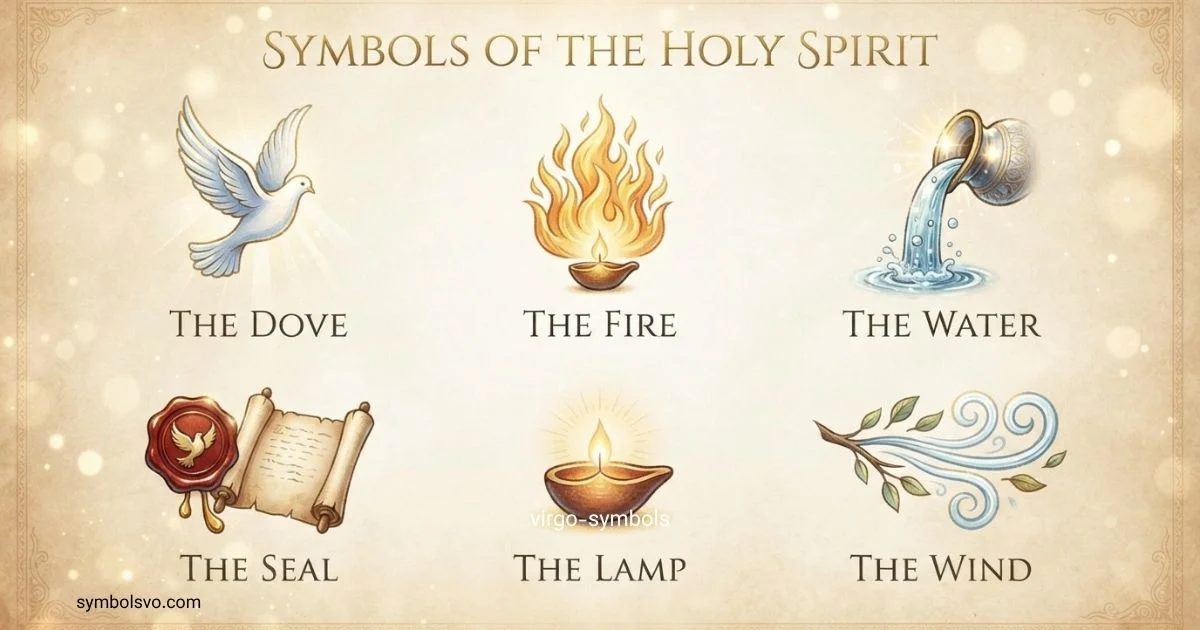
When I explore the Bible, I find that symbols can reveal deep truths about God and faith. The Symbols Of The Holy Spirit help you understand His presence, power, and work in meaningful ways.
From the gentle dove to powerful fire, each symbol carries a unique biblical message. As you explore these symbols, you can discover how they connect with guidance, transformation, purity, and spiritual strength.
I invite you to look beyond the symbols themselves and explore what they represent. You may find familiar biblical images taking on a deeper meaning as you learn their context and significance.
What are Symbols of the Holy Spirit
Symbols of the Holy Spirit are visible images, natural elements, actions, or signs used in Scripture and Christian tradition to communicate something about the Spirit’s activity and presence. The Holy Spirit Himself is not literally a bird, flame, wind, or liquid; these images point to particular ways Scripture describes His work.
The Bible and Christian tradition use several recurring images:
| Symbol | Common meaning or association |
| 🕊️ Dove | The Spirit’s descent upon Jesus at His baptism |
| 🔥 Fire | Transforming, powerful, and purifying action |
| 💧 Water | New birth, life, cleansing, and spiritual renewal |
| 🌬️ Wind/Breath | Life, movement, and the Spirit’s unseen activity |
| 🫒 Oil | Anointing and consecration |
| ☁️ Cloud | Divine presence and glory |
| ✨ Light | Revelation and God’s presence |
| 🔏 Seal | Belonging, authentication, and an enduring spiritual mark |
| ✋ Hand | Giving or receiving the Spirit through laying on of hands |
| ☝️ Finger | God’s active power associated with the Spirit |
| 🗣️ Voice | Divine communication and guidance |
These meanings are contextual rather than universal definitions. For example, water has many meanings throughout Scripture, but particular passages connect it with the Spirit and new life. The Catholic Catechism likewise identifies water, anointing, fire, cloud and light, the seal, the hand, the finger, and the dove among the principal symbols associated with the Holy Spirit.
4 Symbols of the Holy Spirit
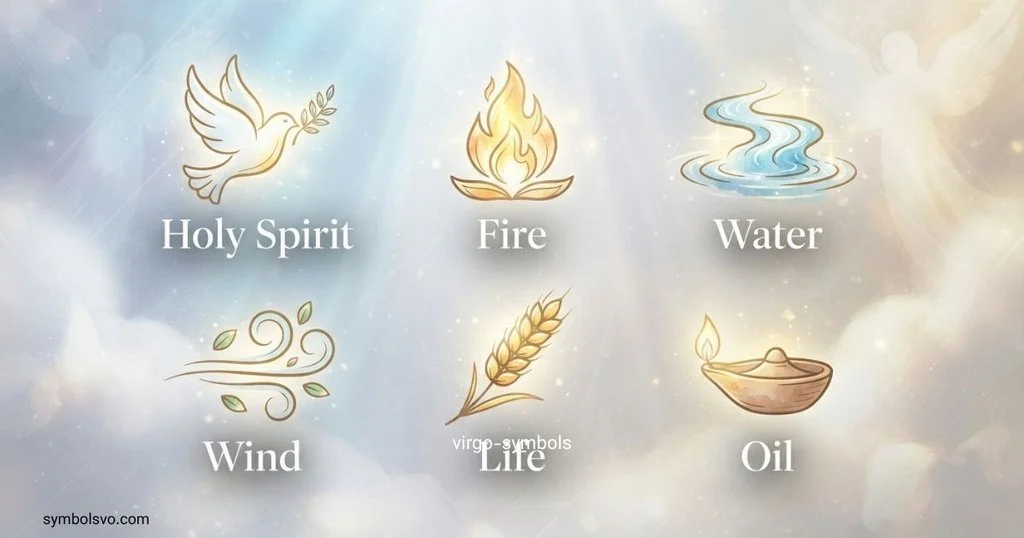
A simple four-symbol introduction can focus on four of the clearest biblical images: the dove, fire, water, and wind.
1. 🕊️ Dove
At Jesus’ baptism, the Spirit descends upon Him “like a dove.” This is the clearest biblical connection between the Holy Spirit and the dove, and it became a major symbol in Christian art.
2. 🔥 Fire
Acts 2 describes what appeared to be tongues of fire resting on the disciples when they were filled with the Holy Spirit. Fire therefore represents the Spirit’s powerful and transforming action.
3. 💧 Water
Water is connected with spiritual life, baptism, renewal, and the Spirit’s life-giving work. Jesus also speaks of living water in connection with the Spirit in John 7:37–39.
4. 🌬️ Wind
The biblical languages connect the ideas of spirit, breath, and wind in important passages. Acts 2 describes a sound like a mighty rushing wind when the Spirit comes upon the disciples.
5 Symbols of the Holy Spirit
A five-symbol list expands the basic group by adding oil or anointing.
- 🕊️ Dove — associated especially with the Spirit at Jesus’ baptism.
- 🔥 Fire — represents transforming and powerful action.
- 💧 Water — associated with life, baptism, and spiritual renewal.
- 🌬️ Wind — emphasizes the Spirit’s unseen but active movement.
- 🫒 Oil — represents anointing and consecration.
Oil has a particularly strong place in Christian symbolism. The Catholic Catechism describes anointing with oil as a symbol of the Holy Spirit and connects it with Confirmation and the anointing of Christ.
7 Symbols of the Holy Spirit
For a broader seven-symbol collection, the following images provide a useful overview:
- 🕊️ Dove — the Spirit’s manifestation at Jesus’ baptism.
- 🔥 Fire — transformation and spiritual power.
- 💧 Water — new birth, cleansing, and life.
- 🌬️ Wind — the Spirit’s unseen movement and activity.
- 🫒 Oil — anointing and consecration.
- ☁️ Cloud — God’s revealed yet mysterious presence.
- 🔏 Seal — belonging, authentication, and an enduring spiritual mark.
The cloud and seal have important biblical and theological associations. The Catechism connects cloud and light with manifestations of divine glory and describes the seal as an image of the enduring effect associated with the Spirit’s anointing.
8 Symbols of the holy spirit
An eight-symbol grouping can build on those seven by adding the hand:
| Symbol | Meaning in Christian symbolism |
| 🕊️ Dove | The Spirit’s descent at Christ’s baptism |
| 🔥 Fire | Transformation and power |
| 💧 Water | Life and spiritual renewal |
| 🌬️ Wind | Unseen movement and activity |
| 🫒 Oil | Anointing |
| ☁️ Cloud | Divine presence and glory |
| 🔏 Seal | Belonging and an enduring mark |
| ✋ Hand | The giving of the Spirit through laying on of hands |
The laying on of hands appears in the New Testament in connection with receiving the Holy Spirit, and the Catholic Catechism treats the hand as one of the Spirit’s symbolic signs.
9 Symbols of the Holy Spirit
A nine-symbol collection can add the finger to the previous group:
- 🕊️ Dove — manifestation at baptism.
- 🔥 Fire — transforming action.
- 💧 Water — spiritual life and renewal.
- 🌬️ Wind — invisible but active movement.
- 🫒 Oil — anointing.
- ☁️ Cloud — divine presence.
- 🔏 Seal — an enduring spiritual mark.
- ✋ Hand — laying on of hands.
- ☝️ Finger — an image of God’s active power.
The “finger of God” appears in biblical language associated with God’s power, while Christian tradition also connects this image with the Holy Spirit. The Catechism specifically discusses the finger as a symbol of the Spirit and refers to the hymn Veni Creator Spiritus, which calls the Spirit the finger of the Father’s right hand.
10 Symbols of the Holy Spirit
A ten-symbol list can add the voice as another biblical image:
| # | Symbol | Main association |
| 1 | 🕊️ Dove | Baptism of Jesus |
| 2 | 🔥 Fire | Transformation |
| 3 | 💧 Water | Life and renewal |
| 4 | 🌬️ Wind | Unseen movement |
| 5 | 🫒 Oil | Anointing |
| 6 | ☁️ Cloud | Divine presence |
| 7 | ✨ Light | Revelation and divine glory |
| 8 | 🔏 Seal | Belonging and authentication |
| 9 | ✋ Hand | Giving the Spirit |
| 10 | 🗣️ Voice | Divine communication |
The voice is best treated as a biblical descriptive image rather than a physical emblem of the Spirit. Scripture sometimes describes the Spirit as speaking or guiding, and Bible reference material lists “voice” among descriptions associated with the Holy Spirit.
12 Symbols of The Holy Spirit
There is no single biblical passage that establishes an official list of exactly twelve symbols. However, a broader study can group twelve recurring images and descriptions found in Scripture and Christian interpretation:
- 🕊️ Dove — especially associated with Jesus’ baptism.
- 🔥 Fire — transformation, power, and the Pentecost experience.
- 💧 Water — life, baptism, and renewal.
- 🌬️ Wind — the Spirit’s unseen movement.
- 🫒 Oil — anointing and consecration.
- ☁️ Cloud — manifestation of divine glory and presence.
- ✨ Light — revelation and divine manifestation.
- 🔏 Seal — belonging and an enduring mark.
- ✋ Hand — laying on of hands and the giving of the Spirit.
- ☝️ Finger — God’s active power associated with the Spirit.
- 🗣️ Voice — speaking, guiding, or communicating God’s will.
- 🌧️ Rain and dew — refreshing and life-giving imagery sometimes associated with the Spirit’s work.
This expanded list combines direct biblical images with broader biblical symbolism. Bible reference material identifies several of these, including dove, wind, fire, oil, water, seal, voice, and rain or dew.
Names and Symbols of The Holy Spirit And What They Mean
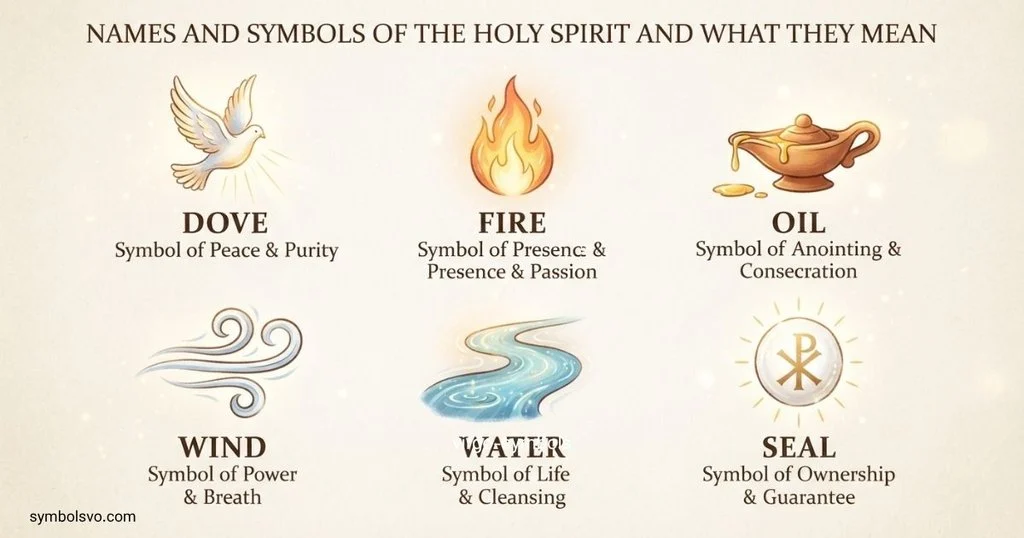
The Holy Spirit has several names and titles in Scripture and Christian theology. These names are not symbols in the same sense as a dove or fire; instead, they describe who the Spirit is and aspects of His relationship with God and believers.
| Name or title | Meaning or emphasis |
| Holy Spirit | The proper Christian name for the third Person of the Trinity |
| Spirit of Truth | Connected with truth and guidance |
| Paraclete | Commonly translated as Advocate or Consoler |
| Spirit of God | Identifies the Spirit in relation to God |
| Spirit of the Lord | Emphasizes divine authority and mission |
| Spirit of Christ | Connects the Spirit with Christ |
| Spirit of Promise | Associated with God’s promised gift |
| Spirit of Adoption | Connected with believers’ adoption as God’s children |
| Spirit of Glory | Associated with divine glory |
The Catechism specifically identifies “Holy Spirit” as the proper name and lists titles such as Paraclete, Spirit of Truth, Spirit of Promise, Spirit of Adoption, Spirit of Christ, Spirit of the Lord, Spirit of God, and Spirit of Glory.
These titles can be paired with symbols for study. For example, “Spirit of Truth” can be considered alongside images of light or guidance, while “Paraclete” highlights the Spirit’s role as Advocate or Consoler. Such pairings are interpretive connections, not claims that every title has one official visual symbol.
Symbols of the Holy Spirit in the Bible
The Bible presents the Holy Spirit through several concrete images. Some are especially direct, while others are broader metaphors or descriptions.
Dove
Matthew 3:16, Mark 1:10, Luke 3:22, and John 1:32 connect the Spirit with a dove-like descent at Jesus’ baptism. This is the strongest biblical foundation for the familiar dove symbol.
Wind And Breath
Acts 2:2 describes a sound like a strong rushing wind. John 3:8 also uses the movement of wind to explain the mysterious work of the Spirit. The relationship between “spirit,” “wind,” and “breath” is especially significant in the biblical languages.
Fire
Acts 2:3 describes appearances like tongues of fire resting on the disciples. Fire is therefore one of the clearest images connected with the Spirit at Pentecost.
Water
John 7:37–39 connects living water with the Spirit, while baptism provides another major setting in which water and the Spirit are closely related.
Oil And Anointing
Biblical anointing with oil is associated with God’s calling and empowerment. Christian interpretation connects this imagery with the Holy Spirit, particularly through passages such as Isaiah 61:1 and Acts 10:38.
Seal
Ephesians 1:13 and 4:30 describe believers as being sealed with the Holy Spirit. The seal communicates ideas such as belonging, authentication, and an enduring mark.
These biblical references show why the Holy Spirit is represented by multiple symbols rather than by only one fixed image.
Biblical Symbols of The Holy Spirit
Biblical symbols of the Holy Spirit can be divided into several broad categories:
Natural Images
- Water — life, renewal, cleansing, and spiritual nourishment.
- Wind — invisible movement and power.
- Fire — transformation and powerful action.
- Cloud — divine presence and glory.
- Rain or dew — refreshing and life-giving imagery.
Living And Animal Imagery
- Dove — the Spirit’s descent at Jesus’ baptism.
Ritual And Sign Images
- Oil — anointing.
- Seal — belonging and authentication.
- Laying on of hands — the giving or reception of the Spirit.
Communication Images
- Voice — the Spirit’s speaking, guidance, or testimony.
- Finger — biblical language for God’s active power.
These categories are useful for studying the symbolism, but they should not be treated as a single official biblical classification. Different Christian reference works and traditions emphasize different images.
Catholic Symbols Of The Holy Spirit
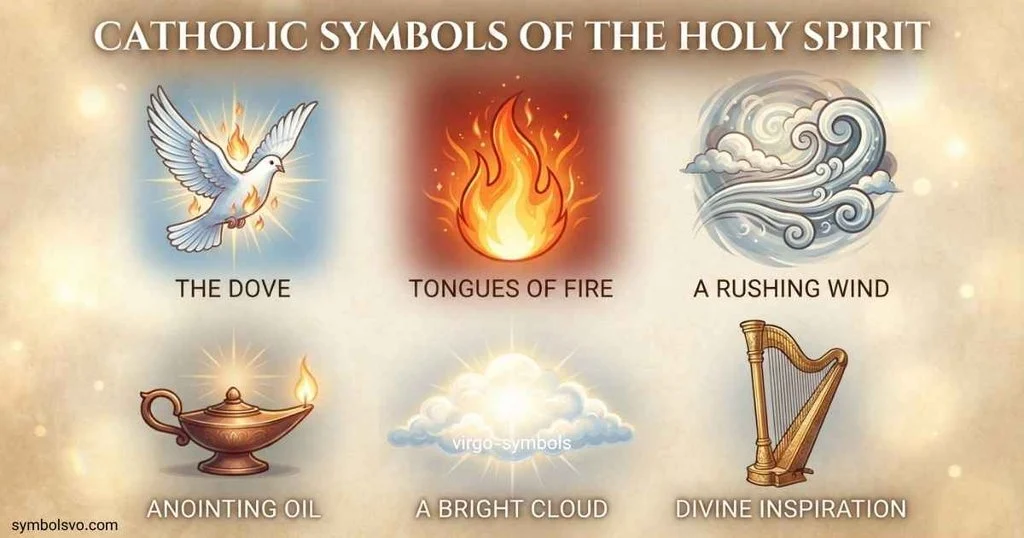
Catholic teaching gives a particularly structured explanation of the Holy Spirit’s symbols. The Catechism of the Catholic Church identifies water, anointing, fire, cloud and light, the seal, the hand, the finger, and the dove as important symbols.
Water
Water signifies the Holy Spirit’s action in Baptism and is associated with new birth and spiritual life.
Anointing
Anointing with oil is associated with the Holy Spirit and has a central role in Christian initiation, including Confirmation.
Fire
Fire represents the transforming action of the Spirit. Catholic teaching particularly connects this image with Pentecost, when what appeared to be tongues of fire rested upon the disciples.
Cloud And Light
Cloud and light are connected with manifestations of divine glory. The Catechism discusses these images in relation to biblical theophanies and events surrounding Christ.
Seal
The seal represents an enduring spiritual mark. Catholic teaching connects this image especially with Baptism, Confirmation, and Holy Orders.
Hand
The hand represents the laying on of hands through which the Holy Spirit is given in biblical and sacramental contexts.
Finger
The finger is connected with the biblical expression “finger of God” and is interpreted in Christian tradition as an image of the Spirit’s divine action.
Dove
The dove is connected directly with the Spirit descending upon Jesus at His baptism and has become a familiar Christian artistic symbol.
The Catholic list is therefore more specific than simply collecting every biblical metaphor associated with the Spirit. It provides an established theological framework for understanding these signs.
FAQ
What Is The Most Common Symbol Of The Holy Spirit?
The dove is probably the most recognizable Christian visual symbol of the Holy Spirit because the Gospels describe the Spirit descending upon Jesus at His baptism in the form or likeness of a dove.
What Does Fire Symbolize In The Holy Spirit?
Fire commonly represents the Spirit’s powerful and transforming action. Acts 2 uses the image of tongues of fire when describing the coming of the Spirit at Pentecost.
What Does Water Symbolize In Relation To The Holy Spirit?
Water can represent spiritual life, cleansing, baptism, renewal, and the Spirit’s life-giving work. John 7:37–39 is an important New Testament passage connecting living water with the Spirit.
Why Is A Dove Used For The Holy Spirit?
The dove is used because the Gospel accounts connect a dove-like descent with the Holy Spirit at Jesus’ baptism. Christian art later adopted the dove as a familiar visual representation of the Spirit.
Are There Exactly 12 Symbols Of The Holy Spirit?
No single biblical passage establishes exactly twelve symbols. Twelve-symbol lists are useful study groupings that combine recurring biblical images and Christian tradition, while specific traditions may use different lists and classifications.
Conclusion
The symbols of the Holy Spirit give readers a practical way to understand descriptions that can otherwise feel abstract. The dove points to the Spirit’s manifestation at Jesus’ baptism, fire highlights transforming power, water suggests life and renewal, and wind emphasizes an unseen but active presence.
Other images add further depth. Oil represents anointing, the seal suggests belonging and an enduring mark, the hand points to laying on of hands, and cloud and light connect with divine manifestation. Catholic teaching gives many of these symbols a particularly clear theological structure.
The most useful approach is to read each symbol in its biblical context rather than assigning one meaning to every appearance. When studied this way, these images become helpful keys for understanding Scripture, Christian art, worship, and the many ways Christians have described the work of the Holy Spirit.

 Grace Whitmore
 Daniel Brooks