When I first see chemical labels filled with unfamiliar symbols, I know they can feel confusing. You may wonder what each symbol means and whether it signals a serious hazard.
I created this guide to make GHS symbols simple to understand. You can quickly learn what each symbol represents, where it is used, and why it matters for everyday chemical safety.
Whether you are a student, worker, or simply curious, I want you to leave with a clear understanding of these important safety symbols.
What Are The GHS Symbols
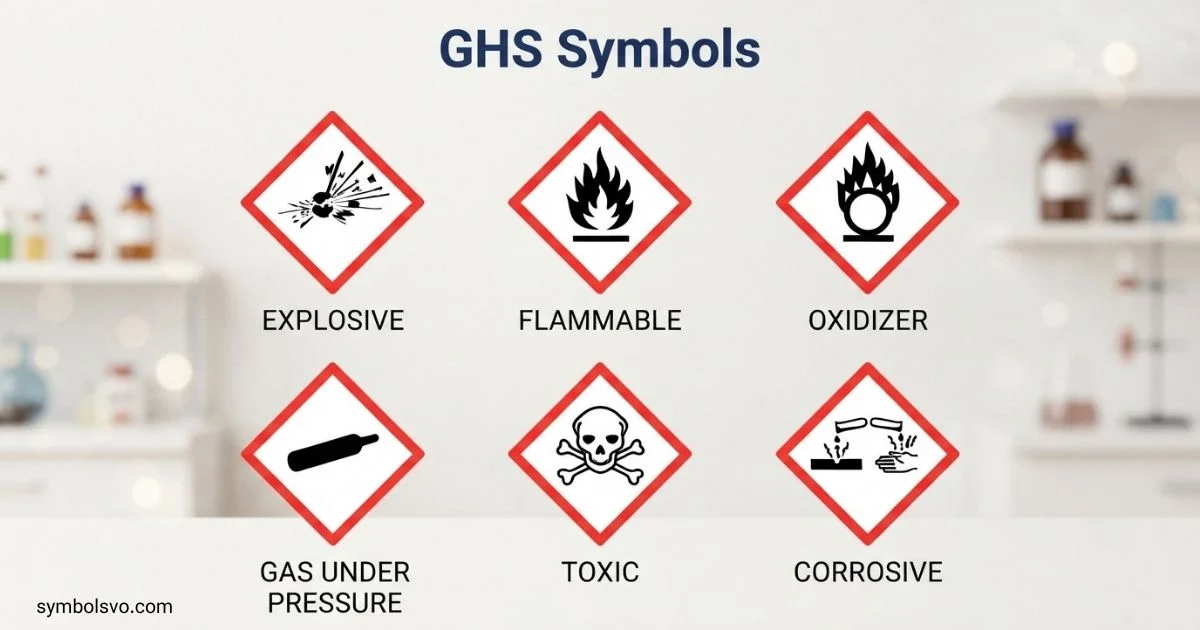
GHS symbols are hazard pictograms used to communicate chemical risks through standardized visual signs. A typical GHS pictogram contains a black hazard symbol on a white background surrounded by a red diamond-shaped frame.
The pictogram is only one part of a chemical label. A complete GHS label can also include the product identifier, signal word, hazard statements, precautionary statements, and supplier information.
The purpose is simple: a person should be able to recognize the general type of hazard without relying only on a long written description.
For example, a flame pictogram alerts users to certain fire-related hazards, while the corrosion pictogram warns about skin burns, serious eye damage, or corrosion of metals.
GHS pictograms are standardized, but their use depends on the hazard classification of the particular chemical or mixture. A chemical does not automatically receive every symbol simply because it is hazardous.
How Many GHS Symbols Are There
There are nine GHS pictograms in the international GHS system. These cover different physical, health, and environmental hazards.
The nine are:
- Health Hazard
- Flame
- Exclamation Mark
- Gas Cylinder
- Corrosion
- Exploding Bomb
- Flame Over Circle
- Environment
- Skull And Crossbones
There is an important distinction for readers in the United States. OSHA’s Hazard Communication Standard requires eight of the nine GHS pictograms. The Environment pictogram is not within OSHA’s jurisdiction because environmental hazards are outside the scope of the OSHA HCS pictogram requirements.
This is why some U.S. references say there are eight OSHA GHS pictograms, while international GHS references say there are nine GHS pictograms.
All GHS Symbols
Here is a quick reference to all nine internationally recognized GHS pictograms:
| GHS pictogram name | Main hazard area | Simple meaning |
| Health Hazard | Serious health effects | May cause serious or long-term health effects |
| Flame | Fire hazards | May burn, ignite, or create fire-related hazards |
| Exclamation Mark | Less severe health hazards | May cause irritation, sensitization, or harmful acute effects |
| Gas Cylinder | Gases under pressure | Contains gas under pressure |
| Corrosion | Corrosive effects | May cause severe burns, eye damage, or metal corrosion |
| Exploding Bomb | Explosive hazards | May explode or present explosive-related hazards |
| Flame Over Circle | Oxidizing hazards | May intensify fire or support combustion |
| Environment | Aquatic hazards | May be hazardous to aquatic life |
| Skull And Crossbones | Severe acute toxicity | May be toxic or fatal after exposure |
The exact hazard classification determines which pictogram appears on a label. Some pictograms can represent several related hazard categories.
The symbols themselves are graphical pictograms rather than ordinary Unicode characters. For that reason, copying a Unicode character such as ☠ does not create a complete GHS skull-and-crossbones pictogram. A compliant GHS label requires the standardized pictogram design.
GHS Symbols With Names
The names make the pictograms easier to identify and remember.
| Symbol name | What to recognize |
| Health Hazard | Human silhouette with a star-like mark in the chest |
| Flame | Flame |
| Exclamation Mark | ! |
| Gas Cylinder | Gas cylinder |
| Corrosion | Test tubes dripping onto a hand and metal |
| Exploding Bomb | Exploding object |
| Flame Over Circle | Flame above a circle |
| Environment | Dead fish and damaged tree |
| Skull And Crossbones | Skull with crossed bones |
The graphic appearance matters. For example, the GHS exclamation mark is not simply a standalone ! printed on a chemical container. The exclamation mark is placed inside the standardized pictogram frame.
Likewise, the skull-and-crossbones GHS pictogram has a specific graphic presentation. A text character such as ☠ can be useful in ordinary text, but it should not be treated as a substitute for an official chemical hazard label.
GHS Symbols Meaning
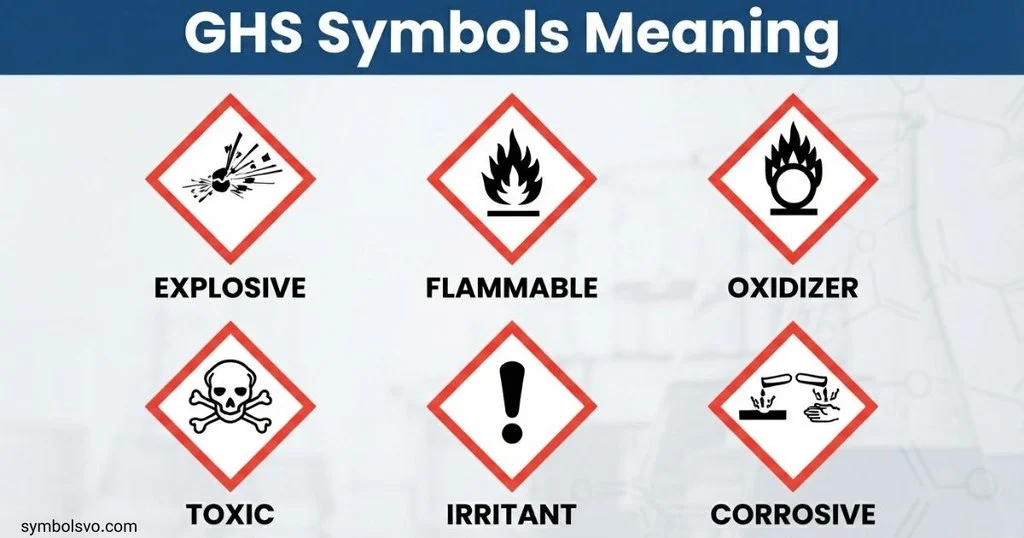
Each GHS pictogram communicates one or more hazard classes.
Health Hazard
The Health Hazard pictogram is associated with serious health hazards such as carcinogenicity, germ cell mutagenicity, reproductive toxicity, respiratory sensitization, specific target organ toxicity, and aspiration toxicity.
Flame
The Flame pictogram can identify flammables, pyrophorics, self-heating chemicals, substances that emit flammable gas, self-reactive substances, and certain organic peroxides.
Exclamation Mark
The Exclamation Mark pictogram can indicate hazards such as skin or eye irritation, skin sensitization, harmful acute toxicity, narcotic effects, and respiratory tract irritation.
Gas Cylinder
The Gas Cylinder pictogram indicates gases under pressure and certain chemicals under pressure.
Corrosion
The Corrosion pictogram can indicate skin corrosion or burns, serious eye damage, and corrosive effects on metals.
Exploding Bomb
The Exploding Bomb pictogram is used for certain explosives, self-reactive substances, and organic peroxides.
Flame Over Circle
The Flame Over Circle pictogram identifies oxidizers. These materials can create or intensify fire-related hazards.
Environment
The Environment pictogram indicates hazards to the aquatic environment. It is part of the international GHS system but is not one of the eight pictograms OSHA requires under its HCS.
Skull And Crossbones
The Skull And Crossbones pictogram identifies certain acute toxicity hazards where exposure may be toxic or fatal.
The pictogram alone does not provide every detail about a chemical. Always read the accompanying hazard and precautionary statements and consult the Safety Data Sheet when handling hazardous chemicals.
GHS Symbols Chart
The following chart provides a compact reference for common GHS pictograms and their main uses.
| Pictogram | Name | Common hazard categories |
| Human silhouette with star | Health Hazard | Carcinogenicity, mutagenicity, reproductive toxicity, respiratory sensitization, target organ toxicity, aspiration |
| Flame | Flame | Flammables, pyrophorics, self-heating, self-reactives, certain organic peroxides |
| ! | Exclamation Mark | Irritation, sensitization, harmful acute toxicity, narcotic effects |
| Cylinder | Gas Cylinder | Gases under pressure, chemicals under pressure |
| Test tubes and hand/metal | Corrosion | Skin corrosion, serious eye damage, corrosive to metals |
| Explosion graphic | Exploding Bomb | Explosives, some self-reactives and organic peroxides |
| Flame above circle | Flame Over Circle | Oxidizers |
| Dead fish and tree | Environment | Aquatic toxicity |
| Skull and crossed bones | Skull And Crossbones | Acute toxicity that may be toxic or fatal |
This chart is useful for learning, but a workplace label should follow the applicable regulatory requirements rather than relying on a simplified text chart.
OSHA specifies that its pictograms use a square set at a point, with a black hazard symbol on a white background and a red frame.
Hazard GHS Symbols
The phrase “hazard GHS symbols” generally refers to pictograms that communicate specific chemical hazards.
They can be grouped into three broad areas:
Physical hazards
- Flame
- Exploding Bomb
- Flame Over Circle
- Gas Cylinder
Health hazards
- Health Hazard
- Exclamation Mark
- Corrosion
- Skull And Crossbones
Environmental hazards
- Environment
These categories are useful for learning, but individual pictograms can cover several classifications. For example, the Flame symbol covers more than ordinary flammability.
A chemical may also have more than one pictogram if it meets several hazard classifications. OSHA notes that each required pictogram may appear only once on a label even when multiple hazards require the same pictogram.
Chemical GHS Symbols
Chemical GHS symbols are selected based on the hazards identified during chemical classification.
For example, a flammable solvent may require the Flame pictogram. A corrosive acid may require the Corrosion pictogram. A compressed gas may require the Gas Cylinder pictogram.
The important point is that there is no single GHS symbol for “chemical.” The symbol depends on the chemical’s specific properties and classification.
A useful way to understand the system is:
Chemical → Hazard classification → Applicable pictogram → Label information
The Safety Data Sheet is an important source for determining the hazards associated with a particular chemical. Section 2 of an SDS generally provides the hazard identification information, including relevant pictograms, signal words, hazard statements, and precautionary statements.
Do not select a pictogram based only on the chemical’s name or on what a similar product uses. Formulation, concentration, and classification can affect the required label elements.
GHS Symbols Exclamation Mark
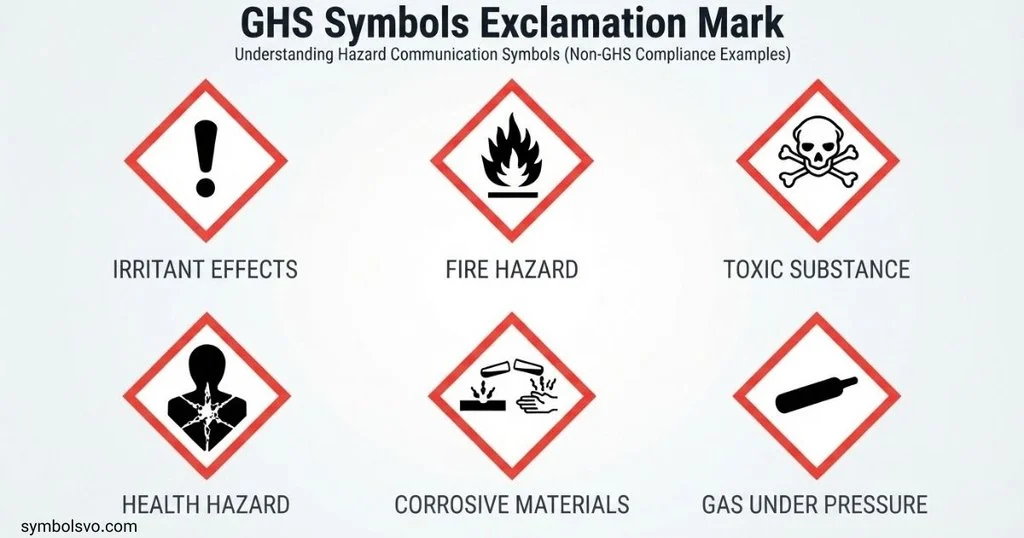
The GHS Exclamation Mark pictogram is one of the most commonly recognized chemical hazard symbols.
Its central graphic is an exclamation mark:
!
However, the official GHS pictogram is the exclamation mark displayed inside the required red diamond-shaped frame. The plain ! character is therefore useful for explaining or typing the symbol, but it is not a complete GHS pictogram.
The exclamation mark may be associated with:
- Skin irritation
- Eye irritation
- Skin sensitization
- Harmful acute toxicity
- Narcotic effects
- Respiratory tract irritation
OSHA’s current pictogram guidance lists these hazard areas under the Exclamation Mark pictogram.
The symbol should not automatically be interpreted as meaning “dangerous” in the same way as every other GHS pictogram. Its meaning depends on the specific hazard classification.
For example, an irritation hazard is different from acute toxicity represented by the Skull And Crossbones pictogram. Reading the label’s hazard statement gives the precise warning.
Where Can You Find GHS Symbols
GHS symbols can be found on labels and containers for hazardous chemicals in workplaces and other settings where GHS-based hazard communication applies.
Common locations include:
- Chemical bottles
- Laboratory containers
- Drums and barrels
- Storage containers
- Chemical transport packaging
- Workplace secondary containers
- Industrial chemical labels
- Safety documentation and training materials
You may also see GHS pictograms in Safety Data Sheets, chemical catalogs, training guides, and regulatory resources.
On a workplace chemical label, the pictogram is normally presented alongside other information rather than being used by itself. OSHA’s Hazard Communication Standard specifies label elements that communicate the identity and hazards of a chemical.
If you need to identify the hazard of a chemical at work, check the container label first and consult its SDS for more detailed information.
OSHA GHS Symbols
OSHA uses GHS-based pictograms through the Hazard Communication Standard, commonly called HazCom.
There are nine pictograms in the GHS, but OSHA requires eight under its HCS. The environmental pictogram is the exception because environmental hazards are outside OSHA’s jurisdiction.
The eight OSHA pictograms are:
- Health Hazard
- Flame
- Exclamation Mark
- Gas Cylinder
- Corrosion
- Exploding Bomb
- Flame Over Circle
- Skull And Crossbones
OSHA describes a GHS pictogram as a symbol plus graphic elements intended to communicate information about a chemical hazard. Its required pictogram format uses a red diamond-shaped frame around a black symbol on a white background.
OSHA also uses the signal words Danger and Warning. These words indicate the relative severity of the hazard and work together with pictograms, hazard statements, and precautionary statements.
A useful distinction is:
| GHS | OSHA HCS |
| Nine pictograms in the international system | Eight pictograms required under OSHA HCS |
| Includes Environment | Environment pictogram is not mandatory under OSHA HCS |
| International framework | U.S. workplace hazard communication requirements |
| Covers physical, health, and environmental hazards | OSHA focuses on workplace safety and health |
Always check the current applicable OSHA requirements for the workplace and chemical involved because regulatory requirements can change.
Sulfuric Acid GHS Symbols
Sulfuric acid is a strong corrosive chemical, so the Corrosion pictogram is a key GHS symbol associated with sulfuric acid classifications.
The Corrosion pictogram is used for hazards such as skin corrosion, serious eye damage, and corrosivity to metals.
However, it is not safe to assume that every sulfuric acid product will have exactly the same complete set of label elements. Classification can depend on the concentration, formulation, and applicable regulatory criteria.
A sulfuric acid label may therefore contain:
- A Corrosion pictogram
- The appropriate signal word
- Relevant hazard statements
- Precautionary statements
- Product identification
- Supplier information
For a specific sulfuric acid product, use the manufacturer’s current SDS and label rather than selecting symbols from a generic internet chart.
This distinction matters because a concentrated sulfuric acid product and a diluted solution can have different classifications. The correct GHS label should reflect the classification of the actual product being supplied or used.
GHS Symbols Quiz
Test your understanding with these quick questions.
1. How many pictograms are in the international GHS system?
Answer: Nine.
2. How many GHS pictograms does OSHA require under its HCS?
Answer: Eight. The Environment pictogram is not required by OSHA because environmental hazards are outside its jurisdiction.
3. Which GHS pictogram shows an exclamation mark?
Answer: The Exclamation Mark pictogram.
4. Which pictogram is associated with gases under pressure?
Answer: Gas Cylinder.
5. Which pictogram represents oxidizers?
Answer: Flame Over Circle.
6. Which pictogram warns of severe acute toxicity?
Answer: Skull And Crossbones.
7. Which pictogram is commonly associated with sulfuric acid’s corrosive hazard?
Answer: Corrosion.
8. Does the plain ! character count as the complete GHS Exclamation Mark pictogram?
Answer: No. It represents the central graphic, but an official GHS pictogram also includes its required frame and presentation.
9. Are GHS pictograms the same as ordinary Unicode symbols?
Answer: No. GHS pictograms are standardized graphical hazard labels. Unicode characters can be useful for text explanations but should not be treated as regulatory substitutes.
10. Where should you find detailed hazard information for a specific chemical?
Answer: Check the product label and the current Safety Data Sheet.
Industrial Label Printers GHS Symbols Text
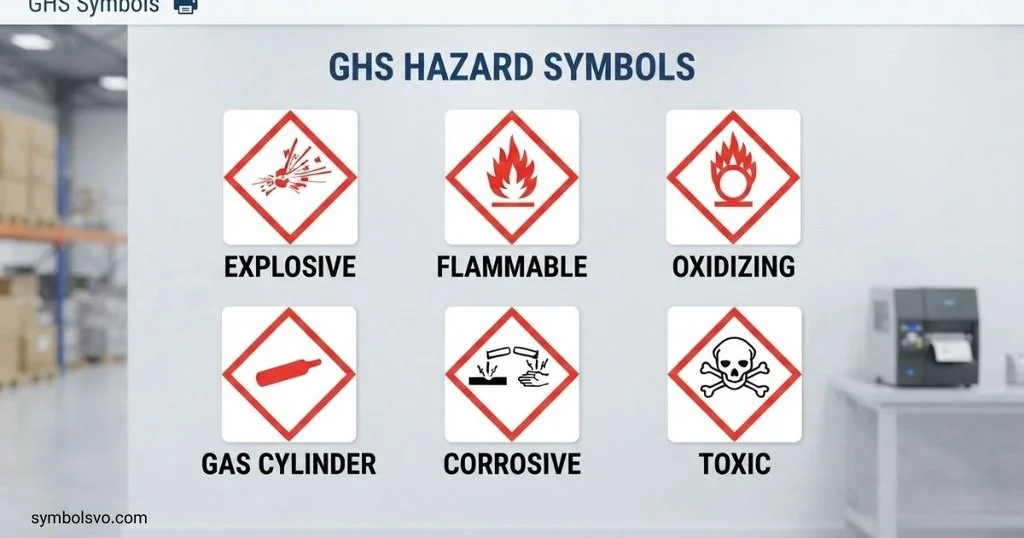
Industrial label printers are commonly used to produce durable chemical labels, workplace identification labels, and other safety markings.
When creating a GHS label, the pictogram should not be replaced with a random text symbol or emoji. A professional label system should use the appropriate standardized pictogram artwork and follow the requirements that apply to the chemical, workplace, and jurisdiction.
For text-based label templates, useful information can include:
- Product identifier
- GHS pictogram
- Signal word
- Hazard statements
- Precautionary statements
- Supplier information
- Relevant supplemental information
For example, a digital label template might contain text such as:
PRODUCT: Sulfuric Acid Solution
PICTOGRAM: Corrosion
SIGNAL WORD: [Use the classification-specific signal word]
HAZARD STATEMENT: [Use the applicable official statement]
PRECAUTIONARY STATEMENTS: [Use applicable statements]
The actual wording should come from the product’s classification and current SDS rather than being copied from a generic template.
For printing, the GHS pictogram must remain clear and recognizable at the final label size. Poor resolution, excessive scaling, low contrast, or an incorrectly designed border can make a safety label harder to interpret.
The United Nations GHS resources provide official pictogram artwork in several formats, including formats intended for label printing.
A printer or label designer should also avoid treating ordinary Unicode characters such as ☠, ⚠, or ! as replacements for the required GHS pictogram artwork. These characters may be useful in educational text, but regulatory labels require the appropriate pictographic design.
Frequently Asked Questions
What Does GHS Stand For?
GHS stands for the Globally Harmonized System of Classification and Labelling of Chemicals. It provides a standardized framework for classifying chemical hazards and communicating them through labels and Safety Data Sheets.
What Is The Most Common GHS Symbol?
There is no single “most common” GHS symbol for every workplace. The pictogram used depends on the hazards of the chemical. The Flame, Corrosion, Exclamation Mark, and Health Hazard pictograms are among those frequently encountered in chemical settings.
Can I Copy And Paste GHS Symbols?
You can copy text representations such as ! for educational content, but official GHS pictograms are graphical designs rather than ordinary Unicode characters. For regulatory labeling, use approved pictogram artwork that meets the applicable requirements.
Is GHS The Same As OSHA?
GHS is an international hazard classification and communication system, while OSHA is a U.S. federal agency that incorporated GHS principles into its Hazard Communication Standard. OSHA’s requirements do not include the Environment pictogram as a mandatory HCS pictogram.
What Is The GHS Symbol For Corrosive Chemicals?
The Corrosion pictogram is used for certain corrosive hazards, including skin corrosion, serious eye damage, and corrosion of metals. The exact classification should be confirmed from the chemical’s current SDS and label information.
Conclusion
GHS symbols make chemical hazards easier to recognize by using consistent pictograms for physical, health, and environmental risks. The international GHS system contains nine pictograms, while OSHA requires eight under its Hazard Communication Standard.
Learning the names and meanings of the symbols can help workers quickly understand labels. The Exclamation Mark, Corrosion, Flame, Health Hazard, Skull And Crossbones, and other pictograms each communicate different types of risk, so the accompanying hazard statements still matter.
For real chemical handling and workplace labeling, use the correct pictogram for the product’s classification and verify the information against the current label and Safety Data Sheet. A simple symbol can provide an important warning, but accurate labeling requires the complete hazard communication system.

 Grace Whitmore
 Daniel Brooks