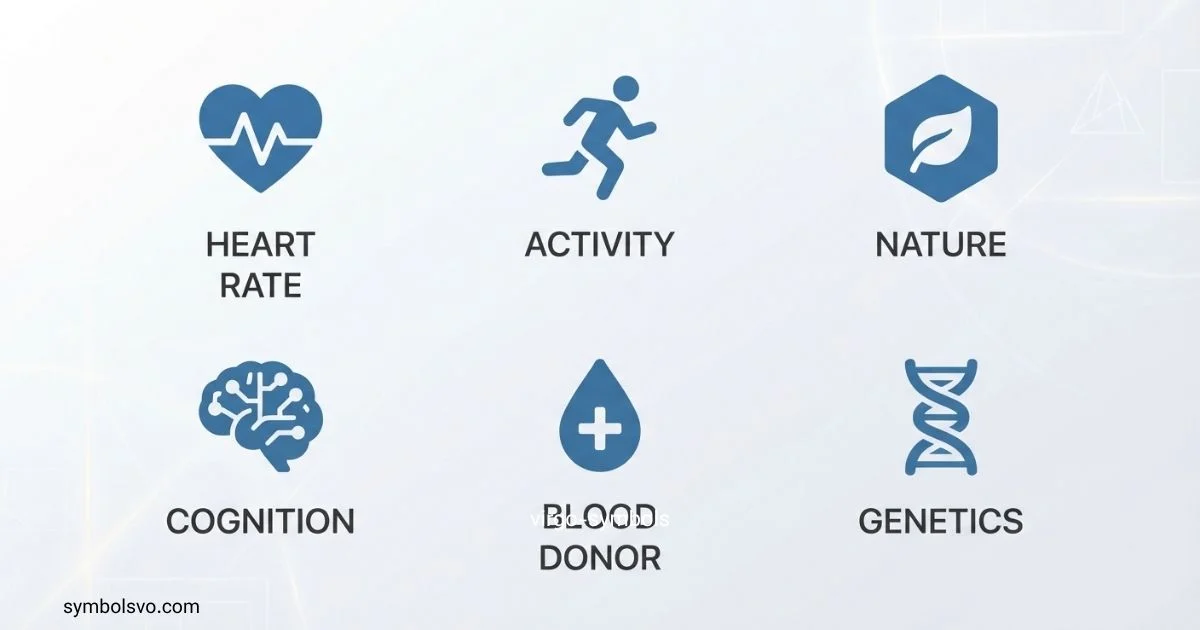
SF Symbols is Apple’s large library of vector-based symbols designed for use across Apple platforms. It gives designers and developers a consistent way to add familiar icons to app interfaces while matching Apple’s typography, sizing, and visual language. Apple currently describes the library as containing more than 7,000 symbols.
This guide covers the main things people search for when working with SF Symbols, including the symbol list, names, SF Symbols 7, online resources, search and browsing tools, the SF Symbols app, fonts, Apple’s design guidelines, and custom symbols. It also explains specific names such as brain, line.3.horizontal, and mappin.and.ellipse.
If you are designing an iPhone, iPad, Mac, Apple Watch, or other Apple-platform interface, knowing how to find and use the right symbol can save time. You will also learn why SF Symbols should not simply be treated as a normal Unicode character collection and how to move symbols into design workflows such as Figma.
Apple SF Symbols
Apple SF Symbols is a collection of vector-based interface symbols created to work naturally with Apple’s design system. Symbols can align with surrounding text, scale with typography, and support different weights and scales. Apple says the current library contains more than 7,000 symbols.
The symbols cover common interface concepts such as:
- Navigation
- Communication
- Media controls
- Devices
- People
- Maps
- Weather
- Accessibility
- Editing
- Commerce
- Files and documents
- Status indicators
- Actions and controls
A major advantage is consistency. Instead of drawing a different icon for every button, a designer can choose an SF Symbol that already follows Apple’s visual conventions.
SF Symbols also support several rendering modes, including monochrome, hierarchical, palette, and multicolor. Apple has expanded the system with animation and variable-rendering features over time.
For developers, SF Symbols can be used through Apple’s platform APIs. For designers, the dedicated SF Symbols app provides a visual way to browse, search, preview, and copy symbols.
SF Symbols List With Names
An SF Symbols list with names is useful because developers generally refer to symbols by their system names rather than by a Unicode code point.
Examples include:
| Symbol name | Common use |
| heart | Heart or favorite action |
| heart.fill | Filled heart or selected favorite |
| star | Rating or favorite |
| star.fill | Filled rating or favorite |
| magnifyingglass | Search |
| gearshape | Settings |
| trash | Delete |
| plus | Add |
| xmark | Close or cancel |
| checkmark | Confirmation |
| person | Person or account |
| house | Home |
| bell | Notifications |
| camera | Camera |
| map | Map |
| brain | Brain or cognitive concept |
The name matters when coding. For example, in SwiftUI, a system symbol can be displayed with a name such as:
Image(systemName: “heart.fill”)
SF Symbols also has variants. A base symbol may have filled, outlined, enclosed, slash, or other related forms. Apple notes that the available variants depend on the individual symbol.
Because the library changes over time, the SF Symbols app is a better source for a current complete list than an old static list copied from a website.
SF Symbols 7
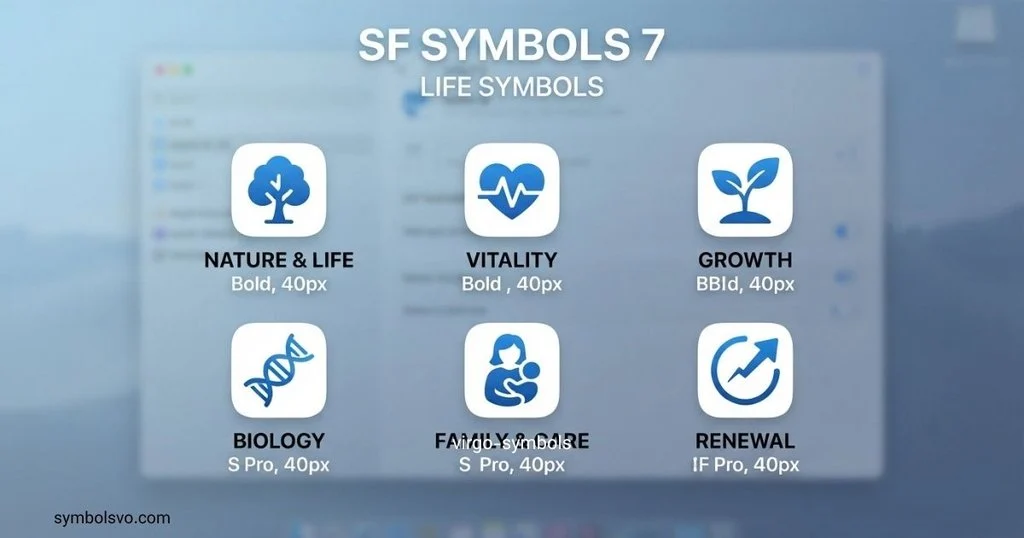
SF Symbols 7 introduced several important additions to Apple’s symbol system. Apple presented SF Symbols 7 at WWDC25, highlighting new animation, drawing, rendering, and customization features.
One major addition is Draw. Symbols can use Draw On and Draw Off effects that make their paths appear or disappear in a handwriting-like motion.
SF Symbols 7 also introduced:
- Draw On and Draw Off animations
- Variable Draw
- Expanded Magic Replace transitions
- Gradient rendering
- Improvements for custom symbols
- Additional animation capabilities
Variable Draw can communicate changing values along a symbol’s path, which can be useful for progress-style interfaces. Gradient rendering adds another way to give symbols visual depth.
Apple’s Human Interface Guidelines were also updated for SF Symbols 7, including guidance for Draw animations and gradient rendering.
SF Symbols 7 is therefore more than a larger icon collection. It expands how symbols can behave and appear inside modern interfaces.
SF Symbols Online
There are several ways to explore SF Symbols online, but Apple’s own developer resources should be the starting point for accurate and current information.
The official Apple SF Symbols page provides access to the library, download information, Human Interface Guidelines, and information about recent versions.
Apple also provides Design Resources that include SF Symbols alongside other official design materials. The current Apple Design Resources page lists the SF Symbols download and states that it requires macOS Sonoma or later.
Online resources are useful for:
- Learning symbol names
- Checking Apple’s design guidance
- Reading documentation
- Finding tutorials
- Learning about new SF Symbols releases
- Understanding custom-symbol requirements
One limitation is that an online article or third-party gallery may become outdated when Apple adds symbols or changes design guidance. For production work, verify important details against Apple’s current documentation.
SF Symbols Browser
The SF Symbols app works as a dedicated browser for Apple’s symbol collection. Apple describes the app as a way to browse the available symbols and use them in design and development workflows.
A browser-style workflow is helpful when you know what you want visually but do not know the exact symbol name.
For example, you might be looking for:
- A location marker
- A brain
- A horizontal menu
- A share icon
- A calendar
- A person
- A document
- A warning indicator
Instead of guessing the name, you can browse categories and visually compare options.
The app is also useful for checking variants, weights, scales, and rendering options before choosing a symbol for an interface.
SF Symbols Search
SF Symbols search is one of the most useful features when you have an idea but do not know the exact symbol name.
Apple’s current SF Symbols page describes Enhanced Search, which uses semantic understanding to find relevant symbols even when the search terms do not exactly match the symbol’s name.
For example, a designer could search for a concept instead of remembering a precise identifier.
A good search workflow is:
- Describe the object or action.
- Review the matching symbols.
- Compare filled and outlined variants.
- Check the available weights and scales.
- Preview the symbol in the intended interface.
- Copy or reference its exact name.
Search is especially useful because SF Symbol names can become detailed. A symbol may have a base name plus modifiers describing its shape, state, direction, or enclosure.
SF Symbols app
The SF Symbols app is Apple’s dedicated Mac application for working with the SF Symbols library. Apple distributes it through its Design Resources.
The app is useful for both designers and developers.
You can use it to:
- Browse symbols
- Search for symbols
- Preview symbols
- Inspect variations
- Copy symbol names
- Copy symbols into supported design workflows
- Explore rendering modes
- Work with custom symbols
- Export symbol templates
Apple has also described the app as a convenient way to browse and copy vector-based icons into applications such as Sketch, Adobe XD, and Figma.
For developers, it can help answer a practical question before writing code: What is the exact system symbol name I need?
That makes the app more than a visual gallery. It is also a reference tool for implementation.
SF Symbols font
SF Symbols are closely related to Apple’s typography system, but it is more accurate to think of SF Symbols as a symbol library rather than simply calling it a font.
Apple explains that SF Symbols are designed to integrate with the San Francisco system font. They can match text styles, weights, scales, and baseline alignment.
This relationship is one reason SF Symbols can look natural beside text.
For example, a symbol can be configured to visually match nearby text:
Image(systemName: “bell”)
.font(.title2)
The exact appearance depends on the symbol, configuration, platform, and rendering mode.
It is also important not to assume that every SF Symbol is an ordinary Unicode character. SF Symbol identifiers such as heart.fill and mappin.and.ellipse are system symbol names, not Unicode character names.
That distinction matters when you are looking for copy-and-paste text symbols. A Unicode character can be inserted as text, while an SF Symbol is normally used as a platform symbol image.
SF Symbols Guidelines Apple
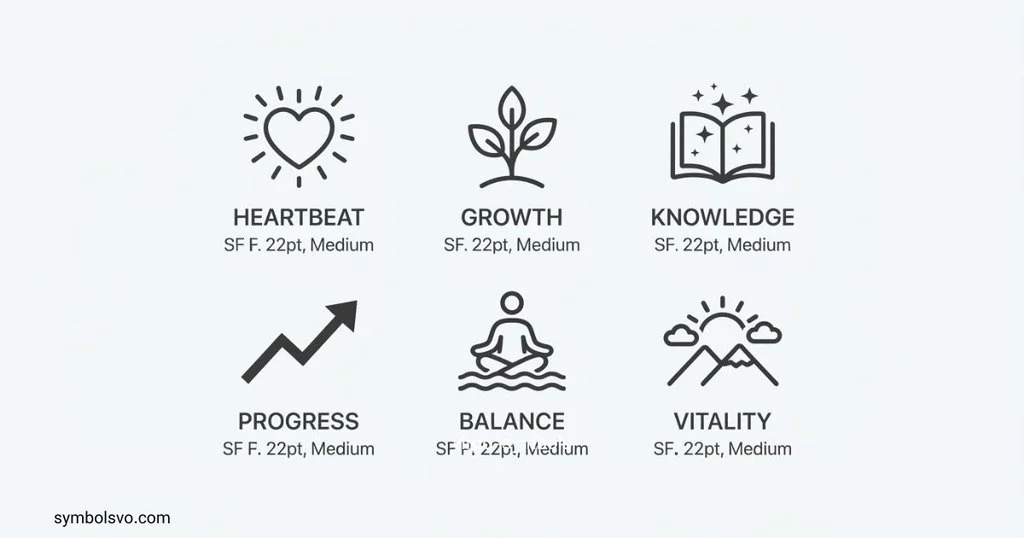
Apple’s SF Symbols guidelines explain how symbols should be selected, configured, and designed so that they fit naturally into Apple interfaces.
The Human Interface Guidelines cover areas such as:
- Symbol weights
- Symbol scales
- Rendering modes
- Design variants
- Animation
- Custom symbols
- Platform considerations
- Visual consistency
Apple recommends using symbols that clearly communicate their intended meaning and fit the surrounding interface.
Symbols can also adapt to text styles and Dynamic Type. Apple notes that symbol images can use font-related traits, weights, scales, and baseline alignment.
A practical rule is simple: choose the clearest symbol for the action or information you are presenting. Do not select an unusual icon merely because it looks decorative.
Custom SF Symbols
Custom SF Symbols let developers and designers create symbol images that fit their own app while using many of the same characteristics as Apple’s system symbols.
Apple’s documented workflow starts by exporting an SVG template from the SF Symbols app. You can then edit the vector artwork in a compatible vector-design application, export the SVG, validate it, and import it back into SF Symbols.
A simplified workflow is:
- Find a suitable existing symbol.
- Duplicate it as a custom symbol or export a template.
- Edit the vector artwork.
- Preserve the required template structure.
- Export the SVG.
- Validate the symbol.
- Add annotations when needed.
- Import or distribute the finished symbol.
Custom symbols can support different weights and scales, as well as rendering features such as multicolor and hierarchical data when properly annotated.
Apple also provides specific requirements for custom-symbol templates. This is why simply drawing an SVG icon and giving it an SF Symbols-style name does not automatically make it a valid custom SF Symbol.
SF Symbols Figma
Figma is commonly used in Apple interface design, and Apple provides official Figma design resources for its platforms. Apple’s Design Resources currently include Figma UI kits for iOS and iPadOS, macOS, watchOS, and visionOS.
SF Symbols can also be brought into design workflows. Apple has specifically described copying vector-based symbols from the SF Symbols app into design tools such as Figma.
A practical workflow is:
SF Symbols app → choose symbol → copy/export as appropriate → place in Figma → build interface
When using symbols in Figma, remember the difference between a design asset and a system symbol used directly by an application.
A Figma mockup may use a vector representation for visual design, while the final iOS or macOS implementation may reference the actual SF Symbol by name.
For the most accurate Apple UI work, use Apple’s current Figma resources alongside the SF Symbols library rather than relying on an old third-party icon pack.
Apple SF Symbols Brain Symbol
The SF Symbols library includes a symbol named brain, which represents a brain-shaped icon.
A basic reference is:
Symbol name: brain
In SwiftUI:
Image(systemName: “brain”)
The brain symbol can be useful for interfaces involving:
- Learning
- Knowledge
- Memory
- Thinking
- Cognitive features
- Mental or neurological topics
- Artificial intelligence concepts, depending on the context
The meaning is contextual. An icon does not automatically communicate one universal concept.
For example, a brain icon in an education app may suggest learning, while the same icon in a health interface may represent a neurological topic.
When selecting an SF Symbol, check its available variants and appearance in the SF Symbols app rather than assuming that a similarly named symbol will have identical visual behavior across versions.
SF Symbols Line.3.Horizontal
line.3.horizontal is an SF Symbol name referring to a symbol made from three horizontal lines.
The name itself follows a useful SF Symbols naming pattern:
line + 3 + horizontal
It can be used for interface concepts such as:
- Menu
- List
- Navigation options
- More controls
- Text or content lines
For example:
Image(systemName: “line.3.horizontal”)
A three-line icon is often associated with a menu, but its exact meaning depends on where it appears.
It is also worth distinguishing it from related symbols. SF Symbols contains multiple line-based icons and variants, so the correct choice depends on the action you want the user to understand.
If the icon opens navigation, a menu-related interpretation may be natural. If it represents a list or content, another variant may communicate the idea more clearly.
SF Symbols Mappin.And.Ellipse
mappin.and.ellipse is an SF Symbol name combining a map pin and an ellipse.
You can reference it in SwiftUI like this:
Image(systemName: “mappin.and.ellipse”)
The symbol can be useful in interfaces involving:
- Location
- Places
- Maps
- Search around a location
- Location-based features
Its name is particularly helpful when searching Apple’s symbol library because it describes the visual components directly.
The exact meaning still depends on context. A map-pin symbol does not necessarily mean “current location,” so it should not be used interchangeably with every location-related icon.
If the interface needs to distinguish a selected location, current location, destination, or general place, compare the available SF Symbol variants before choosing one.
SF Symbols News
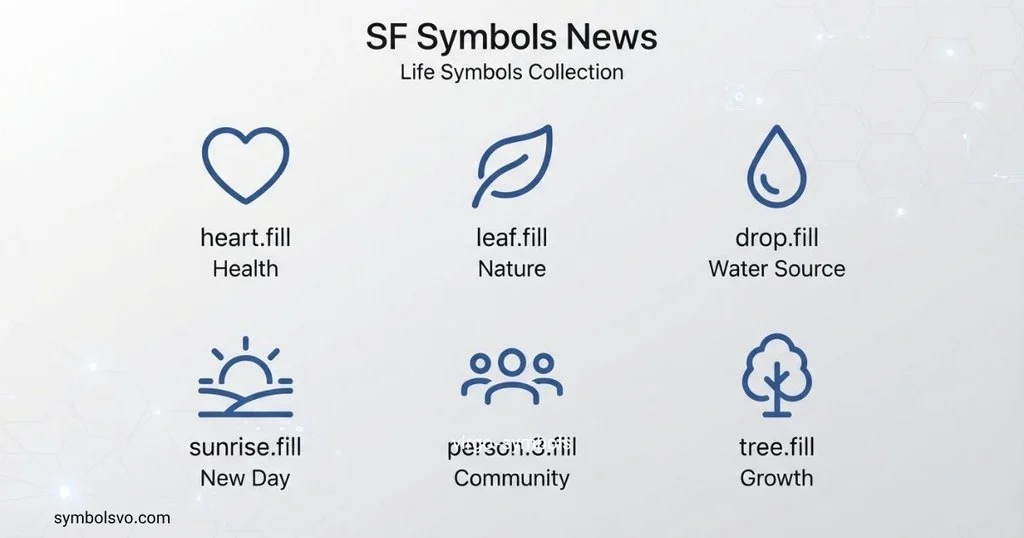
SF Symbols news is most useful when you need information about new symbols, updated rendering features, design guidance, or new versions of the SF Symbols app.
Apple’s official developer resources are the most reliable place to follow these changes. Apple has published dedicated WWDC sessions for SF Symbols 7 and continues to update its design documentation.
For example, SF Symbols 7 brought new Draw effects, Variable Draw, gradient rendering, and improvements to symbol transitions and customization.
Apple’s resources also show that the library continues to evolve. The current Apple Design Resources page lists a newer SF Symbols download while retaining documentation for previous releases.
For current information, check:
- Apple’s SF Symbols page
- Apple Design Resources
- Apple Human Interface Guidelines
- WWDC sessions about SF Symbols
- Apple Developer documentation
This is especially important if an article or tutorial refers to an older version. Symbol counts, features, and supported capabilities can change between releases.
Frequently Asked Questions
What are SF Symbols used for?
SF Symbols are used primarily for interface iconography in Apple-platform apps. They provide scalable, consistent symbols that can align with text and adapt to different sizes, weights, and rendering configurations.
Are SF Symbols free to use?
Apple provides SF Symbols as part of its Apple Design Resources for use in designing and developing Apple-platform apps, subject to Apple’s applicable license terms. Always check the current license and usage conditions that accompany the download.
Are SF Symbols Unicode characters?
No. SF Symbol identifiers are generally system symbol names rather than Unicode character names. For example, heart.fill is an SF Symbol identifier. It should not be confused with a Unicode heart character that can be inserted directly as text.
Can I use SF Symbols in Figma?
Yes. Apple has described workflows for copying SF Symbols into design tools including Figma, and Apple’s official design resources include Figma UI kits.
Can I create my own SF Symbol?
Yes. Apple provides a documented custom-symbol workflow involving SVG templates, vector editing, validation, annotations, and integration with Xcode.
Conclusion
SF Symbols gives Apple-platform designers and developers a consistent library of interface icons that can work naturally with text, different sizes, weights, and rendering modes. The dedicated SF Symbols app makes it easier to browse and search the collection, while Apple’s documentation provides the technical and design guidance needed for production use.
Specific symbol names such as brain, line.3.horizontal, and mappin.and.ellipse show why learning the naming system is useful. Instead of searching for random icon files, you can find the exact system symbol and reference its name directly in your app or design workflow.
For current information, use Apple’s official SF Symbols resources as your main reference. Features and symbol collections change over time, and newer releases such as SF Symbols 7 add capabilities for animation, gradients, and custom symbol design.

I’m Daniel Brooks, a content creator and symbol enthusiast dedicated to researching the fascinating world of signs and symbols. I enjoy discovering the hidden meanings behind famous icons, emojis, historical emblems, and cultural symbols. Through my writing, I aim to provide trustworthy, well-researched, and reader-friendly information that helps people learn something new with every visit.
Books:
- The Complete Guide to World Symbols
- The Power of Universal Signs
 Mason Ellington
 Grace Whitmore