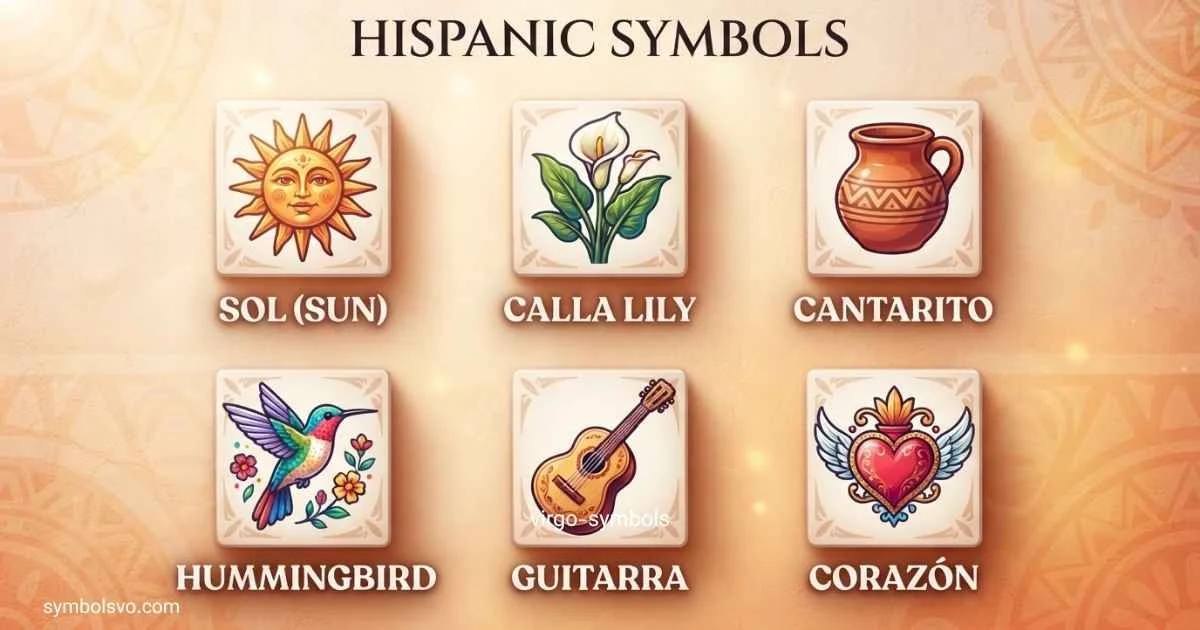
Hispanic symbols can tell powerful stories about culture, family, history, faith, and identity. When I explore these symbols, I see more than simple images—I see traditions and ideas passed from one generation to another.
You may already recognize some Hispanic cultural symbols, but their deeper meanings are often more interesting than they first appear. I’ll help you understand what these symbols represent, where they come from, and why they continue to matter.
Whether you are learning about Hispanic culture for the first time or simply curious about meaningful cultural icons, you’re in the right place. Together, we’ll explore the history, meaning, and significance behind Hispanic symbols in a simple and engaging way.
Hispanic Symbols And Meanings
Hispanic symbols can carry several layers of meaning. Some are connected to a particular country, while others have become widely recognized across Hispanic communities.
Here are some examples:
| Symbol | Common meaning or association |
| 🇲🇽 | Mexico, Mexican identity, national pride |
| 🌺 | Flowers, beauty, celebration, remembrance |
| 🌻 | Warmth, life, remembrance, depending on context |
| ✝ | Christianity and faith |
| 🕊 | Peace, faith, hope |
| ❤️ | Love, family, affection |
| 🦅 | Power, identity, freedom; especially important in Mexican symbolism |
| 🌵 | Mexican landscape and cultural imagery |
| 💀 | Mortality, remembrance, Día de los Muertos imagery |
| 🎶 | Music, celebration, cultural expression |
The meaning of a symbol depends heavily on context. A skull, for example, can represent death, remembrance, Día de los Muertos, rebellion, or simply a decorative style. It should not automatically be interpreted as something negative.
The Mexican flag is another strong example. Its central coat of arms features an eagle, snake, nopal cactus, and related elements connected to the founding story of Mexico-Tenochtitlan. Mexican government cultural sources describe the national emblem as having roots in pre-Hispanic traditions and later historical transformations.
Important Hispanic Symbols
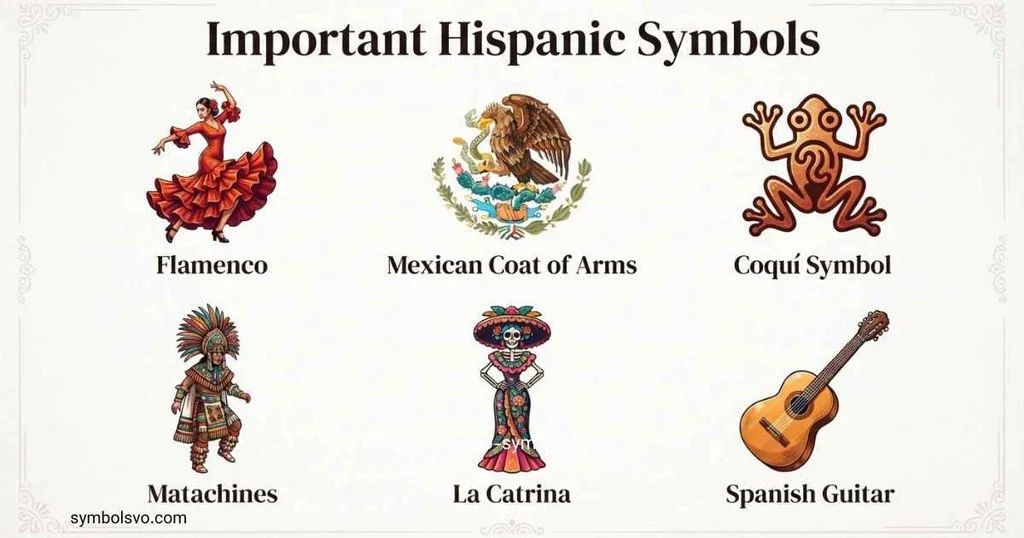
Some symbols have become especially recognizable because they connect history, religion, national identity, or cultural traditions.
Our Lady Of Guadalupe
The image of Our Lady of Guadalupe is one of the most recognizable religious and cultural symbols associated with Mexico and Mexican communities. The image dates to the tradition of the apparition of Mary to Juan Diego at Tepeyac in 1531. The Smithsonian describes Guadalupe as an emblem of unity and perseverance with significance extending beyond religious practice.
Mexican Eagle And Snake
The eagle and snake are central to Mexico’s national emblem. The traditional story tells of the Mexica finding an eagle on a nopal cactus while holding a snake, a sign associated with the place where they would establish their city.
Nopal Cactus
The nopal is more than a plant in Mexican symbolism. It forms part of the national coat of arms and connects modern Mexican identity with older traditions.
Calavera
A calavera, or skull, is strongly associated with Día de los Muertos. In this setting, skull imagery can represent deceased loved ones, remembrance, and the relationship between life and death.
Papel Picado
Papel picado is decorative cut-paper art commonly used during Mexican celebrations. It is especially recognizable in Día de los Muertos displays and other festive settings.
Hispanic Symbols Of Culture
Cultural symbols help express traditions, identity, language, music, food, art, celebrations, and shared heritage.
Common examples include:
- Papel picado — decorative Mexican paper art.
- Marigolds or cempasúchil — strongly associated with Día de los Muertos.
- Calaveras — skull imagery connected with remembrance and Día de los Muertos.
- Sombrero — commonly associated with Mexican cultural imagery, although it is not a universal Hispanic symbol.
- Maracas — associated with musical traditions in parts of Latin America and the Caribbean.
- Guitar — connected with many Spanish-language musical traditions.
- Mariachi imagery — particularly associated with Mexican music and cultural identity.
- Traditional textiles — patterns and techniques can identify specific communities and regions.
- Spanish language — a major shared cultural connection among many Hispanic communities.
Culture should not be reduced to a single list of objects. Hispanic culture is extremely diverse. Symbols are often regional, historical, religious, Indigenous, African, European, or combinations of several influences.
For example, Día de los Muertos includes Indigenous traditions alongside Catholic elements that developed after Spanish colonization. Smithsonian research notes the presence of Catholic images, papel picado, marigolds, photographs, and other elements on modern altars.
Latino Hispanic Symbols
“Latino” and “Hispanic” overlap, but they are not identical terms.
Hispanic generally refers to connections with Spanish-speaking cultures or countries. Latino generally refers to people or cultures connected with Latin America. The categories can overlap, but they do not describe exactly the same populations.
That distinction matters when discussing symbols.
For example:
- 🇲🇽 can represent Mexican identity.
- 🇵🇷 can represent Puerto Rican identity.
- 🇨🇺 can represent Cuban identity.
- 🇨🇴 can represent Colombian identity.
- 🇦🇷 can represent Argentine identity.
- 🇪🇸 can represent Spanish identity.
A broader Latino or Hispanic identity may also be represented through Spanish-language expressions, family imagery, music, food, regional art, religious traditions, and cultural celebrations.
There is no universal “Latino symbol” that has one official meaning for everyone. It is better to identify the country, community, or tradition connected with a particular symbol.
Pre Hispanic Symbols
Pre-Hispanic symbols come from civilizations and Indigenous communities that existed in the Americas before Spanish colonization.
Mexico provides many well-known examples. Mexica, Maya, Zapotec, Mixtec, Olmec, and other cultures developed distinctive visual traditions, religious concepts, calendars, architecture, and artistic symbols.
Some widely recognized examples include:
- Eagle — associated with solar imagery and Mexica traditions.
- Nopal — connected with the traditional foundation story of Tenochtitlan.
- Serpent — appears in several Mesoamerican traditions, with meanings varying by culture and context.
- Quetzalcoatl imagery — associated with the feathered-serpent deity in Mesoamerican traditions.
- Sun imagery — found across several Indigenous cultures, although meanings differ.
- Jaguar imagery — significant in various Mesoamerican traditions.
- Maize or corn — deeply important to Indigenous American agriculture and cultural traditions.
- Aztec calendar imagery — modern designs often use the term “Aztec calendar” for the famous Sun Stone.
Care is needed when using pre-Hispanic symbols. A symbol from one civilization should not automatically be treated as belonging to all Indigenous peoples of Latin America.
Mexican Icons In History
Mexico’s history has produced many people, objects, and images that are now recognized as cultural icons.
Frida Kahlo
If you are searching for a “Mexican icon 5 letters,” the likely answer is Frida. It has five letters and commonly points to Frida Kahlo, the Mexican artist known internationally for her self-portraits and distinctive visual style.
Emiliano Zapata
Zapata became an important figure in the Mexican Revolution and is strongly associated with agrarian demands and the slogan “Tierra y Libertad,” or “Land and Liberty.”
Miguel Hidalgo
Miguel Hidalgo y Costilla was a key figure in Mexico’s independence movement. His historical association with the Virgin of Guadalupe is one reason Guadalupe imagery became connected with Mexican national identity and independence.
The Mexican Eagle
The eagle, serpent, and nopal have remained central to Mexican national symbolism through major historical changes. Mexico’s National Institute of Anthropology and History notes that these elements have roots in pre-Hispanic history and developed through later transformations.
La Catrina
La Catrina became one of Mexico’s best-known visual representations of death. Artist and printmaker José Guadalupe Posada helped popularize the skeletal figure in the early twentieth century.
Hispanic Flags
Flags are among the clearest ways to represent national or regional identity.
Here are some commonly searched Hispanic and Latino flags:
- 🇲🇽 — Mexico
- 🇪🇸 — Spain
- 🇦🇷 — Argentina
- 🇧🇴 — Bolivia
- 🇨🇱 — Chile
- 🇨🇴 — Colombia
- 🇨🇷 — Costa Rica
- 🇨🇺 — Cuba
- 🇩🇴 — Dominican Republic
- 🇪🇨 — Ecuador
- 🇸🇻 — El Salvador
- 🇬🇹 — Guatemala
- 🇭🇳 — Honduras
- 🇳🇮 — Nicaragua
- 🇵🇦 — Panama
- 🇵🇾 — Paraguay
- 🇵🇪 — Peru
- 🇵🇷 — Puerto Rico
- 🇺🇾 — Uruguay
- 🇻🇪 — Venezuela
The 🇲🇽 Mexico flag emoji is a Unicode flag sequence made from two regional indicator characters: U+1F1F2 and U+1F1FD. Unicode explains that regional indicator symbols are paired to produce national flag emoji sequences.
Copy and paste: 🇲🇽
Not every symbol that represents Hispanic identity is a national flag. There is also a historical Flag of Hispanicity, sometimes called the Flag of the Hispanic People. It features a white field, three purple crosses, and a rising sun.
Hispanic Symbols Of Religion
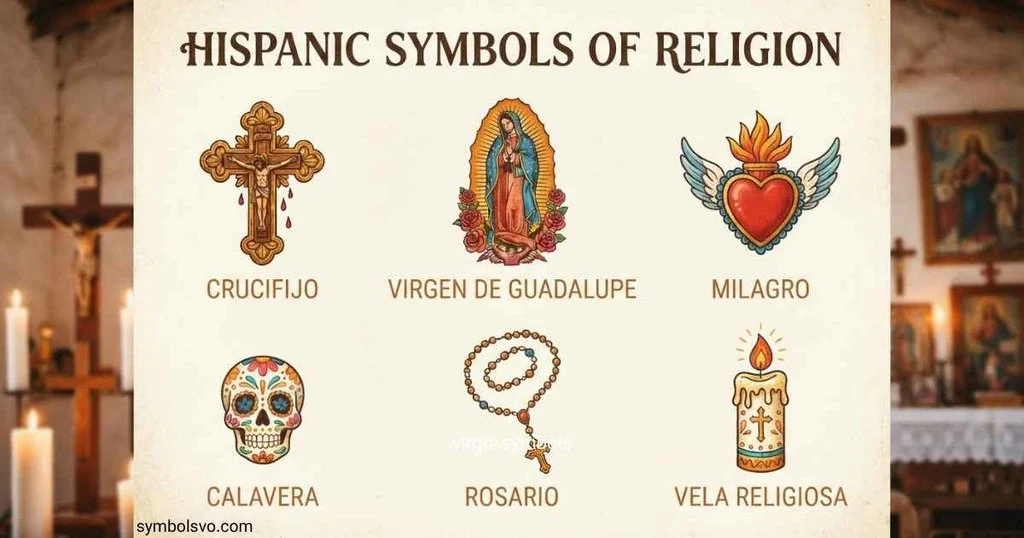
Religion has played an important role in many Hispanic communities, particularly through Catholic traditions, although Hispanic communities also include many other religious beliefs.
Common religious symbols include:
- ✝ Cross — Christianity and the sacrifice of Jesus.
- ☦ Orthodox cross — associated with Eastern Christianity rather than specifically Hispanic culture.
- 🕊 Dove — commonly associated with peace and the Holy Spirit in Christian contexts.
- 🙏 Folded hands — often used digitally to express prayer, gratitude, or hope.
- ❤️ Heart — can represent love and devotion.
- Rosary imagery — commonly associated with Catholic prayer.
- Virgin Mary imagery — important in many Catholic Hispanic communities.
- Our Lady of Guadalupe — especially significant in Mexican Catholic tradition.
The symbols associated with Guadalupe have particular religious meanings. Sources describing the traditional image point to details such as the maternity sash, posture, moon, and rays of light as elements that communicate religious ideas.
Because religious symbols can be sacred, using them in tattoos, fashion, or decoration can carry deeper meaning than simply choosing an attractive design.
Hispanic Symbols For Family
Family is a powerful theme in many Hispanic cultural traditions, but there is no single official Hispanic family symbol.
Symbols that can communicate family, love, or connection include:
- ♥ — love and affection.
- ♡ — softer or decorative expression of love.
- ∞ — lasting or unending connection.
- ♾️ — commonly used online to express something without end.
- 👨👩👧👦 — family.
- 🫶 — affection, support, and care.
- 🤝 — unity and partnership.
- 🌳 — family roots, ancestry, and generations.
- ❤️ — love and emotional connection.
- 🕊 — peace, remembrance, or spiritual connection.
For a family tattoo, people often combine a symbol with names, initials, birth dates, flowers, national colors, or meaningful words in Spanish.
A family-tree design can be especially useful because it communicates ancestry without claiming that one particular icon represents all Hispanic families.
Hispanic Symbols For Strength
Strength can be represented through animals, plants, religious imagery, historical figures, or words.
Some popular choices include:
- 🦅 Eagle — strength, power, freedom, and national identity in some contexts.
- 🐆 Jaguar — power and warrior imagery in several Mesoamerican traditions.
- 🌵 Nopal — endurance and connection with the Mexican landscape.
- 🔥 Fire — determination, energy, and transformation.
- ⚔ Sword — courage, struggle, or defense.
- ✊ Fist — resistance, solidarity, and determination.
- 💪 Flexed arm — physical or personal strength.
- ♾️ Infinity — enduring strength or persistence.
- ☀ Sun — energy, life, and renewal.
The eagle has particular historical importance in Mexico. Mexican cultural and historical sources connect the eagle with Mexica symbolism and the development of the national emblem.
If you want a strength symbol for a tattoo, choosing one tied to a specific family, region, or historical tradition can make the design more personal than using a generic “strong” icon.
Hispanic Symbols Tattoos
Hispanic-inspired tattoos can range from small text symbols to detailed portraits and traditional cultural imagery.
Popular ideas include:
Religious Tattoos
- Virgin of Guadalupe
- Cross
- Rosary
- Sacred Heart
- Angel imagery
- Religious lettering
Mexican Heritage Tattoos
- 🇲🇽 Mexican flag
- Eagle and serpent
- Nopal cactus
- Aztec or Mexica-inspired artwork
- Papel picado designs
- Marigolds
- Calavera or Día de los Muertos imagery
- La Catrina
Family Tattoos
- Family names
- Initials
- Dates
- Family tree
- Hearts
- Infinity symbols
- Matching symbols for relatives
Strength Tattoos
- Eagle
- Jaguar
- Nopal
- Warrior-inspired imagery
- “Fuerza”
- “Familia”
- “Siempre”
- “Nunca te rindas”
A tattoo should be researched carefully before use. Some Indigenous symbols have specific cultural or ceremonial meanings, so copying a design without understanding its origin can unintentionally remove it from its historical context.
Hispanic Symbols Images
Images are useful when you want to compare visual styles before choosing a symbol for a tattoo, logo, poster, school project, craft, or social media design.
Useful image categories include:
- Mexican national symbols — eagle, nopal, serpent, and flag imagery.
- Día de los Muertos symbols — calaveras, marigolds, candles, altars, and papel picado.
- Religious symbols — Guadalupe, crosses, rosaries, and Sacred Heart imagery.
- Pre-Hispanic designs — Mesoamerican patterns and historical motifs.
- Family symbols — hearts, trees, names, and infinity designs.
- Cultural symbols — music, dance, textiles, food, and traditional art.
- National flags — useful for representing a specific country rather than Hispanic identity generally.
When searching for images, include the specific country or tradition in your search. “Mexican eagle symbol” is much more precise than simply searching “Hispanic symbol.”
The same principle applies to tattoo searches. “Mexican family tattoo,” “Guadalupe tattoo,” or “Mesoamerican jaguar symbol” will produce more culturally specific results than a broad search for “Hispanic tattoo.”
Mexican Icon 5 Letters
The most likely answer to “Mexican icon 5 letters” is Frida.
Frida refers to Frida Kahlo, one of Mexico’s most internationally recognized artists. Her name fits the five-letter clue:
F R I D A = 5 letters
She is particularly associated with self-portraits, Mexican visual culture, distinctive clothing, flowers, Indigenous Mexican influences, and personal symbolism.
If the clue comes from a crossword, puzzle, or word game, “Frida” is a strong possibility. The exact answer can still depend on the puzzle’s other clues.
Hispanic Synonym
There is no perfect one-word synonym for Hispanic because the term has a specific meaning and its use depends on context.
Words that may overlap with Hispanic include:
- Latino — often refers to people or cultures from Latin America.
- Latina — feminine form commonly used for a woman from a Latin American background.
- Latine — a gender-neutral term used by some people and communities.
- Spanish-speaking — describes language connection rather than necessarily ethnicity or cultural identity.
- Latin American — refers specifically to Latin America and is not interchangeable with Hispanic.
- Spanish — can refer to Spain, the Spanish language, or people from Spain, depending on context.
For example, a person from Spain may be Hispanic but is not generally described as Latin American. A person from Brazil is generally Latin American but is not Hispanic because Portuguese, rather than Spanish, is the country’s primary language.
So, Latino is sometimes used in similar contexts, but it is not an exact synonym for Hispanic.
FAQ
What Is A Common Hispanic Symbol?
There is no single symbol for all Hispanic people. Common examples include national flags, the cross, Our Lady of Guadalupe, papel picado, marigolds, calaveras, family imagery, and country-specific cultural symbols.
What Symbol Represents Hispanic Heritage?
Hispanic heritage can be represented through national flags, Spanish-language expressions, cultural art, music, family traditions, religious imagery, and regional symbols. The best choice depends on the particular country or community being represented.
What Is The Mexican Symbol For Strength?
The eagle is one possible Mexican symbol associated with strength and power, particularly through the national emblem. Other designs, such as the jaguar or nopal, may also communicate strength depending on the historical and artistic context.
What Does The Mexican Eagle Symbolize?
The Mexican eagle is part of the national coat of arms and is connected to the traditional Mexica founding story. Its symbolism has developed through centuries of Mexican history and should be understood together with the nopal, serpent, and other elements of the emblem.
Is There A Hispanic Symbol Emoji?
There is no single universal Hispanic-heritage emoji. Country flags such as 🇲🇽, 🇪🇸, 🇵🇷, 🇨🇴, and 🇨🇺 can identify particular national connections, while emojis such as ❤️, 🦅, 🌻, 🕊, and 🎶 can express related ideas depending on context. Unicode’s flag system uses regional indicator sequences for national flag emoji.
Conclusion
Hispanic symbols cover a wide range of cultural, historical, religious, national, and personal meanings. Flags can identify countries, religious imagery can express faith, family symbols can represent connection, and Indigenous or pre-Hispanic designs can connect people with older histories and traditions.
The most meaningful symbol depends on the story behind it. A Mexican eagle is different from a Puerto Rican flag, and a Día de los Muertos calavera carries a different context from a generic skull. Being specific about the culture or tradition makes symbol choices more accurate and respectful.
For copy-and-paste use, simple characters and emojis such as 🇲🇽, ❤️, ♡, ∞, 🕊, and ✊ can work well in bios, messages, captions, and designs. For tattoos or artwork, researching the history behind a symbol first can make the final choice much more meaningful.

I’m Nathan Holloway, a passionate researcher and writer with a deep interest in symbols, signs, and their hidden meanings. I enjoy exploring how symbols have influenced different civilizations, religions, and modern communication. Through my work, I aim to make complex historical and cultural concepts easy to understand for readers of all backgrounds. Every article I write is carefully researched to provide reliable and engaging information.
Books:
- Beyond the Symbol
- The Secret Meanings of Everyday Signs
Author 2: Grace Whitmore
Description:
My name is Grace Whitmore, and I love discovering the stories behind the world’s most fascinating symbols. I spend my time researching ancient civilizations, mythology, spiritual traditions, and modern iconography to uncover the meanings people often overlook. I believe that every symbol has a history worth telling, and I enjoy sharing that knowledge in a simple and reader-friendly way.
Books:
- Echoes of Ancient Symbols
- The Symbolic World
 Mason Ellington
 Grace Whitmore
 Daniel Brooks