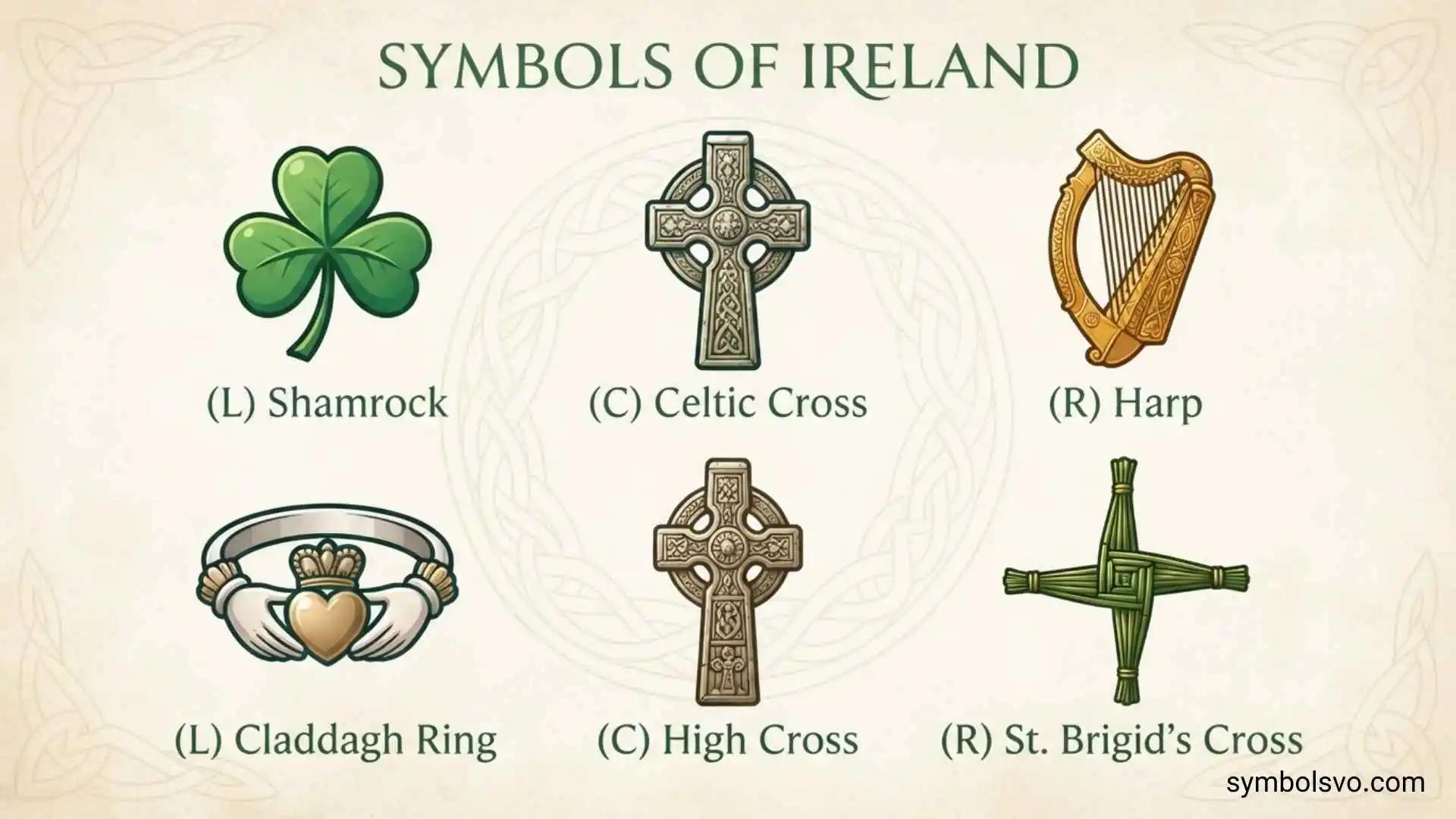
Symbols of Ireland tell powerful stories of history, culture, and national pride. I find these symbols fascinating because each one carries a unique meaning that connects Ireland’s past with its identity today.
From the shamrock to the Celtic cross, every symbol has a story worth discovering.
If you are curious about Ireland’s most famous symbols, you are in the right place. You’ll discover what these iconic symbols mean, where they come from, and why they still matter today.I’ll make it simple for you to explore the traditions and stories behind Ireland’s most meaningful icons.
From ancient Celtic traditions to national emblems, Ireland’s symbols reflect a rich and fascinating heritage. You can use this guide to quickly understand the meaning behind each famous Irish symbol and discover the cultural history it represents.
Quick Answer
The symbols of Ireland are a collection of historic, cultural, and spiritual emblems that represent the identity, heritage, and values of the Irish people. Rooted in ancient Celtic mythology, early Christian history, and deep-rooted folklore, iconic symbols like the shamrock, Celtic harp, and Claddagh ring convey universal human themes of unity, love, and resilience.
Quick Facts About Symbols of Ireland
| Aspect | Information |
| Origin | Ancient Celtic tribes, early Christian monks, and maritime folklore. |
| Historical Significance | Kept Irish identity alive during periods of foreign rule and famine. |
| Main Meaning | Eternal life, identity, fierce independence, and community bonds. |
| Spiritual Meaning | The sacred connection between the physical world and the spiritual realm. |
| Cultural Importance | Forms the foundation of Irish art, music, storytelling, and global celebrations. |
| Modern Usage | Used in state seals, high-end jewelry, traditional tattoos, and branding. |
What Are the Symbols of Ireland?
The symbols of Ireland are meaningful markers that capture the heart of Irish culture. They emerged over thousands of years, starting with the early Celtic leagues who settled on the island around 500 BC. To these people, the world was alive with spirit. They carved stone designs, like spirals and knots, to make sense of the universe around them.
When Saint Patrick brought Christianity to Ireland in the fifth century, these older designs did not vanish. Instead, they transformed. Early Christian monks blended ancient pagan art with Christian themes, creating beautiful illuminated manuscripts like the famous Book of Kells.
Over the centuries, these emblems became even more important. During difficult times in history, such as the Great Famine of the 1840s and years of political struggle, these images became symbols of survival. They reminded the Irish people of who they were, helping them protect their unique heritage even when forced to leave their homeland.
Deep Symbolic Meaning of Symbols of Ireland
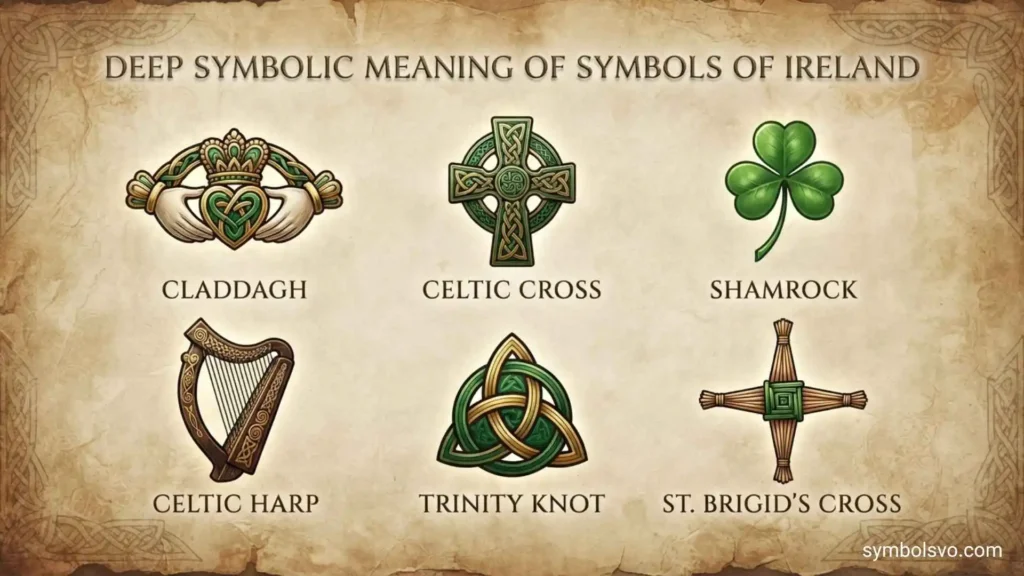
To truly understand Irish icons, you have to look past the surface. They operate on three distinct levels of human experience.
The Spiritual Level
At their core, Irish emblems show how the physical world and the spiritual world weave together. The ancient Celts believed in a concepts called trinitarianism, which means they saw the divine in groups of three. This made it very natural for later generations to embrace spiritual ideas of the Holy Trinity. These designs symbolize inner transformation, showing that our soul’s journey does not move in a straight line but flows in an unbroken cycle of birth, death, and rebirth.
The Psychological Level
Psychologists like Carl Jung noted that certain symbols act as archetypes, which are universal patterns stored deep in the collective human mind. The symbols of Ireland tap directly into this shared memory. For instance, the winding loops of Celtic art mimic the complex paths of human thought and emotion. They offer comfort by showing that even when life feels chaotic, there is an underlying order and a beautiful pattern to our existence.
The Cultural Level
On a social level, these emblems are a source of pride and community connection. They represent traditional Irish values like Céad Míle Fáilte (a hundred thousand welcomes). Whether carved onto an old country gravestone or stamped onto a modern passport, they remind people of a shared history built on storytelling, music, and surviving hard times together.
Types and Variations of Irish Symbols
Ireland possesses a rich vocabulary of historic icons. Here are the most famous variations, along with their meanings and histories.
1. The Shamrock (Seamróg)
- Visual Description: A small green plant with three heart-shaped leaves growing from a single stem.
- Meaning: Faith, hope, love, and the divine presence in nature.
- Symbolism: It represents the balance of nature and the concept of the Holy Trinity.
- Cultural Connection: Famously used by Saint Patrick to teach ancient kings about Christian concepts using a simple field plant.
- Where It Appears: St. Patrick’s Day celebrations, national sports team jerseys, and vintage Irish art.
2. The Celtic Harp (Cláirseach)
- Visual Description: A traditional stringed musical instrument, often decorated with intricate carvings of animals and geometric lines.
- Meaning: Sovereignty, independent spirit, and the power of music.
- Symbolism: It stands for the voice of the soul and the cultural pride of the nation.
- Cultural Connection: Ireland is the only country in the world to use a musical instrument as its official national emblem.
- Where It Appears: Official government documents, Irish euro coins, and the logo of Guinness brewery.
3. The Claddagh Ring
- Visual Description: Two hands holding a central heart, which is topped by a regal crown.
- Meaning: Love, loyalty, and friendship.
- Symbolism: The heart symbolizes love, the hands represent friendship, and the crown signifies loyalty.
- Cultural Connection: Created in a small fishing village in Galway called Claddagh, it carries unique rules for how it is worn to show if your heart is single or taken.
- Where It Appears: Family heirloom jewelry, wedding bands, and traditional literature.
4. The Trinity Knot (Triquetra)
- Visual Description: A continuous, three-pointed loop woven from a single, unbroken line.
- Meaning: Eternity, unity, and the endless cycles of life.
- Symbolism: It represents things that have no beginning and no end, like true love or the human spirit.
- Cultural Connection: Found carved on ancient stones and drawn inside beautiful medieval gospel books.
- Where It Appears: Modern tattoos, silver pendants, and decorative stone monuments.
Irish Symbols Across Different Cultures
The shapes and themes found in Irish icons can also be found in many other ancient civilizations. This shows a deep, shared human attraction to these patterns.
- Ancient Egypt: While the Celts used the continuous Trinity Knot, Egyptians used the Ankh to show eternal life. Both cultures saw loops and knots as symbols of a soul that never dies.
- Ancient Greece: The Greeks used the labyrinth to show the journey of life. This is very similar to the winding patterns of Celtic knots, which represent navigating a complex but beautiful world.
- Roman Culture: Roman art often featured laurel wreaths to celebrate victory. In a similar way, early Irish culture used the Harp to show the power and status of local chieftains.
- Eastern Traditions: The famous Yin and Yang represents balance and harmony. This matches the Celtic triskele (a three-sided spiral), which shows how different forces in nature balance each other out.
- Indigenous Traditions: Native American medicine wheels use four quadrants to honor the cardinal directions. This mirrors the Celtic High Cross, which points out to the four corners of the earth to bridge heaven and earth.
Similar Symbols and Their Meanings
People sometimes confuse Irish emblems with symbols from other cultures. It helps to look at how they compare to clear up these common misunderstandings.
| Irish Symbol | Similar Global Symbol | Key Similarity | Major Difference |
| Shamrock (Three Leaves) | Four-Leaf Clover | Both are small green clover plants found in nature. | The shamrock represents the Trinity and heritage; the four-leaf clover is a generic sign of luck. |
| Celtic Cross (With Ring) | Standard Christian Cross | Both feature a central intersecting crossbar. | The Celtic cross adds a sun circle, representing eternity and ancient solar traditions. |
| Trinity Knot | Infinity Loop | Both use an unbroken line to show eternity. | The Trinity knot focuses on the power of three, while the infinity loop focuses on a dual balance. |
Irish Symbols in Mythology and Folklore
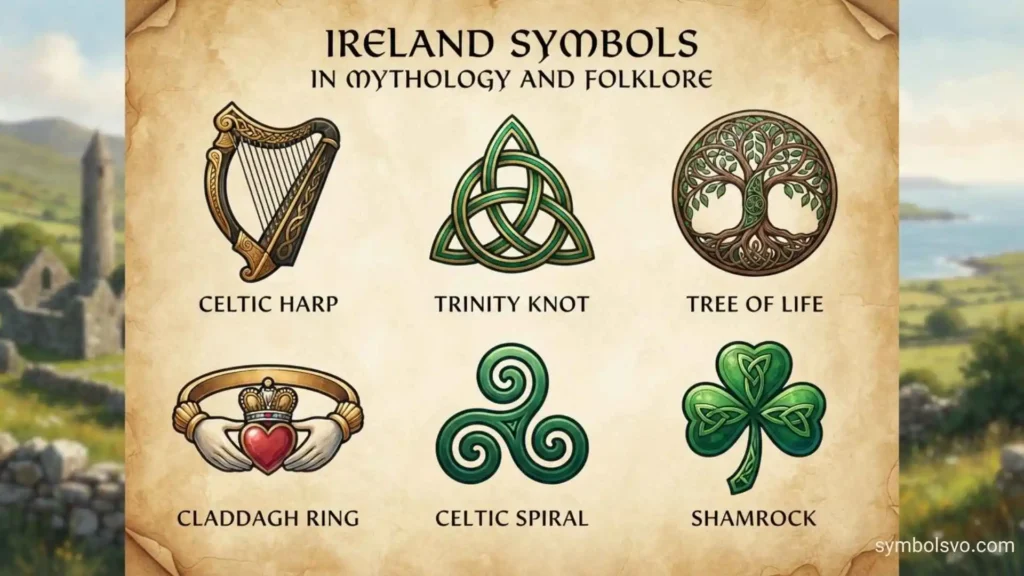
The magic of these symbols comes from the ancient stories told around glowing peat fires. In Irish folklore, the land was ruled by a magical race called the Tuatha Dé Danann. These beings carried special objects that eventually turned into national emblems.
For example, the Celtic Harp was not just an instrument. In legend, the god Dagda owned a magical harp that could control the seasons and change men’s emotions, making them weep, laugh, or fall into a deep sleep.
The shamrock was also seen as a protective charm. People believed that carrying it would ward off evil spirits and protect you from malicious fairy magic. These rich stories have been passed down through generations, turning simple objects into powerful symbols of wonder.
Irish Symbols in Art, Literature, and Pop Culture
Today, these old designs continue to inspire modern art and media. In the nineteenth century, Irish writers like W.B. Yeats led a cultural revival. They brought back ancient symbols to help the country rediscover its poetic roots.
In modern times, you can spot these elements in many places:
- Movies and Television: Animated films like The Secret of Kells and Song of the Sea use Celtic knots to bring folklore to life.
- Tattoos and Fashion: People worldwide choose Trinity knots and Celtic bands as tattoos to honor their family roots or celebrate a personal milestone.
- Modern Design: High-end jewelers craft beautiful gold Claddagh rings, keeping old traditions alive in a modern world.
Spiritual and Dream Meanings
When Irish symbols appear in your dreams or personal quiet moments, they often carry encouraging insights.
- Dreaming of a Shamrock: This is usually seen as a positive sign of growth, fresh starts, and balance entering your life.
- Seeing a Celtic Cross: This image suggests you are searching for stability or trying to balance your physical responsibilities with your spiritual life.
- Encountering a Harp: This often points to a need for harmony, gentle self-care, or listening to your inner voice.
These symbols rarely bring warnings. Instead, they serve as gentle reminders to slow down, connect with your roots, and trust the natural flow of life.
Positive and Negative Meanings
While these emblems are generally positive, their meaning can change depending on how they are viewed.
| Positive Meaning (Light) | Negative Meaning (Shadow) |
| Eternity and Life: Knots show that love and life never truly end. | Feeling Trapped: The complex loops can sometimes feel like a maze with no clear exit. |
| Pride and Identity: The harp celebrates a rich history of art and survival. | Holding Onto the Past: An over-focus on history can make it harder to look forward. |
| Protection: Shamrocks are viewed as shields against negative energy. | Superstition: Relying too much on good-luck charms rather than personal action. |
Why Humans Are Attracted to Irish Symbols
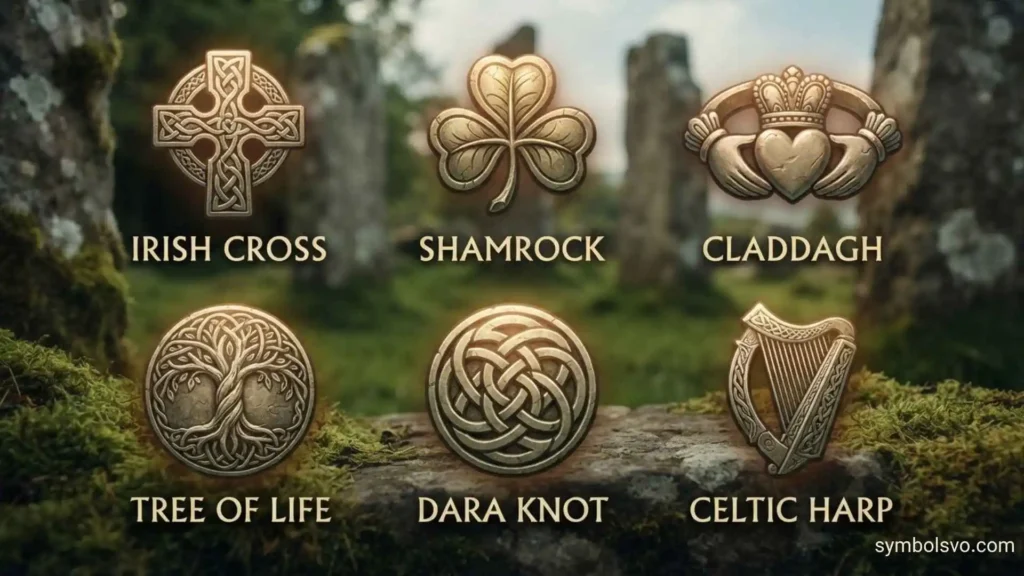
Our attraction to Irish symbols comes from how our brains process patterns. Humans naturally look for order in the world around them. The repeating lines of Celtic knots satisfy this search by creating a sense of balance.
There is also a deeper, emotional reason. In a fast-moving modern world, these old designs offer a comforting link to the past. They connect us to a time when human life was closely attuned to the changing seasons, storytelling, and community bonds, satisfying our universal desire for belonging.
Modern Uses of Irish Symbols
Today, these icons are used for much more than historic museum displays. They are a active part of daily life and global style.
- Jewelry: The Claddagh ring remains a favorite gift for partners, friends, and children.
- Branding: International companies use the harp and shamrock to show quality, authenticity, and heritage.
- Home Decor: Wall hangings featuring Irish blessings and Celtic weaves add a warm, welcoming feel to modern homes.
Interesting Facts About Irish Symbols
- The Queen’s Ring: Queen Victoria was a big fan of the Claddagh ring and wore one regularly during her reign.
- Guinness Got There First: The Guinness brewery registered the harp logo in 1862. When the Irish government wanted to use it as an official state seal in 1922, they had to turn the harp the opposite way to avoid copyright issues.
- The Rare Original: The design of the official Irish harp is modeled on a real medieval instrument from the fourteenth century, which you can see at Trinity College Dublin.
- Three is the Magic Number: To the ancient Celts, the number three was sacred. It represented the three stages of a woman’s life: the maiden, the mother, and the matriarch.
- A Global Empire: On St. Patrick’s Day, famous landmarks around the world, from the Colosseum in Rome to the Empire State Building in New York, light up in green to honor Ireland’s most famous plant.
Frequently Asked Questions
What is the official symbol of Ireland?
The official national symbol of Ireland is the Celtic Harp, not the shamrock. While the shamrock is a beloved national plant, the harp appears on all official state documents, passports, and government seals.
Why is the harp the symbol of Ireland?
The harp became a symbol because musicians held a high, respected place in ancient Celtic society. It stood for independence and cultural pride, which led the country to choose it as its official emblem.
What does the Celtic cross represent?
The Celtic cross features a traditional cross with a circle around the intersection. This circle represents the sun, eternity, and God’s endless love, beautifully bridging ancient solar traditions with early Christian beliefs.
What is the difference between a shamrock and a four-leaf clover?
A shamrock is a three-leaf clover that represents the Holy Trinity and Irish heritage. A four-leaf clover is a rare genetic variation of the same plant that is viewed as a general symbol of good luck worldwide.
How do you wear a Claddagh ring if you are single?
If you are single, you wear the Claddagh ring on your right hand with the point of the heart facing out toward your fingernail, signaling that your heart is open to love.
Conclusion
The symbols of Ireland are far more than simple designs from the past. They are living expressions of hope, connection, and a deep love for life that continues to inspire people around the world. By exploring their history and inner meanings, we can find inspiration for our own lives, reminding us that we are all part of an endless, beautiful human story.

 Grace Whitmore
 Daniel Brooks