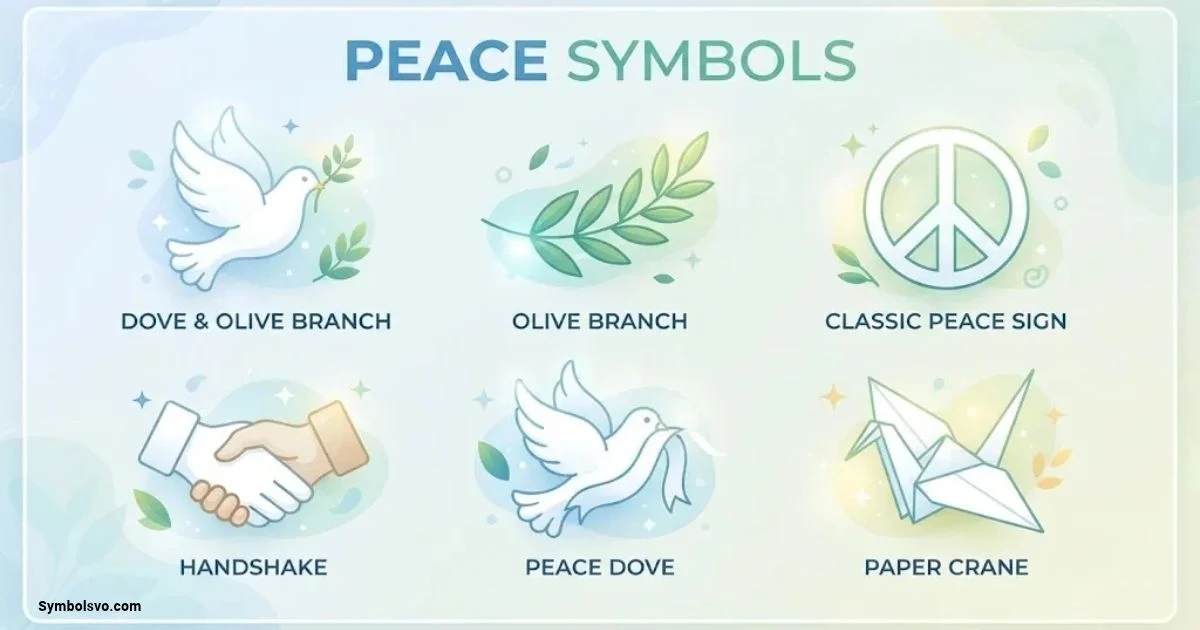
Peace symbols appear in flags, religious artwork, public demonstrations, memorials, and everyday objects. Some represent the end of war, while others express nonviolence, reconciliation, spiritual harmony, or hope for a better future. Although their designs differ, they share one important purpose: communicating ideas that words sometimes struggle to express.
The familiar peace sign, a white dove, and an olive branch are recognized in many parts of the world. However, the meaning of peace reaches far beyond these familiar images. Jainism uses the raised hand of Ahimsa to teach nonviolence. Buddhist and Hindu traditions associate the lotus with spiritual growth. Chinese philosophy uses Yin-Yang to express the relationship between complementary forces.
Understanding these images requires looking at their history and cultural setting. A symbol that represents peace in one tradition may have a different meaning elsewhere. This guide explores 11 important peace symbols, their origins, and the ideas they represent.
Peace Symbols and Their Meanings: Quick Reference Chart
The following chart offers a quick overview of well-known symbols of peace and their main associations.
| Peace symbol | Main meaning | Historical or cultural connection |
| Peace sign ☮ | Nuclear disarmament and peace activism | British Campaign for Nuclear Disarmament |
| Dove 🕊 | Peace, hope, and renewal | Biblical and Christian imagery |
| Olive branch | Reconciliation and goodwill | Ancient Greek and biblical traditions |
| White flag | Request to communicate or negotiate | Customs and laws of armed conflict |
| Broken rifle | Opposition to militarism and war | International antimilitarist movements |
| White poppy | Remembrance and commitment to peace | British peace movement |
| Jain Ahimsa hand | Nonviolence toward living beings | Jainism |
| Calumet | Diplomacy and peaceful relations | Certain Indigenous North American traditions |
| Lotus flower | Purity and spiritual awakening | Buddhism and Hinduism |
| Om or Aum ॐ | Sacred sound and spiritual connection | Hindu traditions |
| Yin-Yang ☯ | Balance and complementary forces | Chinese philosophy and Taoism |
These symbols don’t all represent the same kind of peace. The white flag communicates a desire to speak during conflict, while the broken rifle expresses opposition to war. The lotus and Om have deeper religious and spiritual meanings.
That distinction matters. It helps explain why people use different images to represent global peace, personal calmness, and peaceful relationships.
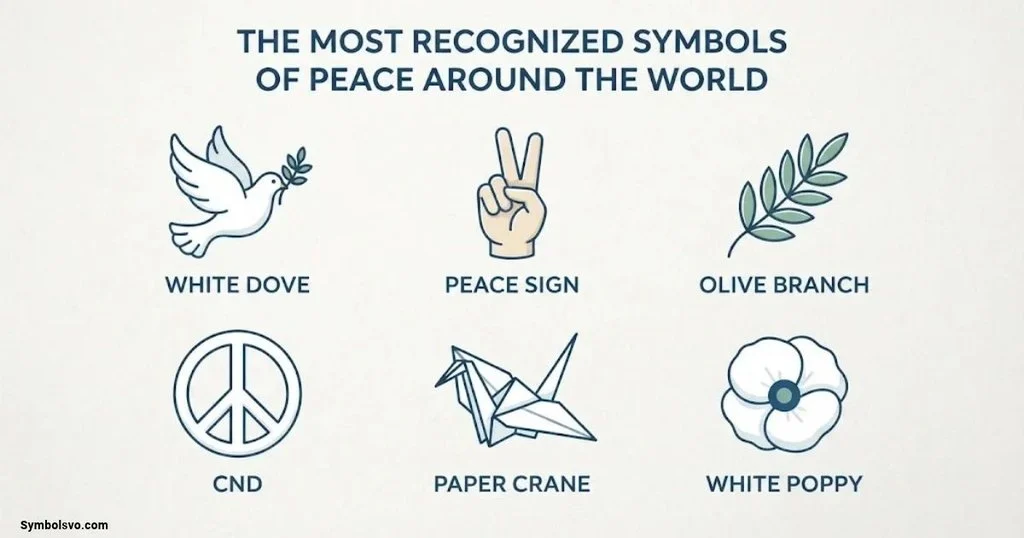
The Most Recognized Symbols of Peace Around the World
The Peace Sign Symbol (☮)
Meaning: Nuclear disarmament, anti-war activism, and peaceful protest
The modern peace sign is one of the most recognizable symbols of peace. Its simple circular design contains three lines that form a distinctive shape. People display it on clothing, jewelry, posters, flags, stickers, and protest banners.
British artist Gerald Holtom designed the symbol in 1958 for the Campaign for Nuclear Disarmament (CND). The organization opposed nuclear weapons and called for their elimination. Holtom created the design by combining two semaphore signals: N and D, representing Nuclear Disarmament.
Semaphore is a system that uses arm positions or flags to communicate letters over a distance. Holtom adapted the positions into a single graphic inside a circle.
The symbol first appeared publicly during a protest march from London to the Atomic Weapons Research Establishment at Aldermaston in April 1958. Its simple design made it easy to reproduce and recognize.
How did the peace sign become internationally famous?
Its meaning expanded during the 1960s. Peace activists adopted it during protests against the Vietnam War and other military conflicts. It also became closely associated with the counterculture movement, which promoted social change, personal freedom, and opposition to militarism.
Over time, the design moved beyond nuclear disarmament. People began using it as a broader expression of peace, love, cooperation, and human unity.
Today, the peace sign appears in many settings:
- Anti-war demonstrations and peace marches.
- Nuclear disarmament campaigns.
- Humanitarian and social justice movements.
- Clothing, accessories, and decorative artwork.
- Digital messages and social media posts.
An important historical fact: The modern peace sign isn’t an ancient religious symbol. It originated in a specific twentieth-century political campaign before becoming a widely recognized emblem of peace.
The Dove Symbol (🕊)
Meaning: Peace, hope, purity, and renewal
A white dove is one of the most familiar images associated with peace. Its gentle appearance, quiet behavior, and graceful flight have helped make it a lasting symbol of hope and goodwill.
One of its best-known historical connections comes from the biblical story of Noah’s Ark. According to the Book of Genesis, Noah released a dove after the great flood. The bird returned carrying a freshly picked olive leaf, showing that the floodwaters had receded and plant life had begun to return.
The dove and olive leaf became a powerful image of renewal. It suggested that destruction had ended and a new beginning was possible.
Christian art later used the dove to represent the Holy Spirit. In other settings, artists and peace organizations adopted the bird as a sign of reconciliation and peaceful intentions.
Spanish artist Pablo Picasso also helped popularize the modern image of the peace dove. His dove artwork became closely connected with international peace campaigns after World War II.
What does a white dove represent?
Its meaning can include:
- Peace: A desire for harmony and freedom from conflict.
- Hope: The possibility of a better future after hardship.
- Purity: Innocence and spiritual cleanliness.
- Renewal: A fresh start after destruction or difficulty.
- Goodwill: Friendly intentions and peaceful relationships.
A dove doesn’t carry the same meaning in every religious or cultural tradition. Its interpretation depends on the artwork and setting. However, its association with peace remains widely recognized.
The Olive Branch Symbol
Meaning: Reconciliation, goodwill, and peaceful relations
The olive branch symbol has represented peace and reconciliation for centuries. Its meaning appears in ancient Greek traditions, biblical stories, and modern diplomatic imagery.
In ancient Greece, the olive tree held cultural, religious, and practical importance. People valued its fruit and oil, while its branches appeared in religious ceremonies and public honors. Olive wreaths were also awarded to victors at the ancient Olympic Games.
Greek mythology connects the olive tree with Athena, the goddess associated with wisdom and the city of Athens. The tree became an important part of Greek identity and cultural life.
The olive branch also appears in the story of Noah’s Ark. The dove’s return with an olive leaf indicated that the floodwaters were falling. This helped establish the branch as an image of hope and renewed peace.
Today, people use olive branches in artwork, official emblems, diplomatic imagery, and peace campaigns.
Why does an olive branch represent peace?
Its meaning is closely connected to reconciliation. Offering an olive branch suggests that someone wants to end hostility and rebuild a relationship.
It can represent:
- Ending an argument or dispute.
- Rebuilding trust between opposing groups.
- Goodwill between nations.
- Forgiveness and reconciliation.
- A peaceful solution after conflict.
The olive branch is also used in the Great Seal of the United States. In the eagle’s right talon, it appears alongside arrows held in the left talon. Together, these objects represent the relationship between peace and the country’s ability to defend itself.
The White Flag Symbol
Meaning: Communication, negotiation, truce, and sometimes surrender
A white flag has a specific meaning in situations involving armed conflict. It traditionally signals that the person displaying it wants to communicate with the opposing side.
Depending on the circumstances, that communication may involve negotiations, a request for a temporary pause, or surrender. Therefore, a white flag doesn’t always mean that someone has given up.
Its meaning is different from the peace sign. The peace sign represents a broader movement or ideal, while the white flag is a practical signal used during conflict.
The white flag also has an important place in international humanitarian law. The law of armed conflict recognizes the use of a flag of truce to indicate a desire to communicate with an opposing party.
However, displaying a white flag doesn’t give someone unlimited protection in every situation. The rules depend on the circumstances and the conduct of the people involved.
What does a white flag mean in war?
It can communicate several intentions:
- A request to negotiate.
- A desire to discuss a temporary ceasefire.
- An intention to surrender.
- A request to recover or discuss wounded people.
- A willingness to communicate rather than continue fighting.
A white flag is therefore best understood as a symbol of communication during conflict, not a guarantee that peace has been achieved.
The Broken Rifle Symbol
Meaning: Anti-war resistance, nonviolence, and opposition to militarism
The broken rifle symbol represents opposition to war and the use of weapons. Unlike the dove or olive branch, it communicates a direct rejection of militarism.
The design shows a rifle with a broken or snapped barrel. The image sends a clear message: weapons should not control human relationships or determine how societies solve their problems.
Its history goes back to the European antimilitarist movement. The broken rifle appeared in the Dutch publication De Wapens Neder in 1909. War Resisters’ International later adopted it as an emblem in 1931.
The organization supports people who reject war and refuse to participate in military violence based on conscience.
The symbol has since appeared in anti-war publications, protest materials, badges, and peace campaigns.
What does the broken rifle represent?
- Opposition to militarism.
- Resistance to war and armed violence.
- Support for conscientious objection.
- Peaceful conflict resolution.
- A commitment to nonviolent action.
The broken rifle is particularly meaningful because it doesn’t simply celebrate peace. It challenges the idea that weapons and military force should be the main tools for resolving disputes.
The White Poppy Symbol
Meaning: Remembrance, opposition to war, and commitment to peace
The white poppy is a symbol associated with remembrance and the promotion of peace. It emerged in Britain during the 1930s through the work of the Co-operative Women’s Guild.
The organization introduced white poppies in 1933. Women who had experienced the effects of World War I wanted to remember those killed in war while also expressing opposition to future conflicts.
The white poppy carries a different message from the red poppy traditionally associated with military remembrance in Britain.
Its supporters connect it with remembering all victims of war, including civilians, and working toward peaceful ways of resolving disagreements.
The symbol has three commonly explained ideas:
- Remembering people affected by war.
- Challenging the glorification of armed conflict.
- Supporting peaceful solutions and reducing violence.
The white poppy remains part of peace and remembrance activities, particularly around Remembrance Day in the United Kingdom.
It can also lead to discussion about how societies remember war, honor those who suffered, and prevent future violence.
The Jain Ahimsa Hand Symbol
Meaning: Nonviolence, compassion, and respect for all living beings
The Jain Ahimsa hand is one of the clearest religious symbols connected with nonviolence. It shows an open palm with a wheel in its center. The design expresses a commitment to avoiding harm.
The word Ahimsa means nonviolence or non-injury. It plays a central role in Jain philosophy and ethical practice.
Jain teachings encourage people to avoid harming living beings through their actions, words, and thoughts. This principle extends beyond avoiding physical violence. It also encourages compassion, self-control, and respect for life.
The wheel in the palm is associated with the Dharmachakra, or wheel of dharma. The word stop is often understood as part of the symbol’s message: stop harmful actions and practice nonviolence.
What does the Ahimsa hand represent?
- Respect for all living beings.
- Compassion toward humans and animals.
- Self-discipline and responsibility.
- Rejection of unnecessary violence.
- Peaceful coexistence.
The Jain Ahimsa hand is more specific than a general peace emblem. It communicates a religious and ethical commitment to nonviolence.
Ahimsa also has an important place in Hindu and Buddhist traditions, although its interpretation and practice vary.
The Calumet or Peace Pipe Symbol
Meaning: Diplomacy, trust, ceremonial relationships, and peaceful communication
The Calumet, sometimes called a peace pipe, has an important place in certain Indigenous North American traditions. It refers to a ceremonial pipe used in formal social, diplomatic, and spiritual settings.
The Calumet could play a role in establishing alliances, welcoming visitors, conducting negotiations, and strengthening relationships between communities.
In some historical contexts, sharing a ceremonial pipe helped express trust and a willingness to engage peacefully. Its use could mark an important agreement or diplomatic gathering.
However, the Calumet shouldn’t be reduced to a simple object that always means peace. Its ceremonial meaning depends on the Indigenous nation, community, and specific occasion.
Different Indigenous peoples have their own languages, traditions, and ceremonial practices. Not all communities use the same type of pipe or assign it the same meaning.
Ideas associated with the Calumet include:
- Mutual respect.
- Sacred diplomacy.
- Trust between communities.
- Peaceful communication.
- Ceremonial agreements and alliances.
The term “peace pipe” became common in popular writing, but it doesn’t fully explain the cultural and spiritual importance of the Calumet.
Religious and Spiritual Symbols Associated With Peace
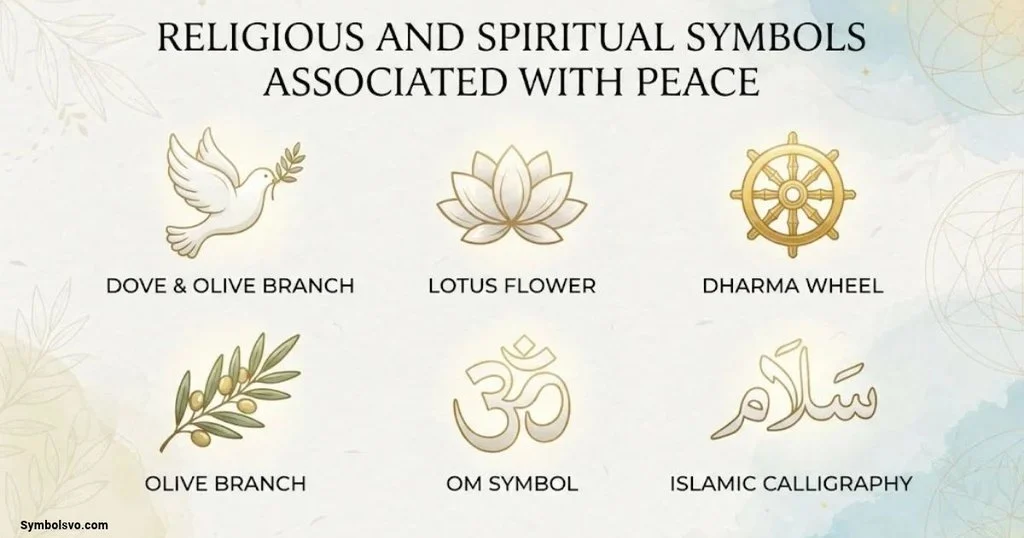
Many religious symbols of peace express ideas such as compassion, spiritual purity, balance, and self-control. They don’t always represent international peace movements. Instead, they often describe the qualities that help people live peacefully.
The Lotus Flower Symbol
Meaning: Purity, spiritual growth, detachment, and enlightenment
The lotus flower is an important symbol in Buddhism and Hinduism. It grows in muddy water but rises above the surface to produce a clean and beautiful flower. This natural process gives it a powerful symbolic meaning.
In Buddhist traditions, the lotus often represents purity, spiritual development, and awakening. Its growth through muddy water can illustrate the journey toward wisdom despite life’s difficulties.
In Hindu traditions, the lotus also appears in religious artwork and is associated with deities, beauty, creation, and spiritual significance.
The flower’s association with inner peace comes from its connection with detachment and spiritual growth. It can remind people that difficult circumstances don’t have to control their thoughts or actions.
The lotus can represent:
- Spiritual purity.
- Personal growth.
- Enlightenment.
- Detachment from unhealthy desires.
- Hope and renewal.
- Inner peace.
Different colors of lotus flowers can carry different meanings in Buddhist art and teaching. However, these interpretations vary across traditions and shouldn’t be treated as one universal color code.
The Om or Aum Symbol (ॐ)
Meaning: Sacred sound, spiritual connection, and consciousness
The Om symbol, also written as Aum, is one of the most important sacred symbols in Hindu traditions. It represents a sacred sound used in prayer, meditation, and spiritual practice.
Om appears in ancient Indian religious texts and philosophical traditions. It is often described as a sound connected with ultimate reality and the nature of existence.
Many people use Om during meditation or yoga because its chanting can help create a focused and calm atmosphere. Its spiritual meaning, however, goes beyond relaxation.
In Hindu philosophy, Om is associated with consciousness, the universe, and the relationship between the individual and ultimate reality.
Why do people connect Om with inner peace?
- Chanting can support concentration.
- It is used in meditation and prayer.
- It carries deep spiritual meaning.
- It can help practitioners focus their attention.
- It is associated with spiritual unity and awareness.
Om is not simply a decorative sign for calmness. It is a sacred religious symbol, so its traditional context deserves respect.
The Yin-Yang Symbol (☯)
Meaning: Balance, interdependence, and complementary forces
The Yin-Yang symbol comes from Chinese philosophy and represents the relationship between complementary forces.
Its familiar design contains two curved sections, one black and one white. Each section includes a small circle of the opposite color.
The design communicates that seemingly opposite forces can exist together and depend on one another. Yin and Yang aren’t simply good and evil. They describe complementary qualities that interact within the natural world.
Yin is commonly associated with qualities such as darkness, coolness, and receptivity. Yang is often associated with light, warmth, and activity. These are relational ideas rather than fixed categories.
The symbol connects with the philosophical concept of balance. When people apply this idea to everyday life, they may associate it with emotional stability, peaceful relationships, and harmony.
The Yin-Yang symbol can represent:
- Balance between complementary forces.
- Harmony within nature.
- Interdependence.
- Change and transformation.
- The relationship between light and darkness.
- The importance of avoiding extremes.
Although people often use Yin-Yang as a symbol of peace, its traditional meaning is broader. It represents the dynamic relationship between opposing but connected forces.
The Dove and Olive Branch in Christianity
The dove and olive branch together form one of the best-known images of peace in Christian tradition.
Their strongest biblical connection comes from the story of Noah. After the flood, the dove returns carrying an olive leaf, suggesting that the waters have receded and the earth is becoming habitable again.
The image later developed additional Christian meanings. The dove also represents the Holy Spirit in Christian art and scripture.
Together, the dove and olive branch can communicate:
- Reconciliation after hardship.
- Hope for a fresh beginning.
- Divine peace.
- Renewal and restoration.
- The end of destruction.
The combination is especially recognizable because it brings together two familiar images. The bird suggests hope, while the branch signals renewed life.
Ahimsa in Hinduism, Jainism, and Buddhism
Ahimsa is an ethical principle that appears in several Indian religious and philosophical traditions.
Although Jainism places especially strong emphasis on nonviolence, Hindu and Buddhist traditions also discuss the importance of avoiding harm.
In Jainism, Ahimsa is a central principle that guides how followers treat living beings. It influences dietary choices, conduct, speech, and daily responsibilities.
In Hindu traditions, Ahimsa appears in discussions of moral behavior, self-discipline, and spiritual development. It is also important in the teachings and actions associated with Mahatma Gandhi.
In Buddhism, the rejection of harmful conduct connects with compassion and the ethical path. Practitioners are encouraged to avoid actions that cause unnecessary suffering.
These traditions share an interest in nonviolence, but their teachings aren’t identical.
Peace and Compassion in Islam
Islam emphasizes peace, justice, mercy, and reconciliation. These values appear in its teachings, religious practices, and everyday expressions.
The Arabic greeting As-salamu alaykum means “Peace be upon you.” Muslims use this greeting to express goodwill and offer peace to others.
The word Islam is linguistically related to the Arabic root associated with peace and submission. Its religious meaning involves submission to God.
Islam doesn’t have one universally recognized visual symbol that exclusively represents peace. The crescent and star, for example, are widely associated with Muslim communities and some national flags, but they aren’t a universal Islamic peace emblem.
Important themes connected with peace in Islamic teachings include:
- Mercy and compassion.
- Justice and fairness.
- Reconciliation between people.
- Respect for human life.
- Peaceful relationships within communities.
Understanding these ideas requires looking at Islamic teachings rather than assuming that one decorative image represents the religion’s entire approach to peace.
Ancient Peace Symbols and Their Historical Meanings
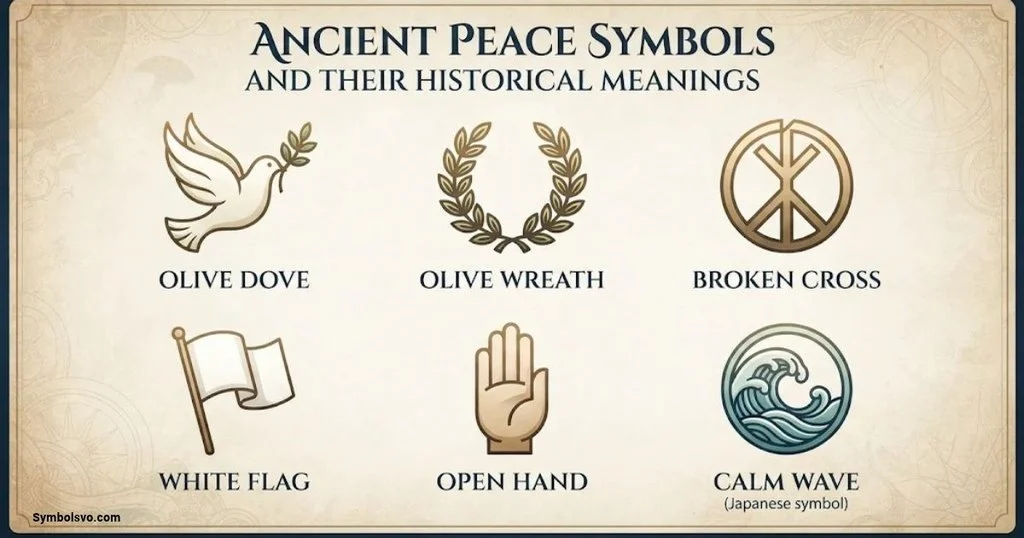
Ancient societies used gods, plants, objects, and artistic images to express ideas about peace and order. Some of these images remain influential today.
However, not every ancient symbol of life or balance was originally a symbol of peace. Its historical meaning deserves careful attention.
The Olive Branch in Ancient Greece
The olive branch was important in ancient Greek culture. The olive tree provided food, oil, and materials for everyday life. It also held religious and symbolic value.
Greek mythology connects the olive tree with Athena, who was believed to have given the tree to the people of Athens. The olive branch later became associated with goodwill and reconciliation.
Greek athletes who won at the ancient Olympic Games received olive wreaths as a mark of honor. These wreaths represented victory and public recognition rather than peace alone.
The olive branch eventually became a familiar symbol of peaceful intentions and reconciliation.
Eirene: The Greek Goddess of Peace
In Greek mythology, Eirene was the personification of peace. Her name is also commonly rendered as Irene.
She belonged to the Horae, a group of goddesses associated with order and the seasons. Eirene represented peace and was connected with prosperity and stable civic life.
One famous ancient statue portrays Eirene holding the child Ploutos, the personification of wealth. The image suggests that peace allows prosperity to grow.
This idea remains relevant. Stable communities can focus more energy on education, trade, culture, and public well-being when conflict doesn’t dominate everyday life.
Pax: The Roman Goddess of Peace
The Romans had their own personification of peace: Pax.
Pax represented peace, stability, and prosperity. Roman leaders used her image in public art, coins, and official messaging.
The concept of Pax Romana describes a long period of relative stability within the Roman Empire, traditionally dated from 27 BCE to 180 CE.
However, this peace was maintained within an empire that still relied on military power and controlled conquered territories. It shouldn’t be confused with modern ideas of equal international cooperation.
Pax is important because she shows how ancient societies connected peace with political order and economic prosperity.
Ma’at: Truth, Justice, and Balance in Ancient Egypt
In ancient Egyptian religion, Ma’at represented truth, justice, balance, and cosmic order.
Egyptians believed that Ma’at helped maintain order in the universe and human society. Kings were expected to uphold it through responsible government and proper religious conduct.
Ma’at was often represented as a woman wearing an ostrich feather. The feather became closely associated with truth and the judgment of the dead.
Ma’at isn’t a direct equivalent of the modern peace sign. However, her connection with justice and social order makes her relevant to a wider discussion of peace and harmony symbols.
A peaceful society needs more than the absence of fighting. Fairness, trust, and stable institutions also matter.
The Ankh: An Ancient Egyptian Symbol of Life
The Ankh is one of the most recognizable symbols from ancient Egypt. It resembles a cross with a loop at the top.
Its primary meaning is life. Ancient Egyptian gods and rulers often appear holding the Ankh in tomb paintings, temple carvings, and other religious artwork.
The symbol could express life, vitality, and eternal existence. It also appeared in religious scenes involving protection and divine power.
Although modern interpretations sometimes connect the Ankh with harmony and spiritual peace, its traditional meaning is more directly associated with life.
It belongs in a discussion of ancient spiritual symbolism rather than a list of established international peace emblems.
Cultural Symbols of Peace Around the World
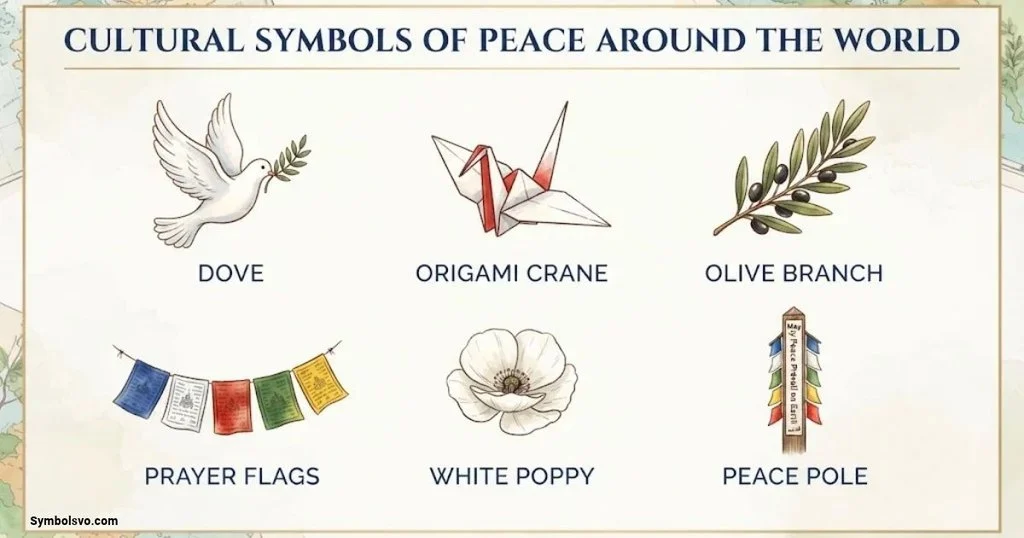
Peace can take different forms across cultures. Some communities use recognizable images, while others express peaceful values through religious practices, ceremonies, or shared traditions.
Peace Symbols in European Cultures
European peace imagery includes several well-known symbols:
- The CND peace sign, created in Britain in 1958.
- The olive branch, with roots in ancient Mediterranean traditions.
- The white poppy, connected with British remembrance and peace activism.
- The broken rifle, used by antimilitarist movements.
These symbols emerged in different periods and contexts. Some grew from ancient traditions, while others developed through modern political campaigns.
Peace and Harmony Symbols in South Asia
South Asian religious and philosophical traditions place strong emphasis on nonviolence, spiritual development, and compassion.
The Jain Ahimsa hand expresses a commitment to avoid harming living beings. The lotus appears in Buddhist and Hindu artwork as an image of purity and spiritual growth.
Om is another important symbol in Hindu traditions. It appears in prayer, meditation, and sacred texts.
These symbols represent different ideas, but each can help explain how spiritual practice connects with personal conduct and peaceful living.
Peace Symbols in East Asian Traditions
The Yin-Yang symbol is among the best-known images associated with Chinese philosophy.
It represents complementary forces and their relationship within the natural world. Its broader philosophical context includes balance, change, and interdependence.
Buddhist imagery also appears across East Asia. The lotus, for example, represents spiritual development and awakening in many Buddhist traditions.
However, East Asian cultures are diverse. Chinese, Japanese, Korean, and other traditions have different histories and religious practices. Their symbols shouldn’t be treated as interchangeable.
Indigenous North American Symbols and Traditions
Certain Indigenous North American communities have used ceremonial pipes in diplomatic and spiritual settings.
The Calumet is an important example. Depending on the community and occasion, it can help express respect, establish relationships, and support formal agreements.
Indigenous peace traditions also include specific agreements, protocols, and ceremonies. These practices are more complex than a single symbol can communicate.
It is important to recognize that Native American nations have distinct identities and cultural traditions. No single object represents every Indigenous community.
Peace Symbols in International Movements
Modern peace movements often use symbols that are easy to reproduce and recognize.
The peace sign became a familiar emblem of nuclear disarmament and anti-war activism. The broken rifle expresses resistance to militarism, while the white poppy connects remembrance with a commitment to peace.
The dove and olive branch also appear in international artwork, public campaigns, and humanitarian messaging.
These images help people communicate shared values across language and national borders.
Is the Rainbow a Symbol of Peace?
The rainbow is often associated with hope, renewal, diversity, and new beginnings. Its appearance after rain can create a powerful image of light following a difficult period.
Some communities use rainbow imagery to communicate unity and peaceful coexistence. However, the rainbow isn’t exclusively or universally recognized as a symbol of peace.
The modern LGBTQ+ Pride flag has a more specific history. Artist Gilbert Baker created its original version in 1978 for the LGBTQ+ community in San Francisco.
The flag represents LGBTQ+ pride, visibility, diversity, and equality. Its colors have developed recognized associations within the movement.
The rainbow and the Pride flag shouldn’t be confused with a general international peace flag. They can support ideas of acceptance and inclusion, but their histories and meanings are distinct.
Symbols of Inner Peace and Spiritual Growth
Not all peace symbols focus on wars, political movements, or relationships between countries. Some represent a quieter form of peace: a person’s ability to develop calmness, compassion, and emotional balance.
These images often appear in meditation, religious art, and personal spiritual practices.
Lotus Flower: Purity and Spiritual Awakening
The lotus represents the possibility of spiritual growth despite difficult surroundings.
Its roots grow in muddy water, yet the flower rises above the surface. This natural image has made it a powerful metaphor for purity and awakening.
People often connect the lotus with inner peace because it represents growth beyond hardship.
Om: Meditation and Spiritual Connection
Om is a sacred symbol used in Hindu prayer and meditation.
Its traditional meaning relates to consciousness and ultimate reality. Chanting Om can help practitioners focus their attention during spiritual practice.
It is associated with calmness, but its significance goes much deeper than a relaxation technique.
Yin-Yang: Balance and Harmony
Yin-Yang represents the relationship between complementary forces.
In everyday life, people may use it as a reminder that rest and activity, quietness and movement, or different viewpoints can coexist.
The symbol suggests that harmony doesn’t always require everything to be identical.
Dove: Calmness and Hope
A dove can represent the hope for peaceful relationships and the possibility of a fresh start.
Its association with Noah’s story makes it especially meaningful as an image of renewal after destruction.
Ahimsa: Compassion and Nonviolence
Ahimsa offers a practical approach to peaceful living.
Rather than focusing only on how someone feels, it emphasizes how they treat other living beings. It encourages compassion, responsibility, and restraint.
Together, these examples show that symbols of inner peace can represent both personal development and ethical behavior.
What Is the Difference Between Peace, Truce, and Nonviolence Symbols?
People often use peace, truce, and nonviolence as if they mean the same thing. However, each describes a different idea.
| Concept | Meaning | Example |
| Peace | A condition of reduced conflict and harmonious relationships | Dove and olive branch |
| Truce | An agreement to pause fighting | White flag |
| Nonviolence | Refusing to use violence or cause unnecessary harm | Jain Ahimsa hand |
| Anti-war activism | Opposition to war and militarism | Broken rifle |
| Nuclear disarmament | Reducing or eliminating nuclear weapons | CND peace sign |
| Remembrance | Honoring people affected by war | White poppy |
| Spiritual harmony | Inner balance and spiritual development | Lotus and Om |
A truce doesn’t automatically create lasting peace. It may only stop fighting temporarily.
Likewise, nonviolence is a principle that guides behavior. It can support peace, but it isn’t the same as a formal agreement between opposing groups.
Understanding these differences makes the meaning of each symbol clearer.
Why Do Peace Symbols Matter?
A simple image can communicate an idea across languages and cultures. That’s one reason peace symbols remain important in public life.
They help people express shared values, remember historical events, and support movements for change.
Here are some of their most important roles.
- They communicate complex ideas: A dove or olive branch can express goodwill without requiring a long explanation.
- They unite people: Shared images help communities show support for a common cause.
- They preserve history: Symbols such as the CND peace sign connect modern movements with their origins.
- They encourage dialogue: Images of reconciliation can remind people that disputes don’t always need violence.
- They represent cultural identity: Religious and traditional symbols help communities express their beliefs.
- They support remembrance: Symbols such as the white poppy encourage reflection on the human cost of war.
- They promote nonviolence: Images such as the Ahimsa hand encourage people to consider the effects of their actions.
Peace symbols matter because they turn broad ideals into images people can recognize and share.
However, a symbol alone cannot create peace. Its value depends on the ideas, choices, and actions that people connect with it.
How Are Peace Symbols Used Today?
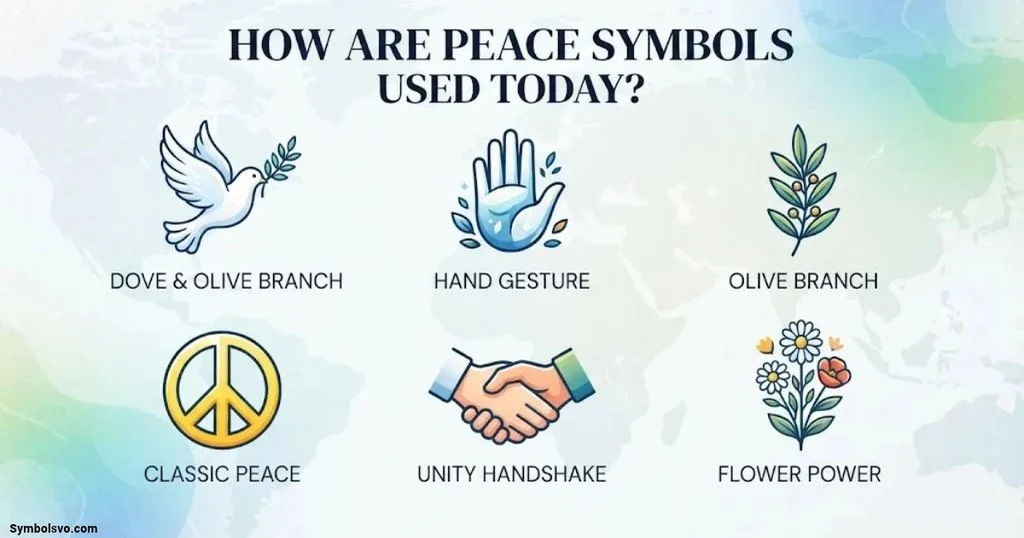
Modern peace symbols appear in many areas of public and private life. Their use has expanded through printing, digital communication, art, and international campaigns.
Common examples include:
- Peace marches: Demonstrators carry peace signs, doves, and olive branch images.
- Anti-war campaigns: Activists use the broken rifle and other antimilitarist imagery.
- Nuclear disarmament: The CND peace sign remains associated with campaigns against nuclear weapons.
- Memorial events: White poppies and doves appear in remembrance activities.
- Religious gatherings: Om, the lotus, and Ahimsa appear in spiritual settings.
- Education: Teachers use peace symbols to discuss history, cultural diversity, and nonviolence.
- Clothing and jewelry: People wear peace signs, lotus designs, and other symbols to express personal values.
- Digital communication: Peace-related images and emojis appear in online messages and social campaigns.
The meaning of an image can shift depending on its setting. A lotus on a meditation poster may express spiritual growth, while a dove on a protest banner may represent a demand for peace.
That flexibility helps explain why peace symbols around the world continue to appear in both traditional and modern settings.
Frequently Asked Questions About Peace Symbols
What Are the 11 Symbols of Peace and Their Meanings?
Eleven important symbols associated with peace include the peace sign, dove, olive branch, white flag, broken rifle, white poppy, Jain Ahimsa hand, Calumet, lotus flower, Om, and Yin-Yang. Their meanings include nuclear disarmament, reconciliation, nonviolence, spiritual growth, balance, and peaceful communication.
What Are the Most Recognized Symbols of Peace Around the World?
The peace sign, white dove, and olive branch are among the most recognizable symbols of peace. The white flag is also widely understood as a request to communicate during armed conflict. Each has a different history and purpose.
What Does the Peace Sign Symbolize?
The modern peace sign originally represented nuclear disarmament. Gerald Holtom designed it in 1958 for Britain’s Campaign for Nuclear Disarmament. It later became a broader emblem of peace, anti-war activism, and peaceful protest.
Who Created the Modern Peace Sign?
British artist Gerald Holtom created the modern peace sign in 1958. He designed it for the Campaign for Nuclear Disarmament. The symbol combines semaphore signals for the letters N and D inside a circle.
What Is the History and Origin of the Peace Sign?
The peace sign first appeared in public during the 1958 Aldermaston protest march in Britain. It represented opposition to nuclear weapons. During the 1960s, anti-war activists and counterculture movements helped spread it internationally.
Why Is the Dove a Symbol of Peace?
The dove’s association with peace comes partly from the biblical story of Noah’s Ark. A dove returned carrying an olive leaf, suggesting that the floodwaters were receding. The image later became associated with hope, reconciliation, and renewal.
What Does a White Dove Carrying an Olive Branch Represent?
A white dove carrying an olive branch represents peace, hope, and reconciliation. The dove is associated with renewal, while the olive branch suggests goodwill and the end of hostility. Together, they create one of the world’s best-known images of peace.
Why Is the Olive Branch a Symbol of Peace?
The olive branch has connections to ancient Greek traditions and the biblical story of Noah. Over time, it became associated with goodwill, reconciliation, and peaceful relationships. Today, people use it in diplomatic imagery and peace campaigns.
What Does a White Flag Mean in War?
A white flag traditionally signals a desire to communicate with an opposing side during armed conflict. It may be used for negotiations, a request for a pause, or surrender. Its meaning depends on the circumstances and shouldn’t be reduced to surrender alone.
What Does the Broken Rifle Symbolize?
The broken rifle represents opposition to war, militarism, and armed violence. It is associated with antimilitarist movements and War Resisters’ International. Its message supports peaceful conflict resolution and resistance to the use of weapons.
What Does the Lotus Flower Symbolize in Buddhism?
In Buddhism, the lotus commonly represents purity, spiritual development, and enlightenment. Its growth from muddy water into a beautiful flower illustrates the possibility of spiritual awakening despite life’s difficulties.
What Is the Spiritual Meaning of the Om Symbol?
Om, or Aum, is a sacred symbol and sound in Hindu traditions. It is associated with consciousness, ultimate reality, and spiritual connection. Practitioners use it in prayer, meditation, and other spiritual practices.
What Does the Yin-Yang Symbol Represent?
The Yin-Yang symbol represents complementary forces and their relationship. It expresses balance, interdependence, and change. Although people sometimes use it as a symbol of peace and harmony, its traditional meaning is broader than peace alone.
What Is the Meaning of the Native American Peace Pipe?
The Calumet, sometimes called a peace pipe, has ceremonial and diplomatic roles in certain Indigenous North American traditions. Depending on the community and occasion, it can express trust, respect, peaceful communication, and formal relationships.
What Does the Ankh Symbol Mean in Ancient Egypt?
The Ankh primarily represents life and eternal existence in ancient Egyptian religion and art. Gods and rulers often appear holding it in temple carvings and tomb paintings. Although modern interpretations sometimes connect it with harmony, it isn’t primarily a peace emblem.
What Are the Oldest Symbols of Peace in Human History?
Ancient olive imagery is among the best-known historical examples associated with peace. Greek traditions also personified peace through Eirene, while Roman culture represented it through Pax. These examples show how ancient societies connected peace with reconciliation, order, and prosperity.
What Are the Religious Symbols of Peace?
Religious traditions use different symbols and teachings associated with peace. Examples include the dove and olive branch in Christian imagery, the Ahimsa hand in Jainism, the lotus in Buddhism and Hinduism, and Om in Hindu spiritual practice. Their meanings depend on their religious context.
Which Symbols Represent Peace, Love, and Harmony?
The dove and olive branch are strongly associated with peace and goodwill. The lotus represents spiritual purity and growth, while Yin-Yang expresses balance and harmony. Their meanings overlap in some modern uses, but their traditional origins differ.
What Symbols Represent Inner Peace and Spiritual Growth?
The lotus, Om, and Yin-Yang are commonly associated with inner peace and spiritual development. The lotus represents purity and awakening, Om has a sacred role in Hindu practice, and Yin-Yang expresses balance between complementary forces.
Why Do Peace Symbols Matter Across Different Cultures?
Peace symbols help people communicate shared values such as compassion, cooperation, and nonviolence. They also preserve cultural and historical traditions. Although their meanings differ, these images can encourage dialogue and remind communities of the importance of peaceful relationships.
Conclusion: Understanding the Meaning Behind Peace Symbols
Peace symbols communicate much more than the simple absence of war. The peace sign represents nuclear disarmament and activism. The dove and olive branch express hope and reconciliation. The white flag communicates a desire to negotiate, while the broken rifle challenges militarism.
Religious and cultural traditions add another layer of meaning. The Jain Ahimsa hand promotes nonviolence, the lotus represents spiritual growth, Om expresses sacred connection, and Yin-Yang illustrates balance.
These images come from different places and periods. Some emerged from ancient religious traditions, while others developed through modern political movements. Their histories show that people have found many ways to express the desire for a more peaceful world.

I’m Nathan Holloway, a passionate researcher and writer with a deep interest in symbols, signs, and their hidden meanings. I enjoy exploring how symbols have influenced different civilizations, religions, and modern communication. Through my work, I aim to make complex historical and cultural concepts easy to understand for readers of all backgrounds. Every article I write is carefully researched to provide reliable and engaging information.
Books:
- Beyond the Symbol
- The Secret Meanings of Everyday Signs
Author 2: Grace Whitmore
Description:
My name is Grace Whitmore, and I love discovering the stories behind the world’s most fascinating symbols. I spend my time researching ancient civilizations, mythology, spiritual traditions, and modern iconography to uncover the meanings people often overlook. I believe that every symbol has a history worth telling, and I enjoy sharing that knowledge in a simple and reader-friendly way.
Books:
- Echoes of Ancient Symbols
- The Symbolic World
 Mason Ellington
 Daniel Brooks