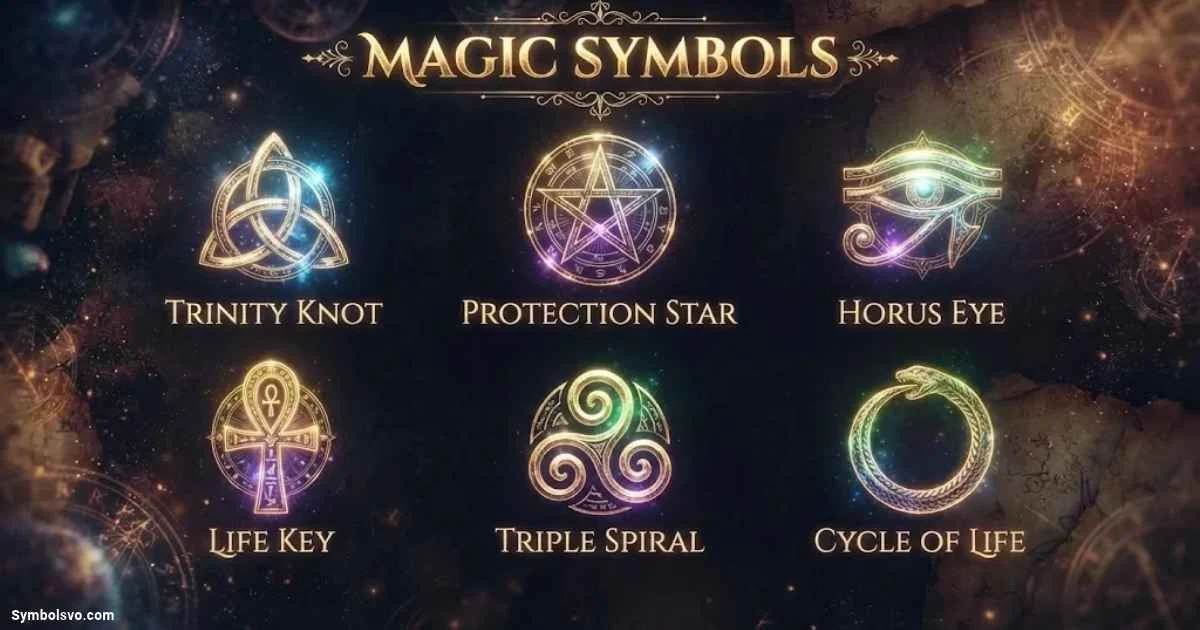
Magic symbols have fascinated people for thousands of years. From the Egyptian Ankh to the protective Hamsa hand, these designs carry stories about life, nature, spirituality, and the unseen world. Some appeared in ancient religious ceremonies, while others became important in medieval magical traditions or modern witchcraft.
But what makes a symbol magical? In many cultures, people believed certain shapes, signs, and images could represent divine forces, offer protection, express spiritual beliefs, or help focus ritual intentions. They carved symbols into stone, painted them on objects, wore them as amulets, and included them in sacred artwork.
Today, magic symbols appear in jewelry, tattoos, meditation spaces, spiritual artwork, and Wiccan practices. However, their meanings aren’t always the same. A symbol might represent protection in one tradition and religious devotion in another.
This guide explores ancient magic symbols, spiritual symbols, witchcraft symbols, and protective magic symbols. You’ll learn about their origins, traditional meanings, cultural connections, and uses in modern spiritual practices.
What Are Magic Symbols?
Magic symbols are signs, shapes, images, or written marks associated with magical practices, spiritual beliefs, religious traditions, or protective customs. People have used them to express ideas that words alone sometimes struggle to communicate.
A symbol might represent a god, an element, a natural cycle, or a particular spiritual principle. In some traditions, practitioners also believed that drawing, wearing, or displaying a symbol could help direct magical intentions or provide protection.
For example, ancient Egyptians used the Ankh to represent life. They also placed Eye of Horus amulets in tombs and wore them during everyday life. In modern Wicca, the pentacle often represents the five elements and the connection between nature and spirit.
It’s important to understand that magical symbols and meanings depend on their historical and cultural settings. Not every spiritual design began as a magical sign, and not every interpretation found online reflects an ancient belief.
What Do Magical Symbols Represent?
Although different cultures developed their own symbolic systems, several themes appear repeatedly.
- Protection: Symbols such as the Hamsa and evil eye amulets traditionally guard against misfortune or harmful influences.
- Life and rebirth: The Ankh and Egyptian scarab represent life, renewal, and continued existence.
- Balance: Yin and Yang expresses the relationship between complementary forces.
- Transformation: Spirals, lunar imagery, and certain modern rune interpretations represent change and personal development.
- Spiritual connection: Om carries deep religious and philosophical meaning in Hindu traditions.
- Divine power: The Eye of Ra represents solar power and divine authority in ancient Egyptian mythology.
These meanings help explain why people continue to use symbols of magic and spirituality today.
Ancient Magic Symbols and Their Meanings
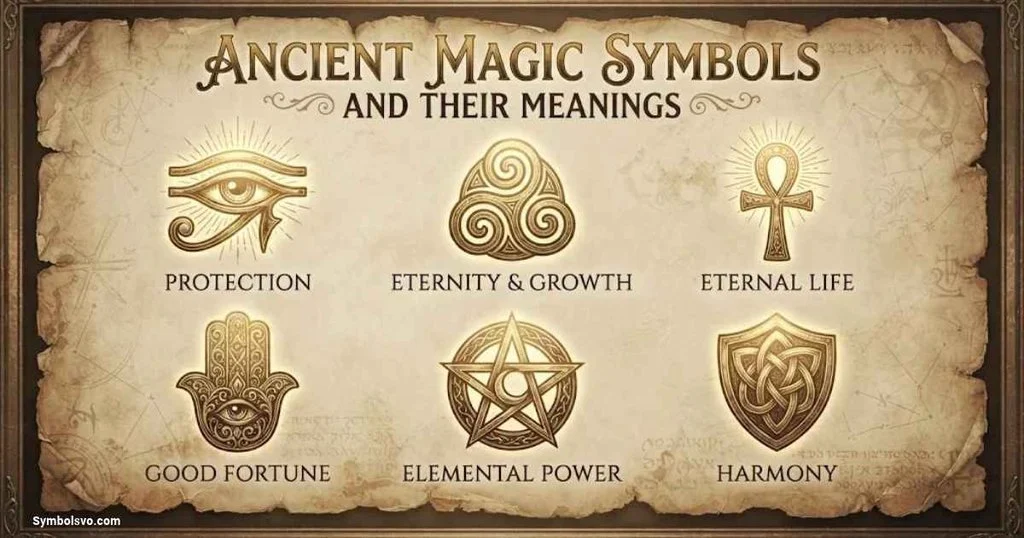
Ancient civilizations created symbols to express religious beliefs, mark sacred objects, and represent forces they believed influenced human life. Some designs also served practical roles as amulets, inscriptions, or ritual objects.
The following symbols have different histories. Some have direct evidence of ancient use, while others gained their magical associations much later.
The Ankh: Ancient Egyptian Symbol of Life
The Ankh is one of the most recognizable symbols from ancient Egypt. It resembles a cross with an oval loop at the top. Egyptian artwork frequently shows gods and goddesses holding it.
The Ankh represents life and the idea of continued existence. It appears in temple carvings, royal images, tomb decorations, and religious scenes. Egyptian deities sometimes hold the symbol near a ruler’s face, expressing the gift or renewal of life.
The Ankh also became connected with ideas about immortality and the afterlife. Ancient Egyptians placed symbolic objects in tombs because they believed the deceased needed protection and provisions beyond death.
Today, people wear Ankh pendants as jewelry and use the design in spiritual artwork. Some associate it with vitality, balance, or eternal life.
Common meanings associated with the Ankh:
- Life and vitality
- Continued existence
- Rebirth and renewal
- Divine power
- Life beyond death
- Spiritual protection
Although modern interpretations sometimes connect the Ankh with masculine and feminine energies, its clearest ancient Egyptian meaning is life.
The Eye of Horus: Protection and Healing
The Eye of Horus, also called the Wedjat or Udjat, is an ancient Egyptian symbol associated with protection, healing, and restoration.
Its appearance comes from the mythology of Horus, a falcon-associated god. In one well-known myth, Horus loses an eye during his conflict with Set. The eye is later restored, making it a powerful image of recovery and wholeness.
Ancient Egyptians used Eye of Horus designs in amulets. They believed these objects could protect the wearer and support good health. Archaeological collections and museum records preserve examples of Egyptian protective amulets.
The symbol also appeared in funerary contexts. People placed protective objects with the dead because they wanted the deceased to remain safe during the journey into the afterlife.
Traditional associations include:
- Protection
- Healing and restoration
- Good health
- Wholeness
- Safety during travel
- Protection in the afterlife
The Eye of Horus remains popular in pendants, artwork, and spiritual designs.
The Eye of Ra: Solar Power and Divine Authority
The Eye of Ra is another important Egyptian symbol, but it has a different mythological role from the Eye of Horus.
Ra was a major solar deity associated with the sun, creation, and royal authority. The Eye of Ra represents his power and ability to protect his authority. Egyptian mythology sometimes presents the eye as a fierce force that punishes threats and restores order.
Several goddesses, including Sekhmet and Hathor in particular stories, become associated with the Eye of Ra.
People often confuse the Eye of Ra with the Eye of Horus because both appear as Egyptian eye symbols. However, their mythological associations differ.
| Symbol | Traditional association |
| Eye of Horus | Healing, restoration, and protection |
| Eye of Ra | Solar power, divine authority, and protection |
In modern symbolic artwork, the Eye of Ra often represents strength, vigilance, and powerful protection.
The Pentagram: The Five-Pointed Star
The pentagram is a five-pointed star drawn using five connected lines. Its history stretches across several cultures and historical periods. It has appeared in religious, philosophical, decorative, and magical contexts.
In Western ceremonial magic, the pentagram became an important protective design. Medieval and later magical traditions associated it with controlling or banishing harmful spirits. Its role developed over time rather than remaining fixed throughout antiquity.
Modern Wiccan and Pagan practices often connect the five points with the five elements:
- Earth
- Air
- Fire
- Water
- Spirit
The upright pentagram commonly appears in modern Wiccan symbolism. Some traditions also use an inverted pentagram, although its meaning varies depending on the group and context.
The pentagram can represent protection, elemental balance, and the relationship between human life and nature.
It’s worth remembering that the five-pointed star doesn’t have one universal meaning. Its interpretation depends on the tradition using it.
The Pentacle: The Star Within a Circle
A pentacle usually refers to a five-pointed star enclosed within a circle, especially in modern Wiccan and Pagan contexts. People sometimes use the words pentacle and pentagram interchangeably, but they aren’t always identical.
The circle adds another layer of symbolism. In modern Wiccan interpretations, it can represent unity, wholeness, and the interconnectedness of the elements.
The five points commonly represent earth, air, fire, water, and spirit. Together, they express the relationship between the natural world and spiritual life.
Practitioners may use pentacles in several ways:
- As a symbol on a personal altar
- As a design on ritual tools
- In necklaces, rings, and bracelets
- As a focus during meditation
- As a religious emblem in modern Wicca
The pentacle is one of the best-known Wiccan symbols. However, not everyone who wears a five-pointed star follows Wicca or Paganism.
The Hexagram: The Six-Pointed Star
The hexagram consists of two overlapping triangles. One points upward and the other points downward, creating a six-pointed star.
This geometric design appears in different religious, artistic, and magical traditions. Its meaning changes depending on where and how people use it.
In some philosophical and esoteric interpretations, the two triangles represent complementary forces. The upward triangle may represent the spiritual or celestial world, while the downward triangle may represent the material or earthly world.
The hexagram also has an important place in Jewish identity as the Star of David. Its religious and cultural significance should not be confused with every magical interpretation associated with the same shape.
In medieval magical traditions, six-pointed designs also appeared in talismans and seals.
Common interpretations include:
- Union of opposing forces
- Balance and harmony
- Spiritual and physical connection
- Protection in certain magical traditions
- Religious identity in Judaism
The Seal of Solomon: A Historical Magical Emblem
The Seal of Solomon appears in Jewish, Islamic, and wider medieval magical traditions. It is traditionally connected with King Solomon, whose legendary wisdom and authority became important in stories about spirits and supernatural beings.
The seal doesn’t have one universally fixed design. Historical sources and later traditions associate it with both five-pointed and six-pointed figures. This is why it shouldn’t automatically be treated as another name for the Star of David.
In medieval magical literature, the Seal of Solomon became associated with protection and authority over spirits. Some traditions described it as a powerful mark used in talismans and ceremonial practices.
Its main associations include:
- Protection
- Wisdom and authority
- Control over spirits in traditional legends
- Magical seals and talismans
- Divine knowledge
The distinction between legend, religious tradition, and historical evidence matters when explaining this symbol.
The Crescent Moon: Lunar Cycles and Transformation
The crescent moon is a widely recognized symbol found in ancient religious imagery, art, and modern spiritual traditions.
Its changing appearance connects it naturally with the lunar cycle. Across different cultures, people associated the moon with timekeeping, agriculture, fertility, and the changing seasons.
In Greek mythology, the moon became associated with deities such as Artemis. Other ancient cultures connected lunar imagery with their own gods and goddesses.
Modern Wiccan and Pagan traditions often use the crescent moon to express intuition, renewal, and the rhythms of nature. It also appears in the Triple Moon symbol.
Common symbolic associations include:
- Change and transformation
- Lunar cycles
- Renewal and new beginnings
- Fertility
- Intuition
- Natural rhythms
The crescent moon also appears in religious and national imagery. Its meaning isn’t limited to witchcraft or magical practices.
The Hamsa Hand: Protection Against the Evil Eye
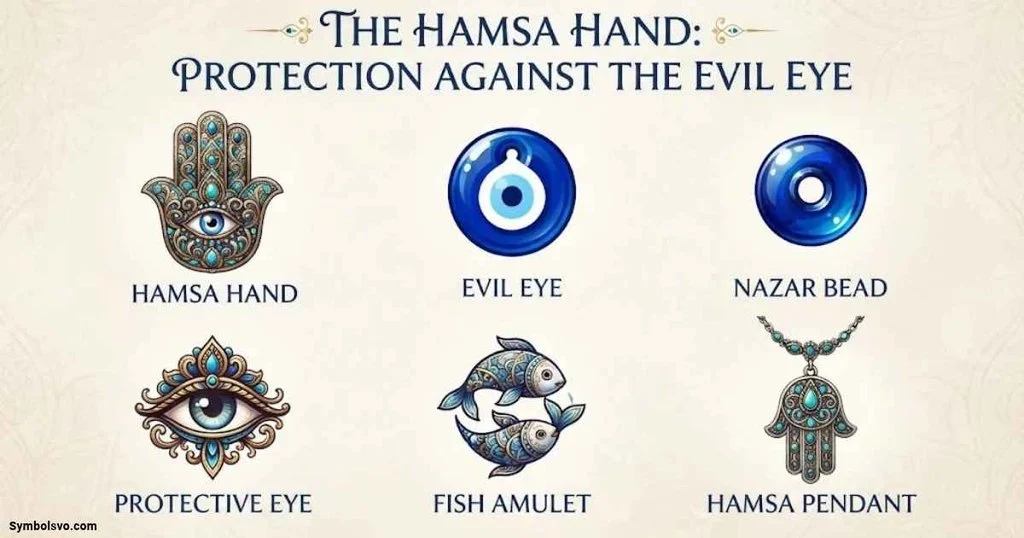
The Hamsa hand is a palm-shaped symbol used in several Middle Eastern and North African traditions. Its name comes from a word meaning five, referring to the five fingers.
People have used Hamsa-shaped objects as protective amulets. The design often includes an eye in the center of the palm, connecting it with protection against the evil eye.
The symbol is associated with different cultural and religious communities. Names such as Hand of Fatima and Hand of Miriam reflect some of its connections with Islamic and Jewish traditions.
Hamsa objects appear as necklaces, bracelets, wall decorations, and household ornaments. Museum collections preserve examples of Hamsa amulets made from glass and metal.
Common meanings include:
- Protection from the evil eye
- Good fortune
- Safety
- Blessings
- Peace
- Well-being
The Hamsa is a good example of how one protective design can become meaningful across several communities.
The Evil Eye: A Symbol of Protection
The evil eye refers to a traditional belief that an envious or harmful gaze can bring misfortune. This belief appears in many parts of the world, including the Mediterranean, Middle East, and North Africa.
An important distinction exists between the evil eye itself and the amulet used to guard against it. The harmful gaze is the feared influence. The eye-shaped object is a protective charm.
Many evil eye amulets use a series of circular shapes. Blue and white designs are especially familiar in contemporary jewelry and home decorations.
People commonly display these objects as:
- Bracelets
- Necklaces
- Wall hangings
- Door decorations
- Beads and charms
- Household ornaments
In traditional belief, the amulet helps protect its owner against envy and misfortune. This is a cultural and spiritual belief, not a scientifically established form of protection.
The Infinity Symbol: Eternity and Continuity
The infinity symbol resembles a sideways figure eight. Mathematicians use it to represent an unbounded quantity, while modern popular culture uses it to express endlessness.
Its mathematical history differs from that of ancient magical symbols. The familiar notation became established in mathematics during the seventeenth century.
Today, people use it to represent:
- Eternal love
- Lasting friendship
- Endless possibilities
- Continuity
- Connection
- Unbreakable bonds
Some modern spiritual interpretations connect the infinity sign with balance and universal connection. These are contemporary symbolic associations rather than evidence of a widely used ancient magical emblem.
Eihwaz: The Yew Rune
Eihwaz, commonly written as ᛇ, is a rune associated with the Elder Futhark, an early Germanic runic alphabet.
Its reconstructed name is connected with the yew tree. The rune’s historical sound value and precise ancient interpretation require care because surviving inscriptions don’t provide a complete dictionary of rune names and meanings.
The yew tree has a long association with endurance and longevity in European traditions. Its evergreen foliage and remarkable lifespan help explain why later interpretations connect it with persistence and continuity.
Modern rune readers often associate Eihwaz with:
- Endurance
- Resilience
- Transformation
- Stability
- Protection
- Personal development
However, many detailed divinatory meanings come from modern esoteric traditions. They shouldn’t be presented as proven ancient interpretations.
The Triquetra: The Celtic Knot Symbol
The Triquetra is a three-part knot design made from interlacing lines. Its name comes from Latin and refers to a three-cornered form.
The design appears in Celtic artwork and medieval Christian manuscripts. In Christian settings, it sometimes represents the Holy Trinity: Father, Son, and Holy Spirit.
Modern spiritual interpretations connect the Triquetra with threefold ideas, unity, and interconnectedness. Some people also associate it with earth, air, and water or the three phases of the moon.
Its common associations include:
- Unity
- Interconnection
- Threefold relationships
- Spiritual continuity
- The Holy Trinity in Christian contexts
The Triquetra is visually related to other knot designs, but it shouldn’t be confused with the triple spiral known as the Triskele.
The Triskele: The Triple Spiral
The Triskele, also called the Triskelion or triple spiral, consists of three connected spirals or curved arms.
One of the best-known examples appears at Newgrange in Ireland. This prehistoric passage tomb dates to approximately 3200 BCE, and its stone carvings include a famous triple-spiral design.
The carving predates the arrival of Celtic culture in Ireland by thousands of years. Therefore, calling every ancient triple spiral a Celtic symbol would be historically inaccurate.
Its original meaning remains uncertain. Modern interpretations often connect the three spirals with movement, cycles, and the relationship between different aspects of life.
Common modern associations include:
- Life, death, and rebirth
- Land, sea, and sky
- Movement and progress
- Natural cycles
- Growth and transformation
- Unity
The Newgrange carving gives the Triskele a fascinating archaeological background, even though its original meaning remains open to interpretation.
The Om or Aum Symbol: Sacred Sound and Consciousness
The Om symbol, also written as Aum, holds deep significance in Hindu religious and philosophical traditions.
Om is both a sacred sound and a written symbol. It appears in prayers, mantras, meditation practices, and religious texts.
Traditional explanations connect the sound’s three parts—A, U, and M—with different states of consciousness. Some Hindu philosophical interpretations also discuss a fourth state, known as Turiya, which goes beyond ordinary waking, dreaming, and deep sleep.
Om also appears in Buddhist and Jain contexts, although its use and meaning vary between traditions.
Its associations include:
- Sacred sound
- Spiritual awareness
- Consciousness
- Meditation
- Religious devotion
- Philosophical reflection
Om is not simply a decorative mystical sign. It carries important religious meaning, so its cultural background deserves respect.
Wiccan and Witchcraft Symbols
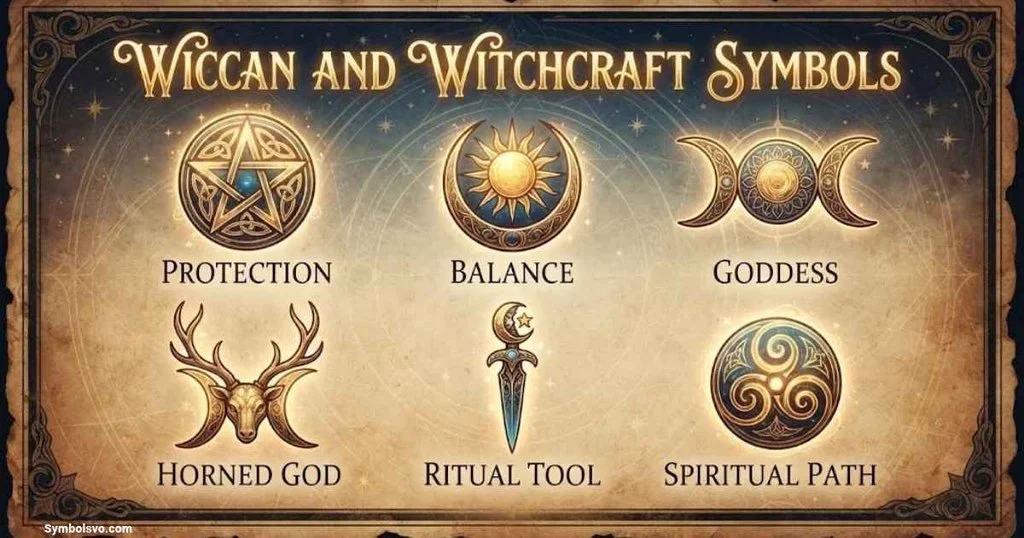
Modern witchcraft and Wicca use a variety of signs, ritual objects, and religious emblems. Some draw on older cultural traditions, while others developed within modern Pagan movements.
The Triple Moon: The Triple Goddess Symbol
The Triple Moon symbol combines three lunar shapes: a waxing crescent, a full moon, and a waning crescent.
In modern Wicca, these phases often represent the Triple Goddess in her Maiden, Mother, and Crone aspects.
Each aspect expresses a different stage or quality:
| Moon phase | Common modern association |
| Waxing moon | Maiden, growth, and new beginnings |
| Full moon | Mother, maturity, and abundance |
| Waning moon | Crone, wisdom, and release |
The symbol connects feminine divinity with the changing lunar cycle. It appears in modern Wiccan jewelry, altar decorations, and spiritual artwork.
The Triple Moon is a recognizable emblem of contemporary Pagan spirituality. It shouldn’t be confused with every ancient image of a crescent or full moon.
The Horned God
The Horned God is a deity in modern Wiccan belief, often associated with nature, animals, fertility, and the wilderness.
Artists commonly represent him with antlers or horns. These features connect him visually with wild animals and the natural world.
In some Wiccan traditions, the Horned God is paired with the Triple Goddess. Their relationship reflects ideas about seasonal cycles, fertility, and the changing patterns of nature.
Common associations include:
- Nature and wilderness
- Fertility
- Animal life
- Seasonal change
- Masculine divinity
- Life, death, and renewal
The Horned God is a religious figure rather than one standardized magical symbol. His imagery and role can differ among Pagan groups.
The Witch’s Knot
The Witch’s Knot is a name used for certain interlaced designs associated with protection in modern witchcraft.
People sometimes connect knotwork with binding, continuity, and the idea of keeping harmful influences away. Knotted cords and protective charms also appear in broader folk traditions.
However, the term Witch’s Knot doesn’t refer to one universally agreed ancient design. Different modern sources may use the name for different patterns.
Its modern associations include:
- Protection
- Binding and warding
- Unity
- Continuity
- Personal intention
When researching this symbol, check the specific design and tradition rather than assuming every knot has the same history.
The Circle of Protection
A Circle of Protection is a ritual boundary used in some forms of ceremonial magic and modern Wiccan practice.
Practitioners may mark or visualize a circle before beginning a ritual. Within that space, they focus their attention, arrange ritual tools, and carry out spiritual activities.
The circle can represent wholeness, sacred space, and a boundary between ordinary activity and ritual work.
Some traditions use chalk, salt, candles, or other materials when marking a ritual area. Others visualize the circle without drawing anything on the floor.
Common associations include:
- Sacred space
- Unity and wholeness
- Ritual focus
- Spiritual boundaries
- Protection within a ritual setting
There isn’t one universal method for creating a protective circle. Practices vary between traditions and individual practitioners.
The Triangle in Ceremonial Magic
The triangle is a basic geometric form with a long history in mathematics, art, religion, and symbolic systems.
In Western alchemy, triangular signs represent the classical elements. An upward-pointing triangle is associated with fire, while a downward-pointing triangle represents water.
Adding a horizontal line creates the traditional signs for air and earth.
| Triangle design | Element |
| Upward-pointing triangle | Fire |
| Downward-pointing triangle | Water |
| Upward triangle with a horizontal line | Air |
| Downward triangle with a horizontal line | Earth |
Triangles also appear in some ceremonial magic diagrams. Their meaning depends on the specific system or ritual in which they appear.
Sacred Geometry and Other Spiritual Symbols
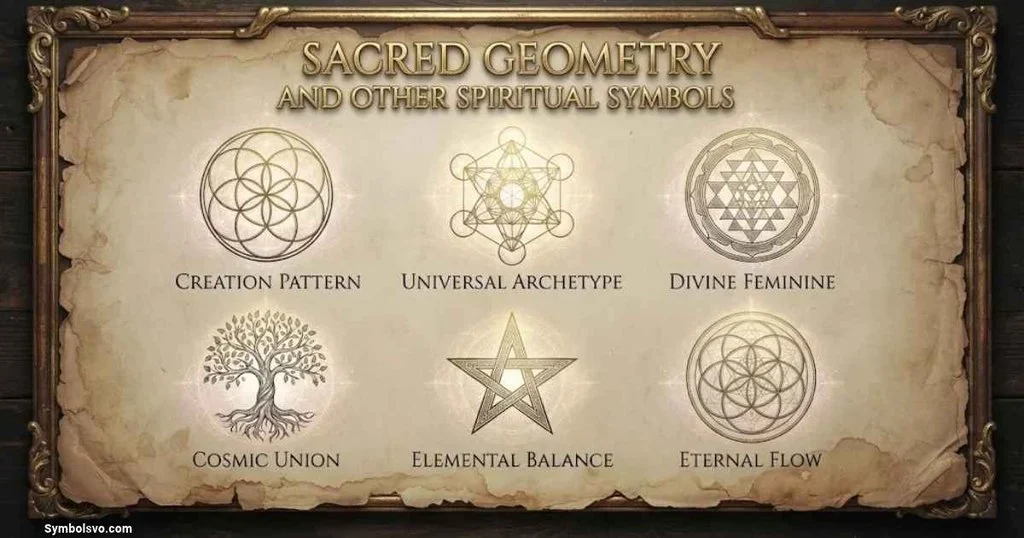
Sacred geometry refers to the use and interpretation of geometric shapes in religious, philosophical, artistic, and spiritual settings. Modern spiritual movements often assign deeper meanings to patterns such as circles, spirals, and overlapping shapes.
These interpretations can be meaningful to practitioners, but claims that a geometric design contains a scientifically proven universal energy code need reliable evidence.
The Flower of Life
The Flower of Life is a geometric pattern formed by overlapping circles arranged in a symmetrical design.
In modern sacred geometry, people often connect it with creation, unity, and the interconnectedness of life. It appears in spiritual artwork, meditation spaces, jewelry, and decorative designs.
Its modern interpretations include:
- Unity and interconnectedness
- Creation
- Harmony
- Geometric order
- Spiritual reflection
The pattern is visually striking, but its modern spiritual explanations should be separated from the historical evidence for particular examples of similar geometric designs.
The Spiral Symbol
The spiral is one of the simplest and most widespread designs in human art. It appears in prehistoric carvings, pottery, decorative objects, and many later artistic traditions.
A spiral can suggest movement, growth, and repetition. Its form naturally invites comparisons with shells, plants, storms, and other patterns found in nature.
Modern spiritual interpretations often connect it with:
- Personal growth
- Transformation
- Natural cycles
- Movement
- Renewal
- Inner reflection
However, a spiral doesn’t have one fixed meaning. A prehistoric carving may have served a different purpose from a modern meditation design.
The Solar Cross
The Solar Cross, also known as a Sun Cross or Wheel Cross in some contexts, usually consists of a cross enclosed within a circle.
Its shape divides the circle into four sections. People sometimes interpret these divisions through the four directions, seasonal changes, or the movement of the sun.
Similar cross-in-circle designs appear in different historical and cultural settings. Their meanings aren’t necessarily identical.
Modern interpretations may include:
- The sun and its cycles
- Four seasons
- Four directions
- Natural balance
- Seasonal transitions
- Unity
The design should be understood within its particular historical context rather than treated as one universal ancient religious symbol.
Yin and Yang: Balance Between Complementary Forces
The Yin and Yang symbol comes from Chinese philosophy. Its familiar circular design contains two curved sections, one dark and one light, each containing a small circle of the opposite color.
The symbol expresses the relationship between complementary forces. Yin and Yang aren’t simply good and evil or enemies fighting against each other. They depend on one another and change through their interaction.
In traditional Chinese thought, Yin and Yang help explain patterns in nature, human life, and the wider world.
Common associations include:
- Balance and harmony
- Interdependence
- Light and darkness
- Rest and activity
- Complementary forces
- Continuous change
The concept appears in Daoist philosophy and other Chinese intellectual traditions. It also influences discussions of traditional medicine, martial arts, and related practices.
Although people sometimes describe Yin and Yang as a magical symbol, its original philosophical background is more specific and deserves proper attention.
Other Important Ancient and Spiritual Symbols
Several additional designs deserve attention because they played important roles in historical religious or symbolic systems.
The Djed Pillar
The Djed pillar is an ancient Egyptian symbol associated with stability and endurance. It resembles a column with several horizontal bars near the top.
Egyptian religious tradition connected the Djed with Osiris. It also appeared in amulets and religious artwork.
Its traditional associations include:
- Stability
- Endurance
- Strength
- Continuity
- Osiris and resurrection
The Was Scepter
The Was scepter is an ancient Egyptian staff-like emblem associated with power and authority.
Egyptian gods and kings appear holding it in religious and royal artwork. Its shape includes a long shaft and a distinctive animal-headed top.
The Was scepter represents authority, dominion, and divine power within Egyptian visual culture.
The Scarab
The scarab represents the dung beetle, an insect that became an important symbol in ancient Egyptian religion.
Egyptians connected the beetle with the sun’s movement and the idea of rebirth. The scarab also became associated with Khepri, a deity connected with the rising sun and renewal.
People used scarab-shaped objects as seals and amulets. Some were placed in burials to support the deceased’s continued existence.
Its main associations include:
- Rebirth
- Renewal
- Transformation
- Protection
- New life
The Ouroboros
The Ouroboros depicts a serpent or dragon eating its own tail. The circular form creates an image of something that continuously returns to itself.
The design appears in ancient and later esoteric imagery. It became especially familiar in alchemical and philosophical traditions.
Modern interpretations connect it with:
- Cycles and renewal
- Eternity
- Self-sufficiency
- Life and death
- Repetition and transformation
The Ouroboros is a useful example of how a symbol can develop new meanings as it moves between cultures and historical periods.
The All-Seeing Eye
The All-Seeing Eye usually appears as an eye surrounded by rays or placed inside a triangle.
Eye imagery has appeared in religious and artistic traditions for centuries. In some Christian contexts, the eye represents divine observation or the providence of God.
Modern designs sometimes connect it with awareness, knowledge, and protection. It also appears in popular conspiracy theories, but those claims shouldn’t be confused with the symbol’s documented religious and artistic history.
Magic Symbols Used for Protection, Healing, and Spiritual Practices
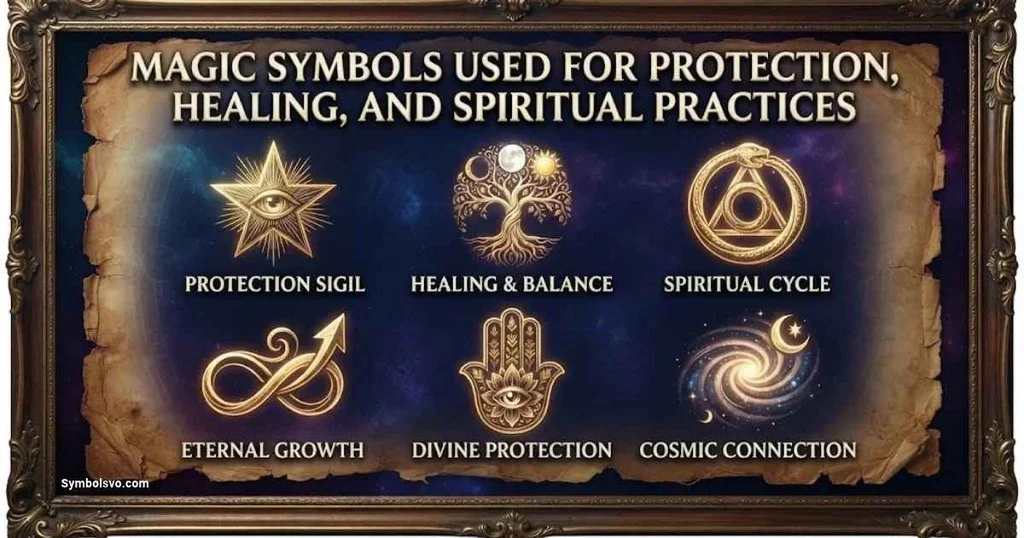
People use magical and spiritual symbols in different ways. Some wear them as jewelry, while others place them in their homes or include them in religious and ritual settings.
The meaning often comes from the tradition behind the object rather than its physical appearance alone.
Protective Magic Symbols
Some of the best-known protective magic symbols include:
- Hamsa hand: Traditionally used as protection against the evil eye.
- Evil eye amulet: Worn or displayed to guard against envy and harmful gazes.
- Eye of Horus: Associated with health, restoration, and protection in ancient Egypt.
- Pentacle: Used as a religious and ritual emblem in modern Wiccan practice.
- Protective knots: Found in different folk traditions and modern magical practices.
- Ankh: Associated with life and divine protection in ancient Egyptian contexts.
These objects reflect traditional beliefs. They don’t provide scientifically verified protection from physical danger.
Symbols Associated With Healing and Renewal
Some symbols have strong connections with recovery, health, or renewed life.
| Symbol | Traditional or modern association |
| Eye of Horus | Health, restoration, and protection |
| Ankh | Life and continued existence |
| Scarab | Rebirth and renewal |
| Djed pillar | Stability and endurance |
| Ouroboros | Cycles and transformation |
The Eye of Horus and scarab have particularly clear connections with ancient Egyptian amulets and funerary practices.
Symbols Associated With Love and Connection
Modern jewelry and spiritual artwork often use symbols to express emotional bonds.
- Infinity symbol: Endless love and lasting connection.
- Interlaced knots: Unity and continuity.
- Yin and Yang: Complementary forces and balance.
- Flower of Life: Interconnectedness in modern sacred geometry.
These meanings are common in contemporary symbolic use, although they don’t all come from ancient magical traditions.
Symbols Associated With Transformation
Some designs naturally lend themselves to ideas about change and renewal.
- Spiral: Growth and movement.
- Crescent moon: Changing phases and new beginnings.
- Ouroboros: Cycles and renewal.
- Triskele: Movement and threefold patterns.
- Eihwaz: Endurance and transformation in modern rune interpretation.
How Are Magic Symbols Used?
The use of magical symbols varies widely. Historical communities used them in religious objects and protective charms. Modern practitioners may include them in rituals, meditation, jewelry, or personal artwork.
Magical Amulets and Protective Talismans
An amulet is generally an object worn or carried for protection. A talisman is often an object created or selected for a particular purpose, such as good fortune or a specific intention.
The distinction isn’t always consistent. Different cultures and historical sources use these terms in overlapping ways.
Examples include:
- Egyptian Ankh pendants
- Eye of Horus amulets
- Scarab seals
- Hamsa charms
- Evil eye beads
- Inscribed protective objects
These objects show how people have used physical symbols to express their hopes, fears, and religious beliefs.
Magical Symbols in Jewelry
Spiritual jewelry makes symbolic designs part of everyday life. People may wear a symbol because of its religious meaning, cultural background, personal importance, or appearance.
Popular examples include:
- Pentacle necklaces
- Ankh pendants
- Hamsa bracelets
- Evil eye jewelry
- Om pendants
- Triquetra rings
Before wearing a symbol, it’s worth learning about its background. Some designs belong to living religious traditions and carry meanings beyond decoration.
Symbols in Witchcraft and Wiccan Rituals
Some modern witchcraft and Wiccan practices use symbols as part of ritual activities.
A practitioner might place a pentacle on an altar, use a circle to define ritual space, or include elemental signs in a ceremony.
Common examples include:
- Pentacles
- Triple Moon imagery
- Protective circles
- Elemental triangles
- Symbolic knots
- Candle inscriptions
There is no single ritual system followed by every witch or Wiccan. Practices differ according to tradition, personal belief, and community.
Symbols in Meditation and Spiritual Reflection
Symbols can also serve as visual points of focus.
For example, someone may meditate on Om within a Hindu spiritual practice. Another person may use a spiral as a prompt for reflecting on personal growth.
Common activities include:
- Focusing attention on a meaningful design
- Reflecting on a symbol’s traditional meaning
- Using sacred imagery during prayer
- Practicing visualization
- Including symbolic objects in a meditation space
A symbol can provide a useful focus for reflection, but it doesn’t replace medical care or guarantee a particular spiritual result.
Symbols in Tattoos and Home Decorations
People often choose spiritual symbols for tattoos, wall art, and home decorations. A design may represent family heritage, personal beliefs, protection, or an important life experience.
Before choosing one, consider three things:
- Understand its origin: Find out which culture or tradition developed the symbol.
- Check its meaning: Don’t rely on a short social media description.
- Consider its religious importance: Some symbols carry sacred meaning for communities today.
This approach helps you make a thoughtful choice rather than treating every spiritual design as interchangeable decoration.
Differences Between Magic, Religious, and Spiritual Symbols
These categories overlap, but they aren’t identical. Understanding the differences makes it easier to interpret symbols correctly.
| Category | What it represents | Examples |
| Magic symbols | Designs used in magical systems or ritual practices | Magical seals and pentagrams in ceremonial traditions |
| Religious symbols | Beliefs, deities, teachings, and religious identity | Om and the Star of David |
| Spiritual symbols | Ideas about awareness, life, and personal meaning | Spiral and infinity sign in modern use |
| Protective symbols | Objects or designs traditionally believed to guard against harm | Hamsa and evil eye amulets |
| Wiccan symbols | Emblems used in modern Wiccan religious practice | Pentacle and Triple Moon |
A single design can belong to more than one category. For instance, the pentagram has appeared in different historical settings, including magical and religious contexts.
Magic Symbols and Their Meanings: Quick Reference Table
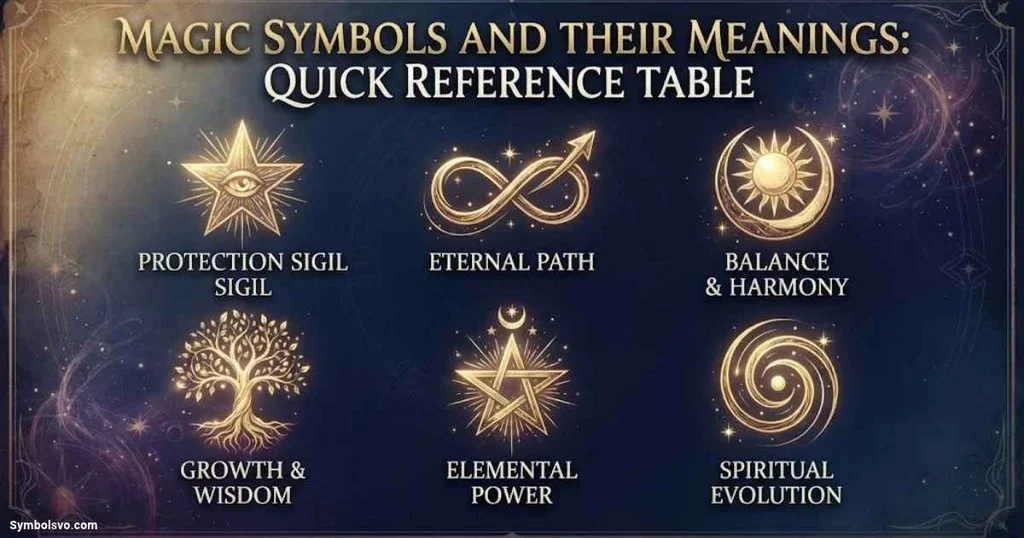
The following table summarizes the main symbols discussed in this guide.
| Magic symbol | Main association |
| Ankh | Life and continued existence |
| Eye of Horus | Healing and protection |
| Eye of Ra | Solar power and divine authority |
| Pentagram | Five-pointed star and varied magical meanings |
| Pentacle | Five elements and modern Wiccan symbolism |
| Hexagram | Six-pointed star and diverse religious or magical uses |
| Seal of Solomon | Protection and authority in magical traditions |
| Crescent Moon | Lunar cycles and renewal |
| Hamsa Hand | Protection against the evil eye |
| Evil Eye | Protective charm against harmful gazes |
| Infinity Symbol | Eternity and continuity |
| Eihwaz Rune | Yew tree and modern interpretations of endurance |
| Triquetra | Interlaced three-part design |
| Triskele | Triple spiral and movement |
| Om | Sacred sound and spiritual consciousness |
| Triple Moon | Triple Goddess in modern Wicca |
| Horned God | Nature and masculine divinity in Wicca |
| Witch’s Knot | Protection in modern witchcraft |
| Circle of Protection | Sacred ritual space |
| Flower of Life | Geometric unity in modern sacred geometry |
| Yin and Yang | Complementary forces and balance |
| Djed Pillar | Stability and endurance |
| Was Scepter | Authority and power |
| Scarab | Rebirth and renewal |
| Ouroboros | Cycles and transformation |
| All-Seeing Eye | Divine observation in certain religious contexts |
Frequently Asked Questions About Magic Symbols
What are magic symbols and their meanings?
Magic symbols are signs, shapes, and images associated with magical practices, spiritual beliefs, religious traditions, or protective customs. Their meanings vary by culture and historical period. For example, the Ankh represents life in ancient Egyptian tradition, while the Hamsa is widely used as a protective amulet.
What are the most powerful magical symbols?
There is no universally accepted ranking of magical symbols by power. However, the pentagram, Eye of Horus, Hamsa, Ankh, and Seal of Solomon have strong associations with protection or spiritual significance in particular traditions. Their importance depends on the beliefs and practices of the people who use them.
What are the oldest known magic symbols?
Some of the oldest symbolic designs come from prehistoric artwork, including spirals and geometric carvings. However, archaeologists cannot always determine whether an ancient design had a magical, religious, decorative, or practical purpose. The triple spiral at Newgrange is one well-known prehistoric example.
What symbols are used for magical protection?
Common protective symbols include the Hamsa hand, evil eye amulet, Eye of Horus, pentacle, and certain magical seals. Different cultures use these designs in different ways. Their protective qualities belong to traditional religious or spiritual beliefs rather than scientifically proven effects.
What is the difference between a pentacle and a pentagram?
A pentagram is a five-pointed star made from connected lines. A pentacle commonly refers to a pentagram enclosed within a circle, particularly in modern Wiccan contexts. The terms sometimes overlap, but the circle is the main visual difference.
What does the hexagram symbolize?
The hexagram is a six-pointed star formed by two overlapping triangles. It has appeared in different religious, decorative, and magical traditions. Some interpretations connect it with balance and complementary forces, while it also holds religious and cultural significance as the Star of David in Judaism.
What is the Seal of Solomon?
The Seal of Solomon is a magical emblem traditionally connected with King Solomon. Medieval legends associated it with wisdom, protection, and authority over spirits. Historical traditions use different designs, including five- and six-pointed forms, so the seal doesn’t always refer to one specific shape.
What does the crescent moon symbolize spiritually?
The crescent moon often represents change, renewal, and the cycles of nature. In modern Wiccan symbolism, lunar phases may represent different aspects of the Triple Goddess. Other cultures connect the crescent with lunar deities, timekeeping, and religious traditions.
What does the Ankh symbolize in ancient Egypt?
The Ankh represents life and continued existence in ancient Egyptian religion. Gods and rulers often appear holding it in temple artwork and other religious images. Egyptians also used Ankh-shaped objects in funerary and protective contexts.
What is the difference between the Eye of Horus and the Eye of Ra?
The Eye of Horus is associated with healing, restoration, and protection. The Eye of Ra represents solar power and divine authority. Both belong to ancient Egyptian mythology, but they have different stories and symbolic roles.
What does the Hamsa hand protect against?
The Hamsa hand is traditionally used as protection against the evil eye and misfortune. It appears in different Middle Eastern and North African communities and is also known by names such as Hand of Fatima and Hand of Miriam.
What is the meaning of the evil eye symbol?
The evil eye refers to a belief that an envious or harmful gaze can cause misfortune. The familiar eye-shaped amulet is intended to protect its wearer against that influence. Blue and white designs are especially common in contemporary jewelry and decorations.
What does the Triquetra symbolize?
The Triquetra is a three-part interlaced knot. In Christian artwork, it can represent the Holy Trinity. Modern interpretations also connect it with unity, interconnectedness, and other threefold ideas.
What is the meaning of the Triskele or triple spiral?
The Triskele is a design made from three connected spirals or curved arms. Its original meaning in prehistoric carvings remains uncertain. Modern interpretations often associate it with cycles, movement, renewal, and the relationship between different aspects of life.
What does the Om symbol represent?
Om is a sacred sound and symbol with deep importance in Hindu traditions. It appears in prayer, meditation, and religious texts. Traditional interpretations connect it with consciousness and the nature of ultimate reality. It also appears in Buddhist and Jain contexts.
Who is the Horned God in Wicca?
The Horned God is a deity in modern Wiccan belief. He is commonly associated with nature, animals, fertility, wilderness, and seasonal cycles. Artists often portray him with antlers or horns. His role and interpretation can differ between Wiccan traditions.
What does the Triple Moon symbol mean?
The Triple Moon combines a waxing crescent, full moon, and waning crescent. In modern Wicca, it represents the Triple Goddess through the Maiden, Mother, and Crone aspects. It can also express the changing stages of life and natural cycles.
What is the meaning of the Witch’s Knot?
The Witch’s Knot is a name used for interlaced designs associated with protection in modern witchcraft. Some interpretations connect knots with binding and warding. However, the name doesn’t refer to one universally agreed ancient symbol.
What does Yin and Yang represent?
Yin and Yang represent complementary forces that interact and depend on one another. The concept comes from Chinese philosophy and helps explain patterns in nature and human life. It is about dynamic balance rather than a simple battle between good and evil.
How are magical symbols used in rituals?
Practitioners may include symbols in altar arrangements, ritual tools, protective circles, written inscriptions, and ceremonial objects. The specific method depends on the tradition. Some people also use symbolic designs during prayer, meditation, or personal reflection.
Can you wear magical symbols as jewelry?
Yes. People commonly wear Ankh pendants, Hamsa bracelets, evil eye charms, pentacles, and Om jewelry. Some choose these designs for religious or cultural reasons, while others appreciate their personal meaning. Learning about a symbol’s background helps ensure respectful use.
Are Wiccan symbols and Pagan symbols the same?
Not exactly. Wicca is one modern Pagan religion, while Paganism includes several different religious and spiritual paths. Some symbols are common in Wicca, such as the pentacle and Triple Moon, but other Pagan traditions may use different imagery.
Do magic symbols have the same meaning in every culture?
No. A symbol can carry different meanings across cultures and historical periods. The hexagram, for example, has religious significance in Judaism and also appears in historical magical traditions. Always consider a symbol’s origin and context before interpreting it.
Conclusion: Understanding the Meaning Behind Magic Symbols
Magic symbols connect people with ideas about life, protection, nature, spirituality, and the supernatural. Their histories reveal how different communities expressed beliefs through shapes, images, objects, and sacred designs.
Some symbols, such as the Ankh and Eye of Horus, have well-documented roots in ancient Egyptian religion. Others, including the Triple Moon and many modern witchcraft emblems, developed within more recent spiritual movements. Designs such as Yin and Yang belong to philosophical traditions and shouldn’t be reduced to generic magical signs.
Understanding these differences makes every symbol more interesting. Instead of memorizing a single meaning, look at its history, cultural setting, and traditional use. That’s how you discover what a symbol truly represents.

I’m Daniel Brooks, a content creator and symbol enthusiast dedicated to researching the fascinating world of signs and symbols. I enjoy discovering the hidden meanings behind famous icons, emojis, historical emblems, and cultural symbols. Through my writing, I aim to provide trustworthy, well-researched, and reader-friendly information that helps people learn something new with every visit.
Books:
- The Complete Guide to World Symbols
- The Power of Universal Signs
 Nathan Holloway
 Mason Ellington