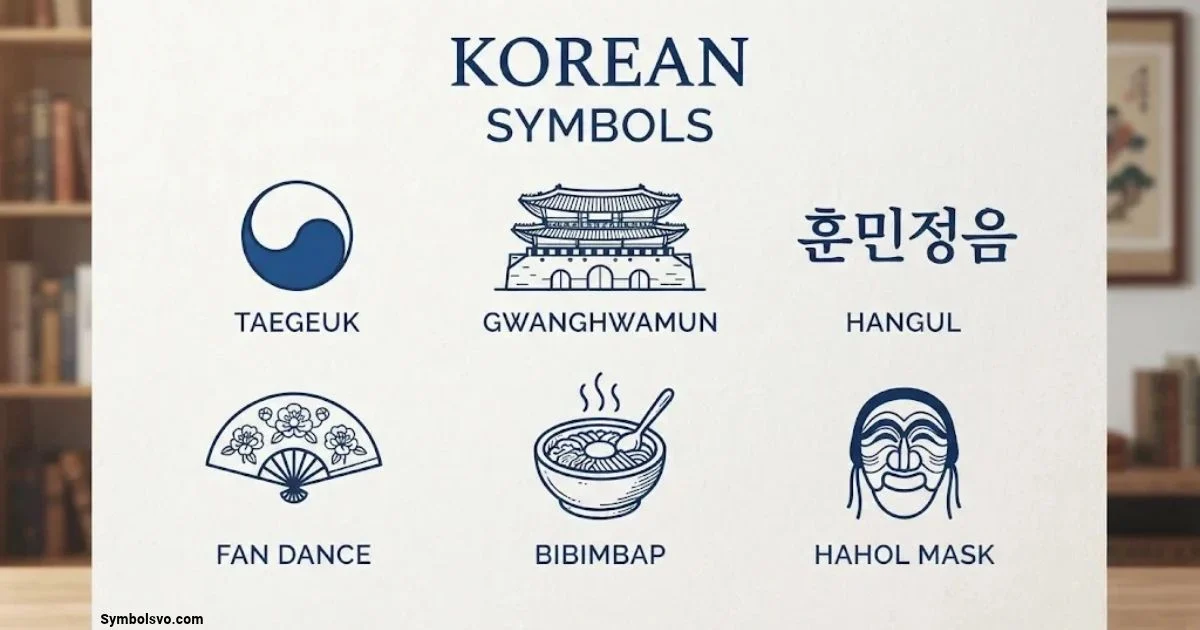
Korean symbols appear in social media bios, text messages, websites, documents, and everyday conversations. Some people search for individual Korean letters to copy, while others want to understand the Korean alphabet or learn what its characters mean. Whatever brings you here, the first thing to know is that most Korean symbols belong to a writing system called Hangul.
Hangul is the alphabet used to write the Korean language. It contains consonants and vowels that combine to form syllable blocks. Unlike English, where letters usually appear in a straight line, Korean letters fit together into compact visual units. For example, ㄱ and ㅏ combine to form 가.
This guide covers the main Korean symbols, including consonants, vowels, double consonants, compound vowels, and final consonant combinations. You’ll also find copy-and-paste characters, pronunciation guides, examples, and practical instructions for typing Korean on different devices.
Korean Symbols Copy and Paste
If you need Korean letters for a profile, message, document, or design, you can copy them directly from the charts below. These characters are part of Hangul, the standard Korean writing system.
Korean Alphabet Symbols to Copy
Here is a quick collection of modern Korean letters:
Basic Korean consonants
ㄱ ㄴ ㄷ ㄹ ㅁ ㅂ ㅅ ㅇ ㅈ ㅊ ㅋ ㅌ ㅍ ㅎ
Double Korean consonants
ㄲ ㄸ ㅃ ㅆ ㅉ
Basic Korean vowels
ㅏ ㅑ ㅓ ㅕ ㅗ ㅛ ㅜ ㅠ ㅡ ㅣ
Other Korean vowels
ㅐ ㅒ ㅔ ㅖ ㅘ ㅙ ㅚ ㅝ ㅞ ㅟ ㅢ
Compound final consonants
ㄳ ㄵ ㄶ ㄺ ㄻ ㄼ ㄽ ㄾ ㄿ ㅀ ㅄ
Common Korean syllables
가 나 다 라 마 바 사 아 자 차
카 타 파 하 한 글 사 랑 행 복
How to Copy and Paste Korean Characters
Copying Korean text works much like copying English letters.
- Find the Korean character you want.
- Select it with your mouse or touch screen.
- Copy it using Ctrl + C on Windows or Command + C on Mac.
- Open your document, message, or profile editor.
- Paste the character using Ctrl + V or Command + V.
On a phone, press and hold the selected character, choose Copy, and then paste it into your preferred application.
A useful tip: Copy complete Korean syllables when you need ordinary Korean words. Individual letters such as ㄱ and ㅏ are useful for alphabet charts, but complete syllables such as 가 are more suitable for normal Korean writing.
What Is Hangul? Understanding the Korean Writing System
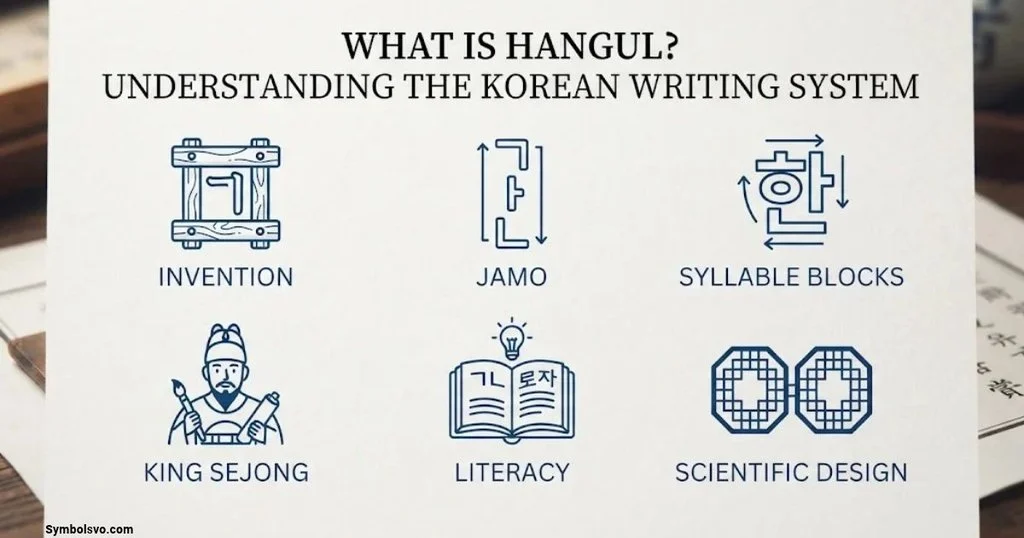
Hangul, also written as Hangeul, is the alphabet used to write modern Korean. It is one of the most recognizable writing systems in East Asia because of its organized letters and distinctive syllable blocks.
The Korean writing system combines individual consonants and vowels. Each letter represents a sound or part of a sound. When these letters come together, they create syllables that form Korean words and sentences.
What Does Hangul Mean?
The name Hangul (한글) refers to the Korean writing system. It is commonly translated as the Korean alphabet.
Hangul is not the same thing as the Korean language itself. Korean is the language people speak, read, and write. Hangul is the script they use to represent it.
For example:
- 한국어 means the Korean language.
- 한글 means Hangul or the Korean writing system.
- 한국 means Korea.
These examples show how Hangul letters combine to represent complete words and ideas.
Who Created the Korean Alphabet?
King Sejong the Great introduced the Korean alphabet in 1443 during the Joseon Dynasty. The original writing system was called Hunminjeongeum, a name commonly translated as “The Correct Sounds for the Instruction of the People.”
Before Hangul became widely available, educated Koreans often relied on Classical Chinese characters for formal writing. Learning that system required considerable time and education. Many ordinary people found written communication difficult.
King Sejong wanted a writing system that more people could learn and use. Hangul provided a practical way to represent Korean speech with a relatively small set of letters.
The system was formally published in 1446. Its original form contained 28 letters: 17 consonants and 11 vowels. Some historical letters eventually fell out of regular use, leaving the modern alphabet.
Today, October 9 is celebrated as Hangul Day in South Korea.
How Does Hangul Work?
Hangul works by combining consonants and vowels into syllable blocks. Each block represents one spoken syllable.
Consider the following example:
| Individual letters | Combined character |
| ㄱ + ㅏ | 가 |
| ㄴ + ㅏ | 나 |
| ㄷ + ㅏ | 다 |
| ㅁ + ㅣ | 미 |
| ㅎ + ㅏ + ㄴ | 한 |
The letters do not simply sit beside one another like English letters. Instead, they form a compact arrangement.
A syllable usually contains:
- An initial consonant.
- A middle vowel.
- An optional final consonant.
This structure gives Korean writing its familiar square-shaped appearance.
Hangul vs. Hanja: What’s the Difference?
Hangul and Hanja are two different writing systems used in Korean history.
Hangul is an alphabetic writing system. Its letters represent sounds, and writers combine them into syllables.
Hanja refers to Chinese characters historically used in Korean writing. Individual Hanja characters generally carry meanings and may represent words or meaningful parts of words.
For example, modern Korean usually writes the word for school as 학교 using Hangul. The same word can be represented with the Hanja characters 學校.
Today, Hangul dominates everyday Korean writing. Hanja appears in some academic, historical, cultural, and specialized contexts.
Korean Consonant Symbols and Their Names
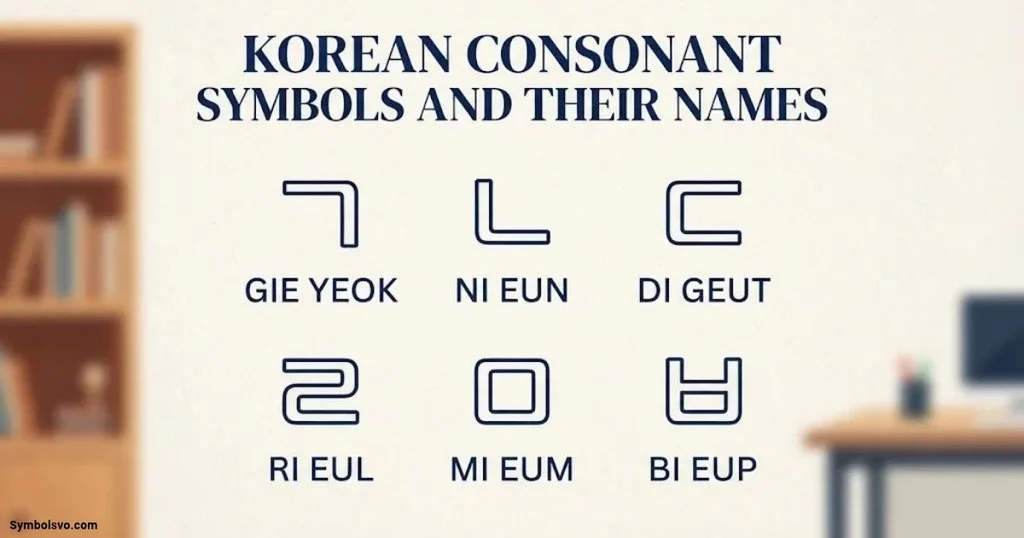
Consonants are an essential part of the Korean alphabet. They represent sounds made by using the lips, tongue, teeth, and other parts of the vocal system.
Modern Hangul has 19 consonant letters. These consist of 14 basic consonants and five double or tense consonants.
The 14 Basic Korean Consonants
The following chart lists the basic Korean consonant symbols, their Korean names, and approximate English sound guides.
| Symbol | Korean name | Approximate sound |
| ㄱ | Giyeok | g/k |
| ㄴ | Nieun | n |
| ㄷ | Digeut | d/t |
| ㄹ | Rieul | r/l |
| ㅁ | Mieum | m |
| ㅂ | Bieup | b/p |
| ㅅ | Siot | s |
| ㅇ | Ieung | Silent initially; ng finally |
| ㅈ | Jieut | j |
| ㅊ | Chieut | ch |
| ㅋ | Kieuk | Aspirated k |
| ㅌ | Tieut | Aspirated t |
| ㅍ | Pieup | Aspirated p |
| ㅎ | Hieut | h |
The English sound guides are approximate. Korean consonants do not always match English sounds perfectly, and pronunciation can change depending on their position in a word.
Individual Korean Consonant Symbols Explained
ㄱ — Giyeok
Giyeok represents a consonant that sounds somewhere between English g and k, depending on its position and pronunciation context. You can see it in 가 and 고.
ㄴ — Nieun
Nieun represents the n sound. It appears in syllables such as 나 and 너. The sound is generally familiar to English speakers.
ㄷ — Digeut
Digeut represents a consonant that can sound like d or t depending on its position. It appears in 다 and 도.
ㄹ — Rieul
Rieul is especially interesting because English does not have one exact equivalent. It can sound closer to a light r or l depending on its position in a word.
ㅁ — Mieum
Mieum represents the m sound. You can find it in syllables such as 마 and 무.
ㅂ — Bieup
Bieup has a sound that can resemble English b or p. Its exact pronunciation depends on its position and surrounding sounds.
ㅅ — Siot
Siot usually represents an s-like sound. Before certain vowels, its pronunciation may sound closer to sh.
ㅇ — Ieung
Ieung has two important uses. At the beginning of a syllable, it acts as a silent placeholder before the vowel. At the end, it represents the ng sound, as in the English word “sing.”
For example, 아 begins with a silent ㅇ, while 강 ends with the ng sound.
ㅈ — Jieut
Jieut represents a consonant similar to English j. It appears in syllables such as 자 and 주.
ㅊ — Chieut
Chieut represents an aspirated ch sound. It differs from the less strongly released sound of ㅈ.
ㅋ — Kieuk
Kieuk represents an aspirated k sound. It has a stronger burst of air than the basic consonant ㄱ.
ㅌ — Tieut
Tieut represents an aspirated t sound. It differs from the basic consonant ㄷ.
ㅍ — Pieup
Pieup represents an aspirated p sound. It has a stronger release of air than ㅂ.
ㅎ — Hieut
Hieut represents an h sound, similar to the beginning of the English word “hello.”
The Five Korean Double Consonants
Korean has five double consonants, also called tense consonants. Their written forms use doubled versions of five basic letters.
| Symbol | Korean name | Sound guide |
| ㄲ | Ssang Giyeok | Tense k |
| ㄸ | Ssang Digeut | Tense t |
| ㅃ | Ssang Bieup | Tense p |
| ㅆ | Ssang Siot | Tense s |
| ㅉ | Ssang Jieut | Tense j |
The word ssang means double or paired in this context.
These consonants are not simply pronounced by holding a sound for twice as long. Instead, they use a tense articulation that distinguishes them from plain and aspirated consonants.
For example:
- ㄱ is a plain consonant.
- ㅋ is aspirated.
- ㄲ is tense.
This distinction matters because changing the consonant can change a Korean word’s meaning.
Korean Compound Final Consonants
Korean also uses combinations of two consonants in the final position of certain syllables. These are commonly called compound final consonants, complex batchim, or double batchim.
Here are the 11 common combinations:
| Symbol | Components |
| ㄳ | ㄱ + ㅅ |
| ㄵ | ㄴ + ㅈ |
| ㄶ | ㄴ + ㅎ |
| ㄺ | ㄹ + ㄱ |
| ㄻ | ㄹ + ㅁ |
| ㄼ | ㄹ + ㅂ |
| ㄽ | ㄹ + ㅅ |
| ㄾ | ㄹ + ㅌ |
| ㄿ | ㄹ + ㅍ |
| ㅀ | ㄹ + ㅎ |
| ㅄ | ㅂ + ㅅ |
These combinations normally appear at the end of a syllable rather than at the beginning.
Their pronunciation depends on the word and the sound that follows. In many situations, only one consonant is heard clearly. In other situations, the following syllable affects how the final combination sounds.
For example, 읽다 contains ㄺ as its final consonant combination. Its pronunciation follows Korean final-consonant rules rather than simply sounding like two separate letters.
Remember: These 11 combinations are not 11 additional basic consonant letters. They are combinations used in the final position of syllables.
Korean Vowel Symbols and Their Names
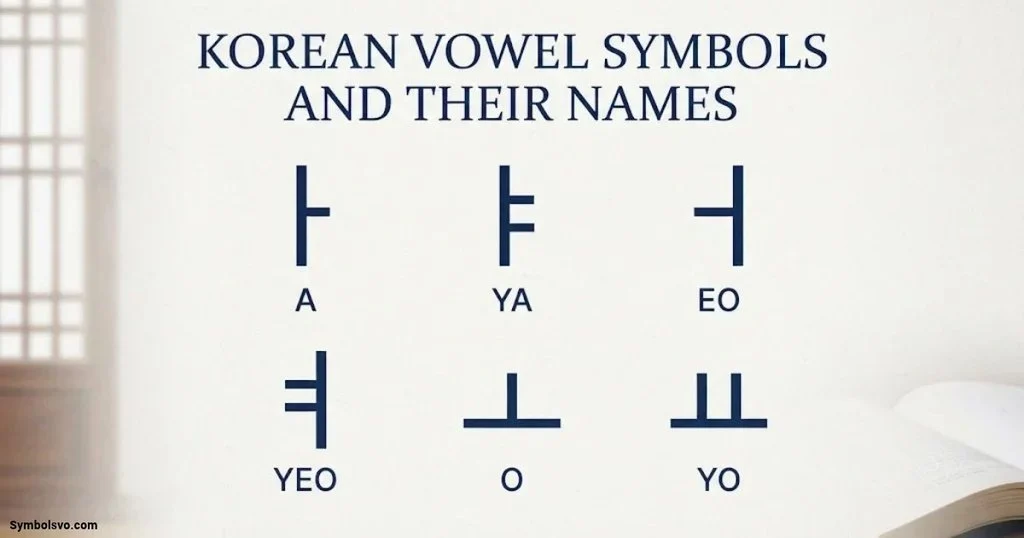
Vowels help form the center of Korean syllables. Modern Hangul contains 21 vowel letters, divided into 10 basic vowels and 11 compound vowels.
Korean vowels have their own pronunciation patterns. Some may look familiar to English speakers, but their actual sounds do not always match English spelling.
The 10 Basic Korean Vowels
| Symbol | Name | Approximate sound |
| ㅏ | A | a |
| ㅑ | Ya | ya |
| ㅓ | Eo | eo |
| ㅕ | Yeo | yeo |
| ㅗ | O | o |
| ㅛ | Yo | yo |
| ㅜ | U | u |
| ㅠ | Yu | yu |
| ㅡ | Eu | eu |
| ㅣ | I | i |
These vowels form the foundation of many Korean syllables.
For example:
- ㅏ appears in 가.
- ㅓ appears in 너.
- ㅗ appears in 고.
- ㅜ appears in 구.
- ㅣ appears in 미.
The 11 Compound Korean Vowels
Compound vowels combine vowel elements to represent more complex sounds.
| Symbol | Name | Approximate sound |
| ㅐ | Ae | ae |
| ㅒ | Yae | yae |
| ㅔ | E | e |
| ㅖ | Ye | ye |
| ㅘ | Wa | wa |
| ㅙ | Wae | wae |
| ㅚ | Oe | oe |
| ㅝ | Wo | wo |
| ㅞ | We | we |
| ㅟ | Wi | wi |
| ㅢ | Ui | ui |
Some of these vowels sound quite similar in contemporary Korean speech. For example, ㅐ and ㅔ are often pronounced similarly by modern speakers. Their spellings remain distinct, so learners still need to recognize both.
How Korean Vowels Are Formed
Traditional Hangul vowel design uses three foundational elements:
- ㆍ represents heaven or the sky.
- ㅡ represents the earth.
- ㅣ represents a human being.
The original vowel system used combinations of these elements to create other vowel forms. The small dot, ㆍ, is an archaic vowel element and is not part of the standard modern vowel inventory.
This design is one of the distinctive features of Hangul. Its vowel shapes reflect a planned system rather than a random collection of marks.
Basic Vowels vs. Compound Vowels
Basic vowels have simpler forms, while compound vowels combine vowel elements into a single letter.
| Feature | Basic vowels | Compound vowels |
| Number | 10 | 11 |
| Structure | Foundational vowel forms | Combined vowel forms |
| Examples | ㅏ, ㅓ, ㅗ, ㅜ | ㅘ, ㅙ, ㅝ, ㅢ |
| Use | Form common syllables | Represent more complex vowel sounds |
Both groups are essential. You need them to read and write modern Korean accurately.
How Korean Letters Combine to Form Syllables
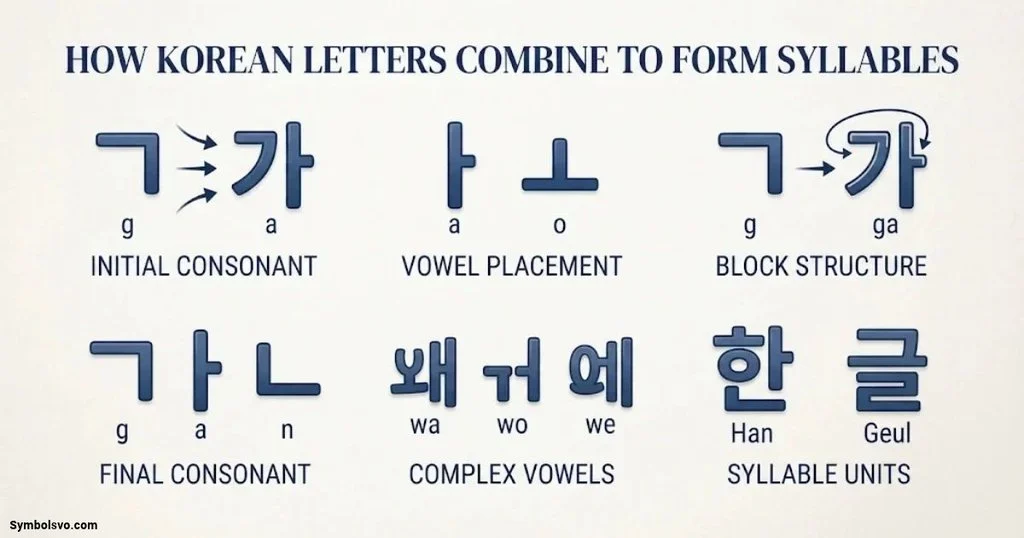
One of the most interesting features of Korean writing is its syllable-block structure. Instead of writing every letter in a single horizontal row, Hangul arranges consonants and vowels into compact blocks.
Each block represents one syllable.
Korean Syllable Structure
A standard modern Korean syllable can contain three positions:
- Choseong: The initial consonant.
- Jungseong: The middle vowel.
- Jongseong: The optional final consonant.
A syllable can have an initial consonant and vowel without a final consonant. It can also include a final consonant when the word requires one.
For example:
| Position | Korean term | Example |
| Initial | Choseong | ㄱ |
| Middle | Jungseong | ㅏ |
| Final | Jongseong | ㄴ |
Together, these letters create 간.
Korean Syllable Examples
| Individual letters | Syllable | Explanation |
| ㄱ + ㅏ | 가 | Initial consonant + vowel |
| ㄴ + ㅏ | 나 | Initial consonant + vowel |
| ㄷ + ㅏ | 다 | Initial consonant + vowel |
| ㅁ + ㅣ | 미 | Initial consonant + vowel |
| ㅎ + ㅏ + ㄴ | 한 | Initial + vowel + final |
| ㄱ + ㅡ + ㄹ | 글 | Initial + vowel + final |
These examples show how Hangul turns separate letters into readable syllables.
What Is Batchim in Korean?
Batchim (받침) refers to the final consonant or consonant combination at the bottom of a Korean syllable block.
For example:
- 가 has no final consonant.
- 간 has ㄴ as its final consonant.
- 감 has ㅁ as its final consonant.
- 강 has ㅇ as its final consonant.
Batchim affects pronunciation. Korean final consonants follow specific sound rules, so their written forms may not always sound exactly as they do at the beginning of a syllable.
When a final consonant comes before a vowel in the next syllable, pronunciation can also change through sound linking.
Why Are Korean Letters Written in Blocks?
The block structure makes it possible to read Korean syllables as visual units.
For example, the word 한글 contains two syllable blocks:
- 한
- 글
Each block combines consonants and vowels. This arrangement gives Korean writing a balanced appearance and allows the script to represent speech with a relatively compact set of letters.
It also explains why copying a complete Korean word is often more useful than copying isolated letters.
Korean Symbol Meanings: Do Individual Letters Have Meanings?
The phrase Korean symbol meanings can refer to different things. Some readers want to know what an individual Hangul letter represents. Others are looking for the meaning of a Korean word or a cultural symbol.
These are not the same.
Do Korean Alphabet Letters Have Individual Meanings?
Most individual Hangul letters represent sounds rather than independent concepts.
For example:
- ㄱ represents a consonant sound.
- ㄴ represents an n-like sound.
- ㅁ represents an m-like sound.
- ㅏ represents a vowel sound.
- ㅣ represents another vowel sound.
The letter ㄱ does not independently mean “love,” “strength,” or another English concept. It becomes part of a meaningful Korean word when combined with other letters.
The names of the letters, such as Giyeok and Nieun, help identify them. Those names are not the same as dictionary meanings.
Meanings of Common Korean Words
When Hangul letters combine into words, they can express complete ideas.
| Korean word | Meaning |
| 사랑 | Love |
| 행복 | Happiness |
| 친구 | Friend |
| 희망 | Hope |
| 가족 | Family |
| 평화 | Peace |
| 한글 | Hangul |
| 한국 | Korea |
| 학교 | School |
| 감사 | Gratitude or thanks |
For example, 사랑 means love. Its letters work together to form a word with a clear meaning. The meaning belongs to the complete word, not to each individual letter.
Korean Symbols vs. Korean Cultural Symbols
Korea also has cultural, historical, and national symbols that are different from Hangul letters.
Some well-known examples include:
Taegeuk (태극)
Taegeuk represents the red-and-blue circular design found at the center of South Korea’s national flag. It is associated with the philosophical idea of complementary forces and balance.
Taegeukgi (태극기)
Taegeukgi is the Korean name for the South Korean national flag. It includes the central Taegeuk design and four black trigrams.
The Four Trigrams
The four black symbols on the flag are called Geon, Gon, Gam, and Ri. They come from traditional East Asian cosmological ideas and represent different natural and philosophical concepts.
Traditional Korean Patterns
Korean art and architecture feature patterns inspired by nature, geometric shapes, animals, and traditional beliefs. These designs appear in textiles, pottery, buildings, and decorative objects.
These cultural symbols have their own histories and meanings. They should not be confused with the consonants and vowels of the Korean alphabet.
Korean Unicode Symbols and Character Encoding
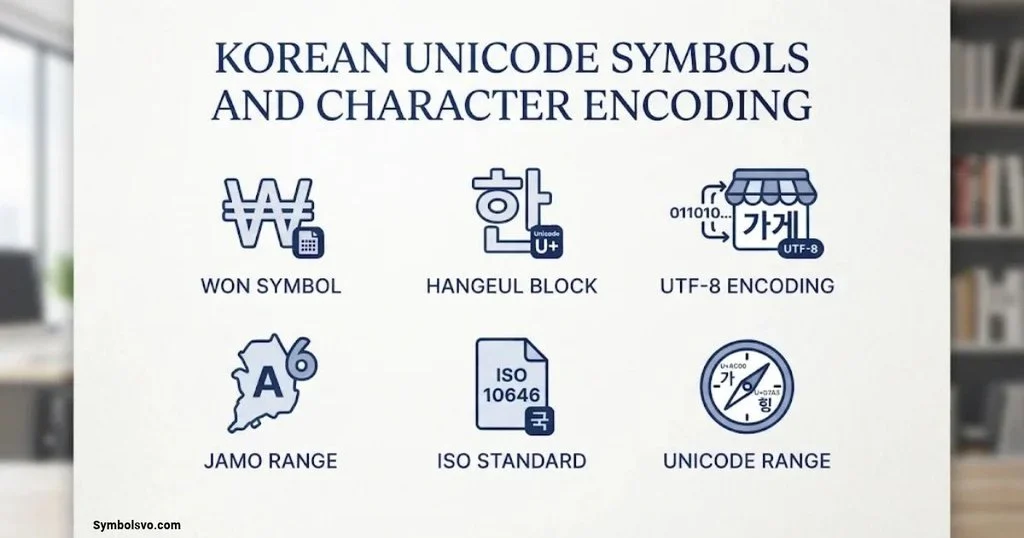
Korean characters work across digital platforms because computers use character-encoding standards to represent written text.
The most important standard for this purpose is Unicode.
What Are Korean Unicode Characters?
Unicode is a universal character standard that assigns a unique code point to characters used in writing systems around the world.
It includes Korean consonants, vowels, complete syllables, and historical Hangul characters.
For example, the Korean syllable 가 has the Unicode code point U+AC00. The character ㄱ has a different code point.
Unicode allows computers, phones, websites, and applications to recognize the same text even when they use different fonts.
Korean Unicode Character Blocks
Unicode organizes related Korean characters into several blocks.
| Unicode block | Purpose |
| Hangul Jamo | Korean letter components |
| Hangul Syllables | Complete precomposed Hangul syllables |
| Hangul Compatibility Jamo | Compatibility forms of Korean letters |
| Hangul Jamo Extended-A | Additional historical and extended Jamo |
| Hangul Jamo Extended-B | Additional historical and extended Jamo |
These blocks support modern and historical Korean writing.
The Hangul Syllables block contains 11,172 precomposed syllable characters. These cover the standard combinations used in modern Hangul.
Korean Jamo vs. Complete Hangul Syllables
Jamo are the individual components of Hangul. They include consonant and vowel letters that combine to create syllables.
A complete Hangul syllable is a precomposed character that represents the combination.
Consider this example:
| Form | Character |
| Initial consonant | ㄱ |
| Vowel | ㅏ |
| Combined syllable | 가 |
The separate letters are useful when discussing pronunciation and alphabet structure. The complete syllable is more convenient for ordinary Korean writing.
Unicode supports both approaches. Applications and fonts use the available character information to display Korean text correctly.
Why Do Some Korean Characters Look Different?
Korean characters may look slightly different across devices, even when the underlying text is identical.
Common reasons include:
- Different fonts use different letter designs.
- Operating systems may use different default Korean fonts.
- Browsers rely on available font support.
- Some applications handle text normalization differently.
- Older software may not support every character.
A character can have the same Unicode identity while appearing with a different visual style.
How to Type Korean Symbols on Different Devices
You don’t need to buy a Korean keyboard to type Hangul. Most modern computers and smartphones support Korean input through built-in language settings.
How to Type Korean Characters on Windows
Windows allows you to add Korean as an input language.
Follow these steps:
- Open Settings.
- Select Time & Language.
- Open Language & Region.
- Choose the option to add a language.
- Search for Korean and install it.
- Switch to the Korean keyboard from the taskbar or language selector.
Windows supports the common two-set Korean keyboard layout. It assigns consonants and vowels to familiar keyboard positions.
You can switch between English and Korean input without changing your physical keyboard.
How to Type Korean Letters on Mac
Mac computers also include Korean input support.
- Open System Settings.
- Select Keyboard.
- Find the text input or input sources settings.
- Add Korean as an input source.
- Choose the preferred Korean keyboard layout.
- Switch between input languages when typing.
Once enabled, you can enter Hangul directly into documents, browsers, messages, and other applications.
How to Type Korean Symbols on Android
Most Android phones support Korean through their keyboard settings.
The exact menu names can vary by manufacturer and keyboard app, but the general process is simple:
- Open your phone’s keyboard settings.
- Find the language settings.
- Add Korean.
- Select a Korean keyboard layout.
- Switch languages whenever you need to type Hangul.
Many Android users type Korean with the built-in keyboard or a supported keyboard application.
How to Type Korean Symbols on iPhone
You can add a Korean keyboard to an iPhone through its language settings.
- Open Settings.
- Select General.
- Tap Keyboard.
- Open Keyboards.
- Choose Add New Keyboard.
- Select Korean and choose a layout.
After adding the keyboard, use the globe or language key to switch between English and Korean.
How to Type Korean Characters Without a Korean Keyboard
If you don’t want to change your device settings, several alternatives are available.
- Copy and paste: Select Korean characters from a character chart.
- Online Korean keyboard: Enter Hangul using an on-screen layout.
- Input method editor: Use an IME to convert keyboard input into Korean characters.
- Mobile keyboard: Install or enable a Korean language keyboard on your phone.
For occasional use, copy and paste is usually the quickest option. If you write Korean regularly, installing a Korean keyboard will save time.
Where Can You Use Korean Symbols?
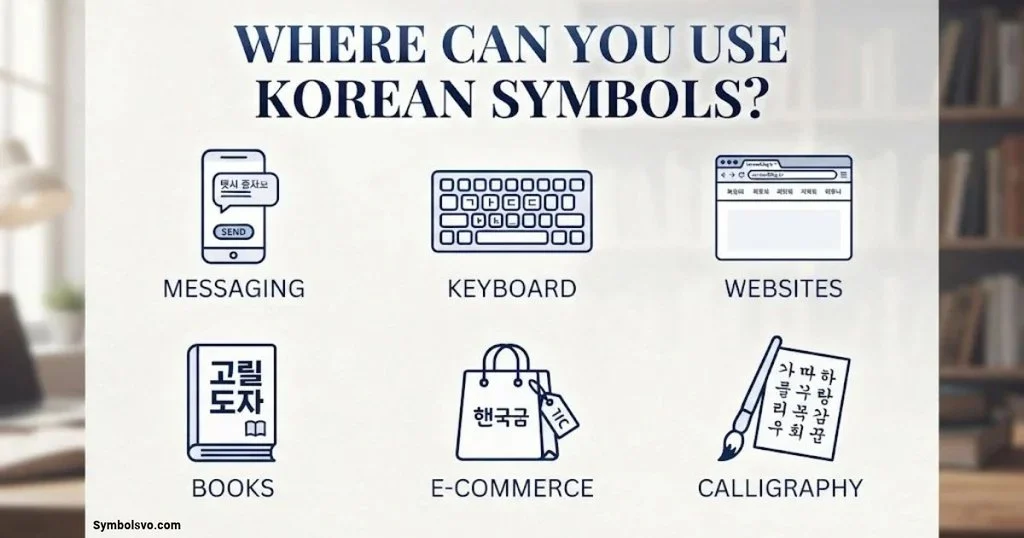
Korean letters work in most modern applications that support Unicode text. You can use them in personal messages, social media profiles, documents, websites, and design projects.
Korean Symbols for Social Media
Korean text is common on social platforms where users share language-learning content, personal interests, music, entertainment, and cultural topics.
You can use Hangul in:
- Instagram bios and captions.
- TikTok profile descriptions.
- YouTube channel names and descriptions.
- Facebook posts and comments.
- Online communities and discussion groups.
For example, you might use 사랑 or 행복 in a profile because these are complete Korean words with recognizable meanings.
If you don’t speak Korean, check the meaning before adding a word to your profile. A character combination may look attractive but communicate something different from what you intended.
Korean Symbols for Documents and Emails
Hangul works in many popular writing applications.
You can use Korean text in:
- Microsoft Word documents.
- Google Docs.
- School assignments.
- Business emails.
- Language-learning notes.
- Presentations and reports.
For professional communication, choose a readable font and check that the recipient’s device can display the characters.
Korean Symbols for Websites and Design
Website owners and designers can use Korean characters in headings, labels, navigation menus, and other interface elements.
For example:
| Korean text | English meaning |
| 홈 | Home |
| 검색 | Search |
| 메뉴 | Menu |
| 설정 | Settings |
| 저장 | Save |
| 취소 | Cancel |
These are real Korean interface labels. They can help create a Korean-language website or a localized application.
When designing a user interface, keep labels short and easy to understand. A clear translation is more useful than adding Korean characters purely for decoration.
Korean Symbols for Text Messages and Chats
Hangul is fully suitable for everyday digital communication.
You can use Korean characters in:
- Messaging applications.
- Group chats.
- Online forums.
- Language-learning conversations.
- Personal messages.
If you’re communicating with a Korean speaker, using complete words and sentences is better than sending isolated letters without context.
Korean Font and Device Compatibility
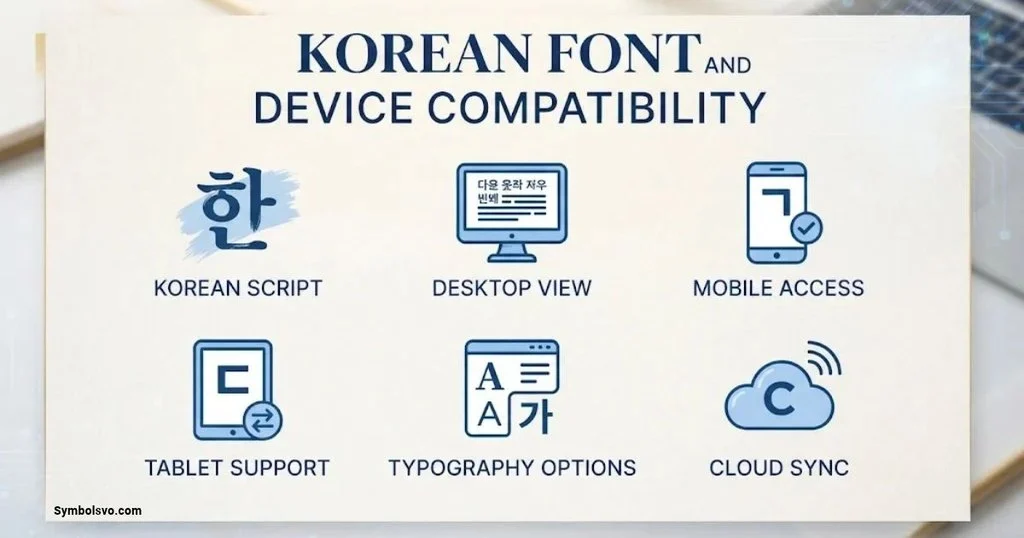
Copying Korean text is usually simple, but displaying it correctly depends on font and software support.
Do Korean Symbols Work on All Devices?
Modern computers and smartphones generally support standard Unicode Hangul. This means most common Korean letters and syllables work in modern browsers, messaging apps, and document editors.
However, compatibility isn’t identical everywhere.
A device may support modern Korean characters but lack a font for a less common historical character. Some older applications may also struggle with certain text sequences.
For ordinary modern Korean writing, compatibility is generally reliable.
Why Do Korean Characters Sometimes Appear as Boxes?
If you see empty squares, question marks, or replacement symbols instead of Korean text, the application may not have the necessary character support.
Common causes include:
- A missing Korean font.
- An outdated operating system.
- An application with limited Unicode support.
- Incorrect text encoding.
- An unsupported historical Hangul character.
The problem doesn’t always mean the original text is damaged. Sometimes the device simply cannot display the character.
How to Fix Korean Character Display Problems
Try these steps when Korean text appears incorrectly:
- Update your operating system and browser.
- Install a font that supports Korean.
- Open the text in another modern application.
- Check that the document uses an appropriate Unicode encoding.
- Copy the text again from a reliable source.
- Test the characters on another device.
For websites, developers should use UTF-8 encoding and make sure the page has access to a font with Hangul coverage.
How to Keep Korean Text Readable
Good typography makes a difference, especially when Korean text appears beside English.
Follow these simple practices:
- Choose a font with clear Korean characters.
- Use a suitable font size.
- Avoid excessive decorative effects.
- Keep line spacing comfortable.
- Check how text appears on mobile screens.
- Use complete syllables and words when possible.
- Test your layout in more than one browser.
Readability should always come before decoration.
Frequently Asked Questions About Korean Symbols
What Are Korean Symbols?
Korean symbols commonly refer to characters from Hangul, the Korean writing system. These include consonants, vowels, and complete syllable blocks. Korean symbols may also refer to cultural designs such as the Taegeuk on South Korea’s national flag, depending on the context.
What Are the Korean Alphabet Symbols?
The Korean alphabet contains 19 modern consonant letters and 21 vowel letters. The consonants include 14 basic letters and five tense letters. The vowels include 10 basic vowels and 11 compound vowels. These letters combine to create Korean syllables.
How Many Letters Are in the Korean Alphabet?
Modern Hangul has 40 basic and combined letter forms: 19 consonants and 21 vowels. The traditional basic-letter count is often given as 24 because it counts 14 basic consonants and 10 basic vowels without counting the additional tense consonants and compound vowels separately.
How Many Consonants Are in Hangul?
Hangul has 19 modern consonant letters. These include 14 basic consonants and five tense or double consonants: ㄲ, ㄸ, ㅃ, ㅆ, and ㅉ.
How Many Vowels Are in Hangul?
Modern Hangul has 21 vowel letters. These consist of 10 basic vowels and 11 compound vowels. The compound vowels combine vowel elements to represent additional sounds.
What Are the Basic Korean Consonant Symbols?
The 14 basic Korean consonants are ㄱ, ㄴ, ㄷ, ㄹ, ㅁ, ㅂ, ㅅ, ㅇ, ㅈ, ㅊ, ㅋ, ㅌ, ㅍ, and ㅎ. Each represents a consonant sound used to form Korean syllables.
What Are Korean Double Consonants?
Korean double consonants are tense consonant letters. The five forms are ㄲ, ㄸ, ㅃ, ㅆ, and ㅉ. They have distinct pronunciations and can change the meaning of a word when substituted for another consonant.
What Are Korean Compound Consonants?
Korean compound consonants are combinations of two consonants used in the final position of certain syllables. Examples include ㄳ, ㄵ, ㄶ, ㄺ, and ㅄ. Their pronunciation depends on Korean final-consonant rules and the surrounding sounds.
What Are the Basic Korean Vowel Symbols?
The 10 basic Korean vowels are ㅏ, ㅑ, ㅓ, ㅕ, ㅗ, ㅛ, ㅜ, ㅠ, ㅡ, and ㅣ. They form the foundation of the modern Hangul vowel system.
What Are Korean Compound Vowels?
Korean compound vowels are vowel letters formed from combinations of vowel elements. The 11 modern forms are ㅐ, ㅒ, ㅔ, ㅖ, ㅘ, ㅙ, ㅚ, ㅝ, ㅞ, ㅟ, and ㅢ.
What Does ㄱ Mean in Korean?
The character ㄱ is called Giyeok. It represents a Korean consonant sound that can resemble English g or k, depending on its position. By itself, ㄱ is a letter rather than a complete Korean word with an independent dictionary meaning.
What Does ㄴ Mean in Korean?
The character ㄴ is called Nieun. It represents an n-like consonant sound. You can find it at the beginning of syllables such as 나 and 너. It does not normally have an independent word meaning.
What Does ㄷ Mean in Korean?
The character ㄷ is called Digeut. It represents a consonant that can sound similar to English d or t depending on its position and pronunciation context. It appears in syllables such as 다 and 도.
What Does ㅅ Mean in Korean?
The character ㅅ is called Siot. It usually represents an s-like consonant sound. Its pronunciation can sound closer to sh before certain vowels. It is a letter rather than an independent word.
What Is the Difference Between Korean Consonants and Vowels?
Consonants represent sounds made by restricting or shaping airflow in the vocal tract. Vowels represent sounds produced with a more open vocal tract. In Hangul, consonants and vowels combine to form syllable blocks.
What Is the Difference Between Hangul and Hanja?
Hangul is the Korean alphabet, which uses consonant and vowel letters to represent sounds. Hanja refers to Chinese characters historically used in Korean writing. Modern Korean mainly uses Hangul, while Hanja appears in selected cultural, historical, and academic contexts.
How Do I Copy and Paste Korean Symbols?
Select the Korean character or word you want, copy it, and paste it into your preferred application. Use Ctrl + C and Ctrl + V on Windows or Command + C and Command + V on Mac. On a phone, press and hold the selected text to access the copy option.
Can I Type Korean Without a Korean Keyboard?
Yes. You can use an online Korean keyboard, an input method editor, or copy-and-paste characters from a Korean symbol chart. You can also enable Korean input on your computer or phone without buying a physical Korean keyboard.
Do Korean Symbols Work on Mobile Devices?
Most modern Android phones and iPhones support standard Korean Unicode characters. You can display Korean text in messages, social media apps, browsers, and documents. If characters appear as boxes, update your device or check its font support.
Are Korean Characters Unicode Symbols?
Yes. Modern Hangul characters are included in Unicode. The standard covers individual Jamo, complete syllable blocks, compatibility forms, and additional historical characters. Unicode allows different digital platforms to represent Korean text consistently.
Why Do Korean Characters Appear as Boxes?
Korean characters may appear as empty boxes when a device or application lacks a suitable font. Outdated software, unsupported historical characters, or incorrect encoding can also cause display problems. Installing a Korean-compatible font or updating the software often fixes the issue.
Can I Use Korean Symbols on Social Media?
Yes. Most major social media platforms support standard Hangul characters. You can use Korean words and letters in bios, captions, comments, and messages. Check the meaning and spelling before using unfamiliar Korean text publicly.
Conclusion: Understanding and Using Korean Symbols
Korean symbols are more than decorative characters. They belong to Hangul, a carefully designed writing system that combines consonants and vowels into readable syllable blocks.
Modern Hangul contains 19 consonant letters and 21 vowel letters. These include basic consonants, tense consonants, basic vowels, and compound vowels. When combined, they create the syllables used to write Korean words and sentences.
You can copy these characters into social media profiles, documents, messages, and websites. You can also type them directly by enabling Korean input on your computer or phone.
The most important distinction is simple: individual Hangul letters usually represent sounds, while complete Korean words carry meanings. Once you understand that difference, Korean characters become much easier to recognize, use, and explore.

Mason Ellington is a creative and dedicated Content Writer and Symbols Expert with a passion for words, communication, and symbolic meanings. He specializes in crafting engaging, informative, and well-structured content while exploring the deeper meanings and interpretations behind symbols. With a creative mindset and attention to detail, Mason transforms ideas into meaningful content that informs, inspires, and connects with readers. His expertise combines powerful storytelling, clear communication, and a deep understanding of symbolism.
 Nathan Holloway
 Daniel Brooks