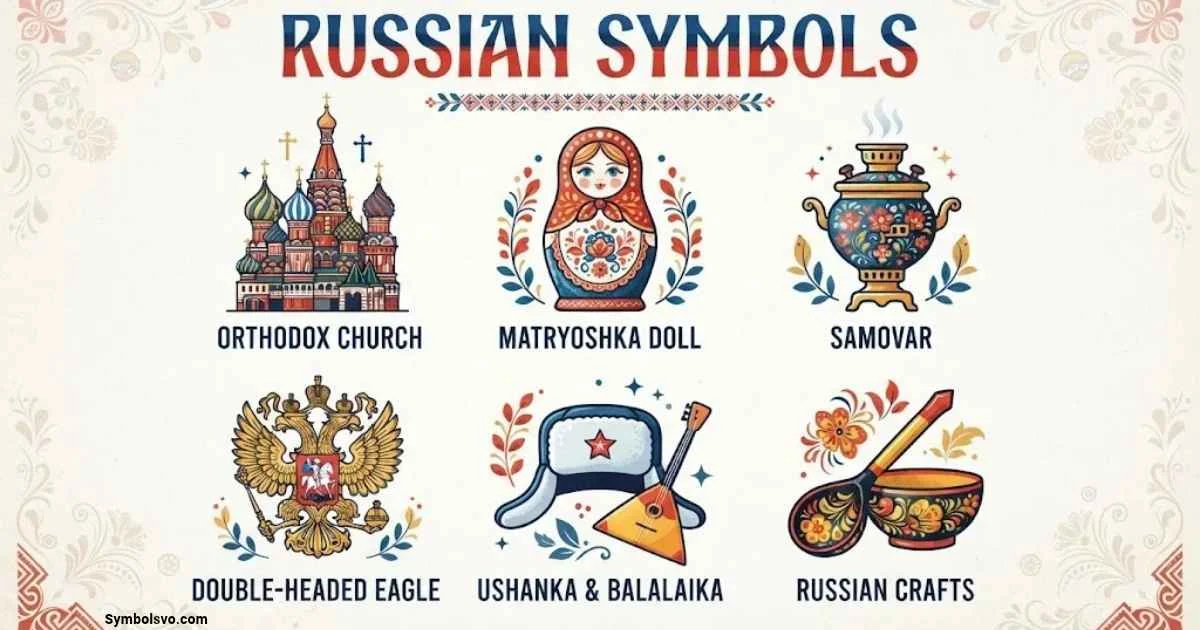
Russia has some of the most recognizable symbols in the world. The white, blue, and red national flag, the double-headed eagle, the Russian bear, and the colorful Matryoshka dolls all bring different parts of the country’s identity to mind. Some represent the Russian government and its history, while others reflect traditional art, folklore, architecture, and everyday life.
However, not every famous Russian symbol has official status. The national flag, state coat of arms, and national anthem are the country’s three official state symbols. The bear, nesting dolls, traditional clothing, and famous landmarks are cultural or historical symbols that became closely associated with Russia over time.
Understanding this difference makes Russian symbols much more interesting. Each one has its own background, and many have changed meaning across different periods. From the imperial double-headed eagle to traditional folk paintings, these symbols offer a closer look at Russia’s history and cultural heritage.
What Are the Symbols of Russia?
Russian symbols are images, objects, traditions, landmarks, and designs that represent the country’s national identity, history, government, and culture. Some have a direct connection to the Russian state, while others developed through centuries of art, religion, folklore, and daily customs.
For example, the Russian tricolor represents the modern state, and the double-headed eagle appears on the country’s coat of arms. Matryoshka dolls, on the other hand, represent a recognizable form of Russian folk art. The bear became a popular cultural and political image, even though it isn’t an officially designated national animal.
Russian symbols generally fall into several categories:
- Official state symbols: The national flag, state coat of arms, and national anthem.
- Historical symbols: Imperial eagles, the Bronze Horseman, and monuments connected with Russian rulers.
- Cultural symbols: Matryoshka dolls, the Russian bear, balalaika, and traditional folk art.
- Religious symbols: Orthodox crosses, church icons, and traditional religious architecture.
- Traditional symbols: Folk clothing, embroidery, food, music, and regional crafts.
- Soviet-era symbols: The red star and hammer and sickle, which represent the history of the former Soviet Union.
These categories often overlap. Saint Basil’s Cathedral, for instance, is an architectural landmark, a religious building, and an important part of Russia’s historical image.
Official National Symbols of Russia
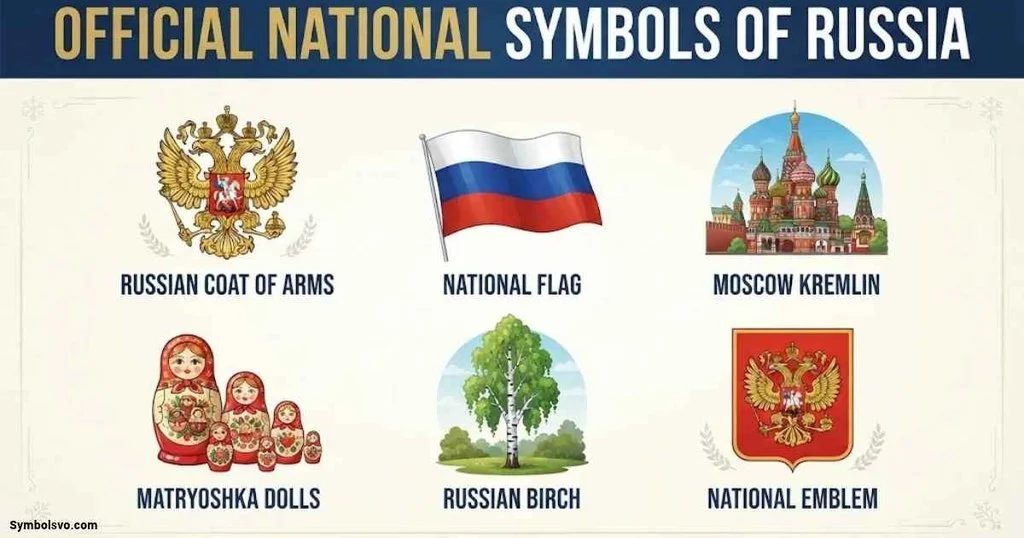
Russia has three principal official state symbols: the national flag, the state coat of arms, and the national anthem. Federal constitutional laws establish their designs and official use.
These symbols represent the Russian Federation as a sovereign state. They appear at government buildings, national ceremonies, official events, and other occasions connected with public life.
Russian National Flag
The Russian national flag, commonly called the Russian tricolor, is one of the country’s most recognizable symbols. Its design consists of three equal horizontal stripes arranged from top to bottom:
- White at the top
- Blue in the middle
- Red at the bottom
The flag has a rectangular shape with a width-to-length proportion of 2:3. Its simple design makes it easy to recognize, whether displayed outside a government building or carried during a sporting event.
The flag’s history goes back to Russia’s development as a naval power. During the reign of Peter the Great, Russia expanded its maritime activities and adopted the white, blue, and red combination for its ships. The design later became closely associated with Russian national identity.
After the Russian Empire ended, the country experienced several political changes. The Soviet Union used a different red flag with the hammer and sickle and a star. Following the end of Soviet rule, the traditional tricolor returned as the Russian national flag in 1991. Its status was formally established through federal constitutional legislation in 2000.
Today, the flag represents the Russian Federation at national and international events. It is also displayed during Russia Day and other official celebrations.
Meaning of the Russian Flag Colors
The Russian flag colors are white, blue, and red. People often connect each color with particular values, although the country’s flag law defines the colors and arrangement without assigning them official symbolic meanings.
Common interpretations include:
| Color | Popular interpretation |
| White | Peace, purity, honesty, and sincerity |
| Blue | Faith, loyalty, and faithfulness |
| Red | Courage, strength, bravery, and sacrifice |
These explanations are traditional interpretations rather than legally established definitions. Different historical writers and cultural sources have offered different explanations over time.
The three colors also have a wider connection with Slavic history. White, blue, and red became known as Pan-Slavic colors and appeared in the flags of several Slavic countries, although their arrangements and individual histories differ.
Russian Coat of Arms
The Russian coat of arms is another major national symbol. Its central image is a golden double-headed eagle placed on a red shield. The eagle has two heads facing opposite directions, and its wings are spread.
Several important details appear in the design:
- Double-headed eagle: The main heraldic figure, associated with Russian state authority and historical continuity.
- Three crowns: One large crown above the eagle’s heads and two smaller crowns above each head.
- Scepter: Held in one of the eagle’s claws as a traditional emblem of authority.
- Orb: Held in the other claw as a symbol of sovereign power.
- Red shield: The background behind the eagle.
- Mounted horseman: A silver-clad rider on a white horse appears on a smaller shield at the eagle’s center.
- Dragon or serpent: The horseman strikes a dark creature beneath the horse.
The mounted figure is traditionally identified with Saint George. In Christian imagery, Saint George’s battle with the dragon represents the struggle between good and evil.
The double-headed eagle has a long history in European and Byzantine heraldic traditions. It became part of Russian royal imagery during the reign of Ivan III in the late fifteenth century. His marriage to Sophia Palaiologina, a member of the Byzantine imperial family, is often discussed when explaining the symbol’s arrival and development in Russia.
The modern coat of arms preserves this historical image while representing the current Russian Federation. It connects the country’s imperial past with its present state identity.
Russian National Anthem
The State Anthem of the Russian Federation is the country’s official national anthem. Its music was composed by Alexander Alexandrov, while the current lyrics were written by Sergei Mikhalkov.
The present anthem uses the melody associated with the former Soviet national anthem. Russia adopted this musical composition again in 2000, with new lyrics reflecting the Russian Federation.
The anthem is performed during official state ceremonies and other important occasions, including:
- Presidential inaugurations.
- Official government events.
- National celebrations.
- Ceremonies involving the national flag.
- International sporting competitions.
- Certain military and public ceremonies.
Like the flag and coat of arms, the anthem is a formal state symbol. It represents the country through music and words rather than through a visual emblem.
Russian National Currency: The Ruble
The Russian ruble, also spelled rouble, is the official currency of the Russian Federation. Its currency code is RUB, and its symbol is ₽.
The ruble has a long history that reaches back several centuries. It has remained an important part of Russian economic life through the imperial, Soviet, and modern periods, although its monetary system and value have changed considerably.
You can recognize the ruble symbol in:
- Store prices and product labels.
- Banking and financial documents.
- Online payment displays.
- Currency exchange listings.
- Business transactions.
The ruble is an important national identifier, but it isn’t one of Russia’s three official state symbols.
Famous Cultural Symbols of Russia
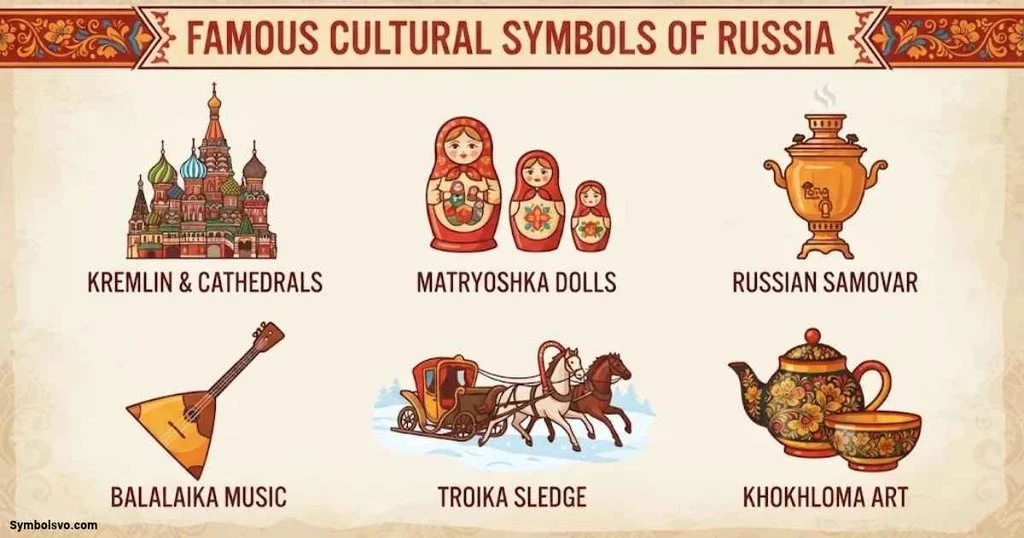
Beyond its official emblems, Russia has many cultural symbols recognized around the world. These objects and images often come from traditional crafts, folklore, wildlife, and everyday customs.
Matryoshka Dolls: Russian Nesting Dolls
Matryoshka dolls, also called Russian nesting dolls, are among the most recognizable examples of Russian folk art. A traditional set consists of hollow wooden figures that fit inside one another. Each doll opens to reveal a smaller figure until the smallest one remains.
The largest doll often looks like a woman wearing a traditional dress and headscarf. Artists decorate the figures with colorful patterns, flowers, family scenes, or other subjects.
The first widely recognized Russian Matryoshka appeared around 1890 at a workshop associated with the Abramtsevo artistic community near Moscow. Woodworker Vasily Zvyozdochkin carved the figures, and artist Sergei Malyutin painted them. The earliest known set contained a mother figure and smaller figures representing children.
The nesting concept has a more complicated history than many people realize. Similar nesting objects existed in other parts of the world, and Japanese wooden figures are often mentioned as a possible inspiration for the first Russian dolls. The exact details of this influence remain a subject of historical discussion.
Matryoshka dolls gained international attention after their presentation at the 1900 Paris Exposition, where they received a bronze medal. Their popularity grew, and workshops across Russia began producing different designs.
What do Matryoshka dolls symbolize?
People commonly associate them with:
- Motherhood: The largest figure often represents a mother.
- Family: The smaller figures suggest children and generations.
- Togetherness: The dolls fit inside one another as parts of a larger set.
- Folk craftsmanship: Each figure displays traditional wood carving and painting.
- Russian cultural identity: Their distinctive appearance makes them popular souvenirs.
These meanings are cultural interpretations rather than official definitions. Modern Matryoshka dolls also feature historical figures, political leaders, athletes, animals, and fictional characters.
The Russian Bear
The Russian bear is one of the country’s best-known cultural and political images. It usually appears as a brown bear, a powerful animal found across large areas of Russia.
Bears have an important place in Russian folklore and traditional storytelling. They appear in fairy tales, folk illustrations, and stories about forests and wildlife. Their size and strength made them natural figures for stories about power, danger, and survival.
The bear later became a familiar image in international political cartoons. Artists often used it to represent Russia’s military power, territorial size, or political influence. Depending on the cartoon, the bear could appear friendly, threatening, defensive, or aggressive.
Common associations include:
- Physical strength and power.
- Endurance in difficult conditions.
- Wilderness and natural landscapes.
- Russian national identity.
- Political and military influence.
The bear also appears in sports mascots, advertising, souvenirs, and popular illustrations. For example, Misha, the bear mascot of the 1980 Moscow Summer Olympics, became a memorable character in international sporting history.
However, the bear is not one of Russia’s three official state symbols. It is better described as a widely recognized cultural and political symbol.
The Double-Headed Eagle
The double-headed eagle deserves attention beyond its appearance on the Russian coat of arms. It is one of the most important historical symbols connected with Russian monarchy and state power.
Its two heads face in opposite directions. Historical interpretations often connect this arrangement with the idea of watching over different territories or representing authority across two directions. However, these interpretations should not be treated as one universally established meaning.
The eagle became closely associated with Russian rulers during the late fifteenth century. Ivan III adopted it for royal and state imagery as Moscow grew in political importance.
Over time, the eagle appeared on royal seals, official documents, buildings, military objects, and government emblems. It survived several changes in Russian history, disappeared from official state imagery during the Soviet period, and returned to the modern Russian coat of arms in 1993.
Today, it connects modern state identity with centuries of Russian heraldic tradition.
The Russian Birch Tree
The birch tree is a familiar feature of Russian landscapes. Its pale bark, slender trunk, and delicate leaves make it easy to recognize, especially in forests and countryside scenes.
Birch trees appear frequently in Russian poetry, folk songs, paintings, and literature. Artists often use them to create scenes of rural life, changing seasons, and natural beauty.
The tree commonly brings to mind:
- Renewal and new beginnings.
- Natural beauty.
- Rural life and familiar landscapes.
- Spring and seasonal change.
- Connection with the countryside.
Birch bark also had practical uses in earlier Russian life. People used it to make containers, writing materials, footwear, and other everyday objects. Birch-bark documents discovered in archaeological excavations provide valuable information about historical communication and daily activities.
Although the birch tree is strongly associated with Russian culture, it should not automatically be described as the country’s officially designated national tree.
Russian Orthodox Cross and Religious Icons
Russian Orthodox Christianity has played an important role in the country’s religious and cultural history. As a result, the Orthodox cross and religious icons are familiar symbols in Russian churches, monasteries, and traditional art.
The Russian Orthodox cross commonly appears with three horizontal bars. The upper bar represents the inscription placed above Jesus during the crucifixion. The middle bar represents the main crossbeam, while the lower slanted bar is associated with the footrest in traditional Orthodox imagery.
Religious icons are also important. These paintings often show Jesus Christ, the Virgin Mary, saints, and scenes from the Bible. Orthodox Christians use icons during prayer and worship, and their artistic style follows established religious traditions.
Russian icon painting developed through Byzantine influence and later acquired distinctive regional features. Gold backgrounds, carefully arranged figures, symbolic gestures, and rich colors are common elements.
These religious symbols reflect Russia’s Orthodox heritage, but they belong to religious tradition rather than the country’s official state emblem system.
Famous Russian Historical Symbols and Monuments
Russia’s architecture and historical monuments tell stories about rulers, religious traditions, political change, and the growth of major cities. Several landmarks have become recognizable symbols of the country.
The Bronze Horseman
The Bronze Horseman is a famous equestrian monument of Peter the Great in Saint Petersburg. It shows the Russian emperor riding a rearing horse above a large stone pedestal.
Catherine the Great commissioned the monument, and French sculptor Étienne Maurice Falconet designed it. The statue was unveiled in 1782 in Senate Square.
One of its most unusual features is the enormous pedestal known as the Thunder Stone. The stone was transported from the surrounding region and shaped to support the monument.
The statue represents Peter the Great’s role in transforming Russia. He expanded the military, modernized government institutions, encouraged education, and promoted closer connections with Western Europe. He also founded Saint Petersburg in 1703, making it a new center of political and cultural life.
The Bronze Horseman became even more famous through Alexander Pushkin’s poem of the same name. The poem helped turn the monument into a powerful literary image associated with the city and its imperial history.
Today, visitors recognize the statue as one of Saint Petersburg’s most important historical landmarks.
Saint Basil’s Cathedral
Saint Basil’s Cathedral, located in Moscow’s Red Square, is one of the most recognizable examples of Russian architecture. Its colorful domes, detailed patterns, and unusual arrangement of towers give it a distinctive appearance.
Ivan IV, better known as Ivan the Terrible, ordered its construction to commemorate the Russian victory over the Khanate of Kazan. Building work began in 1555 and was completed in 1561.
The cathedral consists of several interconnected chapels arranged around a central structure. Its colorful onion-shaped domes and decorative details make it stand out from many other religious buildings.
Saint Basil’s Cathedral is closely associated with Russian Orthodox heritage and the history of Moscow. It is part of the UNESCO World Heritage Site that includes the Kremlin and Red Square.
Its importance goes beyond religion. The cathedral has become an international image of Russia and a major example of traditional Russian architectural design.
The Moscow Kremlin
The Moscow Kremlin is a historic fortified complex at the center of Moscow. It includes defensive walls, towers, churches, palaces, and government buildings.
Its history stretches back to medieval Moscow. Over time, it became the residence of Russian rulers and an important religious and political center.
The Kremlin played a major role during the period of Russian princes, the tsars, the Russian Empire, and the Soviet Union. Today, it remains closely connected with the country’s political leadership.
Some of its best-known features include:
- Red defensive walls and towers.
- Cathedral Square.
- The Grand Kremlin Palace.
- Historic Orthodox churches.
- The Senate building.
- Important ceremonial spaces.
The Kremlin is more than a tourist attraction. It represents centuries of Russian political history and remains one of the country’s most important landmarks.
Red Square
Red Square is a historic public space beside the Moscow Kremlin. It is surrounded by major landmarks, including Saint Basil’s Cathedral, the State Historical Museum, and the GUM department store.
The square has served as a place for public gatherings, celebrations, military parades, and important national events. Its central location has made it a major part of Moscow’s public life.
Red Square is also important because it brings several different periods of Russian history together. Its surroundings include medieval architecture, imperial-era buildings, Soviet monuments, and modern public spaces.
The Kremlin and Red Square together form a UNESCO World Heritage Site. Their historical and architectural importance makes them essential parts of Russia’s national image.
Soviet Symbols: The Red Star and Hammer and Sickle
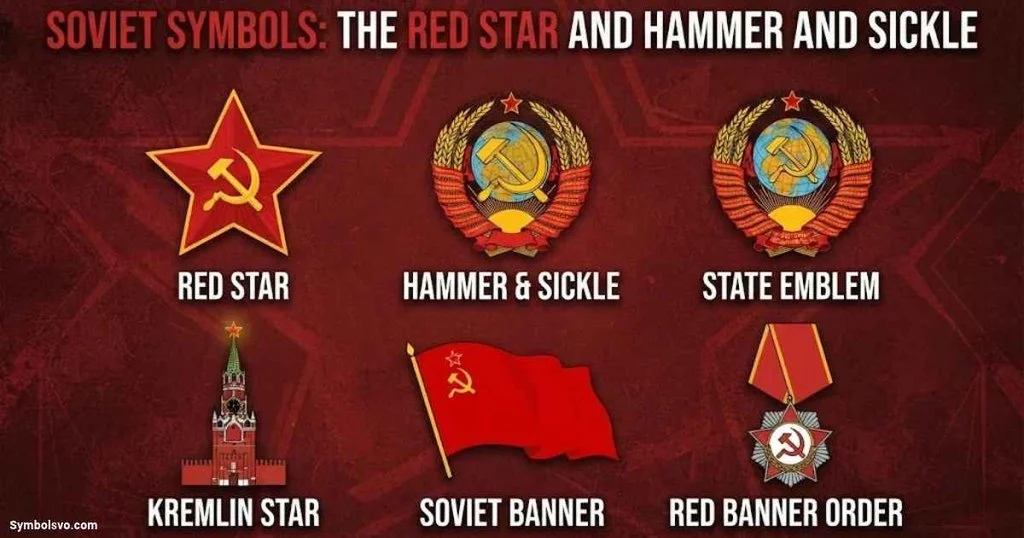
The red star and hammer and sickle are among the most recognizable symbols of Soviet history. They were associated with the political system of the former Soviet Union and appeared on flags, military uniforms, official buildings, medals, and state documents.
The hammer and sickle represented the union of industrial workers and agricultural laborers. The hammer stood for workers, while the sickle represented peasants and agricultural communities.
The red star became a prominent Soviet emblem. It appeared on military equipment, uniforms, government insignia, and other official designs.
These symbols remain visible in historical museums, monuments, films, and discussions about twentieth-century Russia.
However, there is an important distinction: Soviet symbols are not the official state symbols of today’s Russian Federation. They belong to the history of the Soviet Union, which dissolved in 1991.
Traditional Russian Clothing and Its Symbols
Traditional Russian clothing reflects regional differences, climate, available materials, and social customs. Historical folk costumes often included embroidered shirts, skirts, dresses, belts, aprons, and decorative headdresses.
Two important styles are the sarafan and the poneva. Their designs differed, and they were more common in particular regions.
Sarafan
The sarafan is a long, sleeveless dress traditionally worn over a shirt or blouse. It became especially popular among women in northern and central parts of Russia.
Traditional sarafans could be made from linen, cotton, silk, or brocade. Everyday versions were often simpler, while festive clothing featured expensive materials and detailed embroidery.
A typical outfit could include:
- A long linen shirt.
- A sleeveless sarafan.
- A decorative belt.
- An apron.
- A scarf or traditional headdress.
- Embroidered details around the sleeves and neckline.
The sarafan became a recognizable part of Russian women’s folk costume. Its shape and decorative patterns varied from one region to another.
Poneva
The poneva is a traditional wraparound or gathered skirt associated particularly with southern Russian folk clothing.
Unlike the sarafan, which is a sleeveless dress, the poneva was usually worn around the waist with a separate shirt. It often featured checked or striped fabric and could be combined with an apron, sash, and decorative headdress.
The main features of a traditional poneva outfit included:
- A gathered or wraparound skirt.
- A long embroidered shirt.
- A belt or sash.
- A decorative apron.
- A traditional head covering.
- Regional patterns and fabric designs.
The poneva was especially common in areas south of Moscow, while the sarafan was widespread in northern and central regions.
Kokoshnik and Traditional Headdresses
The kokoshnik is a traditional decorative headdress associated with Russian women’s clothing. Its shape could be rounded, pointed, or crescent-like, depending on the region and historical period.
Kokoshniks were often decorated with embroidery, pearls, beads, gold thread, and other ornaments. Wealthier versions used expensive fabrics such as velvet and brocade.
They were worn during celebrations, weddings, religious occasions, and other special events. Today, the kokoshnik remains an important image in Russian folk performances, costume collections, and cultural festivals.
Russian Embroidery and Folk Patterns
Traditional Russian embroidery added decoration and regional character to clothing. It appeared around collars, cuffs, sleeves, hems, and aprons.
Common designs included:
- Geometric shapes.
- Flowers and leaves.
- Repeated decorative lines.
- Animal and bird motifs.
- Cross-stitch patterns.
- Regional color combinations.
Some historical communities associated embroidery with protection and good fortune. However, the meanings varied by region and period. It would be misleading to claim that every flower, line, or geometric shape had one fixed meaning throughout Russia.
Russian Folk Art and Decorative Symbols
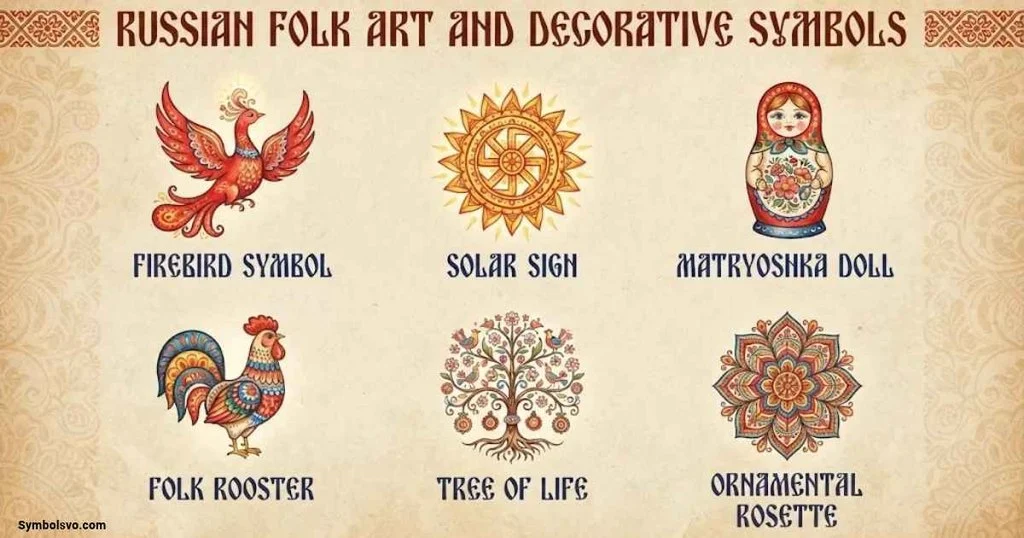
Russian folk art includes a wide range of painted crafts, ceramics, wooden objects, and miniature artwork. Many of these styles became famous because of their distinctive colors and detailed designs.
Khokhloma Painting
Khokhloma is a traditional Russian decorative painting style used on wooden objects. Its most recognizable colors are red, gold, and black.
Artists commonly paint flowers, leaves, berries, and curling branches across wooden bowls, spoons, trays, and other household items.
The gold-like appearance is especially distinctive. Traditional production techniques use special materials and heating processes to create a bright metallic effect without relying on solid gold.
Khokhloma is closely connected with Russian wooden craftsmanship. Its decorative style has also become a recognizable part of the country’s folk-art identity.
Gzhel Ceramics
Gzhel is a well-known Russian pottery tradition recognized for its blue-and-white designs. Artists paint floral patterns, leaves, birds, and decorative scenes onto ceramic objects.
The traditional color combination creates a clear and elegant appearance. Although modern pieces may use different designs, blue paint on a white background remains the most recognizable style.
Gzhel ceramics include:
- Plates and bowls.
- Cups and teapots.
- Decorative figures.
- Vases.
- Souvenir objects.
- Household pottery.
This craft has become an important part of Russian decorative art and is often associated with handmade ceramics.
Palekh Miniature Painting
Palekh miniature painting is a detailed art form traditionally used to decorate lacquered boxes and small objects.
Artists create scenes inspired by Russian fairy tales, literature, historical events, and religious subjects. The paintings often feature fine lines, bright colors, and intricate details.
Palekh developed from an older icon-painting tradition. After the Russian Revolution, some artists adapted their skills to secular objects such as lacquer boxes.
The result is a distinctive style that connects religious artistic techniques with Russian storytelling and decorative craftsmanship.
Firebird in Russian Folklore
The Firebird is a magical creature found in Russian fairy tales. It is usually described as a glowing bird with bright feathers that shine like fire.
In many stories, finding or capturing the Firebird becomes a difficult quest. Its feathers may bring fortune, reveal hidden paths, or lead characters into unexpected adventures.
The Firebird is commonly associated with:
- Beauty and mystery.
- Magic and transformation.
- Good fortune.
- Difficult journeys.
- Hope and discovery.
The creature also influenced Russian music, ballet, literature, and visual art. Igor Stravinsky’s ballet The Firebird, first performed in 1910, helped introduce this figure to international audiences.
Russian Food and Culinary Symbols
Russian cuisine reflects regional ingredients, climate, history, and contact with neighboring cultures. Many traditional dishes developed because people needed filling meals made from ingredients that could be stored or prepared during long winters.
Food is also an important part of family gatherings, celebrations, and hospitality.
Pelmeni
Pelmeni are small dumplings made from thin dough filled with seasoned ingredients, commonly minced meat. Typical fillings include beef, pork, or a mixture of meats, although regional variations may include other ingredients.
The dumplings are sealed into small shapes and boiled before serving. People often eat them with sour cream, butter, black pepper, or vinegar.
Pelmeni are strongly associated with the Ural region and Siberian food traditions. Their compact shape made them practical for storage, and families could freeze large batches for later meals.
Common ingredients include:
- Wheat flour.
- Water.
- Eggs, depending on the recipe.
- Minced meat.
- Onion.
- Salt and pepper.
- Sour cream or butter for serving.
Pelmeni are a popular traditional food, but Russia does not have one universally established official national dish.
Borscht
Borscht is a beet-based soup found in several Eastern European food traditions. It is especially associated with Ukrainian cuisine, although different versions are also prepared in Russia and neighboring countries.
A common version includes beetroot, cabbage, potatoes, carrots, onions, and broth. Some recipes use meat, while others are vegetarian.
Borscht is often served with sour cream and bread. Its deep red color comes mainly from the beetroot.
Because the dish has a shared regional history, it is more accurate to describe it as an important Eastern European food tradition rather than an exclusively Russian invention.
Blini
Blini are thin Russian pancakes that appear in everyday meals and traditional celebrations.
They can be served with sweet or savory toppings, including:
- Sour cream.
- Butter.
- Jam.
- Honey.
- Caviar.
- Smoked fish.
- Cheese.
Blini are especially connected with Maslenitsa, a traditional celebration before the start of Orthodox Lent. During this festival, people gather to eat pancakes, enjoy performances, and take part in seasonal festivities.
Their round shape and golden color are often associated with the sun in popular explanations of Maslenitsa traditions.
Pirozhki
Pirozhki are small pastries that can be baked or fried. Their fillings vary widely, making them a flexible part of Russian food culture.
Popular fillings include:
- Minced meat.
- Cabbage.
- Potatoes.
- Mushrooms.
- Eggs and onions.
- Fruit or sweet fillings.
Pirozhki are often served as snacks, light meals, or additions to soup. Their small size makes them convenient for family gatherings and everyday eating.
Russian Tea Tradition
Tea has a long-standing place in Russian social life. People traditionally served it during family visits, conversations, and gatherings with guests.
One familiar object connected with this tradition is the samovar. This metal vessel was designed to heat water for tea and became a recognizable feature of traditional Russian households.
Tea was commonly served with sugar, jam, pastries, and other sweets. In some households, people placed jam in a small dish and enjoyed it alongside their tea rather than mixing it directly into the cup.
The samovar and tea table became familiar symbols of hospitality and social connection.
Russian Vodka and Its Cultural Significance
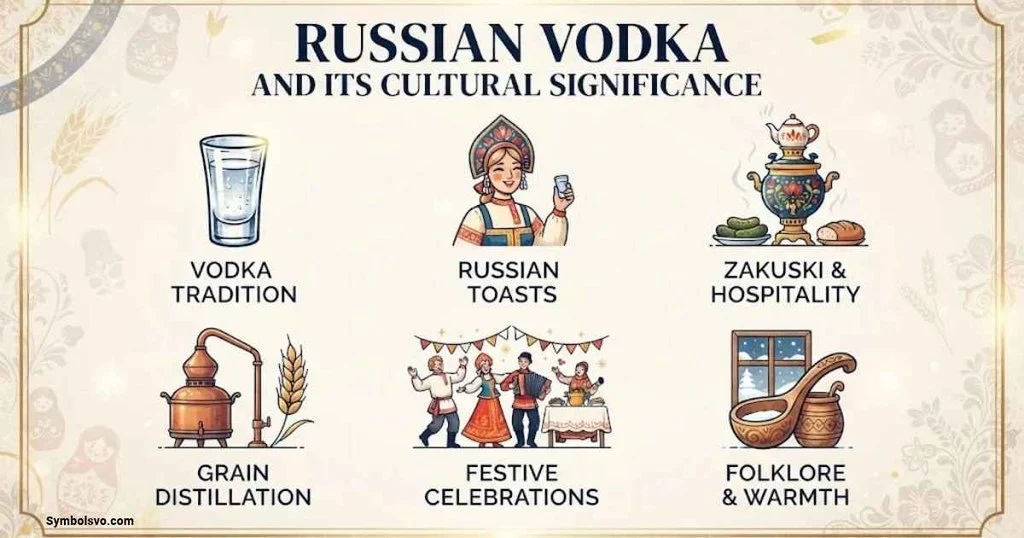
Russian vodka is a distilled alcoholic beverage closely associated with Russian history and popular cultural imagery. It is commonly made from grain-based ingredients, water, and a distillation process that produces a high-strength spirit.
Vodka became an important part of Russian economic and social history. State production and taxation also played a major role in its historical development.
In traditional social settings, vodka has been associated with weddings, celebrations, family gatherings, and other occasions. However, drinking practices differ widely among individuals and communities.
Its reputation as a uniquely Russian drink is partly the result of historical association and international popular culture. Vodka is also produced and consumed in many other countries.
It is important to distinguish the drink’s cultural significance from stereotypes. Vodka does not represent every Russian person or household, and it is not an official national symbol.
Russian Nature and Wildlife Symbols
Russia’s enormous territory includes forests, mountains, rivers, grasslands, and Arctic regions. Its wildlife and natural landscapes have inspired stories, paintings, conservation efforts, and cultural imagery.
Siberian Tiger
The Siberian tiger, also known as the Amur tiger, is one of the most recognizable wild animals associated with Russia’s Far East.
It lives mainly in forest habitats in the Russian Far East, where cold winters and large territories shape its way of life. Its thick coat, powerful body, and distinctive stripes make it one of the world’s most impressive big cats.
The Siberian tiger is important for wildlife conservation. Protecting it also means protecting the forests and ecosystems where it lives.
People commonly associate the animal with:
- Strength and power.
- Wilderness.
- Rarity and conservation.
- Natural beauty.
- Russia’s Far Eastern landscapes.
It is a notable wildlife symbol, but it is not one of the three official state symbols of Russia.
Siberian Fir
The Siberian fir, scientifically known as Abies sibirica, is an evergreen conifer native to northern parts of Eurasia, including Siberia.
It has narrow, needle-like leaves and a tall shape. Its ability to grow in cold environments makes it an important tree in northern forest ecosystems.
Siberian fir has several practical uses:
- Timber and wood products.
- Paper and wood pulp production.
- Essential oil production.
- Traditional forestry applications.
- Landscaping and ornamental planting.
Its evergreen appearance may bring to mind endurance and perseverance, but these are general symbolic interpretations rather than official national meanings.
The Siberian fir should be discussed as an important part of Russia’s natural heritage rather than automatically labeled the country’s national tree.
Russian Forests and Landscapes
Russian forests are an important part of the country’s natural and cultural identity. The Siberian taiga, birch woodlands, and northern landscapes appear throughout Russian paintings, poetry, and literature.
These environments influence traditional stories and seasonal customs. They also shape regional food, clothing, architecture, and everyday life.
For many people, the image of Russia includes snow-covered forests, broad rivers, wooden houses, and vast open landscapes. Such imagery is a cultural association, not a single official national emblem.
Other Important Russian Symbols and Traditions
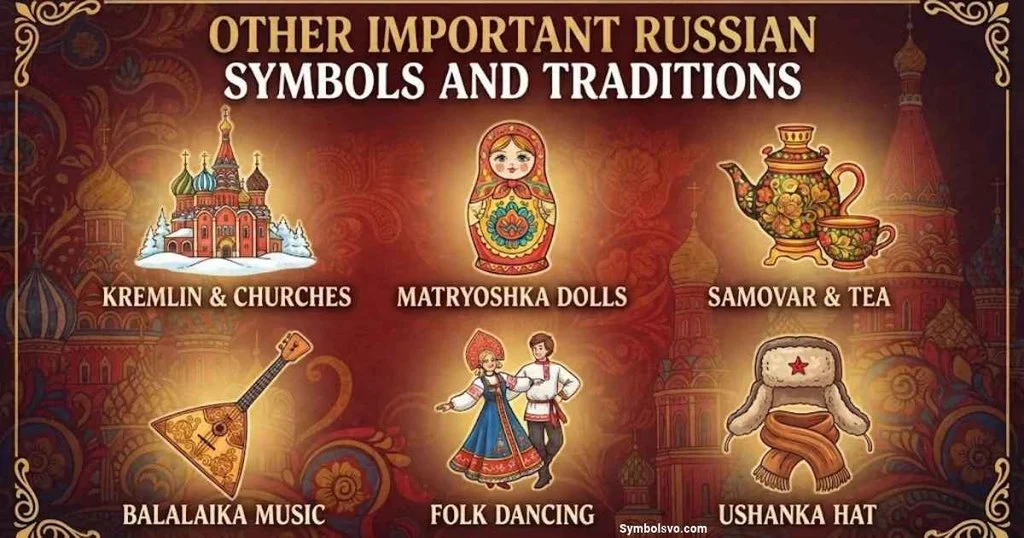
Some symbols are connected with national celebrations, music, currency, and everyday customs rather than government emblems or historical monuments.
Russia Day
Russia Day is celebrated every year on June 12. The holiday marks the anniversary of the 1990 Declaration of State Sovereignty of the Russian Soviet Federative Socialist Republic.
It became an important national holiday after the dissolution of the Soviet Union. Today, celebrations can include concerts, public events, ceremonies, and displays of the Russian flag.
Russia Day is an important occasion for expressing national identity and recognizing the country’s modern statehood. However, it is a national holiday rather than an official state emblem.
The Russian Ruble Symbol
The ruble symbol, ₽, is the familiar sign used to represent Russia’s currency. It was officially approved in 2013.
The symbol combines a Cyrillic letter resembling the Latin letter R with a horizontal line. It appears in financial displays, prices, banking applications, and currency references.
It provides a recognizable visual mark for the Russian ruble in the same way that other countries use their own currency symbols.
The Balalaika
The balalaika is a traditional Russian string instrument recognized by its triangular body and three strings.
It comes in several sizes, from smaller instruments with higher sounds to larger versions with deeper tones. Musicians play it by strumming or picking the strings.
The balalaika is closely associated with Russian folk music. It appears in traditional performances, folk ensembles, concerts, and cultural celebrations.
Its unusual shape and recognizable sound have made it one of the best-known symbols of Russian musical heritage.
Russian Orthodox Onion Domes
Russian churches are often recognized by their colorful onion-shaped domes. These domes appear on many Orthodox religious buildings and have become a familiar part of Russia’s architectural image.
They vary in size, color, and decoration. Some churches have golden domes, while others feature green, blue, or patterned surfaces.
Their design belongs to a wider architectural tradition shaped by regional styles, religious practices, and historical influences. Not every onion dome has the same meaning, and their colors should not be assigned universal symbolic definitions.
What Do Russian Symbols Represent?
Russian symbols represent different parts of the country’s history, government, culture, and natural environment. Some have clear legal definitions, while others have developed through popular use and historical associations.
The following table brings together some of the most recognizable examples.
| Russian symbol | Common meaning or association |
| National flag | Russian statehood and national identity |
| Double-headed eagle | Sovereignty and historical authority |
| National anthem | National identity and official ceremonies |
| Russian bear | Strength, wildlife, and cultural identity |
| Matryoshka dolls | Family, motherhood, and folk craftsmanship |
| Bronze Horseman | Peter the Great and Saint Petersburg’s history |
| Saint Basil’s Cathedral | Russian architecture and Orthodox heritage |
| Moscow Kremlin | Political history and national power |
| Red Square | Public life and Russian history |
| Birch tree | Nature, rural life, and cultural imagery |
| Sarafan | Traditional women’s clothing |
| Poneva | Regional folk costume |
| Kokoshnik | Traditional dress and decorative craftsmanship |
| Khokhloma | Wooden folk art |
| Gzhel ceramics | Blue-and-white pottery |
| Firebird | Folklore, magic, and transformation |
| Pelmeni | Regional cuisine and family traditions |
| Balalaika | Russian folk music |
| Red star | Soviet political and military history |
| Hammer and sickle | Soviet workers and peasants |
| Siberian tiger | Wildlife and conservation |
These associations help explain why Russian symbols are so varied. A state emblem communicates political identity, while a traditional craft may represent a community’s skills and customs.
Official Russian Symbols vs. Popular Cultural Symbols
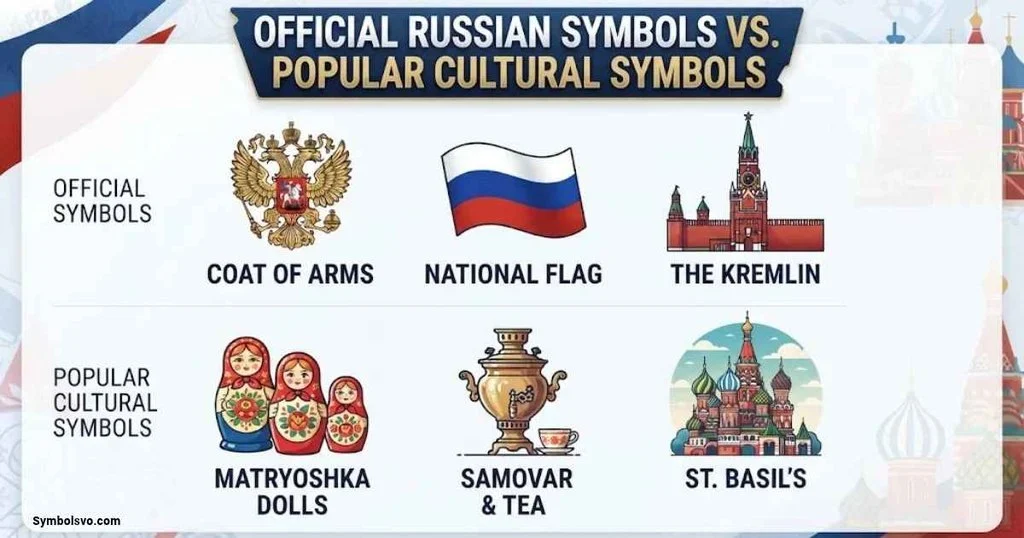
One of the most common mistakes when researching Russian national symbols is treating every famous Russian image as an official state emblem.
The difference is straightforward. Official symbols have a defined legal status, while cultural symbols gain recognition through tradition, history, and popular use.
| Category | Examples | Status |
| Official state symbols | National flag, coat of arms, national anthem | Legally established |
| Currency | Russian ruble | Official national currency |
| Historical symbols | Bronze Horseman, imperial double-headed eagle | Connected with Russian history |
| Cultural symbols | Bear, Matryoshka dolls, balalaika | Widely recognized cultural associations |
| Traditional clothing | Sarafan, poneva, kokoshnik | Regional folk heritage |
| Religious symbols | Orthodox cross and icons | Religious and historical significance |
| Soviet-era symbols | Red star, hammer and sickle | Associated with Soviet history |
| Nature and wildlife | Birch tree, Siberian tiger, Siberian fir | Natural and cultural associations |
This distinction is useful when explaining Russia’s identity. The flag, coat of arms, and anthem represent the state directly. The bear, nesting dolls, and traditional crafts represent broader cultural connections.
Frequently Asked Questions About Russian Symbols
What are the three official national symbols of Russia?
Russia has three principal official state symbols: the national flag, the state coat of arms, and the national anthem. Federal constitutional laws establish their design and official use.
What is the most famous symbol of Russia?
The Russian tricolor flag, double-headed eagle, bear, and Matryoshka dolls are among the country’s most recognizable symbols. The flag and coat of arms have official state status, while the bear and nesting dolls are popular cultural symbols.
What does the Russian flag symbolize?
The Russian flag represents the Russian Federation and its national identity. Its three horizontal stripes are white, blue, and red. People often associate these colors with peace, loyalty, and courage, although these meanings are traditional interpretations rather than official legal definitions.
Why does Russia have a double-headed eagle?
The double-headed eagle became part of Russian state imagery during the reign of Ivan III in the late fifteenth century. It has historical connections with Byzantine and European heraldic traditions and remains the central figure of Russia’s modern coat of arms.
What does the Russian coat of arms represent?
The Russian coat of arms represents the sovereignty and authority of the Russian Federation. Its golden double-headed eagle, three crowns, scepter, orb, and mounted horseman connect modern state identity with Russia’s historical heraldic traditions.
Is the bear the national animal of Russia?
The bear is widely recognized as a symbol of Russia, especially in folklore, political cartoons, and popular culture. However, it is not one of the country’s three official state symbols, and it should not automatically be described as an officially designated national animal.
What do Russian nesting dolls symbolize?
Matryoshka dolls are commonly associated with motherhood, family, generations, and traditional craftsmanship. Their nested design makes them a popular representation of family connections, although these meanings are cultural interpretations rather than formal definitions.
When was the first Matryoshka doll made?
The first widely recognized Russian Matryoshka doll was created around 1890 at a workshop near Moscow. Woodworker Vasily Zvyozdochkin carved the doll, and artist Sergei Malyutin painted it. The dolls became internationally famous after appearing at the 1900 Paris Exposition.
What is the Bronze Horseman in Russia?
The Bronze Horseman is an equestrian statue of Peter the Great in Saint Petersburg. Catherine the Great commissioned it, and French sculptor Étienne Maurice Falconet designed it. The monument was unveiled in 1782 and became an important symbol of the city’s imperial history.
Why is Saint Basil’s Cathedral famous?
Saint Basil’s Cathedral is famous for its colorful onion domes, distinctive architecture, and location in Moscow’s Red Square. Ivan the Terrible ordered its construction, which began in 1555 and finished in 1561. It is part of the UNESCO-listed Kremlin and Red Square site.
What is the traditional clothing of Russian women?
Traditional Russian women’s clothing includes the sarafan, poneva, embroidered shirt, apron, and decorative headdress. The exact outfit depended on the region, occasion, and historical period.
What is the difference between a sarafan and a poneva?
A sarafan is a long, sleeveless dress worn over a shirt or blouse. A poneva is a traditional wraparound or gathered skirt worn around the waist, usually with a separate shirt and other clothing accessories.
What is Russia’s national dish?
Russia does not have one universally established official national dish. Pelmeni, blini, borscht, pirozhki, and other traditional foods are popular parts of Russian cuisine, although several have shared regional histories.
What are pelmeni made of?
Pelmeni are small dumplings made from dough and commonly filled with minced meat, onion, and seasoning. They are usually boiled and served with sour cream, butter, or other toppings.
Why is vodka associated with Russia?
Vodka has a long history in Russia and became connected with social gatherings, celebrations, and the country’s economic history. However, it is also produced in many other countries and does not represent every Russian person’s habits or traditions.
What is the Siberian fir tree?
The Siberian fir, or Abies sibirica, is an evergreen conifer native to parts of northern Eurasia, including Siberia. It grows in cold forest environments and has uses in forestry, wood production, and essential oil production.
Does Russia have an official national flower?
A single officially designated national flower of Russia is not established among the country’s three principal state symbols. Various flowers appear in Russian folk art, literature, and cultural traditions, but they should not be presented as official national emblems without reliable evidence.
What is Russia Day and when is it celebrated?
Russia Day is celebrated on June 12. It marks the anniversary of the 1990 Declaration of State Sovereignty of the Russian Soviet Federative Socialist Republic and is an important modern national holiday.
What is the Russian currency symbol?
The Russian ruble uses the symbol ₽. Its international currency code is RUB, and the symbol appears in prices, financial documents, and payment displays.
Conclusion: The Meaning Behind Russia’s Symbols
Russian symbols offer a fascinating look at the country’s history, traditions, and national identity. Some have official legal status, such as the national flag, coat of arms, and anthem. Others developed through centuries of storytelling, craftsmanship, architecture, religion, and everyday life.
The double-headed eagle connects modern Russia with its historical state traditions. Matryoshka dolls represent a recognizable form of folk art, while the Russian bear became a familiar image of strength and political identity. Landmarks such as Saint Basil’s Cathedral, the Moscow Kremlin, and the Bronze Horseman preserve important parts of the country’s architectural and historical heritage.
Traditional clothing, folk paintings, music, and cuisine reveal another side of Russian culture. Together, these symbols show that Russia’s identity cannot be represented by one flag or emblem alone. Its history and cultural heritage are reflected in a much wider collection of images, objects, and traditions.

I’m Nathan Holloway, a passionate researcher and writer with a deep interest in symbols, signs, and their hidden meanings. I enjoy exploring how symbols have influenced different civilizations, religions, and modern communication. Through my work, I aim to make complex historical and cultural concepts easy to understand for readers of all backgrounds. Every article I write is carefully researched to provide reliable and engaging information.
Books:
- Beyond the Symbol
- The Secret Meanings of Everyday Signs
Author 2: Grace Whitmore
Description:
My name is Grace Whitmore, and I love discovering the stories behind the world’s most fascinating symbols. I spend my time researching ancient civilizations, mythology, spiritual traditions, and modern iconography to uncover the meanings people often overlook. I believe that every symbol has a history worth telling, and I enjoy sharing that knowledge in a simple and reader-friendly way.
Books:
- Echoes of Ancient Symbols
- The Symbolic World
 Mason Ellington