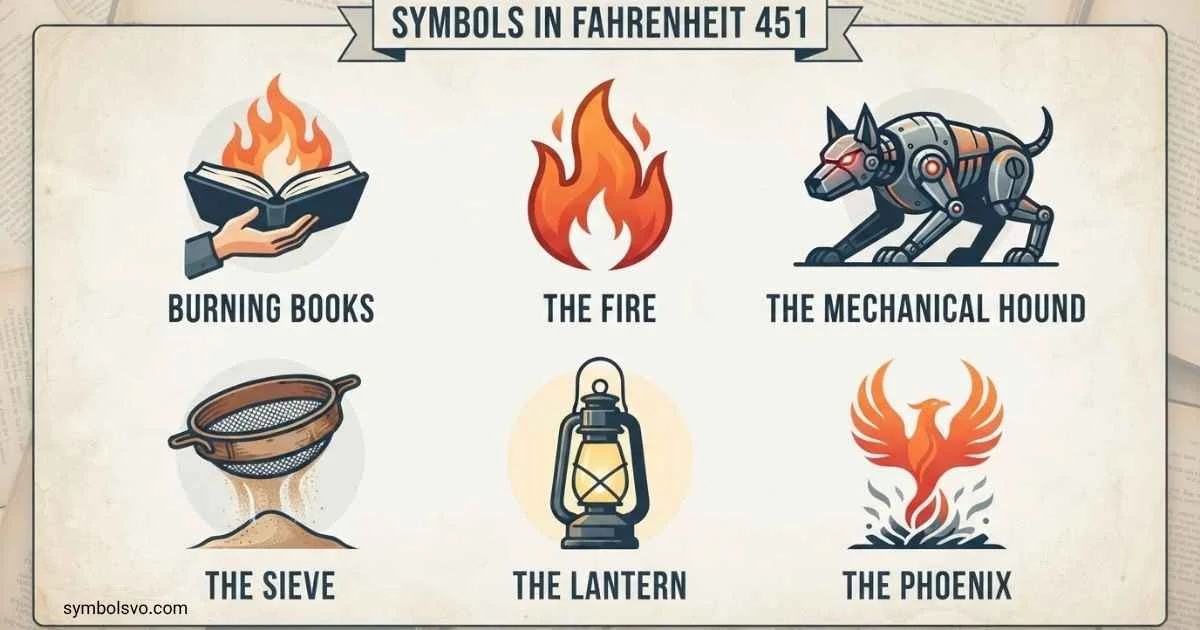
I first noticed that the symbols in Fahrenheit 451 make the story much deeper than it seems. Each one adds meaning to Montag’s journey and helps you understand the novel’s bigger ideas.
As you explore these symbols, I’ll break down what they represent in simple, clear language. You’ll see how fire, books, the phoenix, the sieve, and other important images connect to freedom, knowledge, destruction, and change.
By the end, you’ll have a practical understanding of the major symbols in Fahrenheit 451 and why Bradbury uses them. I’ll also show you how these symbols connect to the novel’s themes and characters.
Quick Answer
Symbols in Fahrenheit 451 are literary devices that represent complex themes like intellectual freedom, spiritual rebirth, and cultural decay. Key symbols, such as fire, the mechanical hound, and the sieve and the sand, act as narrative tools that bridge the gap between the characters’ physical struggles and the deeper, universal search for meaning.
Quick Facts About Symbols in Fahrenheit 451
| Aspect | Information |
| Origin | Literary invention by Ray Bradbury in 1953. |
| Historical Significance | Reflects Cold War fears, McCarthyism, and the rise of mass media. |
| Main Meaning | The struggle between individual thought and oppressive state control. |
| Spiritual Meaning | The phoenix-like possibility of human redemption and consciousness. |
| Cultural Importance | Serves as a vital warning against anti-intellectualism and apathy. |
| Modern Usage | Frequently taught in schools to discuss digital addiction and censorship. |
What Are Symbols in Fahrenheit 451?
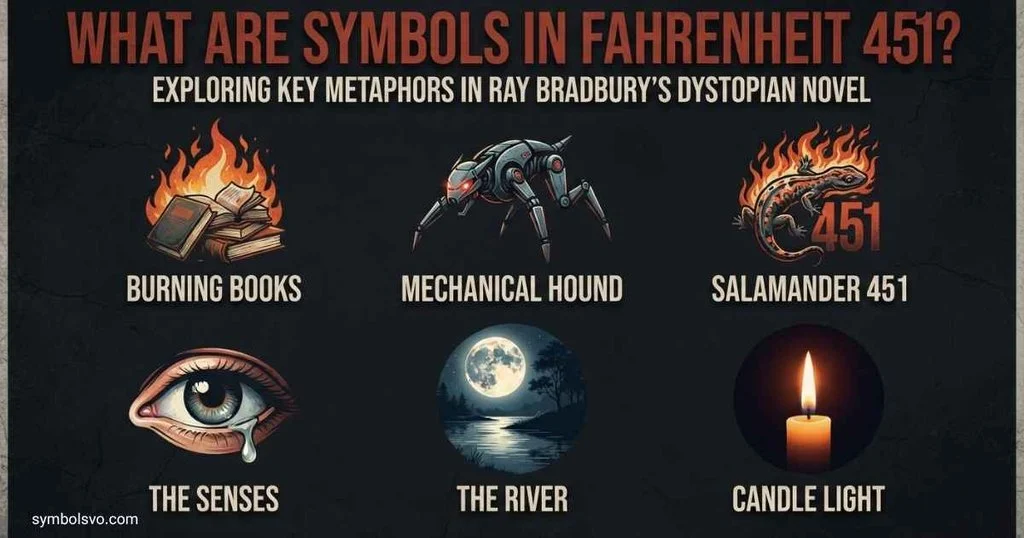
Symbols in Fahrenheit 451 are tangible objects or recurring ideas that carry deeper philosophical significance. Bradbury did not just write a story; he crafted a web of metaphors where every detail, from the temperature of the fire to the nature of the water, holds weight.
These symbols originated from Bradbury’s deep concern for the future of humanity. Writing in the early 1950s, he witnessed the rapid growth of television and a growing trend toward superficial entertainment. He feared that as people became more obsessed with comfort and distraction, they would lose the ability to think for themselves. By embedding symbols throughout his novel, he ensured that his warning would endure long after the specific technologies of his time became obsolete.
Deep Symbolic Meaning of Symbols in Fahrenheit 451
Spiritual Level
On a spiritual level, these symbols chart a journey of inner transformation. The protagonist, Guy Montag, moves from a state of spiritual blindness to a state of awakening. Symbols like the river and the sun represent the cleansing of the soul and the warmth of enlightenment, respectively. They suggest that true consciousness requires letting go of the false light of the television screens to find the authentic light of the spirit.
Psychological Level
Psychologically, the novel is a masterclass in Jungian archetypes. The fireman represents the Shadow, the destructive force that seeks to burn away the inconvenient truth. Conversely, the books represent the Collective Unconscious, the storehouse of human experience and wisdom. The psychological tension between these two forces mirrors our own internal struggle between the comfort of ignorance and the sometimes painful burden of knowledge.
Cultural Level
Culturally, these symbols speak to the danger of a community that has abandoned its history. The symbols of the hearth and the salamander represent a twisted reality where fire, which once brought families together, is used to tear knowledge apart. Through these icons, Bradbury forces us to examine how our current social values might be leading us toward a similar cultural vacuum.
Types and Variations of Symbols in Fahrenheit 451
1. Fire
- Visual Description: Bright, flickering, and all-consuming orange and red flames.
- Meaning: Represents destruction in the hands of the government, but purification when controlled by the individual.
- Symbolism: The duality of technology and human nature.
- Cultural Connection: Mythology of Prometheus and the destruction of the Library of Alexandria.
- Where It Appears: The burning of books, the flamethrower, and the campfire at the end of the story.
2. The Sieve and the Sand
- Visual Description: A childhood memory of trying to fill a sieve with sand.
- Meaning: The futility of trying to grasp knowledge through mindless media.
- Symbolism: The intellectual void created by a society that prioritizes speed over depth.
- Cultural Connection: Parables about wisdom and patience found in Eastern philosophies.
- Where It Appears: During Montag’s traumatic commute on the subway.
3. The Mechanical Hound
- Visual Description: A lethal, spider-like machine with eight legs and a needle that injects poison.
- Meaning: The perfection of technology used to enforce compliance and silence dissent.
- Symbolism: The loss of natural connection and the horror of a dehumanized state.
- Where It Appears: Stalking the corridors of the fire station and hunting Montag.
Symbols in Fahrenheit 451 Across Different Cultures
- Ancient Egypt: The Phoenix, which appears in the book as a symbol of rebirth, was central to Egyptian myth. It represents the cycle of death and resurrection, echoing the hope that knowledge will rise again after it is burned.
- Ancient Greece: The Salamander, the logo on the fireman’s uniform, was believed by the Greeks to live in fire. Bradbury uses this to ironically label the men who start the fires rather than those who survive them.
- Roman Culture: The concept of the Hearth was sacred in Rome. Bradbury subverts this by turning the hearth, once the center of family life, into a place of state-mandated destruction.
- Eastern Traditions: The river in the book acts as a path to enlightenment. In many Eastern traditions, water represents the flow of time and the shedding of the ego, which is exactly what Montag experiences.
- Indigenous Traditions: The use of oral tradition by the book people at the end of the novel reflects the ancient indigenous method of passing down history through memory and storytelling rather than static written records.
Similar Symbols and Their Meanings
Many dystopian novels use similar symbols to explore human themes. Comparing Bradbury’s work to others helps clarify his unique vision.
| Symbol | Fahrenheit 451 | 1984 | The Handmaid’s Tale |
| Fire/Light | Purification & Destruction | The Truth/Reality | Visibility & Exposure |
| Nature | Rebirth & Freedom | A Place of Escape | Fertility & Hidden Truth |
| Technology | Surveillance & Control | Surveillance & Control | Monitoring & Tracking |
Symbols in Fahrenheit 451 in Mythology and Folklore
The most famous mythological reference in the book is the Phoenix. Near the end of the story, Granger compares humanity to a phoenix that burns itself up and then rises from the ashes. This myth serves as the ultimate anchor for the novel’s hope. It suggests that even if we destroy our own culture, the capacity to start over and learn from our mistakes is an inherent part of human nature.
Symbols in Fahrenheit 451 in Pop Culture and Modern Design
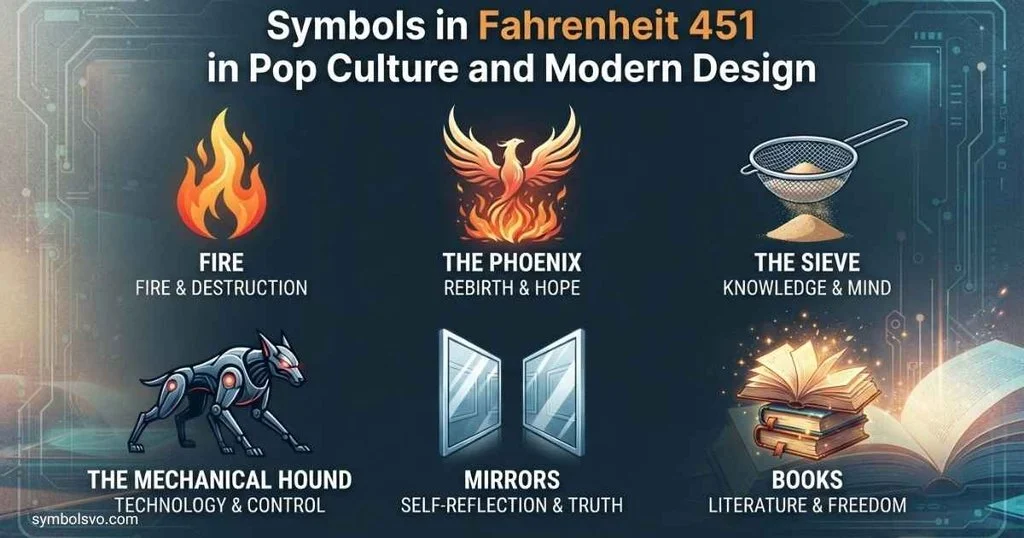
These symbols have transcended the pages of the novel. The image of the burning book has become a universal icon for censorship. In modern art and cinema, references to the mechanical hound appear in discussions about AI and ethics, while the phoenix remains a staple in modern graphic design, symbolizing resilience and the ability to overcome trauma.
Spiritual and Dream Meaning of Symbols in Fahrenheit 451
When these symbols appear in our dreams, they often signal a period of transition. Dreaming of fire can represent an intense internal desire for change, while dreaming of water reflects the need to cleanse oneself of outdated habits. They are powerful reminders that we are in a constant state of becoming, urging us to question the screens we stare at and look for deeper truth.
Positive and Negative Meanings of Symbols
| Symbol | Positive Meaning | Negative Meaning |
| Fire | Warmth, discovery, truth. | Burning, loss, oppression. |
| Books | Wisdom, connection, growth. | Dangerous knowledge, burden. |
| Technology | Progress, convenience. | Isolation, dehumanization. |
Why Humans Are Attracted to Symbols in Fahrenheit 451
We are drawn to these symbols because they articulate our deepest fears and hopes. In a world that is increasingly fast and digital, the struggle for a genuine, slow, and thoughtful life feels incredibly relatable. These symbols act as a mirror, helping us recognize that our search for meaning is not a luxury, but a fundamental human necessity.
Interesting Facts About Symbols in Fahrenheit 451

- The title itself is a symbol; 451 degrees Fahrenheit is the temperature at which book paper spontaneously ignites.
- The mechanical hound’s lack of personality contrasts with the high personality of the book’s human characters.
- Mirrors are used as a symbol for self-reflection throughout the book, forcing characters to see their true selves.
- Bradbury wrote much of the novel on a rented typewriter in the basement of a library, surrounded by the very books he was writing about.
- The “parlor walls” or giant screens are a direct, hauntingly accurate prediction of modern immersive television and social media.
Frequently Asked Questions
What does the phoenix represent in Fahrenheit 451?
The phoenix represents the cycle of destruction and rebirth. It suggests that humanity has the capacity to destroy itself but also the inherent power to rise again and start anew.
Why is the salamander a symbol in Fahrenheit 451?
The salamander is the symbol on the fireman’s uniforms. Traditionally, it was thought to be immune to fire, representing the alternative paradoxical role in a world where fire is used to destroy knowledge.
What is the significance of the river in Fahrenheit 451?
The river symbolizes Montag’s cleansing and his transition into a new, more peaceful life. It represents the barrier between his old, artificial life and the natural, authentic world of the book people.
How does the mechanical hound represent the state?
The hound is a symbol of technology used for oppression. It lacks empathy or moral judgment, representing a society that has traded its humanity for the efficiency of machines.
Conclusion
The symbols in Fahrenheit 451 are a timeless roadmap for the human journey toward truth and self-awareness. By understanding these powerful images, we see that Bradbury’s work is not just a warning about the past, but a light for our own future. Let these symbols remind you to seek depth in a shallow world, to protect the wisdom of others, and to always cherish the freedom to think for yourself.

I’m Daniel Brooks, a content creator and symbol enthusiast dedicated to researching the fascinating world of signs and symbols. I enjoy discovering the hidden meanings behind famous icons, emojis, historical emblems, and cultural symbols. Through my writing, I aim to provide trustworthy, well-researched, and reader-friendly information that helps people learn something new with every visit.
Books:
- The Complete Guide to World Symbols
- The Power of Universal Signs
 Mason Ellington
 Grace Whitmore