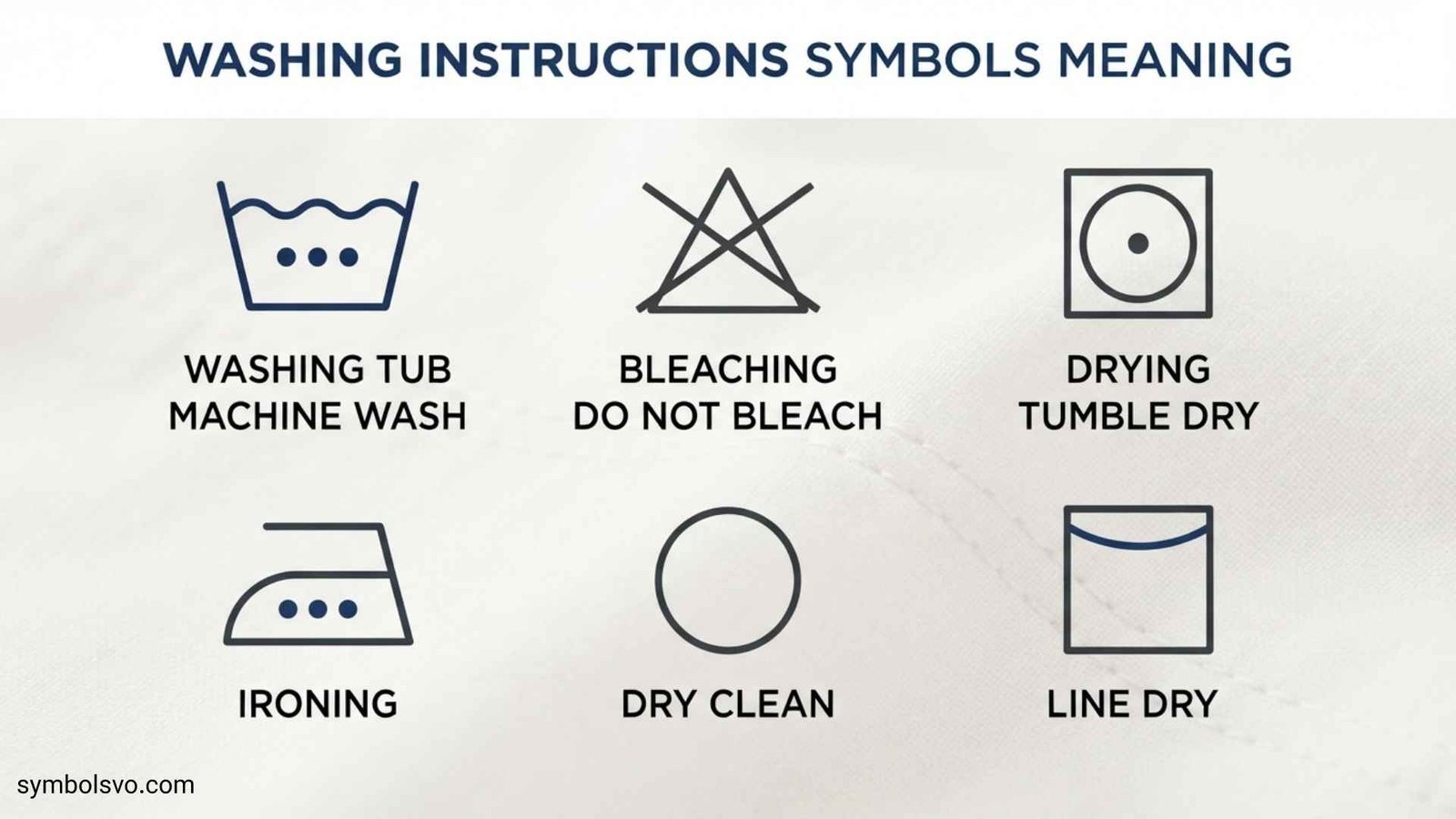
Washing Instructions Symbols Meaning can feel confusing when you see unfamiliar icons on a clothing label. I know how frustrating it can be to wonder if a shirt should be washed, dried, or handled in a special way. You can understand these symbols easily once you know what each one represents.
I’ll help you decode the most common washing, drying, ironing, and bleaching symbols in simple language. You’ll learn what the symbols mean and how they can help you care for your clothes properly.
By the end of this guide, you’ll feel more confident reading laundry labels before putting your clothes in the washer or dryer. You can use these simple symbols as a quick guide to help protect your favorite clothes and keep them looking their best.
Quick Answer
Washing instructions symbols meaning refers to a standardized global system of pictograms on clothing care labels that direct consumers on how to wash, bleach, dry, iron, and professionally clean garments safely. Managed by international bodies like GINETEX, these symbols protect textiles from damage and maximize clothing lifespans.
Quick Facts About Washing Instructions Symbols Meaning
| Aspect | Information |
| Origin | Developed in Europe by GINETEX in 1963 to standardize international textile care. |
| Historical Significance | Replaced confusing multilingual text labels, creating a borderless trading language. |
| Main Meaning | Step by step instructions to optimize fabric longevity and prevent damage. |
| Spiritual Meaning | Rituals of purification, restoration of energy, and honoring our outer shells. |
| Cultural Importance | Fosters a global culture of sustainability, slow fashion, and resource conservation. |
| Modern Usage | Ubiquitous across consumer fashion, global supply chains, and laundry appliance interfaces. |
What Are Washing Instructions Symbols Meaning?
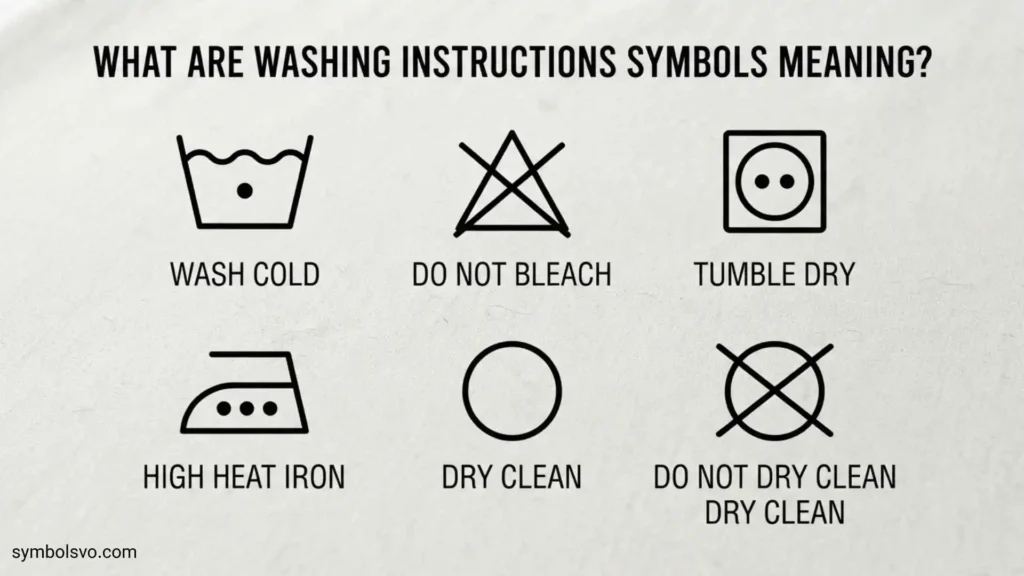
The washing instructions symbols meaning covers a precise visual vocabulary created to solve a massive commercial headache. Before mass manufacturing took over, fabrics were simple, consisting mainly of pure wool, cotton, or linen. Everyone knew how to handle them. However, the mid-twentieth century brought a wild explosion of synthetic fibers like polyester, nylon, and intricate blends. Suddenly, treating a garment incorrectly could melt the fabric or ruin the weave entirely.
To prevent consumer frustration, a European organization named GINETEX introduced a unified visual system in 1963. They realized that words could not easily cross European borders, but icons could.
This smart system splits laundry care into five basic shapes: a washtub, a triangle, a square, an iron, and a circle. Over the decades, these icons became recognized by international standards like ISO 3758. Today, this universal design language ensures that a person in Tokyo, Paris, or New York can care for a garment with identical precision.
Deep Symbolic Meaning of Washing Instructions Symbols Meaning
Spiritual Level
When viewed through a spiritual lens, washing instructions symbols meaning taps into the timeless concept of purification. For millennia, washing clothes was treated as a sacred ritual to cleanse negative energy from the body. These modern icons act as formulas for transformation. They remind us that maintaining the garments we wear is a physical reflection of purifying our soul and consciousness, showing deep respect for the material objects that shield us from the world.
Psychological Level
Psychologically, these laundry symbols satisfy our deep human need for order, predictability, and safety. They touch upon the Caregiver and Ruler archetypes, giving us a comforting sense of control over potential chaos. Shrinking or tearing a garment triggers an emotional vulnerability, reminding us of loss. Following these geometric symbols offers an emotional reassurance that if we follow the rules, our personal world will stay perfectly intact.
Cultural Level
On a cultural level, the washing instructions symbols meaning acts as a shared social agreement about value and preservation. In our modern disposable society, paying close attention to these symbols signals a cultural shift toward slow fashion and intentional living. This visual language reminds communities that clothes are not just temporary commodities, but items of craftsmanship that deserve careful, sustained respect.
Types and Variations of Washing Instructions Symbols Meaning
1. The Washtub (Washing)
- Visual Description: A simple, open vessel filled with wavy water lines.
- Meaning: Governs the precise temperature and cycle speed for machine washing.
- Symbolism: Represents immersion, deep cleansing, and the primal element of water.
- Cultural Connection: Evokes images of communal riverside washing stones used throughout human history.
- Where It Appears: Always listed first on fabric care tags across all apparel.
2. The Triangle (Bleaching)
- Visual Description: An equilateral triangle, sometimes filled with diagonal lines or letters.
- Meaning: Tells the user whether chemical optical brighteners or chlorine agents are safe to use.
- Symbolism: Represents swift chemical action, intense purification, and elemental fire.
- Cultural Connection: Historically mirrors the alchemy signs used to denote reactive chemical transformations.
- Where It Appears: Positioned second on clothing tags to guide color protection.
3. The Square (Drying)
- Visual Description: A perfect square, frequently containing an inner circle or interior lines.
- Meaning: Outlines instructions for tumble drying, air drying, flat drying, or shade drying.
- Symbolism: Represents structure, grounding, stability, and exposure to wind and air.
- Cultural Connection: Reflects traditional outdoor clotheslines hanging in open village squares.
- Where It Appears: Placed carefully in the middle of the label sequence to manage heat exposure.
4. The Iron (Ironing)
- Visual Description: A clear silhouette of a classic, old-fashioned handheld steam iron.
- Meaning: Designates safe heat limits and states whether steam application will ruin the fibers.
- Symbolism: Flattening out wrinkles, smoothing out rough life paths, and pressing away imperfections.
- Cultural Connection: Directly points to industrial-era charcoal irons used to perfect formal attire.
- Where It Appears: Found near the end of the tag sequence, preparing the garment for wear.
5. The Circle (Professional Cleaning)
- Visual Description: A simple, unadorned circle often holding specific interior letters like P, F, or W.
- Meaning: Alerts the consumer that the item requires specialized dry cleaning or wet cleaning.
- Symbolism: Complete cycles, specialized hidden knowledge, and elite protective care.
- Cultural Connection: Reminiscent of ancient shields or protective boundaries that require expert handling.
- Where It Appears: Reserved for the final spot on garment tags, often for luxury or delicate items.
Washing Instructions Symbols Meaning Across Different Cultures
Ancient Egypt
While ancient Egyptians lacked modern synthetic blends, they possessed strict rules for cleaning sacred linen. Priests assigned specific, secret washing instructions to temple garments. They used natron salt and specialized wood ash lye, treating the cleansing process as a spiritual duty required to enter sacred spaces.
Ancient Greece
In Greece, the maintenance of expensive woolen cloaks was outsourced to professional fullers. These artisans used specialized geometric stone stamps on finished fabrics. The marks ensured that owners knew which guild cleaned their clothing, guaranteeing that premium oils and specialized clay were used to treat the wool.
Roman Culture
The Romans scaled up fabric care into a massive urban industry through the Fullonica. These public laundries used specific painted murals on their walls to show workers the correct sequence of cleaning steps. The system functioned exactly like a modern care label, ensuring that workers did not ruin expensive dyed tunics.
Eastern Traditions
In historic Japan, the care of intricate silk kimonos required a specialized process called Arai-hari. The garments were completely unstitched, washed as flat pieces of fabric, and pinned onto wooden boards to dry without wrinkling. Simple brush marks on the hidden inner hems told families exactly how many times the delicate silk had been washed.
Indigenous Traditions
Indigenous communities utilized complex natural systems to clean animal hides and woven plant blankets. They tracked the seasons and specific river locations to wash their materials. Natural rock carvings and oral folklore stories served as permanent washing instructions, warning community members which plants would strip out natural waterproof oils.
Modern Interpretations
Today, globalization has compressed these diverse traditions into a single, sleek visual standard. Modern care symbols bridge all cultural divides, turning a complex chemical science into an easy, intuitive language that works anywhere in the world.
Similar Symbols and Their Meanings
It is incredibly useful to compare how clothing care symbols relate to other everyday consumer markings.
| System | Primary Purpose | Key Focus | Visual Language |
| Washing Symbols | Garment longevity & protection | Thermal and chemical limits | Geometric vessels and bars |
| Recycling Codes | Environmental waste sorting | Material composition | Interlocking arrows with numbers |
| Hazard Icons | Immediate physical safety | Toxic, flammable dangers | Red diamonds with bold drawings |
A common misconception is confusing the care circle with the recycling loop. While recycling loops focus exclusively on what happens after a garment’s life is over, washing icons focus entirely on keeping the garment alive and well for as long as possible.
Washing Instructions Symbols Meaning in Mythology and Folklore
Look closely at mythology, and you will find that the act of washing clothes is filled with powerful omens. In Celtic folklore, the Bean Nighe is a mythical washerwoman found crying by lonely streams. She is seen washing the bloodstained clothing of those who are about to experience tragedy.
In this haunting folklore tradition, the way a garment is washed determines human fate. Our modern washing symbols carry a faint echo of these ancient stories. They remind us that the way we treat our clothes directly influences their survival, acting as an everyday shield against premature ruin.
Washing Instructions Symbols Meaning in Art, Pop Culture, and Design
In the world of high fashion and modern pop culture, designers have actually elevated these hidden laundry tags into bold artistic statements. Brands now print massive versions of these cleaning symbols directly onto the outside of streetwear shirts and luxury tote bags.
[Washtub Icon] —> [Single Underline] —> [Double Underline]
Normal Wash Synthetics Cycle Gentle/Delicate
This design trend turns a boring hidden warning into an ironic badge of honor. In modern graphic design, these symbols are celebrated as masterpieces of minimalist communication. They prove that good design does not need words to tell a clear, compelling story about care and preservation.
Spiritual and Dream Meaning of Washing Instructions Symbols Meaning

If you find yourself dreaming about trying to read a confusing clothing care tag, your subconscious mind is likely processing a real-life situation. Dreams about doing laundry usually represent a deep psychological desire to clear away old emotional baggage, start fresh, or fix a stained reputation.
If the washing symbols in your dream are completely unreadable or blurry, it often points to a cautionary message from your inner self. It suggests that you are feeling overwhelmed by a situation and lack a clear set of instructions to handle your current emotional stress safely.
Positive and Negative Meanings of Washing Instructions Symbols Meaning
Like any highly structured system of rules, care labels carry both comforting and restrictive meanings.
| Positive Meaning | Negative Meaning |
| Empowers users to care for garments with confidence. | Can feel overly confusing or stressful to decode. |
| Saves money by preventing accidental fabric damage. | Adds tedious, time consuming steps to household chores. |
| Supports eco-friendly habits and less landfill waste. | Restricts freedom in how we choose to clean things. |
Why Humans Are Attracted to Washing Instructions Symbols Meaning
Our natural attraction to these symbols comes down to how our brains process visual information. Humans are hardwired to look for clean visual patterns to avoid mental fatigue. Reading long paragraphs of text on a tiny tag inside a shirt would unbelievable anyone inexplicable.
These clever geometric icons allow our brains to gather complex physical data in a fraction of a second. By using a universal visual language, these tags satisfy our basic human desire for simplicity, efficiency, and a feeling of complete control over our daily environment.
Modern Uses of Washing Instructions Symbols Meaning
- Smart Appliances: Modern washers now feature digital cameras that scan care tags and set the cycle automatically.
- Sustainable Fashion: Green brands use oversized symbols to teach buyers how to wash cold and save energy.
- Interior Design: Industrial laundry mats use giant wall decals of the icons as cool, functional art.
- Retail Apps: Digital wardrobe apps let users log these symbols to get automated garment care alerts.
Interesting Facts About Washing Instructions Symbols Meaning
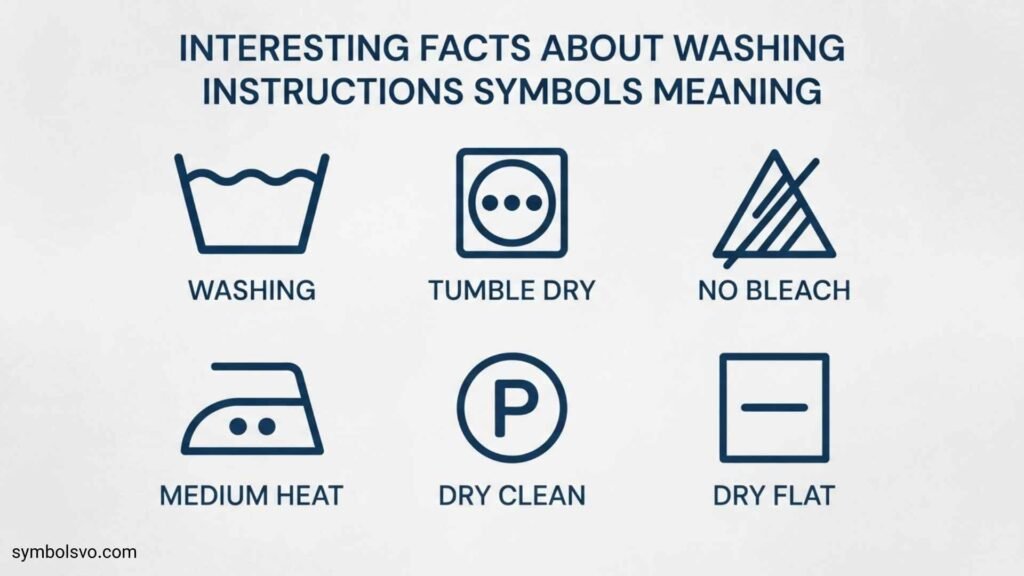
- The single underline beneath a laundry symbol means you should use a mild synthetic cycle, while a double underline demands a very gentle delicate cycle.
- Dots inside an iron silhouette follow a global temperature rule: one dot means cool heat, two dots mean medium, and three dots mean high heat.
- An ‘X’ placed over any care icon serves as a universal warning to stop, meaning do not perform that specific action under any circumstances.
- A circle placed inside a square represents a tumble dryer, while a plain circle means professional dry cleaning only.
- Using correct washing temperatures based on these symbols can slash an average household’s laundry energy use by up to half.
Frequently Asked Questions
What do the dots inside washing symbols mean?
Dots indicate the allowed temperature level. For both washing and drying icons, one dot represents low heat, two dots mean medium heat, and three dots mean high heat settings.
What is the difference between a circle and a circle inside a square?
A plain circle means the garment must be professionally dry cleaned. A circle placed inside a square means the item can be safely dried at home using a standard tumble dryer.
Why do some clothes have an ‘X’ over the symbols?
An ‘X’ over any icon means do not do it. For example, an ‘X’ over a triangle means do not bleach, and an ‘X’ over a washtub means do not machine wash.
Are laundry symbols the same in every single country?
Most countries use the unified international ISO standard managed by GINETEX. However, North America uses a slightly modified ASTM system, though the two systems look very similar.
Conclusion
The washing instructions symbols meaning is a beautiful example of how design protects the things we love. These tiny tag icons connect everyday household chores to a proud, global history of textile art, human psychology, and modern conservation. By taking a quick second to look at and understand these markings, we protect our financial investments and honor the labor that went into making our clothes. Listening to this silent language turns a boring laundry routine into a rewarding act of mindful care.

 Grace Whitmore
 Daniel Brooks