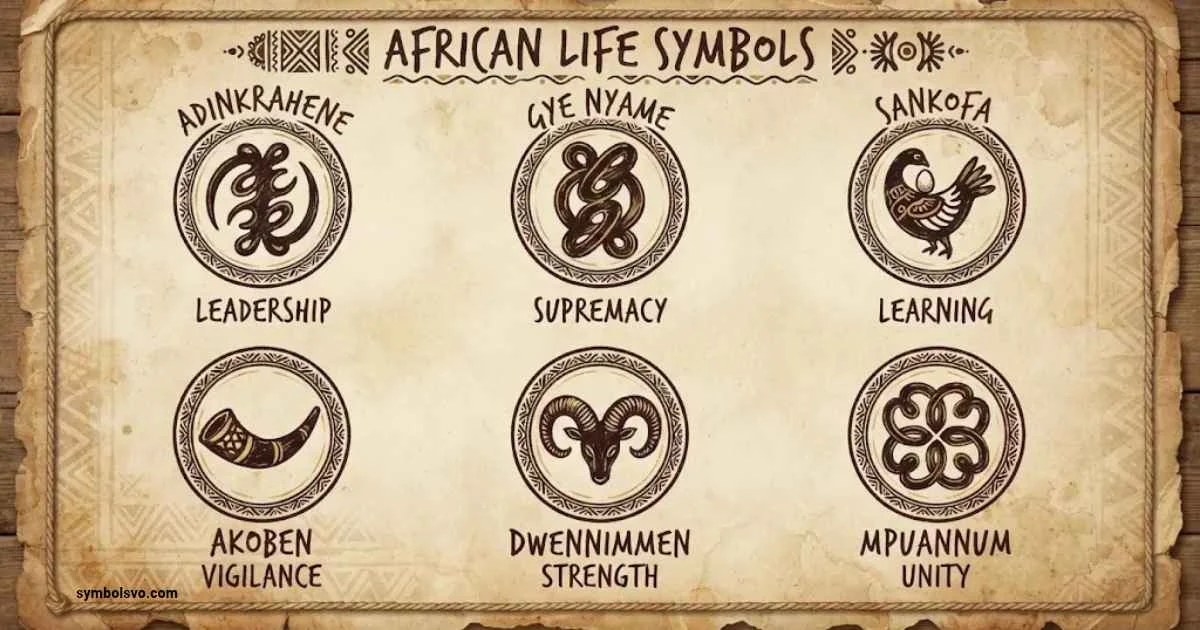
African symbols carry stories about identity, wisdom, spirituality, leadership, and community life. Across the continent, different societies have developed visual traditions to express ideas that words alone cannot always capture. Some symbols appear on ceremonial fabrics, while others decorate buildings, religious objects, jewelry, and everyday belongings.
From Ghanaian Adinkra designs to Nigerian Nsibidi signs and the Luba people’s memory boards in Central Africa, these visual traditions reveal the depth of African cultural heritage. Each system has its own history, artistic style, and cultural purpose.
Many people recognize symbols such as Sankofa, Gye Nyame, and Dwennimmen. However, African symbolism extends far beyond these familiar designs. It includes visual expressions of ancestral wisdom, community relationships, spiritual beliefs, moral values, and historical experiences.
This guide explores traditional African symbols and their meanings, explains their cultural origins, and examines how communities continue using them today. You’ll also discover how different African societies developed their own visual languages and why understanding their original context matters.
What Are African Symbols?
African symbols are visual signs, shapes, patterns, and artistic designs that communicate particular ideas within different African cultures. They can represent religious beliefs, historical events, social relationships, philosophical teachings, and shared community values.
Unlike ordinary decorative patterns, a meaningful cultural symbol communicates something beyond its physical appearance. A carved animal, repeated geometric shape, or stamped textile design may represent a proverb, historical experience, or moral lesson.
For example, the Akan symbol Sankofa encourages people to look toward the past to gain knowledge for the future. Its message connects cultural identity, memory, and personal development.
African symbols appear in several forms, including:
- Textiles: Traditional fabrics decorated with meaningful patterns and designs.
- Architecture: Carved doors, decorated walls, and symbolic building elements.
- Jewelry: Pendants, beads, bracelets, and ceremonial ornaments.
- Woodwork: Carved objects, sculptures, and religious items.
- Body art: Painted designs, tattoos, and other forms of personal decoration.
- Ceremonial objects: Items used during religious, royal, and community gatherings.
It’s important to understand that Africa doesn’t have one universal symbolic language. The Akan, Ejagham, Luba, Kongo, Ndebele, and other communities developed distinct artistic traditions.
Their symbols may sometimes share broad themes such as strength, protection, or unity. However, their meanings depend on the originating culture and historical context.
History and Origins of African Symbols
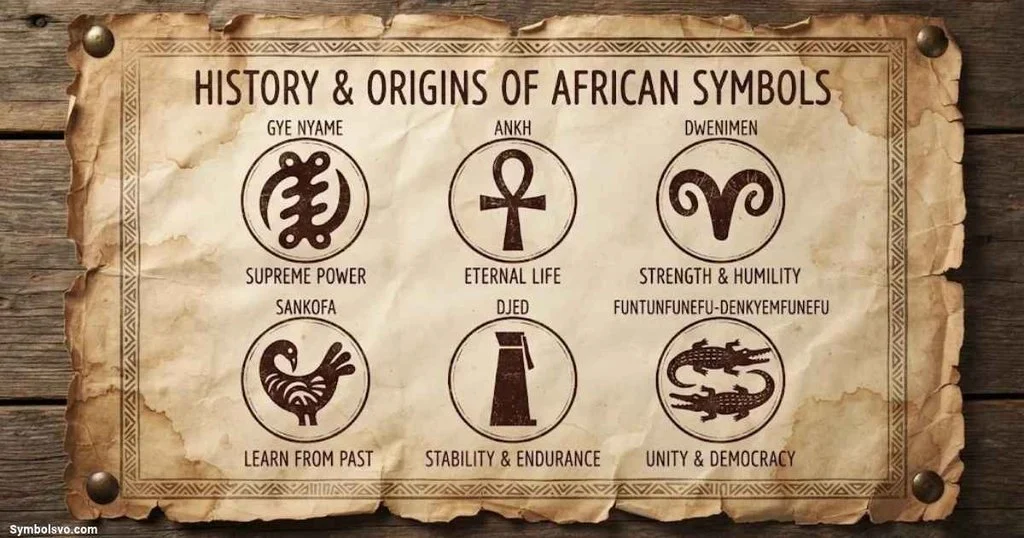
African symbolism developed through centuries of artistic expression, religious practice, political organization, and oral communication. Different societies created visual systems that helped preserve knowledge and express their understanding of the world.
Ancient African Symbols and Early Visual Communication
Long before modern printing and digital communication, African communities used images, markings, and artistic patterns to express ideas.
Ancient Egyptian hieroglyphs provide one of Africa’s most recognizable historical examples of visual communication. This writing system combined signs representing sounds, words, and ideas. It served religious, administrative, and monumental purposes.
Other African societies developed different systems of graphic expression. These included geometric designs, carved objects, body markings, and symbolic decorations.
However, not every ancient image was a written symbol. Some represented animals, people, natural events, or spiritual ideas through artistic expression.
Understanding this difference helps prevent confusion between historical artwork, decorative motifs, and established symbolic systems.
Traditional Symbols in African Kingdoms and Communities
Several African kingdoms developed sophisticated visual traditions connected to leadership, religion, trade, and cultural identity.
The Akan and Asante peoples of Ghana became particularly well known for Adinkra symbolism. Their designs often communicate traditional proverbs and moral teachings.
In southeastern Nigeria and southwestern Cameroon, the Ejagham people developed Nsibidi, an indigenous graphic communication system. Neighboring communities also adopted and adapted aspects of this visual tradition.
The Luba people of Central Africa developed Lukasa memory boards, which helped trained members preserve and interpret historical and political knowledge.
Meanwhile, Kongo communities developed spiritual visual traditions that included cosmograms and other meaningful designs.
These examples demonstrate that African visual language developed through many independent cultural traditions rather than one shared system.
How African Symbols Passed Between Generations
Traditional African communities often preserved knowledge through oral teaching, artistic practice, and community participation.
Elders, craftspeople, religious specialists, and traditional leaders played important roles in passing cultural knowledge to younger generations.
Several methods helped preserve symbolic traditions:
- Oral storytelling: Elders explained historical events, proverbs, and traditional beliefs.
- Traditional craftsmanship: Artists taught younger generations how to carve, stamp, weave, and decorate objects.
- Ceremonies: Community gatherings reinforced shared values and cultural practices.
- Family traditions: Parents passed down customs, stories, and meaningful objects.
- Traditional education: Experienced members taught younger people how to understand particular symbols.
This process supported cultural preservation and allowed communities to maintain their identities across generations.
Different Types of African Symbols
African symbols communicate many kinds of ideas. Some focus on spirituality, while others represent social relationships, natural objects, historical experiences, or philosophical teachings.
Understanding these categories makes it easier to explore their meanings.
Traditional African Cultural Symbols
Traditional cultural symbols reflect the identity, customs, and shared experiences of particular communities.
They may represent family connections, historical events, traditional leadership, or important community values.
For example, Adinkra designs often communicate Akan proverbs and ideas about human behavior. Their meanings connect visual art with African philosophy, morality, and everyday experience.
Cultural symbols can appear on:
- Traditional clothing and ceremonial fabrics.
- Royal ornaments and decorative objects.
- Household items and carved furniture.
- Community buildings and gathering places.
- Religious and cultural artifacts.
African Spiritual and Religious Symbols
Spiritual symbols express beliefs about divine power, ancestors, human existence, and the relationship between the physical and spiritual worlds.
In Akan culture, Gye Nyame represents the supremacy of God. Other Adinkra designs communicate ideas about divine grace, faith, and spiritual protection.
Kongo cosmograms provide another example of spiritual symbolism. Their visual arrangements connect ideas about life, death, transformation, and the relationship between different realms of existence.
These traditions reflect different understandings of African spirituality. Their meanings shouldn’t be treated as interchangeable.
African Animal Symbols
Animals appear frequently in African artistic traditions because they represent recognizable qualities, behaviors, and relationships with the natural environment.
For example:
- Crocodile: Can represent adaptability and survival in particular traditions.
- Ram: Associated with strength and humility in the Adinkra symbol Dwennimmen.
- Elephant: Often represents power, authority, or importance in specific African artistic contexts.
- Spider: Appears in Akan storytelling and is associated with Ananse, a well-known trickster figure.
- Butterfly: Can represent transformation in contemporary interpretations and particular artistic traditions.
Animal symbolism depends on cultural context. The same animal may communicate different ideas in different communities.
African Nature and Plant Symbols
Nature has influenced African symbolism through plants, trees, celestial bodies, landscapes, and agricultural life.
The Adinkra symbol Aya represents a fern and is commonly associated with endurance and the ability to overcome difficulties.
Asase Ye Duru expresses the importance and sacredness of the Earth within Akan cultural interpretation.
Other designs may connect natural elements with renewal, fertility, abundance, and the changing seasons.
These ideas reflect environmental stewardship, traditional knowledge, and the relationship between communities and their surroundings.
African Geometric and Decorative Symbols
Geometric patterns are common in African textiles, pottery, architecture, and decorative arts.
Artists use circles, lines, triangles, diamonds, and repeated arrangements to create visually striking compositions.
However, a geometric pattern doesn’t automatically have a specific symbolic meaning. Some designs primarily serve decorative or structural purposes, while others carry established cultural associations.
The distinction matters when interpreting African symbolic art. Accurate explanations should identify the originating tradition rather than assign universal meanings to common shapes.
Adinkra Symbols: The Famous Ghanaian Symbolic Tradition
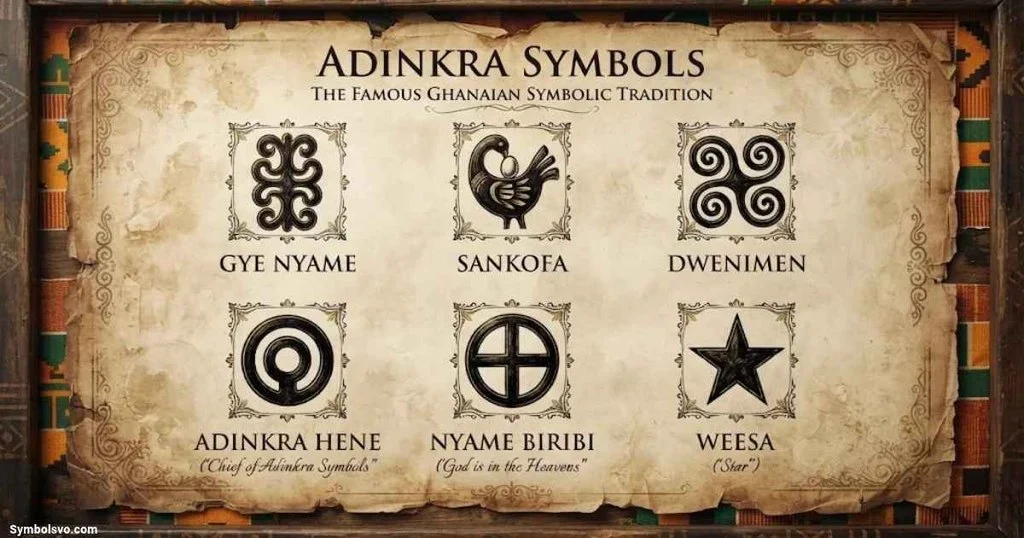
Among the many traditional African symbols, Adinkra holds a particularly important place. This visual tradition comes from the Akan cultural world of Ghana, especially the Asante people.
Adinkra designs communicate ideas through recognizable shapes and motifs. Many connect directly with proverbs, historical experiences, human behavior, and philosophical teachings.
The symbols appear on traditional cloth, decorative objects, architecture, and contemporary designs. Their meanings make them an important part of Ghanaian cultural heritage.
What Are Adinkra Symbols?
Adinkra symbols are traditional Akan visual motifs that communicate messages through artistic designs.
The word Adinkra is associated with saying goodbye or farewell in Twi. This connection reflects the historical use of Adinkra cloth during funerals and other occasions associated with remembrance.
Each symbol has a name and an associated meaning. Some represent physical objects, such as a crocodile or a comb. Others communicate abstract ideas such as wisdom, patience, freedom, and divine authority.
A well-known example is Nyansapo, commonly called the wisdom knot. It represents wisdom, intelligence, and ingenuity.
Adinkra symbols are particularly interesting because their meanings often connect with traditional Akan proverbs. A simple visual design can communicate a complete philosophical lesson.
Origin and History of Adinkra Symbols
Adinkra’s historical development is closely associated with the Akan and Asante peoples of present-day Ghana.
Historical accounts connect the tradition with the former Gyaman Kingdom, located in an area associated with present-day Côte d’Ivoire. The Asante later became important in the development and wider use of Adinkra cloth.
The tradition became especially visible through ceremonial textiles worn during funerals and other significant occasions.
One important historical record dates to 1817, when British traveler Thomas Edward Bowdich collected an Adinkra cloth. The object is now held in the British Museum. This provides an early documented example of the textile tradition.
Over time, Adinkra designs moved beyond their earlier ceremonial settings. They became recognizable elements of Ghanaian artistic identity and eventually gained international recognition.
How Adinkra Symbols Are Made
Traditional Adinkra cloth involves a distinctive process of preparing fabric, creating stamps, producing dye, and printing designs.
Artisans traditionally use several materials and techniques:
- Calabash stamps: Craftspeople carve designs into dried gourd pieces.
- Traditional cloth: Cotton fabric provides the surface for printing.
- Natural dye: A dark pigment is prepared using tree bark and other materials.
- Hand stamping: Artisans press carved stamps onto the fabric to create repeated patterns.
- Pattern arrangement: Different motifs appear in organized arrangements across the cloth.
Traditional Adinkra ink often uses bark from the Bridelia ferruginea tree. The resulting dark pigment creates recognizable designs against the fabric.
Saint Louis Art Museum+1
The finished cloth can communicate several ideas at once. A person may select particular motifs to express remembrance, respect, faith, or other messages.
What Makes Adinkra Symbols Different?
Adinkra stands out because its designs combine visual art with language, philosophy, and cultural knowledge.
Its main characteristics include:
- Named motifs: Individual designs have recognized names.
- Proverbial meanings: Many symbols connect with Akan sayings and teachings.
- Visual storytelling: A design can communicate a message without a written explanation.
- Cultural identity: The motifs preserve aspects of Akan history and values.
- Artistic flexibility: Artists combine different symbols to create meaningful compositions.
An important historical example is the Adinkra cloth worn by Asante King Agyeman Prempeh I in 1896. Its collection of motifs communicated strength, resilience, and awareness of political danger during his meeting with British authorities.
Adinkra Symbols vs. Kente Patterns
Adinkra and Kente are both important Ghanaian textile traditions, but they use different production methods and visual approaches.
| Feature | Adinkra | Kente |
| Main technique | Stamping or printing | Strip weaving |
| Traditional materials | Cotton cloth and natural pigment | Woven textile strips |
| Visual appearance | Repeated named motifs | Colorful geometric arrangements |
| Cultural associations | Akan proverbs, values, and messages | Identity, prestige, history, and cultural expression |
| Traditional use | Funerals and ceremonial occasions | Royal, festive, and ceremonial clothing |
Adinkra designs communicate through named symbols and their meanings. Kente is particularly recognized for its woven structure, colors, and patterns.
Neither tradition is simply decorative. Both preserve important aspects of Ghanaian artistic knowledge.
African Symbols and Their Meanings: Traditional Symbols Explained
The following collection explores widely recognized African symbols, particularly those associated with the Akan and Asante traditions.
Because many familiar symbols come from Adinkra, their meanings should be understood within that cultural setting. Other African visual systems have their own distinct interpretations.
The explanations below focus on established and commonly documented associations rather than assigning invented meanings.
Popular Adinkra Symbols and Their Meanings
| Symbol | Common meaning | Cultural message |
| Gye Nyame | Supremacy of God | Divine power and authority |
| Sankofa | Learning from the past | Use history to guide the future |
| Adinkrahene | Leadership and greatness | Good leadership influences others |
| Dwennimmen | Strength and humility | Balance power with modesty |
| Funtunfunefu-Denkyemfunefu | Unity and cooperation | Different individuals share responsibility |
| Denkyem | Adaptability | Adjust to changing circumstances |
| Akoma | Patience and tolerance | Develop emotional strength |
| Akoma Ntoaso | Agreement and understanding | Build harmony through cooperation |
| Nkonsonkonson | Unity | Human relationships create collective strength |
| Nyansapo | Wisdom | Intelligence requires thoughtful judgment |
| Mate Masie | Wisdom and listening | Understand before responding |
| Wawa Aba | Toughness | Remain strong during difficulties |
| Aya | Endurance | Overcome adversity |
| Fawohodie | Freedom | Independence carries responsibility |
| Mpatapo | Reconciliation | Resolve disagreements peacefully |
| Bi Nka Bi | Peace | Avoid unnecessary conflict |
| Osram Ne Nsoromma | Love and faithfulness | Maintain loyalty in relationships |
| Duafe | Beauty and cleanliness | Care, grooming, and feminine qualities |
| Bese Saka | Prosperity | Wealth and abundance |
| Akofena | Courage | Defend important values |
| Akoben | Vigilance | Stay alert and prepared |
| Nyame Dua | Divine presence | Recognize sacred protection |
| Nsoromma | Heavenly child | Divine guardianship |
| Hye Won Hye | Endurance | Remain strong through challenges |
| Mmere Dane | Change | Life and circumstances evolve |
| Sesa Wo Suban | Transformation | Improve your character |
| Ananse Ntontan | Wisdom and creativity | Use intelligence and resourcefulness |
| Dame-Dame | Strategic thinking | Solve problems through intelligence |
| Ese Ne Tekrema | Friendship and interdependence | Relationships require cooperation |
| Odo Nnyew Fie Kwan | Enduring love | Genuine affection maintains its connection |
| Fihankra | Family security | A protected and united home |
| Eban | Protection | Safety and security |
| Akoko Nan | Parenting and nurturing | Care should include responsible discipline |
| Nkrabea | Destiny | Life has a personal direction |
| Akwaaba | Welcome | Show hospitality and kindness |
| Tabono | Strength and determination | Work hard toward your goals |
Meanings are concise summaries. Traditional interpretations can vary, and English translations may not capture every cultural detail.
African Symbols of Strength and Courage
Strength is an important theme in many African artistic and philosophical traditions. It can describe physical power, emotional endurance, courage, or the ability to face difficult circumstances.
Several Adinkra symbols communicate these qualities.
Dwennimmen – Strength with Humility
Dwennimmen represents the horns of a ram. Its message connects physical strength with humility and self-control.
The symbol teaches that genuine strength doesn’t require arrogance. A capable person can remain confident while respecting others.
Wawa Aba – Toughness and Perseverance
Wawa Aba represents the seed of the wawa tree. Its traditional association with toughness reflects the ability to withstand hardship.
It encourages determination, patience, and resilience when circumstances become challenging.
Aya – Endurance and Resourcefulness
Aya represents a fern. Its meaning relates to endurance and the ability to overcome adversity.
The symbol encourages people to remain resourceful when facing difficult situations.
Akofena – Courage and Heroism
Akofena represents a ceremonial or state sword. It communicates courage, bravery, and authority.
Its association with traditional leadership also connects it with responsibility and protection.
Okodee Mmowere – Strength and Bravery
This symbol represents the talons of an eagle. It communicates strength, power, and bravery.
Its imagery draws on the eagle’s ability to seize and hold its prey.
African Symbols of Wisdom and Knowledge
Wisdom involves more than collecting information. It requires understanding, judgment, experience, and the ability to make thoughtful decisions.
Akan symbolism communicates these ideas through several recognizable designs.
Nyansapo – The Wisdom Knot
Nyansapo represents wisdom, intelligence, and ingenuity.
Its message suggests that genuine wisdom requires careful thought and practical understanding.
Sankofa – Learning From the Past
Sankofa is among the most recognized Adinkra symbols. It commonly appears as a bird looking backward while moving forward.
The symbol teaches that remembering the past helps people make better decisions. It doesn’t encourage living in history. Instead, it promotes learning from experience.
Mate Masie – What I Hear, I Keep
Mate Masie expresses the importance of listening, understanding, and remembering valuable knowledge.
Its lesson emphasizes thoughtful communication rather than speaking without considering what others say.
Ananse Ntontan – Spider’s Web
Ananse Ntontan represents the spider’s web and is associated with wisdom, creativity, and ingenuity.
Its name connects with Ananse, the spider figure in Akan folklore. Ananse stories often explore intelligence, cleverness, and human behavior.
Dame-Dame – Strategic Thinking
Dame-Dame refers to a traditional board game. Its symbolism connects with intelligence, planning, and problem-solving.
It highlights the value of thinking ahead rather than relying on chance.
African Symbols of Love, Family, and Friendship
Family relationships and social connections play important roles in many African cultural traditions.
Symbols associated with these themes communicate affection, loyalty, care, and mutual responsibility.
Osram Ne Nsoromma – Moon and Star
Osram Ne Nsoromma represents the moon and star. It commonly communicates love, faithfulness, and harmony within relationships.
Its imagery suggests a complementary relationship between two elements.
Odo Nnyew Fie Kwan – Love Never Loses Its Way Home
This symbol expresses enduring love and loyalty.
Its message suggests that genuine affection maintains its connection even when circumstances become difficult.
Duafe – Wooden Comb
Duafe represents a traditional wooden comb. It is associated with beauty, cleanliness, care, and feminine qualities.
The design connects personal grooming with dignity and self-respect.
Akoko Nan – Hen’s Leg
Akoko Nan communicates responsible parenting and nurturing discipline.
The symbol is associated with the protective behavior of a mother hen. Its message suggests that caring for children sometimes requires correction alongside affection.
Eban – Fence
Eban represents a fence surrounding a home. It communicates protection, safety, and family security.
The symbol emphasizes the importance of creating a safe environment for loved ones.
Abusua Pa – Good Family
Abusua Pa is commonly associated with family unity, loyalty, and mutual support.
Its meaning reflects the importance of strong family relationships.
African Symbols of Peace and Unity
Unity doesn’t mean everyone must think alike. It means people can work together while respecting their differences.
Several Akan symbols communicate cooperation, reconciliation, and shared responsibility.
Nkonsonkonson – Chain Link
Nkonsonkonson represents connected chain links. It symbolizes unity, human relationships, and collective strength.
Its message emphasizes the importance of social bonds.
Funtunfunefu-Denkyemfunefu – Siamese Crocodiles
This symbol depicts two crocodiles sharing one stomach.
Although they have separate heads, they depend on the same source of nourishment. The design communicates cooperation, unity, and shared responsibility.
Its central lesson is that individuals can harm themselves when they fight over something they must share.
Bi Nka Bi – Nobody Should Bite the Other
Bi Nka Bi communicates peace and nonviolence.
Its imagery discourages hostility and encourages peaceful coexistence.
Mpatapo – Knot of Reconciliation
Mpatapo represents reconciliation, forgiveness, and conflict resolution.
The knot suggests that disagreements can be settled through understanding and mutual respect.
Kuronti Ne Akwamu – Shared Leadership
This symbol represents consultation and shared leadership.
It reflects the importance of collective decision-making rather than depending entirely on one authority figure.
African Symbols of Faith and Spirituality
Spirituality appears throughout African artistic traditions. Many symbols communicate beliefs about God, divine authority, faith, and the relationship between human beings and the spiritual world.
Gye Nyame – Except God
Gye Nyame is one of the most recognizable Adinkra symbols.
It represents the supremacy and greatness of God. Its message expresses the belief that divine power exceeds human authority.
Nyame Nti – By God’s Grace
Nyame Nti communicates faith and dependence on divine provision.
It reflects gratitude for the blessings and nourishment that sustain human life.
Nyame Biribi Wo Soro – God Is in the Heavens
This symbol communicates hope, prayer, and faith in divine guidance.
Its message encourages believers to maintain confidence in God’s presence.
Nyame Dua – Tree of God
Nyame Dua represents a sacred connection with divine presence.
Traditionally, the name is associated with a sacred place or altar connected with prayer and spiritual practice.
Nsoromma – Child of the Heavens
Nsoromma represents a child of the heavens and is associated with divine guardianship.
Its meaning can communicate faith, spiritual care, and protection.
Nyame Nnwu Na Mawu – God Never Dies
This symbol expresses the eternal nature of God and the enduring character of divine power.
It reflects a belief in God’s continued presence beyond human mortality.
African Symbols of Freedom, Justice, and Leadership
Leadership symbols communicate authority, responsibility, justice, and the qualities expected from people who guide communities.
Fawohodie – Independence and Freedom
Fawohodie represents freedom and emancipation.
Its broader message connects independence with personal responsibility. Freedom requires people to make thoughtful decisions and accept the consequences.
Adinkrahene – Chief of Adinkra Symbols
Adinkrahene represents greatness, leadership, and charisma.
It is widely regarded as an important design within the Adinkra tradition. Its message emphasizes the influence of strong leadership.
Nea Ope Se Obedi Hene – He Who Wants to Be King
This symbol teaches that leadership requires service and responsibility.
Its central lesson is simple: authority should come with humility and a willingness to support others.
Epa – Handcuffs
Epa represents handcuffs and has historical associations with law, authority, and captivity.
Its imagery also provides a reminder of the history of slavery and punishment.
Akofena – Sword of Authority
Akofena connects courage with leadership and traditional authority.
Its visual form reflects the importance of defending a community and protecting its values.
African Symbols of Prosperity and Good Fortune
Prosperity symbols communicate abundance, material well-being, hard work, and the importance of productive community life.
Bese Saka – Sack of Cola Nuts
Bese Saka represents cola nuts and is associated with wealth, abundance, and prosperity.
Cola nuts historically held social and economic importance in West African communities. Their use in hospitality and trade adds cultural context to the symbol.
Nserewa – Cowry Shells
Nserewa represents cowry shells, which historically served as important objects of exchange and wealth in several African regions.
The symbol is associated with prosperity and abundance.
Abe Dua – Palm Tree
Abe Dua represents a palm tree and communicates resourcefulness and prosperity.
Palm trees provide useful products, including food, oil, and materials for everyday life.
Nkuruma Kesee – Big Okra
This symbol is associated with fertility, sustenance, and abundance.
Its agricultural imagery reflects the importance of food production and nourishment.
Okuafo Pa – Good Farmer
Okuafo Pa represents diligence, hard work, and dedication.
Its message highlights the value of productive effort and the contribution of agriculture to community well-being.
African Symbols of Nature and Transformation
Nature provides an important source of visual inspiration throughout African artistic traditions.
Trees, plants, celestial objects, and animals often become symbols of endurance, renewal, and changing circumstances.
Mmere Dane – Time Changes
Mmere Dane represents the changing nature of time.
Its message reminds people that circumstances don’t remain the same forever. Adaptability helps individuals respond to new situations.
Asase Ye Duru – The Earth Has Weight
Asase Ye Duru expresses the importance and sacredness of the Earth.
It connects with the idea that land sustains life and deserves respect.
Fafanto – Butterfly
Fafanto represents a butterfly and is associated with transformation and change in commonly circulated Adinkra interpretations.
Its imagery provides a natural way to communicate personal growth and renewal.
Owia A Repue – Rising Sun
Owia A Repue represents the rising sun and is associated with hope and new beginnings.
It communicates the possibility of renewal after a difficult period.
Owo Foro Adobe – Snake Climbing the Raffia Tree
This symbol depicts a snake climbing a raffia tree. It is associated with persistence and determination.
Its message emphasizes the importance of continuing despite difficult challenges.
Other Traditional African Symbol Systems Beyond Adinkra
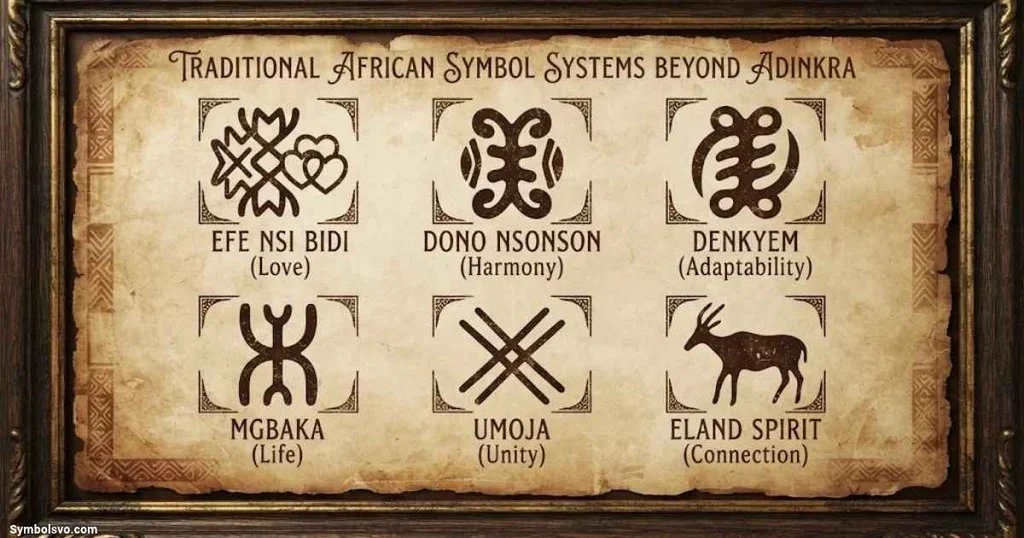
Although Adinkra received considerable international attention, other African communities developed equally interesting systems of visual communication.
These traditions demonstrate the diversity of African cultural symbols and their relationship with history, politics, spirituality, and social organization.
Nsibidi Symbols of Southeastern Nigeria and Cameroon
Nsibidi is an indigenous graphic communication system associated with the Ejagham people of the Cross River region in southeastern Nigeria and southwestern Cameroon.
Unlike ordinary alphabets, Nsibidi uses graphic signs to communicate concepts, actions, relationships, and objects. Its symbols don’t correspond to one spoken language.
The system has influenced neighboring communities, including the Igbo, Ibibio, and Efik.
Nsibidi appears in several artistic forms:
- Decorative textiles known as Ukara.
- Body markings and tattoos.
- Carved objects and masks.
- Architectural decorations.
- Gestures and ground drawings.
Some Nsibidi knowledge historically belonged to specialized associations. Certain signs communicated information that outsiders couldn’t easily interpret.
A particularly interesting example is Ukara cloth, which features Nsibidi designs printed or dyed onto fabric. These textiles could communicate social relationships, authority, and other important matters.
Nsibidi demonstrates that African visual language can function as a sophisticated communication system rather than simply a collection of decorative images.
Luba Lukasa Memory Boards of Central Africa
The Luba people of the Democratic Republic of the Congo developed an unusual visual tradition known as Lukasa.
A Lukasa is a handheld wooden memory board decorated with beads, shells, carved marks, and other materials.
At first glance, its surface may look like an abstract arrangement of objects. However, trained interpreters can use its patterns to recall historical and political information.
Lusaka boards helped preserve:
- Royal genealogies.
- Historical events.
- Migration histories.
- Territorial relationships.
- Political traditions.
- Important cultural knowledge.
Members of the Mbudye association played an important role in interpreting these boards.
Their knowledge helped preserve Luba history and provided a way to maintain records across generations.
The Metropolitan Museum of Art documents a Luba Lukasa memory board from the nineteenth to mid-twentieth century. Its collection description explains how the board communicates aspects of Luba political organization and historical geography.
This tradition is especially important because it shows that traditional African knowledge systems didn’t depend entirely on written books or conventional alphabets.
Kongo Cosmograms and Spiritual Visual Traditions
Kongo cosmograms belong to the visual and spiritual traditions of Kongo-speaking communities in Central Africa.
One widely discussed design is the dikenga, often represented through a cross-like arrangement within a circle.
Its interpretation connects with ideas about the movement of life, spiritual existence, and transitions between different states of being.
The four directional points are commonly explained through stages of existence, although interpretations can differ between scholars and cultural contexts.
The cosmogram is important because it communicates relationships between:
- Life and death.
- Physical and spiritual existence.
- Ancestral knowledge.
- Personal transformation.
- The natural order.
These visual traditions should be understood within their Kongo historical and spiritual setting rather than treated as universal African religious symbols.
Ethiopian Crosses and Christian Symbolism
Ethiopian Christian art has a long history of distinctive cross designs.
The Ethiopian Orthodox Tewahedo Church uses crosses in religious ceremonies, worship, and sacred artistic traditions.
Traditional Ethiopian crosses often feature intricate geometric patterns and carefully arranged openings.
Artisans create different styles using materials such as silver, brass, iron, and wood.
Common examples include:
- Processional crosses carried during religious ceremonies.
- Hand crosses used by clergy.
- Decorative crosses connected with churches and religious objects.
- Elaborate designs associated with regional craftsmanship.
These crosses communicate Christian faith and devotion while preserving distinctive Ethiopian artistic traditions.
Ndebele Geometric Art and Architectural Patterns
Ndebele communities in southern Africa are particularly recognized for colorful geometric wall paintings.
Artists create compositions using strong outlines, repeated shapes, and contrasting colors.
These designs decorate traditional buildings and reflect artistic identity, family traditions, and cultural expression.
Ndebele art often features:
- Repeated geometric patterns.
- Triangles and diamonds.
- Parallel lines and borders.
- Strong color combinations.
- Carefully arranged decorative compositions.
Not every pattern has a fixed symbolic translation. Some communicate cultural identity through artistic style rather than representing one specific idea.
The tradition continues to inspire contemporary painting, fashion, architecture, and graphic design.
What Do African Symbols Represent in Traditional Culture?
African symbols communicate more than individual meanings. They connect people with shared histories, social expectations, religious beliefs, and traditional values.
Their significance becomes clearer when examined within the communities that created them.
Cultural Identity and Ancestral Heritage
Symbols help communities preserve their cultural identity.
Traditional designs can identify particular artistic traditions, historical experiences, and relationships between generations.
For example, Adinkra cloth connects Akan visual expression with proverbs and traditional values. Lukasa boards preserve aspects of Luba history and political organization.
These examples demonstrate how cultural heritage can survive through objects, patterns, and artistic knowledge.
Spirituality, Religion, and Traditional Beliefs
Religious symbols express beliefs about divine power, spiritual protection, ancestors, and human existence.
Gye Nyame communicates the supremacy of God within Akan symbolism. Ethiopian crosses express Christian devotion through distinctive artistic forms.
Kongo cosmograms offer another perspective by representing relationships between life, death, and spiritual existence.
Although these traditions differ, each provides insight into the beliefs of its originating community.
Leadership, Royalty, and Social Authority
Many African societies developed artistic traditions connected to traditional leadership.
Royal objects, ceremonial textiles, stools, crowns, and decorative designs could communicate authority and social position.
In Akan culture, several Adinkra symbols communicate leadership, responsibility, and good governance.
For example, Adinkrahene represents greatness and leadership. Nea Ope Se Obedi Hene teaches that becoming a good leader requires service.
These ideas reflect moral responsibility and the expectation that authority should benefit the wider community.
Wisdom, Proverbs, and Moral Values
Traditional proverbs play an important role in several African societies.
They communicate practical advice about relationships, behavior, responsibility, and everyday decisions.
Adinkra symbols frequently connect visual designs with these proverbial teachings.
Consider three examples:
- Sankofa: Learn from the past to guide the future.
- Nyansapo: Wisdom requires intelligence and thoughtful judgment.
- Mpatapo: Reconciliation helps restore relationships.
Such symbols preserve African ancestral wisdom by turning philosophical lessons into memorable visual forms.
Family, Community, and Social Relationships
Community relationships appear throughout African symbolic traditions.
Symbols associated with friendship, family, hospitality, and unity communicate the importance of cooperation.
Nkonsonkonson represents connected relationships, while Akwaaba expresses hospitality and welcome.
These meanings connect with broader ideas about mutual support, respect, and community responsibility.
How African Symbols Are Used in Traditional Art and Everyday Life
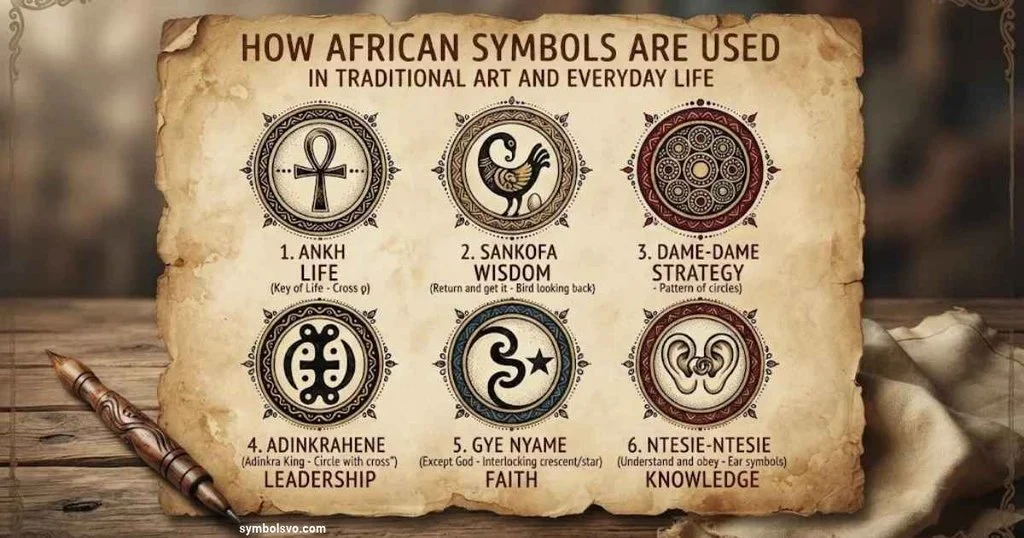
African symbols have historically appeared in many forms of artistic production. Their uses depend on local customs, available materials, and the purpose of particular objects.
African Symbols in Traditional Clothing
Traditional textiles provide one of the most visible ways to explore African symbolism.
Adinkra cloth is especially recognized for its stamped designs. Artisans arrange named motifs across fabric to communicate different messages.
Kente offers another important example. Its woven patterns and colors communicate cultural identity, prestige, and social significance.
Traditional clothing may appear during:
- Weddings and marriage ceremonies.
- Funerals and mourning periods.
- Religious celebrations.
- Royal gatherings.
- Cultural festivals.
The fabric itself can carry meaning through its production technique, colors, patterns, and cultural associations.
African Symbols in Jewelry and Accessories
Jewelry provides another way to preserve and display cultural motifs.
Traditional artisans have used materials such as gold, silver, brass, beads, shells, and wood to create meaningful accessories.
Examples include:
- Pendants featuring Adinkra motifs.
- Beaded necklaces associated with cultural identity.
- Royal ornaments and ceremonial jewelry.
- Bracelets featuring traditional patterns.
- Decorative objects connected with spiritual traditions.
Some accessories communicate wealth or status, while others express religious beliefs or personal connections.
African Symbols in Architecture and Buildings
Traditional African architecture can feature carved doors, decorated walls, geometric patterns, and symbolic objects.
In Asante architecture, Adinkra-derived motifs have appeared in decorative reliefs and building designs.
These elements help connect physical spaces with cultural identity and traditional values.
Architectural decoration may communicate:
- Community identity.
- Religious significance.
- Royal authority.
- Historical remembrance.
- Artistic craftsmanship.
African Symbols in Pottery and Wood Carving
Pottery and wood carving have provided important ways to express cultural knowledge.
Artisans create decorative vessels, sculptures, ceremonial objects, and household items using traditional techniques.
Some designs represent animals, human figures, or spiritual ideas. Others preserve recognizable motifs associated with particular communities.
The materials and craftsmanship also provide information about local artistic traditions.
African Symbols in Storytelling and Oral Traditions
Visual symbolism often works alongside oral storytelling.
A proverb can explain a symbol’s deeper meaning, while a story can provide historical context.
Ananse stories, for example, use a spider character to explore human intelligence, cleverness, selfishness, and problem-solving.
In this way, African folklore helps preserve lessons that can also appear in visual designs and artistic traditions.
African Symbols in Modern Culture and Design
Traditional symbols haven’t disappeared from modern African life. Artists, designers, educators, and cultural organizations continue to use them in contemporary settings.
However, modern interpretations sometimes differ from historical meanings.
African Symbols in Fashion
Contemporary fashion designers use traditional motifs to create clothing that celebrates African heritage.
Adinkra-inspired prints appear on dresses, shirts, scarves, bags, and accessories.
Designers may combine traditional motifs with modern fabrics, silhouettes, and printing techniques.
These designs provide a way to celebrate cultural identity while introducing traditional artwork to new audiences.
African Symbols in Tattoos
African symbols have become popular tattoo designs because many communicate meaningful ideas through recognizable shapes.
Some commonly selected designs include:
- Sankofa: Learning from experience.
- Gye Nyame: Faith and divine supremacy.
- Dwennimmen: Strength with humility.
- Wawa Aba: Perseverance.
- Nyansapo: Wisdom.
- Nkonsonkonson: Unity and connection.
- Mpatapo: Reconciliation and peace.
Before choosing an African symbol as a tattoo, research its cultural origin and traditional meaning.
Some designs have ceremonial, spiritual, or restricted associations. Understanding their context helps prevent inaccurate or disrespectful use.
African Symbols in Jewelry and Accessories
Modern jewelry designers frequently incorporate traditional African motifs into contemporary accessories.
Adinkra pendants, bracelets, earrings, and necklaces provide recognizable examples.
Some designers use traditional meanings directly, while others reinterpret the shapes as decorative elements.
The most responsible approach identifies the original cultural tradition and avoids claiming that every design represents all African communities.
African Symbols in Branding and Graphic Design
Businesses and cultural organizations sometimes use traditional motifs in their visual identities.
Adinkra symbols are particularly recognizable in Ghanaian-inspired branding.
Designers may use them for:
- Cultural organization logos.
- Educational projects.
- Heritage campaigns.
- Community initiatives.
- African-inspired product packaging.
- Event identities.
However, cultural symbols deserve careful treatment. A design associated with a particular community shouldn’t be used in ways that misrepresent its history or meaning.
African Symbols in Digital Art and Social Media
Digital technology has created new opportunities for sharing traditional African artwork.
Artists can now reproduce cultural motifs as illustrations, vector designs, typography, and digital patterns.
Educational platforms also use digital graphics to explain traditional symbols to younger audiences.
These applications help support cultural preservation and make historical knowledge more accessible.
How to Identify and Interpret African Symbols Correctly
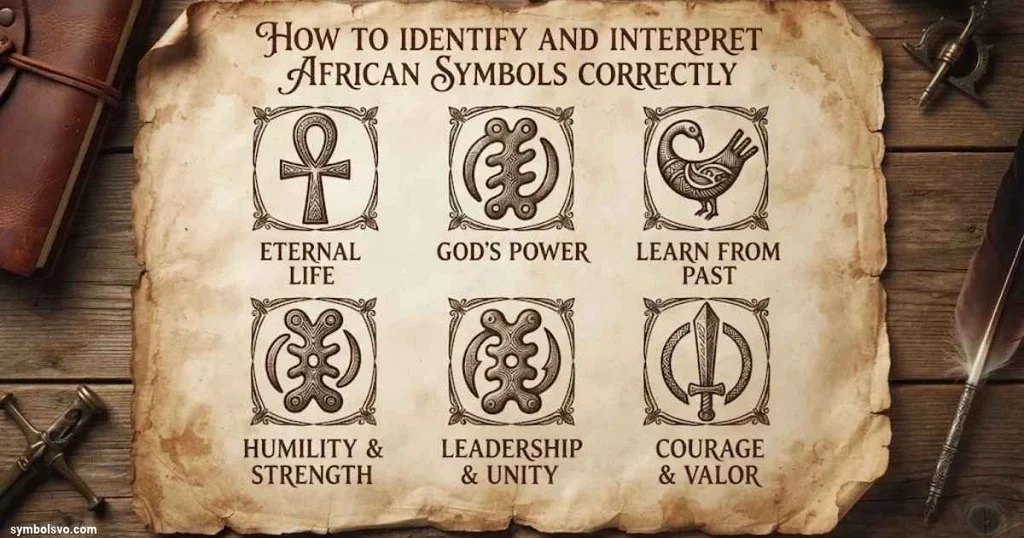
Recognizing a design is only the first step. Understanding its original meaning requires attention to cultural history and context.
Look at the Symbol’s Cultural Origin
Start by identifying the community associated with the design.
For example:
- Adinkra belongs to the Akan cultural tradition.
- Nsibidi is associated with the Ejagham people and neighboring communities.
- Lukasa belongs to the Luba tradition.
- Ethiopian crosses belong to Ethiopian Christian artistic traditions.
- Ndebele geometric painting reflects Ndebele cultural expression.
This first step prevents confusion between unrelated symbolic systems.
Understand the Symbol’s Original Meaning
Research the original name and its traditional interpretation.
For Adinkra symbols, learning the associated Twi name and proverb can provide useful context.
Avoid relying entirely on short social media descriptions. Many online explanations simplify complicated cultural meanings.
Consider the Context in Which It Appears
A design may communicate different things depending on where and how people use it.
A symbol on ceremonial clothing may have a different role from a similar-looking motif in modern graphic design.
Consider:
- Who created the object?
- Which community used it?
- What materials were involved?
- Was it connected with a ceremony?
- Did it represent a religious or political idea?
Understand Regional and Historical Variations
Symbols can change as they move between communities and generations.
Their spelling, appearance, and interpretation may also vary.
For this reason, distinguish between documented traditional meanings and modern interpretations.
A careful explanation should identify uncertainty rather than present every popular definition as an established historical fact.
African Symbols vs. Adinkra Symbols: What’s the Difference?
The terms African symbols and Adinkra symbols are related, but they don’t mean the same thing.
African symbols describe a broad collection of visual traditions across the continent. Adinkra refers to a specific symbolic tradition associated with Akan culture.
| Comparison | African symbols | Adinkra symbols |
| Cultural scope | Multiple African societies | Akan cultural tradition |
| Geographic range | Across the African continent | Particularly Ghana |
| Visual forms | Diverse patterns, signs, and objects | Distinct named motifs |
| Historical context | Varies by community | Akan and Asante history |
| Materials | Textiles, wood, pottery, metal, and more | Traditionally stamped cloth and other objects |
| Meanings | Depend on the originating culture | Often connected with Akan proverbs and values |
| Examples | Nsibidi, Lukasa, Kongo cosmograms | Sankofa, Gye Nyame, Nyansapo |
The main difference is cultural scope.
Adinkra is an important part of African symbolic heritage, but it represents only one of many visual traditions developed across the continent.
Why African Symbols Are Still Important Today
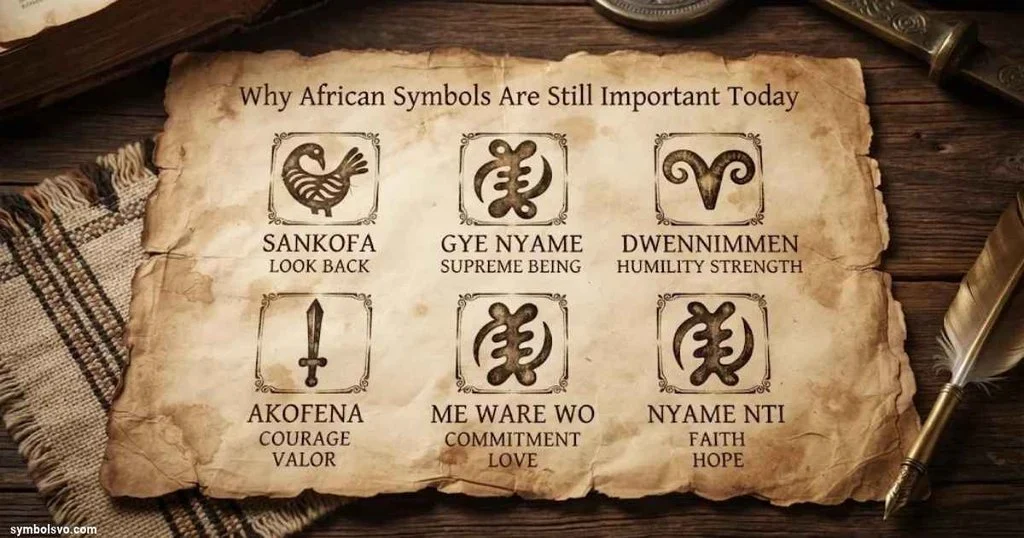
Traditional symbols remain relevant because they connect historical knowledge with contemporary cultural identity.
Their importance extends beyond decoration.
Preserving Cultural Heritage
Traditional symbols help communities maintain artistic practices and historical knowledge.
Teaching younger generations about traditional designs supports the continuation of indigenous craftsmanship.
Museums, cultural institutions, artists, and educational organizations also contribute to this preservation.
Strengthening African Identity
African symbols provide recognizable connections to cultural roots.
For members of the African diaspora, traditional designs can offer opportunities to explore family histories and ancestral connections.
However, learning about a symbol’s actual cultural origin remains essential. African heritage includes many different traditions and experiences.
Educating Future Generations
Symbols provide useful ways to introduce historical and philosophical ideas.
Students can explore traditional proverbs through Adinkra designs, study Nsibidi as a graphic communication system, or learn how Lukasa boards preserve Luba history.
These examples show how art can support education beyond conventional textbooks.
Inspiring Modern Creativity
Traditional African designs continue to influence fashion, graphic design, jewelry, architecture, and contemporary artwork.
Artists can build on these traditions while respecting their original cultural meanings.
This balance helps keep African traditional art relevant without separating it from its historical roots.
Frequently Asked Questions About African Symbols
What Are the Most Famous African Symbols?
Some widely recognized African symbols include Sankofa, Gye Nyame, Dwennimmen, Nyansapo, and Nkonsonkonson. These belong to the Akan Adinkra tradition of Ghana.
Other important examples include Nsibidi signs from the Cross River region and Luba Lukasa memory boards from Central Africa.
What Are African Symbols and Their Meanings?
African symbols are visual signs and artistic designs that communicate ideas within different African cultures.
Their meanings can relate to spirituality, wisdom, leadership, history, family, nature, and community values. Each symbol should be understood within its original cultural tradition.
What Are the 129 African Symbols?
There isn’t one universally accepted collection containing exactly 129 African symbols.
The number 129 sometimes appears in online collections of Adinkra designs. However, African symbolic traditions extend far beyond any single numbered list.
Different collections may include spelling variations, regional designs, and disputed interpretations.
What Are Adinkra Symbols?
Adinkra symbols are traditional Akan motifs, particularly associated with the Asante people of Ghana.
They communicate ideas through visual designs, often drawing on proverbs, historical experiences, and philosophical teachings.
Where Did Adinkra Symbols Originate?
Adinkra’s history is associated with the Akan cultural region and historical connections with the Gyaman Kingdom.
The Asante people played an important role in developing and popularizing Adinkra cloth in Ghana.
What Does the Sankofa Symbol Mean?
Sankofa means learning from the past to build a better future.
Its familiar bird design looks backward while moving forward. It reminds people to remember valuable experiences rather than ignore history.
What Does Gye Nyame Mean?
Gye Nyame is an Akan Adinkra symbol representing the supremacy of God.
Its message expresses divine greatness and the belief that God’s power exceeds human authority.
Which African Symbol Represents Strength?
Dwennimmen is a well-known Adinkra symbol representing strength combined with humility.
Wawa Aba also represents toughness and perseverance, while Aya communicates endurance and the ability to overcome difficulties.
Which African Symbol Represents Wisdom?
Nyansapo, commonly known as the wisdom knot, represents intelligence, wisdom, and ingenuity.
Sankofa also communicates the importance of learning from past experiences.
Which African Symbol Represents Love?
Osram Ne Nsoromma represents love, faithfulness, and harmony.
Odo Nnyew Fie Kwan is another Adinkra symbol associated with enduring love and loyalty.
Which African Symbol Represents Unity?
Nkonsonkonson represents unity and human relationships through its chain-link design.
Funtunfunefu-Denkyemfunefu also communicates cooperation and shared responsibility through its image of two connected crocodiles.
Which African Symbol Represents Protection?
Eban is associated with home security and protection. Nyame Dua also communicates sacred presence and divine protection.
The exact meaning depends on the symbol’s traditional cultural context.
Are African Symbols the Same as Tribal Symbols?
No. African symbols include visual traditions from many ethnic, linguistic, and cultural communities.
The word tribal sometimes oversimplifies these differences. More precise terms, such as Akan symbols, Ejagham symbols, or Luba artistic traditions, provide better cultural context.
Are All African Symbols Religious?
No. African symbols communicate many different ideas.
Some express spiritual beliefs, while others represent leadership, family relationships, historical events, wisdom, justice, cooperation, and artistic identity.
Are Adinkra and Kente Symbols the Same?
No. Adinkra consists of named motifs traditionally stamped onto cloth.
Kente is a woven textile tradition recognized for its colorful patterns and cultural associations.
Both are important parts of Ghanaian heritage, but their production methods and visual structures differ.
Can You Use African Symbols in Tattoos?
Yes, many people choose African symbols for tattoos because of their cultural and philosophical meanings.
However, research the design’s origin before using it. Some symbols have specific ceremonial or spiritual associations, and their meanings shouldn’t be separated from their cultural background.
Are African Symbols Still Used Today?
Yes. African symbols continue to appear in traditional clothing, jewelry, architecture, contemporary fashion, tattoos, branding, and educational artwork.
Artists and cultural organizations also use them to preserve heritage and introduce traditional knowledge to new audiences.
Conclusion
African symbols provide a fascinating look into the continent’s diverse cultural traditions. They communicate ideas about wisdom, faith, courage, love, leadership, community, and the relationship between people and their surroundings.
Adinkra offers one of the most recognizable examples through its connection with Akan proverbs and Ghanaian artistic heritage. However, traditions such as Nsibidi, Lukasa, Kongo cosmograms, and Ethiopian crosses reveal an even broader world of African symbolism.
Understanding these traditions requires more than memorizing names and definitions. It means exploring their histories, communities, artistic methods, and original purposes.
If you’re researching traditional African symbols, exploring their meanings for educational purposes, or learning about your cultural heritage, remember that every visual tradition deserves its own context. That’s what makes African symbols so meaningful and worth preserving.

Mason Ellington is a creative and dedicated Content Writer and Symbols Expert with a passion for words, communication, and symbolic meanings. He specializes in crafting engaging, informative, and well-structured content while exploring the deeper meanings and interpretations behind symbols. With a creative mindset and attention to detail, Mason transforms ideas into meaningful content that informs, inspires, and connects with readers. His expertise combines powerful storytelling, clear communication, and a deep understanding of symbolism.
 Daniel Brooks