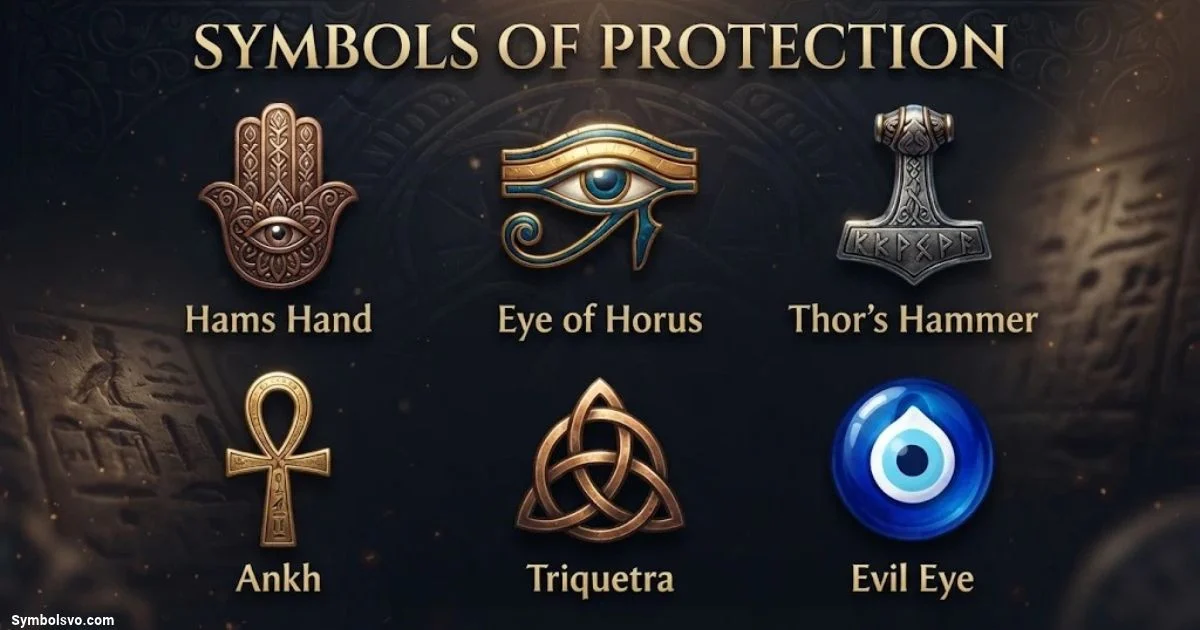
Throughout history, people have turned to symbols for safety, strength, hope, and spiritual guidance. From the ancient Egyptians to the Norse and Celtic cultures, protective signs have appeared in jewelry, religious objects, household decorations, and sacred artwork. Each culture developed its own way of expressing the desire to keep danger and misfortune away.
Today, symbols of protection remain popular around the world. Some people wear a Hamsa Hand necklace to represent protection against the evil eye. Others choose Thor’s Hammer for strength or the Eye of Horus for healing and restoration. These designs carry stories that stretch back centuries.
But what do these symbols actually mean? Where did they originate, and why have people continued to use them? This guide explores 30 ancient protection symbols, their cultural origins, traditional meanings, and modern uses. Whether you’re interested in spiritual protection symbols, good luck symbols, or traditional protective amulets, you’ll discover the history behind each design.
What Are Symbols of Protection?
Symbols of protection are signs, images, objects, or patterns that represent safety, defense, strength, or protection from perceived harm. Different societies have used them to express religious faith, cultural identity, spiritual beliefs, and hopes for good fortune.
Some protective symbols represent a particular deity or religious teaching. Others come from folklore, mythology, sacred geometry, or traditional practices. Their appearance can range from a simple hand or eye to an elaborate knot, geometric pattern, or mythical weapon.
For example, ancient Egyptians placed protective amulets in tombs and wore them as jewelry. In Turkish tradition, the blue Nazar amulet became associated with protection against the evil eye. Norse communities wore hammer-shaped pendants connected to Thor.
What Do Protective Symbols Represent?
Although every symbol has its own cultural background, several themes appear across different traditions.
- Protection from evil: Symbols associated with warding off harmful forces or evil spirits.
- Good luck and fortune: Designs connected to happiness, success, and favorable outcomes.
- Spiritual protection: Religious or sacred signs representing faith and divine guidance.
- Strength and courage: Symbols associated with bravery, resilience, and overcoming challenges.
- Healing and restoration: Images representing recovery, renewal, and well-being.
- Home and family safety: Traditional signs displayed in houses to represent security and household protection.
It’s important to understand that these meanings come from cultural traditions and spiritual beliefs. A symbol’s historical significance doesn’t establish that it can physically prevent harm or change someone’s luck.
Difference Between Protective Symbols, Amulets, and Talismans
People often use these terms interchangeably, but they have slightly different meanings.
| Term | Meaning | Example |
| Protective symbol | An image or design associated with safety or defense | Pentagram |
| Amulet | An object traditionally carried or worn for protection | Nazar Boncugu |
| Talisman | An object believed to attract a particular benefit or influence | Protective or good-fortune charm |
| Sacred symbol | An image connected to religious or spiritual beliefs | Ankh |
| Protective charm | A small object traditionally used as a symbol of good fortune or safety | Hamsa pendant |
An amulet traditionally focuses on protection, while a talisman may represent protection, prosperity, love, or another desired benefit. However, historical and cultural usage sometimes overlaps.
Ancient Symbols of Protection and Their Meanings
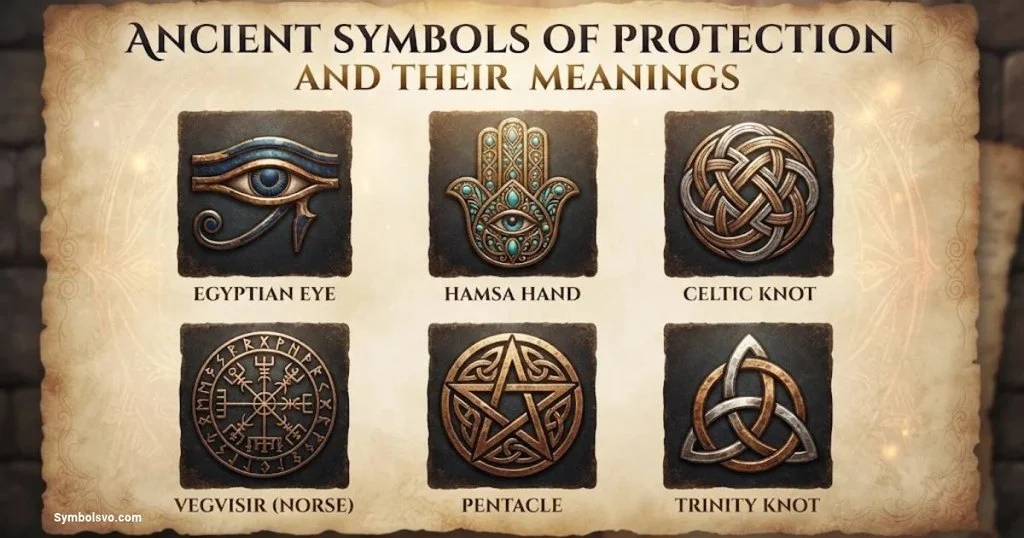
Protective symbols come from different periods and regions. Some have well-documented historical uses, while others became popular through later religious, spiritual, or cultural interpretations.
The following symbols offer a closer look at their designs, origins, and traditional associations.
Hamsa Hand – Symbol of Protection and Good Fortune
The Hamsa Hand is one of the most recognizable symbols of protection. It features an open palm with five fingers, often with an eye placed in the center. People traditionally associate it with protection against the evil eye, happiness, health, and good fortune.
The name comes from words meaning five in Arabic and Hebrew. The symbol appears in Jewish and Muslim cultural traditions, particularly across parts of the Middle East and North Africa. Its history also connects to wider Mediterranean traditions.
The central eye represents protection against harmful looks, envy, and jealousy. Some designs feature decorative flowers, geometric patterns, or religious inscriptions.
Common meanings of the Hamsa Hand:
- Protection against the evil eye.
- Happiness and good fortune.
- Health and well-being.
- Blessings for the home and family.
- Faith and spiritual safety.
You may notice two common orientations. An upward-facing Hamsa is often associated with protection and warding off harm, while a downward-facing version is sometimes connected to blessings and abundance. Interpretations vary between communities.
Today, people wear the Hamsa as necklaces, bracelets, rings, and decorative charms. It also appears on wall hangings and household ornaments.
Eye of Horus – Ancient Egyptian Symbol of Protection
The Eye of Horus, also called the Wedjat or Udjat, comes from ancient Egyptian mythology. It represents protection, healing, restoration, and well-being.
According to Egyptian mythology, Horus lost an eye during his conflict with Set. The god Thoth restored the damaged eye, giving it an important connection to healing and completeness.
Ancient Egyptians used the Wedjat as an amulet and placed it in funerary contexts. Its protective meaning extended to both living people and the deceased.
The design contains several distinctive elements, including a curved eyebrow, a stylized eye, and markings beneath it. These features made it one of the most recognizable images in Egyptian religious art.
Traditional meanings include:
- Protection against danger.
- Healing and restoration.
- Wholeness and completeness.
- Health and well-being.
- Safety during the afterlife.
The Eye of Horus is often confused with the Eye of Ra. Although both have connections to Egyptian deities and appear as protective imagery, they have different mythological identities and associations.
Ankh – Egyptian Symbol of Life and Immortality
The Ankh is an ancient Egyptian symbol shaped like a cross with a loop at the top. It represents life, immortality, and the continuation of existence.
Egyptian gods frequently appear holding an Ankh in temple carvings and tomb paintings. Sometimes they extend it toward a ruler’s face, symbolically offering life or divine breath.
The symbol also appears in Egyptian jewelry, amulets, and religious artwork. Its association with eternal life made it especially meaningful in funerary traditions.
The Ankh commonly represents:
- Eternal life and immortality.
- Divine power and spiritual connection.
- Life and regeneration.
- Protection in religious contexts.
- The relationship between earthly and divine existence.
In modern times, the Ankh appears in jewelry, tattoos, artwork, and spiritual decorations. It also holds significance in some African diasporic religious and cultural settings.
Tyet – Knot of Isis and Symbol of Divine Protection
The Tyet, commonly called the Knot of Isis, is an ancient Egyptian symbol associated with the goddess Isis. Its shape resembles a tied knot with loops extending outward.
Isis held an important position in Egyptian religion. Ancient traditions connected her with motherhood, magic, healing, and protection. The Tyet became closely associated with her protective powers.
Egyptians used Tyet amulets in funerary practices. Archaeological examples often feature red materials, including red jasper and carnelian. These materials carried additional symbolic associations with life and vitality.
Its traditional meanings include:
- Protection through the power of Isis.
- Life and vitality.
- Divine care.
- Safety in the afterlife.
- Healing and restoration.
The Tyet is particularly interesting because it demonstrates how ancient Egyptians used specific objects to express religious beliefs about life, death, and protection.
Pentagram – Five-Pointed Symbol of Protection
The Pentagram is a five-pointed star drawn using five connected lines. It has appeared in several historical and religious contexts, including ancient Greek mathematics and later Western esoteric traditions.
In some modern Pagan and Wiccan traditions, the five points represent earth, air, fire, water, and spirit. These elements symbolize different aspects of the natural and spiritual world.
The pentagram also developed protective associations in Western ceremonial magic. Its meaning depends heavily on the period, culture, and religious context in which it appears.
Common symbolic associations include:
- Spiritual protection.
- Balance between the five elements.
- Harmony and wholeness.
- Connection between nature and spirit.
- Protection against perceived negative influences.
An upright pentagram has different interpretations from an inverted one. However, the inverted form doesn’t have one universal meaning across every historical tradition.
Pentacle – Symbol of Spiritual Protection and Balance
A Pentacle generally refers to a five-pointed star enclosed within a circle. Although people sometimes use pentagram and pentacle as synonyms, the circle is an important visual distinction.
In modern Wicca, the pentacle often represents the five elements: earth, air, fire, water, and spirit. The surrounding circle can symbolize unity, wholeness, and the interconnected nature of existence.
People use pentacles in ritual practices, jewelry, altar decorations, and spiritual artwork.
Its common associations include:
- Spiritual balance.
- Protection and harmony.
- Connection with nature.
- Unity of the elements.
- Personal spiritual identity.
Unlike some popular assumptions, the pentacle isn’t automatically a symbol of evil. Its meaning depends on the tradition and the person using it.
Triple Goddess Symbol – Protection and Feminine Power
The Triple Goddess symbol features three moon shapes arranged together: a waxing crescent, a full moon, and a waning crescent.
The symbol represents three feminine archetypes known as the Maiden, Mother, and Crone. These figures symbolize different stages of life and aspects of feminine identity in modern Wiccan spirituality.
- Maiden: Youth, independence, discovery, and new beginnings.
- Mother: Nurturing, creation, care, and abundance.
- Crone: Wisdom, experience, transformation, and aging.
The three moon phases provide a visual connection to natural cycles. In modern Wiccan practice, the Triple Goddess can represent feminine power, spiritual growth, and protection.
Its present-day popularity comes largely from modern Pagan and Wiccan traditions rather than one universally shared ancient religious system.
Horned God Symbol – Strength and Protection in Wicca
The Horned God is a deity figure in modern Wiccan traditions. Artists often portray him with antlers or horns, connecting his image to nature, wildlife, and the natural world.
The Horned God is commonly understood as the masculine counterpart to the Triple Goddess. His symbolism includes strength, fertility, wilderness, courage, and the cycles of life and death.
Some modern Pagan traditions connect this figure with older horned deities, including Cernunnos from ancient Celtic imagery. However, these figures shouldn’t automatically be treated as identical.
Common symbolic meanings include:
- Strength and bravery.
- Connection with nature.
- Fertility and vitality.
- Protection of the natural world.
- Life, death, and renewal.
Hecate’s Wheel – Symbol of Magic and Spiritual Guidance
Hecate’s Wheel, also called the Strophalos, is a symbol associated with Hecate, a goddess in ancient Greek religion connected with crossroads, night, magic, and transitions.
The design commonly features a central shape surrounded by three connected or turning pathways. Some versions resemble a labyrinth or a rotating wheel.
Hecate’s connection to crossroads makes her an important figure in traditions involving choices, transitions, and journeys. Modern practitioners sometimes use her wheel as a spiritual symbol representing guidance and protection.
Its associations include:
- Guidance during difficult decisions.
- Spiritual transformation.
- Protection during transitions.
- Connection with Hecate.
- Magic and mystery.
Unicursal Hexagram – Symbol of Unity and Balance
The Unicursal Hexagram is a six-pointed star drawn with one continuous line. It differs from the traditional hexagram, which consists of two overlapping triangles.
The symbol became especially associated with Thelema, a religious and philosophical movement developed by Aleister Crowley in the early twentieth century.
Its design represents a continuous movement through the six-pointed structure. Within Thelemic symbolism, it carries associations with the relationship between different cosmic and spiritual forces.
Common interpretations include:
- Unity and interconnectedness.
- Harmony between opposing forces.
- Spiritual balance.
- Esoteric knowledge.
- Cosmic relationships.
It is best understood within its specific occult and Thelemic background rather than treated as a universal ancient protection symbol.
Witch’s Knot – Traditional Symbol of Folk Protection
The Witch’s Knot is associated with European folk magic and traditional protective practices. The term can refer to different knot designs and protective markings depending on the source.
Knots have appeared in many folk traditions because their interwoven structure can represent binding, continuity, and the containment of something.
In some historical and modern magical practices, knot designs were believed to help protect people, property, or households against harmful influences.
Its associated themes include:
- Protection against perceived witchcraft.
- Binding and warding.
- Household safety.
- Magical protection.
- Continuity and interconnectedness.
The name shouldn’t be taken as evidence that one standardized Witch’s Knot design existed throughout medieval Europe.
Triquetra – Celtic Knot of Eternity and Protection
The Triquetra, also known as the Trinity Knot, features three interconnected loops. Its continuous design gives it a distinctive appearance and makes it popular in Celtic-inspired artwork.
The design appears in early medieval Insular art, including manuscripts and stonework. Its exact original meaning isn’t always clear, although later interpretations connect it with eternity, unity, and the number three.
Christian communities later adopted the Triquetra as a representation of the Holy Trinity: Father, Son, and Holy Spirit.
Modern spiritual interpretations sometimes connect it with the Maiden, Mother, and Crone.
Its common meanings include:
- Eternity and continuity.
- Three interconnected forces.
- Spiritual unity.
- Family and relationships.
- Religious faith.
Triskele – Celtic Symbol of Movement and Renewal
The Triskele, also called the Triskelion, is an ancient three-part spiral or rotational design. It appears in different forms across ancient European art.
Its three arms create a sense of movement around a central point. This visual structure makes it suitable for representing cycles, motion, and interconnected forces.
Modern interpretations often connect the Triskele with birth, death, and rebirth. Other interpretations focus on land, sea, and sky.
Its symbolic associations include:
- Movement and progress.
- Transformation and renewal.
- Life cycles.
- Balance between three forces.
- Interconnectedness.
The Triskele and Triquetra are different designs. The Triskele emphasizes spirals or rotating arms, while the Triquetra features interlocking loops.
Mistletoe – Traditional Plant Associated With Protection
Mistletoe is an evergreen plant with small white berries that grows on the branches of trees. Its unusual growth pattern made it an important plant in several European traditions.
Ancient Greek sources and later European folklore associate mistletoe with fertility, vitality, and special seasonal customs. Celtic Druids also appear in historical accounts describing the plant’s ceremonial importance.
In some traditions, people believed mistletoe could protect against harmful forces. Its evergreen appearance also contributed to associations with life and renewal.
Traditional associations include:
- Protection and good fortune.
- Fertility and vitality.
- Peace and reconciliation.
- Love and romance.
- Seasonal renewal.
Mistletoe later became particularly famous through European Christmas customs, especially the tradition of kissing beneath it.
Apotropaic Marks – Protective Symbols on Ancient Buildings
Apotropaic marks are protective signs placed on buildings or objects to ward off perceived danger. The word apotropaic comes from a Greek term meaning to turn away.
These marks appear in historic European buildings, particularly around doorways, windows, fireplaces, and other openings. People believed these vulnerable areas could allow harmful spiritual influences to enter.
Common designs include:
- Daisy wheels and overlapping circles.
- Interlocking lines.
- Repeated geometric patterns.
- Protective crosses.
- Certain letter-like markings.
Some examples are known as witch marks because people believed they could prevent witchcraft or harmful supernatural activity.
Historic buildings preserve many of these markings, making them valuable evidence of everyday folk beliefs.
Auseklis Cross – Latvian Symbol of Light and Protection
The Auseklis Cross is an eight-pointed star associated with Latvian folklore and the figure of Auseklis, a personification of the morning star.
In Latvian cultural traditions, Auseklis is connected with light and the victory of light over darkness. The eight-pointed design appears in traditional patterns and decorative artwork.
Some Latvian folk interpretations associate the symbol with protection against evil forces. It also carries themes of hope, renewal, and the return of light.
Its common associations include:
- Light and brightness.
- Protection against evil.
- Hope and new beginnings.
- Renewal and vitality.
- Latvian cultural identity.
Nazar Boncugu – Turkish Symbol Against the Evil Eye
The Nazar Boncugu is a blue glass amulet traditionally associated with protection against the evil eye. Its familiar design features concentric circles resembling an eye.
The evil eye is a traditional belief that envy or an intense harmful gaze can bring misfortune. This belief appears across several Mediterranean, Middle Eastern, and neighboring cultures.
The Nazar amulet is especially recognizable in Turkish culture. People display it in homes, shops, cars, and workplaces. It also appears in necklaces and bracelets.
Traditional meanings include:
- Protection against envy.
- Warding off the evil eye.
- Good luck and fortune.
- Household protection.
- Personal safety.
The Nazar and Hamsa are often displayed together because both have strong associations with protection against the evil eye.
Aegishjalmur – Norse-Related Symbol of Strength and Protection
The Aegishjalmur, often called the Helm of Awe or Helm of Terror, is an Icelandic magical symbol associated with courage, intimidation, and protection against enemies.
Its design usually features eight radiating arms with sharp, forked endings. The shape resembles a protective wheel or star.
The symbol appears in Icelandic magical literature, including traditions recorded in early modern grimoires. Although popular culture frequently labels it a Viking symbol, evidence doesn’t establish that the familiar design was widely used by Viking warriors.
Its traditional associations include:
- Courage in dangerous situations.
- Strength against enemies.
- Intimidation and authority.
- Protection in magical traditions.
- Victory and confidence.
Mjolnir – Thor’s Hammer and Symbol of Protection
Mjolnir, also known as Thor’s Hammer, is one of the most recognizable objects in Norse mythology. It belongs to Thor, the god associated with thunder, lightning, and protection.
According to Norse mythology, Mjolnir was an extraordinarily powerful weapon. Thor used it to defend the gods and protect the world against dangerous beings.
Archaeologists have discovered Viking Age hammer-shaped pendants, demonstrating that Mjolnir held cultural and religious importance beyond mythology.
Mjolnir traditionally represents:
- Strength and courage.
- Protection against threats.
- Thunder and lightning.
- Divine power.
- Protection of communities.
Today, people wear Thor’s Hammer as jewelry to express an interest in Norse mythology, historical heritage, or modern Heathen traditions.
Bagua Mirror – Chinese Symbol of Home Protection
The Bagua Mirror is a traditional Feng Shui object featuring a mirror surrounded by an eight-sided frame. Its design connects to the Bagua and the eight trigrams of Chinese cosmology.
In Feng Shui traditions, practitioners use Bagua mirrors to address environmental influences around buildings. Their placement depends on the surrounding architecture and the type of mirror.
There are three commonly discussed forms:
- Convex mirror: Traditionally believed to scatter or deflect harmful influences.
- Concave mirror: Traditionally believed to gather or absorb energy.
- Flat mirror: Associated with reflecting the surrounding environment.
The Bagua connects to concepts of direction, natural forces, and the relationship between humans and their surroundings.
People traditionally place these mirrors outside homes or buildings. Their use should follow the relevant Feng Shui tradition rather than arbitrary placement.
Flower of Life – Sacred Geometry and Spiritual Symbolism
The Flower of Life is a geometric pattern made from multiple evenly spaced, overlapping circles. Together, the circles create a symmetrical design associated with sacred geometry.
The pattern appears in historical decorative contexts, including examples at the Temple of Osiris complex in Abydos, Egypt. Its presence in ancient artwork doesn’t automatically prove that ancient Egyptians assigned it every meaning found in modern spiritual literature.
Today, people connect the Flower of Life with creation, unity, harmony, and the structure of existence.
Modern symbolic interpretations include:
- Interconnectedness.
- Creation and life.
- Harmony and balance.
- Spiritual awareness.
- Sacred geometry.
Some New Age traditions also associate it with energy protection. This is a modern spiritual interpretation rather than an established scientific property.
Seed of Life – Symbol of Creation and New Beginnings
The Seed of Life is a geometric pattern consisting of seven overlapping circles arranged in a symmetrical formation.
It is closely connected to the Flower of Life because its seven-circle arrangement forms part of the larger geometric pattern.
Modern sacred geometry traditions interpret the Seed of Life as a representation of creation, beginnings, and the development of life.
Its common associations include:
- New beginnings.
- Creation and growth.
- Unity.
- Spiritual development.
- The interconnected nature of life.
Eye of Ra – Ancient Egyptian Symbol of Divine Power
The Eye of Ra is an important symbol in ancient Egyptian religion. It represents the power and authority of Ra, the sun god.
Egyptian mythology sometimes portrays the Eye of Ra as a powerful protective and destructive force. It could defend divine authority while punishing threats against the gods.
The symbol is frequently associated with solar power, royal authority, and divine protection.
Its traditional meanings include:
- Power and authority.
- Solar energy.
- Protection against enemies.
- Divine strength.
- Destructive force against threats.
The Eye of Ra and Eye of Horus share visual similarities, but they shouldn’t be treated as identical symbols.
Eban – Adinkra Symbol of Safety and Security
Eban is an Adinkra symbol associated with the Akan cultural traditions of Ghana. Its design represents a fence surrounding a home.
A fence creates a boundary between a protected household and the outside environment. For this reason, Eban represents security, safety, and the value of a peaceful home.
Its meaning extends beyond physical barriers. It can also express family care, love, and the importance of maintaining a secure living environment.
Common associations include:
- Home protection.
- Family security.
- Love and care.
- Safety and stability.
- Community and belonging.
Eban demonstrates how a familiar everyday object can become a meaningful cultural symbol.
Gye Nyame – Adinkra Symbol of Divine Power
Gye Nyame is one of the most widely recognized Adinkra symbols. It comes from Akan traditions and expresses the supremacy and power of God.
Its name is commonly translated as a phrase expressing the supremacy of God. The design carries religious significance and reflects the importance of divine power in Akan thought.
Although it isn’t exclusively a protection symbol, many people associate its message with faith, guidance, and dependence on a higher power.
Its main associations include:
- Divine authority.
- Faith and spirituality.
- The power of God.
- Reverence and humility.
- Religious identity.
The symbol appears in Ghanaian clothing, jewelry, artwork, and cultural decorations.
Christian Cross – Religious Symbol of Faith and Protection
The Christian Cross is the central symbol of Christianity. It represents the crucifixion of Jesus Christ and his significance in Christian teachings about salvation and resurrection.
Christians across many denominations use the cross in churches, homes, jewelry, and religious ceremonies.
Its primary meaning is connected to faith and salvation rather than a universal claim of physical protection. However, many Christian communities also associate wearing or displaying a cross with divine guidance and spiritual reassurance.
Its common associations include:
- Faith in Jesus Christ.
- Salvation and redemption.
- Sacrifice and love.
- Hope and resurrection.
- Spiritual guidance.
Saint Benedict Medal – Christian Protective Amulet
The Saint Benedict Medal is a Christian devotional object associated with Saint Benedict of Nursia and the Benedictine tradition.
The medal features an image of Saint Benedict on one side and a cross surrounded by Latin initials on the other. These initials refer to traditional Latin prayers against evil and spiritual temptation.
Catholics use the medal as a sign of faith and devotion. It may appear on necklaces, rosaries, religious objects, and household decorations.
Its associations include:
- Prayer and faith.
- Spiritual protection.
- Resistance to temptation.
- Trust in divine guidance.
- Christian devotion.
The medal is a devotional object, not an independent source of supernatural power in Christian teaching.
Om Symbol – Sacred Symbol of Spiritual Wholeness
The Om, also written as Aum, is a sacred symbol in Hindu traditions and several other Indian religious and philosophical contexts.
Om represents a sacred sound and carries deep philosophical significance. It appears in prayers, meditation, religious texts, and spiritual practices.
Its meaning connects to consciousness, the universe, and ultimate reality. Different Hindu philosophical traditions explain its significance in different ways.
Common associations include:
- Spiritual awareness.
- Universal consciousness.
- Meditation and concentration.
- Religious devotion.
- Peace and wholeness.
Although people sometimes describe Om as a spiritual protection symbol, its central importance is much broader than protection alone.
Dharmachakra – Buddhist Symbol of Spiritual Guidance
The Dharmachakra, or Wheel of Dharma, is a major Buddhist symbol. Its circular shape and eight spokes represent the Buddha’s teachings and the Noble Eightfold Path.
The eightfold path teaches a practical approach to overcoming suffering through ethical conduct, wisdom, and mental discipline.
Its eight components are:
- Right View.
- Right Intention.
- Right Speech.
- Right Action.
- Right Livelihood.
- Right Effort.
- Right Mindfulness.
- Right Concentration.
The wheel represents the spread and continuation of the Buddha’s teachings. Its connection to protection comes through spiritual guidance and the Buddhist path toward liberation.
Double Dorje – Tibetan Buddhist Symbol of Stability and Protection
The Double Dorje, also known as the Double Vajra or Vishvavajra, is a symbol used in Tibetan Buddhist traditions.
It consists of two vajra forms arranged across one another. The vajra itself represents indestructibility, spiritual power, and the unshakable nature of enlightenment.
The crossed design is associated with stability and the ordering of the universe. It also appears in Buddhist ritual objects and religious artwork.
Its common meanings include:
- Stability and strength.
- Indestructible spiritual truth.
- Balance and harmony.
- Spiritual protection.
- Sacred Buddhist authority.
The Double Dorje is a religious symbol with a specific Buddhist background, not simply a decorative geometric pattern.
What Symbols Protect You From Bad Luck?
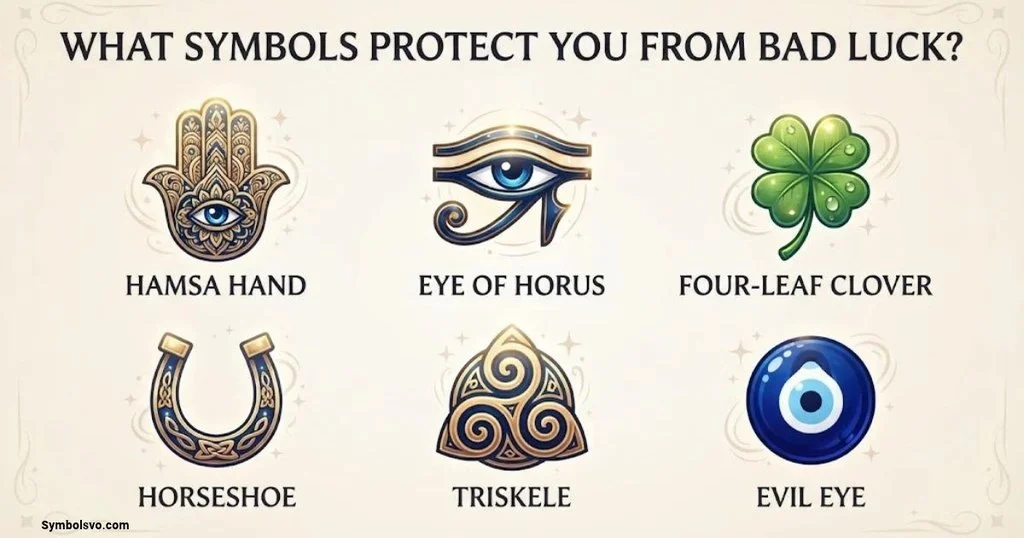
Many cultures have developed symbols associated with good fortune, safety, and protection against misfortune. Some focus on the evil eye, while others represent divine guidance, courage, or household security.
The following symbols are particularly well known for their traditional associations with good luck and protection.
| Symbol | Traditional association |
| Hamsa Hand | Protection against the evil eye and blessings |
| Nazar Boncugu | Protection against envy and harmful gazes |
| Eye of Horus | Healing, restoration, and protection |
| Mjolnir | Strength and protection against threats |
| Auseklis Cross | Light and protection against evil |
| Pentacle | Spiritual protection and balance |
| Eban | Family and household security |
| Ankh | Life and divine protection |
Symbols That Ward Off Evil Spirits
Some traditional symbols were specifically associated with keeping evil spirits away from people, homes, and sacred places.
Examples include:
- Apotropaic Marks: Protective markings carved into historic buildings.
- Pentagram: Used as a protective sign in certain historical magical traditions.
- Tyet: Associated with the protective powers of Isis.
- Bagua Mirror: Traditionally used in Feng Shui to address harmful environmental influences.
- Saint Benedict Medal: A Christian devotional object associated with prayers against evil.
Historic English buildings provide particularly interesting evidence of these practices. Protective markings appear around doorways, fireplaces, and windows because people considered these areas vulnerable points of entry.
Historic England+2
Symbols Associated With Protection Against Negative Energy
In modern spiritual practices, people often use certain designs to represent protection from negative influences.
Popular examples include:
- Hamsa Hand: Represents protection against envy and the evil eye.
- Nazar Boncugu: Traditionally associated with harmful gazes.
- Flower of Life: Represents harmony and interconnectedness in modern sacred geometry.
- Double Dorje: Represents stability and indestructible spiritual truth.
- Pentacle: Represents balance between the five elements.
These associations aren’t universal. Their meanings depend on the religious, cultural, and spiritual traditions in which people use them.
Best Protection Symbols for Different Purposes
Not every protective symbol represents the same kind of safety. Some connect to religious faith, others to family security, and several represent courage or good fortune.
The following comparison makes it easier to identify symbols according to their traditional meanings.
| Purpose | Symbols | Main association |
| Protection from the evil eye | Hamsa Hand, Nazar Boncugu | Warding off envy |
| Spiritual protection | Pentacle, Double Dorje | Spiritual balance and strength |
| Home protection | Bagua Mirror, Eban, Apotropaic Marks | Household security |
| Strength and courage | Mjolnir, Aegishjalmur | Bravery and resilience |
| Healing and restoration | Eye of Horus | Recovery and wholeness |
| Life and immortality | Ankh | Eternal life |
| Feminine power | Triple Goddess | Life cycles and wisdom |
| Balance and harmony | Unicursal Hexagram, Flower of Life | Unity and interconnectedness |
| Divine protection | Tyet, Saint Benedict Medal | Religious devotion |
| Good fortune | Hamsa Hand, Nazar Boncugu | Blessings and favorable outcomes |
How to Use Symbols of Protection in Everyday Life
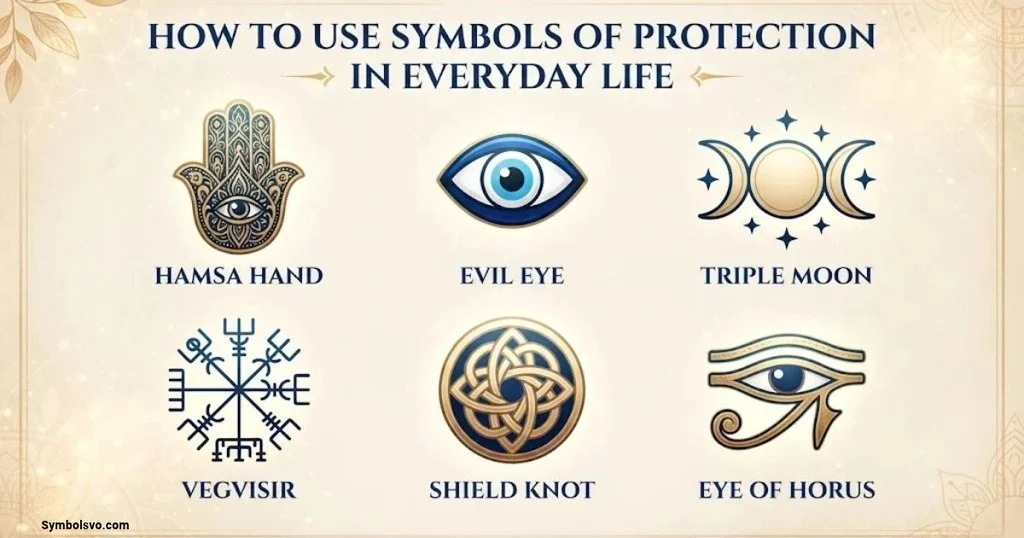
Protective symbols appear in many everyday objects. People wear them as jewelry, display them at home, or include them in religious and spiritual practices.
Their uses often reflect personal beliefs, cultural traditions, and aesthetic preferences.
Wearing Protective Symbols as Jewelry
Jewelry offers a convenient way to keep meaningful symbols close. Necklaces, bracelets, rings, and pendants can all feature traditional protective designs.
Popular choices include:
- Hamsa Hand necklaces: Associated with protection and good fortune.
- Nazar bracelets: Traditionally worn against the evil eye.
- Mjolnir pendants: Represent strength and Norse cultural identity.
- Pentacle necklaces: Associated with modern Pagan and Wiccan spirituality.
- Ankh jewelry: Represents life and immortality.
- Saint Benedict medals: Used as Christian devotional jewelry.
Before choosing a design, learn about its cultural and religious background. A symbol can carry meanings that go beyond its appearance.
Displaying Protection Symbols at Home
Many traditions include protective decorations for houses and family spaces.
For example, the Bagua Mirror appears in Feng Shui practices. The Hamsa Hand is commonly displayed in Middle Eastern and Mediterranean-inspired home decorations. Historic European households also used horseshoes and other protective objects near entrances.
Common household choices include:
- Hamsa Hand wall decorations.
- Nazar glass ornaments.
- Bagua Mirrors.
- Christian crosses.
- Traditional protective markings.
- Adinkra Eban designs.
In historic England, people sometimes placed protective objects near doors and windows. Horseshoes, ritual markings, and concealed objects all appeared in traditional household practices.
English Heritage+1
Using Protective Symbols in Spiritual Practices
Some people include symbols in their spiritual routines because the designs represent beliefs or values that matter to them.
Examples include:
- Using a pentacle in Wiccan rituals.
- Including the Om symbol in meditation spaces.
- Displaying the Dharmachakra in Buddhist settings.
- Using a Saint Benedict Medal as a devotional object.
- Incorporating the Double Dorje into Tibetan Buddhist religious art.
The meaning comes from the relevant tradition and the person’s relationship with it. A symbol doesn’t need to promise supernatural results to have personal or religious significance.
Choosing a Protection Symbol That Matches Your Beliefs
Before selecting a protective symbol, consider these points:
- Understand its origin: Learn which culture or religious tradition developed or adopted it.
- Check its meaning: Make sure its traditional associations match what you’re looking for.
- Respect its background: Some symbols have deep religious significance.
- Consider its design: Choose a form that accurately represents the symbol.
- Avoid misleading claims: Be cautious of sellers who promise guaranteed protection, wealth, or success.
A meaningful symbol can serve as a reminder of faith, courage, family, and personal values.
Protection Symbols vs. Good Luck Symbols: What’s the Difference?
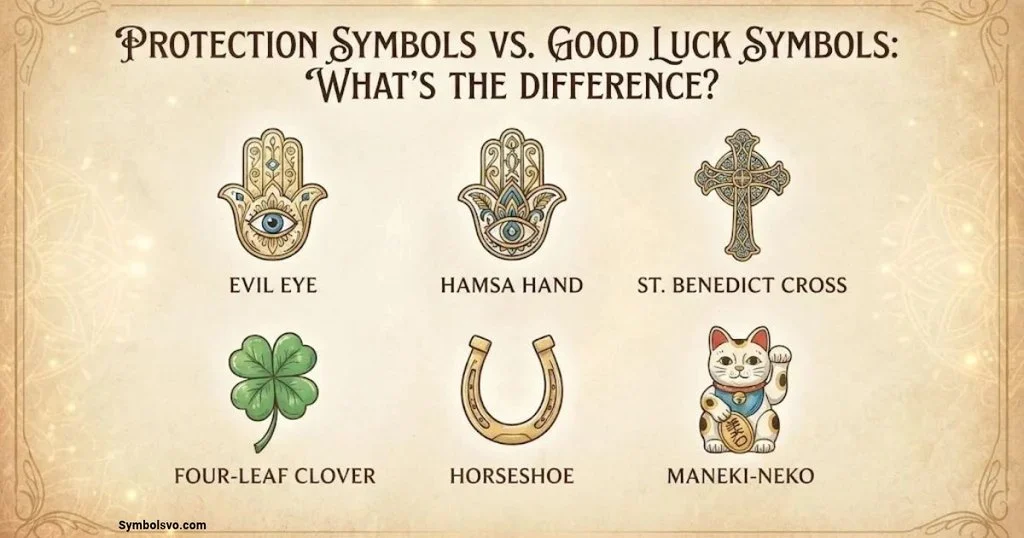
Protection symbols and good luck symbols often overlap, but they don’t always represent the same thing.
A protection symbol traditionally represents defense against danger, evil, or harmful influences. A good luck symbol generally represents favorable circumstances, prosperity, happiness, or success.
What Are Protection Symbols?
Protection symbols are designs associated with safety, security, and defense.
Examples include:
- Eye of Horus: Protection and restoration.
- Saint Benedict Medal: Christian prayers against evil.
- Mjolnir: Strength and protection.
- Apotropaic Marks: Traditional evil-averting markings.
- Tyet: Protection associated with Isis.
What Are Good Luck Symbols?
Good luck symbols represent favorable outcomes, blessings, and positive fortune.
Examples include:
- Hamsa Hand: Happiness, blessings, and protection.
- Nazar Boncugu: Protection against the evil eye.
- Mistletoe: Traditional associations with fertility and good fortune.
- Eban: Household security and family well-being.
Can a Symbol Represent Both Protection and Good Luck?
Yes. Many traditional symbols have overlapping meanings.
The Hamsa Hand, for instance, represents protection against the evil eye while also carrying associations with happiness and blessings. Similarly, the Nazar amulet traditionally protects against envy while symbolizing good fortune.
This overlap reflects how people have historically connected safety with a prosperous and peaceful life.
Frequently Asked Questions About Symbols of Protection
What Are the Most Powerful Symbols of Protection?
Some of the best-known protective symbols include the Hamsa Hand, Eye of Horus, Nazar Boncugu, Pentacle, and Mjolnir. Each comes from a different cultural or spiritual tradition. Their perceived protective power depends on the beliefs associated with them rather than scientifically established effects.
What Symbol Protects You From Bad Luck?
The Hamsa Hand and Nazar Boncugu are widely recognized symbols associated with protection against the evil eye and misfortune. Both have strong connections to Middle Eastern and Mediterranean traditions.
What Is the Oldest Symbol of Protection?
There isn’t one universally accepted oldest protection symbol. Ancient protective imagery includes Egyptian amulets, early geometric signs, and religious symbols. The Eye of Horus is among the best-known examples from ancient Egypt.
What Is the Universal Symbol for Protection?
No single symbol represents protection universally. Different cultures developed their own designs, including the Hamsa Hand, Eye of Horus, Christian Cross, and Mjolnir.
Which Symbol Represents Protection and Strength?
Mjolnir is strongly associated with strength and protection through its connection to Thor. The Aegishjalmur also represents courage and protection in Icelandic magical traditions.
What Are Ancient Egyptian Symbols of Protection?
Important Egyptian examples include:
- Eye of Horus.
- Ankh.
- Tyet or Knot of Isis.
- Eye of Ra.
These symbols had different roles in Egyptian religion, mythology, funerary practices, and protective traditions.
What Are the Most Recognized Norse Protection Symbols?
Mjolnir is the best-known Norse protective symbol because of its connection to Thor. Aegishjalmur is another popular design, although its familiar eight-armed form belongs to later Icelandic magical traditions rather than securely documented Viking Age artifacts.
What Is the Difference Between the Hamsa Hand and the Evil Eye?
The Hamsa Hand features an open palm, often containing an eye in its center. The evil eye refers to a traditional belief that envy or a harmful gaze can bring misfortune.
The Nazar Boncugu is an eye-shaped amulet traditionally used to guard against the evil eye. The Hamsa is a separate hand-shaped symbol with overlapping protective associations.
Does the Pentagram Represent Protection?
Yes, in certain historical and modern spiritual traditions. Western esoteric practices and modern Wicca associate the pentagram with protection and the five elements. Its meaning changes according to its orientation and cultural context.
What Is the Difference Between an Amulet and a Talisman?
An amulet is traditionally carried or worn for protection against harm. A talisman is an object believed to attract a desired benefit, such as prosperity, love, or success. Both terms overlap in many cultures.
Which Protection Symbols Are Traditionally Used in Homes?
Common examples include the Hamsa Hand, Nazar Boncugu, Bagua Mirror, Eban, and European apotropaic marks. Their placement and meaning vary across cultural traditions.
Can You Wear Multiple Protection Symbols Together?
Yes. People often combine symbols in jewelry or personal decorations. For example, a Hamsa Hand may contain a Nazar eye, combining two recognizable protective designs.
However, consider the cultural and religious significance of each symbol before combining them.
Are Protection Symbols Religious or Spiritual?
Some protection symbols belong to specific religious traditions, while others come from mythology, folklore, or cultural practices. The Christian Cross, Dharmachakra, Om, and Double Dorje have distinct religious backgrounds. The Nazar and Hamsa have broader cultural and traditional uses.
Do Protection Symbols Actually Work?
There is no reliable scientific evidence that a symbol can physically prevent evil spirits, eliminate negative energy, or guarantee good luck. However, symbols can have meaningful cultural, religious, and personal value.
For many people, they represent faith, hope, identity, courage, and a connection to their heritage.
Conclusion: Understanding the Meaning of Protection Symbols
Symbols of protection reveal how different cultures have expressed their hopes for safety, strength, and good fortune. From the Egyptian Eye of Horus to the Turkish Nazar Boncugu, each design carries a distinct history and cultural meaning.
Some symbols represent divine protection, while others connect to family security, spiritual balance, or personal courage. Mjolnir reflects the strength of Thor, the Hamsa Hand represents protection against the evil eye, and the Ankh expresses the ancient Egyptian idea of eternal life.
Understanding these differences makes protective symbols more meaningful. Rather than viewing them as interchangeable good luck charms, explore their origins, traditional uses, and cultural significance.
Ultimately, these symbols preserve stories about human beliefs, religious traditions, and the timeless desire to live a safe and meaningful life.

Mason Ellington is a creative and dedicated Content Writer and Symbols Expert with a passion for words, communication, and symbolic meanings. He specializes in crafting engaging, informative, and well-structured content while exploring the deeper meanings and interpretations behind symbols. With a creative mindset and attention to detail, Mason transforms ideas into meaningful content that informs, inspires, and connects with readers. His expertise combines powerful storytelling, clear communication, and a deep understanding of symbolism.
 Daniel Brooks
 Nathan Holloway