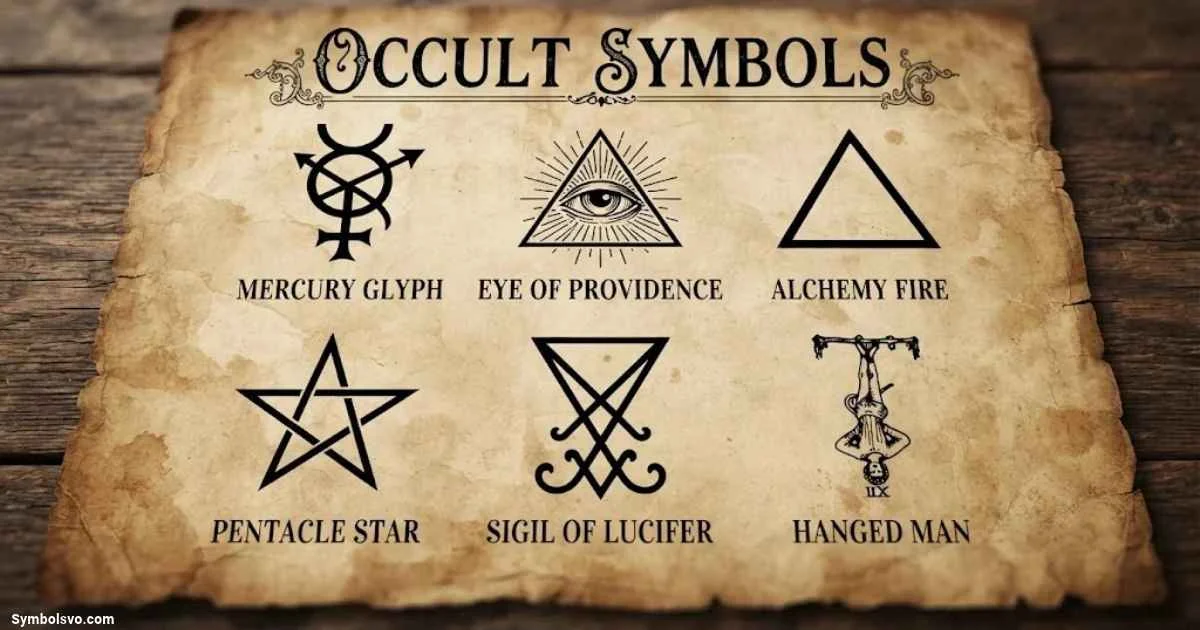
Occult symbols have fascinated people for centuries. From mysterious geometric shapes to ancient religious emblems, these signs carry layers of meaning connected to spirituality, philosophy, magic, and hidden knowledge. Some appear in medieval manuscripts, while others became popular during the Renaissance and the modern occult revival.
You might recognize the goat-headed figure of Baphomet, the mysterious Rose Cross, or the ten-point structure of the Kabbalistic Tree of Life. However, these symbols aren’t simply decorative images. Their shapes, colors, numbers, and arrangements often communicate specific ideas about the universe, human existence, divine power, and spiritual transformation.
The word occult means hidden or concealed. In historical discussions, occult symbolism generally refers to signs and images associated with knowledge that particular religious, philosophical, or magical traditions considered specialized or difficult to understand. These traditions include Hermeticism, Kabbalah, alchemy, and Western esotericism.
Although some occult symbols have ancient roots, others developed much later. Their meanings also changed as different groups adopted and reinterpreted them. Understanding their historical backgrounds helps separate documented meanings from popular myths.
This guide explores important occult symbols and their meanings, explains their origins, introduces the people who shaped their development, and examines their connections with major esoteric traditions.
What Are Occult Symbols?
Occult symbols are visual signs, geometric figures, letters, diagrams, and emblems used to communicate specialized spiritual, philosophical, religious, or magical ideas. They appear in historical manuscripts, ceremonial objects, alchemical illustrations, religious texts, and esoteric artwork.
The word occult comes from the Latin occultus, meaning hidden or concealed. It doesn’t automatically mean evil, dangerous, or associated with devil worship. Historically, occult subjects included astrology, alchemy, natural philosophy, angelic magic, and theories about hidden relationships within nature.
For example, an alchemical drawing might combine planetary signs, geometric shapes, and elemental symbols. Each component could represent a particular substance, process, or philosophical principle.
Similarly, the Tree of Life represents a complex arrangement of divine attributes within Jewish Kabbalah. The Rose Cross connects floral and Christian imagery with Rosicrucian teachings.
Occult symbols generally serve several purposes:
- Communication: Express complicated philosophical ideas through visual representations.
- Identification: Represent a particular religious, magical, or esoteric tradition.
- Interpretation: Help explain relationships between the universe, humanity, and divine principles.
- Ritual use: Function as meaningful signs within specific ceremonial practices.
- Memory: Organize teachings into recognizable visual arrangements.
It’s important to remember that a symbol doesn’t have one universal meaning. Its interpretation depends on its historical origin and the tradition using it.
History and Origins of Occult Symbolism
The history of occult symbolism stretches across different civilizations, religious traditions, and intellectual movements. However, there wasn’t one original occult system from which every symbol developed.
Instead, different cultures created symbolic languages to explain nature, divine powers, creation, death, and spiritual experience.
Ancient Civilizations and Early Symbolic Traditions
Ancient civilizations used religious and symbolic imagery long before the development of organized Western occult movements.
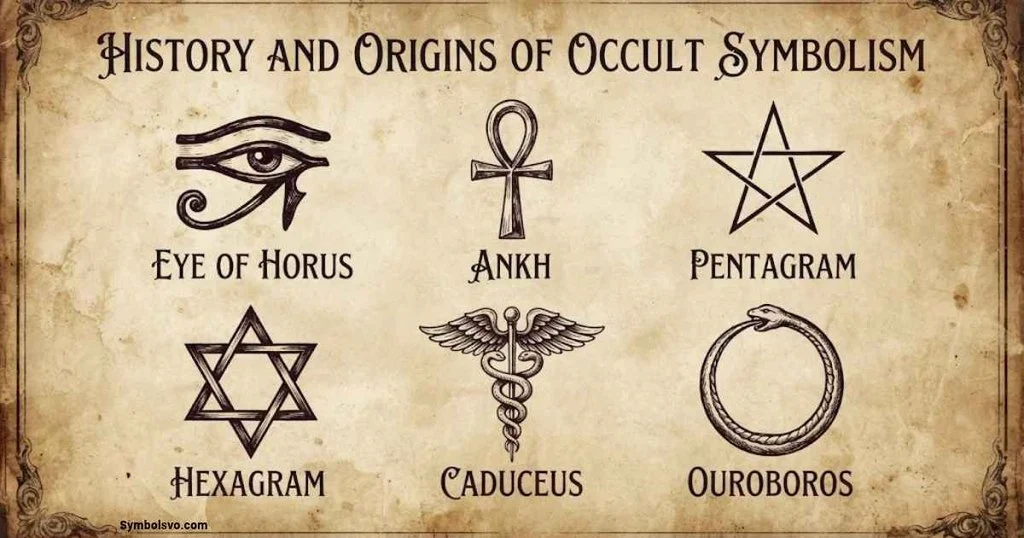
Ancient Egyptians created elaborate systems of hieroglyphs and religious images. Their artwork included the ankh, the Eye of Horus, scarabs, and representations of gods. These symbols appeared in temples, tombs, amulets, and funerary texts.
The Eye of Horus, for example, became associated with protection, healing, and restoration. The ankh represented life and appeared frequently in Egyptian religious artwork.
Ancient Mesopotamian cultures also developed symbolic systems connected with astronomy, divination, and religious authority. Celestial bodies played an important role in interpreting events and understanding the relationship between humanity and the gods.
Greek traditions contributed philosophical and mystical ideas through Pythagoreanism, Platonism, and religious mystery movements.
The Pythagoreans explored mathematical relationships and believed numbers offered insights into the structure of reality. These ideas later influenced sacred geometry, Renaissance philosophy, and Western esoteric symbolism.
Medieval Occultism and Esoteric Knowledge
During the Middle Ages, several intellectual traditions preserved and developed symbolic approaches to understanding nature and spirituality.
Alchemy became particularly important. Its practitioners used coded illustrations, planetary correspondences, elemental signs, and symbolic descriptions of transformation.
Medieval European scholars also explored astrology, magical manuscripts, and Christian mystical philosophy.
Meanwhile, Jewish mystical traditions developed sophisticated approaches to divine names, Hebrew letters, and the structure of creation.
The development of Kabbalistic literature introduced symbolic frameworks that later influenced Christian and Hermetic interpretations.
These traditions weren’t identical. However, their use of numbers, letters, geometric figures, and symbolic relationships created connections that Renaissance thinkers would explore further.
Renaissance Occultism and Symbolic Illustrations
The Renaissance marked an important period in the development of Western esoteric thought.
Scholars rediscovered ancient philosophical writings and explored connections between Christianity, Platonism, Hermeticism, astrology, and Kabbalah.
Renaissance occultism treated the universe as an interconnected creation in which numbers, words, natural objects, and celestial movements could reveal deeper principles.
Two important figures were John Dee and Robert Fludd.
John Dee published Monas Hieroglyphica in 1564. This work introduced his famous Hieroglyphic Monad, a complex figure combining astronomical, alchemical, and philosophical symbolism.
Robert Fludd later produced elaborate cosmological illustrations showing relationships between divine creation, spirit, matter, and the physical universe.
These illustrations demonstrate how Renaissance thinkers used symbolic representations to explain complicated theories about existence.
Nineteenth-Century Occult Revival
The nineteenth century brought renewed interest in Western esotericism.
Writers and occultists revisited older magical texts, adapted Kabbalistic concepts, and developed new interpretations of historical symbols.
One of the most influential figures was Eliphas Levi, a French occult author whose famous Baphomet illustration appeared in Dogme et Rituel de la Haute Magie in 1854–1856.
Rosicrucian ideas also influenced later esoteric movements. Organizations such as the Hermetic Order of the Golden Dawn incorporated planetary, elemental, Kabbalistic, and alchemical symbolism into ceremonial systems.
During this period, older symbols acquired additional interpretations. Some became associated with spiritual transformation, while others entered popular culture through literature and artwork.
Occult Symbols in Modern Culture
Today, occult imagery appears in books, films, music, fashion, games, and contemporary spiritual movements.
The pentagram, Baphomet, Ouroboros, and All-Seeing Eye are recognizable examples.
However, modern appearances don’t always reflect historical meanings. A filmmaker might use an inverted pentagram to create an atmosphere of mystery, while a historical practitioner might have understood a five-pointed star through elemental or mathematical associations.
Understanding this difference helps prevent modern entertainment from becoming mistaken for historical evidence.
Important Occult Symbols and Their Meanings
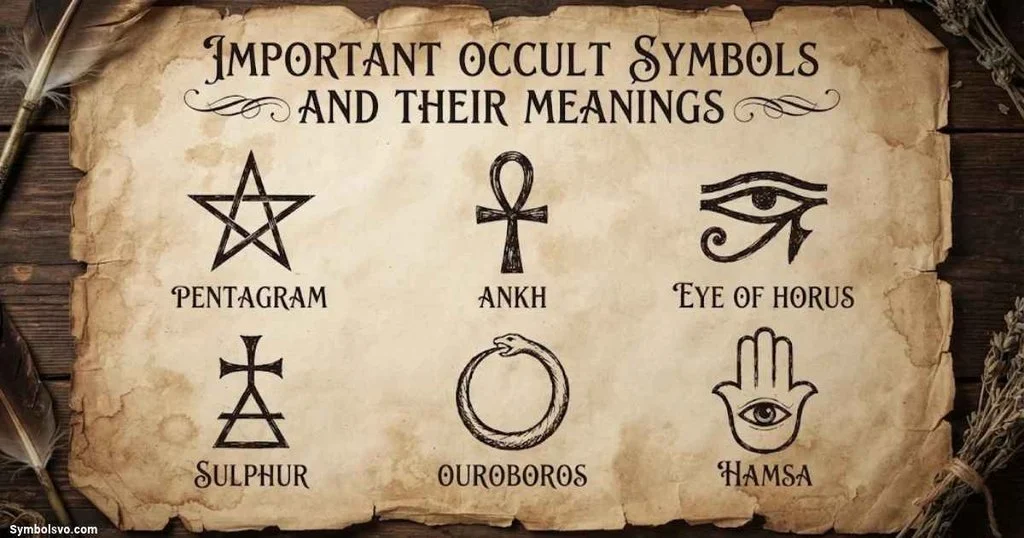
The following symbols represent different historical periods and esoteric traditions. Some developed within religious communities, while others became prominent through Renaissance philosophy or modern occultism.
Baphomet Symbol: Meaning of the Goat of Mendes
Historical association: 19th-century Western occultism
Baphomet is among the most recognizable figures in modern occult imagery. Its familiar appearance comes from a drawing by French occultist Eliphas Levi, published in 1854.
The illustration shows a winged, goat-headed figure sitting with a torch above its head. Its body combines masculine and feminine characteristics, while its arms point in opposite directions.
Levi’s Baphomet contains several symbolic elements:
- Goat’s head: Represents the animal imagery associated with the figure.
- Torch: Connects with enlightenment and intellectual illumination.
- Wings: Suggest spiritual or elevated qualities.
- Male and female characteristics: Express the relationship between opposing principles.
- Raised and lowered arms: Suggest the relationship between contrasting forces.
- Pentagram: Appears on the forehead and contributes to the figure’s magical symbolism.
What does Baphomet represent?
Levi’s illustration shouldn’t be reduced to a simple image of evil. Its symbolism reflects his ideas about magical philosophy, the Astral Light, and the reconciliation of opposing principles.
The term Goat of Mendes became closely associated with Levi’s depiction, although its relationship with ancient Egyptian religious imagery requires historical care.
Baphomet’s modern reputation also differs from its original nineteenth-century context. Later movements adopted the image for religious, artistic, political, and countercultural purposes.
Rose Cross (Rosy Cross): Symbol of Rosicrucianism
Historical association: Early 17th-century Rosicrucian literature
The Rose Cross, also called the Rosy Cross, combines two familiar images: a rose and a Christian cross.
The emblem became closely associated with Rosicrucian literature during the early seventeenth century. The Rosicrucian manifestos described a mysterious brotherhood dedicated to spiritual reform and hidden wisdom.
The rose and cross carry different symbolic associations.
- Rose: Often represents beauty, spiritual development, and the unfolding of knowledge.
- Cross: Represents Christianity, sacrifice, and spiritual life.
- Combined emblem: Became associated with Rosicrucian ideas about spiritual transformation and divine wisdom.
The symbol later appeared in different forms across Western esoteric organizations.
The Hermetic Order of the Golden Dawn developed its own elaborate Rose Cross symbolism, incorporating Hebrew letters, elemental correspondences, and planetary associations.
Thelema and the Ordo Templi Orientis (O.T.O.) also adopted Rose Cross imagery in certain contexts.
However, these organizations didn’t all interpret the emblem identically. Its meaning depends on the particular system using it.
Tetragrammaton (YHWH): The Four-Letter Divine Name
Historical association: Ancient Hebrew religious tradition
The Tetragrammaton is the four-letter Hebrew name of God written as YHWH.
Its four Hebrew letters are:
| Hebrew letter | Common transliteration |
| י | Yod |
| ה | He |
| ו | Waw or Vav |
| ה | He |
The name holds exceptional religious significance in Judaism. Traditional Jewish practice generally avoids pronouncing it aloud and uses substitutes such as Adonai or HaShem.
Several related terms require distinction:
- YHWH: Standard scholarly transliteration of the four Hebrew consonants.
- JHVH: An older Latin-based representation.
- Yahweh: A widely used scholarly reconstruction of the ancient pronunciation.
- Jehovah: A historical form that developed through the combination of the consonants YHWH with vowel indications associated with a substitute reading.
- Adonai: Hebrew for Lord, commonly used when reading the divine name.
- Elohim: A Hebrew divine title used in the Bible.
Within Western esoteric traditions, the Tetragrammaton also became important in ceremonial magic, Christian Kabbalah, and discussions of divine names.
Some systems associate the four letters with elemental or cosmological correspondences. These interpretations belong to particular esoteric frameworks rather than representing universal Jewish teachings.
Sigillum Dei Aemaeth: The Seal of Divine Truth
Historical association: John Dee’s 16th-century angelic magic
The Sigillum Dei Aemaeth, sometimes written Sigillum Dei Aemeth, is a complex magical seal associated with English scholar John Dee and his associate Edward Kelley.
The name is commonly translated as the Seal of God’s Truth.
Dee explored angelic communication and divine knowledge during the sixteenth century. His records describe elaborate systems involving angelic names, sacred geometry, and symbolic arrangements.
The seal contains several geometric layers, including:
- Circles and intersecting lines.
- Letters and divine names.
- Names associated with angels.
- Geometric divisions and symbolic arrangements.
The structure reflects Dee’s interest in mathematics, sacred names, and the possibility of understanding divine knowledge through carefully arranged symbols.
Unlike a simple decorative emblem, the seal belonged to a specific ceremonial system.
Its historical importance comes from its connection with Dee’s surviving manuscripts and the broader development of Renaissance angelic magic.
Tree of Life (Etz Chaim): Kabbalistic Symbolism
Historical association: Jewish Kabbalah and later Hermetic Qabalah
The Tree of Life, known in Hebrew as Etz Chaim, is one of the most important diagrams in Jewish mystical thought.
It represents ten Sephirot, commonly understood as divine emanations or attributes through which the infinite divine reality relates to creation.
The diagram connects these ten aspects through a network of lines and pathways.
At the center of Kabbalistic thought is Ein Sof, a term describing the infinite and unknowable aspect of God.
The ten Sephirot are:
| Sephirah | Common meaning or association |
| Keter | Crown |
| Chokhmah | Wisdom |
| Binah | Understanding |
| Hesed | Loving-kindness or mercy |
| Gevurah | Strength or judgment |
| Tiferet | Beauty or harmony |
| Netzah | Eternity or endurance |
| Hod | Splendor |
| Yesod | Foundation |
| Malkuth | Kingdom |
These names represent a complex theological system. Their meanings cannot be reduced to simple personality traits or universal spiritual labels.
The diagram also appears in later Hermetic Qabalah, where Western occultists adapted its structure into magical, astrological, and philosophical systems.
One important distinction is that Jewish Kabbalah and Hermetic Qabalah share certain concepts but aren’t interchangeable.
Hieroglyphic Monad: John Dee’s Monad Symbol
Historical association: Renaissance philosophy and alchemy, 1564
The Hieroglyphic Monad, also called the Monad Hieroglyph, is a symbol created by John Dee.
He explained it in his Latin work Monas Hieroglyphica, published in 1564.
Dee combined several familiar signs into one complex figure. These included:
- The Moon.
- The Sun.
- The cross associated with the elements.
- Astrological and zodiacal imagery.
- Alchemical correspondences.
The central idea was unity. Dee wanted to express relationships between different areas of knowledge through one symbolic construction.
His interests included mathematics, astronomy, alchemy, biblical interpretation, and Kabbalah.
The Monad therefore represents more than a simple planetary sign. It reflects Dee’s belief that different branches of knowledge shared a deeper foundation.
Its interpretation remains difficult because Dee’s accompanying explanations are highly complex. Nevertheless, the work became influential in later Renaissance and early modern esoteric literature.
Pentagram: The Five-Pointed Occult Symbol
Historical association: Ancient mathematics and later Western ceremonial magic
The pentagram is a five-pointed star drawn using five connected lines.
It has appeared in different cultures and traditions, making its history much broader than modern occultism.
Ancient Greek mathematical traditions associated the pentagram with geometric relationships and proportions. Later magical systems developed additional interpretations.
In certain Western esoteric traditions, the five points represent the classical elements:
- Earth
- Water
- Air
- Fire
- Spirit
The upright pentagram is frequently associated with the ordering or harmony of these elements.
An inverted pentagram received different interpretations in later occult movements and popular culture. Some modern groups use it as an emblem, while horror films often employ it as a sign of danger.
Important: The pentagram doesn’t have one fixed religious or magical meaning. Its orientation, surrounding imagery, and historical context all matter.
Hexagram: The Six-Pointed Star
Historical association: Religious, geometric, and esoteric traditions
The hexagram consists of two overlapping triangles that form a six-pointed star.
It appears in several cultural and religious settings. Its most familiar modern association is the Star of David, an important Jewish symbol.
However, the six-pointed geometric design also appears in historical decorative artwork, manuscripts, and certain magical traditions.
In some Western esoteric systems, the two triangles represent opposing or complementary principles.
The upward triangle may symbolize ascent or fire, while the downward triangle may symbolize descent or water in particular alchemical contexts.
When combined, they can express the relationship between contrasting forces.
It’s important not to assume that every hexagram carries occult meaning. Its use as a Jewish religious symbol and its appearance in magical diagrams belong to different historical contexts.
Ouroboros: The Serpent Eating Its Tail
Historical association: Ancient Egyptian, Greek, and alchemical imagery
The Ouroboros depicts a serpent or dragon swallowing its own tail.
Its circular shape makes it a recognizable representation of cycles and renewal.
The image appears in ancient Egyptian material and later Greek alchemical manuscripts. It became particularly important in alchemical symbolism.
Its common interpretations include:
- Eternal cycles.
- Renewal and transformation.
- Unity and continuity.
- The relationship between beginnings and endings.
- The cyclical nature of natural processes.
In alchemical artwork, the Ouroboros can express the unity of a process in which matter undergoes repeated transformation.
Its circular form also makes it useful as a visual representation of eternity.
All-Seeing Eye: The Eye of Providence
Historical association: Christian religious art and later esoteric imagery
The All-Seeing Eye is usually depicted as an eye surrounded by rays of light. It sometimes appears inside a triangle.
One familiar form is the Eye of Providence, which represents divine observation and God’s awareness of human actions.
The triangular version became prominent in Christian artwork and later appeared in Masonic imagery.
It is important to distinguish this symbol from the ancient Egyptian Eye of Horus.
Although both feature an eye, they have different historical origins and symbolic backgrounds.
The Eye of Horus is associated with protection, healing, and restoration in ancient Egyptian religion. The Eye of Providence belongs to a different religious and artistic tradition.
Alchemical Symbols: Signs of Transformation
Alchemical symbols form a large visual language used by historical alchemists.
They represented substances, elements, planetary metals, laboratory processes, and philosophical ideas.
Some common examples include:
| Symbol or substance | Traditional association |
| Sulfur | One of the three alchemical principles |
| Mercury | Fluidity, transformation, and the mercurial principle |
| Salt | Solidity and material stability |
| Gold | Sun and the metal associated with perfection |
| Silver | Moon and lunar associations |
| Iron | Mars |
| Copper | Venus |
| Lead | Saturn |
| Tin | Jupiter |
| Quicksilver | Mercury |
Historical alchemy involved both practical experimentation and philosophical speculation.
Some practitioners investigated metals, minerals, medicines, and chemical processes. Others interpreted transformation as a spiritual or symbolic journey.
Therefore, alchemical symbolism cannot be understood through spiritual interpretations alone. Its imagery also belongs to the history of early chemistry and natural philosophy.
Triangle and Sacred Geometry
The triangle is among the simplest and most widely used geometric symbols.
Its importance comes from its mathematical structure and the different meanings cultures have attached to it.
In alchemical symbolism, an upward triangle traditionally represents fire, while a downward triangle represents water.
Triangles with horizontal lines represent air and earth in the familiar four-element alchemical system.
Other traditions use triangular forms to express threefold religious or philosophical concepts.
For example, Christian art sometimes uses a triangle to represent the Trinity: Father, Son, and Holy Spirit.
Within sacred geometry, triangles can also represent balance, proportion, and relationships between geometric forms.
However, a triangle doesn’t automatically indicate occult activity. Its meaning depends on the system in which it appears.
Spiral Symbolism and Cosmology
Spirals appear in ancient artwork, decorative patterns, and different symbolic traditions.
Their curved structure can suggest movement, growth, development, or repeated cycles.
In some philosophical and spiritual contexts, spiral imagery represents the unfolding of creation or the movement between different levels of existence.
However, the term spiral cosmology shouldn’t be treated as one universally recognized occult doctrine. Different authors and traditions use spiral forms in different ways.
When studying a particular spiral diagram, its original creator and historical setting provide the most reliable clues to its meaning.
Major Types of Occult Symbols and Their Uses
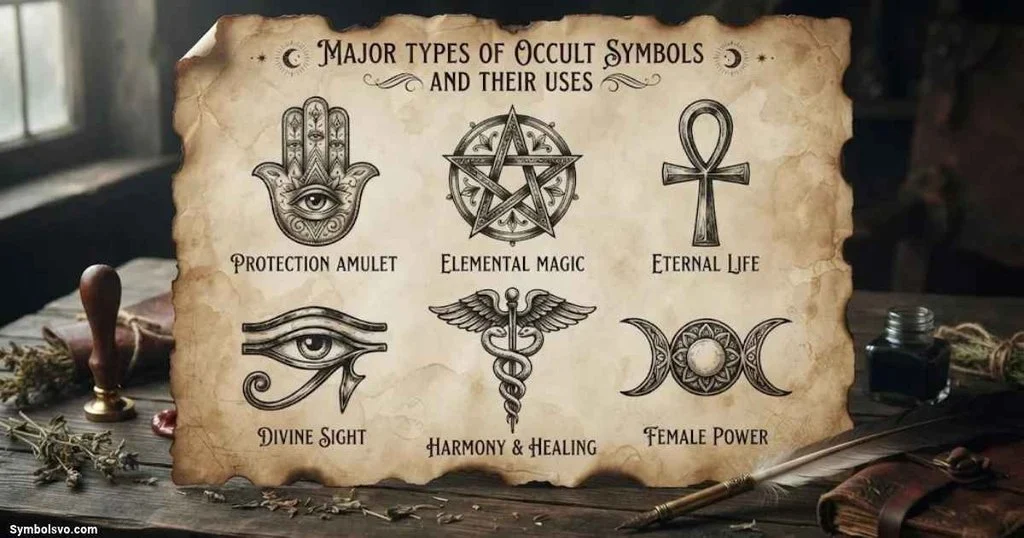
Not every occult symbol serves the same purpose. Some communicate philosophical teachings, while others represent divine names, planetary forces, or specific ritual practices.
Understanding these categories makes it easier to recognize the traditions behind different symbols.
Hermetic Symbols
Hermetic symbols come from traditions influenced by Hermetic philosophy, a body of religious and philosophical writings associated with Hermes Trismegistus.
Hermeticism became especially influential during the Renaissance. Its teachings explored the relationship between God, humanity, nature, and the universe.
One recurring idea is the relationship between the Macrocosm and Microcosm.
- Macrocosm: The greater universe and its cosmic structure.
- Microcosm: The human being as a smaller reflection of the universe.
Hermetic thinkers explored how the natural world and human existence might reflect the same underlying principles.
This idea influenced later magical diagrams, alchemical illustrations, and philosophical systems.
The familiar expression “as above, so below” is often associated with Hermetic thought. It describes a correspondence between different levels of existence, although its popular modern use doesn’t always reflect the complexity of historical Hermetic writings.
Kabbalistic Symbols
Kabbalistic symbols come from Jewish mystical traditions that explore divine attributes, creation, sacred language, and spiritual understanding.
The Tree of Life is the best-known example.
Other important elements include:
- Hebrew letters: Used in mystical interpretations of sacred language.
- Sephirot: Ten divine emanations represented in the Tree of Life.
- Ein Sof: The infinite aspect of God.
- Divine names: Sacred Hebrew names associated with God’s nature.
- Numerical symbolism: Interpretations involving the numerical values of Hebrew letters.
Kabbalistic symbolism became influential beyond Judaism during the Renaissance.
Christian scholars developed forms of Christian Kabbalah, and later Western occultists adapted selected ideas into Hermetic Qabalah.
These later systems sometimes combined Kabbalistic concepts with astrology, tarot, alchemy, and ceremonial magic.
However, Jewish Kabbalah has its own religious foundations and shouldn’t be treated simply as a branch of Western magic.
Alchemical Symbols
Alchemical symbols represent materials, substances, planetary metals, chemical operations, and philosophical concepts.
Historical alchemists used visual signs because written descriptions alone couldn’t always communicate the complicated relationships between substances and processes.
Three especially important principles were sulfur, mercury, and salt.
These weren’t necessarily identical to the modern chemical substances carrying the same names. They often represented broader philosophical principles.
The four classical elements also played a major role:
| Element | Traditional symbolic association |
| Earth | Stability, solidity, and material existence |
| Water | Fluidity and adaptability |
| Air | Movement and breath |
| Fire | Heat, energy, and transformation |
Alchemical manuscripts frequently combined these signs with planetary symbols and illustrations of laboratory processes.
The Philosopher’s Stone became one of alchemy’s most recognizable concepts. It was associated with the transformation of base metals into precious metals and, in some traditions, the pursuit of spiritual perfection.
Magical Symbols and Sigils
Magical symbols include signs used in historical ritual practices, magical manuscripts, and ceremonial systems.
A sigil is a specially constructed sign that may represent a name, intention, spiritual entity, or magical purpose.
Unlike a traditional emblem passed down through a religious community, some sigils were created according to specific instructions.
Historical examples include:
- Planetary seals.
- Angelic seals.
- Magical squares.
- Divine names arranged in geometric patterns.
- Signs recorded in medieval and Renaissance grimoires.
The Sigillum Dei Aemaeth is an important example of a complex ceremonial seal.
Planetary seals also appear in magical traditions influenced by astrology. Their designs connect geometric arrangements with planetary names and symbolic correspondences.
A sigil’s meaning should always be considered within the manuscript or magical system where it appears.
Religious and Mystical Symbols
Religious symbols communicate beliefs about divine beings, creation, spiritual life, and sacred history.
Some also appear in occult manuscripts because Western esoteric traditions developed alongside Christianity and drew on Jewish mystical ideas.
Examples include:
- The Christian cross.
- The Star of David.
- The Eye of Providence.
- Hebrew divine names.
- The Tree of Life.
- The Rose Cross.
These symbols don’t become occult simply because an occult author uses them.
For example, the Christian cross has a much broader religious history than its later appearance in Rosicrucian or ceremonial magical artwork.
Understanding the difference between original religious use and later esoteric adaptation is essential.
Astrological and Planetary Symbols
Astrological signs form another important part of occult symbolism.
Historical astrologers used planetary and zodiacal glyphs to represent celestial bodies and their supposed influences.
The seven traditional planetary symbols were associated with the visible planets and luminaries known in ancient and medieval astronomy.
| Celestial body | Traditional planetary association |
| Sun | Gold |
| Moon | Silver |
| Mercury | Quicksilver |
| Venus | Copper |
| Mars | Iron |
| Jupiter | Tin |
| Saturn | Lead |
These associations became important in alchemy and Renaissance natural philosophy.
Zodiac symbols also appeared in astrological charts, magical diagrams, and cosmological illustrations.
For instance, Aries is represented by a ram and traditionally associated with the planet Mars.
Important Occult Traditions and Their Symbolism
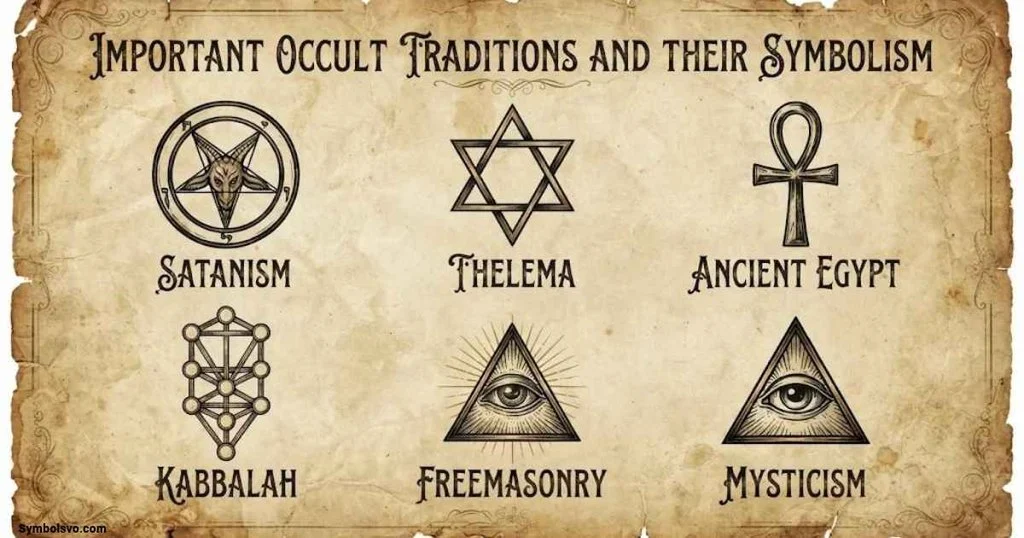
Occult symbols become easier to understand when you know the traditions that developed or adopted them.
Several historical movements contributed to the visual language of Western esotericism.
Hermeticism and Its Symbolic Philosophy
Hermeticism is a religious and philosophical tradition associated with writings attributed to Hermes Trismegistus.
Its historical development involved Greek, Egyptian, and other intellectual influences, particularly during the early centuries of the Common Era.
Renaissance scholars rediscovered important Hermetic writings and treated them as sources of ancient wisdom.
Hermetic philosophy explored several important subjects:
- The nature of divine reality.
- The relationship between God and creation.
- Human spiritual development.
- The structure of the universe.
- The correspondence between different levels of existence.
These ideas influenced the development of Renaissance occult philosophy.
Hermetic symbolism frequently connects the physical world with spiritual and cosmic principles.
Kabbalah and Hermetic Qabalah
Kabbalah is a Jewish mystical tradition concerned with understanding God, creation, divine attributes, and spiritual knowledge.
Its symbolic language includes Hebrew letters, divine names, and the ten Sephirot.
The Tree of Life provides a visual framework for understanding these concepts.
During the Renaissance, Christian scholars developed interpretations of Jewish mystical teachings. Later Western occult movements created Hermetic Qabalah by combining selected Kabbalistic concepts with other esoteric systems.
The distinction matters:
| Jewish Kabbalah | Hermetic Qabalah |
| Rooted in Jewish religious and mystical traditions | Developed within Western esoteric movements |
| Uses Hebrew sacred texts and religious interpretation | Combines Kabbalistic ideas with other occult systems |
| Explores divine attributes and creation | Often incorporates astrology, tarot, alchemy, and ceremonial magic |
| Has its own historical schools and teachings | Developed through later adaptations |
Both traditions use related symbolic concepts, but they have different religious and intellectual contexts.
Rosicrucianism and the Rose Cross
Rosicrucianism developed around a series of early seventeenth-century publications known as the Rosicrucian manifestos.
These texts described a mysterious brotherhood associated with Christian spirituality, hidden knowledge, and intellectual reform.
The figure of Christian Rosenkreuz became central to the movement’s legendary narrative.
The Rose Cross emerged as its most recognizable emblem.
The manifestos combined ideas from several traditions, including:
- Hermetic philosophy.
- Christian mysticism.
- Alchemy.
- Kabbalistic influences.
- Renaissance intellectual culture.
Historians continue to debate the authorship and historical reality of the brotherhood described in these texts. There is limited evidence for the existence of an organized secret society matching the manifestos’ description.
Nevertheless, the writings had a major influence on later Western esotericism.
Alchemy and the Search for Transformation
Alchemy combined practical experimentation with philosophical and religious ideas.
Historical alchemists investigated substances, metals, minerals, medicines, and methods of transformation.
Their writings also used symbolic language to describe purification, perfection, and the relationship between matter and spirit.
Three recurring concepts were:
- Nigredo: Blackening, often associated with breakdown or decomposition.
- Albedo: Whitening, associated with purification.
- Rubedo: Reddening, associated with completion or culmination.
These stages appear in various alchemical texts, although their exact meanings and arrangements differ.
The Philosopher’s Stone became a powerful symbol of transformation. Some alchemists approached it through material experimentation, while others emphasized spiritual or philosophical interpretations.
Hermetic Order of the Golden Dawn
The Hermetic Order of the Golden Dawn was established in London in 1888.
It became one of the most influential organizations in modern Western ceremonial magic.
Its teachings combined several earlier traditions:
- Hermetic philosophy.
- Hermetic Qabalah.
- Astrology.
- Alchemy.
- Tarot symbolism.
- Egyptian religious imagery.
- Ceremonial magic.
The Golden Dawn developed elaborate symbolic arrangements and ritual systems.
Its Rose Cross imagery became particularly recognizable. The order also used the Tree of Life as a framework for organizing magical correspondences.
Its influence extended into later occult movements and the work of several twentieth-century esoteric authors.
Thelema and Ordo Templi Orientis (O.T.O.)
Thelema is a religious and philosophical movement associated with Aleister Crowley.
Its central ideas include individual spiritual development and the concept of discovering one’s True Will.
Crowley’s writings incorporated symbolism from several earlier traditions, including Hermeticism, Kabbalah, astrology, and ceremonial magic.
The Ordo Templi Orientis (O.T.O.) is a separate historical organization that became closely associated with Thelema under Crowley’s leadership.
Both movements use specialized symbolic language. However, their teachings and organizational histories shouldn’t be treated as identical to those of the Rosicrucians or Golden Dawn.
Famous Historical Figures Behind Occult Symbols
Several scholars, writers, and occultists played important roles in developing the symbols recognized today.
Eliphas Levi
1810–1875 | French occult author
Eliphas Levi, whose birth name was Alphonse-Louis Constant, was an influential figure in nineteenth-century French occultism.
His best-known work, Dogme et Rituel de la Haute Magie, appeared in two parts during 1854–1856.
Levi’s famous Baphomet illustration became one of the most recognizable images in Western occult art.
He combined religious, philosophical, and magical ideas to develop a symbolic figure representing his understanding of the Astral Light and the relationship between opposing forces.
His work influenced later occult writers and organizations.
However, his interpretation reflects nineteenth-century intellectual and religious debates rather than an unchanged ancient tradition.
John Dee
1527–1609 | English mathematician and natural philosopher
John Dee was an English scholar who studied mathematics, astronomy, astrology, navigation, and natural philosophy.
He became an influential figure during the reign of Elizabeth I.
His important contributions to occult symbolism include:
- Monas Hieroglyphica (1564).
- The Hieroglyphic Monad.
- Angelic communication records.
- The Sigillum Dei Aemaeth.
- Studies involving mathematics, Kabbalah, and alchemy.
Dee believed that mathematical and symbolic structures could reveal deeper relationships within creation.
His work provides an important example of how Renaissance scholars combined subjects that modern academic disciplines usually study separately.
Robert Fludd
1574–1637 | English physician and philosopher
Robert Fludd was a physician and philosopher known for his elaborate illustrations of the universe.
His writings explored Renaissance cosmology, Hermetic philosophy, divine creation, and the relationship between spirit and matter.
Fludd’s diagrams often represented the universe as a structured system with different levels of existence.
His illustrations included ideas about:
- The physical world.
- The spiritual world.
- Celestial existence.
- Divine creative power.
- The Soul of the World.
- Macrocosm and Microcosm.
His work is especially valuable for understanding how early modern thinkers used diagrams to explain complex philosophical ideas.
Heinrich Khunrath
1560–1605 | German physician and alchemist
Heinrich Khunrath combined alchemical ideas with Christian mystical philosophy.
His best-known work, Amphitheatrum Sapientiae Aeternae, contains elaborate symbolic illustrations.
These images connect alchemy, religious devotion, and philosophical interpretations of nature.
Khunrath’s artwork also influenced later occult interpretations of alchemical imagery, including some elements associated with Levi’s Baphomet.
Heinrich Cornelius Agrippa
1486–1535 | German Renaissance scholar
Agrippa was a major figure in Renaissance magical philosophy.
His best-known work, Three Books of Occult Philosophy, explored relationships between natural magic, celestial influences, numbers, divine powers, and intellectual knowledge.
The book became an important source for later Western esoteric writers.
Agrippa’s discussions helped preserve and organize ideas that connected astrology, Kabbalah, Hermeticism, and magical practice.
Israel Regardie
1907–1985 | British-American occult author
Israel Regardie was an influential twentieth-century writer associated with the Golden Dawn tradition.
His publications helped preserve and make ceremonial magical teachings more accessible to later readers.
His work covered ritual practices, symbolic correspondences, Hermetic Qabalah, and psychological interpretations of magical systems.
Unlike Dee and Fludd, Regardie belongs to the modern history of Western occultism rather than the Renaissance.
Occult Cosmology: Macrocosm, Microcosm, and the Universe
Occult cosmology explores symbolic explanations of the universe, divine creation, and the relationship between different levels of existence.
Renaissance thinkers often approached the cosmos as an interconnected structure. They believed that understanding the relationship between humanity, nature, and the heavens could reveal deeper philosophical principles.
Robert Fludd’s illustrations provide some of the clearest examples of this approach.
Macrocosm and Microcosm: The Universe and Human Existence
The concepts of Macrocosm and Microcosm appear throughout Hermetic philosophy and Renaissance esoteric thought.
The macrocosm represents the greater universe, while the microcosm represents the human being.
The relationship between them suggests that human existence reflects certain patterns found throughout creation.
For example:
- The universe represents the larger structure of existence.
- Human beings represent a smaller reflection of that structure.
- Nature connects physical and spiritual ideas.
- Symbolic correspondences help explain relationships between different levels of reality.
This concept became particularly important in Hermeticism and Renaissance natural philosophy.
Robert Fludd’s Cosmological Diagrams
Robert Fludd developed elaborate diagrams to explain the structure of creation.
His illustrations explored how divine creative power related to the physical universe.
One important theme was the relationship between spirit and matter.
Fludd’s cosmological writings included concepts such as:
| Concept | Meaning in his cosmological framework |
| Divine source | The ultimate origin of creation |
| Spirit | An immaterial or spiritual principle |
| Matter | The material basis of physical existence |
| Hyle | A philosophical term associated with matter |
| Soul of the World | A principle connecting life and the cosmos |
| Empyrean | The highest heavenly region in traditional cosmology |
| Aether | A concept associated with celestial or subtle substance |
His illustrations also explored the relationship between the visible universe and invisible spiritual principles.
These diagrams shouldn’t be mistaken for modern scientific models. They represent the religious and philosophical worldview of their historical period.
Three Realms in Renaissance Cosmological Illustrations
Some Renaissance cosmological models divided existence into different levels or realms.
A familiar arrangement distinguished spiritual, celestial, and elemental existence.
| Realm | General description |
| Spiritual realm | Associated with divine or intellectual existence |
| Celestial realm | Associated with heavenly bodies and celestial order |
| Elemental realm | Associated with the physical world and classical elements |
The Empyrean sometimes appeared as the highest heavenly region in traditional Christian cosmology.
Other systems used concepts such as angelic hierarchies and intermediary levels of existence.
These arrangements varied between authors. There wasn’t one universal three-realm model followed by every occult tradition.
The Trinity and the Triangle Symbol
The triangle became an important visual representation of threefold religious and philosophical ideas.
In Christianity, the triangle can represent the Trinity:
- Father
- Son
- Holy Spirit
The three persons belong to one divine Godhead according to Christian doctrine.
Certain esoteric systems also used triangular arrangements to express relationships between different principles.
However, Christian theological symbolism and later occult interpretations shouldn’t be treated as identical.
How to Interpret Occult Symbols Correctly
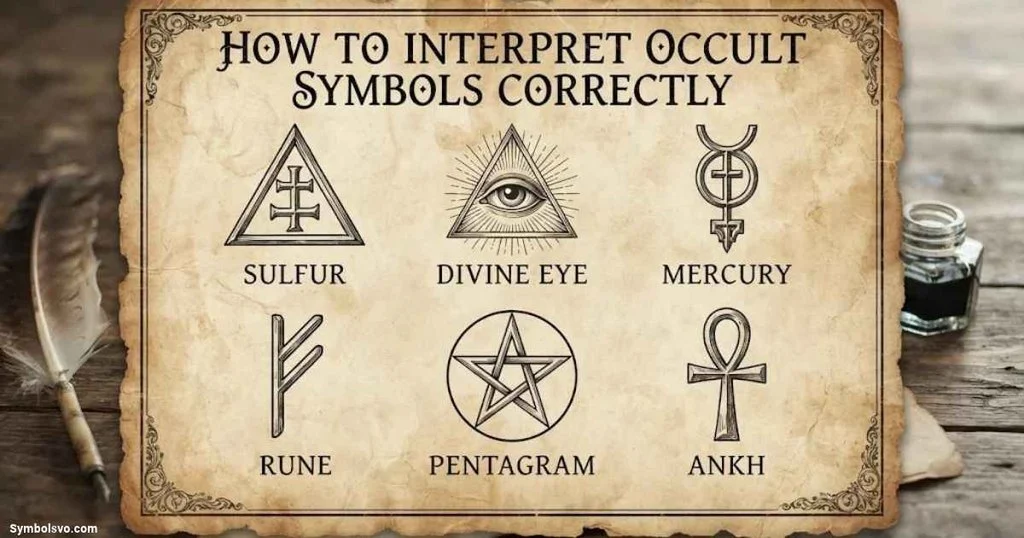
Occult symbols can be confusing because the same design sometimes appears in several traditions.
A pentagram in a historical magical manuscript might have a different meaning from one displayed in modern artwork.
The following steps help identify a symbol’s actual background.
Examine the Historical Origin
Start by identifying when and where the symbol first appeared.
Ask yourself:
- Which historical period does it belong to?
- Who created or documented it?
- What is the earliest known written reference?
- Did the design change over time?
For example, Levi’s famous Baphomet illustration belongs to nineteenth-century France. Calling that exact image an ancient Egyptian artifact would be historically inaccurate.
Understand the Religious or Philosophical Tradition
A symbol’s meaning often depends on the tradition using it.
The Tree of Life provides a useful example.
Its Jewish Kabbalistic context differs from its later use in Hermetic Qabalah.
Likewise, the Rose Cross carries different associations in Rosicrucian literature and later ceremonial magical systems.
Understanding these distinctions prevents misleading interpretations.
Study the Visual Elements
Look closely at the individual parts of a symbol.
Pay attention to:
- Geometric shapes.
- Hebrew or Latin inscriptions.
- Numbers and letters.
- Planetary signs.
- Animals and human figures.
- Colors and their documented associations.
- The arrangement of individual elements.
For instance, the Hieroglyphic Monad combines recognizable planetary and elemental imagery into one complex design.
Its individual parts help explain Dee’s larger philosophical intentions.
Separate Historical Meaning from Modern Interpretations
Popular culture frequently gives old symbols new meanings.
Films, music videos, fashion brands, and online communities may use occult imagery for artistic or dramatic reasons.
However, a modern interpretation doesn’t automatically represent the original meaning.
When studying ancient occult symbols, prioritize historical manuscripts, academic research, and documented religious traditions over unsupported claims.
Are Occult Symbols Religious, Magical, or Evil?
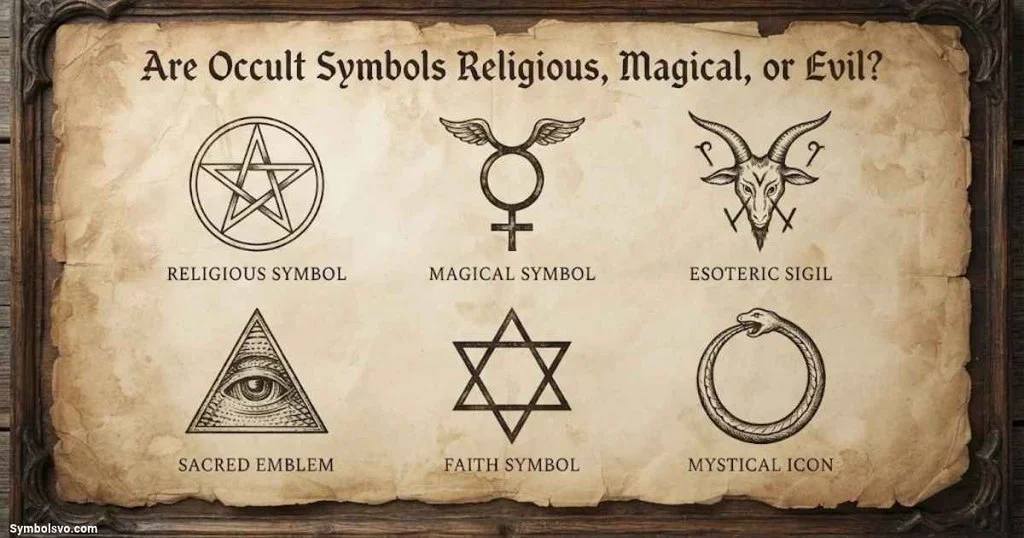
The word occult often creates confusion because popular culture frequently connects it with frightening imagery, supernatural danger, or devil worship.
Historically, however, occult subjects covered a much wider range of ideas.
Alchemy, astrology, Hermetic philosophy, Kabbalah, and ceremonial magic all contributed to Western esoteric traditions.
Some practitioners worked within Christian religious frameworks. Others developed philosophical or magical systems outside conventional religious institutions.
The distinction matters because a symbol’s association with occultism doesn’t automatically make it evil.
Consider these examples:
- Tetragrammaton: A sacred Hebrew divine name with deep significance in Judaism.
- Tree of Life: A central diagram in Jewish mystical thought.
- Rose Cross: An emblem associated with Rosicrucian literature and later esoteric movements.
- Pentagram: A geometric figure with different historical, religious, and magical uses.
- Baphomet: A nineteenth-century occult illustration later adopted by different cultural and religious movements.
Some occult symbols have controversial modern associations. Others remain important religious symbols for millions of people.
Their meanings depend on their origins, uses, and interpretations.
Occult Symbols vs. Religious Symbols vs. Esoteric Symbols
These categories overlap, but they don’t mean exactly the same thing.
Understanding their differences helps explain why certain symbols appear in several traditions.
| Symbol category | Main purpose | Examples |
| Occult symbols | Express specialized or hidden philosophical and magical ideas | Baphomet, magical seals |
| Religious symbols | Represent religious beliefs and sacred teachings | Christian cross, Star of David |
| Esoteric symbols | Communicate specialized spiritual or philosophical knowledge | Rose Cross, Tree of Life |
| Alchemical symbols | Represent substances, processes, and transformations | Mercury, sulfur, salt |
| Magical symbols | Function within particular magical systems | Planetary seals, sigils |
| Astrological symbols | Represent planets and zodiac signs | Sun, Moon, Aries |
A single symbol can belong to more than one category.
For example, the Tree of Life is a Jewish religious and mystical symbol. Later Western occultists also incorporated it into their esoteric systems.
Similarly, the cross has a broad Christian history, but it also appears in alchemical diagrams and Rosicrucian emblems.
The historical context matters more than the label attached to a symbol.
Frequently Asked Questions About Occult Symbols
What are occult symbols?
Occult symbols are signs, geometric figures, diagrams, and images used to represent specialized spiritual, philosophical, religious, or magical ideas. They appear in traditions such as Hermeticism, alchemy, Kabbalah, and Western ceremonial magic.
What is the most famous occult symbol?
Baphomet is among the most recognizable symbols associated with modern Western occultism. Other well-known examples include the pentagram, Rose Cross, Tree of Life, and Ouroboros.
Their popularity comes from their historical influence and continued appearance in books, artwork, religious movements, and popular culture.
What does the Baphomet symbol represent?
Eliphas Levi’s famous Baphomet illustration represents a complex combination of philosophical and magical ideas. Its imagery includes opposing principles, spiritual illumination, and the relationship between different aspects of existence.
It first appeared in Levi’s nineteenth-century work Dogme et Rituel de la Haute Magie.
What does the Rose Cross symbolize?
The Rose Cross combines Christian cross imagery with a rose. It became associated with Rosicrucian teachings about spiritual development, divine wisdom, and transformation.
Later esoteric organizations developed their own interpretations of the emblem.
What is the Tetragrammaton in occultism?
The Tetragrammaton is the four-letter Hebrew divine name YHWH. It holds deep religious significance in Judaism and also appears in Christian Kabbalah and Western ceremonial magic.
Some esoteric systems associate its four letters with elemental, spiritual, or cosmological principles.
What is the Tree of Life in Kabbalah?
The Tree of Life is a diagram representing ten Sephirot, which describe divine emanations or attributes in Jewish Kabbalistic thought.
It explores the relationship between the infinite divine reality, creation, and spiritual understanding.
What is the difference between occult and esoteric symbols?
Occult symbols generally relate to hidden knowledge, magical practices, or specialized philosophical systems.
Esoteric symbols communicate teachings intended for particular traditions or groups of students.
The categories overlap, and many symbols belong to both.
Are occult symbols connected to witchcraft?
Some occult symbols appear in modern witchcraft and magical practices. However, occultism is much broader than witchcraft.
It also includes historical traditions such as alchemy, Hermeticism, Kabbalah, ceremonial magic, and Renaissance natural philosophy.
What are the most common alchemical symbols?
Common alchemical symbols include those representing sulfur, mercury, salt, the four classical elements, and planetary metals.
The Ouroboros and Philosopher’s Stone are also important examples of alchemical imagery.
What does the pentagram mean in occultism?
The pentagram is a five-pointed star with several historical interpretations.
In some Western magical traditions, its five points represent earth, water, air, fire, and spirit. Its meaning can change depending on its orientation and the tradition using it.
What are planetary seals?
Planetary seals are geometric or symbolic designs associated with celestial bodies in historical magical systems.
They may incorporate planetary names, letters, numbers, and geometric arrangements.
Who created the Hieroglyphic Monad?
John Dee created the Hieroglyphic Monad and explained it in his 1564 book Monas Hieroglyphica.
The design combines astronomical, alchemical, and philosophical symbols into one figure representing unity.
What is the Sigillum Dei Aemaeth?
The Sigillum Dei Aemaeth is a complex ceremonial seal associated with John Dee and Edward Kelley.
Its geometric structure contains divine and angelic names. It formed part of Dee’s historical system of angelic magic.
How did Renaissance scholars use occult symbols?
Renaissance scholars used symbols to explore connections between mathematics, religion, astronomy, alchemy, and natural philosophy.
John Dee and Robert Fludd are notable examples. Their books and illustrations show how symbolic diagrams helped communicate complicated theories about creation and the universe.
Do occult symbols have the same meaning in every tradition?
No. A symbol can carry different meanings depending on its historical period, religious background, and cultural use.
For example, the hexagram has important Jewish associations but also appears in certain Western magical systems.
Understanding the context is essential for interpreting it accurately.
Conclusion: Understanding the Meaning of Occult Symbols
Occult symbols offer a fascinating look into the religious, philosophical, and intellectual history of different cultures. Their designs communicate ideas about divine creation, spiritual knowledge, natural processes, and the relationship between humanity and the universe.
From Baphomet and the Rose Cross to the Tetragrammaton and the Tree of Life, each symbol carries its own historical background. Some developed within ancient religious traditions, while others emerged through Renaissance philosophy or nineteenth-century occult movements.
Figures such as John Dee, Robert Fludd, and Eliphas Levi helped shape the symbolic language associated with Western esotericism. Their writings and illustrations continue to influence how people understand magical and mystical imagery today.
The most important thing to remember is that symbols need historical context. A design’s modern reputation doesn’t always reflect its original purpose. By examining its origins, visual elements, and associated traditions, you can understand its meaning without confusing historical facts with popular myths.

I’m Daniel Brooks, a content creator and symbol enthusiast dedicated to researching the fascinating world of signs and symbols. I enjoy discovering the hidden meanings behind famous icons, emojis, historical emblems, and cultural symbols. Through my writing, I aim to provide trustworthy, well-researched, and reader-friendly information that helps people learn something new with every visit.
Books:
- The Complete Guide to World Symbols
- The Power of Universal Signs
 Mason Ellington
 Nathan Holloway