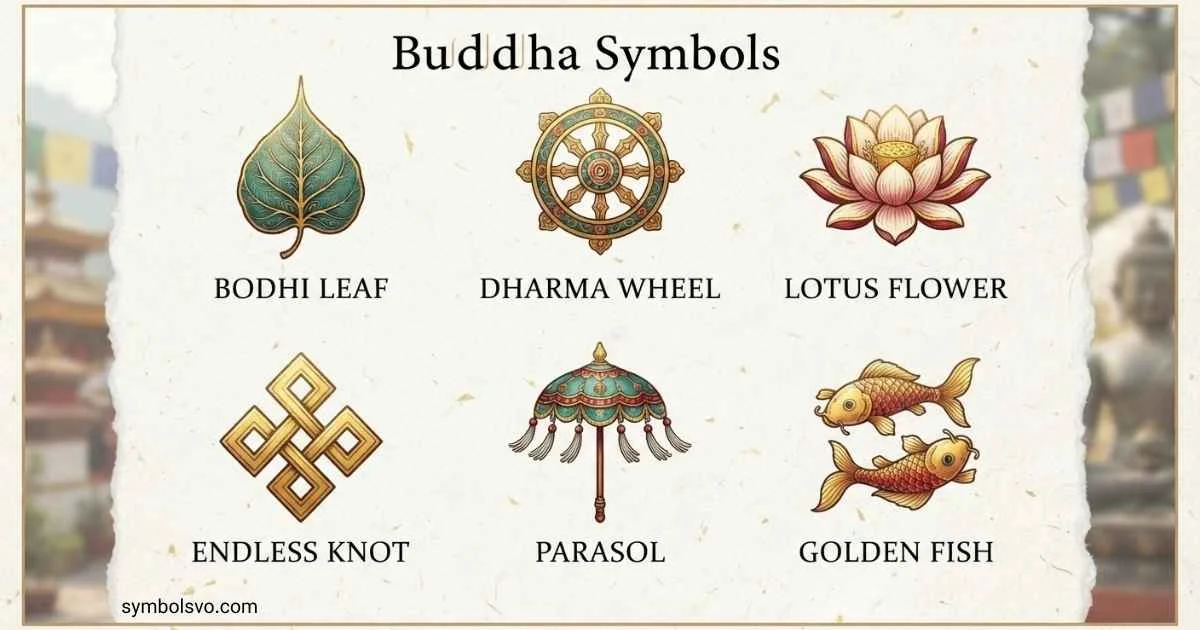
I’ve always found Buddha symbols fascinating because each sign can carry a deeper story, teaching, or spiritual meaning. What may look like a simple image can represent wisdom, peace, protection, compassion, or enlightenment.
If you’re curious about Buddha symbols, you’re in the right place. I’ll help you explore their meanings in a simple way so you can understand what these important Buddhist symbols represent.
You don’t need to be an expert to appreciate them. As you learn about each symbol, you may discover new connections to Buddhist traditions, spiritual ideas, and the timeless search for inner peace.
Buddha Signs And Symbols Meaning
Buddhist signs and symbols communicate ideas through images rather than long explanations. They appear in temples, paintings, sculptures, manuscripts, textiles, ritual objects, jewelry, architecture, and decorative art.
Some symbols are connected directly with the Buddha’s life, while others represent Buddhist teachings or qualities.
| Symbol | Common association |
| ☸ | Dharma, Buddha’s teaching, the Noble Eightfold Path |
| 🪷 | Lotus, purity and spiritual development |
| Bodhi tree | Awakening and the Buddha’s enlightenment |
| Buddha footprints | The presence and path of the Buddha |
| Endless knot | Interconnection and the continuity of causes and effects |
| Conch shell | Proclamation of the Dharma |
| Parasol | Protection and spiritual authority |
| Golden fish | Freedom and liberation |
| Treasure vase | Abundance and spiritual wealth |
| Victory banner | Victory over obstacles and harmful forces |
The lotus, wheel, parasol, and Buddha footprint have especially important places in Buddhist art. The Metropolitan Museum of Art notes that early Buddhist art sometimes represented the Buddha through symbols instead of a human figure, including the lotus, eight-spoked wheel, parasol, and footprint.
Meanings should not be treated as universal one-word definitions. Buddhist symbolism developed across India, Tibet, China, Japan, Southeast Asia, and other regions, so context matters.
What Are The 8 Symbols Of Buddhism
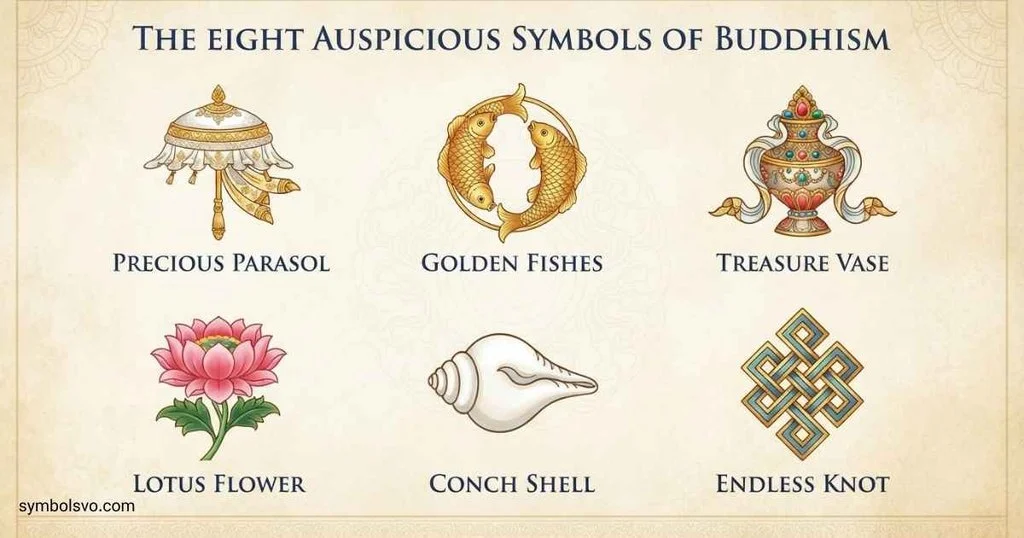
The Eight Auspicious Symbols, often called the Eight Auspicious Signs or Eight Treasures, are a famous group of Buddhist symbols.
The traditional set is:
- ☸ Wheel of Dharma — Buddhist teaching and the turning of the Dharma.
- 🐚 Conch shell — The spreading or proclamation of the Dharma.
- ☂ Parasol — Protection and shelter from suffering or harmful influences.
- 🏺 Treasure vase — Abundance, prosperity, and spiritual wealth.
- 🐟 Golden fish — Freedom and liberation.
- 🪷 Lotus — Purity and spiritual awakening.
- ♾ Endless knot — Interdependence and interconnectedness.
- 🏳 Victory banner — Victory over obstacles and negative forces.
The exact visual designs vary by artistic tradition. The Metropolitan Museum of Art identifies the eight as the parasol, pair of golden fish, treasure vase, lotus, right-turning conch shell, endless knot, victory banner, and Dharma wheel.
These eight symbols frequently appear together in Tibetan Buddhist art. They can also be found in Chinese Buddhist decorative arts.
5 Symbols Of Buddhism
There is no single official list of only five Buddhist symbols. Different traditions and educational sources select different groups depending on their purpose.
Five widely recognized examples are:
1. Dharma Wheel ☸
The Dharma Wheel represents the Buddha’s teachings. The eight-spoked wheel is especially associated with the Noble Eightfold Path.
Unicode identifies ☸ as WHEEL OF DHARMA, U+2638.
2. Lotus 🪷
The lotus is strongly associated with purity, awakening, and spiritual development. Its growth from muddy water is commonly used as an image of rising above difficult conditions.
3. Bodhi Tree
The Bodhi tree represents the Buddha’s awakening. According to Buddhist tradition, Siddhartha Gautama attained enlightenment while meditating beneath a Bodhi tree.
4. Buddha Footprints
Buddha footprints, known as Buddhapada, symbolize the Buddha’s presence and path. They are especially important in early Buddhist art.
5. Endless Knot
The endless knot is one of the Eight Auspicious Symbols. Its interwoven design can be understood in connection with interdependence and the relationship between causes and effects.
32 Buddha Symbols
The phrase 32 Buddha symbols can refer to a different Buddhist concept: the 32 marks of a great man, traditionally associated with the Buddha and other spiritually or historically significant figures in Buddhist literature.
These are not 32 Unicode symbols that can simply be copied into a message.
The 32 marks are physical characteristics described in Buddhist texts. Examples traditionally include features involving the feet, hands, body, skin, hair, eyes, teeth, and other physical characteristics.
The concept belongs to Buddhist iconography and textual tradition rather than to the modern collection of copy-and-paste characters.
This distinction is useful because “32 Buddha symbols” is sometimes used online as though it means a list of 32 decorative icons. That is not the same thing as the traditional 32 marks of a great man.
Simple Buddhist Symbols
If you want simple Buddhist symbols for notes, profiles, messages, captions, or decorative text, the following characters are easy to recognize:
- ☸ — Wheel of Dharma
- ☮ — Peace symbol
- ☯ — Yin-yang symbol
- ☼ — Sun-like decorative symbol
- 🪷 — Lotus emoji
- 🛐 — Place of worship emoji
The most directly Buddhist Unicode character in this list is ☸ WHEEL OF DHARMA. Unicode also lists it among religious symbols and gives it the code point U+2638.
Not every peaceful-looking or spiritual character is specifically Buddhist. For example, ☮ is officially the PEACE SYMBOL, while ☯ is the YIN YANG symbol associated primarily with Chinese philosophical traditions.
Buddha Symbols Of Peace
Peace is an important theme in Buddhist teachings, but there is no single Unicode character that universally means “Buddhist peace.”
The Dharma Wheel ☸ can represent the Buddha’s teaching and path, while the lotus is often associated with purity and spiritual development.
For a simple peace-themed design, people commonly use:
☮ ☸ 🪷
Each has a different background:
- ☮ — Peace symbol
- ☸ — Wheel of Dharma
- 🪷 — Lotus
Using them together can create a peaceful Buddhist-inspired visual, but the symbols should not be treated as interchangeable.
For example:
☸ 🪷 Peace Through Wisdom 🪷 ☸
or
🪷 ☸ Inner Peace ☸ 🪷
These combinations are decorative rather than traditional Buddhist inscriptions.
Inner Peace Buddha Symbols
Several Buddhist images can be connected with the idea of inner peace.
Lotus
The lotus is one of the clearest visual choices. It grows in muddy water but produces a clean flower, making it a powerful image in Buddhist art.
Buddha Meditation Image
A seated Buddha in meditation is widely used as an image of calm, concentration, and contemplative practice. The meaning depends on the specific posture, mudra, and artistic tradition.
Dharma Wheel
The Dharma Wheel can represent the Buddha’s teachings and the path of practice rather than peace alone.
Bodhi Tree
The Bodhi tree connects with the Buddha’s awakening and therefore with the deeper spiritual goal behind Buddhist practice.
A simple text design might be:
☸ 🪷 ☸
or
🪷 — Peace — 🪷
These are modern decorative combinations, not traditional Unicode Buddhist phrases.
Karma Buddha Symbols
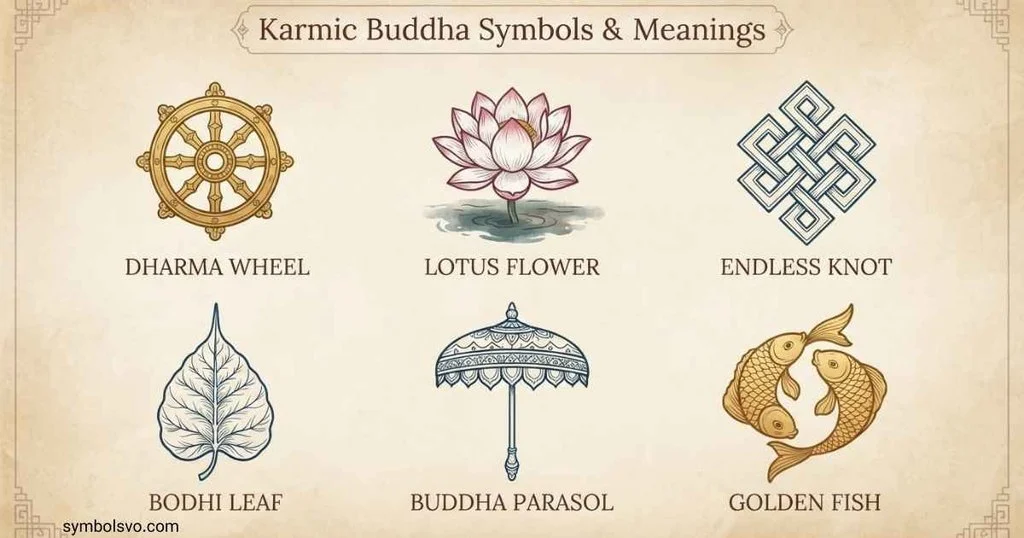
Karma is a major Buddhist concept, but there is no single universal karma symbol in Buddhism.
Karma generally concerns intentional actions and their consequences. Different Buddhist traditions explain karma in different ways, and it should not be reduced to the simple idea that “everything bad happens because of something you did.”
Several Buddhist images may be used when discussing karma:
- Endless knot — often associated with interconnection and interconnected causes and effects.
- Dharma Wheel ☸ — represents Buddhist teaching and practice.
- Lotus 🪷 — can represent spiritual development arising from difficult conditions.
- Bodhi tree — associated with awakening and Buddhist practice.
The endless knot is especially useful when someone wants a visual representation of interconnectedness. Its meaning is broader than karma alone.
Lotus Buddha Symbols
The lotus is one of the most recognizable symbols associated with Buddhism.
🪷
Its imagery is closely connected with purity and spiritual growth. Buddhist art frequently places Buddhas and bodhisattvas on lotus thrones.
The lotus also works well as a copy-and-paste symbol:
🪷
You can use it in:
- Social media bios
- Meditation posts
- Inspirational captions
- Digital artwork
- Personal journals
- Buddhist-themed designs
- Decorative headings
A lotus emoji should not be confused with every traditional Buddhist lotus design. Buddhist art contains many detailed lotus forms that are artistic images rather than Unicode characters.
A simple decorative combination is:
🪷 ☸ 🪷
Chinese Buddha Symbols
Chinese Buddhist art contains many symbols, images, characters, and auspicious motifs. Some developed within Chinese culture, while others entered Chinese visual culture through Buddhism and were adapted over time.
The Eight Buddhist Treasures became important in Chinese decorative art. The Metropolitan Museum documents examples from Chinese objects featuring the wheel, conch, parasol, lotus, treasure vase, paired fish, and endless knot among the Buddhist treasures.
Common Buddhist imagery found in Chinese art includes:
- Lotus flowers
- Dharma wheels
- Buddhist figures
- Endless knots
- Conch shells
- Treasure vases
- Golden fish
- Auspicious banners
- Buddha images
- Buddhist inscriptions
Chinese Buddhist symbolism should not be confused with symbols that are exclusively Chinese. Many motifs moved between India, Central Asia, Tibet, China, and other parts of Asia.
For example, the Eight Auspicious Symbols were introduced into China with Buddhism and later became part of Chinese decorative traditions.
Buddha Symbols Swastika
The swastika is an ancient symbol found in several cultures and religious traditions, including Buddhism.
In Buddhist contexts, it can appear as an auspicious sign and is found in Buddhist art across parts of Asia. The Metropolitan Museum notes the use of the svastika among Tibetan Buddhist decorative motifs.
The direction and visual form can vary by culture and tradition. In some Buddhist settings, the symbol may be associated with good fortune, auspiciousness, or the Buddha’s teachings.
The important historical distinction is that the swastika is much older than the twentieth-century Nazi movement. The Nazi regime appropriated a version of the symbol and turned it into a political emblem associated with Nazism, antisemitism, racism, war, and genocide.
Unicode also recognizes swastika-related characters in East Asian scripts, including 卍 and 卐, but their historical and cultural meanings depend heavily on context.
Buddha Symbols Nazi
The Buddhist swastika and the Nazi swastika are often confused because they can look similar.
Their historical contexts are different.
The swastika existed for centuries before the Nazi era and appears in Asian religious and cultural traditions, including Buddhism. In Buddhist art, it may represent auspiciousness and other positive religious associations.
The Nazi regime adopted a hooked-cross design as its central political emblem in the twentieth century. In modern Western contexts, that Nazi association is often the first meaning people recognize.
This difference matters when interpreting Buddhist artwork.
| Buddhist context | Nazi context |
| Ancient religious and cultural symbol | Modern political emblem |
| Found in Asian religious art | Associated with Nazi Germany |
| Can represent auspiciousness | Associated with Nazism and genocide |
| Predates the twentieth century by centuries | Adopted by the Nazi movement in the twentieth century |
A symbol’s appearance alone does not tell you its meaning. Historical setting, orientation, surrounding imagery, language, and cultural context all matter.
Buddha Symbols Tattoo
Buddhist-inspired tattoos often use symbols associated with wisdom, compassion, meditation, protection, or spiritual development.
Popular choices include:
- ☸ Dharma Wheel — Buddhist teaching and the path.
- 🪷 Lotus — purity and spiritual growth.
- Bodhi tree — awakening.
- Endless knot — interconnectedness.
- Buddha image — meditation or devotion, depending on the person’s intention.
- Eight Auspicious Symbols — a group representing Buddhist auspicious imagery.
A tattoo should be researched carefully because Buddhist imagery can have religious significance. A design that looks decorative online may carry a deeper meaning in a particular Buddhist tradition.
Placement can matter culturally as well. People considering Buddhist imagery should learn how the specific tradition treats sacred images, clothing, body placement, and representations of the Buddha.
For a simple text-based design, ☸ and 🪷 are recognizable options, but a detailed tattoo normally requires an actual artwork rather than a Unicode character.
Buddha Symbols Copy And Paste
If you need Buddha symbols for digital use, these are some of the easiest characters to copy:
| Symbol | Name or common use | Copy |
| ☸ | Wheel of Dharma | ☸ |
| 🪷 | Lotus | 🪷 |
| ☮ | Peace symbol | ☮ |
| ☯ | Yin-yang | ☯ |
| 🛐 | Place of worship | 🛐 |
| 卍 | CJK ideograph associated with swastika form | 卍 |
| 卐 | CJK ideograph associated with reverse swastika form | 卐 |
The most clearly Buddhist Unicode character here is ☸ WHEEL OF DHARMA, officially encoded at U+2638.
The lotus emoji 🪷 is useful for modern digital communication, but it is an emoji rather than a special Unicode character officially named “Buddhist lotus symbol.” Unicode’s emoji data lists ☸ specifically as the “wheel of dharma” with Buddhist and religious keywords.
Copy a symbol directly from the table and paste it into a message, profile, document, caption, or other supported text field.
Buddha Symbol Text
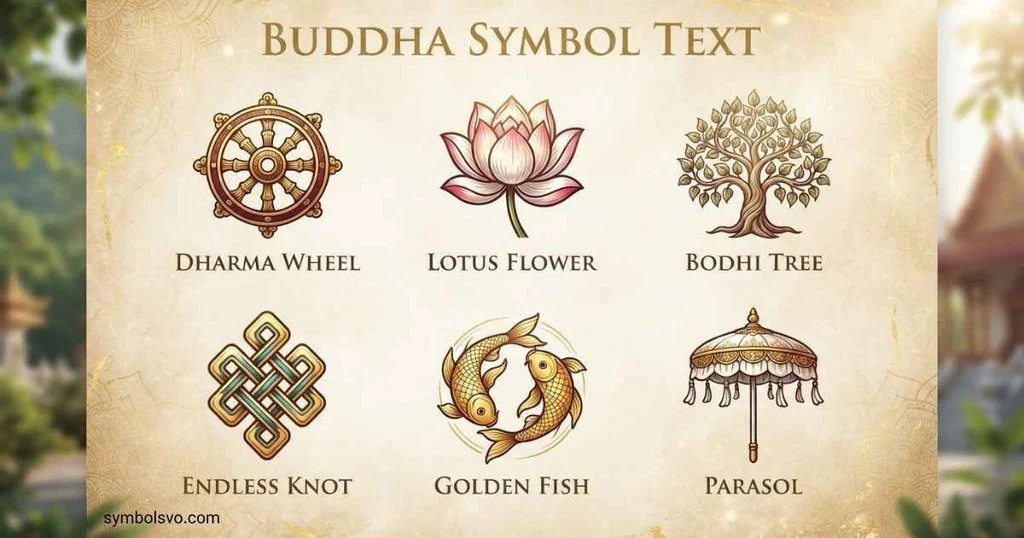
Buddha symbol text is useful when you want a Buddhist-inspired design without using an image.
Here are some simple combinations:
☸ 🪷 ☸
🪷 Peace 🪷
☸ Dharma ☸
🪷 Inner Peace 🪷
☸ Buddhism ☸
🪷 Wisdom • Compassion • Peace 🪷
You can also use plain text alongside symbols:
☸ Buddha’s Teachings ☸
🪷 Mindfulness 🪷
☸ Dharma • Wisdom • Practice ☸
These are modern text decorations. They should not be presented as traditional Buddhist prayers, mantras, or sacred inscriptions unless the actual language and source have been verified.
If you need a traditional Buddhist phrase, mantra, or script for copying, check its original language and tradition first. Transliteration and Unicode rendering can vary, and an attractive-looking character sequence is not automatically a historically accurate Buddhist inscription.
Frequently Asked Questions
What is the main Buddhist symbol?
The Dharma Wheel, ☸, is one of the most recognizable Buddhist symbols. It represents the Dharma, or the Buddha’s teachings, and the eight-spoked form is commonly connected with the Noble Eightfold Path. Unicode officially names ☸ “WHEEL OF DHARMA.”
What are the 8 auspicious Buddhist symbols?
The eight are the Dharma Wheel, conch shell, parasol, treasure vase, golden fish, lotus, endless knot, and victory banner. They are especially prominent in Tibetan and Himalayan Buddhist art.
Is the swastika a Buddhist symbol?
Yes. Swastika forms have been used as auspicious religious symbols in Buddhist traditions and other Asian cultures for centuries. The Nazi movement later appropriated a version of the symbol for its political emblem, so its meaning must be understood from historical and cultural context.
What symbol represents Buddhist peace?
There is no single universal “Buddhist peace symbol.” The lotus, Dharma Wheel, Bodhi tree, and meditating Buddha can all be used in contexts involving Buddhist ideas of peace, practice, or awakening. The separate Unicode character ☮ is officially the Peace Symbol, rather than a specifically Buddhist symbol.
What Buddhist symbol can I copy and paste?
The easiest specifically Buddhist Unicode symbol is ☸, the Wheel of Dharma. You can also copy 🪷 for the lotus, although it is an emoji rather than a character officially named “Buddhist lotus symbol.”
Conclusion
Buddha symbols give visual form to important Buddhist ideas and traditions. The Dharma Wheel, lotus, Bodhi tree, Buddha footprints, endless knot, and Eight Auspicious Symbols each carry their own history and associations. Their meanings can change with cultural and religious context, so a symbol is best understood as part of a larger tradition.
For digital use, ☸ is the clearest Buddhist Unicode symbol, while 🪷 offers a simple lotus design for modern text. These can be used in captions, profiles, messages, artwork, and other creative projects without pretending that every decorative combination is an ancient Buddhist inscription.
The swastika also deserves special care because an ancient auspicious symbol in Buddhist and other Asian traditions became closely associated with Nazism after its twentieth-century appropriation. Looking at history, context, and cultural meaning helps prevent very different symbols and traditions from being incorrectly treated as the same thing.

 Grace Whitmore
 Daniel Brooks