Have you ever looked at a clothing label and wondered what all those tiny wash symbols mean? I know they can seem confusing at first, especially when you want to care for your favorite clothes properly.
You don’t need to memorize every symbol to understand your laundry labels. I’ll help you learn what the most common wash symbols mean, from machine washing and hand washing to temperature and drying instructions.
Once you understand these simple signs, you can make smarter laundry choices and avoid common mistakes. You’ll know exactly what your clothes need to stay clean, fresh, and in good condition.
Wash Symbols And Meanings
Wash symbols are pictograms printed or woven onto clothing care labels. They provide instructions about the maximum treatment a textile can safely receive.
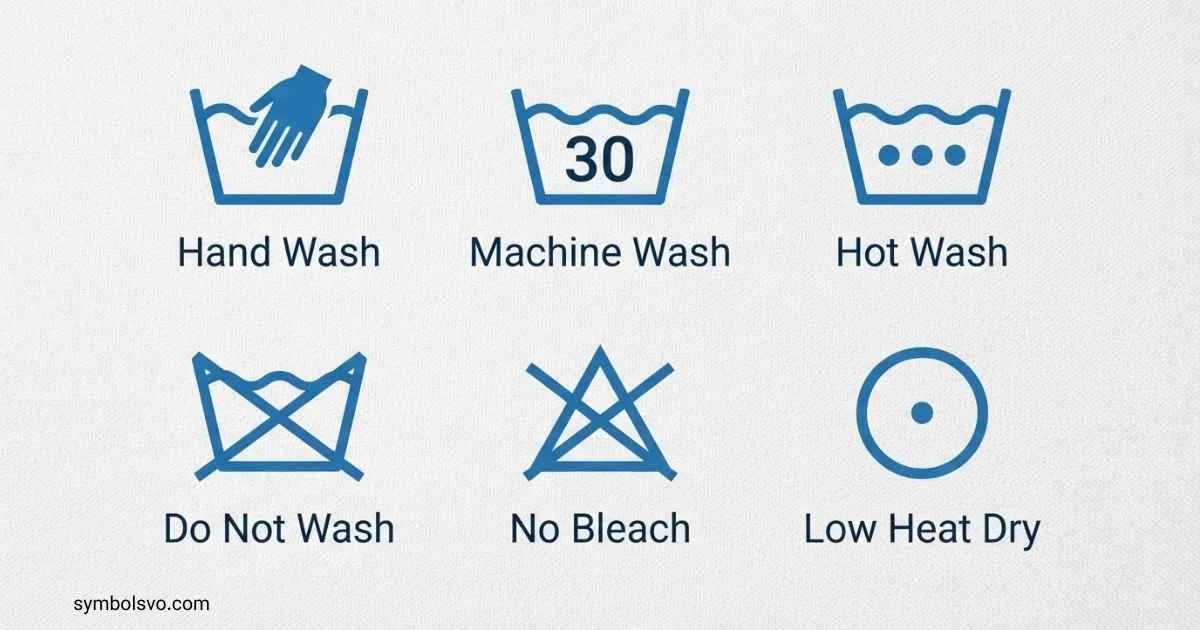
The basic washing symbol looks like a washtub. Its variations tell you whether the garment can be machine washed, hand washed, washed at a particular temperature, or should not be washed.
Here are the most useful washing symbols to recognize:
| Wash symbol | Meaning |
| 🛁 / washtub with a number | Machine washing up to the stated temperature |
| Washtub with a hand | Hand wash |
| Washtub with one line underneath | Mild or reduced-mechanical-action wash |
| Washtub with two lines underneath | Very mild wash |
| Crossed-out washtub | Do not wash |
The actual standardized care-label graphics are more precise than emoji representations, so the table above is a visual aid rather than a claim that the emoji is the official laundry symbol.
Numbers are particularly important. A 30 inside the tub means the maximum washing temperature is 30°C. A 40 means 40°C, and so on. The number is a maximum, not a recommendation that you must always use that exact temperature.
A lower temperature or gentler treatment is generally permitted when it provides adequate cleaning. GINETEX specifically explains that milder treatments and lower temperatures than the maximum shown on the label are permitted.
Laundry Symbols Chart
A laundry symbols chart makes care labels much easier to understand at a glance. Washing is only one part of a complete textile care label. Standard care labeling also covers bleaching, drying, ironing, and professional textile care. ISO 3758:2023 provides the current international framework for these care symbols.
Washing Symbols
| Symbol appearance | Meaning |
| Washtub + 30 | Wash at maximum 30°C |
| Washtub + 40 | Wash at maximum 40°C |
| Washtub + 60 | Wash at maximum 60°C |
| Washtub + 95 | Wash at maximum 95°C |
| Washtub + hand | Hand wash |
| Washtub + one bar | Mild wash |
| Washtub + two bars | Very mild wash |
| Crossed washtub | Do not wash |
Other Laundry Care Symbols
| Symbol shape | Care category | General meaning |
| Triangle | Bleaching | Indicates whether bleaching is permitted |
| Square | Drying | Gives natural or tumble-drying information |
| Iron | Ironing | Indicates ironing temperature |
| Circle | Professional care | Indicates professional cleaning processes |
A crossed symbol generally means that the treatment represented by that symbol is not permitted.
Remember that a laundry chart is a quick reference. The complete care label on your specific garment should always take priority.
How To Wash Symbols
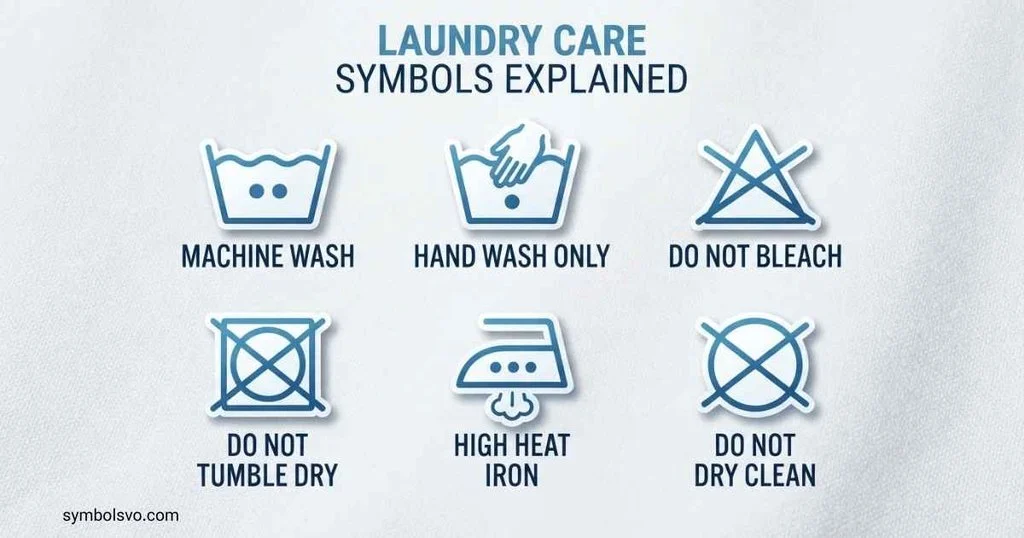
To understand how to wash symbols, start with the washtub and then look for additional marks inside or underneath it.
A number inside the tub specifies the maximum temperature. For example:
- 30 — maximum 30°C
- 40 — maximum 40°C
- 60 — maximum 60°C
- 95 — maximum 95°C
A hand inside the tub means hand washing rather than a standard machine wash. The ISO/GINETEX system also includes an ambient-temperature hand-wash symbol in the current standard.
What The Lines Under The Tub Mean
The lines underneath the wash tub describe the severity of the washing process.
- No line: Normal washing process.
- One line: Reduced mechanical action or mild washing.
- Two lines: Very mild mechanical action, commonly associated with especially sensitive fabrics.
The lines do not mean “wash at a lower temperature” by themselves. They mainly indicate reduced mechanical treatment.
If you see a crossed-out wash tub, do not put the item through a domestic washing process unless the manufacturer provides another specific instruction.
Machine Wash Symbols
Machine wash symbols tell you if a garment can go into a washing machine and how much washing intensity it can tolerate.
The temperature shown inside the tub is the maximum permitted temperature. For example, a 40°C symbol does not mean that every 40°C program is required; it means the wash should not exceed that temperature.
The lines underneath are equally useful. A garment marked with a mild-wash line may need a gentle or easy-care cycle rather than a strong cotton cycle.
For delicate clothing:
- Choose the appropriate temperature.
- Select a gentle program when the label shows a bar.
- Avoid overloading the drum.
- Use an appropriate detergent.
- Follow any additional garment-specific instructions.
- Avoid aggressive spinning when the fabric requires gentle treatment.
GINETEX recommends reducing the load and using suitable mild cycles for many easy-care and mechanically sensitive textiles.
Your washing machine’s program names can differ from the symbols on a garment label. The label describes the maximum permitted treatment; your machine manual explains which program best matches that treatment.
Clothing Wash Symbols
Clothing wash symbols are found on care labels sewn into garments. They are especially useful because different fabrics, dyes, finishes, and garment construction can react differently to heat and mechanical action.
Common examples include:
- Cotton shirts with a 30°C or 40°C wash limit
- Towels with a higher temperature allowance
- Wool garments with very mild or hand-wash instructions
- Synthetic garments marked for mild washing
- Delicate clothing requiring reduced mechanical action
- Items marked with a crossed tub that should not be washed
Do not assume that two garments can be washed together simply because they look similar. Their care labels may specify different temperatures or washing intensities.
Color also matters in practical laundry sorting. GINETEX recommends sorting by factors such as degree of soiling, treatment type, color, and fiber content when appropriate.
Wash Symbols On Tags
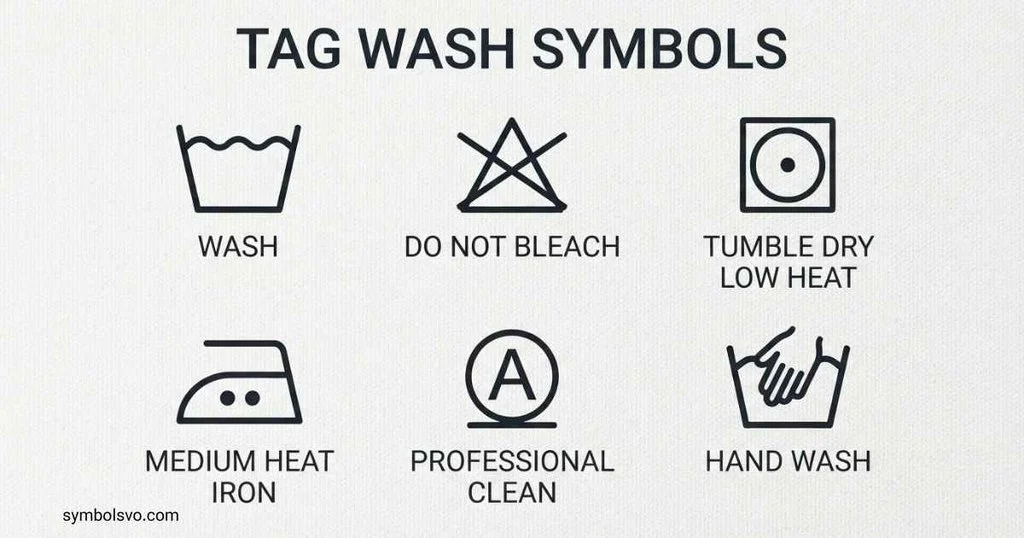
Wash symbols on tags are designed to provide care instructions directly on the garment.
You will commonly find a row containing several symbols. The traditional sequence is:
Washing → Bleaching → Drying → Ironing → Professional textile care
GINETEX states that this sequence has been used in its care-labeling system since 2006.
The first symbol is normally the washing symbol. Once you understand the tub, you can quickly determine the maximum wash temperature and whether special mechanical treatment is required.
For example, a tag might effectively communicate:
Wash 30°C → Do not bleach → Tumble dry with specified limits → Low-temperature iron → Professional-care instruction
Never look at only one symbol if the entire tag is available. A garment can be washable but still have strict drying or ironing restrictions.
Tag Wash Symbols
Tag wash symbols are often small, which can make them difficult to read. A phone camera or magnifying feature can help when the printed label is tiny.
When reading a tag, follow this order:
- Find the wash tub.
- Check the number or hand symbol.
- Look for one or two lines underneath.
- Check for a crossed-out tub.
- Read the remaining care symbols.
- Follow the most restrictive relevant instruction.
A common mistake is seeing “machine washable” and assuming any machine program is safe. The washing symbol gives a maximum permitted treatment, while bars and temperature numbers provide additional limits.
Also remember that care symbols are not a promise that every stain will disappear. GINETEX explains that care labeling is intended to prevent damage under the specified treatment, not to guarantee removal of every type of dirt or stain.
Garment Wash Symbols
Garment wash symbols are especially helpful for clothes made from fabrics that require careful handling.
A useful way to read them is to think in terms of temperature + mechanical action.
| Label detail | What to consider |
| 30°C | Keep the wash at or below 30°C |
| 40°C | Keep the wash at or below 40°C |
| 60°C | Keep the wash at or below 60°C |
| Hand symbol | Hand-wash treatment |
| One bar | Use a gentler mechanical process |
| Two bars | Use a very gentle process |
| Crossed tub | Do not wash |
Wool, delicate synthetics, viscose, and garments with special finishes may need more careful treatment than durable cotton items. GINETEX lists several mild and very mild washing categories for fabrics such as wool, modal, viscose, polyester, polyamide, and other sensitive textiles.
The fabric name alone should not override the care label. If the label gives a specific instruction, follow the label.
Universal Wash Symbols
“Universal wash symbols” usually refers to standardized or widely recognized laundry-care pictograms that allow care instructions to be understood across languages.
The international care-labeling framework is standardized through ISO 3758. The current edition is ISO 3758:2023. It covers graphic symbols for washing, bleaching, drying, ironing, and professional textile care.
However, “universal” does not mean that every country or system uses exactly identical graphics. GINETEX notes that U.S. ASTM care symbols can differ from GINETEX/ISO-based symbols in both graphics and some details.
That distinction matters when you are comparing clothing purchased from different markets.
The safest approach is to learn the underlying ideas:
- Tub = washing
- Number = maximum wash temperature
- Hand in tub = hand washing
- Bars under tub = reduced mechanical action
- Cross = treatment prohibited
These visual conventions make care labels much easier to understand even when the exact graphic style varies.
Laundry Symbols Copy And Paste
If you are searching for laundry symbols to copy and paste, there is an important limitation: standardized clothing-care pictograms are graphic care-label symbols, not a simple collection of ordinary Unicode characters.
That means you should not assume that an emoji or text character is the official Unicode equivalent of a wash-tub care symbol.
For example, these characters can be copied as ordinary text:
- 🧺 — basket emoji
- 🫧 — bubbles emoji
- 💧 — droplet emoji
- 👕 — shirt emoji
- ♨ — hot springs symbol
But these are not interchangeable with standardized textile-care pictograms. They are decorative or contextual characters and should not be used to communicate an official washing instruction on a garment.
For websites, social posts, laundry checklists, or decorative text, they can still be useful:
🧺 Laundry day
💧 Cold wash
👕 Clothing care
🫧 Gentle cleaning
For an actual care label, use the appropriate standardized care-symbol artwork rather than substituting an emoji.
GINETEX also explains that its five core care symbols are protected trademarks in many countries, so businesses should not simply reproduce them without considering the applicable licensing requirements.
IKEA Wash Symbols
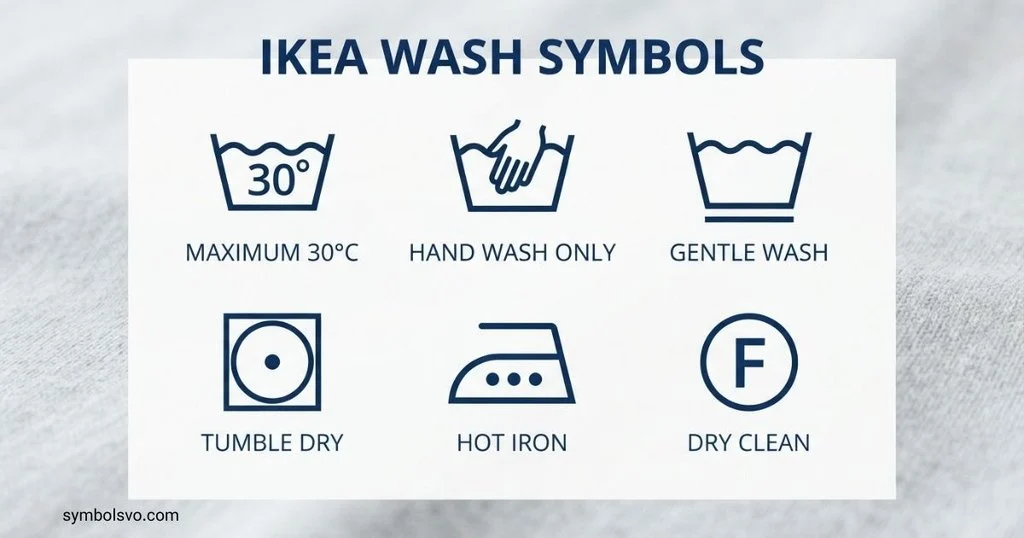
IKEA products use care instructions to explain how items should be washed, dried, ironed, or otherwise maintained. IKEA materials show examples such as machine wash normal 40°C, machine wash warm 60°C, and do not wash, along with other care instructions.
IKEA also provides washing-machine documentation that connects garment labels with machine programs. For example, its washing-machine manual discusses programs such as Cotton, Wool, Delicates, Synthetics, and other cycles.
When reading an IKEA product label:
- Check the washing temperature first.
- Look for hand-wash or do-not-wash instructions.
- Check drying restrictions before putting the item in a dryer.
- Follow ironing limitations.
- Pay attention to special instructions for covers, textiles, and delicate materials.
IKEA’s laundry guidance also encourages practical organization around laundry care, including keeping care-symbol information available in the laundry area.
The safest rule is simple: use the care symbols on the specific IKEA product rather than assuming every IKEA textile has the same washing requirements.
Frequently Asked Questions
What does the wash symbol mean on clothes?
The wash symbol is usually a washtub. It tells you whether the garment can be washed and, when a number is shown, the maximum washing temperature. Lines underneath can indicate a gentler mechanical process.
What does a triangle mean on a laundry label?
A triangle is the symbol for bleaching. Different versions indicate whether bleaching is allowed and what type may be permitted. A crossed triangle means bleaching is not allowed.
What does one line under the washing symbol mean?
One line underneath the wash tub indicates a mild process with reduced mechanical action. Two lines indicate an even gentler process.
Can I use emojis as laundry symbols?
Emojis can be used for decorative laundry-related content, but they should not be treated as official care-label symbols. A shirt, basket, water droplet, or bubbles emoji does not necessarily communicate a standardized washing instruction.
Are laundry symbols the same worldwide?
Many care symbols are standardized internationally through ISO 3758, but regional systems can differ. For example, GINETEX notes differences between ISO/GINETEX-based symbols and U.S. ASTM care symbols.
Conclusion
Wash symbols turn complicated garment-care instructions into a small set of recognizable visual signs. The washtub tells you about washing, numbers show maximum temperatures, hand symbols indicate hand washing, and lines underneath the tub signal reduced mechanical action.
The best way to read a care label is to consider the complete set of instructions rather than focusing only on the washing temperature. Drying, bleaching, ironing, and professional-care symbols can be just as important for protecting a garment.
For everyday laundry, remember the key rule: treat the number inside the tub as a maximum, pay attention to bars and crosses, and follow the specific label attached to the garment. When you understand these symbols, choosing the right wash cycle becomes much easier.

I’m Nathan Holloway, a passionate researcher and writer with a deep interest in symbols, signs, and their hidden meanings. I enjoy exploring how symbols have influenced different civilizations, religions, and modern communication. Through my work, I aim to make complex historical and cultural concepts easy to understand for readers of all backgrounds. Every article I write is carefully researched to provide reliable and engaging information.
Books:
- Beyond the Symbol
- The Secret Meanings of Everyday Signs
Author 2: Grace Whitmore
Description:
My name is Grace Whitmore, and I love discovering the stories behind the world’s most fascinating symbols. I spend my time researching ancient civilizations, mythology, spiritual traditions, and modern iconography to uncover the meanings people often overlook. I believe that every symbol has a history worth telling, and I enjoy sharing that knowledge in a simple and reader-friendly way.
Books:
- Echoes of Ancient Symbols
- The Symbolic World
 Mason Ellington
 Grace Whitmore
 Daniel Brooks