
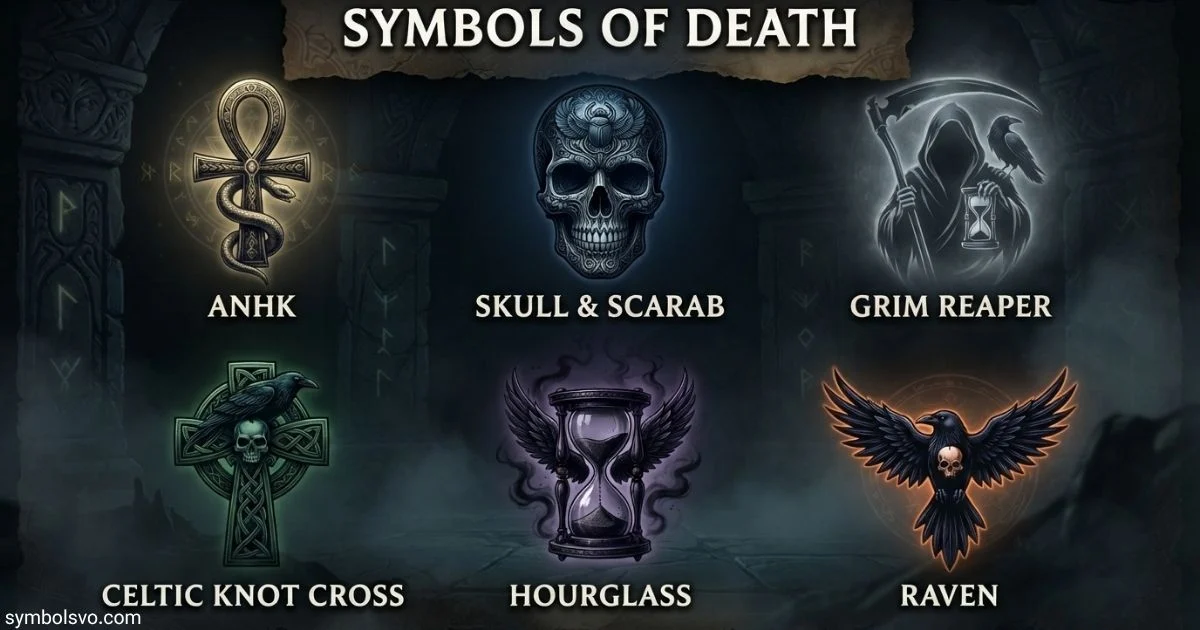
I have always found symbols of death fascinating because they can say so much without using a single word. From skulls and ravens to candles, flowers, and other meaningful signs, I see how different cultures use symbols to express death, mourning, remembrance, and the mystery of life. You may recognize some of these symbols, but their deeper meanings can be surprisingly different from what you expect.
As you explore these symbols of death, you’ll discover how they can represent not only loss and grief, but also remembrance, transformation, honor, and the natural cycle of life. I’ll help you understand the stories and meanings behind these powerful symbols in a simple, thoughtful way.
Whether you are researching symbolism, exploring cultural traditions, or simply curious about why certain images are connected with death, this guide gives you a clear place to start. You can explore each symbol at your own pace and discover the meaning behind it.
What Are Symbols Of Death
Symbols of death are images, objects, plants, animals, colors, or signs that people associate with death, mortality, mourning, the afterlife, or the end of a life stage.
Some have direct connections with funerary traditions. Others developed through stories, religion, folklore, and visual art.
Common examples include:
- ☠ Skull and crossbones — mortality, danger, or death
- 💀 Skull — death, mortality, or the macabre
- ⚰ Coffin — burial and physical death
- ⌛ Hourglass — passing time and the limited nature of life
- 🕯 Candle — remembrance, mourning, or a life that has ended
- 🥀 Wilted rose — loss, fading beauty, or grief
- Raven — death, mystery, or the unknown in some traditions
- Scythe — mortality and the harvesting of life
- Grave marker — burial, remembrance, and the dead
- Skeleton — physical mortality and the inevitability of death
These meanings depend heavily on context. A skull can represent death in one setting but rebellion, danger, humor, or fashion in another.
Common Symbols Of Death
Several death symbols have become familiar across modern Western visual culture. Their meanings often come from religious art, folklore, literature, historical customs, and popular media.
| Symbol | Common association |
| 💀 Skull | Death, mortality, impermanence |
| ☠ Skull and crossbones | Death, poison, danger |
| ⚰ Coffin | Burial and death |
| 🪦 Headstone | Grave, remembrance |
| ⌛ Hourglass | Passing time and mortality |
| 🕯 Candle | Remembrance and mourning |
| 🥀 Wilted flower | Loss and fading life |
| Scythe | Death and the harvesting of life |
| Black clothing | Mourning and grief in many Western contexts |
| Raven | Death, mystery, or prophecy in some traditions |
| Crow | Death, transformation, or bad omen in some folklore |
| Broken candle | A life ended or extinguished |
| Fallen leaf | Aging, change, and mortality |
| Funeral bell | Mourning and death |
Some of these are not exclusively death symbols. The hourglass, for example, can symbolize time in general. A candle can represent hope or spirituality as well as remembrance. Meaning comes from how the symbol is used.
Symbols Of Death And Their Meanings
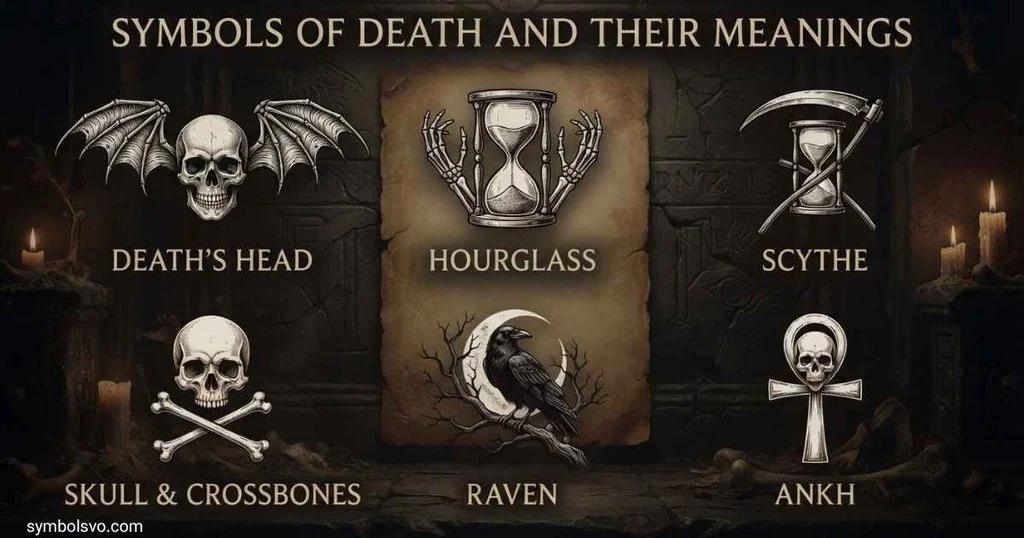
The same symbol can communicate several related ideas. Understanding the context makes its meaning much clearer.
Skull
The skull is one of the most recognizable symbols of mortality. It represents the physical remains of a human being and is often used to remind viewers that death is unavoidable.
Copy and paste: 💀 ☠
The plain skull emoji, 💀, has modern uses that extend beyond literal death. Online, it can express dark humor, shock, embarrassment, or the idea of being “dead” from laughter.
Scythe
The scythe is strongly associated with the Grim Reaper in Western imagery. Its connection comes from the agricultural idea of harvesting crops, which became a metaphor for harvesting human lives.
Hourglass
An hourglass represents time running out. Because the sand gradually falls from one chamber to another, it can symbolize the limited time available to every person.
Candle
A candle can represent a person’s life, remembrance, prayer, or the light that remains after someone has died. An extinguished candle can create an especially strong image of a life ending.
Coffin
A coffin directly represents burial and the physical end of life. It is often used in funerary art and modern horror imagery.
Wilted flower
A dying or wilted flower can represent fading beauty, grief, aging, and the temporary nature of life.
Ancient Symbols Of Death
Ancient cultures used many symbols to express death, burial, the afterlife, and transformation. These symbols were often connected with religious beliefs rather than death alone.
Ancient Egyptian funerary objects provide particularly clear examples. The British Museum records funerary objects containing symbols such as the ankh, djed pillar, scarab, and representations of Osiris and Anubis.
Some ancient death-related symbols include:
- Anubis — protection of the dead and funerary traditions in ancient Egypt
- Osiris — death, resurrection, and the afterlife in Egyptian religion
- Djed pillar — stability and an important association with Osiris
- Scarab — transformation, renewal, and rebirth
- Pomegranate — associated with the Greek story of Persephone and the Underworld
- Funerary masks — protection and representation of the deceased
- Tombs and sarcophagi — physical reminders of burial and the journey after death
It is important not to treat all ancient symbols as simple “death signs.” Many represented a larger cycle involving life, death, protection, resurrection, or renewal.
Symbols Of Death In Different Cultures
Death symbolism differs greatly between cultures. A symbol that suggests mourning in one society may represent protection, rebirth, or spiritual transition somewhere else.
| Culture or tradition | Example | Common association |
| Ancient Egypt | Anubis | Funerary rites and the dead |
| Ancient Egypt | Osiris | Death, afterlife, resurrection |
| Ancient Greece | Hades | Underworld |
| Ancient Greece | Pomegranate | Persephone and the seasonal cycle |
| Japan | White clothing in some funerary contexts | Mourning and death |
| Celtic traditions | Raven or crow | Battle, fate, death, or prophecy in some traditions |
| Christian art | Cross | Death, sacrifice, resurrection |
| Mexican traditions | Calaveras | Death, remembrance, and celebration of the dead |
These examples should be read as cultural associations rather than universal definitions. Traditions also change over time, and meanings can vary between regions and historical periods.
Symbols Of Death In Mythology
Mythology contains some of the world’s most recognizable stories about death. Rather than simply treating death as an ending, many myths connect it with journeys, transformation, judgment, seasonal cycles, and the afterlife.
Common mythological death figures and symbols include:
- Hades — ruler of the Greek Underworld
- Thanatos — personification of death in Greek mythology
- Anubis — Egyptian deity strongly associated with funerary practices
- Osiris — Egyptian god associated with the dead and afterlife
- Hel — figure associated with the realm of the dead in Norse mythology
- The Morrígan — Irish mythological figure associated in some traditions with warfare, fate, and death
- Yama — a death and afterlife figure in several South Asian religious traditions
Greek mythology provides a particularly clear example. Thanatos is described as the personification of death, while Hades rules the Underworld.
Mythological symbols often communicate more than physical death. They can represent crossing a boundary, entering another realm, losing an old identity, or beginning a new phase.
Greek Symbols Of Death
Greek mythology contains several important symbols connected with death and the Underworld.
Hades
Hades is both the name of the Greek Underworld and the god who rules it. In ancient Greek art, he could be shown with symbols such as a staff, a cornucopia, or a chariot drawn by black horses.
Thanatos
Thanatos represents death itself. Unlike Hades, who governs the Underworld, Thanatos personifies the act or condition of death.
Pomegranate
The pomegranate is closely associated with the story of Persephone. After eating pomegranate seeds in the Underworld, Persephone became connected with the seasonal return between the world above and the realm below. The story has therefore been interpreted through themes of death, renewal, agriculture, and cyclical change.
Underworld
The Underworld itself is one of the strongest Greek mythological symbols of death. It represents a destination for the dead rather than simply a symbol of physical destruction.
Egyptian Symbols Of Death
Ancient Egyptian symbolism around death was closely connected with funerary rituals and beliefs about continued existence after death.
Anubis
Anubis is commonly depicted with a jackal head and has a strong connection with funerary practices and the dead. The British Museum describes Anubis and other jackal deities in relation to the necropolis and the Egyptian funerary world.
Osiris
Osiris was an important deity of the dead and the afterlife. Museum objects depict him as a shrouded figure holding important emblems including the ankh, crook, flail, and djed pillar.
Djed
The djed pillar was associated with stability and Osiris. It appears on funerary objects and amulets connected with the deceased.
Scarab
The scarab was strongly associated with renewal and rebirth. Ancient Egyptians connected the beetle’s life cycle with the movement of the sun and renewal. The British Museum describes the scarab as a symbol connected with rebirth.
Ankh
The ankh is primarily a symbol of life, not simply death. Its connection to funerary imagery reflects the Egyptian interest in continued or eternal life. The British Museum identifies the ankh as the hieroglyphic word for life and a symbol of eternal life.
This distinction matters: Egyptian death symbolism often focused on what could continue after death rather than death as a final endpoint.
Celtic Symbols Of Death
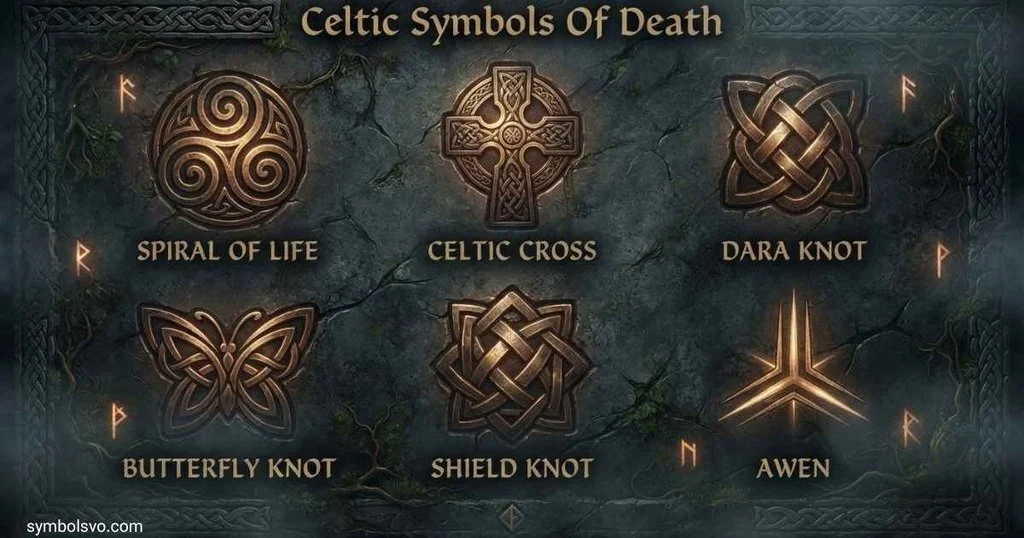
Celtic death symbolism is often discussed through mythology, folklore, nature, warfare, and the relationship between the living world and the Otherworld.
Several images are commonly associated with Celtic or Irish traditions:
- Raven — warfare, fate, prophecy, and death in some mythological contexts
- Crow — similar associations with battle and fate
- Spiral — transformation and cycles, although it should not automatically be labeled a death symbol
- Triskelion — cycles and movement rather than death specifically
- Morrígan — warfare, sovereignty, fate, and associations with death
- Cailleach — an ancient figure connected in Irish and Scottish folklore with winter and landscape
Modern designs often use Celtic knots and spirals in memorial artwork. However, these patterns should not automatically be described as ancient Celtic “death symbols.” Many have broader meanings involving continuity, nature, or interconnectedness.
Japanese Symbols Of Death
Japanese death symbolism is shaped by Buddhism, Shinto traditions, folklore, literature, visual art, and funeral customs.
Some commonly encountered associations include:
- Skeletons — mortality and the impermanence of life
- White clothing — historically associated with death and funerals in Japan
- Black clothing — modern mourning and funeral dress
- Lotus — Buddhist spiritual awakening and purity, often connected with death and rebirth in religious contexts
- Jizō — a Buddhist figure associated with protecting travelers and, in Japanese religious practice, children and the deceased
- Yūrei — ghosts or spirits of the dead in Japanese folklore
- Higan — a Buddhist period associated with remembrance and spiritual reflection
The Japanese concept of death cannot be reduced to one symbol. Different religious and cultural contexts produce different meanings.
For example, the lotus is not simply a “flower of death.” Its stronger symbolism is spiritual purity, awakening, and transformation, which can become relevant to ideas about life, death, and rebirth.
Pagan Symbols Of Death
“Pagan” describes many different historical and modern religious traditions, so there is no single universal pagan symbol of death.
Common symbols used in modern pagan or occult-inspired artwork may include:
- Skull — mortality and impermanence
- Raven — mystery, transformation, or death
- Black candle — endings, protection, mourning, or ritual symbolism depending on the tradition
- Crescent moon — cycles and transformation
- Spiral — change and cycles of life
- Waning moon — endings and release
- Triple Moon — cycles associated with some modern Goddess traditions
Care is needed with historical claims. A symbol used by modern pagan practitioners is not automatically evidence that the same symbol had the same meaning in an ancient pagan religion.
Animals That Are Symbols Of Death
Animals have long appeared in stories and folklore about death, the Underworld, prophecy, and transformation.
| Animal | Common death-related association |
| Raven | Death, prophecy, warfare, mystery |
| Crow | Omens, death, intelligence, transformation |
| Owl | Night, wisdom, mystery, death in some traditions |
| Vulture | Decay, death, cleansing |
| Bat | Night, darkness, transformation |
| Snake | Death, rebirth, transformation |
| Black butterfly | Death or transformation in some folklore |
| Wolf | Wildness, danger, death, or spiritual transition in some traditions |
| Jackal | Funerary symbolism in ancient Egypt |
| Moth | Night, transformation, mortality in some modern symbolism |
The snake is especially interesting because it can represent both death and renewal. Shedding its skin makes it a natural symbol of transformation, so it does not have one fixed meaning.
The vulture can also have a more complex role. Although associated with death and carrion, vultures can symbolize cleansing because they remove dead organic matter from the environment.
Symbols Of Death In Flowers
Flowers often represent the temporary nature of life because they bloom, fade, and eventually decay.
Black Rose
A black rose is strongly associated with death, mourning, mystery, farewell, and endings in modern symbolism. True naturally black roses are not common; many flowers described as black are actually very dark shades of red, purple, or burgundy.
Chrysanthemum
Chrysanthemums have different meanings around the world. In some countries, particularly parts of Europe and East Asia, certain chrysanthemums are strongly associated with funerals and remembrance.
White Lily
White lilies are widely used in Western funeral and memorial settings. They can suggest purity, peace, innocence, and the soul.
Poppy
Poppies can symbolize remembrance of people who died in war, particularly in connection with World War I remembrance traditions.
Wilted Rose
A wilted rose can symbolize lost love, grief, aging, fading beauty, or the end of a relationship.
Flowers demonstrate why symbolism should always be connected to culture. The same flower can represent love and beauty in one context and mourning in another.
Symbols Of Death In Art
Artists have used death symbols to explore mortality, grief, time, violence, religion, and the temporary nature of human life.
One famous tradition is vanitas art, especially associated with European art of the 16th and 17th centuries. Paintings in this tradition often included objects such as:
- Skulls
- Candles
- Hourglasses
- Wilting flowers
- Musical instruments
- Books
- Soap bubbles
- Decaying fruit
These objects reminded viewers that worldly achievements, beauty, pleasure, and possessions do not last forever.
The skull became especially powerful because it creates an immediate visual reminder of human mortality. An hourglass adds the idea of time passing, while a dying flower connects beauty with impermanence.
Death symbolism also appears in sculpture, photography, film, posters, fashion, and modern graphic design.
Symbols Of Death In Literature
Literature often uses death symbols indirectly. A writer may use an object, animal, season, landscape, or color to suggest death without directly mentioning it.
Common literary symbols include:
- Raven — grief, death, mystery, or psychological darkness
- Autumn — aging, decline, and approaching endings
- Winter — death, stillness, isolation, or dormancy
- Darkness — uncertainty, fear, or the unknown
- Wilted flowers — fading life or lost love
- Graves — memory, mortality, and the past
- Crows — ominous atmosphere or death
- Falling leaves — change and the end of a cycle
- Candle flames — life, hope, or a life nearing its end
Edgar Allan Poe’s famous use of the raven is a strong example of how an animal can become linked with grief and death through literature. A symbol’s meaning can grow through repeated use, even when the object itself does not universally mean death.
Symbols Of Death And Rebirth
Death and rebirth symbolism focuses on transformation rather than death as a final ending.
Several symbols are commonly used for this idea:
- ♾ Infinity — continuity and endless cycles
- ♻ Recycling symbol — renewal and repeated transformation
- Phoenix — destruction followed by renewal in its traditional mythic symbolism
- Butterfly — transformation and a new stage of existence
- Snake shedding its skin — renewal and transformation
- Lotus — spiritual awakening and renewal
- Sunrise — a new beginning after darkness
- Seasonal cycle — endings followed by new growth
- Pomegranate — life, death, and seasonal transition in the Persephone myth
The Greek story of Persephone is particularly useful for understanding this theme. Her movement between the Underworld and the world of the living was linked with the seasonal cycle and the renewal of vegetation.
In ancient Egypt, the scarab also demonstrates how death-related symbolism can overlap with rebirth. Egyptian sources connect the scarab with renewal and resurrection rather than treating it as a simple death emblem.
Symbols Of Death Tattoo
Death tattoos can carry deeply personal meanings. Some people choose them to represent mortality, grief, remembrance, change, survival, or acceptance of life’s temporary nature.
Popular choices include:
| Tattoo symbol | Possible meaning |
| 💀 Skull | Mortality, fearlessness, impermanence |
| ☠ Skull and crossbones | Danger, death, rebellion |
| Scythe | Mortality and the passage of life |
| Black rose | Grief, loss, farewell |
| Hourglass | Limited time |
| Raven | Mystery, memory, death, transformation |
| Moth | Transformation and darkness |
| Skeleton | Mortality and impermanence |
| Wilted flower | Loss and fading life |
| Phoenix | Rebirth after destruction |
A meaningful tattoo does not have to use an obvious death image. A falling leaf, moon phase, fading flower, or broken clock can communicate the same idea in a more subtle way.
If you are choosing a cultural symbol, research its history first. A symbol connected to a specific religion or Indigenous tradition can carry meanings beyond the visual appearance.
Unique Symbols Of Death
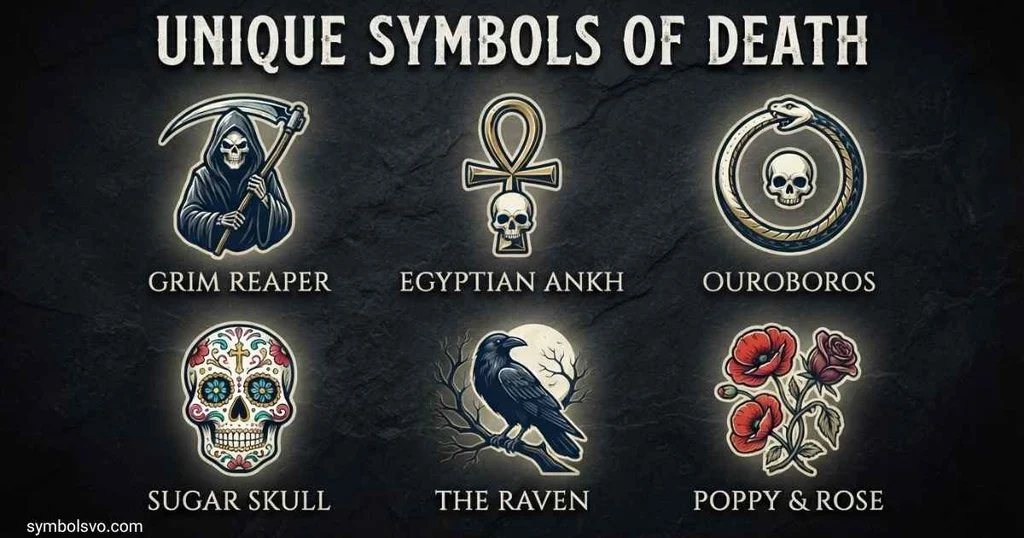
If you want a less common symbol, consider imagery that suggests death indirectly rather than using the familiar skull or coffin.
Some distinctive ideas include:
- Extinguished candle — a life or period that has ended
- Falling leaf — natural decline and the end of a cycle
- Broken hourglass — time interrupted or a life cut short
- Empty chair — absence and remembrance
- Wilted branch — loss and fading vitality
- Closed door — an ending or transition
- Fading footprint — a person’s passage through life
- Black butterfly — transformation or loss in selected traditions
- Dried flower — memory preserved after life has faded
- Moon entering darkness — transition and disappearance
- Cracked gravestone — age, memory, and the passage of generations
- Falling feather — loss, remembrance, or spiritual symbolism depending on context
For a symbol that feels personal, combine two ideas. An hourglass with a wilted flower can suggest time and mortality. A raven beside a candle can represent memory and loss. A growing plant beside a grave can express death and renewal.
The strongest symbolic designs usually leave room for interpretation rather than relying on a single universal definition.
Frequently Asked Questions
What Is The Most Recognizable Symbol Of Death?
The skull is probably one of the most immediately recognizable visual symbols associated with death and mortality. Its meaning can change in modern contexts, where it may also represent danger, rebellion, humor, or fashion.
What Flower Is Most Associated With Death?
There is no single flower that universally represents death. Black roses, chrysanthemums, lilies, and poppies can all have death-related associations in particular cultural or historical contexts.
What Animal Represents Death?
Ravens, crows, vultures, owls, snakes, and jackals can have death-related meanings in different traditions. Their symbolism varies significantly by culture and historical period.
What Symbol Represents Death And Rebirth?
The phoenix is one of the best-known symbols of destruction followed by renewal. Butterflies, snakes, lotuses, seasonal cycles, and the pomegranate can also express transformation or renewal in particular traditions.
What Symbol Represents The End Of Life?
Common symbols include a skull, coffin, extinguished candle, hourglass, grave marker, wilted flower, and scythe. The most suitable symbol depends on whether the intended message is mortality, grief, remembrance, or finality.
Conclusion
Symbols of death appear across religion, mythology, folklore, art, literature, nature, and modern design. The skull, scythe, hourglass, coffin, raven, flowers, and grave are among the most familiar examples, but cultures around the world have developed much richer ways to represent mortality and the afterlife.
The meaning of a symbol is rarely fixed. An Egyptian scarab can suggest renewal rather than death itself, a pomegranate can connect death with seasonal rebirth, and a black rose can communicate grief or farewell. Cultural background and personal experience can completely change how an image is understood.
The best way to use death symbolism is to look beyond the surface image. Consider its history, cultural setting, and intended message before using it in art, writing, jewelry, tattoos, memorials, or digital designs. A symbol becomes more meaningful when its visual form and deeper idea work together.

 Mason Ellington
 Daniel Brooks