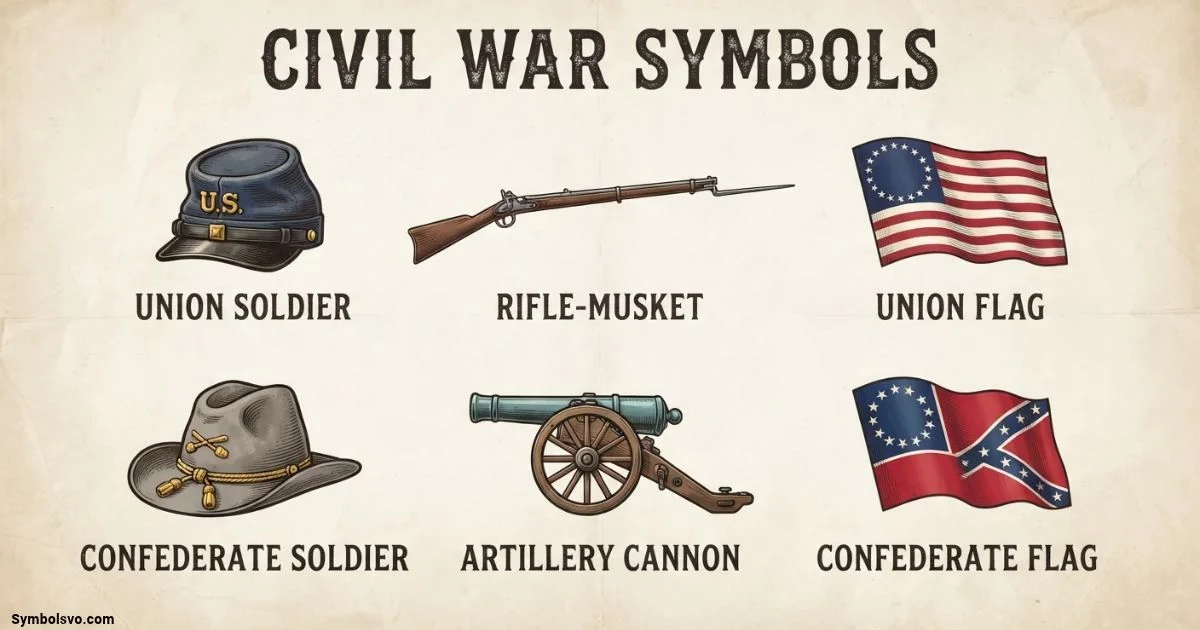
The American Civil War (1861–1865) left behind many symbols that still carry powerful historical and political meanings. Flags, military emblems, national colors, and other visual signs helped identify armies, represent political beliefs, and communicate loyalty during the conflict. Some of these symbols remain familiar today, while others require historical context to understand.
Civil War symbols were not limited to the United States. Similar conflicts in England, Spain, China, and Russia also produced distinctive flags and emblems. Each side used visual designs to represent its political goals, military identity, and ideas about government. Understanding these symbols helps explain how people identified with different movements and causes.
This guide explores American Civil War symbols, including Union and Confederate flags, their names, meanings, and differences. It also covers symbols from other major civil wars, along with simple designs, drawing ideas, and clipart concepts. You will learn which symbols are suitable for educational projects and why some historical flags remain controversial.
American Civil War Symbols
The American Civil War was fought between the United States (the Union) and the Confederate States of America (the Confederacy). It began in 1861 after several Southern states seceded from the Union and ended in 1865 with the defeat of the Confederacy.
Both sides used flags, badges, military insignia, and other visual symbols to identify their forces and represent their beliefs.
Some of the most recognizable American Civil War symbols include:
- 🇺🇸 United States Flag: Represented the Union and the federal government. The number of stars changed during the war as additional states were represented.
- Confederate Battle Flag: A red flag featuring a blue diagonal cross with white stars. It became one of the most recognizable Confederate military symbols.
- Union Eagle: The bald eagle represented the United States, national strength, and federal authority.
- Stars and Stripes: The traditional American flag symbolized the Union and national unity.
- Military Crossed Rifles: Crossed rifles appeared in military insignia and represented infantry units.
- Artillery Emblems: Cannons and crossed artillery equipment identified artillery units.
- Regimental Colors: Individual military regiments carried distinctive flags into battle.
These symbols served practical and emotional purposes. Soldiers used them to recognize their units, while civilians associated them with political loyalty, national identity, and the outcome of the war.
Civil War Symbols And Meanings

Civil War symbols represented different ideas depending on the side, military unit, and historical situation. A flag could identify an army, while an emblem could communicate a military role or political belief.
Here are some important symbols and their common historical meanings.
| Symbol | Name | Historical meaning |
| 🇺🇸 | United States Flag | Union, national identity, and federal government |
| ★ | Star | States represented in a national or political union |
| 🦅 | Bald Eagle | American national identity and strength |
| ✚ | Cross | Religious identity and symbolism in some historical contexts |
| ⚔ | Crossed Swords | Military service and armed conflict |
| 🚩 | Red Flag | A flag of warning, identification, or revolutionary movements, depending on context |
| ⭐ | Confederate Stars | States represented by the Confederacy |
| 🏳 | White Flag | Surrender or a request for a ceasefire in military situations |
The star was particularly important in Civil War flags. Both the Union and Confederacy used stars, but they represented different political arrangements.
The Union flag displayed stars for states in the United States. Confederate flags also used stars to represent states that joined the Confederacy.
It is worth remembering that modern text and emoji symbols are simplified illustrations. They are not exact reproductions of historical military flags or insignia.
Union Civil War Symbols
The Union was the name used for the United States during the Civil War. It included the Northern states and remained under the leadership of President Abraham Lincoln.
Union symbols focused on national unity, federal authority, and the preservation of the United States.
Important Union symbols included:
- Stars and Stripes: The United States national flag represented the Union.
- Bald Eagle: A national emblem associated with American strength, independence, and authority.
- Union Shield: The shield represented national defense and the protection of the United States.
- Union Army Insignia: Military badges and shoulder insignia helped identify soldiers and their branches.
- Regimental Flags: These flags represented individual Union military units.
The Union flag changed during the war as the number of states represented increased. The familiar red, white, and blue design remained a central symbol of the United States.
Union Army Civil War Symbols
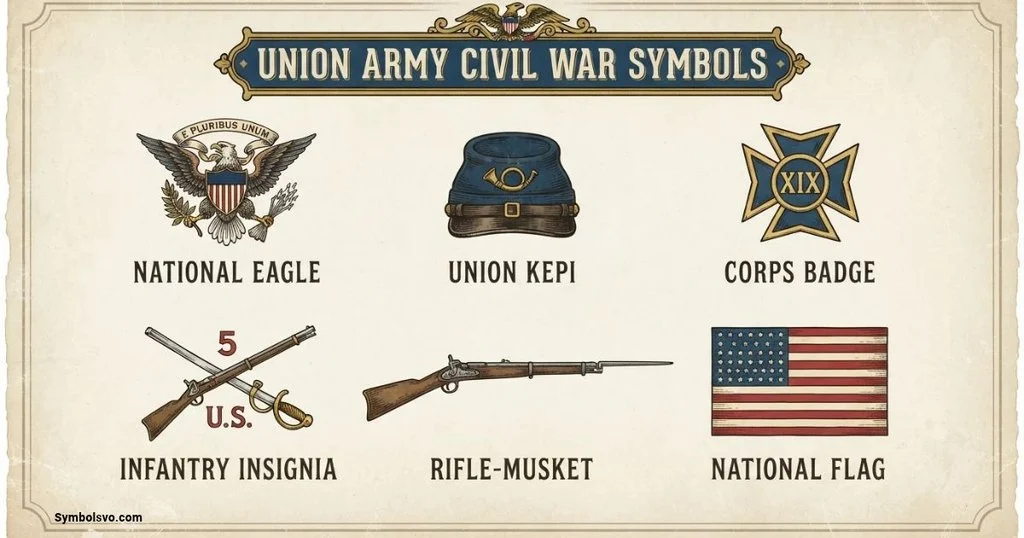
The Union Army used different insignia to identify military branches, ranks, and responsibilities. These markings helped soldiers recognize their fellow service members and understand their positions within the army.
Some common Union Army symbols and visual elements included:
- Infantry: Crossed rifles were used as a recognizable infantry emblem.
- Artillery: Cannons and crossed artillery equipment represented soldiers who operated artillery weapons.
- Cavalry: Sabers and crossed swords were associated with mounted military units.
- Military Eagles: Eagles appeared in some army insignia and represented national authority.
- Corps Badges: Distinctive shapes and colors helped identify soldiers belonging to particular army corps.
Union Army Corps Badge Shapes
During the Civil War, the Union Army of the Potomac used a system of corps badges to identify different army corps.
Common badge shapes included:
- ★ Star — First Corps
- 🌙 Crescent — Second Corps
- ♦ Diamond — Third Corps
- △ Triangle — Fifth Corps
- ✚ Cross — Sixth Corps
- ♡ Heart — Twelfth Corps
These simple shapes helped soldiers identify their units, especially during large military operations. The examples above are modern visual approximations of the badge shapes, not exact historical reproductions.
North Civil War Symbols
The Northern states supported the Union during the American Civil War. Their main objective was to preserve the United States as one country. As the war continued, ending slavery also became a central Union war aim.
Northern symbols were closely connected to American national identity.
The most important examples included:
- United States Flag: Represented the federal government and the Union.
- Union Eagle: Symbolized national strength and authority.
- Stars: Represented the states within the United States.
- Union Shield: Expressed national defense and protection.
- Liberty Symbols: Represented freedom, independence, and American republican ideals.
The American flag was the most recognizable symbol associated with the North. However, Northern soldiers and civilians also used state flags, military badges, and local regimental banners.
Union Flag Civil War
The Union flag during the American Civil War was the national flag of the United States, commonly known as the Stars and Stripes.
The flag featured three main design elements:
- Red stripes: Part of the traditional American flag design, associated with the country’s founding symbolism.
- White stripes: Alternated with red stripes in the national flag.
- Blue canton: Contained white stars representing the states.
Union Flag Star Changes
The number of stars changed during the Civil War as states were added to the national representation.
| Flag version | Number of stars | Historical period |
| 33-star flag | 33 | 1859–1861 |
| 34-star flag | 34 | 1861 |
| 35-star flag | 35 | 1863 |
| 36-star flag | 36 | 1865 |
The 35-star flag included West Virginia, which became a state in 1863. The 36-star flag followed Nevada’s admission to the Union in 1864 and became official in 1865.
The Union flag represented the United States government and the continued existence of the nation.
Civil War Flags
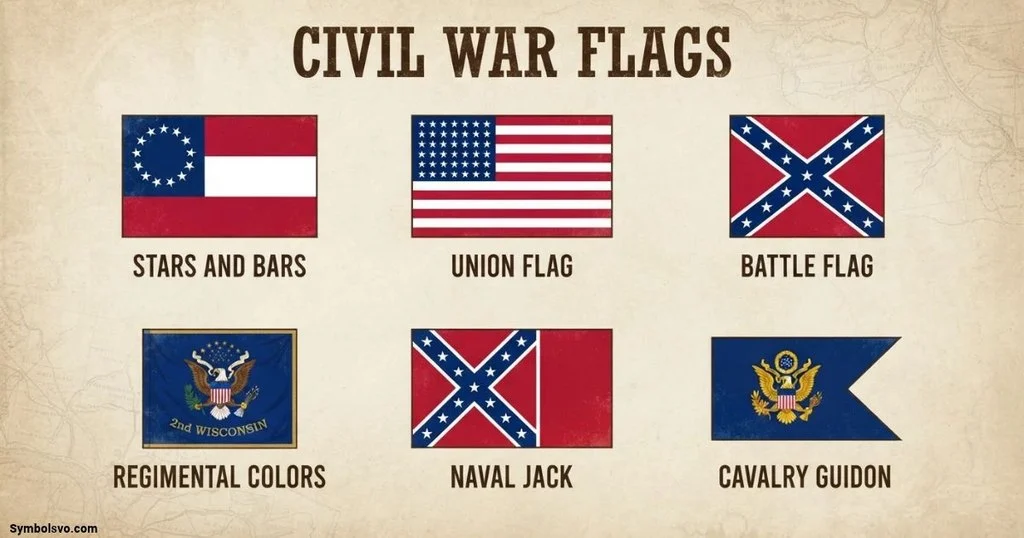
Flags were among the most important symbols of the American Civil War. They identified military forces, represented political loyalties, and helped soldiers recognize their positions on the battlefield.
The Union and Confederacy used several different flags throughout the conflict. Some designs changed because of battlefield confusion, political developments, and the need for clearer military identification.
Main American Civil War Flags
| Flag | Name | Side |
| Stars and Stripes | United States Flag | Union |
| First National Flag | Stars and Bars | Confederacy |
| Second National Flag | Stainless Banner | Confederacy |
| Third National Flag | Blood-Stained Banner | Confederacy |
| Battle Flag | Southern Cross | Confederacy |
The Confederate government adopted different national flags during the war. Its military forces also used battle flags that became more recognizable than some of its official national designs.
Why Were Civil War Flags Important?
Civil War flags served several purposes:
- Military identification: Soldiers could recognize their regiments during battles.
- Political identity: Flags represented loyalty to the Union or Confederacy.
- Communication: Commanders and troops used flags to identify positions and movements.
- Morale: Soldiers often viewed their regimental flags as symbols of honor and courage.
- Historical records: Surviving flags help historians understand military units and important battles.
Confederate Flag Name
The Confederate States of America used several flags between 1861 and 1865. For this reason, the phrase Confederate flag does not refer to just one historical design.
The most recognizable Confederate flag is commonly called the Confederate Battle Flag or Southern Cross.
Here are the main Confederate flag names:
First National Flag (Stars And Bars)
The First National Flag was adopted in March 1861. It featured three horizontal stripes in red, white, and red, with a blue canton containing white stars.
It became known as the Stars and Bars. Its design looked similar to the United States flag, which sometimes caused confusion on battlefields.
Second National Flag (Stainless Banner)
The Second National Flag was adopted in 1863. It featured a white field with the Confederate Battle Flag in the upper-left corner.
It was called the Stainless Banner because of its large white background.
Third National Flag (Blood-Stained Banner)
The Third National Flag was adopted in March 1865. It kept the basic design of the Second National Flag but added a vertical red stripe along the outer edge.
Confederate Battle Flag (Southern Cross)
The Confederate Battle Flag featured a red background, a blue diagonal cross, and white stars.
Although it was originally a military battle flag, it later became the most widely recognized symbol associated with the Confederacy.
Confederate Flag Vs Union Flag
The Confederate flag and Union flag represented opposing sides of the American Civil War. Their designs, political meanings, and historical backgrounds were different.
| Feature | Union Flag | Confederate Battle Flag |
| Side | Northern United States | Confederate States |
| Main colors | Red, white, and blue | Red, blue, and white |
| Main design | Stripes and stars | Diagonal cross and stars |
| Political association | United States and federal union | Southern secession |
| Main historical purpose | National identification | Confederate military identification |
| Modern meaning | American national identity | Contested symbol associated with the Confederacy |
Main Differences
1. Design: The Union flag used horizontal stripes and a blue canton containing white stars. The Confederate Battle Flag used a diagonal blue cross with white stars on a red background.
2. Political identity: The Union flag represented the United States. The Confederate Battle Flag represented Confederate military forces.
3. Historical meaning: The Union flag became associated with preserving the United States. The Confederate flag became associated with secession and the Confederate cause, which was closely connected to the defense of slavery.
4. Modern interpretation: The American flag remains the national flag of the United States. The Confederate Battle Flag is controversial because of its connections to slavery, segregation, and white supremacist movements.
Rebel Flag Vs Confederate Flag

The terms Rebel flag and Confederate flag are often used to describe the same design, but they do not always have identical meanings.
The word Rebel was commonly used to describe Confederate soldiers and supporters during the American Civil War. As a result, people sometimes call the Confederate Battle Flag the Rebel Flag.
However, the Confederacy used several different flags.
Are They The Same Flag?
In everyday American usage:
- Rebel Flag: Usually refers to the Confederate Battle Flag with the blue diagonal cross and white stars.
- Confederate Flag: Can refer to any official flag of the Confederate States, although many people use the term for the Battle Flag.
The difference is mainly in terminology. The Rebel Flag is generally a nickname for the Confederate Battle Flag rather than the name of every Confederate national flag.
What Does The Confederate Flag Represent
The Confederate Battle Flag has different interpretations depending on historical context and the person displaying it.
During the American Civil War, it represented Confederate military identity and the cause of the Southern states that had left the United States.
The Confederacy was founded by states that seceded to protect slavery. This connection is documented in the secession declarations of several Confederate states.
Historical Meanings
The flag is associated with several historical ideas:
- Southern Confederate identity: It represented the military forces and political identity of the Confederacy.
- Secession: It became a symbol of the Southern states’ attempt to leave the United States.
- Slavery: The Confederate cause was fundamentally connected to protecting the institution of slavery.
- Military history: It appeared on battlefields and became associated with Confederate soldiers.
- Southern heritage: Some people later adopted it as a symbol of Southern family history, regional identity, or cultural traditions.
Modern Interpretations
Today, the flag has no single universally accepted meaning.
Some people display it to express an interest in Civil War history or Southern heritage. Others associate it with racism, slavery, segregation, and white supremacist movements.
Its meaning depends heavily on where, why, and by whom it is displayed.
Is The Confederate Flag A Hate Symbol
The Confederate Battle Flag is widely recognized as a hate symbol in many contexts, although not everyone who displays it claims to support hatred or racial discrimination.
Its historical connection to the Confederacy is central to understanding the controversy. The Confederate government was established by states seeking to preserve slavery, and its political leaders openly defended slavery.
After the Civil War, the flag became associated with the Lost Cause movement, which promoted a romanticized interpretation of the Confederacy. During the twentieth century, it was also used by segregationists and white supremacist organizations.
Why Is It Considered A Hate Symbol?
Several historical developments explain its reputation:
- Slavery: The Confederate government defended slavery as an institution.
- Segregation: The flag became a symbol used by opponents of the American civil rights movement.
- White supremacist groups: Extremist organizations have used it to communicate racist beliefs.
- Racial intimidation: Its display has sometimes been used to intimidate Black Americans and other communities.
- Political controversy: Its appearance in public spaces, schools, and government settings has created ongoing debates.
Is Every Display Of The Flag Racist?
Not necessarily. People may display the flag for different personal or historical reasons. However, its established historical associations cannot be separated from the context in which it is used.
A historical museum displaying the flag to explain the Civil War is different from someone using it to promote racial superiority or intimidate others.
Understanding this distinction helps explain why the flag remains controversial.
Why Is The Confederate Flag Offensive

Many Americans consider the Confederate Battle Flag offensive because it represents a government that fought to preserve slavery.
For African Americans, the flag can also recall generations of racial discrimination, segregation, and violence.
Its use during the civil rights era strengthened its association with resistance to racial equality.
Main Reasons People Find It Offensive
1. Connection To Slavery
The Confederate states separated from the United States to protect slavery. Their political leaders made this connection clear in several official secession documents.
2. History Of Racial Segregation
The flag became a visible symbol of resistance to desegregation and civil rights reforms during the twentieth century.
3. White Supremacist Associations
Racist organizations have used the flag as an emblem of their beliefs, giving it an additional association with racial hatred.
4. Historical Pain
For many families, the flag represents the suffering and discrimination experienced by their ancestors.
5. Public Display
Displaying the flag at government buildings, schools, or public events can be viewed as an endorsement of the Confederacy rather than a neutral reference to history.
The debate is not simply about a piece of fabric. It concerns how historical symbols communicate values, identity, and respect for people affected by the past.
Easy Civil War Symbols
Simple Civil War symbols are useful for school assignments, history notebooks, educational presentations, and basic illustrations.
The following symbols are easy to recognize or draw. Some are modern text representations of historical objects rather than exact Civil War insignia.
| Symbol | Name | Historical connection |
| ★ | Star | State representation on national flags |
| ⚔ | Crossed swords | Military conflict |
| 🦅 | Eagle | United States national identity |
| 🚩 | Flag | Military and political identification |
| ◇ | Diamond | Shape used in Union corps badges |
| △ | Triangle | Shape used in Union corps badges |
| ✚ | Cross | Shape used in Union corps badges |
| ♡ | Heart | Shape used in Union corps badges |
| ✦ | Decorative star | Simplified star representation |
| 🛡 | Shield | Military protection and defense |
Simple Historical Drawing Ideas
- Draw an American flag with red and white stripes and a blue star field.
- Sketch a simple bald eagle to represent the United States.
- Draw a military drum to represent Civil War marching bands.
- Create a crossed-rifles illustration to represent infantry.
- Sketch a cannon to represent artillery units.
- Draw a simple five-pointed star inspired by historical flags.
These designs are suitable for basic educational artwork. They should not be mistaken for official reproductions of specific historical insignia.
Drawing Civil War Symbols
Drawing Civil War symbols can make history lessons more interesting. Students can use simple shapes and lines to create recognizable designs without needing advanced artistic skills.
Here are some easy drawing ideas.
Draw The Union Flag
Steps:
- Draw a rectangle.
- Divide it into thirteen horizontal stripes.
- Color the stripes red and white alternately.
- Draw a blue rectangle in the upper-left corner.
- Add white stars inside the blue section.
Draw The Confederate Battle Flag
Steps:
- Draw a red rectangular background.
- Add a blue diagonal cross from corner to corner.
- Create a white outline around the blue cross.
- Add white stars along the blue sections.
For historical accuracy, use a clearly identified historical version rather than treating every Confederate flag as the same design.
Draw A Civil War Eagle
Steps:
- Sketch the eagle’s head and body.
- Add a curved beak.
- Draw two wings extending outward.
- Add feathers using short curved lines.
- Draw the legs and claws.
Draw A Military Cannon
Steps:
- Draw a long horizontal barrel.
- Add a wider opening at the front.
- Draw two large wheels.
- Add a simple supporting frame.
- Include small details to make the cannon look historical.
Drawing Tips
- Use a pencil for the first outline.
- Check the historical design before adding colors.
- Keep stars and stripes evenly spaced.
- Label each drawing with its correct historical name.
- Include the year or military side when it helps explain the design.
Civil War Symbols Clipart
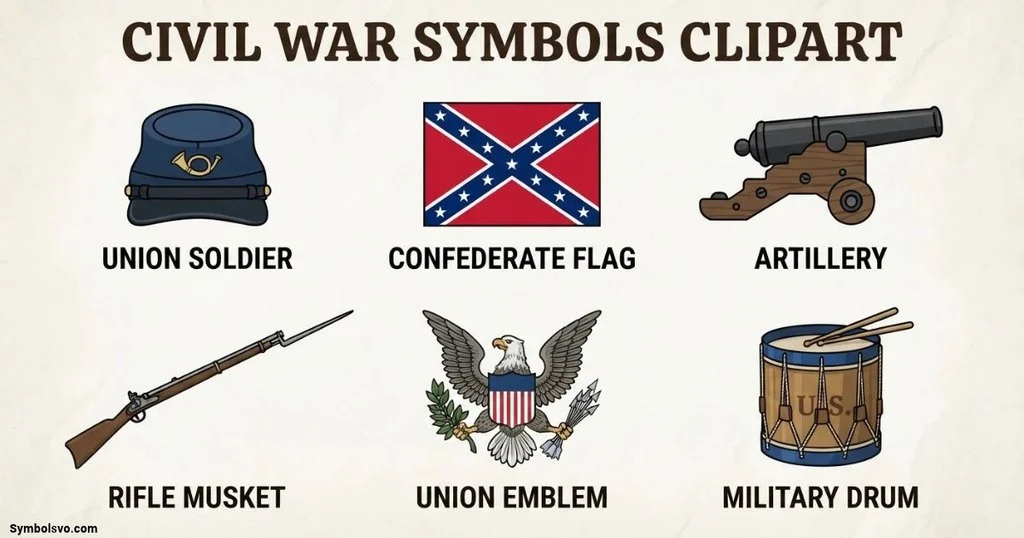
Civil War symbols clipart refers to digital illustrations of flags, military equipment, uniforms, and historical emblems connected to civil wars.
These illustrations are useful for school projects, classroom presentations, history worksheets, educational posters, and digital documents.
Popular Civil War Clipart Ideas
| Clipart subject | Suggested design |
| Union flag | Stars and Stripes illustration |
| Confederate flag | Historical Confederate flag design |
| Civil War soldier | Uniformed Union or Confederate soldier |
| Bald eagle | Traditional American eagle illustration |
| Military cannon | Historical artillery equipment |
| Crossed rifles | Infantry-inspired military emblem |
| Cavalry saber | Historical curved military sword |
| Civil War drum | Military marching drum |
| Military tent | Historical army camp |
| Corps badge | Star, crescent, diamond, or cross shape |
How To Use Civil War Clipart
You can use these illustrations in:
- School history assignments.
- Civil War timelines.
- Educational posters.
- Classroom presentations.
- Historical comparison charts.
- Digital learning materials.
- Civil War-themed craft projects.
Always check the licensing terms before using downloaded clipart in commercial projects. Also, label Confederate imagery accurately and provide historical context when using controversial designs.
English Civil War Symbols
The English Civil War (1642–1651) was a series of conflicts between supporters of King Charles I and supporters of Parliament. It was mainly a struggle over political authority, the power of the monarchy, and the role of Parliament.
Unlike the American Civil War, the English Civil War did not have two sides known simply by North and South. Its main opposing groups were the Royalists and Parliamentarians.
Royalist Symbols
Historical side: Supporters of King Charles I
The Royalists were also known as Cavaliers. They supported the king and his claim to rule.
Their symbols included:
- Royal Standard: The royal banner represented the authority of King Charles I.
- Royal Coat Of Arms: Displayed royal identity and the monarchy’s authority.
- Red Cross Of St George: The red cross on a white background was an important English national and military symbol.
- Royalist Colors: Red and other traditional royal colors appeared in military and royal designs.
Parliamentarian Symbols
Historical side: Supporters of Parliament
The Parliamentarians opposed the king’s unrestricted authority. They were also called Roundheads.
Their symbols included:
- Parliamentary Banners: Military banners identified Parliamentarian forces.
- St George’s Cross: The English red cross appeared in several military contexts.
- Parliamentary Seals: Official seals represented governmental and political authority.
- Military Standards: Different regiments used their own banners and identifying designs.
English Civil War Symbol Comparison
| Symbol or name | Associated side | Meaning |
| Royal Standard | Royalists | Royal authority |
| Coat Of Arms | Royalists | Monarchy and royal identity |
| St George’s Cross | Used by both sides | English identity |
| Parliamentary Banners | Parliamentarians | Support for Parliament |
| Military Standards | Both sides | Regimental identification |
One important detail is that the St George’s Cross was not exclusive to either side. It was an established English symbol used in different military and national settings.
Spanish Civil War Symbols
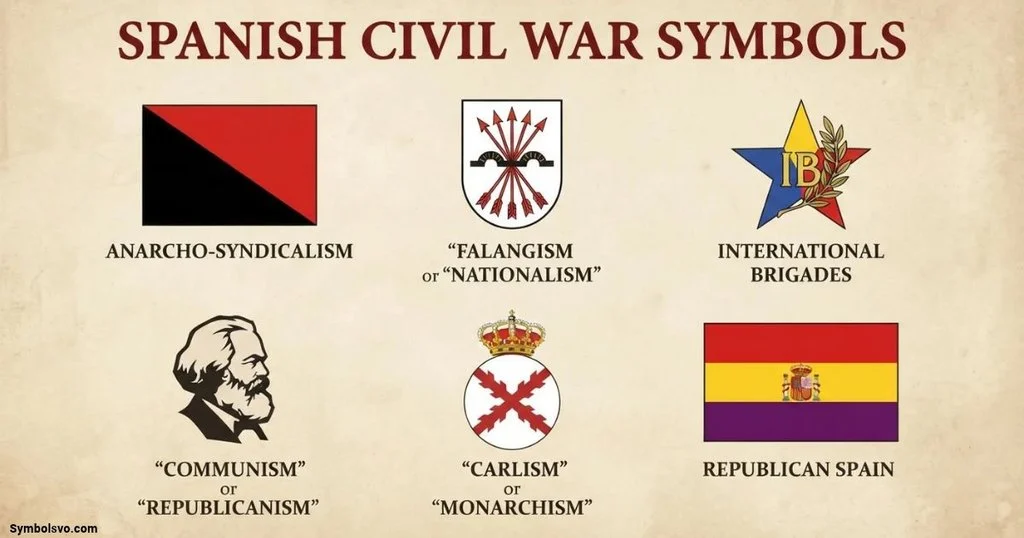
The Spanish Civil War (1936–1939) was fought between the Republicans and Nationalists. It began after a military uprising against the Spanish Republican government and developed into a major conflict involving political, social, and international divisions.
Both sides used flags, political emblems, and military insignia to communicate their identities.
Republican Symbols
The Republicans supported the Second Spanish Republic and included several political groups, such as socialists, communists, liberals, and anarchists.
Their important symbols included:
- Republican Tricolor Flag: A red, yellow, and purple horizontal flag associated with the Second Spanish Republic.
- Red Star: Associated with communist and socialist movements.
- Hammer And Sickle: A communist emblem representing workers and peasants.
- Red Flag: Used by socialist and communist groups.
- Anarchist Red And Black Flag: Represented anarchist movements and their political beliefs.
Nationalist Symbols
The Nationalists were led by military rebels, including General Francisco Franco. Their coalition included conservative, monarchist, traditionalist, and fascist groups.
Important symbols included:
- Red And Yellow Spanish Flag: The traditional Spanish national colors were used by Nationalist forces.
- Yoke And Arrows: The emblem of the Falange, a Spanish fascist political movement.
- Imperial Eagle: A historical eagle design associated with the Francoist state and its national imagery.
- Carlist Cross: A symbol associated with the Carlist traditionalist movement.
Spanish Civil War Symbols Comparison
| Symbol | Associated group | Meaning |
| 🇪🇸 Republican Tricolor | Republicans | Spanish Republic |
| ☭ Hammer And Sickle | Communist groups | Communist political ideology |
| ★ Red Star | Socialist and communist groups | Revolutionary political identity |
| Red And Black Flag | Anarchists | Anarchist movement |
| Yoke And Arrows | Falange | Spanish fascist movement |
| Imperial Eagle | Francoist Spain | Nationalist state identity |
The Spanish Civil War produced many different symbols because each side contained several political movements. Not every Republican used communist symbols, and not every Nationalist belonged to the Falange.
Chinese Civil War Symbols
The Chinese Civil War was a prolonged conflict between the Chinese Communist Party (CCP) and the Kuomintang (KMT), also known as the Chinese Nationalist Party.
The conflict began in 1927, was interrupted by the Second Sino-Japanese War, and resumed on a large scale after World War II. In 1949, the Communists established the People’s Republic of China on the mainland, while the Nationalist government retreated to Taiwan.
Communist Symbols
The Chinese Communist Party used symbols associated with communism, revolution, and workers’ movements.
Important examples included:
- Red Flag: Represented the communist revolutionary movement.
- Hammer And Sickle: Symbolized the political alliance of workers and peasants.
- Red Star: Represented revolutionary identity and communist ideology.
- Chinese Communist Party Emblem: Features a hammer and sickle, representing the party’s communist identity.
Nationalist Symbols
The Kuomintang used national and party symbols associated with Chinese nationalism and the Republic of China.
Important examples included:
- Blue Sky With A White Sun: The central emblem of the Kuomintang.
- Blue Sky, White Sun, And A Wholly Red Earth: The national flag of the Republic of China.
- White Sun Emblem: Represented the Kuomintang’s political identity.
- Blue And White Colors: Were closely associated with the Nationalist movement.
Chinese Civil War Symbols Comparison
| Symbol | Associated side | Meaning |
| Red Flag | Communists | Communist revolutionary identity |
| ★ Red Star | Communists | Revolutionary movement |
| ☭ Hammer And Sickle | Communists | Workers and peasants |
| Blue Sky With White Sun | Kuomintang | Nationalist party identity |
| Blue Sky, White Sun, Red Earth | Republic of China | Chinese republican national identity |
The most recognizable difference between these movements was their visual identity. The Communists mainly used red revolutionary imagery, while the Nationalists used the blue, white, and red emblem associated with the Republic of China.
Russian Civil War Symbols

The Russian Civil War (1917–1923) followed the Russian Revolution and the collapse of the Russian Empire. It was fought mainly between the Bolshevik-led Red Army and several opposing groups commonly known as the White movement.
The conflict also involved foreign intervention, regional independence movements, and other political forces.
Red Army Symbols
The Red Army supported the Bolshevik government and the emerging Soviet state.
Its major symbols included:
- Red Flag: Represented the communist revolution and Bolshevik political movement.
- Red Star: Became a recognizable military emblem of the Red Army.
- Hammer And Sickle: Represented workers and peasants.
- Red Army Star: A five-pointed red star appeared on military insignia and uniforms.
The red star became one of the most recognizable symbols of the Soviet military.
White Army Symbols
The White movement included several groups opposed to Bolshevik rule. It was not a single unified political organization.
Its symbols varied according to the military commander and region.
Common historical associations included:
- Imperial Russian Tricolor: The white, blue, and red horizontal flag was associated with pre-revolutionary Russia and was used by some anti-Bolshevik forces.
- Imperial Double-Headed Eagle: Represented the former Russian monarchy.
- St George’s Ribbon: Associated with Russian military honors and traditions.
- Monarchist Emblems: Some White forces supported restoring the monarchy and used imperial imagery.
Russian Civil War Symbols Comparison
| Symbol | Associated side | Meaning |
| Red Flag | Red Army | Bolshevik revolution |
| ★ Red Star | Red Army | Soviet military identity |
| ☭ Hammer And Sickle | Bolsheviks | Communist ideology |
| White-Blue-Red Tricolor | Some White forces | Russian national identity |
| Double-Headed Eagle | Imperial supporters | Russian imperial heritage |
| St George’s Ribbon | Russian military tradition | Military honor and bravery |
The Red Army and White movement used different visual identities to represent their political and military goals. However, the White movement included many groups, so its symbols were not completely uniform.
Frequently Asked Questions About Civil War Symbols
What Was The Main Symbol Of The American Civil War?
The Stars and Stripes was the main national symbol of the Union, while the Confederate Battle Flag became the most recognizable military symbol of the Confederacy. Both represented opposing sides of the conflict.
What Is The Difference Between The Confederate Flag And The Rebel Flag?
The Confederate flag can refer to several official flags used by the Confederate States. The Rebel Flag usually refers specifically to the Confederate Battle Flag, also known as the Southern Cross.
What Did The Stars On Civil War Flags Represent?
Stars generally represented states or political membership in a union. The Union and Confederacy both used stars, but their flags represented different political governments.
What Were The Main Symbols Of The Union Army?
The Union Army used the American flag, bald eagle, crossed rifles, artillery insignia, and distinctive corps badges. These symbols helped identify military branches and individual units.
Which Symbols Were Used In Other Civil Wars?
Different conflicts used different symbols. English Royalists used royal banners, Spanish Republicans used the Republican tricolor, Chinese Communists used red revolutionary imagery, and Russian Bolsheviks used the red flag and red star.
Conclusion
Civil War symbols tell important stories about political struggles, military identities, and national divisions. From the American Stars and Stripes to the Confederate Battle Flag, each design represents a particular historical background. Other conflicts in England, Spain, China, and Russia also produced recognizable flags and emblems.
Understanding these symbols requires more than recognizing their colors and shapes. Their meanings are connected to the political movements, military organizations, and historical events that created them. Some, particularly Confederate imagery, remain controversial because of their association with slavery, racism, and segregation.
For school projects, history research, drawings, or educational presentations, always use accurate symbol names and historical context. Knowing the difference between similar flags and emblems makes it easier to understand the past and explain why these symbols still matter today.

I’m Daniel Brooks, a content creator and symbol enthusiast dedicated to researching the fascinating world of signs and symbols. I enjoy discovering the hidden meanings behind famous icons, emojis, historical emblems, and cultural symbols. Through my writing, I aim to provide trustworthy, well-researched, and reader-friendly information that helps people learn something new with every visit.
Books:
- The Complete Guide to World Symbols
- The Power of Universal Signs
 Mason Ellington
 Nathan Holloway