
When I first explore Hindu symbols, I find that each one can tell a deeper story about faith, life, spirituality, and tradition. You may recognize symbols like Om, the lotus, or the Swastika, but their meanings can be much richer than they appear.
I created this guide to help you understand Hindu symbols and meanings in a simple and respectful way. As you explore each symbol, you can discover how its shape, history, and traditional use connect with important Hindu beliefs.
Whether you are a beginner, a student, or simply curious about Hindu culture, I want you to leave with a clearer understanding of these meaningful symbols. You’ll discover what they represent, where they come from, and why they remain important today
Quick Answer
Hindu symbols and meanings represent the visible form of Sanatana Dharma (eternal law). These sacred icons, including the Om and Swastika, bridge the physical world with the transcendental reality. They convey complex spiritual philosophies, cosmic laws, and psychological archetypes, helping practitioners focus their minds, invite auspicious energies, and realize their inner divinity.
Quick Facts About Hindu Symbols and Meanings
| Aspect | Information |
| Origin | Found in ancient Vedic texts, Indus Valley artifacts, and sacred scriptures. |
| Historical Significance | Guided spiritual seekers, protected sacred spaces, and preserved cultural cosmic laws for millennia. |
| Main Meaning | Interconnectedness of all life, the journey of the soul, and ultimate truth. |
| Spiritual Meaning | Outer keys to inner awakening, unlocking direct connection with the Supreme Consciousness. |
| Cultural Importance | Forms the foundation of traditional Indian art, architecture, daily rituals, and festive celebrations. |
| Modern Usage | Global yoga culture, mindful jewelry, architectural design, tattoos, and meditation practices. |
What Are Hindu Symbols and Meanings?
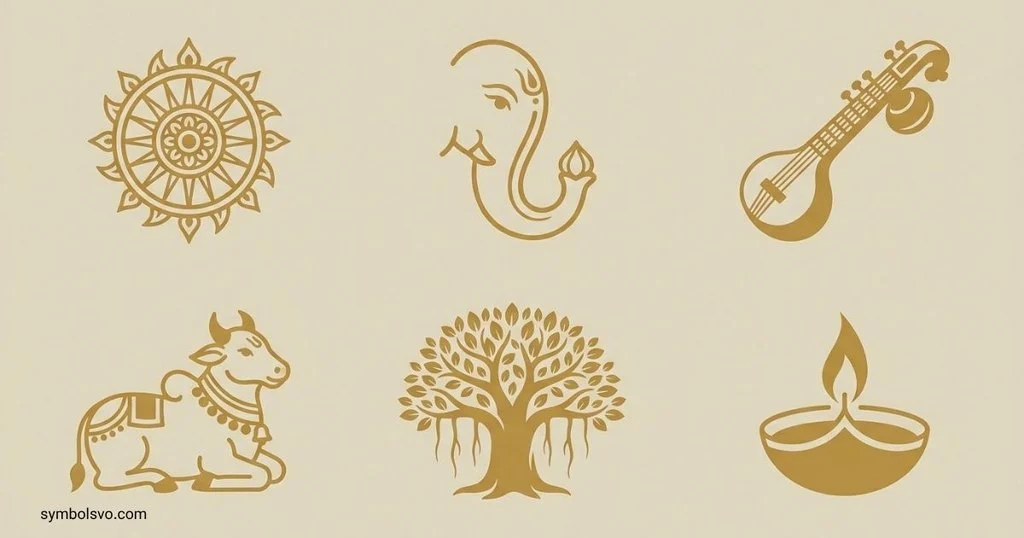
Hindu symbols and meanings comprise a complex visual language developed over thousands of years within the rich soil of Indian spiritual thought. The root of these symbols lies in the concept of Yantra (mystic diagrams) and Pratima (sacred imagery). In the ancient Vedic tradition, realized sages understood that the human mind struggles to grasp abstract, infinite concepts like absolute reality or boundless love. To make these ideas accessible, they created tangible visual forms.
Historically, these symbols appeared as early as the Indus Valley Civilization, visible on soapstone seals featuring proto-Shiva figures and sacred fig trees. As Hinduism evolved through the expansive era of the Upanishads and Puranas, the library of symbols grew. Symbols changed from simple boundary marks or sacrificial altar designs into deeply layered philosophical blueprints. They became essential because they acted as a safe, unalterable archive of knowledge, preserving profound psychological and spiritual truths across generations without relying solely on the spoken or written word.
Deep Symbolic Meaning of Hindu Symbols and Meanings
Spiritual Level
On a spiritual level, Hindu symbols are maps for inner transformation. They are not idols to be worshipped blindly, rather, they are instruments of alignment. When a seeker meditates on a symbol like the Lotus, they are reminded of the soul’s capacity to rise above the mud of material desires. These visual markers act as portals, drawing the individual’s scattered consciousness back to its pure origin, fostering a direct experience of the supreme soul.
Psychological Level
Psychologically, these symbols resonate perfectly with universal human emotions and unconscious archetypes. Famous psychologist Carl Jung recognized that ancient religious icons mirror the deep, shared structures of the human mind.
- The Trishula (Trident): Represents mastery over the three central psychological forces: desires, actions, and thoughts.
- The Kalasha (Sacred Pot): Acts as the archetype of abundance, representing a healthy, well-nourished mind overflowing with wisdom.
These symbols hold a deep emotional attraction because they give order to our internal struggles, helping us visually process our psychological growth.
Cultural Level
Culturally, these icons build a powerful sense of community and social alignment. They are stitched into the very fabric of daily life. From the brightly colored patterns drawn on doorsteps each morning to the signs blessing a new business, these visuals reinforce shared traditional interpretations of righteousness, hospitality, and respect for all living things.
Types and Variations of Hindu Symbols and Meanings
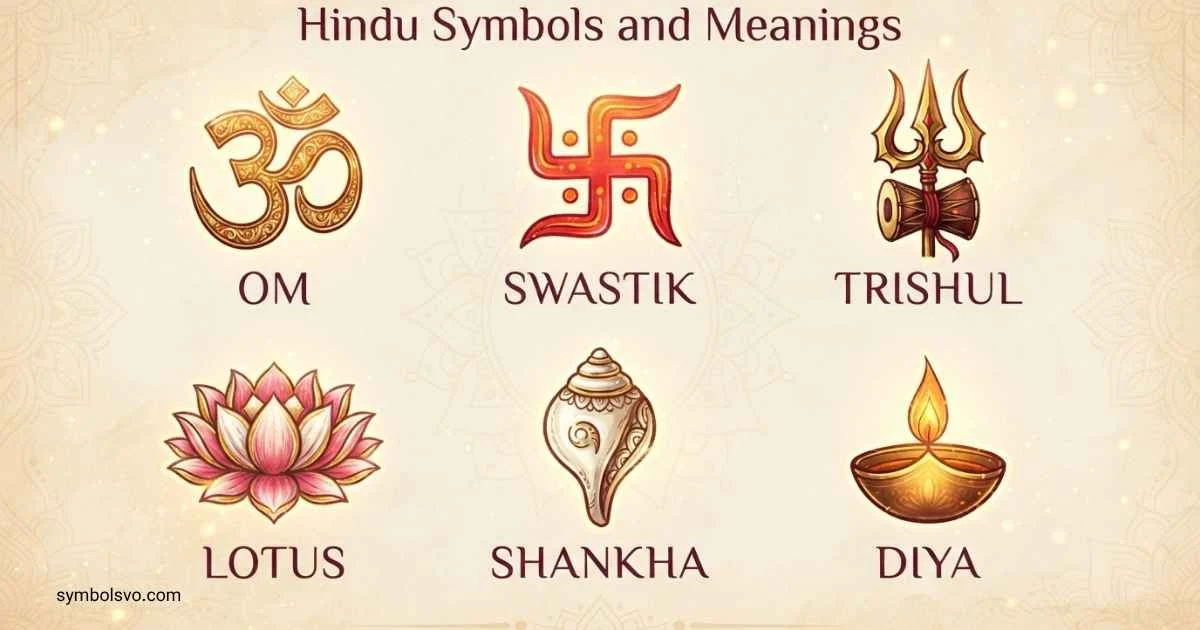
1. Om (Aum)
- Visual Description: A flowing Sanskrit character consisting of three curves, a semicircle, and a single dot at the top.
- Meaning: The primordial sound of the universe, encompassing past, present, and future.
- Symbolism: The three curves represent the waking state, dreaming state, and deep sleep, while the dot represents pure, unconditioned consciousness.
- Cultural Connection: Sung or chanted at the absolute beginning and end of all Hindu prayers, yoga sessions, and sacred texts.
- Where It Appears: Temple entrances, home altars, sacred jewelry, and spiritual literature.
2. The Swastika
- Visual Description: An equilateral cross with four arms bent at right angles in a clockwise direction, often accented with four inner dots.
- Meaning: Auspiciousness, well-being, good fortune, and the orderly movement of the sun.
- Symbolism: Represents the four directions, the four Vedas, and the four ultimate goals of human life.
- Cultural Connection: Used for millennia in ancient traditions as a protective blessing for thresholds and new beginnings.
- Where It Appears: Wedding invitations, thresholds of new homes, ledger books, and religious festivals.
3. The Lotus (Padma)
- Visual Description: A perfectly symmetrical, multi-petaled flower rising cleanly out of calm water.
- Meaning: Purity, spiritual detachment, beauty, and rapid enlightenment.
- Symbolism: Represents the human heart opening up to divine light while remaining unstained by the muddy world around it.
- Cultural Connection: Associated closely with deities of wisdom and wealth, like Saraswati and Lakshmi, who sit gracefully upon it.
- Where It Appears: Traditional Indian art, temple pillars, classical poetry, and modern meditation spaces.
Hindu Symbols Across Different Cultures
Ancient Egypt
While ancient Egypt relied on icons like the Ankh and the Lotus, their use of the lotus flower shares a beautiful parallel with Hindu thought. In both cultures, the lotus emerged from primordial waters to symbolize creation, the sun, and the daily rebirth of cosmic order.
Ancient Greece
Ancient Greek traditions favored geometric harmony, much like the precise mathematics found in Hindu Yantras. The Greek use of the caduceus, a staff entwined with two snakes, mirrors the Hindu understanding of the Kundalini energy moving up the subtle energy channels of the spine.
Roman Culture
The Romans placed great emphasis on household protective spirits and public visual markers. Their use of sacred fire in the Temple of Vesta matches the deep reverence for Agni (the sacred fire) in Hindu homes, where fire serves as a living symbol of purity and a witness to divine truth.
Eastern Traditions
Across Buddhist, Jain, and East Asian traditions, Hindu symbols like the Om, the endless knot, and the footprint of the divine transitioned seamlessly. These neighboring cultures kept the core meanings of non-violence, mindfulness, and spiritual liberation intact, showing a shared philosophical foundation.
Indigenous Traditions
Indigenous cultures worldwide hold a deep reverence for natural symbols like the sun, rivers, and trees. This closely mirrors the Hindu worship of the sacred Peepal tree and holy rivers, proving that humans share a universal instinct to find divine meaning in the natural world.
Modern Interpretations
In our globalized world, these ancient symbols have travelled far beyond India. Today, they are widely recognized across Western societies as universal markers for mindfulness, mental clarity, holistic health, and a conscious lifestyle.
Similar Symbols and Their Meanings
To truly appreciate the unique nature of Hindu iconography, it helps to see how it compares to other global traditions.
| Symbol Type | Purpose | Key Focus | Lifespan |
| Hindu Symbol | Evokes cosmic alignment | Interconnectedness and eternal laws | Ageless, passed down through yoga and texts |
| Western Brand Icon | Establishes commercial identity | Consumer trust and lifestyle choice | Shifting, adapts to market trends |
| National Emblem | Asserts political unity | Patriotism, history, and borders | Tied directly to the life of a nation |
A common misconception is that the Hindu Swastika shares a history with twentieth-century political emblems used in Europe. In truth, they are completely separate. The ancient Hindu symbol is thousands of years old, rooted entirely in peace, light, and well-being. Its arms bend clockwise to follow the natural path of the sun, making it fundamentally different from later, unrelated political signs.
Hindu Symbols in Mythology and Folklore
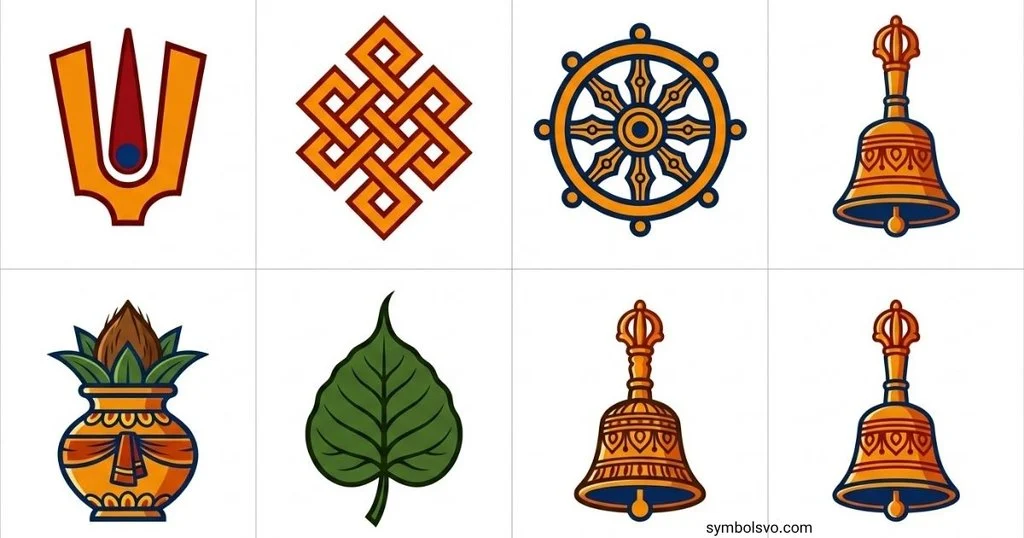
The rich stories of Hindu mythology are packed with symbolic objects that bring abstract ideas to life. Take the legend of Lord Shiva’s Trishula. Mythological texts tell us this weapon is not meant for physical warfare. Instead, it represents the absolute destruction of the ego and the illusions of the material world.
Similarly, the story of Lord Ganesha’s large ears is a folkloric reminder of the vital spiritual art of listening deeply before acting. By embedding these symbols within exciting stories of gods, demons, and cosmic battles, the ancient sages ensured that deep psychological lessons remained memorable, entertaining, and accessible to everyone, from young children to advanced scholars.
Hindu Symbols in Art, Literature, and Pop Culture
During the classical period of Indian art, painters and sculptors used exact proportional codes to recreate these symbols in stone and canvas. Today, this tradition continues to thrive in modern design.
[ Natural Phenomenon ] —> [ Mythological Story ] —> [ Sacred Sacred Symbol ]
In contemporary pop culture, these symbols have entered global fashion, architecture, and television. Musicians wear the Om symbol on stage, while international designers weave intricate mandalas into modern textiles and streetwear. Furthermore, when these symbols are chosen for tattoos, they mark a deeply personal step. The wearer adopts the ancient design as a permanent outward statement of their dedication to inner peace and self-realization.
Spiritual and Dream Meaning of Hindu Symbols and Meanings
When Hindu symbols appear during meditation or dream experiences, they carry significant personal messages from our subconscious mind. Since the subconscious speaks through timeless metaphors, seeing a sacred symbol like a temple lamp or a conch shell while sleeping is rarely an accident.
Dreaming of a burning Diya (oil lamp) often signifies that a period of internal darkness or confusion is coming to an end, showing a path toward new hope. Hearing the sound of a conch shell in a dream can act as a helpful wake-up call, urging you to speak your truth and live with greater purpose. These dream experiences act as gentle inner mirrors, showing us where we need to heal, let go, or step forward on our life path.
Positive and Negative Meanings of Hindu Symbols and Meanings
In Hindu thought, symbols reflect the complete spectrum of reality, recognizing that the universe contains both creation and destruction.
| Positive Meaning | Negative Meaning (The Shadow Aspect) |
| The Lotus represents pure spiritual growth. | The mud below reminds us of material stagnation. |
| The Sacred Fire cleanses and transforms. | Uncontrolled fire represents total destruction. |
| The Conch Shell calls people to prayer. | Its battle-cry origins represent the pain of conflict. |
| The Nataraja dance symbolizes cosmic creation. | The surrounding flames represent the end of time. |
Why Humans Are Attracted to Hindu Symbols and Meanings
Our natural attraction to these designs comes from a deep human love for symmetry, balance, and pattern recognition. The human brain is built to find meaning in shapes, and the sacred geometry of Hindu icons satisfies this internal search for order.
On a deeper level, these symbols tap into our shared cultural memory. They provide an immediate emotional bridge to a simpler, more spiritually connected way of living. By interacting with these symbols, we satisfy a quiet, universal human craving to look beyond our demanding modern routines and feel connected to something grand, timeless, and peaceful.
Modern Uses of Hindu Symbols and Meanings
In our fast-paced digital world, these ancient designs have found creative new expressions.
- Mindful Jewelry: Rings and pendants featuring the Om or Lotus to help wearers stay grounded during stressful workdays.
- Wellness Branding: Clean, minimalist logos used by global yoga studios and natural skincare lines.
- Interior Design: Large mandala wall art used to create calming, peaceful environments in modern homes.
- Digital Spheres: Beautifully designed emojis and stickers used to share warm blessings on social media during traditional festivals.
Interesting Facts About Hindu Symbols and Meanings
- The geometric patterns of the Sri Yantra are based on complex mathematical equations that modern scientists still find incredibly sophisticated.
- The sacred Rudraksha beads used in prayer lines are actually the dried seeds of a specific blue fruit tree found in the Himalayas.
- The traditional greeting Namaste is a living physical symbol, meaning the divine spark in me bows to the divine spark in you.
- The color saffron, seen on holy flags, represents the pure fire of renunciation and the sacrifice of human ego.
- Ancient temple architects built entire complexes to mirror the shape of the human body, turning the physical building into a living symbol of the soul.
Frequently Asked Questions
What does the Om symbol mean in everyday life?
In daily life, the Om symbol serves as a comforting reminder of peace, cosmic unity, and mindfulness. It helps people slow down, breathe deeply, and remember their connection to the wider universe.
How should I respectfully display Hindu symbols at home?
To show proper respect, place these symbols in clean, elevated areas of your home, such as a dedicated shelf, living room wall, or altar. It is best to avoid placing them directly on floors, carpets, or footwear.
Is the Swastika in Hinduism the same as the Western political sign?
No, they are completely different. The Hindu Swastika is an ancient, sacred symbol of peace, luck, and solar energy that predates modern European political movements by thousands of years.
Why do many Hindu deities hold a conch shell?
The conch shell represents the primordial sound of creation. Deities hold it to symbolize the awakening of spiritual awareness and the ultimate victory of truth over ignorance.
Conclusion
Hindu symbols and meanings offer us a beautiful, living bridge to the infinite. They remind us that our daily lives are deeply connected to a grand, orderly cosmic dance. By welcoming these symbols into our modern spaces, we keep an ancient, unbroken tradition of wisdom alive. Let these timeless shapes serve as a quiet inspiration to look beneath the surface of a busy world, helping you find your own path toward lasting clarity, purpose, and peace.

 Mason Ellington
 Daniel Brooks