Music has its own written language. A few lines, dots, curves, letters, and marks can tell a musician which notes to play, how long to hold them, how loudly to perform, and when to pause. These marks are called music symbols, and they make it possible to write down a musical idea so someone else can understand and perform it.
Learning music symbols and their meanings can seem difficult at first. You might see a treble clef, a row of notes, a sharp sign, or a curved line and wonder what each one does. The good news is that most sheet music uses a familiar group of symbols. Once you understand the basic categories, reading a musical score becomes much easier.
This guide explains musical symbols, sheet music symbols, note values, rests, clefs, accidentals, dynamics, tempo markings, and other common signs. You’ll also find a practical music symbols chart, beginner-friendly examples, and answers to frequently asked questions. Whether you’re learning piano, guitar, violin, singing, or music theory, this guide will help you understand the written language of music.
What Are Music Symbols and Their Meanings?
Music symbols are written signs used to represent musical sounds, silence, rhythm, pitch, expression, and performance instructions. They appear on a musical staff and help musicians understand how a piece should be played or sung.
The complete system is known as musical notation. It allows composers to record musical ideas and share them with performers. Instead of explaining every note in words, a composer can use a combination of symbols to communicate the music clearly.
Most music notation symbols perform one or more of these jobs:
- Show pitch: Tell musicians which note to play or sing.
- Show duration: Explain how long a note or silence should last.
- Show rhythm: Organize notes into beats and measures.
- Show volume: Indicate whether music should sound soft or loud.
- Show expression: Explain how notes should be connected, separated, emphasized, or decorated.
- Show direction: Tell musicians when to repeat a section or move to another part of the composition.
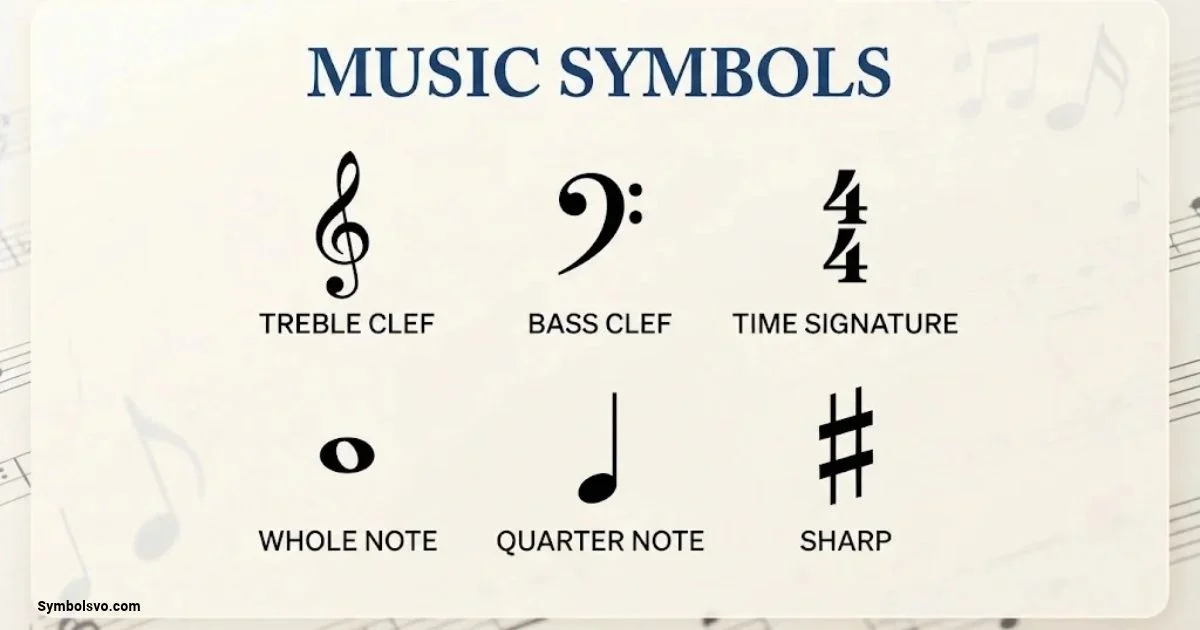
For example, a treble clef establishes the pitch names on a staff. A quarter note represents a specific rhythmic value. A sharp sign raises a note by a semitone in standard Western notation. A p marking tells the performer to play softly.
These symbols work together. A note by itself doesn’t provide every instruction needed to perform a passage. Its position, shape, surrounding marks, and musical context all matter.
Music Symbols Chart: Common Symbols and Their Meanings
The following music symbols chart introduces many of the signs you’ll encounter in standard Western sheet music. Some symbols are shown as text characters, while others are described by name because their printed appearance can vary between music fonts.
| Music symbol or marking | Name | Meaning |
| 𝄞 | Treble clef | Establishes the pitch reference for higher notes |
| 𝄢 | Bass clef | Establishes the pitch reference for lower notes |
| ♩ | Quarter note | A note with the duration of one quarter-note unit |
| ♪ | Eighth note | Half the duration of a quarter note |
| ♫ | Beamed eighth notes | Two eighth notes connected by a beam |
| ♬ | Beamed sixteenth notes | Two sixteenth notes connected by beams |
| ♯ | Sharp | Raises a note by one semitone |
| ♭ | Flat | Lowers a note by one semitone |
| ♮ | Natural | Cancels a previous sharp or flat alteration |
| 𝄽 | Quarter rest | A silence lasting one quarter-note unit |
| 𝄐 | Fermata | Holds a note or rest longer than its written value |
| p | Piano | Play softly |
| f | Forte | Play loudly |
| mf | Mezzo-forte | Play moderately loudly |
| pp | Pianissimo | Play very softly |
| ff | Fortissimo | Play very loudly |
| > | Accent | Give a note extra emphasis |
| staccato dot | Staccato | Play a note short and detached |
| slur | Slur | Connect notes smoothly |
| tie | Tie | Join two notes of the same pitch into one longer sound |
| trill | Trill | Rapidly alternate between a note and a neighboring note |
| D.C. | Da Capo | Return to the beginning |
| D.S. | Dal Segno | Return to the sign |
| Coda | Coda | Move to a concluding section |
Important: A symbol’s appearance can depend on the notation font, instrument, or musical tradition. The chart focuses on common Western notation. It isn’t a complete list of every mark used in music around the world.
The Musical Staff and Basic Notation Symbols
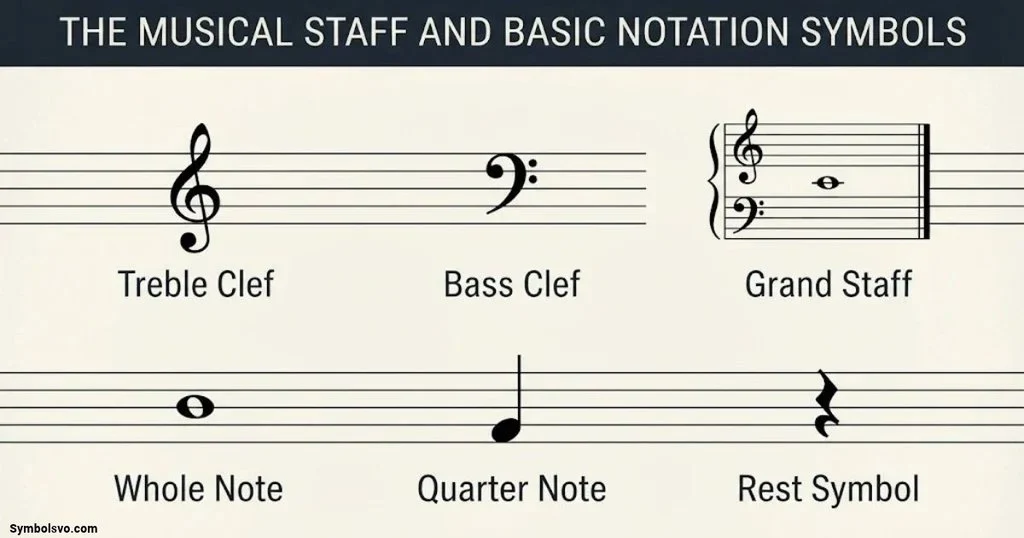
The musical staff is the foundation of standard written music. It consists of five horizontal lines and the four spaces between them. Notes appear on these lines and spaces to show their pitch.
A staff is read from left to right, just like written text in English. However, its vertical position also matters. A note placed higher on the staff represents a higher pitch than a note placed lower on it.
Staff Lines and Spaces
A standard staff contains five lines and four spaces. Each line or space represents a different letter name in the musical alphabet: A, B, C, D, E, F, and G.
The exact pitch assigned to each position depends on the clef at the beginning of the staff.
For example, in treble clef:
- The bottom line is E.
- The second line is G.
- The middle line is B.
- The fourth line is D.
- The top line is F.
The spaces between those lines represent F, A, C, and E from bottom to top.
Ledger Lines
Sometimes a melody moves above or below the five-line staff. Rather than creating a much larger staff, musicians use short additional lines called ledger lines.
Ledger lines extend the staff temporarily. They allow musicians to write notes that fall outside its normal range.
Middle C is a familiar example. In treble clef, it is usually written on a ledger line below the staff. In bass clef, it appears on a ledger line above the staff.
Noteheads, Stems, and Flags
A written note can contain several parts:
- Notehead: The oval-shaped part that shows the note’s position and pitch.
- Stem: The vertical line attached to many noteheads.
- Flag: The curved mark attached to a stem to show a shorter note value.
- Beam: A thick horizontal or angled line that connects shorter notes.
A whole note has an open notehead and no stem. A half note has an open notehead with a stem. A quarter note has a filled notehead and a stem. Eighth notes and shorter values use flags or beams.
Bar Lines and Measures
A bar line is a vertical line that separates music into sections called bars or measures. Each measure contains a specific number of beats according to the time signature.
Common bar-line types include:
| Bar line | Meaning |
| Single bar line | Separates one measure from the next |
| Double bar line | Marks an important section boundary |
| Final bar line | Shows the end of a piece or movement |
| Repeat bar line | Directs musicians to play a section again |
A measure helps musicians organize rhythm. It also makes it easier to rehearse, count, and discuss specific parts of a composition.
Braces and Brackets
A brace is a curved line that connects two or more staves. It is especially common in piano music, where the right hand usually reads the treble staff and the left hand reads the bass staff.
A bracket can connect several staves belonging to related instruments or sections in an orchestral or ensemble score.
Clef Symbols and Their Meanings
A clef is a symbol placed at the beginning of a staff. It tells musicians which pitches the lines and spaces represent. Without a clef, the same note position could refer to different pitches.
The most familiar clefs are the treble clef, bass clef, and C clefs.
Treble Clef or G Clef (𝄞)
The treble clef, also called the G clef, is commonly used for higher-pitched instruments and melodies. Its curled center circles the second line from the bottom, identifying that line as G.
The five treble-clef lines are:
- E
- G
- B
- D
- F
The spaces from bottom to top are F, A, C, and E.
Treble clef is used for instruments such as the flute, violin, trumpet, and many guitar and piano passages. It is also common in vocal music for higher voices.
Bass Clef or F Clef (𝄢)
The bass clef, also known as the F clef, is used for lower-pitched music. Its two dots surround the fourth line from the bottom, which represents F.
The five bass-clef lines are:
- G
- B
- D
- F
- A
The spaces from bottom to top are A, C, E, and G.
Bass clef is commonly used for cello, bassoon, trombone, tuba, double bass, and the left hand of piano music.
Alto and Tenor Clefs (C Clefs)
The C clef identifies the line that represents middle C. Its position determines the clef’s name.
Two common examples are:
- Alto clef: Places middle C on the middle line. It is often used for viola music.
- Tenor clef: Places middle C on the fourth line. It appears in some higher-register passages for instruments such as cello, bassoon, and trombone.
Other historical or specialized C clefs include soprano, mezzo-soprano, and baritone clefs. They’re less common in everyday modern sheet music.
Other Clefs and Ottava Signs
Percussion music may use a neutral clef or percussion clef. It indicates that the staff is being used to represent percussion sounds rather than conventional pitched notes.
An ottava sign changes the sounding octave of written notes. For example, an 8va marking tells a performer to play the passage one octave higher. An 8vb marking directs the performer to play one octave lower.
These signs make music easier to read when many ledger lines would otherwise be necessary.
Music Note Symbols and Their Values
Music note symbols show both pitch and duration. Their position on the staff identifies the pitch, while their shape indicates how long the sound should last in relation to other notes.
The following table uses the quarter note as a reference unit. The actual beat depends on the time signature and tempo.
| Note value | Appearance | Relative duration |
| Double whole note (breve) | Two connected open noteheads | 8 quarter-note units |
| Whole note | Open notehead | 4 quarter-note units |
| Half note | Open notehead with stem | 2 quarter-note units |
| Quarter note | Filled notehead with stem | 1 quarter-note unit |
| Eighth note | Filled notehead with one flag | 1/2 quarter-note unit |
| Sixteenth note | Filled notehead with two flags | 1/4 quarter-note unit |
| Thirty-second note | Filled notehead with three flags | 1/8 quarter-note unit |
| Sixty-fourth note | Filled notehead with four flags | 1/16 quarter-note unit |
Whole Note
A whole note has an open notehead without a stem. It lasts four quarter-note units in the basic system of note values.
In a 4/4 measure, one whole note fills the entire measure.
Half Note
A half note has an open notehead with a stem. Its duration is twice that of a quarter note.
Two half notes have the same combined duration as one whole note.
Quarter Note
A quarter note has a filled notehead and a stem. It is often used as the main beat unit in simple beginner exercises.
In 4/4 time, four quarter notes fill one measure.
Eighth and Sixteenth Notes
An eighth note has one flag or is connected to other eighth notes with a single beam. Two eighth notes equal one quarter note.
A sixteenth note has two flags or two beams when grouped. Four sixteenth notes equal one quarter note.
Shorter values, such as thirty-second and sixty-fourth notes, are used for faster rhythmic patterns.
Dotted Notes
A dot placed after a note increases its duration by half of the note’s original value.
Examples:
- A dotted half note lasts three quarter-note units.
- A dotted quarter note lasts one and a half quarter-note units.
- A dotted eighth note lasts three-quarters of a quarter-note unit.
A second dot adds half the value of the first dot. This is called a double-dotted note.
Tuplets: Triplets and Other Groupings
A tuplet divides a rhythmic value into an unusual number of equal parts.
A triplet is one of the most common examples. It divides a beat or another rhythmic span into three equal parts where two would normally fit.
Other groupings include duplets, quintuplets, and sextuplets. The number printed above or below the group helps performers identify the intended division.
Music Rest Symbols and Their Meanings
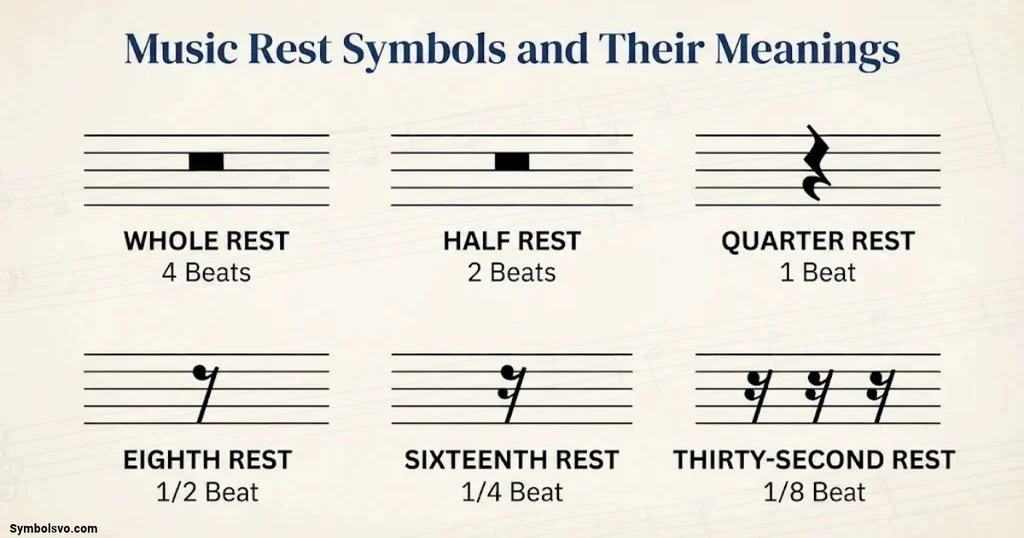
Music isn’t made up of sound alone. Silence is an important part of rhythm and expression. Music rest symbols tell performers when to stop producing sound and how long the silence should last.
Each basic note value has a corresponding rest.
| Rest | Duration in quarter-note units |
| Whole rest | 4 |
| Half rest | 2 |
| Quarter rest | 1 |
| Eighth rest | 1/2 |
| Sixteenth rest | 1/4 |
| Thirty-second rest | 1/8 |
| Sixty-fourth rest | 1/16 |
A whole rest is commonly shown as a small rectangle hanging below a staff line. A half rest looks similar but sits above a line. Shorter rests use distinctive curved or angled shapes.
Dotted Rests
A dot after a rest increases its silence by half of the original duration. For example, a dotted quarter rest lasts one and a half quarter-note units.
Dotted rests are useful when a rhythmic pattern includes a pause that doesn’t fit a basic note value.
Multi-Measure Rests
A multi-measure rest tells a performer to remain silent for several consecutive measures. Instead of printing a separate rest in every measure, the score can show one consolidated marking with a number above it.
This is especially useful in orchestral and ensemble music. A musician might have dozens of measures to wait through before playing again.
Accidentals and Their Meanings
Accidentals are symbols that change the pitch of a note. They appear immediately before the note they affect.
The five common accidental types are sharp, flat, natural, double sharp, and double flat.
| Accidental | Symbol | Meaning |
| Sharp | ♯ | Raises a note by one semitone |
| Flat | ♭ | Lowers a note by one semitone |
| Natural | ♮ | Cancels a sharp or flat alteration |
| Double sharp | 𝄪 | Raises a note by two semitones |
| Double flat | 𝄫 | Lowers a note by two semitones |
Sharp Symbol (♯)
A sharp raises a note by one semitone. For example, C becomes C-sharp (C♯).
On a standard piano keyboard, C-sharp is the key immediately to the right of C.
Flat Symbol (♭)
A flat lowers a note by one semitone. For example, B becomes B-flat (B♭).
On a standard piano keyboard, B-flat is the key immediately to the left of B.
Natural Symbol (♮)
A natural cancels a sharp or flat that would otherwise apply to a note. For example, if a key signature makes every F an F-sharp, an F-natural sign tells the performer to play the natural F instead.
Double Sharp and Double Flat
A double sharp raises a note by two semitones. A double flat lowers it by two semitones.
These signs can look unusual to beginners, but they serve an important purpose in written harmony. Their use depends on the key and musical spelling, not just on which piano key produces the sound.
What Is the Difference Between Accidentals and Key Signatures?
An accidental usually changes a note within a particular passage or measure. A key signature establishes a pattern of sharps or flats that applies throughout the piece or until the key signature changes.
In standard notation, an accidental generally applies to the same pitch and octave for the rest of the measure, subject to notation conventions and the next bar line. A natural sign can cancel a key-signature alteration for that measure.
Key Signature Symbols
A key signature appears after the clef at the beginning of a musical staff. It shows which notes are consistently sharp or flat throughout a piece.
For example:
- C major has no sharps or flats.
- G major has one sharp: F-sharp.
- D major has two sharps: F-sharp and C-sharp.
- F major has one flat: B-flat.
- B-flat major has two flats: B-flat and E-flat.
Key signatures help musicians understand the tonal framework of a composition. They also reduce the need to write the same accident repeatedly.
A key signature doesn’t tell you the entire melody or harmony. It establishes the default pitch alterations that apply unless another marking changes them.
Time Signature Symbols and Their Meanings
A time signature appears near the beginning of a piece, usually after the clef and key signature. It tells musicians how beats are grouped into measures and which note value represents the beat unit.
A time signature usually contains two numbers:
- Top number: Tells you how many beat units are in each measure.
- Bottom number: Identifies the note value used as the beat unit.
| Time signature | Common description | Basic meaning |
| 2/4 | Duple meter | Two quarter-note beats per measure |
| 3/4 | Triple meter | Three quarter-note beats per measure |
| 4/4 | Quadruple meter | Four quarter-note beats per measure |
| 2/2 | Cut time | Two half-note beats per measure |
| 6/8 | Compound duple meter | Two main beats, each commonly divided into three eighth notes |
| 9/8 | Compound triple meter | Three main beats, each commonly divided into three eighth notes |
| 12/8 | Compound quadruple meter | Four main beats, each commonly divided into three eighth notes |
Common Time (C)
The letter-like symbol C is used to represent common time, which means 4/4. It indicates four quarter-note beats per measure.
Cut Time (¢)
Cut time represents 2/2. It has two half-note beats per measure and is often associated with a quicker two-beat feel.
Simple and Compound Meter
In a simple meter, each main beat is normally divided into two equal parts. Examples include 2/4, 3/4, and 4/4.
In compound meter, each main beat is normally divided into three equal parts. Examples include 6/8, 9/8, and 12/8.
Understanding this distinction helps you count rhythms correctly. A 6/8 measure, for instance, usually feels like two larger beats rather than six equally strong beats.
Tempo Symbols and Musical Terms
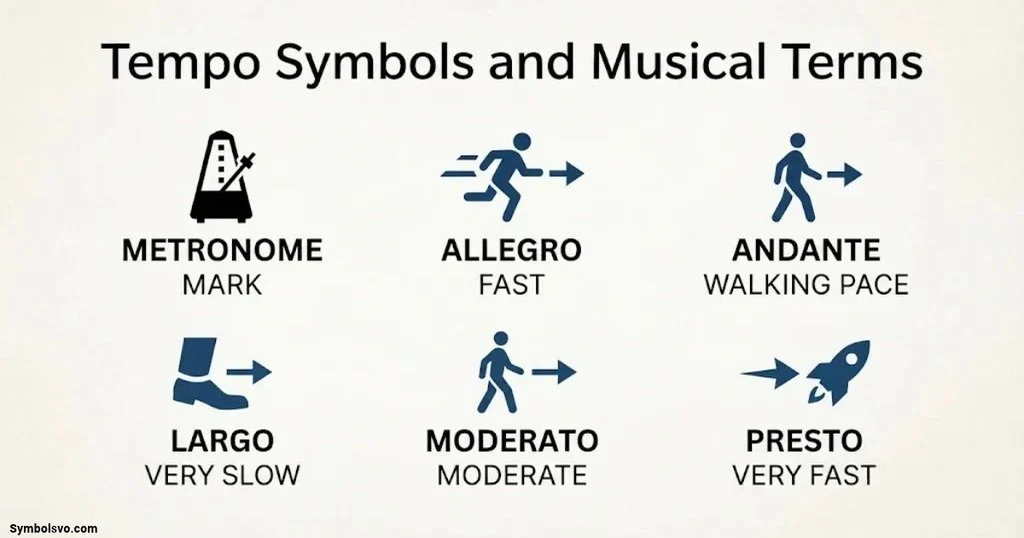
Tempo describes the speed of a piece of music. Composers may use Italian words, metronome numbers, or written instructions to communicate the intended pace.
A metronome marking such as ♩ = 120 means that the quarter note should occur 120 times per minute.
| Tempo term | General meaning |
| Grave | Very slow and serious |
| Largo | Broad and slow |
| Lento | Slow |
| Adagio | Slow and relaxed |
| Andante | At a walking pace |
| Moderato | Moderate speed |
| Allegretto | Moderately fast |
| Allegro | Fast and lively |
| Vivace | Lively and brisk |
| Presto | Very fast |
| Prestissimo | Extremely fast |
These words describe general musical character as well as speed. Their exact tempo can vary according to the composition, historical period, and performer.
Tempo Change Symbols and Terms
Music may become faster or slower during a performance. Composers use additional terms to show these changes.
- Accelerando: Gradually become faster.
- Ritardando: Gradually become slower.
- Rallentando: Slow down gradually, often with a broadening effect.
- A tempo: Return to the previous or established tempo.
- Rubato: Use flexible timing for expressive effect.
- Stringendo: Gradually increase urgency or speed.
- Tempo primo: Return to the original tempo.
A tempo instruction can affect the feeling of an entire passage. Even when the notes remain unchanged, a slower or faster performance can create a very different musical impression.
Dynamic Symbols and Their Meanings
Dynamics tell musicians how loud or soft to play. They help shape the emotional character of music and create contrast between sections.
Most dynamic markings use Italian terms or abbreviations.
| Dynamic symbol | Full term | Meaning |
| ppp | Pianississimo | Extremely soft |
| pp | Pianissimo | Very soft |
| p | Piano | Soft |
| mp | Mezzo-piano | Moderately soft |
| mf | Mezzo-forte | Moderately loud |
| f | Forte | Loud |
| ff | Fortissimo | Very loud |
| fff | Fortississimo | Extremely loud |
The markings are relative rather than fixed volume measurements. A piano passage should sound softer than a forte passage, but the actual volume depends on the instrument, performance space, and musical context.
Crescendo and Decrescendo
A crescendo tells performers to gradually increase the volume. It is often shown as a hairpin that opens outward.
A decrescendo or diminuendo tells performers to gradually decrease the volume. Its hairpin closes inward.
These symbols can stretch across a short phrase or a long musical passage.
Other Dynamic Markings
Some additional dynamic terms include:
- Sforzando (sf or sfz): A sudden strong emphasis.
- Fortepiano (fp): Play a note loudly and then immediately softly.
- Subito piano (sub. p): Suddenly become soft.
- Subito forte (sub. f): Suddenly become loud.
- Morendo: Gradually fade away.
- Calando: Gradually become softer and often slower.
- Niente: Reduce the sound to almost nothing or begin from silence, depending on context.
Dynamics add contrast and help musicians communicate the intended expression of a composition.
Articulation Symbols in Music
Articulation describes how a note begins, continues, and ends. It helps performers shape a musical phrase instead of playing every note in exactly the same way.
| Articulation marking | Name | Meaning |
| Dot above or below a note | Staccato | Play short and detached |
| Wedge above or below a note | Staccatissimo | Play very short and sharply separated |
| > | Accent | Emphasize the note |
| ^ | Marcato | Give the note a strong, marked emphasis |
| Short line | Tenuto | Hold the note for its full value or give it slight emphasis |
| Curved line over different pitches | Slur | Connect notes smoothly |
| Curved line between identical pitches | Tie | Combine their durations into one continuous sound |
| 𝄐 | Fermata | Hold the note or rest longer than its written value |
Staccato and Staccatissimo
A staccato note is shorter and more detached than its written duration might otherwise suggest. The exact length depends on musical context and performance style.
Staccatissimo indicates an even shorter or more sharply separated note.
Accent and Marcato
An accent emphasizes a particular note. It may be played with a stronger attack or greater intensity.
Marcato generally asks for a more pronounced emphasis. It can suggest a bold or strongly marked sound.
Slur and Tie: What’s the Difference?
These two curved markings look similar, but they have different jobs.
A slur connects notes of different pitches and tells the performer to play them smoothly. A tie connects notes of the same pitch and combines their durations.
For example, two tied quarter notes of the same pitch last as long as one half note, with no new attack between them.
Musical Ornament Symbols and Their Meanings
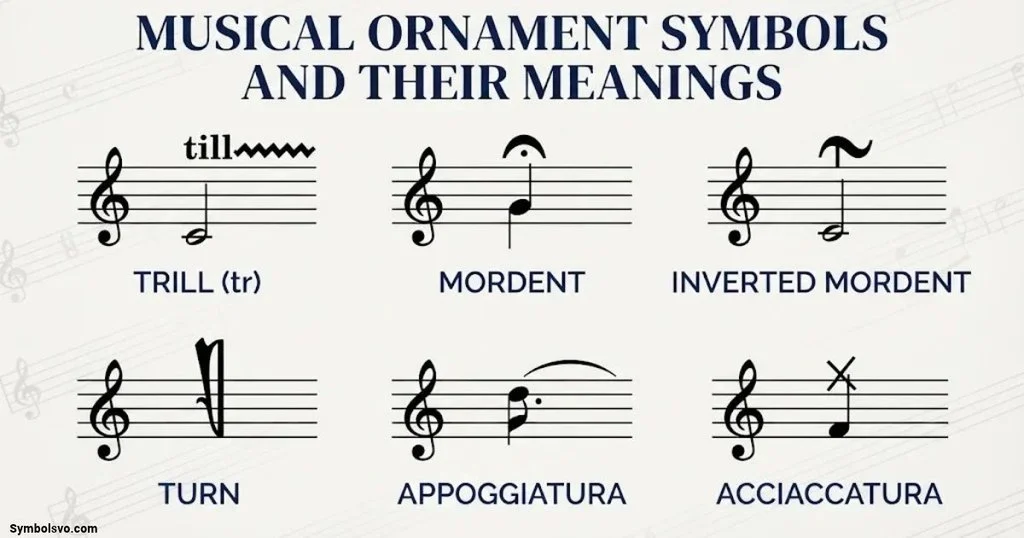
Ornaments are decorative musical figures added to a melody. They can make a passage more expressive, elaborate, or stylistically distinctive.
Some ornaments are written as small notes, while others use special signs.
Trill
A trill instructs the performer to rapidly alternate between the written note and the note immediately above it in the relevant scale or musical context.
The exact execution can depend on the period, style, and surrounding notes.
Mordent
A mordent is a short ornament involving the main note and a neighboring note. A lower mordent moves briefly to the note below, while an upper mordent moves to the note above.
Turn or Gruppetto
A turn, sometimes called a gruppetto, is a short decorative pattern that moves around the main note using neighboring pitches.
The precise order and execution depend on the type of turn and its placement.
Grace Notes
A grace note is a small note printed before a principal note. It adds a quick decorative sound and is usually performed with less rhythmic weight than a regular note.
Common grace-note types include the acciaccatura and appoggiatura. Their timing and emphasis can vary with musical style.
Tremolo
Tremolo indicates a rapid repetition of a note or a rapid alternation between two notes. It is used on instruments such as piano, strings, and some percussion instruments.
Arpeggio and Glissando
An arpeggio means playing the notes of a chord one after another rather than simultaneously. A wavy line beside a chord often indicates this technique.
A glissando is a continuous or rapidly stepped movement between pitches. It is often heard on instruments such as piano, violin, trombone, and harp, although the exact technique differs between instruments.
Musical Navigation and Repeat Symbols
Some music notation symbols tell performers where to go next in a composition. These signs are especially helpful when a piece contains repeated sections or a non-linear structure.
| Symbol or term | Meaning |
| Repeat sign | Play a section again |
| D.C. or Da Capo | Return to the beginning |
| D.S. or Dal Segno | Return to the sign |
| Segno | Marks the point to which the performer returns |
| Coda | Indicates a concluding section |
| To Coda | Directs the performer to move to the coda |
| Fine | Marks the end of the piece or section |
| 1st and 2nd endings | Provide different endings for repeated sections |
Repeat Signs
Repeat signs use pairs of dots beside a double bar line. They tell musicians to play a section again.
If a passage has a repeat sign at both ends, the performer plays the enclosed section twice unless the score gives different instructions.
Da Capo (D.C.)
Da Capo means “from the beginning.” A D.C. instruction sends the performer back to the start of the piece.
A marking such as D.C. al Fine means to return to the beginning and continue until the Fine marking.
Dal Segno (D.S.)
Dal Segno means “from the sign.” The performer returns to the point marked with a segno symbol.
D.S. al Coda instructs the musician to return to the segno and then move to the coda when the appropriate direction appears.
First and Second Endings
A passage may have two different endings. The first ending is played the first time through. On the repeat, the performer skips it and plays the second ending.
This method allows a composer to repeat a musical section without writing the entire passage again.
Instrument-Specific Music Symbols and Techniques
Some signs are used mainly by particular instruments. Their meanings may be familiar to one group of musicians but unfamiliar to another.
Piano Symbols
Piano music often includes pedal markings:
- Ped. or a pedal line: Press the sustain pedal.
- Release mark: Lift the sustain pedal.
- Una corda: Use the soft pedal on a traditional piano.
- Tre corde: Return to normal playing by releasing the una corda pedal.
Piano scores may also include octave signs, arpeggio markings, hand indications, and chord symbols.
String Instrument Symbols
String instruments such as violin, viola, cello, and double bass use several specialized instructions.
| Term | Meaning |
| Arco | Play with the bow |
| Pizzicato | Pluck the strings |
| Down-bow | Move the bow downward |
| Up-bow | Move the bow upward |
| Col legno | Use the wood of the bow |
| Harmonics | Produce a bell-like sound using light string contact |
| Sul ponticello | Play near the bridge |
| Sul tasto | Play over the fingerboard |
These techniques change the tone and texture of a musical passage. A composer may use them to create a bright, thin, metallic, or unusual sound.
Guitar and Tablature Symbols
Guitar music may use standard staff notation, tablature, or both.
In tablature, six horizontal lines commonly represent the guitar’s six strings. Numbers show which fret the player should press.
Other common guitar markings include:
- Bend: Raise the pitch by pushing or pulling a string.
- Slide: Move between frets without fully lifting the finger.
- Hammer-on: Sound a higher note by pressing a finger onto the string.
- Pull-off: Sound a lower note by releasing a fretting finger.
- Palm mute: Dampen the strings with the picking hand.
- Harmonic: Produce a bell-like tone using a specific string technique.
Tablature symbols aren’t always identical across publishers, so check the notation key when one is provided.
Percussion Symbols
Percussion notation uses different conventions depending on the instrument and score.
A drum staff may assign different lines and spaces to the bass drum, snare drum, hi-hat, toms, and cymbals. Notehead shapes can also distinguish instrument types or playing techniques.
Common instructions include:
- Open hi-hat: Let the hi-hat cymbals ring.
- Closed hi-hat: Play with the cymbals closed.
- Damp: Stop a ringing sound.
- Damp all: Stop all indicated ringing sounds.
- Roll: Repeat a stroke rapidly or sustain a continuous percussion sound.
Vocal and Choral Symbols
Vocal scores may include instructions for breathing, pronunciation, and expression.
A breath mark shows where a singer can take a breath. A caesura indicates a noticeable pause or break. Other directions may tell singers to sustain a vowel, pronounce a word in a particular way, or sing with a specified character.
Other Important Music Notation Symbols
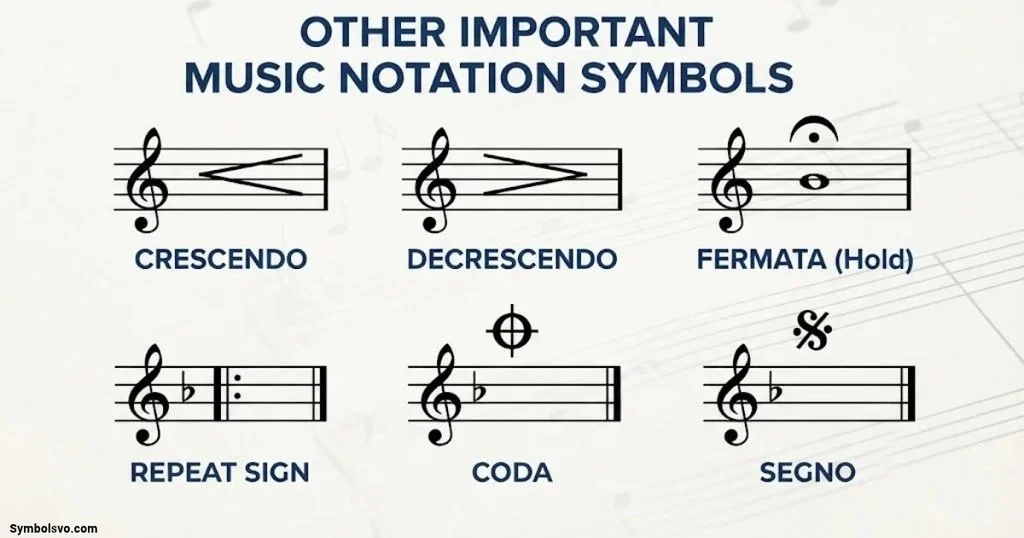
Beyond the most common signs, sheet music may contain additional markings that help performers understand the composer’s intentions.
Breath Mark
A breath mark is a small comma-like symbol placed above the staff. It shows a suggested breathing point, particularly in vocal or wind-instrument music.
Caesura
A caesura indicates a deliberate break or pause. It is sometimes called a railroad-track marking because of its appearance.
The pause’s length is generally determined by the musical context and the performer’s interpretation.
Chord Symbols and Chord Numerals
Chord symbols appear above a staff and tell musicians which harmony to play. Examples include C, Am, G7, and Dm.
Roman numeral chord analysis uses numerals such as I, ii, IV, and V to describe chords in relation to a key. Uppercase numerals commonly indicate major chords, while lowercase numerals commonly indicate minor chords.
Chord symbols are especially useful for guitar, piano, jazz, and popular music arrangements.
Hemiola
A hemiola is a rhythmic effect that changes how beats are grouped or perceived. In triple meter, for example, a passage may temporarily create the feeling of two groups of three becoming three groups of two.
It isn’t simply a note symbol. It’s a rhythmic relationship that can be shown through the grouping and placement of notes.
Demi-Sharp and Demi-Flat
A demi-sharp or demi-flat is used in some systems of microtonal notation to indicate a pitch alteration smaller than a standard semitone.
These signs aren’t part of the basic accidental system used in most beginner sheet music. Their exact meaning can depend on the notation system or composer.
How to Read Sheet Music Symbols Step by Step
Learning how to read sheet music is easier when you follow the same order each time. Don’t try to understand every symbol at once. Start with the markings that establish the musical framework, then read the notes and performance instructions.
Start With the Clef
Look at the symbol at the far left of the staff. Identify whether it’s a treble clef, bass clef, or another clef.
This tells you how to name the notes on the lines and spaces.
Check the Key Signature
Look immediately after the clef. Count the sharps or flats and identify which notes they affect.
This helps you know which notes are altered by default.
Read the Time Signature
Check the two numbers at the beginning of the music. Determine how many beats belong in each measure and which note value represents the beat unit.
For example, 3/4 time has three quarter-note beats in each measure.
Follow the Notes and Rests
Read the notes from left to right. Use their positions to identify pitches and their shapes to understand duration.
Pay attention to rests because they are just as important as notes when counting rhythm.
Notice Accidentals
Check for sharp, flat, natural, double-sharp, or double-flat signs before individual notes.
Remember that accidentals can temporarily change the pitch established by the key signature.
Follow Dynamics and Articulation
Look for markings such as p, f, staccato, accent, and slur. These instructions shape how the notes should sound.
Follow Repeats and Navigation Marks
Before performing the whole piece, check for repeat signs, D.C., D.S., first and second endings, and coda instructions.
This prevents you from accidentally skipping or repeating the wrong section.
Music Symbols for Beginners: What Should You Learn First?
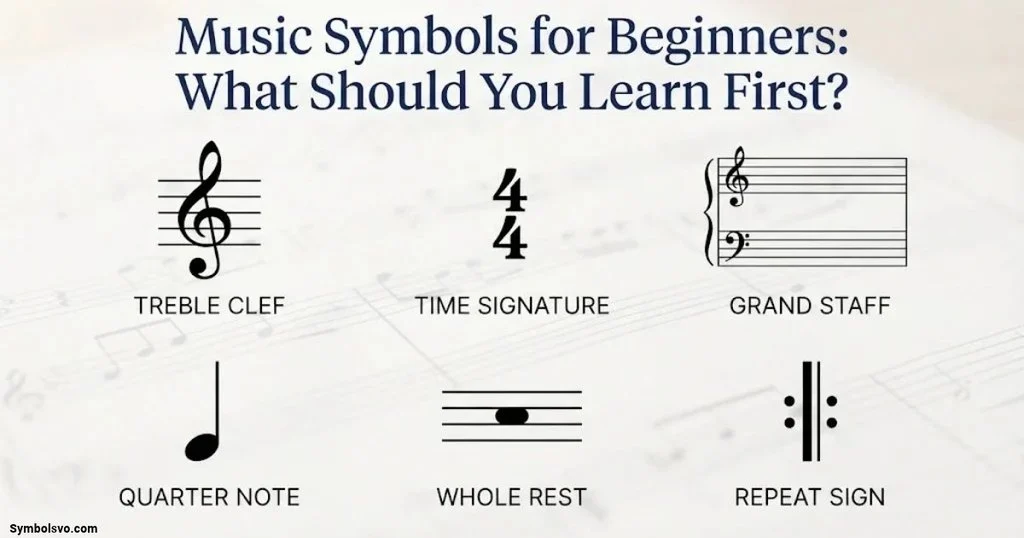
If you’re new to music theory, you don’t need to memorize every symbol immediately. Focus on the signs that appear most often in beginner sheet music.
A practical learning order is:
- Staff and clef: Learn the five lines, four spaces, and treble and bass clefs.
- Note names: Understand A through G and how they appear on the staff.
- Basic note values: Recognize whole, half, quarter, and eighth notes.
- Rests: Learn the matching silence symbols.
- Time signatures: Start with 4/4, 3/4, and 2/4.
- Accidentals: Memorize sharp, flat, and natural.
- Dynamics: Understand piano, forte, and the markings between them.
- Articulation: Learn staccato, accent, slur, and tie.
- Tempo: Recognize common speed instructions.
- Repeat signs: Understand how to follow a repeated section.
Try learning a small group of symbols each day. Write them down, identify them in a short piece, and clap the rhythm. Practicing with real music is more useful than memorizing a long list without applying it.
Commonly Confused Music Symbols
Some musical signs and symbols look alike or have related meanings. Understanding their differences helps prevent mistakes when reading a score.
| Symbols or terms | Main difference |
| Sharp and flat | Sharp raises pitch; flat lowers pitch |
| Natural and accidental | Natural cancels an alteration; accidental is the broader category of pitch-changing signs |
| Note and rest | A note represents sound; a rest represents silence |
| Slur and tie | Slur connects different pitches smoothly; tie joins the duration of notes with the same pitch |
| Staccato and accent | Staccato shortens or separates a note; accent emphasizes it |
| Crescendo and decrescendo | Crescendo grows louder; decrescendo becomes softer |
| Treble and bass clef | Treble is commonly used for higher pitches; bass is commonly used for lower pitches |
| Tempo and dynamics | Tempo controls speed; dynamics control loudness |
| Time signature and key signature | Time signature organizes beats; key signature establishes default sharps or flats |
| Arpeggio and glissando | Arpeggio plays chord notes successively; glissando moves between pitches |
A useful way to remember these distinctions is to ask what kind of instruction each marking gives. Does it change pitch, duration, volume, speed, technique, or navigation? That question often reveals the symbol’s purpose.
How Many Music Symbols Are There?
There isn’t one fixed number of music symbols used in every musical tradition. The total depends on the instrument, notation system, historical period, and level of detail in the score.
A beginner learning piano may encounter a relatively small set of standard signs. An orchestral musician may need to recognize many more markings for bowing, articulation, percussion, dynamics, and navigation. Contemporary and experimental music can introduce additional symbols for extended techniques and unusual sounds.
For that reason, a practical music symbols list is better organized by category than treated as one final numbered collection.
The main categories include:
- Staff and clef symbols
- Notes and rests
- Accidentals and key signatures
- Time signatures and rhythmic groupings
- Tempo markings
- Dynamics
- Articulation signs
- Ornaments
- Repeat and navigation symbols
- Instrument-specific techniques
- Chord symbols and analytical markings
The most important thing is to understand the common symbols first. More specialized notation becomes easier when you already know how the basic system works.
Why Are Music Symbols Important?
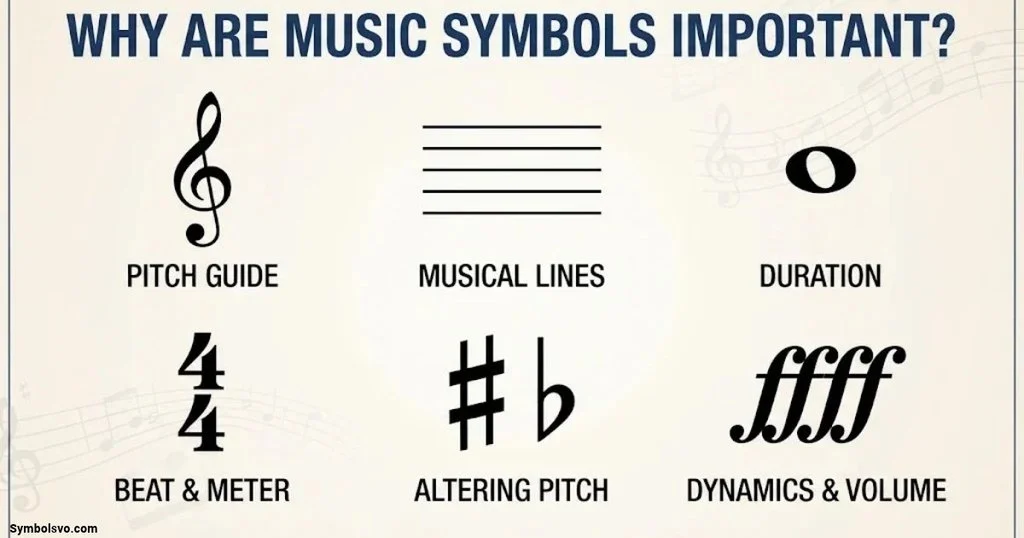
Music symbols and definitions help performers share musical ideas accurately. Without a common notation system, musicians would need to learn every composition through demonstration, memory, or lengthy verbal instructions.
Music notation offers several important benefits.
It preserves musical ideas. Composers can record melodies, rhythms, harmonies, and performance instructions so that others can study and perform them later.
It supports collaboration. Musicians in an orchestra, choir, band, or chamber group can work from the same score. Each performer can follow their own part while staying connected to the larger composition.
It improves musical learning. Understanding notation helps students recognize patterns, intervals, rhythms, scales, and chords. It also builds a foundation for music theory.
It communicates expression. Dynamics, articulation, tempo, and ornament signs give performers guidance about how a composition should feel and sound.
It makes complex music easier to organize. A full score can contain several instruments playing different parts at the same time. Standard notation helps musicians read those parts together.
Music notation isn’t the only way to learn or share music. Musicians also use recordings, tablature, chord charts, oral traditions, and other systems. However, standard notation remains an important tool in many forms of music education and performance.
Frequently Asked Questions About Music Symbols and Their Meanings
What are the most common music symbols?
The most common symbols include the treble clef, bass clef, whole note, half note, quarter note, eighth note, rests, sharp, flat, natural, time signature, and dynamic markings such as p and f. These signs appear frequently in beginner and intermediate sheet music.
What does the treble clef mean?
The treble clef identifies the second line from the bottom of the staff as G. It is commonly used for higher-pitched instruments and melodies, including violin, flute, and many vocal parts.
What does the bass clef mean?
The bass clef identifies the fourth line from the bottom as F. It is commonly used for lower-pitched instruments such as cello, bassoon, tuba, and double bass.
What does a sharp symbol mean in music?
A sharp (♯) raises a note by one semitone. For example, C becomes C-sharp. The exact written spelling matters because a sharp and its enharmonic equivalent may sound the same on many instruments but serve different musical purposes.
What does a flat symbol mean in music?
A flat (♭) lowers a note by one semitone. For example, B becomes B-flat. Flats can appear in a key signature or as individual accidentals.
What does a natural symbol mean?
A natural sign (♮) cancels a sharp or flat alteration that would otherwise apply. It returns the note to its natural letter-name pitch in the relevant octave.
What does the letter C mean in sheet music?
A C-shaped marking can represent common time, which is another way of writing 4/4. The letter C can also appear as a note name or within other musical instructions, so its meaning depends on its position and context.
What is the difference between a bar and a measure?
In standard music terminology, bar and measure generally refer to the same thing: a section of music between two bar lines. “Measure” is common in American English, while “bar” is widely used in British English and many musical contexts.
What does a fermata symbol mean?
A fermata (𝄐) tells the performer to hold a note or rest longer than its written duration. The exact length is usually determined by the performer, conductor, and musical context.
What is the difference between a slur and a tie?
A slur connects notes of different pitches and tells the performer to play them smoothly. A tie connects notes of the same pitch and combines their durations into one continuous sound.
What does crescendo mean?
Crescendo means to gradually increase the volume. It is commonly represented by a hairpin that opens outward.
What does decrescendo mean?
Decrescendo means to gradually decrease the volume. It is commonly represented by a hairpin that closes inward. Diminuendo is another term often used for this instruction.
What are music symbols used for?
Music symbols communicate pitch, rhythm, duration, silence, volume, tempo, articulation, expression, and musical structure. They help performers understand and reproduce a composition.
What are the most important music theory symbols for beginners?
Beginners should start with the treble and bass clefs, staff lines, note values, rests, time signatures, sharps, flats, naturals, and basic dynamics. These symbols provide the foundation for reading most simple sheet music.
Conclusion
Understanding music symbols and their meanings is one of the most useful steps toward reading and performing written music. The staff and clefs identify pitches. Notes and rests explain sound and silence. Accidentals and key signatures control pitch changes, while time signatures organize beats into measures. Dynamics, tempo, articulation, and ornaments add expression and detail.
You don’t have to learn every marking at once. Begin with the common music notes and symbols, practice identifying them in real sheet music, and gradually add more advanced signs as you improve.
With regular practice, a page of unfamiliar notation starts to make sense. What once looked like a collection of dots and lines becomes a set of clear musical instructions.

I’m Daniel Brooks, a content creator and symbol enthusiast dedicated to researching the fascinating world of signs and symbols. I enjoy discovering the hidden meanings behind famous icons, emojis, historical emblems, and cultural symbols. Through my writing, I aim to provide trustworthy, well-researched, and reader-friendly information that helps people learn something new with every visit.
Books:
- The Complete Guide to World Symbols
- The Power of Universal Signs
 Mason Ellington
 Nathan Holloway