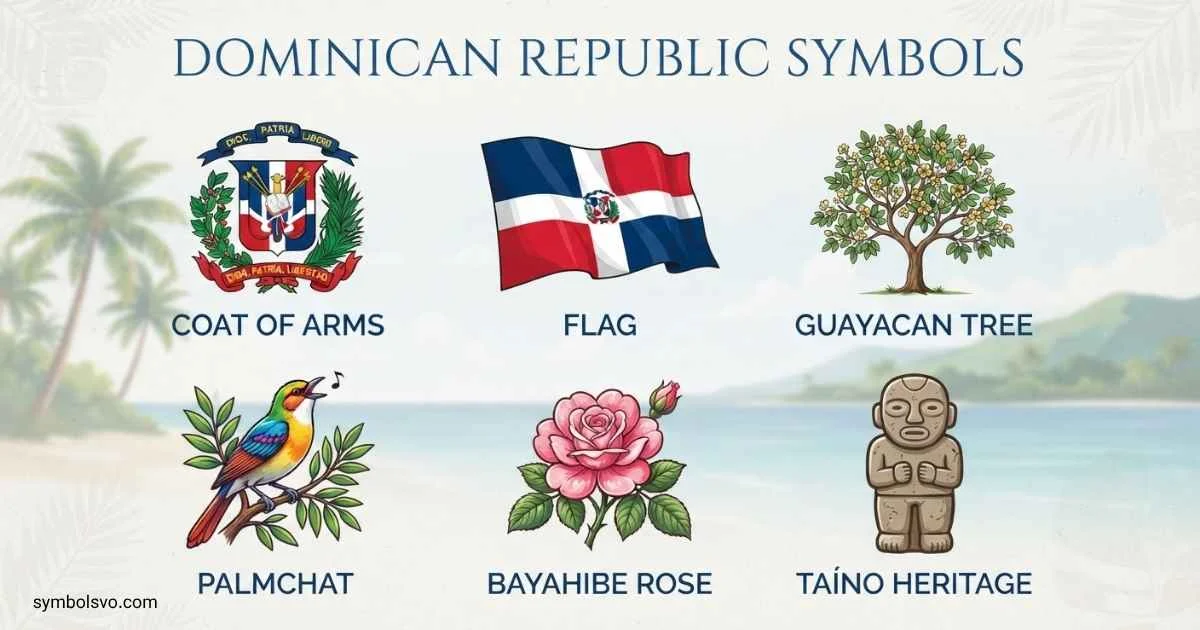
I’ve always found national symbols fascinating because they tell stories that words alone cannot. Dominican Republic symbols reveal the country’s history, identity, culture, and deep sense of national pride.
When you explore these symbols, you’ll discover more than a flag or an emblem. You’ll see how history, nature, religion, and national traditions come together to represent the Dominican Republic.
I’ll walk you through the most important Dominican Republic symbols in a simple and engaging way. You’ll learn what each symbol means and why it matters today.
Quick Answer
Dominican Republic symbols are the officially recognized national emblems, flora, and fauna that represent the sovereignty, heritage, and identity of the Dominican nation. Rooted in the 1844 independence movement led by Juan Pablo Duarte, these symbols include the unique national flag, the Bible-bearing coat of arms, the Cigua Palmera bird, and the rare Bayahibe Rose flower.
Quick Facts About Dominican Republic Symbols
| Aspect | Information |
| Origin | Formulated during the secret independence movement of La Trinitaria in 1844. |
| Historical Significance | Established the separate identity of the Dominican people following liberation from foreign rule. |
| Main Meaning | A declaration of liberty, national peace, and unwavering community unity. |
| Spiritual Meaning | Divine protection and Christian devotion, marked uniquely by an open Holy Bible. |
| Cultural Importance | Rooted in everyday life through merengue music, local art, and annual carnival festivals. |
| Modern Usage | Displayed on official government currency, digital identity documents, and athletic team uniforms. |
What Are Dominican Republic Symbols?
Dominican Republic symbols are a collection of constitutional and natural tokens that define the essence of the country. Their official journey began on February 27, 1844, when the founding father, Juan Pablo Duarte, established a secret society called La Trinitaria. This group sought to break free from Haitian rule and establish an independent democracy on the island of Hispaniola.
To give his people a unified vision, Duarte designed the basic concepts of the national flag and emblem. Over the years, these constitutional icons were joined by specific natural elements. The government slowly added native plants and endemic wildlife to represent the rich biodiversity of the land.
Today, these symbols serve as an emotional bridge. They connect the modern Caribbean nation to its historical roots, reminding citizens of the immense sacrifices made by their ancestors to secure a free, self-governed homeland.
Deep Symbolic Meaning of Dominican Republic Symbols
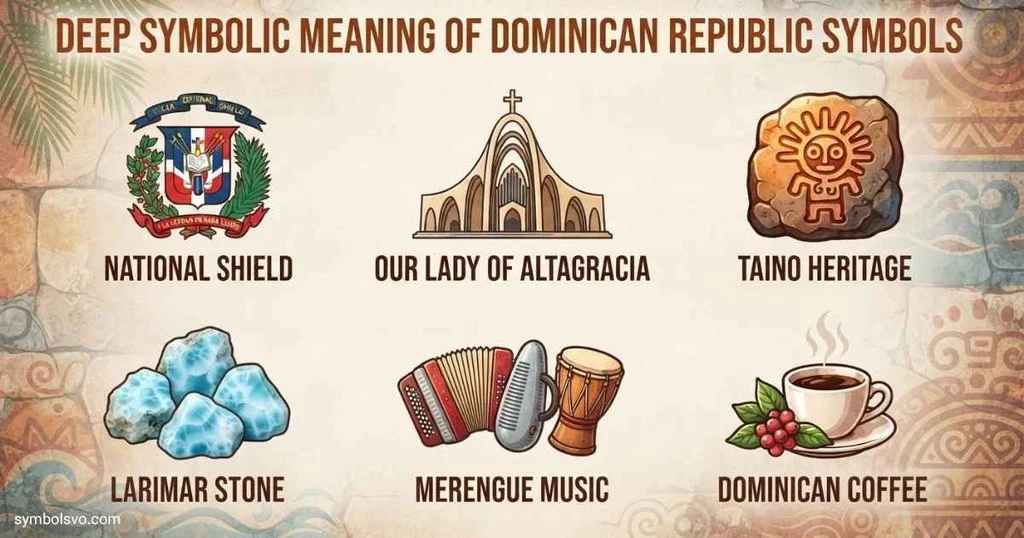
Spiritual Level
The spiritual symbolism embedded within these national items is incredibly unique. Unlike almost any other sovereign nation, the Dominican identity puts sacred scripture right at the absolute center of its national awareness. This placement represents an open portal for divine protection and inner transformation. It suggests that true liberty can only be sustained when a community aligns its collective consciousness with higher moral truths, compassion, and spiritual integrity.
Psychological Level
Psychologically, these emblems tap into the powerful archetype of the Liberated Warrior. They speak directly to the human desire to overcome oppression, break internal chains, and claim personal sovereignty. The bold contrast of colors triggers an emotional attraction of safety balanced with intense vitality. It reminds individuals that they belong to a lineage of survivors, feeding a collective memory of psychological resilience against overwhelming odds.
Cultural Level
On a daily cultural level, these symbols represent a beautiful tapestry of Taino, African, and European histories. They echo through traditional community beliefs, local artwork, and seasonal festivals. They reinforce a social contract of hospitality, warmth, and shared joy, acting as a visual handshake that immediately unifies Dominicans whether they are walking the streets of Santo Domingo or living far away in New York City.
Types and Variations of Dominican Republic Symbols
1. The National Flag
- Visual Description: A large, centered white cross dividing the space into four alternating blocks of ultramarine blue and vermilion red.
- Meaning: Peace, divine protection, and the blood spilled by national heroes.
- Symbolism: The blue blocks represent the open sky and God’s protective hand over the land. The red blocks symbolize the sacrificial blood of the freedom fighters. The white cross stands for eternal peace and absolute unity among citizens.
- Cultural Connection: It was hand-sewn by heroic women like Maria Trinidad Sanchez and Concepcion Bona, flying proudly for the very first time on independence day.
- Where It Appears: Government buildings, public classrooms, international sporting events, and household balconies during the month of February.
2. The Constitutional Coat of Arms
- Visual Description: A quartered shield featuring a golden cross and an open Bible, flanked by six spears, a green laurel branch on the left, and a lush palm frond on the right.
- Meaning: Divine truth, honorable victory, and democratic freedom.
- Symbolism: The open Bible is turned specifically to the Gospel of John, chapter 8, verse 32, which states, And the truth shall make you free. The upper blue ribbon carries the foundational motto, Dios, Patria, Libertad, meaning God, Homeland, Liberty.
- Cultural Connection: This emblem makes the Dominican Republic the only country in the world to display an open Holy Bible on its national flag.
- Where It Appears: Placed dead center on the national flag, stamped on official legal documents, and minted onto all national coins.
3. The National Bird: Cigua Palmera
- Visual Description: A small, lively songbird featuring olive-brown feathers with soft yellow-green streaks and expressive, dark eyes.
- Meaning: Community cooperation, vocal expression, and natural adaptability.
- Symbolism: This bird is famous for building massive, communal nests where multiple bird families live together under one roof. It perfectly mirrors the cooperative, family-focused nature of Dominican society.
- Cultural Connection: It is an endemic species, meaning it is found naturally only on the island of Hispaniola.
- Where It Appears: Local nature documentaries, children’s educational textbooks, and regional environmental art pieces.
4. The National Flower: Bayahibe Rose
- Visual Description: A delicate, pastel-pink flower that blooms from a highly unique species of leafy cactus plant.
- Meaning: Resilience, rare beauty, and environmental conservation.
- Symbolism: The fact that a soft, beautiful flower grows directly out of a thorny, tough cactus symbolizes the ability of the Dominican people to thrive and create beautiful lives even in harsh, challenging environments.
- Cultural Connection: Discovered near the town of Bayahibe, it was officially declared the national flower in 2011 to protect it from critical extinction.
- Where It Appears: Fine jewelry designs, high-end fashion prints, botanical stamp collections, and eco-tourism branding.
Dominican Republic Symbols Across Different Eras and Cultures
Indigenous Taino Traditions
Long before European contact, the native Taino people worshipped the natural elements of Hispaniola. They carved petroglyphs of native birds and palm trees into cave walls. To the Taino, the local flora and fauna were sacred tokens of fertility, spiritual guidance, and balance, laying the initial groundwork for the island’s deep connection to nature.
The Spanish Colonial Era
During the centuries of Spanish rule, European heraldry dominated the landscape. The classic royal shield, family crests, and Catholic crosses were introduced to the island. This period deeply infused the local culture with a profound respect for religious symbols, shields, and formal institutional emblems.
The Haitian Unification Period
For twenty-two years, the eastern side of the island was unified under the flag of Haiti. During this tense historical era, the unique cultural identity of the Dominican people was heavily suppressed. This restriction caused a massive psychological longing for distinct, self-made icons, sparking the secret creation of new patriotic markers.
The 1844 Independence Breakthrough
When La Trinitaria finally struck for freedom, they did not just change governments, they completely remade their visual world. By layering a bold white cross directly over the existing colors of the region, they created a brand new visual statement. This layout announced to the global community that a fresh, sovereign, and deeply faithful nation had officially arrived.
Modern Global Interpretations
In our current interconnected world, these traditional icons have evolved into global symbols of tropical warmth, athletic dominance, and rich musical heritage. When international travelers see these colors, they no longer just think of historical battles. Instead, they visualize the infectious rhythm of merengue, world-class baseball players, and a culture of radical hospitality.
Similar Symbols and Their Meanings
It is very common for people to compare the visual identity of the Dominican Republic with other tricolor flags and heraldic crests across the Caribbean and Latin America.
| Symbol | Dominican Republic | Cross-Regional Neighbors |
| Primary Focus | Explicit religious devotion and absolute peace. | Revolutionary action and political liberty. |
| Central Emblem | An open Bible with a golden Christian cross. | Phrygian caps, stars, or native landscapes. |
| Greenery Used | Laurel for victory and palm for absolute freedom. | Olive branches or tropical agricultural crops. |
A very frequent misconception is that the flag is simply a copy of the French or Haitian layouts. While it uses similar raw colors due to historic trade ties, the addition of the massive white cross completely transforms its structural meaning. The cross shifts the visual narrative away from political rebellion and toward a permanent promise of internal peace, structural order, and spiritual salvation.
Dominican Republic Symbols in Mythology and Folklore
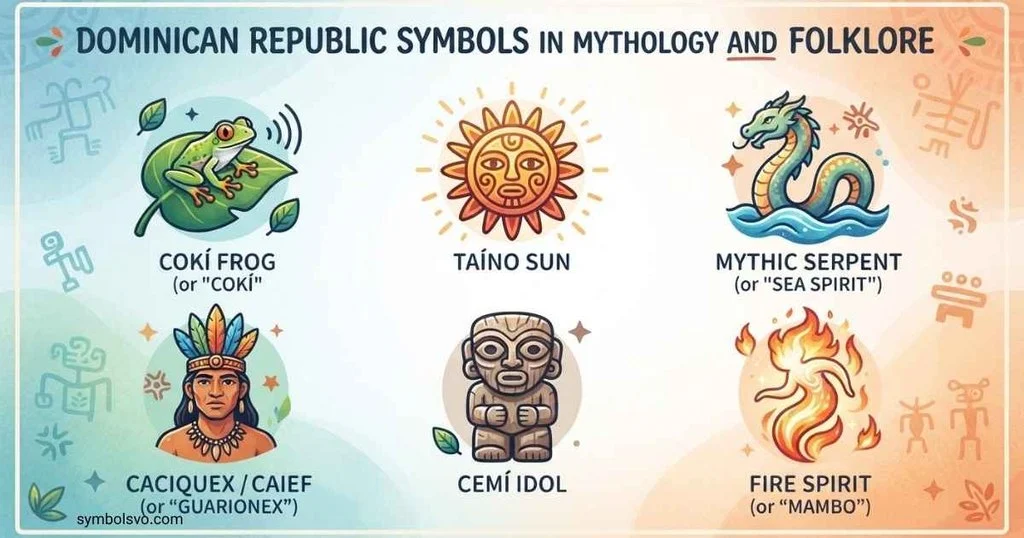
The natural emblems of the country are deeply woven into the rich fabric of rural Dominican folklore and magical realism. For generations, old country legends have claimed that the Cigua Palmera bird holds a special blessing from the sky. Storytellers say its loud, constant singing is actually a daily prayer of gratitude for the safety of the island’s families.
Similarly, the royal palm tree, which supports the bird’s nests, is viewed in local folklore as an unbreakable pillar of strength. It is said that the palm tree can bend completely in half during a fierce Caribbean hurricane but will almost never snap. This folkloric narrative has trained generations of Dominicans to view themselves as flexible yet unyielding, transforming a common tree into a profound psychological lesson on surviving life’s toughest storms.
Dominican Republic Symbols in Art, Pop Culture, and Design
In modern times, these classic icons have moved completely off government documents and into the vibrant world of contemporary pop culture. Famous Dominican painters, such as Candido Bido, routinely use the striking ultramarine blue and vermilion red of the flag to fill their canvases with emotional warmth and national nostalgia.
[ Taino Earth Symbols ] —> [ 1844 Patriotic Cross ] —> [ Modern Global Icon ]
In the worlds of fashion and tattoo design, young Dominicans frequently merge the delicate Bayahibe Rose with bold geometric shapes to create gorgeous, personal statements of heritage. Furthermore, during the annual Dominican Carnival, these national colors and animal symbols are blown up into magnificent, larger-than-life costumes. This creative explosion proves that these traditional markers are not dusty relics of the past, but living, breathing expressions of modern artistic pride.
Spiritual and Dream Meaning of Dominican Republic Symbols
When national emblems show up unexpectedly in our dreams or deep meditation sessions, they usually bring profound personal messages from the subconscious mind. Because our brains process deep concepts through visual shorthand, seeing these specific Caribbean tokens carries unique inner guidance.
- Dreaming of the White Cross: Points to a deep, subconscious need for emotional healing, forgiveness, and the resolution of a major conflict in your waking life.
- Dreaming of the Open Bible: Suggests a search for absolute truth, a craving for moral clarity, or a reminder to look within for spiritual answers.
- Dreaming of the Cigua Palmera: Often represents a call to focus on your local community, strengthen your family bonds, or open your throat chakra to speak your truth clearly.
- Dreaming of the Bayahibe Rose: Acts as a beautiful, encouraging message that you are fully capable of blooming and finding joy even when your current life situation feels thorny or restrictive.
Positive and Negative Meanings of Dominican Republic Symbols
Every historical symbol carries a complex balance of light and shadow, changing its emotional weight based on perspective and historical context.
| Positive Meaning | Negative Meaning |
| Directs the mind toward peace, unity, and deep family cooperation. | Can be manipulated to fuel exclusionary, rigid nationalism. |
| Connects modern citizens to a proud heritage of freedom fighters. | Runs the risk of oversimplifying complex colonial pasts. |
| Inspires people to find beauty and resilience in tough environments. | Can lose its deeper meaning when overused in cheap commercial tourism. |
Why Humans Are Attracted to Dominican Republic Symbols
Our natural human attraction to these specific Caribbean emblems goes far beyond basic aesthetics. The human brain is a master pattern recognition system that naturally craves bright, high-contrast visuals that signal warmth, life, and safety. The combination of deep blue and fiery red provides an immediate sensory spark, while the clean white cross introduces an instant feeling of psychological balance and calm.
Beyond the biology of sight, humans are deeply narrative-driven creatures. We are naturally drawn to stories of triumph over adversity. When we look at these emblems, our minds instantly connect with the romantic, story-driven history of a small island nation that successfully claimed its own destiny, feeding our collective human desire for ultimate freedom and self-determination.
Modern Uses of Dominican Republic Symbols
In our highly visual, digital world, these timeless markers have found an array of exciting new applications.
- Contemporary Tattoos: Worn proudly by the global Dominican diaspora as a permanent badge of cultural honor.
- Luxury Jewelry: Crafted into stunning gold and silver pendants shaped like the Bayahibe Rose or the national shield.
- Global Branding: Integrated cleanly into international export packaging for premium Dominican coffee, organic cacao, and fine rum.
- Social Media Culture: Dropped daily into digital profiles, hashtags, and viral videos to signal instant community pride.
- Urban Streetwear: Reimagined by young fashion designers into modern, minimalist jackets and caps worn in major cities worldwide.
Interesting Facts About Dominican Republic Symbols
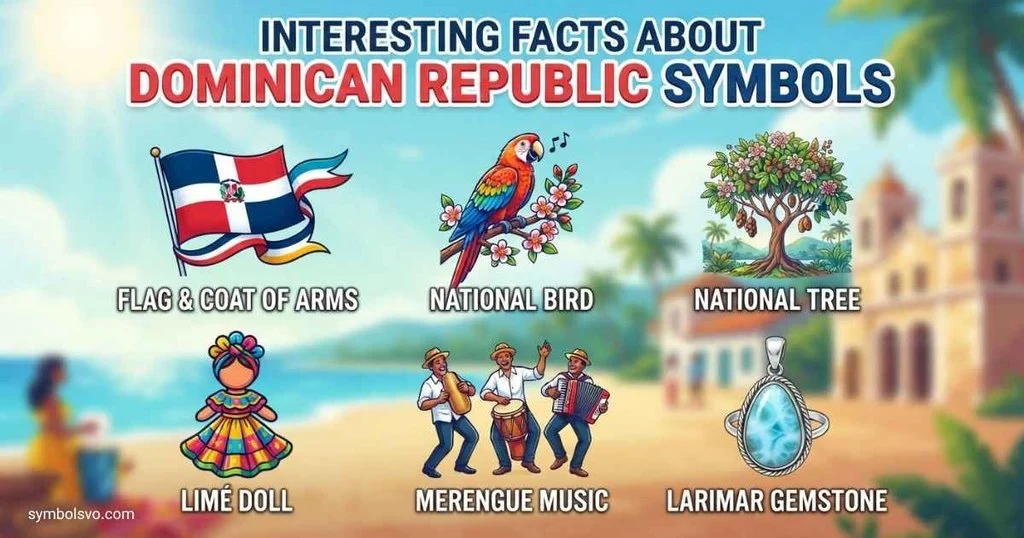
- The Dominican coat of arms has been altered and redesigned at least twenty-one times since its initial creation in 1844.
- The exact verse displayed on the open Bible in the shield is from John 8:32, written completely in Spanish: Y conoceréis la verdad, y la verdad os hará libres.
- The flag is constructed so that if it accidentally touches the ground during a public ceremony, it is historically considered a major dishonor to the nation.
- The Cigua Palmera bird builds such structurally advanced, multi-room nests that other bird species regularly move into the extra rooms for safety.
- The Bayahibe Rose cactus grows actual, fully formed leaves, making it an extreme botanical rarity among the world’s cactus families.
- The laurel branch on the left of the national shield represents immortality, while the palm branch on the right stands explicitly for liberty.
Frequently Asked Questions
Why does the Dominican Republic flag have a Bible on it?
The founding fathers of the nation were deeply religious men who formed their independence movement under the explicit guidance of Christian values. They placed the open Bible at the absolute center of the shield to symbolize that the country’s freedom, laws, and future would always rest upon divine truth and spiritual protection.
Who actually designed the primary Dominican Republic symbols?
The initial conceptual designs for the flag and coat of arms were created by Juan Pablo Duarte, the leader of the independence movement. The very first physical flag was subsequently hand-crafted and sewn by patriot women, including Concepcion Bona and Maria Trinidad Sanchez.
What do the exact colors of the flag represent?
According to the official national constitution, the ultramarine blue represents the open sky and God’s protective care over the nation. The vermilion red signifies the brave blood shed by patriotic heroes in the fight for freedom, and the white cross symbolizes peace, salvation, and the ultimate unity of the people.
When did the Bayahibe Rose become an official symbol?
The Bayahibe Rose was officially adopted as the national flower of the Dominican Republic on July 12, 2011, through a special environmental law. It replaced the mahogany flower to draw global attention to this critically endangered, native cactus flower.
Conclusion
Dominican Republic symbols are far more than mere graphic designs; they are the living, breathing artwork of a nation’s soul. By beautifully combining natural wonders like the resilient Bayahibe Rose with profound spiritual icons like the open Bible, these emblems continue to inspire a deep sense of global family, community strength, and joyful pride. They serve as a timeless visual anchor, reminding the world that no matter how intense the tropical storms of life may get, the human spirit can always bend, survive, and bloom with spectacular beauty.

 Grace Whitmore
 Daniel Brooks