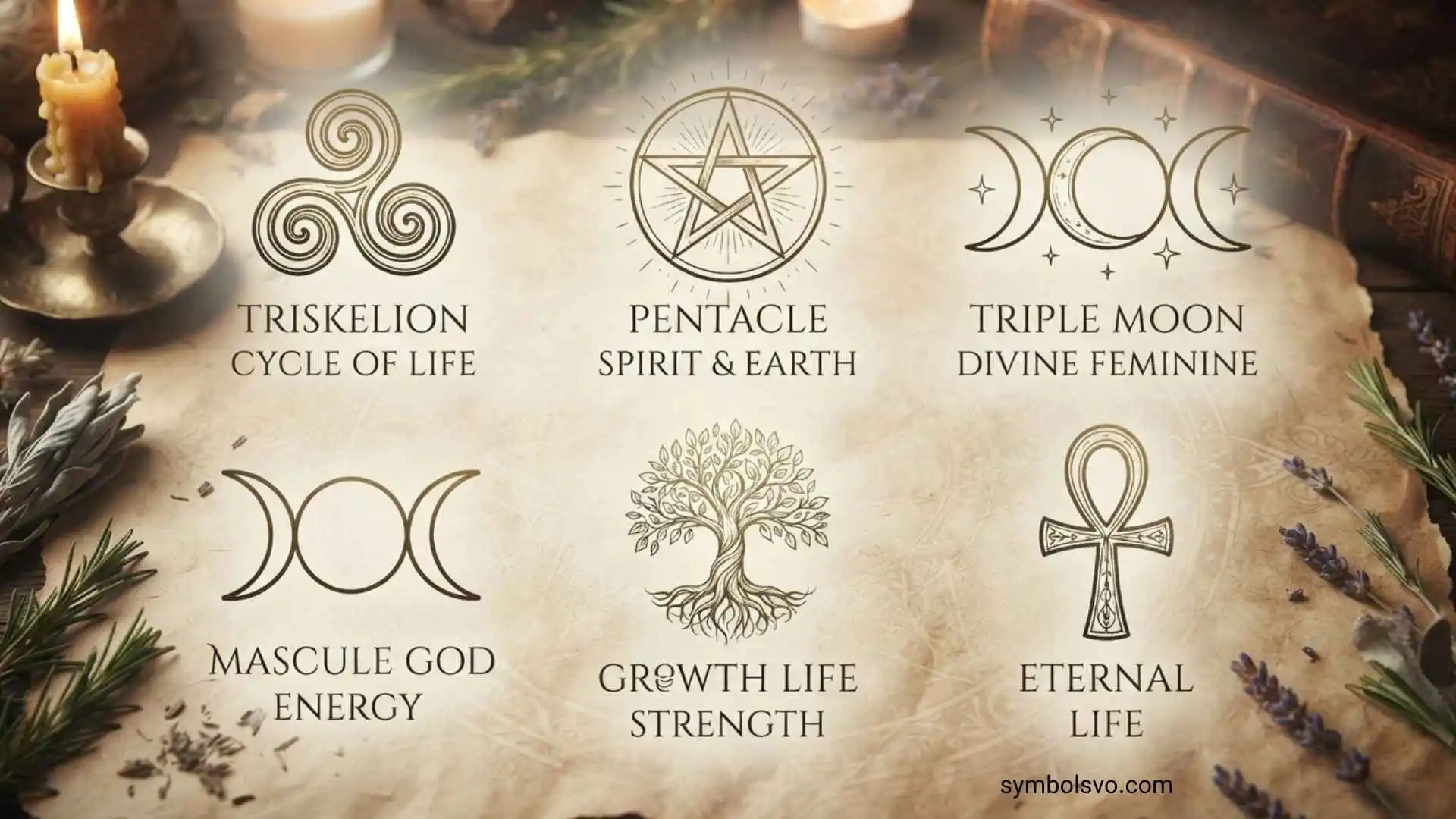
Witch Symbols and Meanings can reveal a fascinating world of history, folklore, spirituality, and cultural traditions. I find these symbols especially interesting because a simple shape, animal, plant, or mark can carry layers of meaning. You may recognize some of them without knowing what they originally represented.
As you explore these symbols, you’ll discover that their meanings are not always as simple as modern media suggests. I’ll help you look at their historical and cultural backgrounds in a clear, easy-to-understand way. You can learn what common witch symbols represent and why they have remained meaningful across different traditions.
From the pentagram and moon symbols to herbs, animals, and protective signs, each symbol has a story worth exploring. I’ll break down the most important examples so you can understand their meanings without confusion. By the end, you’ll have a practical starting point for exploring witch symbols and their rich history.
Quick Answer
Witch symbols and meanings represent a collection of sacred geometric shapes, celestial emblems, and natural marks used across traditions like Wicca and paganism to channel energy, honor deities, and protect practitioners. Rooted in ancient history, these symbols serve as visual tools that connect human consciousness directly to cosmic forces and natural elements.
Quick Facts About Witch Symbols and Meanings
| Aspect | Information |
| Origin | Pre-Christian European cultures, ancient Egyptian mysteries, and medieval occult alchemy. |
| Historical Significance | Reclaimed from historic persecutions to become global emblems of feminist empowerment and spiritual autonomy. |
| Main Meaning | A visual shorthand representing the direct connection between humanity, the elements, and the universe. |
| Spiritual Meaning | Act as modern energetic focal points for setting intent, manifestation, and personal awakening. |
| Cultural Importance | Inspires contemporary fashion trends, fantasy literature, digital media, and modern alternative lifestyles. |
| Modern Usage | Worn as personal jewelry, used in ritual altars, featured in body tattoos, and used as digital profile icons. |
What Are Witch Symbols?
Witch symbols and meanings refer to the distinct visual shapes, geometric glyphs, and natural emblems used by practitioners of magic, paganism, and Wicca to represent spiritual truths. The word witch itself is connected to the Old English word wicca, which roughly translates to a wise person or a shaper of energies. In ancient communities, these symbols were not seen as evil, but rather as essential blueprints of the natural world.
Over thousands of years, these markings evolved from simple cave drawings and prehistoric fertility carvings into highly structured alchemical codes during the Renaissance. For a long time, particularly during the European witch trials, practicing with these symbols carried extreme danger. Practitioners had to hide their meanings inside everyday household crafts, folk art, and hidden sigils.
When the modern pagan revival and Wiccan movement blossomed in the mid-twentieth century, these shapes came out of the shadows. Today, they have evolved from secret protectors into open, global statements of personal independence, respect for the Earth, and spiritual freedom.
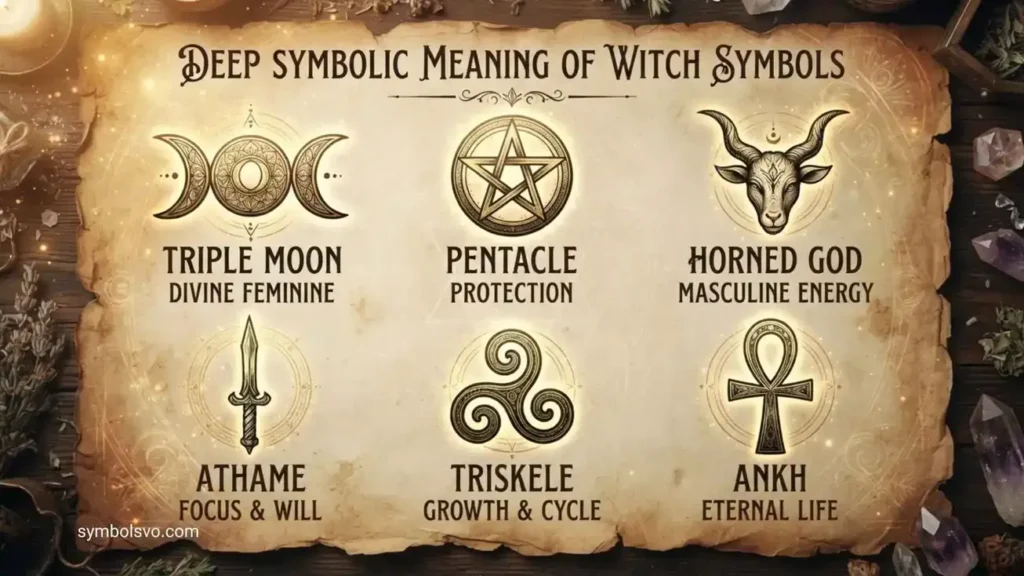
Deep Symbolic Meaning of Witch Symbols
Spiritual Level
On a deep spiritual level, these symbols serve as focal points for inner transformation. They are not merely pictures, but energetic maps meant to awaken the human soul. By meditating on a specific symbol, a practitioner attempts to align their individual consciousness with the broader, intelligent energies of the universe, using the image as a key to unlock hidden spiritual insights.
Psychological Level
Psychologically, these images tap directly into what Carl Jung called the collective unconscious. They carry timeless human archetypes that bypass our everyday logical thinking.
- The Mother: Represents nurturing, growth, and the creation of life.
- The Crone: Symbolizes deep inner wisdom, endings, and ancient knowledge.
- The Circle: Expresses ultimate wholeness, safety, and the continuous loop of time.
These shapes create a deep emotional attraction because they speak directly to our natural human desire to find patterns, comfort, and meaning within a chaotic world.
Cultural Level
From a cultural standpoint, these visual markers hold immense social significance. They unite global alternative communities under a shared belief system centered on protecting the Earth and honoring the feminine divine. Displaying these symbols allows individuals to silently communicate their worldview, building an immediate sense of safety and community with like-minded people.
Types and Variations of Witch Symbols
1. The Pentacle
- Name: The Pentacle or Pentagram.
- Visual Description: A five-pointed star pointing upward, usually enclosed inside a perfect circle.
- Meaning: Harmony, spiritual protection, and the perfect balance of nature.
- Symbolism: The four lower points represent the physical elements of Earth, Air, Fire, and Water, while the top point signifies Spirit ruling over physical matter.
- Cultural Connection: Linked to ancient Pythagorean geometry, early Christian mysticism, and modern Wicca.
- Where It Appears: Used on ritual altar pentacles, protective silver jewelry, and classic fantasy illustrations.
2. The Triple Moon
- Name: The Triple Moon or Triple Goddess.
- Visual Description: A central full moon flanked by a waxing crescent on the left and a waning crescent on the right.
- Meaning: The continuous cycles of life, death, rebirth, and feminine power.
- Symbolism: Represents the three distinct phases of the Goddess: the Maiden (youth and new beginnings), the Mother (fertility and growth), and the Crone (wisdom and endings).
- Cultural Connection: Rooted in ancient lunar mythologies and modern Goddess spirituality.
- Where It Appears: Displayed on ritual headpieces, sacred tapestries, and pagan temple altars.
3. The Triquetra
- Name: The Triquetra or Celtic Trinity Knot.
- Visual Description: A continuous, three-pointed loop woven tightly with an unbroken line, often featuring a circle through its center.
- Meaning: Eternity, unity, and the interconnected nature of existence.
- Symbolism: Illustrates the three domains of the world (Earth, Sea, and Sky) or the stages of human life (Mind, Body, and Spirit).
- Cultural Connection: Found heavily throughout historic Celtic art, Germanic runestones, and Christian manuscripts.
- Where It Appears: Carved into ancient stone monuments, modern wedding rings, and pop culture fantasy designs.
4. The Witch’s Knot
- Name: The Witch’s Knot or Magic Knot.
- Visual Description: Four interlaced loops forming a symmetrical knot, intersecting with a central circle.
- Meaning: Binding magic, intense protection, and a shield against negative energy.
- Symbolism: The four loops point to the four cardinal directions, creating a secure energetic boundary that keeps harm away.
- Cultural Connection: Popular in medieval European folk magic as a protective charm against malevolent spells.
- Where It Appears: Engraved on historical protective amulets, doorstep carvings, and modern silver talismans.
Witch Symbols for Protection
Protection is one of the most common themes associated with modern witchcraft and folk-magic traditions. However, there is no single universal “witch protection symbol.” Different traditions use different signs, objects, and motifs according to their beliefs and historical background.
The pentagram, especially when enclosed in a circle as a pentacle, is frequently associated with protection in modern Wicca and other contemporary Pagan practices. Other protective imagery can include the triple moon, protective knots, circles, herbs, crystals, and symbols borrowed from particular cultural traditions.
The meaning of a symbol depends heavily on the tradition using it. A symbol used for protection in one spiritual practice may have a completely different meaning somewhere else.
What Are Witch Symbols Called?
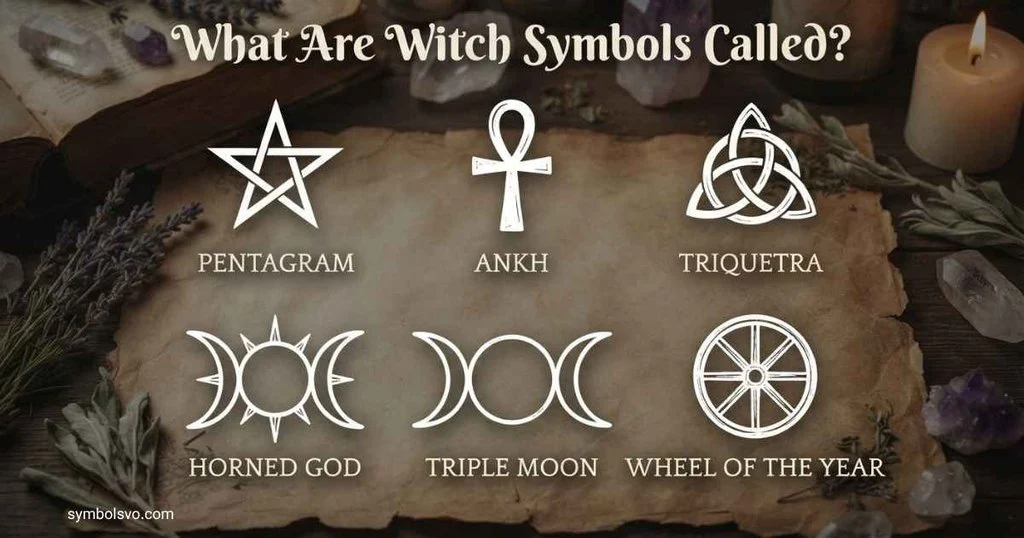
Witch symbols can be described using several different terms, depending on their origin and purpose. Common terms include witchcraft symbols, magical symbols, occult symbols, Pagan symbols, Wiccan symbols, sigils, magical signs, and protective symbols.
Not every symbol associated with witches is historically a “witch symbol.” Some are modern designs, while others come from older religious, magical, astronomical, or folk traditions.
For example, a sigil generally refers to a specially designed symbol used within a magical or ritual context. A pentacle has a more specific relationship to a five-pointed star enclosed within a circle, particularly in modern Pagan and Wiccan contexts.
Evil Witch Symbols
The idea of an “evil witch symbol” largely comes from folklore, popular culture, and modern entertainment rather than one standardized historical system of symbols. Stories about witches have often connected them with darkness, curses, mysterious markings, black cats, cauldrons, skulls, or inverted imagery.
It is important to distinguish these fictional associations from historical evidence. Witchcraft accusations in Europe and elsewhere were shaped by religious, social, and political circumstances, and many people accused of witchcraft did not actually practice the magical traditions later associated with them.
Today, dark witch imagery is often used creatively in art, tattoos, fashion, fantasy, and Halloween designs.
Witch Symbols for Money
Modern witchcraft and folk-magic practices sometimes use symbols to represent wealth, prosperity, abundance, and financial opportunity. There is no universally recognized witch symbol that guarantees money or material success.
Common modern associations include coins, green candles, herbs, the pentacle, abundance imagery, and planetary or lunar symbols. Some practitioners also create personal sigils representing financial goals or prosperity.
These symbols are best understood as spiritual or symbolic representations of intention rather than scientifically proven methods for producing wealth.
Pagan Symbols and Meanings
Paganism is a broad category that includes many different religious and spiritual traditions, so Pagan symbols do not have one universal meaning. Some symbols are connected with nature, seasonal cycles, deities, elements, fertility, protection, or spiritual transformation.
The pentacle, triquetra, triple moon, spiral, sun wheel, and various representations of the elements are commonly encountered in contemporary Pagan communities. Their meanings can vary between groups and individual practitioners.
When discussing Pagan symbols, it is useful to identify the specific tradition instead of treating all Pagan beliefs as one system.
Green Witch Symbols
“Green witch” generally refers to a modern form of witchcraft that places strong emphasis on nature, plants, herbs, gardening, and the natural world. Green witch symbolism therefore often includes leaves, trees, flowers, herbs, seeds, mushrooms, moons, and other natural imagery.
The green color itself can represent nature, growth, renewal, and abundance in modern symbolic systems. However, there is no official collection of symbols that every green witch must use.
Green witch aesthetics are particularly common in contemporary spiritual communities, where natural objects and plant imagery are often incorporated into personal rituals and practices.
Witch Symbol Tattoos and Meanings
Witch-inspired tattoos can represent many different ideas, including personal spirituality, independence, protection, nature, transformation, mystery, femininity, or connection with a particular Pagan tradition.
Popular designs include pentacles, moons, stars, herbs, crystals, snakes, ravens, cats, celestial imagery, and personalized sigils. A tattoo’s meaning ultimately depends on the person wearing it.
Before choosing a culturally specific symbol, it is worth researching its historical and religious background. A symbol may have meanings beyond the aesthetic interpretation commonly found online.
Wiccan Symbols Images
Images of Wiccan symbols commonly feature the pentacle, triple moon, triquetra, elemental symbols, sun and moon imagery, and other designs connected with contemporary Wiccan practice.
The pentacle is particularly recognizable in modern Wicca, where the five points can be interpreted in relation to the four classical elements and spirit. Interpretations vary, however, and not every five-pointed star has a specifically Wiccan meaning.
The triple moon symbol is also widely associated with modern Goddess-centered spirituality and is often interpreted through the phases of the Moon.
Grey Witch Symbols and Meanings
“Grey witch” is a modern term rather than the name of one universally defined historical religious tradition. It is commonly used to describe someone who views magical practice as existing somewhere between concepts traditionally described as “white” and “black” magic.
Symbols associated with grey witch aesthetics may include moons, pentacles, ravens, keys, candles, herbs, crystals, and balanced imagery. Some people use these symbols to represent balance, personal power, wisdom, or the idea of working with both positive and challenging aspects of life.
Because “grey witch” has no universally standardized symbol set, meanings can differ considerably between practitioners.
Good Witch Symbols and Meanings
“Good witch” is primarily a descriptive phrase rather than a formal religious category. In popular culture, a good witch is often portrayed as someone who uses magic for healing, protection, guidance, kindness, or helping others.
Symbols connected with this idea may include hearts, flowers, stars, protective circles, herbs, moons, white or light-colored imagery, and pentacles. These associations are largely modern and should not be confused with a universal historical classification of witches.
The concept of a “good witch” also reflects the common cultural division between benevolent and harmful magic.
White Witch Symbols and Meanings
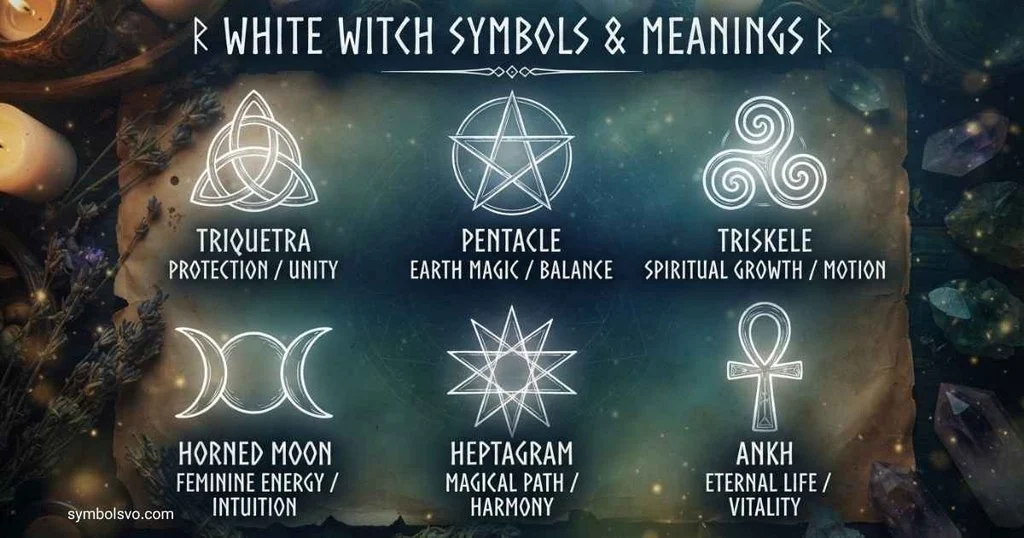
The phrase white witch is traditionally used in some modern and historical discussions to describe someone associated with benevolent or beneficial forms of magic. Depending on the source, this may include healing, protection, blessings, herbal knowledge, or helping the community.
There is no universally accepted “white witch symbol.” Modern representations may include white candles, pentacles, moons, flowers, protective circles, herbs, and angelic or nature-inspired imagery.
The meaning of “white magic” has also changed across historical periods and cultures, so it should not be treated as a single worldwide tradition.
Signs and Symbols of Witchcraft
Witchcraft has never had one universal symbol system. Signs associated with witchcraft can come from folk traditions, ceremonial magic, modern Pagan religions, occult literature, personal sigils, and contemporary popular culture.
Frequently encountered symbols include the pentagram or pentacle, crescent moon, triple moon, triquetra, spirals, elemental signs, magical circles, runes, herbs, and planetary symbols.
Some of these symbols are much older than modern witchcraft itself. Their presence in a historical object does not automatically prove that the object belonged to a witch or was used for witchcraft.
Witchcraft Symbols
Witchcraft symbols are visual signs used to express ideas such as protection, nature, transformation, spirituality, personal intention, the elements, or connection with particular deities and traditions.
The pentacle is one of the most recognizable symbols in contemporary witchcraft. Other common imagery includes the Moon, stars, herbs, animals, candles, cauldrons, crystals, and personalized sigils.
Because witchcraft encompasses many different practices, the meaning of a symbol should always be considered in context rather than assumed from its appearance alone.
Ancient Witchcraft Symbols
Ancient magical traditions used many signs, inscriptions, amulets, and religious symbols, but calling all of them “ancient witchcraft symbols” can be historically misleading. Many symbols originated in religious traditions, astrology, protective magic, medicine, or ceremonial practices rather than a distinct category called witchcraft.
Ancient and medieval sources contain examples of magical signs, planetary symbols, protective inscriptions, amulets, and geometric figures. Their meanings depended on the culture and historical period in which they appeared.
For this reason, a responsible discussion of ancient witchcraft symbols should identify the civilization or tradition connected with each symbol instead of suggesting that one ancient worldwide witchcraft system existed.
Wiccan Symbols and Meanings
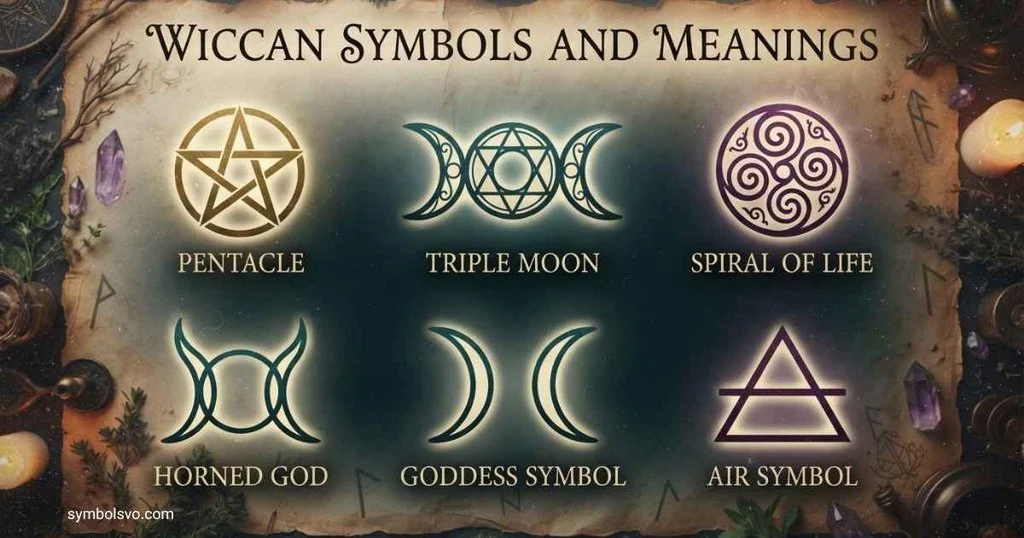
Wicca is a modern Pagan religion that developed in the 20th century, and several symbols are now strongly associated with Wiccan practice.
The pentacle is among the best-known. Its five points are commonly connected with the four classical elements—earth, air, fire, and water—and spirit. The triple moon is associated in many modern Pagan contexts with the waxing, full, and waning phases of the Moon and with Goddess symbolism.
Other symbols used by Wiccans may include elemental signs, the athame, ritual circles, the sun, Moon, and seasonal imagery. Practices and interpretations vary between Wiccan traditions and individuals.
Witch Stick Symbols
The phrase “witch stick symbols” can refer to several different things, so it does not describe one universally recognized category of symbols. In folklore and modern witchcraft aesthetics, sticks, staffs, wands, or decorated branches may represent nature, ritual practice, magical tools, or personal symbolism.
A wand is particularly familiar from modern magical traditions and fantasy, although its historical uses and meanings differ across sources. Decorative sticks marked with symbols may also be modern creations rather than surviving examples of an ancient witchcraft system.
If a specific “witch stick symbol” appears in an image or historical object, its meaning should be identified from the source and cultural context.
Witchy Symbols and Meanings
“Witchy symbols” is a broad modern term commonly used for designs associated with witchcraft aesthetics, spirituality, mystery, and nature. Popular examples include moons, stars, pentacles, crystals, herbs, black cats, ravens, snakes, mushrooms, candles, keys, and celestial designs.
Some have historical or religious meanings, while others became popular through books, films, fashion, tattoos, and social media.
For example, the Moon can symbolize cycles and change, while herbs may represent nature and traditional plant knowledge. A black cat is strongly associated with witch folklore in popular culture, although cats have much broader historical symbolism.
What Do Witches Symbolize?
Witches have different meanings across cultures, historical periods, religions, literature, and modern spiritual movements. In folklore, the witch has often represented mystery, forbidden knowledge, supernatural power, fear, healing, or social nonconformity.
In modern witchcraft and Pagan communities, the word can instead represent personal spirituality, connection with nature, ritual practice, self-discovery, independence, and personal empowerment.
The historical figure of the witch is especially complex because many people accused of witchcraft were victims of social and religious persecution rather than practitioners of the magical traditions later imagined in popular culture.
Today, the witch can therefore symbolize very different things depending on context—from a folklore character to a modern spiritual practitioner or a fictional character.
Witch Symbols Across Different Cultures
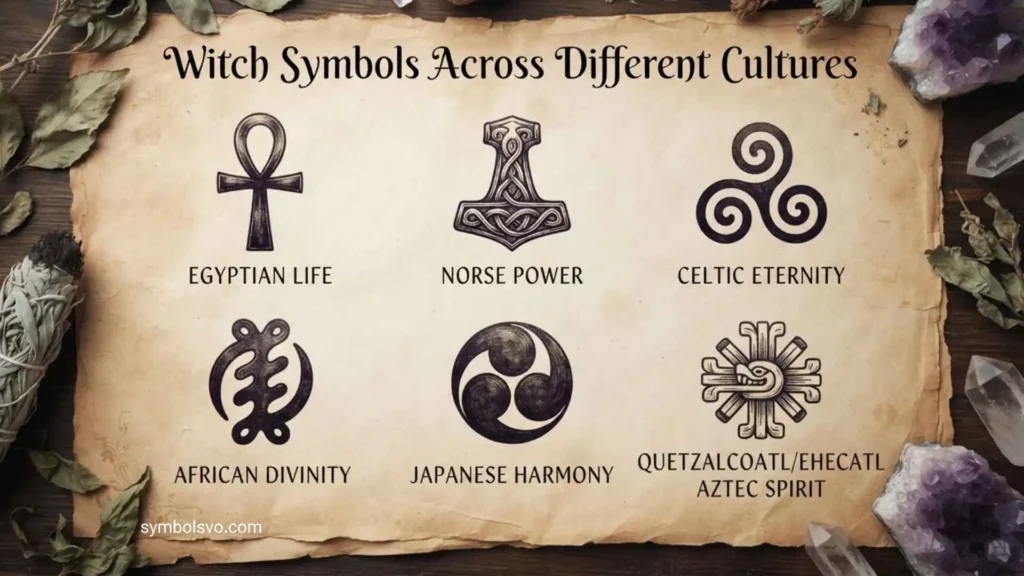
Ancient Egypt
Egyptian culture deeply influenced modern magical symbols. The Ankh, representing the breath of eternal life, and the Eye of Horus, a potent symbol of royal protection and sight beyond the physical world, were adopted by later esoteric traditions as foundational symbols of power, wisdom, and energetic healing.
Ancient Greece
Greek mysticism provided the world with the Wheel of Hecate, an intricate circular labyrinth design. Hecate was the ancient goddess of the crossroads, magic, and the night. Her swirling symbol represents the labyrinth of life and the divine spark hidden within all human thoughts.
Roman Culture
The Romans interacted closely with the nature-based traditions of the lands they conquered. They documented the use of crescent moon charms worn by local women to honor Diana, the goddess of the wild woods and hunting. This deep lunar connection directly shaped modern goddess symbols.
Eastern Traditions
In Eastern philosophies, the continuous flow of cosmic energy is mirrored in symbols like the Yin and Yang or the sacred Sri Yantra. These geometric shapes represent the delicate balance between masculine and feminine energies, heavily influencing how western occultists view elemental balance.
Indigenous Traditions
Indigenous cultures across North America and Siberia utilize medicine wheels, spiral petroglyphs, and animal totems. These sacred symbols ground the human experience to the seasonal shifts of the land, providing a deep blueprint for the eco-conscious focus of modern witchcraft.
Modern Interpretations
In our current era, these distinct cultural streams have blended into a diverse, global language. Today, anyone can use these symbols to celebrate personal growth, spiritual exploration, and a deep respect for the natural world.
Similar Symbols and Their Meanings
It helps to look at how witch symbols compare to other historical and sacred markings.
| Symbol | Primary Purpose | Main Visual Theme | Cultural Context |
| Witch Symbol | Connects personal intent to nature | Fluid lines, moons, and element stars | Nature-centric spirituality |
| Alchemical Glyph | Charts physical and mental materials | Triangles, planetary signs, and bars | Renaissance science & mysticism |
| Sacred Geometry | Maps the structure of the cosmos | Mathematical grids, cubes, and shapes | Universal architecture |
A frequent misconception is that these categories are completely separate. In truth, they overlap. The primary difference is that witch symbols prioritize a personal, emotional connection to nature, whereas alchemy focuses on chemical transformations and sacred geometry emphasizes universal mathematical laws.
Witch Symbols in Mythology and Folklore
The stories we find in ancient folklore have directly shaped the modern interpretations of magical symbols. In old European fairy tales, a simple broomstick stood by the hearth as a domestic tool. However, in folk legend, it became the broomstick or besom, a powerful symbol used to ritually sweep away negative energy and cleanse a sacred space.
Similarly, the cauldron in Celtic myth was not just a cooking pot, but the magical vessel of the goddess Cerridwen. It symbolized deep inspiration, endless rebirth, and cosmic wisdom. These colorful old stories remind us that everyday objects can become sacred symbols when they are used to hold a higher spiritual focus.
Witch Symbols in Art, Literature, and Pop Culture
During the nineteenth century, Romantic and Symbolist painters frequently depicted mythical witches surrounded by glowing celestial geometry, changing the public image of magic from scary to beautiful.
[ Natural Phenomenon ] —> [ Folklore Story ] —> [ Pop Culture Icon ]
In modern pop culture, these symbols have entered mainstream television, movies, and alternative fashion. From the protective symbols featured in hit fantasy shows to minimalist moon designs on fashion runways, these marks have shifted away from taboo status. Today, they are celebrated as artistic expressions of inner strength, intuition, and individual mystery.
Spiritual and Dream Meaning of Witch Symbols
When witch symbols show up unexpectedly in your dreams or meditation sessions, your subconscious mind is using a deeply vivid metaphor. Because our dreaming minds communicate through images rather than words, seeing a pentacle or a crescent moon usually indicates a personal need for balance, protection, or self-reflection.
For instance, dreaming of a protective knot often suggests that you are trying to resolve an emotional tangle in your waking life, or that you need to set firmer personal boundaries. These encounters serve as helpful internal mirrors, encouraging you to trust your natural intuition and look for deeper answers within yourself.
Positive and Negative Meanings of Witch Symbols
One single shape can hold both light and shadow meanings depending entirely on how it is viewed and used.
| Positive Meaning | Negative Meaning |
| Represents a deep love and respect for nature. | Can cause fear due to historic misunderstandings. |
| Empowers personal intuition and inner strength. | Sometimes used superficially as a dark fashion trend. |
| Promotes community bonding and unity. | Can lead to social isolation from conservative views. |
| Focuses on protection and healing energies. | Misinterpreted by media as a sign of harm. |
Why Humans Are Attracted to Witch Symbols
Our natural attraction to these symbols is deeply woven into human psychology. The human mind is naturally designed to seek out patterns and comfort within the world around us.
When modern life begins to feel too fast, mechanical, or disconnected from the Earth, our subconscious craves a return to something grounded. These ancient symbols act as visual anchors. They satisfy a primal human need to feel connected to the passing seasons, the stars above, and an unbroken line of human history.
Modern Uses of Witch Symbols
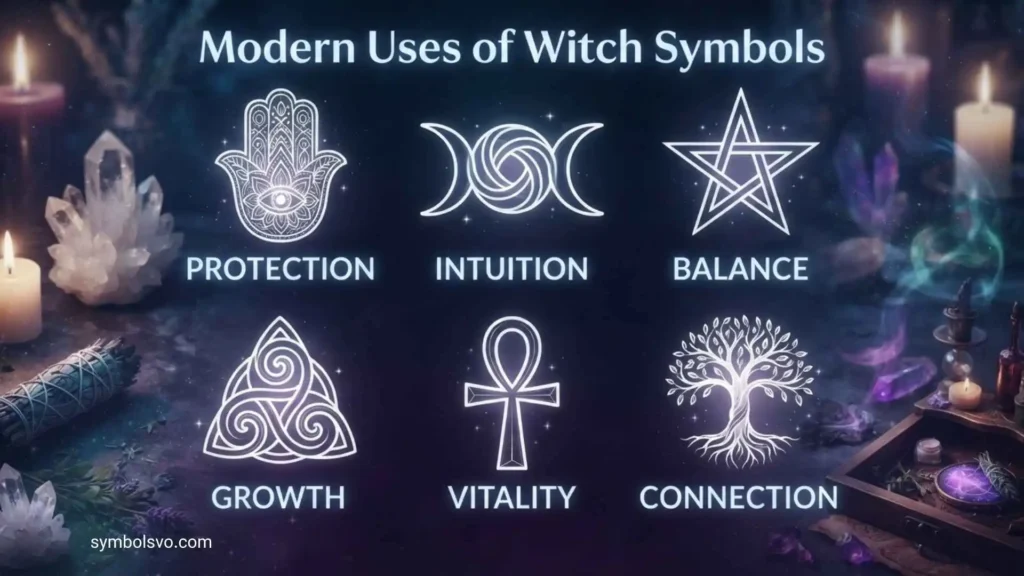
In our current world, these ancient designs are experiencing an incredible modern revival.
- Body Art: Worn as delicate line-work tattoos that symbolize a person’s inner journey.
- Fine Jewelry: Crafted into beautiful silver and crystal pendants worn for everyday protection.
- Home Decor: Featured on celestial blankets, patterned pillows, and modern altars to bring calm energy to a living space.
- Digital Spaces: Used as creative graphics, profile icons, and aesthetic stickers across social media platforms.
Interesting Facts About Witch Symbols
- The pentagram was used in ancient times as a official seal to protect Jerusalem from harm.
- Historically, the three lines of the Triquetra had to be drawn using one single, continuous line to ensure the protective magic remained unbroken.
- During the European Middle Ages, people carved unique protective marks called witch marks near chimneys to stop negative spirits from entering the home.
- Many classic symbols are based on the actual physical paths that planets like Venus trace across the night sky over several years.
- The word cauldron comes from a Latin word meaning hot water, evolving from a simple cooking tool into a symbol of spiritual rebirth.
Frequently Asked Questions
Is the pentacle a negative symbol?
No. In nature-based spiritual traditions, the upward-pointing pentacle is a purely positive symbol representing protection, harmony, and the spirit ruling in balance over the four physical elements.
What does the triple moon symbol mean?
The triple moon represents the three main phases of the moon and the three stages of a woman’s life: the Maiden, the Mother, and the Crone. It symbolizes continuous life cycles and feminine intuition.
How do people use the witch’s knot today?
Today, people wear the witch’s knot as a beautiful piece of protective jewelry, carve it into spiritual tools, or draw it to create a peaceful, safe environment at home.
Why are these symbols so popular in fashion?
They offer a unique blend of historical mystery, minimalist geometric design, and personal expression, allowing individuals to showcase their love for nature and alternative style.
Conclusion
Witch symbols and meanings offer us a beautiful, living bridge to our ancestral past and the natural world. They remind us that there is a quiet poetry to the changing seasons, the cycles of the moon, and the power of human intention. By learning to read this unique visual language, we gain a deeper appreciation for our history and a comforting sense of balance in our daily lives. Ultimately, these symbols show us that real magic begins when we choose to live in complete harmony with the universe around us.

I’m Daniel Brooks, a content creator and symbol enthusiast dedicated to researching the fascinating world of signs and symbols. I enjoy discovering the hidden meanings behind famous icons, emojis, historical emblems, and cultural symbols. Through my writing, I aim to provide trustworthy, well-researched, and reader-friendly information that helps people learn something new with every visit.
Books:
- The Complete Guide to World Symbols
- The Power of Universal Signs
 Mason Ellington
 Grace Whitmore