
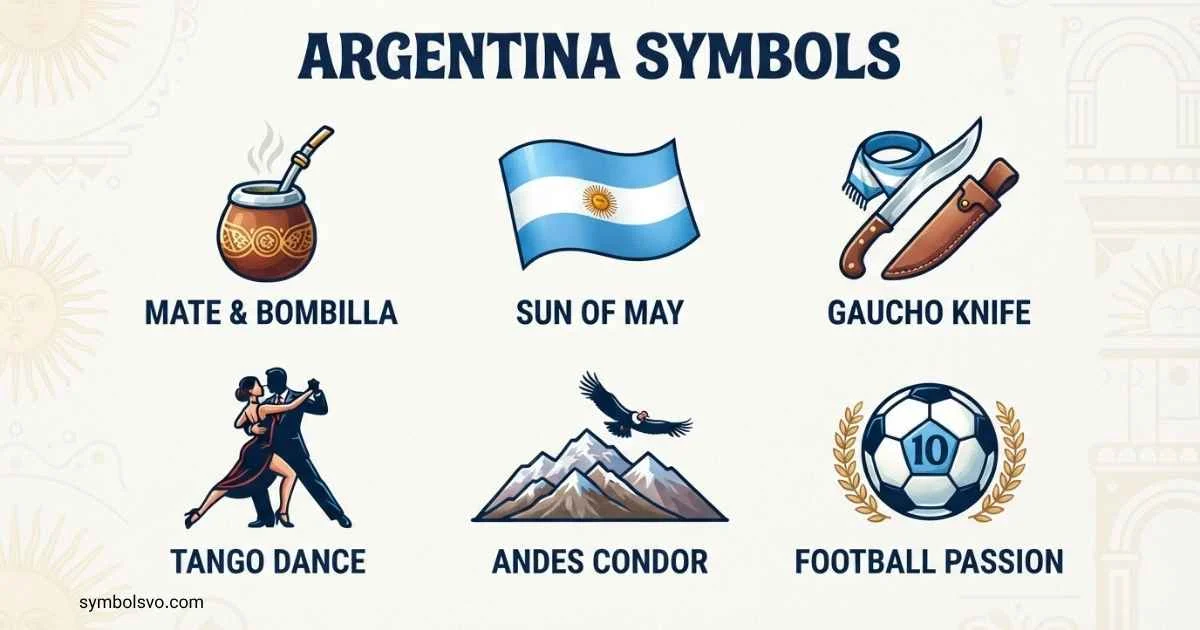
When I explore Argentina symbols, I discover more than flags and national emblems. You can find history, culture, nature, and national pride reflected in each important symbol.
I’ll help you understand what these symbols represent and why they matter to Argentina. You can explore everything from the national flag and coat of arms to meaningful animals, flowers, colors, and cultural icons.
Whether you’re a student, traveler, or simply curious, I’ve made this guide simple to follow. You’ll discover the most important Argentina symbols, their meanings, and the stories behind them.
Quick Answer
Argentina symbols are a collection of official emblems, natural icons, and cultural touchstones that represent the identity, values, and history of the Argentine Republic. Ranging from the celestial Sun of May and the official coat of arms to cultural expressions like Tango and Yerba Mate, these markers tell the ongoing story of national freedom, resilience, and unity.
Quick Facts About Argentina Symbols
| Aspect | Information |
| Origin | Rooted in the May Revolution of 1810, indigenous Incan folklore, and European immigration waves. |
| Historical Significance | Acted as rally icons for the revolutionary forces fighting for freedom from Spanish colonial rule. |
| Main Meaning | Universal representations of ultimate liberty, collective brotherhood, and an unyielding national pride. |
| Spiritual Meaning | Manifested through the protective, life-giving solar energy of the Sun of May and ancestral ties to the earth. |
| Cultural Importance | Defines daily local social rituals, passionate musical arts, and the iconic mythological identity of the open plains. |
| Modern Usage | Proudly displayed on global sports jerseys, political emblems, historic architecture, and local artisan crafts. |
What Are Argentina Symbols?
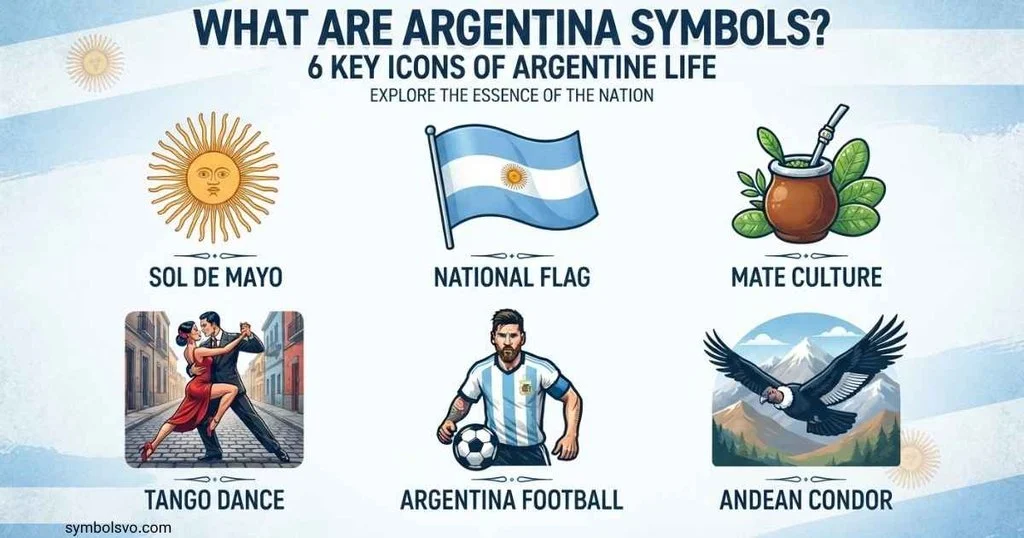
An Argentina symbol is an official emblem or cultural touchstone designed to express the core values and identity of the Argentine nation. These symbols began taking shape during the volatile birth of the republic in the early nineteenth century. When the citizens of Buenos Aires launched the May Revolution of 1810, they stepped out from the shadow of the Spanish crown and urgently required visual markers to unify their bold fight for autonomy.
As the years rolled on, these markers evolved dramatically. What started as basic military ribbons and war flags quickly grew into deep expressions of a unique lifestyle. The vast South American landscape played a massive role in this visual evolution. The untamed Pampas grasslands, the towering Andes mountains, and the unique native wildlife all contributed to the national visual catalog. Today, these emblems bridge the gap between a turbulent revolutionary past and a modern, vibrant society that celebrates passion in everything it does.
Deep Symbolic Meaning of Argentina Symbols
Spiritual Level
On a profound spiritual level, the foundational symbols of this land reflect a desire for inner transformation and national rebirth. The prominent celestial themes point to a connection with cosmic consciousness and higher ideals. Relying on these ancient solar elements allows the national spirit to draw strength from a source of eternal light and warmth, viewing the birth of the nation as a divine awakening of human consciousness.
Psychological Level
Psychologically, these cultural touchstones perfectly tap into universal human emotions and powerful inner archetypes.
- The Liberator: Evoked through the imagery of broken chains, celebrating the ultimate triumph over oppression.
- The Rebel Explorer: Captured beautifully by the free-spirited Gaucho, who represents our deep psychological craving for absolute independence and harmony with nature.
These icons hold an intense emotional attraction because they speak directly to the unconscious human desire for personal freedom and self-determination.
Cultural Level
When you look at the social landscape, these markers serve as the ultimate glue for community beliefs. They are not distant historical footnotes; instead, they are active parts of daily life. From the shared ritual of passing a warm cup of mate among close friends to the dramatic, melancholy embrace of a Tango dance, these symbols celebrate the supreme importance of human connection, deep passion, and mutual social support.
Types and Variations of Argentina Symbols
1. The Sun of May (Sol de Mayo)
- Visual Description: A golden radiant sun featuring a human face, surrounded by sixteen straight and sixteen wavy alternating rays.
- Meaning: Ultimate freedom, the dawn of a new dawn, and divine protection.
- Symbolism: Represents the ancient Incan sun god Inti, serving as a powerful bridge to indigenous roots while honoring the rainy day in May 1810 when the sun suddenly broke through the clouds during the push for freedom.
- Cultural Connection: It is the central crowning jewel of the national flag and military regalia.
- Where It Appears: The official flag, currency notes, historical monuments, and national military uniforms.
2. The Argentine Coat of Arms (Escudo Nacional)
- Visual Description: An oval shield featuring a red Phrygian cap on a vertical pike, held by two clasped human hands, all enclosed by a green laurel wreath.
- Meaning: Collective liberty, internal peace, and defensive glory.
- Symbolism: The clasped hands mean unbreakable brotherhood, the red cap represents absolute freedom, and the laurel wreath stands for glorious victory.
- Cultural Connection: Rooted in classic Roman design traditions that celebrate republican virtues and freedom from tyranny.
- Where It Appears: Official government documents, passports, public school seals, and historic federal buildings.
3. The National Cockade (Escarapela)
- Visual Description: A circular ribbon rosette showing concentric bands of bright sky blue and pure white.
- Meaning: Immediate revolutionary identity, national allegiance, and unity.
- Symbolism: The chosen colors mirror the clear sky and white clouds, first worn by freedom fighters to distinguish themselves from Spanish troops.
- Cultural Connection: Carries an immense emotional value as the very first physical mark of a distinct Argentine identity.
- Where It Appears: Pinned to lapels during national holidays, historical reenactments, and patriotic parades.
Argentina Symbols Across Different Cultures
Ancient Incan Empire
The golden sun symbol directly connects to the ancient Incan civilization, which worshipped Inti as the supreme, life-giving solar deity. When revolutionary leaders adopted this radiant face, they deliberately honored the deep, indigenous history of the South American continent, using an ancient sacred icon to validate their modern fight for regional sovereignty.
Ancient Greece
The green laurel wreath found on the national coat of arms traces its proud history straight back to ancient Greek athletic and military triumphs. In those ancient times, laurels crowned heroes and poets. Argentina adopted this classical emblem to show the world that its revolutionary victories were just, honorable, and worthy of historic remembrance.
Roman Culture
The striking red Phrygian cap held high on the coat of arms is a direct borrowing from ancient Roman traditions. In Rome, when a slave was granted their legal freedom, they were given this specific soft cap, known as a pileus. It became a universal symbol of liberty, signaling to all viewers that the young republic had permanently broken its colonial chains.
Eastern Traditions
When these vibrant South American icons travel to Eastern cultures today, they are heavily associated with extreme artistic passion and natural beauty. The symbols of Tango and elite polo horses are viewed in faraway lands as indicators of refined skill, emotional depth, and a high-status lifestyle that respects tradition.
Indigenous Traditions
Beyond the Incas, local indigenous groups like the Mapuche and Guaraní used specific native flora and fauna symbols to navigate their daily world. Their profound reverence for the Ceibo flower and the Ceibo tree influenced how the modern republic selected its natural national markers, ensuring the land’s original caretakers left an indelible stamp on the nation’s identity.
Modern Interpretations
In our interconnected global landscape, these historic icons have adapted to the fast-moving digital world. The famous blue and white stripes have become synonymous around the world with unmatched soccer excellence, genius sports figures, and an electric, festive stadium culture that captivates millions of international viewers.
Similar Symbols and Their Meanings
It is fascinating to see how the prominent design elements of Argentina compare to other famous global markers.
| Symbol | Core Meaning | Visual Focus | Historic Origin |
| Argentina Sun of May | Incan heritage and revolutionary freedom | Human face with alternating straight and wavy rays | May Revolution of 1810 |
| Uruguay Sun of May | Independence and shared regional roots | Human face with fewer, distinct solar rays | Shared revolutionary struggles |
| French Phrygian Cap | Liberty, republicanism, and citizen power | Worn by the allegorical figure Marianne | French Revolution of 1789 |
A common misconception is that the sky blue color on the flag was chosen to represent the sky. While that is a beautiful and popular local story, historic records reveal that the revolutionary leaders actually chose the colors of the royal house of Bourbon to show temporary loyalty while plotting their total independence from Spain. Over time, the meaning shifted beautifully to represent the clear, open sky of the homeland.
Argentina Symbols in Mythology and Folklore
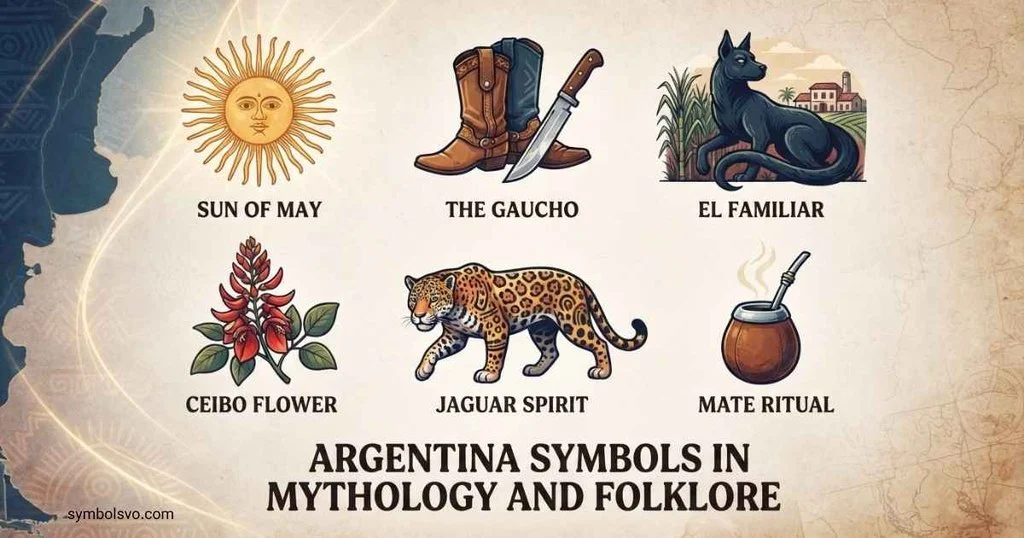
The natural world of Argentina is wrapped in beautiful folklore stories that explain how its beloved icons came to be. One of the most touching legends involves the national flower, the deep red Ceibo blossom.
According to ancient Guaraní folklore, a young indigenous woman named Anahí used to enchant her entire village with her sweet singing voice. When conquistadors invaded her lands, she fought bravely to protect her people but was eventually captured and condemned to die at the stake.
As the flames rose around her, instead of crying out in pain, Anahí began to sing a beautiful song about her beloved forests. The next morning, where the execution fire had burned, the soldiers did not find ashes. Instead, they discovered a lush tree covered in brilliant, velvety red blossoms. The Ceibo flower instantly became a lasting symbol of indigenous bravery, unyielding love for the homeland, and the ultimate triumph of beauty over cruelty.
Argentina Symbols in Art, Pop Culture, and Design
The iconic imagery of the nation has always found a comfortable home in creative arts and modern design. In the early twentieth century, the unique artistic style known as Fileteado took over Buenos Aires. This local design style uses swirling lines, vibrant colors, stylized flowers, and hidden patriotic symbols to transform ordinary objects into folk art.
[ Incan Sun God Inti ] —> [ 1810 May Revolution ] —> [ Modern Global Icon ]
In modern pop culture, these traditional markers have been completely revitalized by global sports. The famous vertical light blue and white stripes of the national soccer jersey are instantly recognized in every corner of the planet. When fans don this jersey or display tattoos of the Sun of May, the traditional icons transition out of dusty history museums. They become living, breathing emblems of a collective contemporary passion.
Spiritual and Dream Meaning of Argentina Symbols
When these highly specific cultural markers show up in your dreams or deep meditation sessions, they carry valuable psychological messages. Because the subconscious mind speaks to us using vivid metaphors, dreaming of these symbols rarely relates to geographical travel.
For instance, dreaming of the bright, smiling Sun of May can signal a personal period of warmth, clarity, and the successful end of a dark chapter in your life. Witnessing the dramatic, intense movements of a Tango dance in a dream often points to an internal struggle regarding personal relationships, balancing control, or discovering your own hidden creative passions. These dream occurrences act as gentle inner mirrors, urging you to explore where you need to break free and where you need to connect more deeply.
Positive and Negative Meanings of Argentina Symbols
Every powerful national symbol holds a natural balance of light and shadow, representing different historical chapters to different observers.
| Positive Meaning | Negative Meaning |
| Celebrates the ultimate victory of freedom over tyranny. | Can be used to fuel exclusionary nationalist movements. |
| Fosters a deep sense of social brotherhood and community. | Historically masked regional political divides. |
| Honors indigenous roots through the solar Inti imagery. | European-style imagery sometimes overshadowed local alternative. |
| Inspires global artistic expression and sporting pride. | Can reduce a complex culture to shallow stereotypes. |
Why Humans Are Attracted to Argentina Symbols
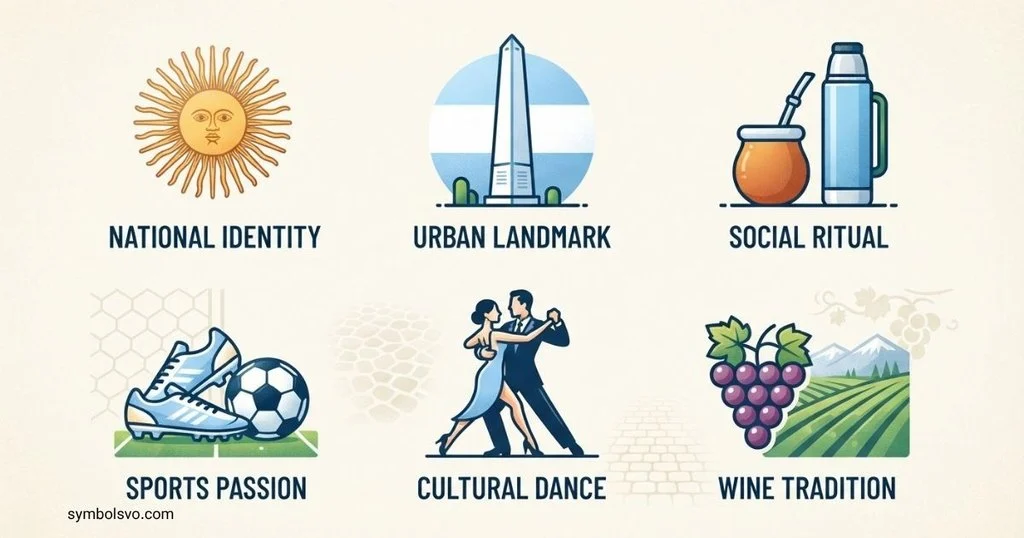
Our natural attraction to these vibrant markers is deeply rooted in human psychology and our love for pattern recognition. The human mind naturally craves stories of resilience, triumph, and intense emotional expression.
The symbols of this South American nation offer a captivating narrative that satisfies this craving. They don’t just celebrate cold bureaucratic rules; instead, they celebrate raw human experiences. Whether it is the ultimate freedom of the Gaucho riding through the endless grass or the shared warmth of holding a mate cup, these icons provide comfort, spark our imagination, and satisfy a timeless human need to belong to something deeply passionate and authentic.
Modern Uses of Argentina Symbols
In our fast-paced contemporary world, these traditional icons continue to find new and exciting expressions.
- Body Art & Tattoos: Worn by millions of locals and global admirers to show personal pride and artistic love.
- Contemporary Fashion: Traditional Gaucho hats and rustic leather accessories are regularly reimagined on global fashion runways.
- Social Platforms: The national flag emoji and sports icons serve as instant digital handshakes for global communities online.
- Interior Design: The fluid, colorful curves of Fileteado lettering are used to add vintage charm to modern cafes and home decor.
Interesting Facts About Argentina Symbols
- The iconic Sun of May featured on the flag is an exact replica of the engraved image found on the very first Argentine coin issued in 1813.
- The National Hornero, a small native bird chosen as a national symbol, is celebrated because it builds complex, sturdy mud nests that resemble traditional country ovens.
- The national sport of Argentina is actually Pato, a fast-paced game played on horseback, rather than soccer.
- The national stone is Rhodochrosite, a beautiful pink gemstone often called the Inca Rose because legends say it formed from the blood of ancient rulers.
- By federal law, the game of Truco, a traditional card game filled with bluffing and secret signals, is considered a living cultural symbol of the nation.
Frequently Asked Questions
Why does the Argentine sun have a human face?
The human face represents the Incan sun god Inti. Revolutionary designers chose this specific face to honor the deep, indigenous history of South America while signaling the bright dawn of their new independent nation.
What do the sky blue and white colors on the flag mean?
While they originally matched the colors of the Spanish House of Bourbon, they quickly evolved to symbolize the clear, open sky, the pure white clouds, and the snowy peaks of the majestic Andes mountains.
Why is the Gaucho considered a national symbol?
The Gaucho represents the ultimate spirit of freedom, bravery, and self-reliance. Their historic lifestyle on the open plains shaped the country’s early economy and created a lasting folk hero archetype.
What is the significance of the national flower?
The bright red Ceibo flower represents indigenous resilience and bravery, rooted in a classic folklore legend about a young native girl who transformed into a tree to protect her land.
Conclusion
Argentina symbols provide an enchanting window into a nation that lives, breathes, and creates from the absolute depths of the human heart. From the ancient solar legends of the Incas to the modern, electric energy of global sports stadiums, these emblems remind us of the universal human quest for freedom and authentic connection. By keeping these historic stories alive in their daily habits, the people of Argentina show us that a country’s truest icons are not found on pieces of paper, but in the shared passions that bring a community to life.

 Mason Ellington
 Daniel Brooks