
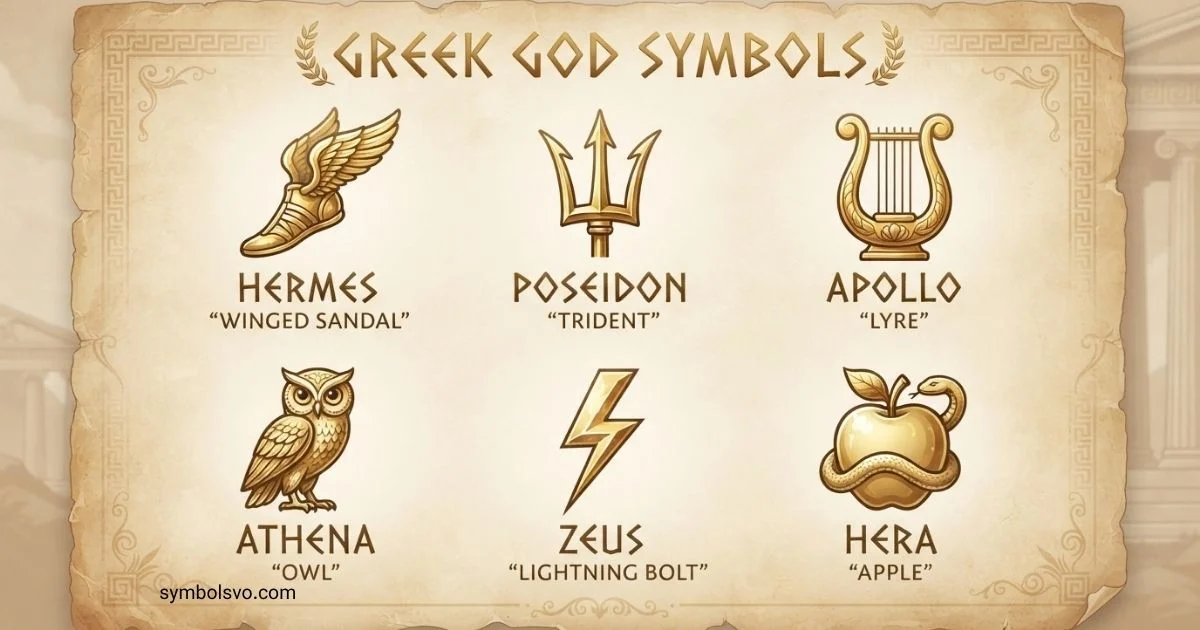
Greek god symbols are more than ancient images—they tell stories about power, wisdom, love, war, nature, and the mysteries of mythology. When I explore these symbols, I see how a simple animal, weapon, or object can reveal something important about the god behind it.
You may already know symbols like Zeus’s thunderbolt or Athena’s owl, but there is much more to discover. I’ll help you understand what these symbols mean and why they became closely connected with the Greek gods.
As you explore each symbol, you can connect the ancient stories with the meanings behind them. Whether you are a mythology beginner or simply curious, I want to make Greek god symbols easy, interesting, and enjoyable to understand.
Greek God Symbols And Meanings
Greek mythology contains many gods and goddesses, and each deity is associated with particular objects, animals, plants, weapons, or natural forces. These associations were not always fixed like a modern logo system. A god could have several symbols depending on the story, artwork, region, or period.
Here are some of the best-known associations:
| Greek deity | Common symbols | Main associations |
| Zeus | ⚡ Eagle, oak | Sky, thunder, kingship |
| Hera | Peacock, pomegranate | Marriage, queenship |
| Poseidon | 🔱 Horse, dolphin | Sea, earthquakes |
| Hades | ⚫ Helm of invisibility, cypress | Underworld, the dead |
| Athena | 🦉 Owl, olive tree | Wisdom, strategy, warfare |
| Apollo | ☀️ Lyre, laurel, bow | Music, prophecy, healing |
| Ares | ⚔️ Spear, shield | Violent warfare |
| Hermes | 🪽 Caduceus, winged sandals | Travel, messages, trade |
| Artemis | 🏹 Deer, bow | Hunting, wilderness |
| Demeter | 🌾 Wheat, torch | Agriculture, harvest |
| Dionysus | 🍇 Grapevine, thyrsus | Wine, theater, celebration |
| Hephaestus | 🔨 Hammer, anvil | Fire, metalworking |
| Aphrodite | 🕊️ Dove, rose, shell | Love, beauty |
| Eros | 🏹 Bow and arrows | Desire and love |
| Pan | 🐐 Goat, panpipes | Wild nature, shepherds |
| Hypnos | 💤 Poppy, wings | Sleep |
Some modern lists use emoji such as ⚡, 🔱, 🦉, 🏹, and 🔨 because they are easy to copy. These emoji are not ancient Greek writing symbols. They are modern Unicode characters used to represent familiar objects.
Ancient Greek God Symbols
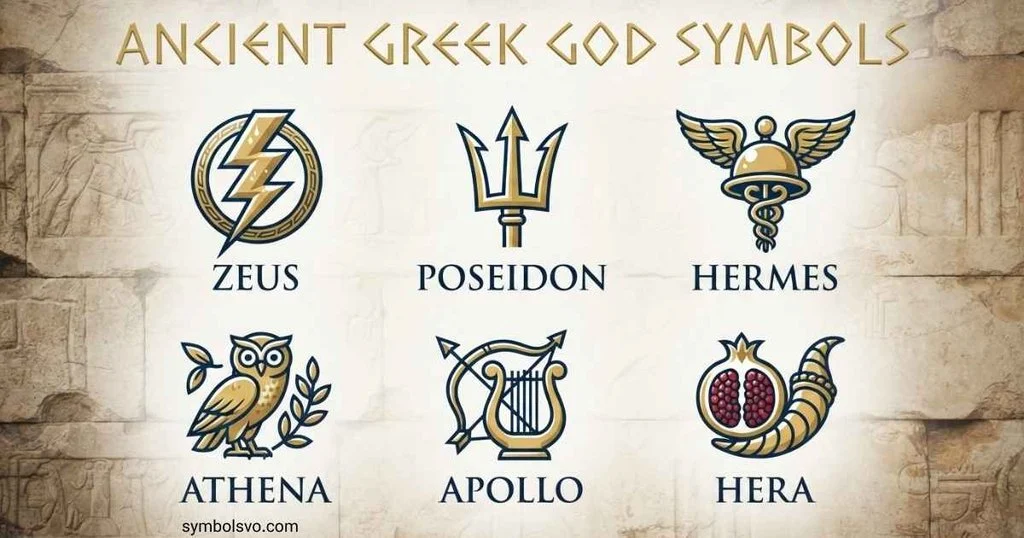
Ancient Greek religious art frequently used recognizable attributes to identify a deity. A statue of Athena, for example, could include an owl, helmet, shield, or aegis. Zeus might be shown holding a thunderbolt, while Poseidon is commonly depicted with a trident.
These associations came from mythology, religious practice, literature, sculpture, pottery, coins, and other forms of ancient art. They should not always be treated as one-to-one official emblems.
A few important examples include:
- Thunderbolt ⚡ — strongly associated with Zeus.
- Trident 🔱 — strongly associated with Poseidon.
- Owl 🦉 — closely associated with Athena.
- Lyre 🎵 — associated with Apollo.
- Bow 🏹 — associated with Apollo and Artemis.
- Hammer 🔨 — associated with Hephaestus.
- Grapevine 🍇 — associated with Dionysus.
- Wheat 🌾 — associated with Demeter.
- Peacock 🦚 — associated with Hera.
- Dove 🕊️ — associated with Aphrodite.
The modern emoji versions are useful for digital content, but they should not be confused with historical Greek symbols.
All Greek God Symbols
There is no single universally accepted list of “all” Greek god symbols because ancient Greek mythology developed over centuries and included many local traditions. Different sources may emphasize different attributes.
For a practical reference, these are some of the most recognizable deity-symbol pairings:
Zeus: ⚡ eagle, oak, thunderbolt
Hera: 🦚 peacock, pomegranate, cow
Poseidon: 🔱 trident, horse, dolphin
Hades: ⚫ helm of invisibility, cypress, Cerberus
Athena: 🦉 owl, olive tree, aegis
Apollo: 🎵 lyre, laurel, bow
Artemis: 🏹 bow, deer, cypress
Ares: ⚔️ spear, shield, helmet
Hermes: 🪽 winged sandals, caduceus, traveler’s hat
Demeter: 🌾 wheat, grain, torch
Dionysus: 🍇 grapevine, thyrsus, ivy
Hephaestus: 🔨 hammer, anvil, forge
Aphrodite: 🕊️ dove, rose, shell
Eros: 🏹 bow and arrows
Pan: 🐐 goat, panpipes
Hypnos: 💤 poppy, wings
Some attributes overlap. For example, the bow belongs to both Apollo and Artemis, while several gods have connections with animals or plants. Context matters when identifying a symbol.
Zeus Greek God Symbols
Zeus was the chief Olympian god and was associated with the sky, thunder, lightning, justice, authority, and kingship.
His most famous attribute is the thunderbolt ⚡. Ancient Greek art often depicts Zeus holding or throwing it.
Other important Zeus associations include:
- Eagle 🦅 — a prominent sacred animal of Zeus.
- Oak 🌳 — especially associated with Zeus at Dodona.
- Thunderbolt ⚡ — his most recognizable weapon and attribute.
- Aegis — a protective divine object associated with Zeus and also Athena.
- Bull 🐂 — appears in several myths and artistic traditions connected with Zeus.
For modern copy-and-paste use, ⚡ Zeus ⚡ is a simple decorative representation, but the lightning emoji itself is not an ancient Greek character.
Hera Greek God Symbols
Hera was the queen of the Olympian gods and was strongly associated with marriage, queenship, women, and family.
Her best-known animal is the peacock 🦚. Ancient artistic traditions also associate Hera with the cow 🐄 and the lion in some contexts.
Other associations include:
- Peacock 🦚 — one of her most recognizable attributes.
- Pomegranate — associated with fertility and marriage in later symbolic traditions.
- Crown — reflects her status as queen of the gods.
- Scepter — represents divine authority.
- Cow 🐄 — an ancient association of Hera.
A modern decorative combination can be written as 🦚👑 Hera.
Poseidon Greek God Symbols
Poseidon was the Greek god of the sea and was also associated with horses and earthquakes. His most famous attribute is the trident 🔱.
The trident is one of the easiest Greek deity symbols to identify because ancient art repeatedly depicts Poseidon carrying it.
His major associations include:
- Trident 🔱 — his signature weapon.
- Horse 🐎 — strongly connected with Poseidon in mythology.
- Dolphin 🐬 — linked with his maritime domain.
- Bull 🐂 — appears in myths involving Poseidon.
- Sea 🌊 — represents his primary divine domain.
For a simple copy-and-paste reference: 🔱 Poseidon 🌊.
Hades Greek God Symbols
Hades ruled the underworld and the realm of the dead in Greek mythology. He was not simply a Greek version of the modern concept of “death”; his role was specifically connected with the underworld and its inhabitants.
His important associations include:
- Helm of invisibility — a magical helmet that could make its wearer unseen.
- Cerberus 🐕 — the multi-headed guardian of the underworld.
- Cypress 🌲 — associated with death and mourning.
- Pomegranate — important to the story of Persephone.
- Bident — a two-pronged weapon sometimes associated with Hades.
- Darkness ⚫ — a modern visual association with the underworld.
There is no single official Unicode “Hades symbol.” Characters such as ⚫ or 🖤 can be used decoratively, but they are modern representations rather than ancient Hades glyphs.
Athena Greek God Symbols
Athena was associated with wisdom, strategic warfare, crafts, and civic protection. She was one of the most important Olympian deities.
Her most recognizable symbols include:
- Owl 🦉 — a major symbol of Athena and wisdom.
- Olive tree 🫒 — connected with the myth of Athena and the city of Athens.
- Aegis — a protective divine garment or object often depicted with a Gorgon head.
- Helmet 🪖 — reflects her warrior aspect.
- Spear — represents strategic warfare.
- Shield 🛡️ — another common martial attribute.
For digital use, 🦉🫒 Athena 🛡️ creates an easy visual reference.
Apollo Greek God Symbols
Apollo was associated with music, poetry, prophecy, healing, archery, and several other areas of Greek religious life. His symbols vary depending on the aspect being represented.
The lyre 🎵 is one of his most recognizable attributes. The laurel is also strongly associated with Apollo and the myth of Daphne.
Common Apollo associations include:
- Lyre 🎵 — music and poetry.
- Laurel 🌿 — strongly connected with Apollo.
- Bow 🏹 — his role as an archer.
- Raven 🐦⬛ — appears in myths associated with Apollo.
- Python — connected with Apollo’s sanctuary at Delphi.
- Sun ☀️ — a common modern association, although Apollo should not simply be equated with the sun god Helios in ancient Greek tradition.
Ares Greek God Symbols
Ares represented the violent and destructive side of warfare. His symbols reflect battle and military conflict.
Common Ares attributes include:
- Spear ⚔️ — a weapon of war.
- Shield 🛡️ — protection in battle.
- Helmet — a standard military attribute.
- Sword ⚔️ — a modern visual representation of warfare.
- Boar 🐗 — associated with Ares in ancient traditions.
- Vulture — sometimes connected with the aftermath of battle.
A simple modern combination is ⚔️🛡️ Ares.
Ares and Athena are both associated with warfare, but they represent different aspects. Ares is closely linked with the violence and chaos of battle, while Athena is more strongly associated with strategy and disciplined warfare.
Hermes Greek God Symbols
Hermes was the messenger of the gods and was associated with travel, communication, trade, boundaries, and several forms of movement.
His best-known attributes include the winged sandals and the caduceus.
Important Hermes symbols include:
- Winged sandals 🪽 — speed and travel.
- Caduceus ☤ — Hermes’ staff, traditionally shown with two snakes and wings.
- Petasos — a traveler’s hat associated with Hermes.
- Tortoise 🐢 — connected with the myth of Hermes and the invention of the lyre.
- Ram 🐏 — another animal associated with Hermes.
- Herald’s staff — represents his messenger role.
The caduceus ☤ is a Unicode character, but it should not be confused with the Rod of Asclepius, which is the traditional medical staff with one serpent. The two are often mixed up in modern usage.
Artemis Greek God Symbols
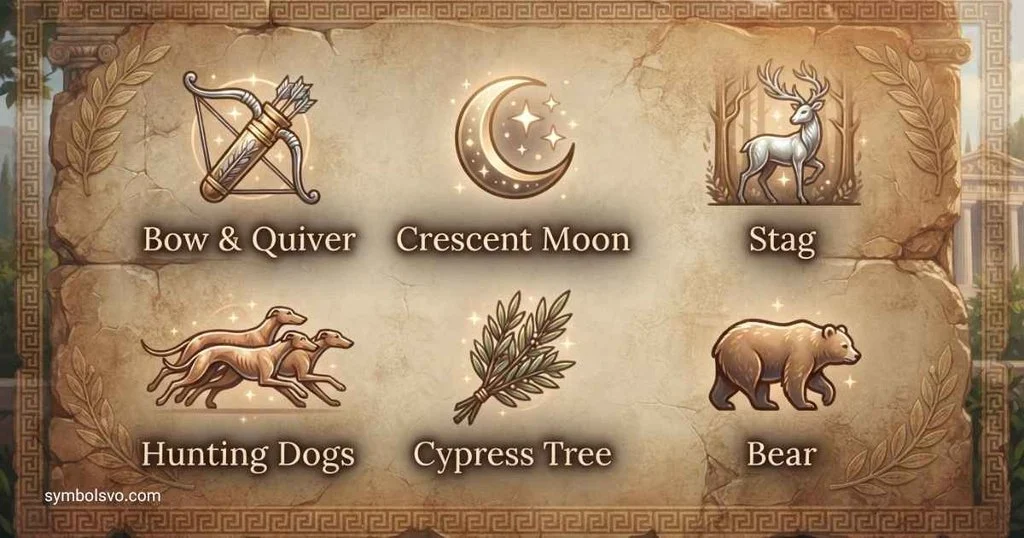
Artemis was associated with hunting, wild animals, wilderness, and the moon in later and some broader traditions. She was also the twin sister of Apollo.
Her main symbols include:
- Bow 🏹 — her most recognizable weapon.
- Deer 🦌 — strongly associated with her.
- Cypress 🌲 — connected with Artemis in ancient traditions.
- Hunting dogs 🐕 — associated with the hunt.
- Moon 🌙 — a common later association.
The crescent moon is useful for modern Artemis-themed designs, but the symbol ☾ is a general lunar symbol, not an ancient Unicode “Artemis symbol.”
Demeter Greek God Symbols
Demeter was the goddess of agriculture, grain, harvest, and fertility of the earth. Her mythology is closely connected with her daughter Persephone and the seasonal cycle.
Her main symbols include:
- Wheat 🌾 — one of her clearest associations.
- Grain — represents agriculture and food production.
- Torch 🔥 — appears in myths and religious traditions involving Demeter.
- Poppy 🌺 — associated with Demeter in ancient art and religious contexts.
- Cornucopia — a later artistic symbol connected with abundance and harvest.
For a simple digital design, 🌾🔥 Demeter captures two major associations.
Dionysus Greek God Symbols
Dionysus was associated with wine, vegetation, theater, ecstasy, ritual celebration, and transformation. His symbolism often appears through plants, animals, and objects used in his worship.
His most important symbols include:
- Grapevine 🍇 — wine and cultivation.
- Thyrsus — a staff wrapped with ivy and often topped with a pine cone.
- Ivy 🌿 — strongly associated with Dionysus.
- Drinking cup 🍷 — a modern visual shorthand for wine.
- Leopard 🐆 — appears frequently in Dionysian imagery.
- Theater masks 🎭 — a later and modern association with his connection to drama.
The emoji 🍇 is particularly useful when creating a Dionysus-inspired username, caption, or design.
Hephaestus Greek God Symbols
Hephaestus was the divine craftsman and smith of Greek mythology. He was associated with fire, metalworking, forging, craftsmanship, and technology.
His major symbols include:
- Hammer 🔨 — his most recognizable tool.
- Anvil — represents the blacksmith’s craft.
- Tongs — another smithing tool.
- Fire 🔥 — connected with the forge.
- Volcano 🌋 — a strong modern association with divine smithing.
Unlike several Olympians, Hephaestus is often represented through practical tools rather than an animal. 🔨🔥 Hephaestus is an easy modern text representation.
Aphrodite Greek God Symbols
Aphrodite was the goddess of love, beauty, and desire. Her mythology includes several recurring plants, animals, and objects.
Common Aphrodite symbols include:
- Dove 🕊️ — associated with love and Aphrodite.
- Rose 🌹 — a strong modern association with romantic love and beauty.
- Myrtle 🌿 — connected with Aphrodite in ancient tradition.
- Swan 🦢 — appears in artistic associations.
- Sea shell 🐚 — strongly connected with the famous artistic image of Aphrodite’s birth.
- Girdle — a magical object associated with her beauty and attraction.
A popular modern combination is 🕊️🌹🐚 Aphrodite.
Eros Greek God Symbols
Eros was the Greek god of sexual love and desire. In later artistic traditions, especially during the Hellenistic and Roman periods, he became increasingly represented as a youthful or childlike winged figure.
His most recognizable attributes are:
- Bow 🏹
- Arrows
- Wings 🪽
- Torch 🔥
- Rose 🌹 in later romantic imagery
The familiar image of a winged Cupid shooting arrows comes from the Roman tradition of Cupid, which developed from the Greek figure Eros.
Pan Greek God Symbols
Pan was a rustic god associated with shepherds, flocks, wild places, mountains, and pastoral music. He is commonly portrayed with goat-like features.
His main symbols include:
- Goat 🐐 — reflects his physical appearance and pastoral associations.
- Panpipes 🎵 — his most famous musical attribute.
- Pine tree 🌲 — appears in stories and imagery connected with Pan.
- Shepherd’s crook — reflects his pastoral setting.
- Mountains — represent his wild natural domain.
The panpipes are especially useful for identifying Pan because the instrument is directly linked with his mythology.
Hypnos Greek God Symbols
Hypnos was the personification and god of sleep. He was the brother of Thanatos, the personification of death, and the son of Nyx in Greek mythology.
His symbolism often centers on sleep and peaceful rest:
- Poppy 🌺 — connected with sleep and dreams.
- Wings 🪽 — used in artistic representations of Hypnos.
- Sleep mask 😴 — a modern visual shorthand.
- Night 🌙 — reflects his connection with darkness and sleep.
- Horn — appears in ancient artistic and literary traditions involving sleep and dreams.
The sleeping-face emoji 😴 is convenient for digital content, but it is a modern Unicode emoji rather than an ancient symbol of Hypnos.
Greek God Symbols Tattoos
Greek mythology provides many strong tattoo concepts because individual symbols can represent power, wisdom, love, war, protection, travel, or transformation.
Popular ideas include:
- ⚡ Zeus thunderbolt — authority, power, or the sky.
- 🦉 Athena owl — wisdom and strategy.
- 🔱 Poseidon trident — the sea and strength.
- 🏹 Artemis bow — hunting, independence, and wilderness.
- 🌾 Demeter wheat — harvest and growth.
- 🔨 Hephaestus hammer — craftsmanship and creation.
- 🌹 Aphrodite rose — love and beauty.
- 🍇 Dionysus grapevine — celebration and transformation.
- 🐐 Pan imagery — nature and freedom.
- 🏹 Eros imagery — love and desire.
For a tattoo, the historical association matters more than simply choosing an attractive icon. Research the deity, object, and myth together so the design represents the idea you actually want.
Greek God Symbols Copy And Paste
Many readers searching for Greek god symbols want quick characters they can use in bios, captions, usernames, messages, notes, or designs.
Here are convenient modern copy-and-paste options:
Zeus: ⚡ 🦅
Hera: 🦚 👑
Poseidon: 🔱 🌊 🐎
Hades: ⚫ 🐕
Athena: 🦉 🛡️ 🫒
Apollo: ☀️ 🎵 🏹
Ares: ⚔️ 🛡️
Hermes: 🪽 ☤
Artemis: 🏹 🦌 🌙
Demeter: 🌾 🔥
Dionysus: 🍇 🌿 🎭
Hephaestus: 🔨 🔥
Aphrodite: 🕊️ 🌹 🐚
Eros: 🏹 🪽 ❤️
Pan: 🐐 🎵
Hypnos: 😴 💤 🌙
These are representative copy-and-paste characters, not a standardized collection of ancient Greek deity glyphs.
For decorative text, you can combine them with names:
- ⚡ Zeus ⚡
- 🦉 Athena 🦉
- 🔱 Poseidon 🔱
- 🌹 Aphrodite 🌹
- 🏹 Artemis 🏹
- 🔨 Hephaestus 🔨
Some devices may display emoji differently because emoji designs are controlled by individual platforms and fonts.
Greek God Symbols Percy Jackson
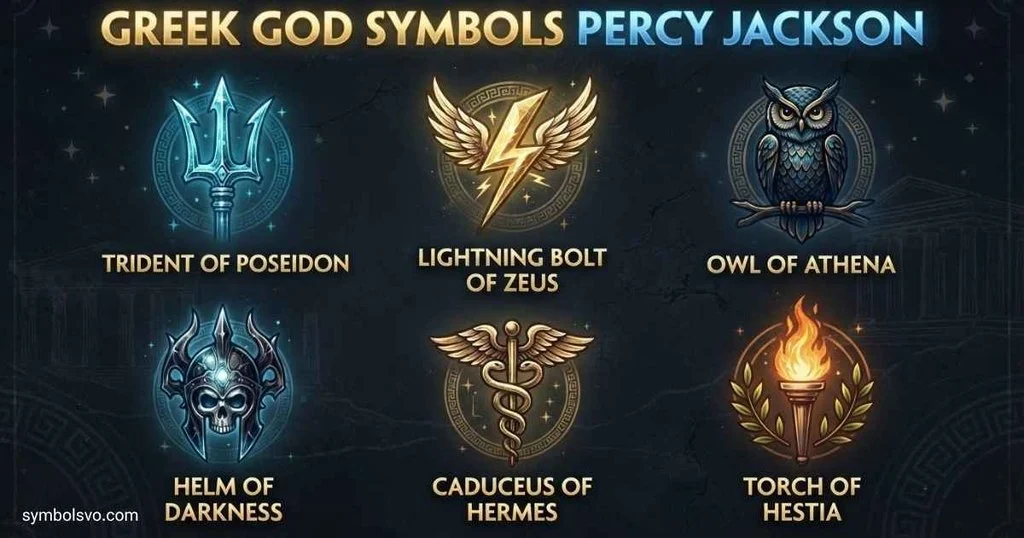
The Percy Jackson universe draws heavily from Greek mythology, so many familiar deity symbols also appear in the books and their adaptations.
However, there is an important distinction between traditional mythology and the fictional presentation in the Percy Jackson series. A symbol may have a mythological origin while its meaning, appearance, or importance is adapted for the fictional world.
Examples include:
- Zeus — thunderbolt ⚡
- Poseidon — trident 🔱
- Athena — owl 🦉
- Ares — weapons and armor ⚔️
- Hermes — winged imagery 🪽
- Apollo — bow and musical imagery 🏹🎵
- Artemis — bow and hunting imagery 🏹
- Hades — underworld imagery and Cerberus
Percy Jackson fans can use these associations for profile names, fan art, themed usernames, captions, costumes, and tattoos. For an accurate mythology reference, however, it is better to separate Rick Riordan’s fictional adaptations from ancient Greek sources.
Roman God Symbols
Greek and Roman religions share many gods with similar roles, but the traditions are not identical. Roman culture adopted and adapted many Greek deities, giving them Roman names and developing their own religious practices.
Some of the most familiar equivalents are:
| Greek god | Roman counterpart | Common symbol or association |
| Zeus | Jupiter | ⚡ Thunderbolt, eagle |
| Hera | Juno | 🦚 Peacock |
| Poseidon | Neptune | 🔱 Trident |
| Hades | Pluto | Underworld, wealth |
| Athena | Minerva | 🦉 Owl, wisdom |
| Ares | Mars | ⚔️ Warfare |
| Hermes | Mercury | 🪽 Winged sandals |
| Artemis | Diana | 🏹 Hunting |
| Apollo | Apollo | 🎵 Lyre, laurel |
| Demeter | Ceres | 🌾 Grain |
| Dionysus | Bacchus | 🍇 Wine |
| Aphrodite | Venus | 🌹 Love and beauty |
| Hephaestus | Vulcan | 🔨 Forge and fire |
| Eros | Cupid | 🏹 Love and desire |
The similarities make Greek and Roman mythology easy to connect, but the gods should not always be treated as exact copies. Their cults, myths, titles, and cultural roles developed within different religious traditions.
Frequently Asked Questions
What Is The Most Famous Greek God Symbol?
The thunderbolt ⚡ is one of the most recognizable Greek god symbols because it is strongly associated with Zeus. The trident 🔱 of Poseidon and owl 🦉 of Athena are also widely recognized.
What Symbol Represents Athena?
The owl 🦉 is one of Athena’s best-known symbols. The olive tree, helmet, spear, shield, and aegis are also strongly associated with her.
What Is The Symbol Of Poseidon?
Poseidon’s most famous symbol is the trident 🔱. Horses, dolphins, and the sea are also closely connected with him.
Are Greek God Symbols Official Unicode Symbols?
Usually, no. Unicode contains characters such as ⚡, 🔱, 🦉, and ☤, but these characters were not created as an official set of Greek mythology symbols. Their connection to a deity comes from cultural and mythological association.
What Is The Difference Between Greek And Roman God Symbols?
Greek and Roman gods often have corresponding deities, but the traditions developed separately. For example, Zeus corresponds broadly to Jupiter, Poseidon to Neptune, and Aphrodite to Venus. Their myths and religious practices can still differ.
Greek god symbols offer a simple way to connect an image with a much larger mythological story. The thunderbolt of Zeus, owl of Athena, trident of Poseidon, bow of Artemis, and rose of Aphrodite can each communicate an idea without a long explanation.
For digital use, modern Unicode characters and emoji make these associations easy to copy into bios, captions, usernames, messages, and designs. Just remember that an emoji such as ⚡ or 🦉 is a modern character, while the ancient association comes from mythology and historical art.
The best symbol is the one that matches the meaning you want to express. If you are choosing a tattoo, profile symbol, or decorative design, look beyond the image and learn the story behind the deity. That extra context can make the symbol far more meaningful.

 Mason Ellington
 Daniel Brooks