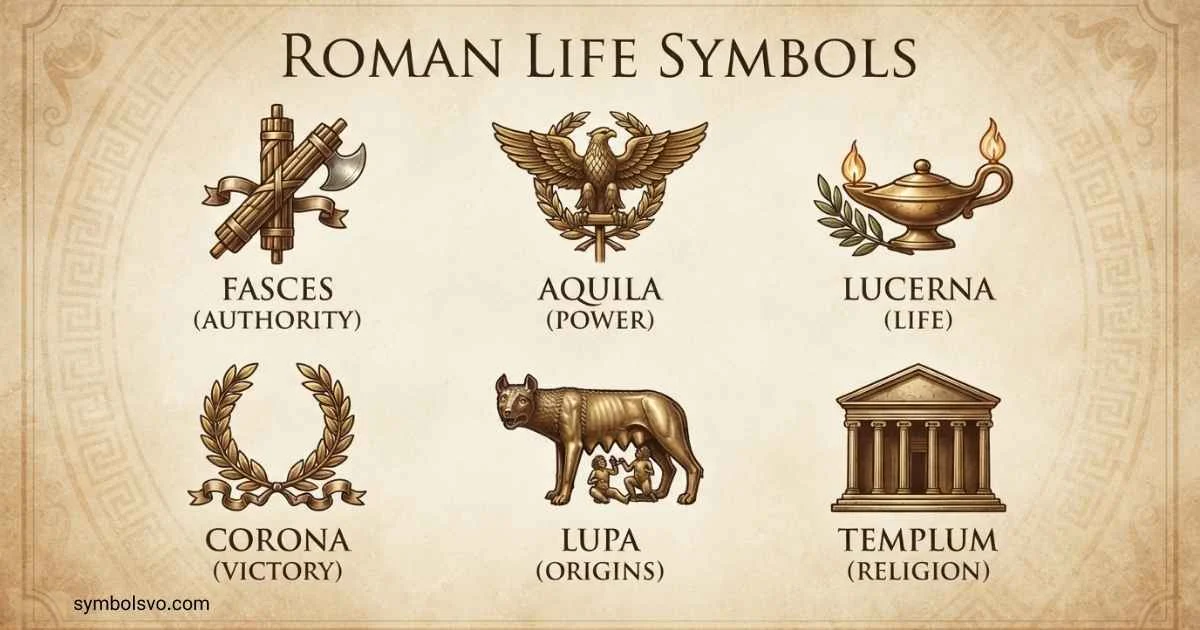
When I first explore Roman symbols, I’m always amazed by how much meaning can be hidden inside a simple sign. These symbols were connected to Roman life, beliefs, power, identity, and culture.
If you are curious about Roman symbols, you’re in the right place. I’ll help you understand what these ancient signs meant, where they came from, and why they still capture our attention today.
As you explore each symbol, you’ll discover that Roman history is more than dates and battles. You can see how people communicated ideas through powerful symbols that continue to influence art, language, and culture.
Roman Symbols And Meanings
Roman symbols were used in religion, government, warfare, public ceremonies, art, architecture, coins, inscriptions, and everyday life. Unlike a modern emoji, an ancient Roman symbol usually belonged to a particular social, religious, or political context.
Here are some of the best-known Roman symbols and their commonly associated meanings:
| Symbol | Common meaning or association |
| 🦅 Eagle | Military power, Jupiter, Roman legions |
| 🌿 Laurel wreath | Victory, honor, achievement, triumph |
| ⚔️ Sword | Military strength, combat, authority |
| ⚖️ Scales | Justice and legal order |
| 🏛️ Temple | Religion, civic life, devotion |
| 🛡️ Shield | Protection and military identity |
| ⚡ Lightning bolt | Jupiter, divine power, sky and thunder |
| 🐺 She-wolf | Rome, especially the Romulus and Remus tradition |
| ♀ Venus symbol | Venus, femininity, love in later symbolic usage |
| ♂ Mars symbol | Mars, masculinity, war in later symbolic usage |
| Fasces | Magistrate authority and public office |
| SPQR | The Senate and People of Rome |
These associations should not be treated as universal definitions. The same image could have different meanings depending on where and how it appeared.
For example, the eagle was strongly associated with Roman military standards and with Jupiter. The Roman standard known as the aquila became one of the most recognizable emblems of a legion.
The fasces had a more specific political meaning. It consisted of rods bound together, traditionally with an axe, and was carried by lictors as a sign of magistrate authority.
Ancient Roman Symbols
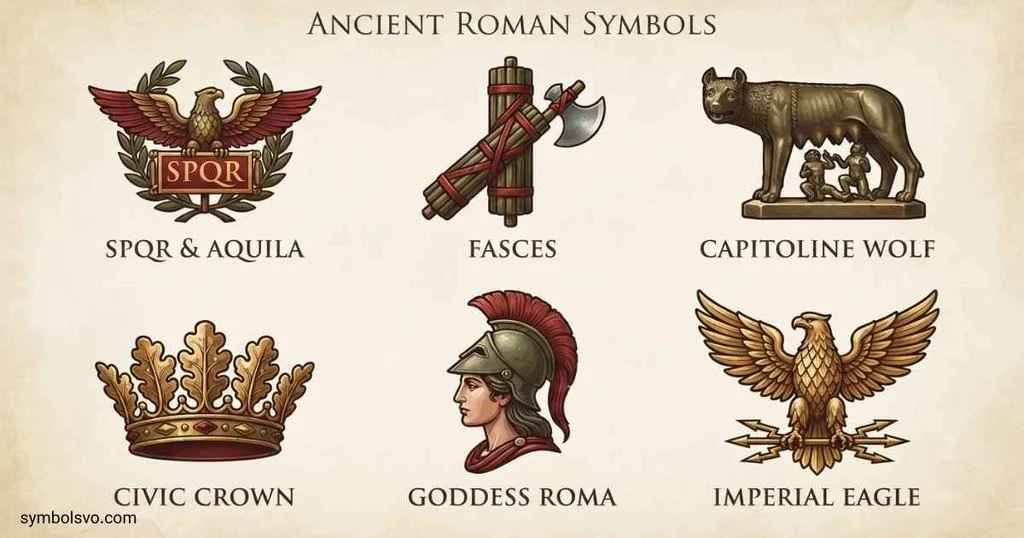
Ancient Roman symbols developed across many centuries, so there was never one single official list of “Roman symbols.” Religious symbols, military standards, political emblems, architectural decorations, and household signs all formed part of Roman visual culture.
Some important examples include:
- Aquila 🦅 — the eagle standard associated especially with Roman legions.
- Laurel wreath 🌿 — connected with victory, honor, and triumph.
- Fasces — a bundle of rods representing official authority.
- SPQR — abbreviation of Senatus Populusque Romanus, meaning “The Senate and People of Rome.”
- She-wolf 🐺 — strongly associated with the traditional story of Romulus and Remus.
- Thunderbolt ⚡ — associated with Jupiter and divine power.
- Globus — a globe or sphere appearing in Roman art as an emblem of dominion or cosmic authority in particular contexts.
- Scepter — associated with authority and rulership.
- Shield — military protection and identity.
- Sword — warfare, military force, and martial imagery.
Roman standards were especially important to the army. The eagle was the most famous legionary animal standard, although Roman military units could also be associated with animals such as the boar, wolf, horse, and others.
Ancient Roman Symbols And Meanings
The meaning of an ancient Roman symbol becomes clearer when it is connected to the setting in which Romans used it.
Religious meanings
Roman religion included many gods, spirits, rituals, sacred objects, temples, and signs. Jupiter was associated with the eagle and lightning, Mars with warfare, Venus with love and beauty, Minerva with wisdom and crafts, and Neptune with the sea. Roman religion also absorbed and adapted influences from Greek and other cultures.
Military meanings
Military symbols communicated identity, authority, victory, and loyalty. The eagle standard served as a rallying point for soldiers and represented the honor of the unit that carried it.
Political meanings
Symbols such as the fasces represented public office and authority. The fasces were carried by lictors accompanying magistrates, making the symbol closely connected with Roman government.
Victory meanings
The laurel wreath and laurel branches became strongly associated with victory and triumph. Roman triumphal processions used laurel imagery, including laurel-decorated fasces.
This shows why simply labeling a symbol as “Roman” is not always enough. Its meaning often comes from the object, person, ceremony, or deity connected to it.
Old Roman Symbols
“Old Roman symbols” can refer to symbols from the Roman Republic, Roman Empire, or earlier Roman religious traditions. Some symbols also changed meaning as Roman society changed.
Popular old Roman imagery includes:
- SPQR — Roman state identity.
- Aquila — legionary eagle.
- Fasces — magistrate authority.
- Laurel wreath — victory and honor.
- Gladius — Roman short sword and military imagery.
- Scutum — Roman shield.
- She-wolf — Rome and its foundation legend.
- Thunderbolt — Jupiter and divine force.
- Roman temple — worship and civic religion.
- Roman numeral letters — numerical notation.
Not every object listed here was a “symbol” in exactly the same sense. Some were physical objects that gained symbolic associations through repeated use.
That distinction matters when researching Roman history. A sword, for example, was a real weapon first; its symbolic meaning comes from its association with soldiers, warfare, authority, and victory.
Famous Roman Symbols
Some Roman symbols remain famous because they survived in monuments, books, films, museums, heraldry, government imagery, and modern popular culture.
The most recognizable include:
🦅 Roman eagle — One of the strongest visual associations with the Roman legions.
🌿 Laurel wreath — A classic image of victory, achievement, and triumph.
Fasces — A distinctive bundle-of-rods design linked to Roman magistrates and public authority.
SPQR — A famous Roman abbreviation representing the Senate and People of Rome. It appeared in Roman public and military contexts.
She-wolf and twins — An enduring image connected with the traditional foundation story of Rome.
Roman numerals — I, V, X, L, C, D, and M remain widely recognized today.
Roman symbols are especially popular in modern graphic design because they can suggest age, tradition, authority, military history, or classical culture without requiring a long explanation.
Simple Roman Symbols
If you want Roman-inspired symbols that are easy to recognize or draw, start with simple shapes and familiar imagery.
- I V X — Basic Roman numeral forms.
- 🌿 — Laurel-inspired decoration.
- 🦅 — Eagle imagery.
- ⚔ — Sword or military imagery.
- 🛡 — Shield imagery.
- ⚡ — Lightning associated with Jupiter.
- 🏛 — Classical Roman architecture.
- SPQR — Short Roman historical inscription.
- ∞ — A modern symbol sometimes used in Roman-themed designs, although it is not an ancient Roman symbol.
For drawings, a laurel branch, shield, sword, eagle, or Roman numeral is usually easier to reproduce than a detailed historical emblem.
Remember that a modern emoji is not automatically an ancient Roman character. For example, 🦅 is an emoji representation of an eagle, not a special Unicode character created by ancient Romans.
Roman Symbols Of Power
Roman culture used several images to communicate authority and power.
The fasces is one of the clearest examples. It represented the authority of Roman magistrates and was carried by lictors. The rods suggested the power of the office, while the axe could represent coercive or judicial authority in particular contexts.
The eagle also became a powerful symbol through the Roman army. A legion’s standard was more than decoration. It served as a rallying point and represented the identity and honor of the military unit.
Other power-related imagery includes:
- Scepter — rulership and authority.
- Crown or wreath — honor or victory.
- Globe — dominion in certain imperial representations.
- Sword — military force.
- Laurel — victory and achievement.
- Imperial portraits — political and imperial authority.
The exact meaning depends on the object and its historical setting.
Roman Symbols Of Strength
Roman strength symbols are often connected with military life, endurance, authority, and victory.
The fasces can represent strength through unity because many rods are bound into one object. Historically, however, its primary Roman meaning was connected to official authority rather than being simply a generic “strength symbol.”
The eagle can suggest military strength because of its role in Roman legionary standards. The sword and shield naturally evoke combat and protection.
For modern designs, these combinations can work well:
- 🦅 + ⚔ — military strength
- 🌿 + 🛡 — victory and protection
- SPQR + 🦅 — Roman military identity
- Roman numeral + laurel — classical achievement
- Fasces-inspired design + laurel — authority and victory
These are modern design combinations, so they should not be presented as official ancient Roman formulas.
Roman Symbols Of War
War was a major part of Roman history, and Roman military imagery remains one of the most recognizable forms of Roman symbolism.
Common war-related Roman imagery includes:
- Aquila 🦅 — legionary eagle standard.
- Gladius — short sword associated with Roman soldiers.
- Scutum — large Roman shield.
- Spear — weapon and military imagery.
- Fasces — authority, with military significance in certain contexts.
- Laurel — victory and triumph.
- Vexillum — military standard or banner.
- SPQR — Roman state identity.
Roman standards were particularly important in battle. Soldiers could rally around them, and their loss was a serious matter for military honor.
The fasces could also have a military dimension. During the Republic, the axe element was associated with military authority when a consul was outside Rome, and fasces were used in triumphal processions.
Roman Symbols For Gods
Roman gods were often represented through recognizable attributes rather than one universal “god symbol.”
| Roman god | Common attribute or symbol | Association |
| Jupiter | ⚡ Eagle | Sky, thunder, divine authority |
| Mars | Spear, shield | War and military power |
| Neptune | Trident | Sea and water |
| Venus | Dove, myrtle, rose in later traditions | Love and beauty |
| Minerva | Owl, helmet, spear | Wisdom, crafts, warfare |
| Diana | Bow, deer | Hunting and wilderness |
| Mercury | Winged sandals, caduceus | Commerce, travel, messages |
| Vulcan | Hammer, anvil | Fire and metalworking |
| Saturn | Sickle or scythe | Agriculture and time-related traditions |
| Vesta | Sacred flame | Hearth and home |
These associations developed through art, mythology, literature, ritual, and later artistic traditions. They should not be treated as a single fixed ancient Roman icon system.
Jupiter is especially associated with the eagle and thunderbolt. Ancient Roman religious traditions also changed over time and incorporated influences from Greek and other cultures.
Gods Roman Symbols
If you are looking specifically for symbols connected to Roman gods, the following quick list is useful:
- Jupiter — ⚡ 🦅
- Mars — 🛡️ ⚔️
- Neptune — 🔱
- Venus — ♀
- Minerva — 🦉 🛡️
- Diana — 🏹 🦌
- Mercury — 🪽
- Vulcan — 🔨
- Vesta — 🔥
- Saturn — sickle/scythe imagery
Some of these displayed characters are modern Unicode symbols or emoji approximations, not ancient Roman glyphs. For example, 🔱 is a modern trident emoji, while Roman artistic representations of Neptune often show a trident as an object.
For historical artwork, it is better to describe the attribute rather than claim that the modern emoji itself was used by ancient Romans.
Greco Roman Symbols
Roman culture had deep connections with Greek culture. Roman religion absorbed and adapted many Greek gods and traditions, although Roman deities were not always exact copies of their Greek counterparts.
Some commonly compared pairs are:
| Greek | Roman | Common association |
| Zeus | Jupiter | Sky and thunder |
| Hera | Juno | Marriage and queenship |
| Athena | Minerva | Wisdom and warfare |
| Ares | Mars | War |
| Aphrodite | Venus | Love and beauty |
| Poseidon | Neptune | Sea |
| Artemis | Diana | Hunting |
| Hermes | Mercury | Messages and commerce |
| Hephaestus | Vulcan | Fire and metalworking |
| Demeter | Ceres | Agriculture |
These comparisons are useful, but “Roman version” does not always mean identical mythology. Roman religion developed through its own traditions and absorbed outside influences over time.
Greek And Roman Symbols
Greek and Roman symbols can look similar because the cultures influenced one another. However, their writing systems and numeral systems are different.
For example:
- Roman numerals: I, V, X, L, C, D, M
- Greek letters: α, β, γ, δ, etc.
- Greek numeral traditions: used Greek letters in numerical systems.
- Roman numeral tradition: used Latin letter forms as numerical signs.
The Unicode Standard treats Roman numeral characters as part of the Number Forms block. It also explains that, for most purposes, Roman numerals are preferably composed using sequences of the appropriate Latin letters.
So Ⅳ and IV both represent four, but they are not technically identical characters. Ⅳ is the single Unicode character ROMAN NUMERAL FOUR, while IV consists of two Latin letters.
Roman Symbols Tattoos
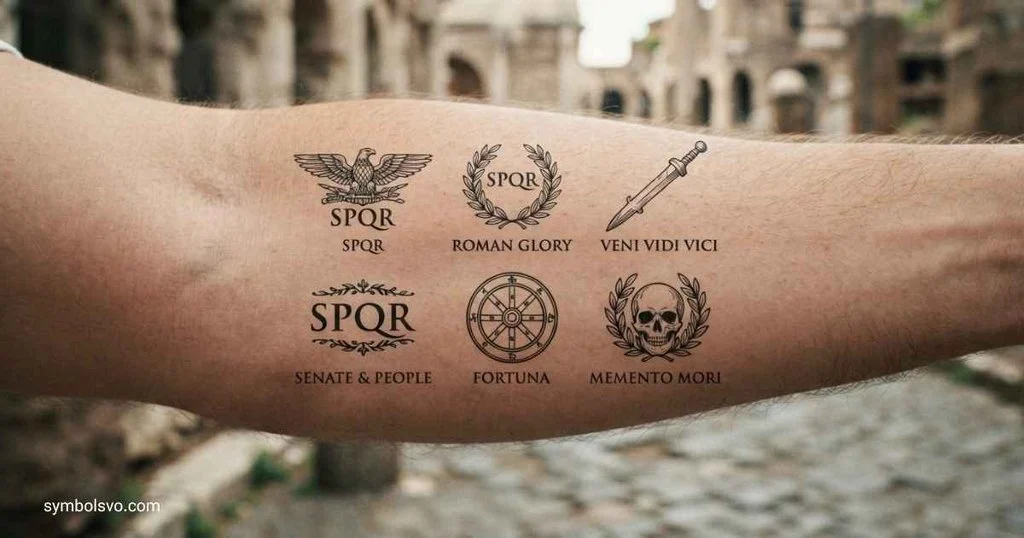
Roman symbols are popular tattoo choices because they can combine historical imagery with personal meaning.
Common ideas include:
- Roman numerals for a meaningful date.
- Laurel wreath for victory or achievement.
- Roman eagle for strength, pride, or military history.
- SPQR for Roman identity and history.
- Gladius for courage or warrior imagery.
- Fasces-inspired artwork for historical authority.
- Roman god attributes for mythology-themed tattoos.
- Columns or arches for classical architecture.
Before choosing a historical symbol, research its original meaning. Some symbols have acquired additional modern political associations. The fasces, for example, was an ancient Roman symbol of official authority but was later adopted by the Italian Fascist movement, giving it a significant additional modern association.
Roman Symbols 1 To 100
Roman numerals use seven basic symbols:
| Symbol | Value |
| I | 1 |
| V | 5 |
| X | 10 |
| L | 50 |
| C | 100 |
| D | 500 |
| M | 1,000 |
Here are Roman numerals from 1 to 100:
| Number | Roman | Number | Roman |
| 1 | I | 51 | LI |
| 2 | II | 52 | LII |
| 3 | III | 53 | LIII |
| 4 | IV | 54 | LIV |
| 5 | V | 55 | LV |
| 6 | VI | 56 | LVI |
| 7 | VII | 57 | LVII |
| 8 | VIII | 58 | LVIII |
| 9 | IX | 59 | LIX |
| 10 | X | 60 | LX |
| 11 | XI | 61 | LXI |
| 12 | XII | 62 | LXII |
| 13 | XIII | 63 | LXIII |
| 14 | XIV | 64 | LXIV |
| 15 | XV | 65 | LXV |
| 16 | XVI | 66 | LXVI |
| 17 | XVII | 67 | LXVII |
| 18 | XVIII | 68 | LXVIII |
| 19 | XIX | 69 | LXIX |
| 20 | XX | 70 | LXX |
| 21 | XXI | 71 | LXXI |
| 22 | XXII | 72 | LXXII |
| 23 | XXIII | 73 | LXXIII |
| 24 | XXIV | 74 | LXXIV |
| 25 | XXV | 75 | LXXV |
| 26 | XXVI | 76 | LXXVI |
| 27 | XXVII | 77 | LXXVII |
| 28 | XXVIII | 78 | LXXVIII |
| 29 | XXIX | 79 | LXXIX |
| 30 | XXX | 80 | LXXX |
| 31 | XXXI | 81 | LXXXI |
| 32 | XXXII | 82 | LXXXII |
| 33 | XXXIII | 83 | LXXXIII |
| 34 | XXXIV | 84 | LXXXIV |
| 35 | XXXV | 85 | LXXXV |
| 36 | XXXVI | 86 | LXXXVI |
| 37 | XXXVII | 87 | LXXXVII |
| 38 | XXXVIII | 88 | LXXXVIII |
| 39 | XXXIX | 89 | LXXXIX |
| 40 | XL | 90 | XC |
| 41 | XLI | 91 | XCI |
| 42 | XLII | 92 | XCII |
| 43 | XLIII | 93 | XCIII |
| 44 | XLIV | 94 | XCIV |
| 45 | XLV | 95 | XCV |
| 46 | XLVI | 96 | XCVI |
| 47 | XLVII | 97 | XCVII |
| 48 | XLVIII | 98 | XCVIII |
| 49 | XLIX | 99 | XCIX |
| 50 | L | 100 | C |
The most useful patterns to remember are IV = 4, IX = 9, XL = 40, XC = 90, and C = 100.
Roman Symbols Numbers
Roman numerals are a number-writing system rather than decorative symbols alone. They are made from letter-based signs that developed in the Roman tradition.
The main values are:
I = 1
V = 5
X = 10
L = 50
C = 100
D = 500
M = 1,000
Some numbers are formed by adding symbols:
- VIII = 8
- XV = 15
- XX = 20
- LX = 60
- LXX = 70
Other numbers use subtractive notation:
- IV = 4
- IX = 9
- XL = 40
- XC = 90
Unicode includes dedicated Roman numeral characters such as Ⅰ, Ⅱ, Ⅲ, Ⅳ, Ⅴ, Ⅹ, Ⅼ, Ⅽ, Ⅾ, and Ⅿ. These belong to the Number Forms block.
For ordinary writing, Unicode recommends using sequences of Latin letters for most purposes rather than automatically replacing every numeral with a dedicated compatibility character.
Roman Symbols Physics
The phrase “Roman symbols in physics” can refer to Roman or upright Latin letters used in scientific notation, but these should not be confused with ancient Roman symbols.
Physics commonly uses Latin letters for quantities and variables. Examples include:
- m — commonly mass
- v — commonly velocity
- t — commonly time
- F — commonly force
- E — commonly energy
- I — commonly electric current
- V — commonly electric potential or voltage
- P — commonly power or pressure, depending on context
The exact meaning depends on the equation and field. A letter such as I is not a Roman historical symbol merely because it is also the Roman numeral for one.
Roman numeral characters can occasionally appear in scientific or technical labels, numbering systems, classifications, sections, or names. For example, Ⅲ is officially a Unicode ROMAN NUMERAL THREE character.
The key distinction is simple: Roman numerals are a historical numbering system, while Latin-letter notation is part of modern scientific writing.
Roman Symbols Text
If you want Roman-inspired text for a message, username, caption, heading, or design, standard Roman numeral characters are among the easiest options.
Roman numeral text
Ⅰ Ⅱ Ⅲ Ⅳ Ⅴ Ⅵ Ⅶ Ⅷ Ⅸ Ⅹ
Ⅺ Ⅻ Ⅼ Ⅽ Ⅾ Ⅿ
You can also use ordinary Latin-letter Roman numerals:
I II III IV V VI VII VIII IX X
XI XII XIII XIV XV XVI XVII XVIII XIX XX
For a classical look, combine numerals with other text:
- ROMA • MMXXVI
- SPQR • IV
- V • VI • VII
- ROMAN • XII
- LEGION • X
These are modern design examples rather than historical inscriptions.
Dedicated Unicode Roman numeral characters are available for uppercase and lowercase forms through 12, as well as L, C, D, and M. Unicode also includes several archaic Roman numeral characters, including ↀ, ↁ, ↂ, and Ↄ.
Roman Symbols Copy And Paste
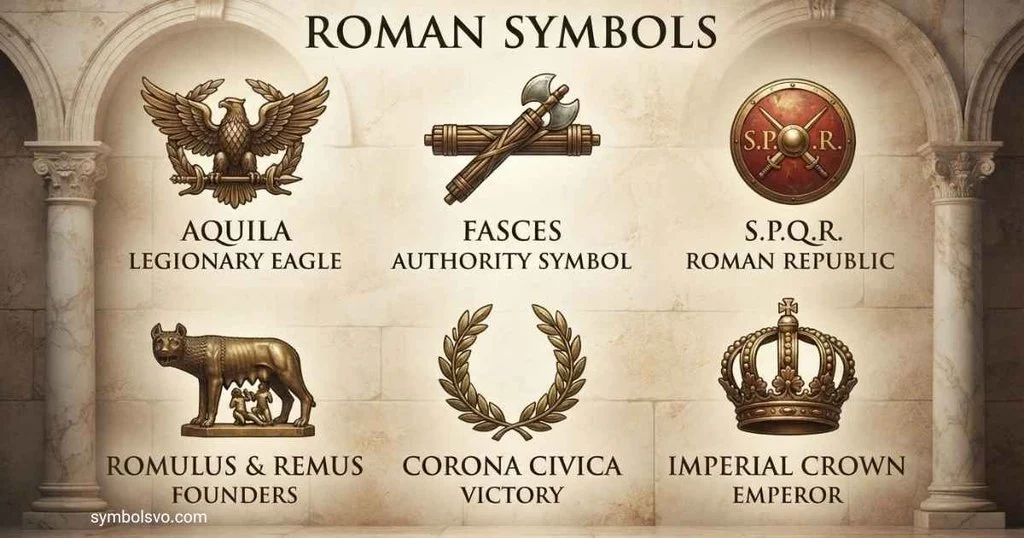
Here are Roman symbols and Roman numeral characters you can copy and paste directly.
Roman numeral characters
Ⅰ Ⅱ Ⅲ Ⅳ Ⅴ Ⅵ Ⅶ Ⅷ Ⅸ Ⅹ
Ⅺ Ⅻ Ⅼ Ⅽ Ⅾ Ⅿ
Small Roman numeral characters
ⅰ ⅱ ⅲ ⅳ ⅴ ⅵ ⅶ ⅷ ⅸ ⅹ
ⅺ ⅻ ⅼ ⅽ ⅾ ⅿ
Archaic Roman numeral characters
ↀ ↁ ↂ Ↄ
Unicode identifies ↀ as ROMAN NUMERAL ONE THOUSAND C D, ↁ as ROMAN NUMERAL FIVE THOUSAND, ↂ as ROMAN NUMERAL TEN THOUSAND, and Ↄ as ROMAN NUMERAL REVERSED ONE HUNDRED.
Common Roman symbols and text
SPQR
🦅
🌿
⚔
🛡
⚡
🏛
Ⅰ Ⅱ Ⅲ Ⅳ Ⅴ
Ⅹ Ⅺ Ⅻ Ⅼ Ⅽ Ⅾ Ⅿ
A useful tip is to test dedicated Unicode numeral characters before using them in an important design. Some fonts may render them differently from ordinary Latin-letter sequences, and Unicode notes that these characters were encoded partly for compatibility with East Asian standards and vertical layout.
FAQ
What are the main Roman symbols?
The best-known Roman symbols include the eagle, fasces, laurel wreath, SPQR, military standards, Roman numerals, and imagery connected with Roman gods. Their meanings depend on their historical context.
What does SPQR mean?
SPQR stands for Senatus Populusque Romanus, meaning “The Senate and People of Rome.” It was an important expression of Roman state identity and appeared in public and military contexts.
What Roman symbol represents strength?
The eagle, fasces, sword, and shield can all communicate strength in modern Roman-inspired designs. Historically, the fasces primarily represented official authority, while the eagle was strongly associated with Roman military standards.
What is the Roman symbol for 100?
The standard Roman numeral for 100 is C. Unicode also provides the dedicated character Ⅽ, named ROMAN NUMERAL ONE HUNDRED.
Are Roman numerals the same as Roman symbols?
Roman numerals are one category of Roman symbols. Roman culture also used military, religious, political, architectural, and artistic imagery. So the term “Roman symbols” is broader than Roman numerals.
Conclusion
Roman symbols cover much more than the familiar I, V, X, L, C, D, and M. Ancient Roman culture used eagles, laurel wreaths, fasces, military standards, religious attributes, and political marks to communicate identity, authority, victory, and devotion.
For modern use, Roman numerals are especially practical because they work well in dates, tattoos, names, headings, designs, and decorative text. Dedicated Unicode characters such as Ⅳ and Ⅹ can add a distinct visual style, while ordinary forms such as IV and X remain simple and widely useful.
The best Roman symbol depends on your purpose. Choose a numeral for a date, a laurel for victory, an eagle for Roman military imagery, or a deity’s attribute for mythology. When historical accuracy matters, always check the original context instead of relying on a modern symbol’s popular interpretation.

 Grace Whitmore
 Daniel Brooks