
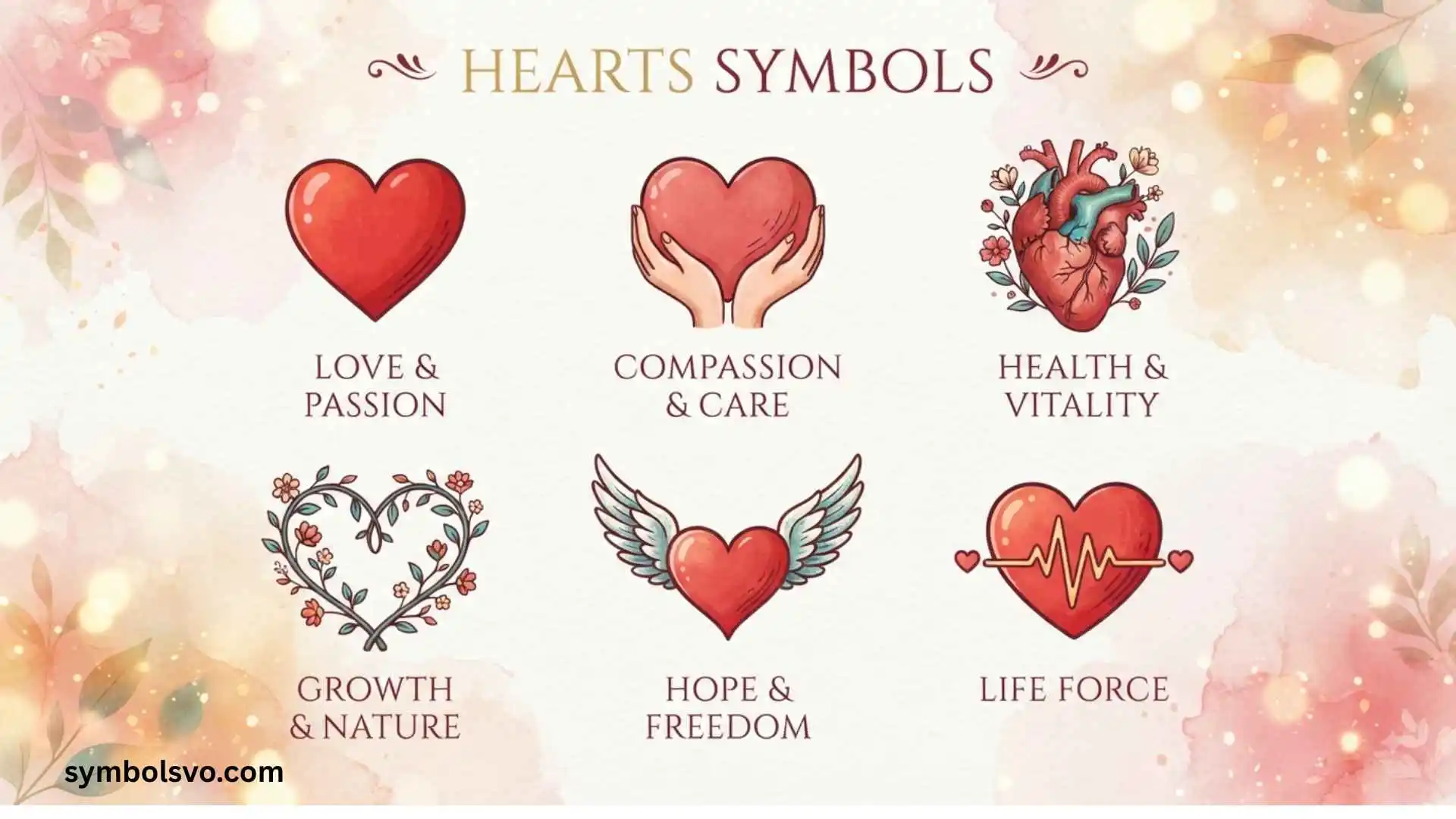
I’ve always felt that a simple heart can say more than a whole paragraph, and hearts symbols do exactly that. When you start using the right ones, you notice how quickly people feel seen and cared for.
You deserve easy ways to show affection in a world that often feels rushed and cold. These symbols give you a warm, quiet power to connect.
I want you to feel confident choosing the perfect heart so every message you send lands softer and means more.
Quick Answer
Hearts symbols are universal ideographs used to represent love, affection, emotion, and the spiritual core of the human experience. While the modern shape does not match a biological human heart, it serves as a powerful cultural and psychological emblem signifying deep connection, empathy, and life force across global digital and physical media.
Quick Facts About Hearts Symbols
| Aspect | Information |
| Origin | Ancient Mediterranean, linked to the silphium plant and classical philosophy. |
| Historical Significance | Evolved from a botanical design into a medieval emblem of courtly love and devotion. |
| Main Meaning | Romantic love, deep affection, compassion, and emotional vulnerability. |
| Spiritual Meaning | The center of consciousness, divine love, sacred truth, and the soul. |
| Cultural Importance | Central to global art, literature, religious iconography, and modern digital communication. |
| Modern Usage | Emojis, tattoos, fashion, brand logos, fine jewelry, and social media engagement. |
What Are Hearts Symbols?
The hearts symbols we recognize today are simplified geometric shapes used to represent the emotional and spiritual center of a human being. Visually, the icon features a scalloped top with two symmetrical lobes that taper down into a sharp point at the base. It is a beautiful irony that this design looks very little like the actual muscle pumping blood through our chests. Instead, it is a conceptual image, an artistic creation that has captured the human imagination for centuries.
The true story of its origin is a fascinating journey through time. Long before it meant romance, the shape appeared in ancient art as stylized ivy, fig, or laurel leaves. Over the centuries, these botanical illustrations began to take on deeper meanings. By the time the Middle Ages arrived, European artists and writers started using the shape to illustrate the concepts of romance and chivalry.
It became important because humans naturally seek visual shortcuts to express complex internal worlds. The symbol evolved from a simple decorative leaf into a profound statement of human vulnerability. It survived the fall of empires, the shift from parchment to printing presses, and the transition into the internet age, proving its timeless value to our collective psychology.
Deep Symbolic Meaning of Hearts Symbols
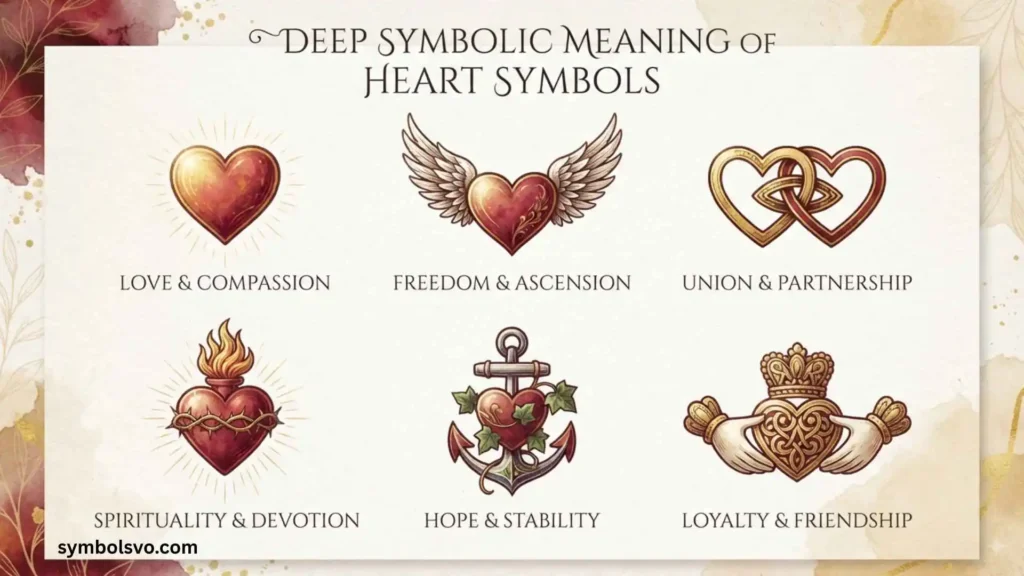
To fully grasp the magic of this icon, we have to look at it through three unique lenses: the spiritual, the psychological, and the cultural.
Spiritual Level
On a spiritual path, the heart is considered the seat of the soul. Many ancient mystical traditions teach that while the brain processes logical thoughts, the heart perceives absolute truth. It represents inner transformation and the awakening of higher consciousness. When you see a heart symbol in a spiritual context, it often points to unconditional love, divine grace, and the invisible threads that connect all living beings to the universe.
Psychological Level
Psychologically, the heart is the ultimate symbol of our emotional landscape. Carl Jung talked extensively about archetypes, which are universal symbols embedded in the human collective unconscious. The heart acts as a powerful archetype for the “Anima” and “Animus,” representing deep emotional attraction, empathy, and integration. It shows our willingness to be vulnerable, to expose our softest parts to the world, and to experience both the joy and pain of attachment.
Cultural Level
Culturally, the heart serves as a foundation for social trust and community bonds. In traditional storytelling, a person with a big heart is generous, while someone with no heart is detached. We use it to celebrate marriages, honor friendships, and comfort those who are grieving. It is a visual contract of safety, reminding us that despite our differences, we all share the same baseline need for care and belonging.
Types and Variations of Hearts Symbols
❤️ Standard Red Heart 💔 Broken Heart
💖 Sparkling Heart 🖤 Black Heart
The heart shape is incredibly adaptive, changing its meaning based on color, design elements, and context. Here are some of the most prominent variations found in history, art, and modern media.
The Sacred Heart
- Visual Description: A heart wrapped in a crown of thorns, topped with a cross, and radiating bright flames or divine light.
- Meaning and Symbolism: Represents transformative divine love, immense compassion, and enduring spiritual suffering.
- Where It Appears: This symbol is deeply rooted in Christian theology and Roman Catholic religious art. It also appears frequently in traditional tattoos, Mexican folk art, and classical European paintings.
The Broken Heart
- Visual Description: A standard heart shape with a jagged, zigzag crack running straight down the center, splitting it into two halves.
- Meaning and Symbolism: Signifies grief, intense emotional pain, betrayal, lost love, and deep longing.
- Where It Appears: Widely featured in tragic literature, pop music album covers, romantic poetry, and everyday digital messaging when someone is hurt.
The Sacred Silphium Seed
- Visual Description: An upside-down heart shape, often wider at the top lobes, resembling a seed pod.
- Meaning and Symbolism: Associated with ancient romance, wealth, sensuality, and fertility.
- Where It Appears: Minted directly onto ancient silver coins from the city of Cyrene, found in historical archaeological digs across the Mediterranean.
The Winged Heart
- Visual Description: A classic heart flanked by two outspread bird or angel wings.
- Meaning and Symbolism: Represents freedom, soaring love, spiritual transcendence, and the memory of a loved one who has passed away.
- Where It Appears: Common in Sufi spiritual emblems, fantasy illustrations, memorial art, and freedom-themed jewelry.
Hearts Symbols Across Different Cultures
+—————————————————————–+
| HISTORICAL EVOLUTION |
| |
| [Ancient Egypt] –> [Ancient Greece] –> [Middle Ages] |
| Heart as judgment Silphium & Ivy leaf Courtly Love |
+—————————————————————–+
Ancient Egypt
The Egyptians did not use our modern heart icon, but they were among the first to elevate the heart, known as the “Ib,” to a status of supreme importance. They believed the heart recorded all a person’s good and bad deeds. In the afterlife, during the Weighing of the Heart ceremony, the god Anubis would balance the deceased person’s heart against the feather of Ma’at, the goddess of truth. If the heart was light as a feather, the soul entered paradise.
Ancient Greece
In Greek culture, the shape we now use for the heart was originally linked to ivy leaves, which symbolized Dionysus, the god of wine, passion, and ecstasy. Furthermore, the Greeks relied heavily on a rare, extinct plant called silphium. Its seed pods looked exactly like our modern heart symbol. Because silphium was used as a natural form of birth control and a luxury spice, the shape became intertwined with sexuality, romance, and immense financial value.
Roman Culture
The Romans adopted many Greek traditions, using the heart-shaped silphium and ivy emblems in their decorative mosaics, villa murals, and jewelry designs. To the Romans, the heart area was also the home of courage and vital energy. Soldiers who showed immense bravery were said to have great heart, cementing the link between the physical chest and noble character traits.
Eastern Traditions
In ancient Indian philosophies, particularly within the system of Yoga and Ayurveda, the heart is home to the Anahata chakra. This is the fourth primary energy center, located in the middle of the chest. While it is often depicted as a twelve-petaled lotus flower rather than a Western heart shape, the underlying meaning is identical. It represents the bridge between earthly and spiritual realms, housing compassion, love, and psychic harmony.
Indigenous Traditions
Many Native American leagues look at the heart as a symbol of the cosmic heartbeat of Mother Earth. The shape is often integrated into animal art, such as the heartline symbol found in Zuni bear carvings. This line runs from the mouth down to the center of the chest, representing the life force, breath, and inner spirit of the creature.
Modern Interpretations
Today, the heart has been completely universalized by digital culture. The introduction of emojis transformed the heart into a multi-colored vocabulary. A yellow heart means pure friendship, a blue heart shows loyalty, a black heart expresses dark humor or grief, and the classic red heart remains the king of romantic adoration. It has become a truly borderless language.
Similar Symbols and Their Meanings
To truly appreciate the heart, it helps to see how it compares to other symbols that handle similar emotional or structural themes.
| Symbol | Key Similarities | Major Differences | Common Misconceptions |
| The Diamond | Symmetrical, geometric, used in jewelry and playing cards. | Represents strength, clarity, and wealth rather than raw emotion. | People often confuse their playing card values; hearts represent the clergy, while diamonds represent merchants. |
| The Infinity Sign | Represents endlessness and deep connection. | Lacks the vulnerability and emotional warmth inherent in the heart. | Many think it is a modern romantic symbol, but it originated as a pure mathematical concept. |
| The Lotus Flower | Symbolizes deep spiritual love and the heart chakra. | Rooted in eastern purity, rebirth, and rising above mud, rather than romantic passion. | People assume it means the same as a western heart, but it focuses more on detached peace. |
Hearts Symbols in Mythology and Folklore
Mythology is rich with stories that helped shape our understanding of the heart. In Norse mythology, the giant Hrungnir had a famous heart made of solid stone with three sharp corners, which resembled a carved runic knot. This story showed that a heart could be hardened by anger and malice, contrasting sharply with the soft, loving hearts of the benevolent gods.
In Western folklore, Cupid, the mischievous Roman god of desire, carries arrows tipped with gold to pierce human hearts, causing them to fall desperately in love. These stories passed down through generations, slowly merging the physical act of falling in love with the visual image of a wounded yet ecstatic heart.
Hearts Symbols in Art, Literature, and Pop Culture
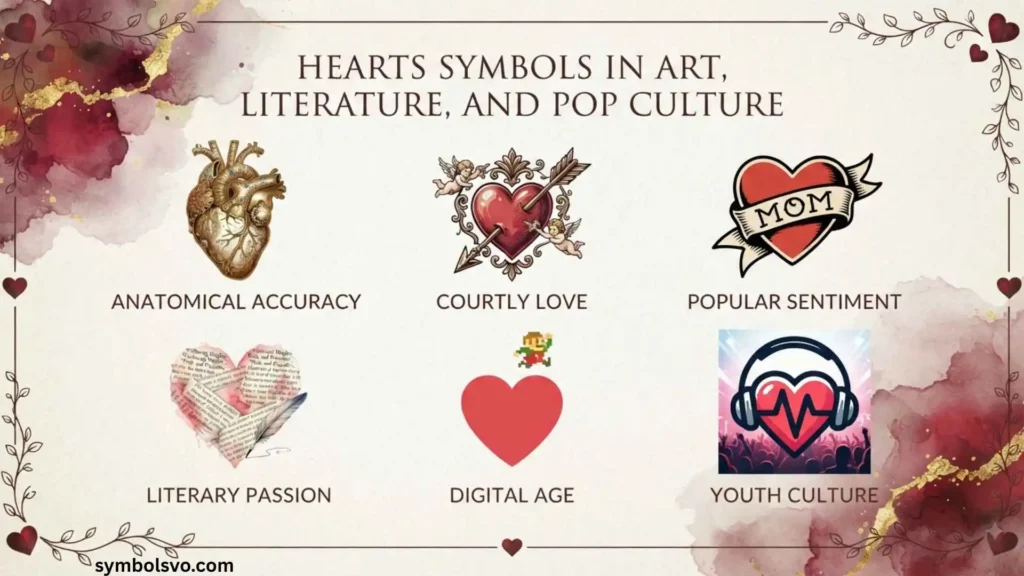
🎨 Fine Art (Giotto, Frida Kahlo)
📚 Literature (Shakespeare, Edgar Allan Poe)
🎸 Pop Culture (I ❤️ NY, Emoji Lifestyle)
The artistic world has always been obsessed with this shape. During the Renaissance, Italian painter Giotto depicted the virtue of Charity handing her heart directly to God. Centuries later, surrealist artist Frida Kahlo used raw, anatomical hearts connected by exposed veins in her paintings to illustrate her profound heartbreak and dual cultural identity.
In literature, William Shakespeare used the heart as a central playground for his characters’ motives, famously writing about people who wear their hearts upon their sleeves. In horror literature, Edgar Allan Poe used the relentless sound of a hidden organ to drive a killer mad in The Tell-Tale Heart.
Moving into modern pop culture, the icon achieved a massive marketing milestone in 1977 with the creation of Milton Glaser’s famous “I ❤️ NY” logo. This brilliant design substituted a single red heart for a verb, changing global advertising forever. Today, the symbol dominates the fashion world, appearing on high-end sneakers, luxury streetwear, and millions of daily social media likes.
Spiritual and Dream Meaning of Hearts Symbols
When hearts symbols show up in your dreams or during deep meditation, they usually carry a message from your subconscious mind.
- Seeing a Bright Red Heart: This is generally a positive sign indicating a season of emotional healing, new relationships, or a surge of self-love.
- Dreaming of a Locked Heart: This serves as a cautionary message, suggesting you are building walls around your emotions and refusing to let people in out of fear of getting hurt.
- Receiving a Heart as a Gift: In the dream world, this represents acceptance, a validation of your worth, and the arrival of peace after a long period of conflict.
Positive and Negative Meanings of Hearts Symbols
Like all great archetypes, this symbol contains both light and shadow sides. Its meaning depends entirely on how and where it is displayed.
| Positive Meaning | Negative Meaning |
| Unconditional Love: Pure, selfless devotion to another person. | Obsession: Love turning into toxic control and possessiveness. |
| Compassion: Deep empathy and a desire to help those who suffer. | Heartache: The crushing pain of loss, rejection, and grief. |
| Emotional Vitality: Feeling alive, passionate, and connected. | Vulnerability: The risk of being easily wounded or exploited. |
Why Humans Are Attracted to Hearts Symbols
Our deep attraction to this shape is rooted in human psychology and pattern recognition. As infants, the first thing we look for is human faces. The two rounded lobes of the heart softly mimic the comforting, organic curves of a smiling face, eyes, or a maternal form.
Furthermore, our brains are hardwired to look for symmetry. The perfect balance of the heart symbol satisfies our aesthetic need for harmony. It functions as a piece of shared cultural memory. Because we see it used positively from the time we are toddlers, our minds automatically trigger feelings of warmth, safety, and comfort whenever the shape appears in our environment.
Modern Uses of Hearts Symbols
The versatility of the heart ensures it remains a dominant force in contemporary lifestyle design:
- Tattoos: It is one of the most requested tattoo designs in history, ranging from minimalist fine-line wrist tattoos to bold, old-school banner designs honoring family members.
- Jewelry: Heart-shaped lockets, diamond pendants, and promise rings remain top-sellers for anniversaries, birthdays, and holidays.
- Branding: Companies use the shape in their logos to instantly signal that their brand is caring, health-conscious, or customer-centric.
- Social Media: The double-tap heart function on platforms like Instagram and TikTok has turned the symbol into the universal currency of digital approval.
Interesting Facts About Hearts Symbols
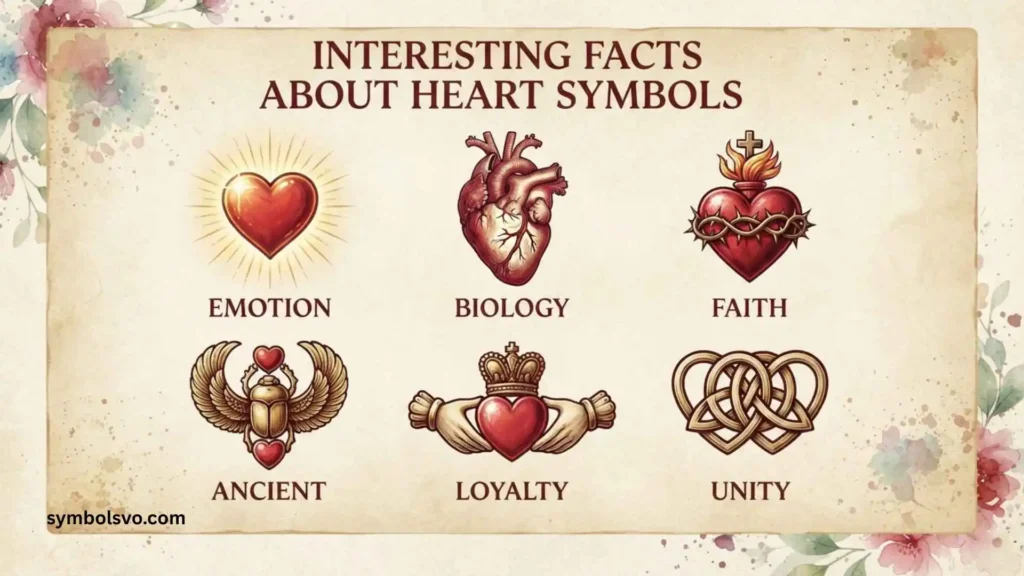
- The First Romantic Depiction: The earliest known art piece showing a heart used for romance dates back to the 1250s in a French manuscript called The Romance of the Pear.
- Card Suit Origins: The hearts suit in modern playing cards originally evolved from the French suit of “coeurs,” which represented the clergy and holy goodness.
- The Famous Emoji: The classic red heart emoji is consistently ranked among the top three most frequently used emojis worldwide across all communication apps.
- The Anatomy Myth: Galen, the famous ancient physician, believed the liver created blood and the heart simply distributed spirit, helping to cement its mystical reputation.
- A Royal Signature: Medieval kings and queens often sealed their private love letters with red wax stamped in the shape of a heart to guarantee absolute privacy.
Frequently Asked Questions
Why does the heart symbol look different from a real heart?
The symbol is a conceptual design rather than an anatomical drawing. It likely originated from ancient illustrations of ivy and silphium leaves, which were heavily associated with fertility, passion, and love. Over time, artists simplified these shapes into the clean, symmetrical icon we use today.
What does a black heart symbol mean?
A black heart symbol typically represents dark humor, grief, sorrow, or a sense of emotional emptiness. In digital text messages, people often use it to show solidarity during tough times or to express a sarcastic, moody vibe without sounding overly sentimental.
When did the heart symbol become associated with Valentine’s Day?
The association grew strong during the 14th and 15th centuries with the rise of courtly love traditions in Europe. It became fully commercialized during the Victorian era in England, when mass-printed Valentine’s Day cards featuring hearts and cupids became a cultural phenomenon.
What is the spiritual meaning of a flaming heart?
A flaming heart, often known as the Sacred Heart, represents intense, non-physical love, spiritual passion, and divine light. It symbolizes a soul that is completely on fire with devotion, compassion, and a desire to bring goodness to the world.
Conclusion
Hearts symbols are far more than mere decorative shapes; they are the enduring language of the human soul. They remind us that our capacity to love, feel pain, and show compassion is what truly makes us human. By carrying the weight of our history, psychology, and dreams, this simple icon continues to light up our world, one heartbeat at a time. Lean into its power, share it generously, and let it remind you of the beautiful connections that bind us all together.

 Mason Ellington
 Daniel Brooks