
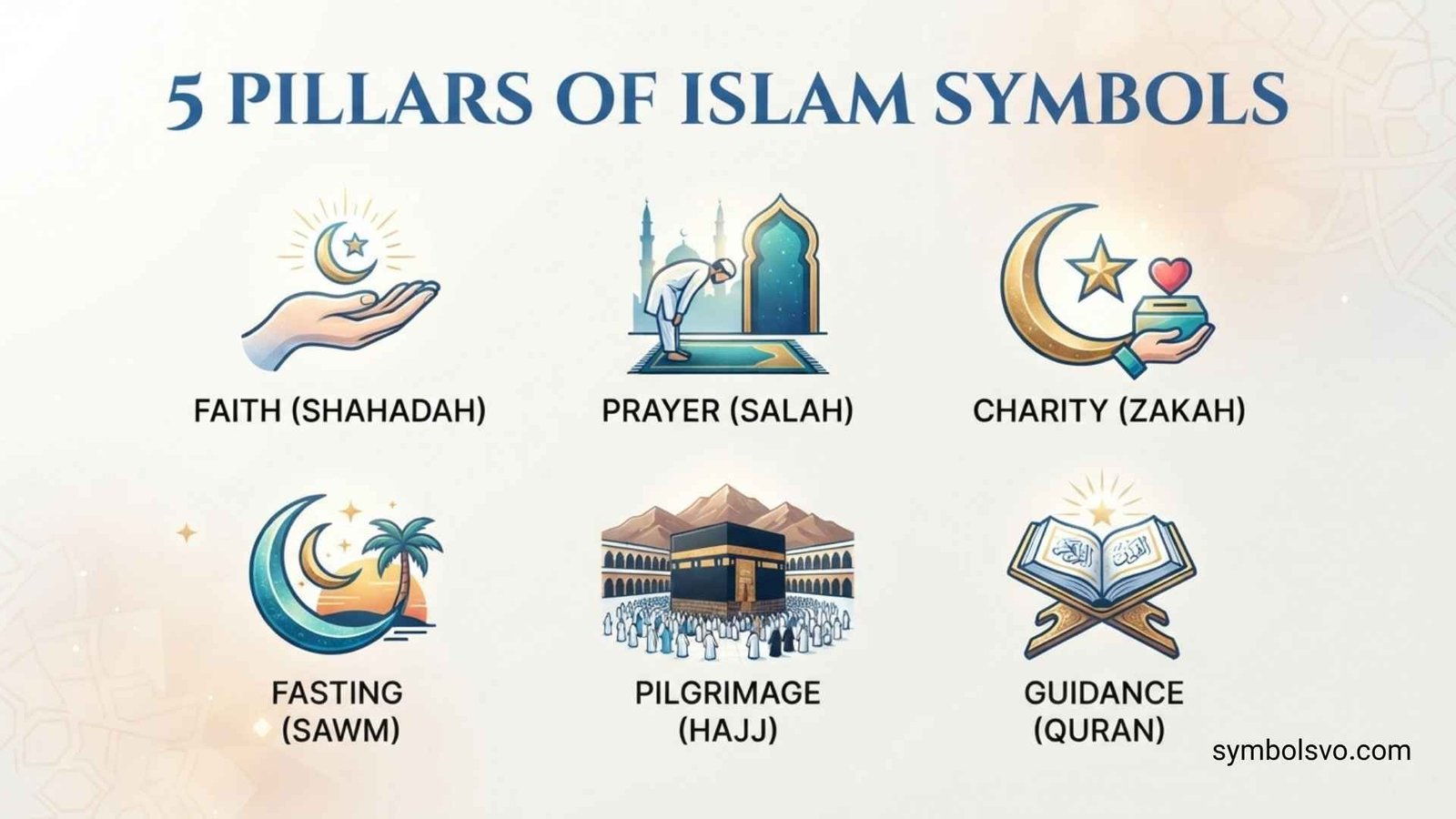
5 Pillars of Islam Symbols represent some of the most meaningful beliefs and practices in Islam. I want to help you understand these symbols in a simple and clear way, so you can discover the deeper meaning behind each pillar.
When you learn about these important symbols, you see how faith, devotion, and daily life connect together. You can explore their importance with a fresh perspective and build a better understanding of Islamic traditions.
I created this guide to make the topic easier for you to follow. You will discover the meaning, purpose, and value of these symbols while I explain their role in the lives of Muslims around the world.
Quick Answer
The 5 pillars of islam symbols are visual and conceptual icons used in Islamic history, education, and art to represent the core obligatory acts of worship: Shahada (Declaration of Faith), Salah (Ritual Prayer), Zakat (Almsgiving), Sawm (Fasting), and Hajj (Pilgrimage). These symbols include exquisite Arabic calligraphy, prayer mats, open giving hands, the crescent moon, and the majestic cubic Kaaba.
Quick Facts About 5 Pillars of Islam Symbols
| Aspect | Information | Origin |
| Historical Significance | Grounded in the Hadith of Gabriel and early Islamic art, tracking the structural growth of the Muslim community. | 7th Century Arabian Peninsula |
| Main Meaning | Structural supports that keep the spiritual roof of a believer’s faith secure and properly balanced. | Classical Islamic Theology |
| Spiritual Meaning | The path of complete soul alignment, purification of ego, and continuous mindfulness of the Divine creator. | Revelations of the Holy Quran |
| Cultural Importance | Forms the baseline of global Muslim unity, architectural design, identity, and daily social rhythms. | Global Muslim Ummah (Community) |
| Modern Usage | Digital infographics, institutional logos, Islamic book illustrations, fine jewelry, and interior home decor. | Modern Global Graphic Design |
What Are 5 pillars of islam symbols?
The concept of the five pillars comes from a famous saying of the Prophet Muhammad, known as the Hadith of Gabriel. In this narration, faith is described as a beautiful building supported by five solid pillars. Without these structural supports, the entire spiritual house would collapse.
Over the centuries, as Islam spread across different continents, artists, teachers, and scholars developed specific visual cues to teach these deep concepts. These icons became known as the 5 pillars of islam symbols. They are not objects of worship themselves, because Islamic theology strictly forbids idolatry. Instead, they serve as beautiful educational tools and artistic expressions. They make abstract theological duties clear, tactile, and visually unforgettable for adults and children alike.
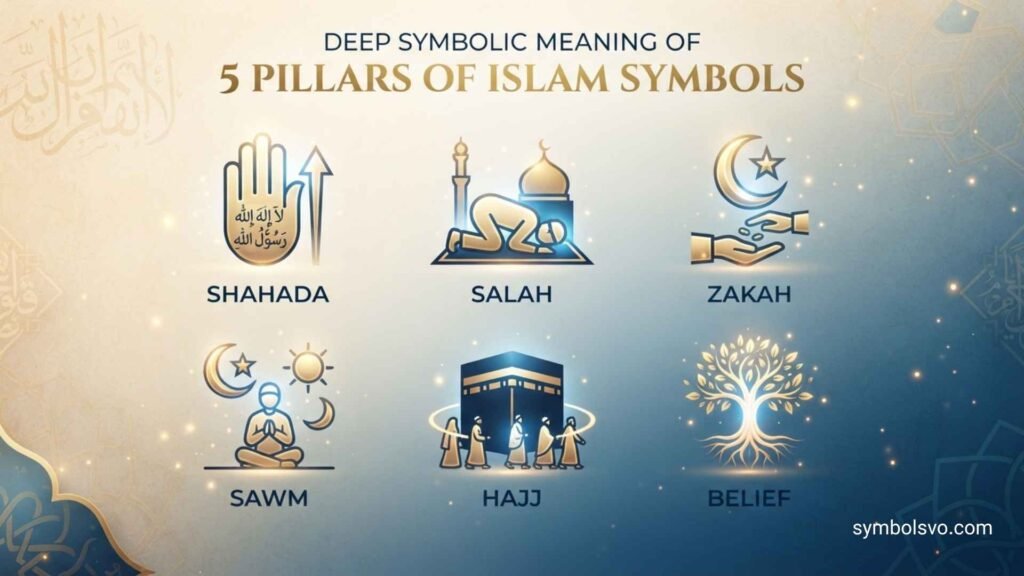
Deep Symbolic Meaning of 5 pillars of islam symbols
Spiritual Level
On a deeply spiritual level, each icon represents a stage of inner transformation. The symbols serve as a mirror for the human soul. For instance, the transition from the declaration of faith to the physical bowing of prayer shows how a thought turns into physical submission. It represents the journey of the human consciousness moving away from the loud distractions of the material world and returning back to its quiet divine source.
Psychological Level
Psychologically, these symbols connect with universal human archetypes. Carl Jung wrote extensively about how symbols reflect the collective deep mind of humanity. The pillars satisfy our natural human craving for structure, rhythm, and moral balance. They act as psychological anchors. In a chaotic world, symbols like the steady prayer mat or the perfectly geometric Kaaba provide the human mind with a deep sense of safety, mental order, and ultimate purpose.
Cultural Level
Culturally, these faith icons foster incredible social harmony. They bridge the gap between people of different languages, races, and financial backgrounds. When a wealthy businessman and a poor laborer look at the symbol of the open hand or stand together facing the Kaaba, their worldly differences melt away entirely. The symbols reinforce the shared cultural belief that everyone is completely equal before the Creator.
Types and Variations of 5 pillars of islam symbols
1. The Shahada (The Declaration of Faith)
- Visual Description: Elegant Arabic calligraphy spelling out the testimony of faith, often sweeping upward in graceful black or gold fluid strokes.
- Meaning: The absolute oneness of God and the recognition of Muhammad as His final messenger.
- Symbolism: Spiritual awakening, the ultimate truth, and the absolute focus of human life.
- Cultural Connection: Found on national flags, entryways of homes, and beautifully hand-painted wall canvases.
- Where It Appears: Islamic architecture, sacred manuscripts, coins, and traditional textiles.
2. The Salah (The Five Daily Prayers)
- Visual Description: A stylized silhouette of a worshipper kneeling in deep prostration, or a beautifully woven prayer rug featuring a pointed arch pattern.
- Meaning: Direct, unmediated daily communication between the creation and the Creator.
- Symbolism: Humility, stripping away the human ego, and the sacred gateway into Paradise.
- Cultural Connection: Dictates the entire daily schedule and audio atmosphere of Muslim cities through the rhythmic call to prayer.
- Where It Appears: Mosque minarets, educational posters, and daily religious mobile applications.
3. The Zakat (The Obligatory Almsgiving)
- Visual Description: A pair of open, welcoming hands holding a glowing coin, or a classic balanced scale of justice.
- Meaning: Giving away a mandatory two point five percent of one’s accumulated annual wealth to the people with low-income.
- Symbolism: Social purification, breaking the dangerous grip of human greed, and cosmic balance.
- Cultural Connection: Inspires massive community food drives, charity organizations, and institutional social safety nets.
- Where It Appears: Charity collection boxes, community center logos, and financial accounting books.
4. The Sawm (Fasting During Ramadan)
- Visual Description: A slender, glowing crescent moon paired with a traditional glowing glass lantern or a small plate of ripe dates.
- Meaning: Complete abstinence from food, drink, and negative behaviors from dawn until the sun sets.
- Symbolism: Spiritual mastery over physical desires, deep empathy for the hungry, and inner illumination.
- Cultural Connection: Sparks vibrant night markets, festive family gatherings, and deep community bonds after dark.
- Where It Appears: Greeting cards, television holiday broadcasts, and seasonal city street decorations.
5. The Hajj (The Sacred Pilgrimage)
- Visual Description: The stark black and gold geometric cube of the Kaaba surrounded by flowing white concentric circles.
- Meaning: The ultimate journey to the holy city of Mecca that every able Muslim must take once in their life.
- Symbolism: Perfect human equality, the center of the spiritual universe, and a complete spiritual rebirth.
- Cultural Connection: Gathers millions of diverse humans together, creating a beautiful global mosaic of unity.
- Where It Appears: Travel agency posters, historic oil paintings, and millions of living room wall frames.
5 pillars of islam symbols Across Different Cultures
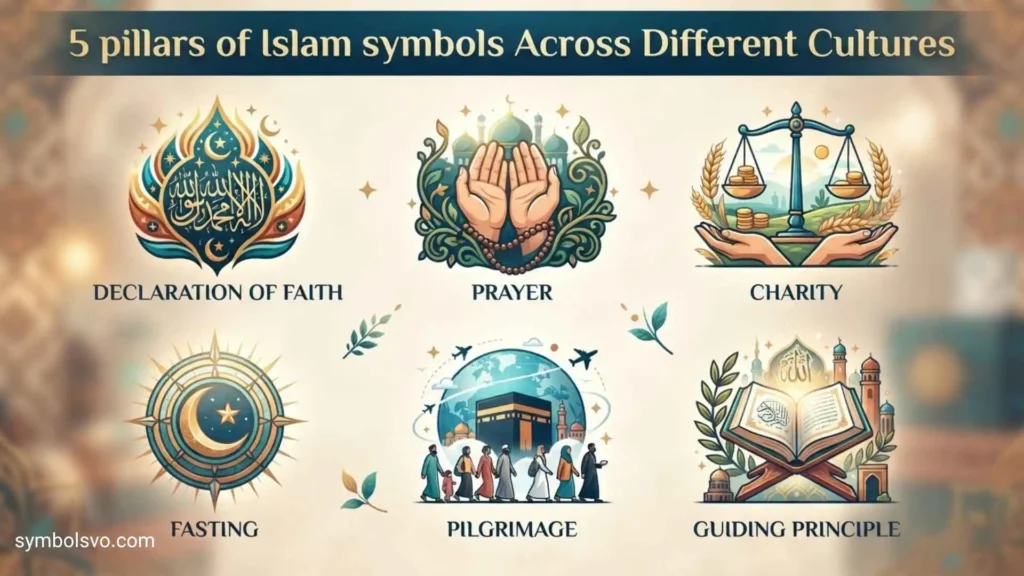
Islamic iconography has touched and interacted with many geographic cultures over the last millennium.
- Persian and Mughal Traditions: In these historic cultures, the symbols were woven into incredibly detailed miniature paintings and royal court tapestries, featuring elaborate floral borders and stunning turquoise color palettes.
- North African and Moorish Culture: Here, the symbols became highly geometric. The prayer arch and calligraphy were translated into intricate tile mosaics called zellij, which adorned public fountains and massive university walls.
- East Asian Traditions: In Chinese Muslim communities, the Shahada calligraphy was gracefully adapted to match classic Chinese brushwork styles, using traditional ink rolls and bamboo frames.
- Sub-Saharan African Traditions: The symbols were expressed through stunning mud-brick mosque architecture, such as the famous structures in Djenné, where the physical pillars of the buildings visibly mirrored the five pillars of faith.
- Modern Western Interpretations: In today’s modern European and American spaces, the symbols have shifted toward clean, minimalist lines and flat vector designs used in educational apps and contemporary publishing.
Similar Symbols and Their Meanings
It is highly beneficial to compare how these Islamic icons relate to similar symbols in other major world traditions to avoid common misunderstandings.
| Islamic Symbol | Comparable World Symbol | Shared Meaning | Core Difference |
| The Kaaba (Hajj) | Axis Mundi / Sacred Center | The center of spiritual focus and cosmic connection. | The Kaaba is a focus direction for prayer, never an object of worship. |
| The Open Hand (Zakat) | Buddhist Varada Mudra | Charity, boundless generosity, and open offering. | Zakat is a mandatory societal duty, not just a voluntary act of compassion. |
| Crescent Moon (Sawm) | Lunar Calendar Markers | Tracking sacred time and seasonal changes. | In Islam, it marks the specific start of internal spiritual fasting, not a deity. |
5 pillars of islam symbols in Art, Literature, and Pop Culture
In classical art, these icons formed the bedrock of complex architectural spaces. Architects used the rhythm of physical arches to remind people of the daily prayers. In literature, famous Sufi poets like Rumi used the symbols of the fast and the pilgrimage as metaphors for the inner longing of the human soul searching for its maker.
In modern pop culture, these symbols have made a powerful leap into contemporary fashion, high-end graphic branding, and social media media. You will find minimal Kaaba lines on sleek travel mugs, beautiful silver necklaces shaped like the Ramadan crescent moon, and bold typographic calligraphy prints hanging in modern metropolitan art galleries.
Spiritual and Dream Meaning of 5 pillars of islam symbols
Seeing these profound icons in dreams or deep meditation often carries significant personal meaning.
- Dreaming of the Kaaba: This often indicates a deep internal desire for stability, finding your true center, or a subconscious call to embark on a major life transition.
- Dreaming of the Ramadan Moon: This is widely interpreted as a positive sign of upcoming renewal, emotional healing, and the washing away of past difficulties.
- Dreaming of Giving Charity: This serves as a gentle psychological prompt to let go of hidden anxieties about financial security and open your heart to community service.
Positive and Balanced Meanings of Faith Symbols
Islamic theology teaches that every beautiful symbol has a light that guides, but misinterpreting it can lead to spiritual emptiness.
| Authentic Spiritual Light | Misunderstood Shadow Practice |
| Sincere Prayer (Salah): True inner peace, deep humility, and connecting with the Creator. | Performative Worship: Praying purely to be seen by others to gain social status. |
| Generous Giving (Zakat): Purifying your money and actively helping the poor. | Arrogant Philanthropy: Giving money to make yourself feel superior to the needy. |
| Dedicated Fasting (Sawm): Developing ultimate self-control and deep empathy. | Empty Starvation: Fulfilling the ritual physically while keeping a bitter heart. |
Why Humans Are Attracted to 5 pillars of islam symbols
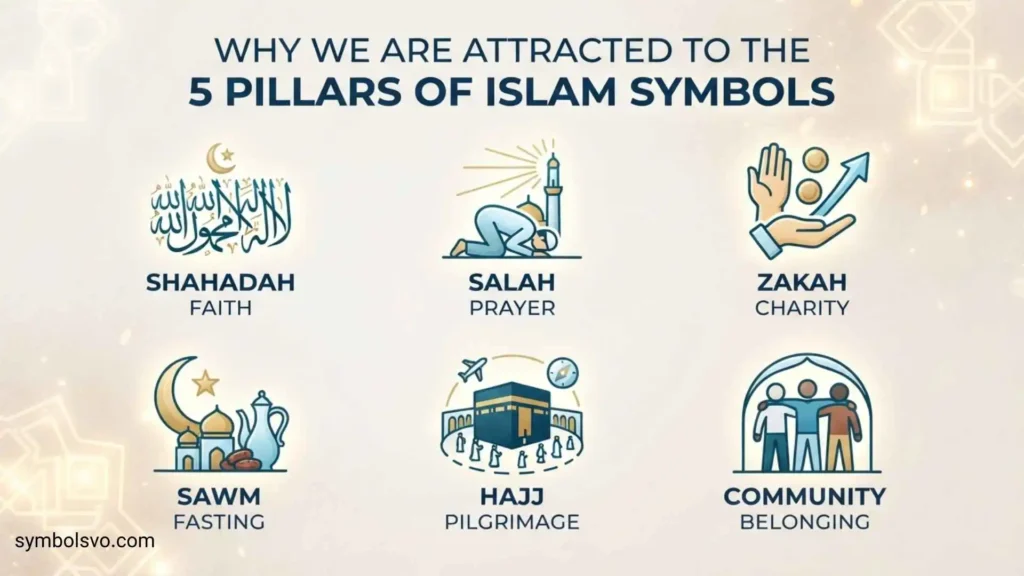
Our human brain is hardwired to look for clear patterns and deep meanings. We naturally reject chaos. The 5 pillars of islam symbols provide a beautiful visual language for complex, heavy metaphysical realities.
By turning huge, abstract ideas like divine justice and cosmic balance into concrete shapes like a coin or a crescent moon, our minds can process them much easier. They connect our daily physical lives with the infinite universe, making us feel grounded, safe, and deeply unified with a global family.
Interesting Facts About 5 pillars of islam symbols
- The Golden Ratio: Many modern architectural designers have discovered that the classic proportions of the Kaaba symbol perfectly align with the pleasing aesthetics of the golden ratio.
- The Calligraphy Trick: The flowing calligraphy of the Shahada is intentionally designed so that your lips do not have to move much to pronounce it, symbolizing ease and quick entry into faith.
- Astronomy Links: The symbol of the Sawm moon directly connected historical Islamic societies to advanced global astronomy, as tracking the thin moon required highly precise mathematical calculations.
- The Single Fabric: The simple white garment symbolized in Hajj icons is completely seamless, representing how all human divisions are erased in the eyes of God.
- The Weight of the Scale: In historic Islamic legal documents, the symbol of Zakat was often stamped alongside official state seals to show that economic fairness was a legal foundation.
Frequently Asked Questions
Are the 5 pillars of islam symbols considered holy objects?
No, they are absolutely not holy objects or items of worship. Islam has a strict rule of monotheism. These symbols are strictly pedagogical tools and artistic expressions designed to remind people of their duties to God.
Why is the crescent moon used to represent fasting?
The crescent moon, known as the Hilal, is used because the Islamic calendar is completely lunar. The visual sighting of the new crescent moon is what officially triggers the beginning and the end of the holy fasting month of Ramadan.
Can these symbols be used in home decorations?
Yes, millions of families use these symbols in beautiful canvas paintings, wooden carvings, and metal wall hangings to create a mindful, peaceful, and spiritually oriented home environment.
What is the most widely recognized symbol among the five?
The geometric cube of the Kaaba is universally recognized as the most iconic visual symbol, as it represents the singular point toward which every single Muslim faces during their daily prayers.
Conclusion
The 5 pillars of islam symbols are far more than historical artifacts or simple icons. They are a living, breathing visual map that connects ancient history with modern daily life. By bringing together art, history, psychology, and deep devotion, these timeless faith icons remind us that true spiritual structure can bring profound peace, balance, and unity to our beautifully complex human world.

 Mason Ellington
 Grace Whitmore
 Daniel Brooks