I’ve always been drawn to symbols that carry more weight than words ever could, and Palestine symbols do exactly that. When you look closer, you start to see layers of history, resilience, and identity woven into each one.
You deserve clear, honest information that helps you understand these symbols without noise or confusion. They offer a quiet window into stories that matter to millions.
I want you to feel confident exploring them so every detail you learn can deepen your perspective and respect for what they represent.
Quick Answer
Palestine symbols are a collection of cultural, natural, and artistic emblems—such as the black-and-white keffiyeh scarf, the ancient olive tree, Handala the cartoon refugee child, and the watermelon—that represent Palestinian national identity, ancestral connection to the land, and unbreakable resistance against political erasure and military occupation.
Quick Facts About Palestine Symbols
| Aspect | Information | Origin |
| Historical Significance | Reclaiming indigenous identity and preserving memory through decades of exile. | British Mandate & 1948 Nakba |
| Main Meaning | Sumud (steadfastness), cultural preservation, and the right of return. | Palestinian working class and rural farmers |
| Spiritual Meaning | Sacred ties to the land, holy spaces, divine justice, and generational continuity. | Abrahamic faiths and ancient agricultural rites |
| Cultural Importance | Fuses art, dress, cuisine, and flora into a unified visual vocabulary of defiance. | Levantine heritage and village folklore |
| Modern Usage | Digital emojis, global street art, protest fashion, and human rights iconography. | Global solidarity movements |
What Are Palestine Symbols?
Palestine symbols are the visual vocabulary of a nation surviving without formal state borders. Historically, these emblems grew out of the daily rhythms of Palestinian life under successive empires, including the Ottoman and British administrations. However, their meanings completely shifted during the mid-twentieth century.
Following the 1948 Nakba, which translates to “the catastrophe” and marked the displacement of over 750,000 Palestinians, these ordinary objects were transformed into profound political statements.
When an occupying force strips away a people’s passport, controls their movement, and even bans their physical flag, the culture adapts. The people find new ways to say “we are still here.”
Ordinary agricultural items like an orange or an olive tree ceased to be mere food. They became legal deeds written in soil. Artistic creations became flags, and headdresses became uniforms of solidarity. Over time, these symbols evolved from localized markers of rural identity into universally recognized icons of human rights, self-determination, and anti-colonial resistance.
Deep Symbolic Meaning of Palestine Symbols
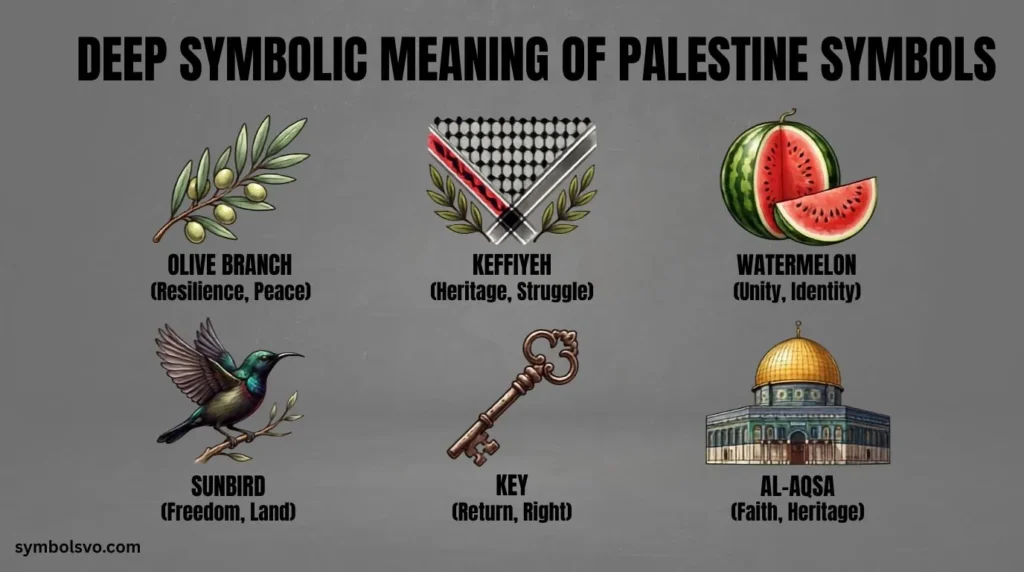
To truly comprehend these icons, we must look at them through three distinct lenses: the spiritual, the psychological, and the cultural.
The Spiritual Level
On a spiritual level, Palestine symbols reflect a deep sacred connection to the earth. In Palestine, land is not a commodity bought and sold; it is an extension of the soul. Symbols like the olive tree or the ancient stones of Jerusalem represent a sacred trust that bridges the human and the divine. The concept of Sumud (steadfastness) is treated almost as a spiritual discipline. It is the quiet, unchanging choice to remain rooted in truth and justice, even when the surrounding world is completely upended.
The Psychological Level
Psychologically, these symbols function as collective anchors. They speak directly to archetypes of the exiled wanderer, the resilient survivor, and the innocent child. In Jungian psychology, a symbol holds power because it expresses something that words cannot fully capture. For a community scattered across the globe in a vast diaspora, seeing a shared symbol evokes a powerful sense of belonging. It heals the psychological fracture of displacement, keeping the collective memory whole across generations.
The Cultural Level
Culturally, these symbols are woven into everyday life. They are found in the rhythmic thump of the Tatreez (traditional embroidery) needle, the shared stories during the autumn olive harvest, and the proverbs passed from grandmothers to children. They reinforce community bonds by reminding every individual that their personal story is part of a massive, unbreakable collective history.
Palestine Symbol Text
Palestine symbol text refers to characters, emojis, words, and visual elements that people use to represent Palestinian identity. The most recognizable text symbol is 🇵🇸, which represents the Palestinian flag.
Other text-based representations include:
- 🇵🇸 Palestine
- Free Palestine
- Palestine Forever
- فلسطين
- فلسطين 🇵🇸
- غزة
- Gaza 🇵🇸
Arabic text is also important because Arabic is the main language associated with Palestinian cultural and national expression.
Palestine Symbols and Their Meanings
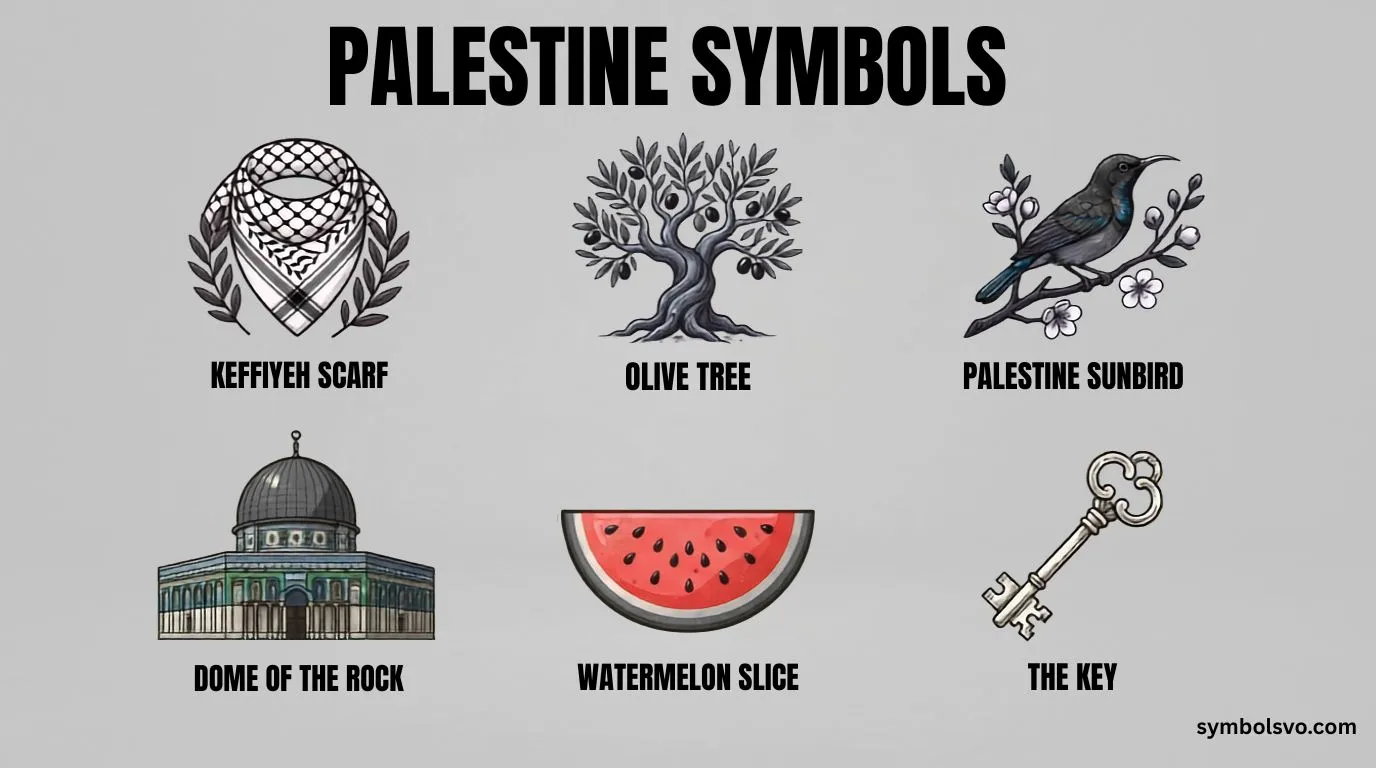
Palestine has several symbols connected with national identity, heritage, agriculture, history, and cultural traditions. The Palestinian flag represents national identity, while the olive tree is strongly associated with Palestinian land, agriculture, endurance, and heritage.
The keffiyeh is another widely recognized Palestinian cultural symbol. Its distinctive pattern has become associated internationally with Palestinian identity and solidarity. The watermelon has also become a contemporary symbol of Palestinian identity and solidarity, partly because its colors correspond to the Palestinian flag.
Other important symbols include traditional embroidery, especially tatreez, which carries cultural and regional significance.
Palestine Symbols of Resistance
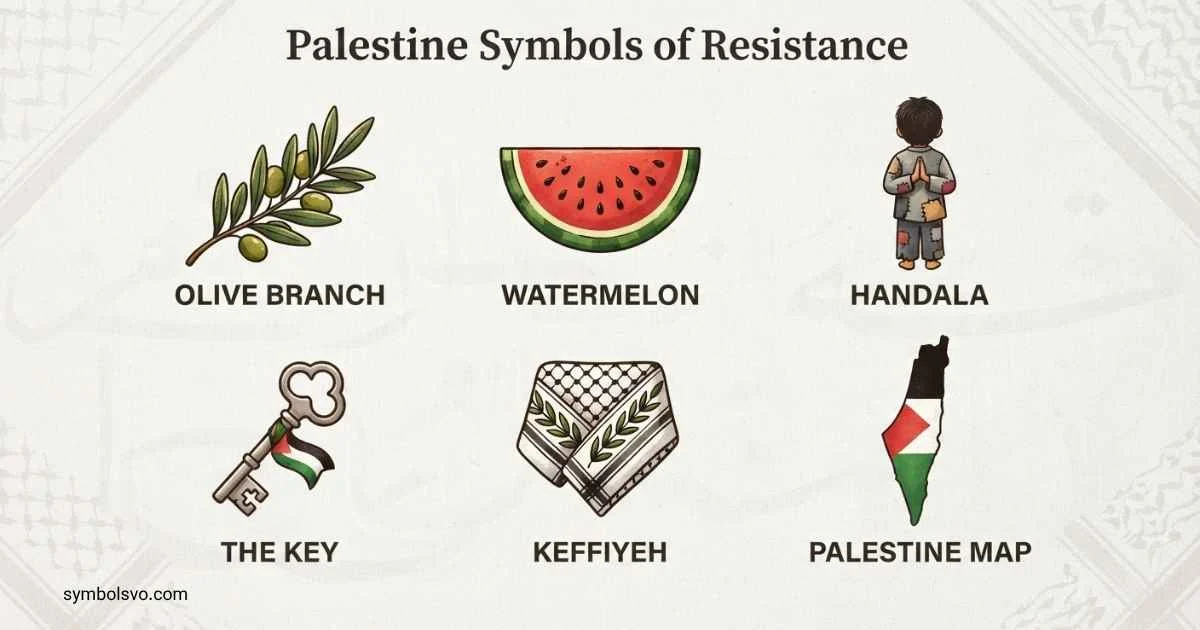
Symbols of Palestinian resistance have changed over time and can carry political, cultural, or historical meanings. The keffiyeh, Palestinian flag, olive tree, and watermelon are among the symbols frequently seen in expressions of Palestinian solidarity.
The keffiyeh in particular became internationally recognizable as a symbol connected with Palestinian identity and resistance. The olive tree can represent attachment to land and cultural continuity, while the watermelon became especially prominent in modern visual expressions of Palestinian solidarity.
These symbols can have different meanings depending on the historical period and context in which they are used.
Free Palestine Symbols
Free Palestine symbols are commonly used in posters, social media graphics, artwork, and demonstrations expressing support for Palestinian freedom and rights. The Palestinian flag 🇵🇸 is one of the most recognizable symbols used alongside the phrase.
Other commonly associated imagery includes:
- 🇵🇸 Palestinian flag
- 🫒 Olive branches and olive trees
- 🍉 Watermelon imagery
- Keffiyeh patterns
- Palestinian tatreez designs
- Arabic calligraphy
- Map imagery representing Palestine
The symbolism behind these elements generally focuses on Palestinian identity, heritage, solidarity, and connection to the land.
Pro Palestine Symbols
Pro-Palestine symbols are visual or textual elements used to express solidarity with Palestinians. The Palestinian flag, keffiyeh, olive branch, watermelon, and traditional tatreez are among the most recognizable examples.
The watermelon symbol is particularly notable because its red, green, white, and black colors resemble the colors of the Palestinian flag. It has therefore become a widely used visual shorthand for Palestinian solidarity in situations where people may prefer imagery over political slogans.
Palestine National Symbols
Palestine’s national symbols include elements that represent Palestinian national identity and heritage. The Palestinian flag is the most recognizable national symbol. Other important symbols include the national emblem, traditional cultural dress, olive trees, and tatreez embroidery.
The Palestinian flag consists of black, white, and green horizontal bands with a red triangle at the hoist. These colors are traditionally associated with Arab history and identity.
The olive tree is also deeply connected with Palestinian agriculture and cultural heritage, particularly in communities where olive cultivation has been practiced for generations.
Symbols for Palestine
People use different symbols for Palestine depending on whether they want to represent the country, its people, its culture, or solidarity with Palestinians. The Palestinian flag 🇵🇸 is the clearest general-purpose symbol.
Other symbols include:
🇵🇸 Flag: Palestinian national identity
🫒 Olive tree: Land, agriculture, heritage, and continuity
🍉 Watermelon: Contemporary Palestinian solidarity
Keffiyeh: Palestinian cultural identity
Tatreez: Traditional Palestinian embroidery and heritage
فلسطين: Arabic name for Palestine
Together, these symbols communicate different aspects of Palestinian identity.
Lubenica Simbol Palestine
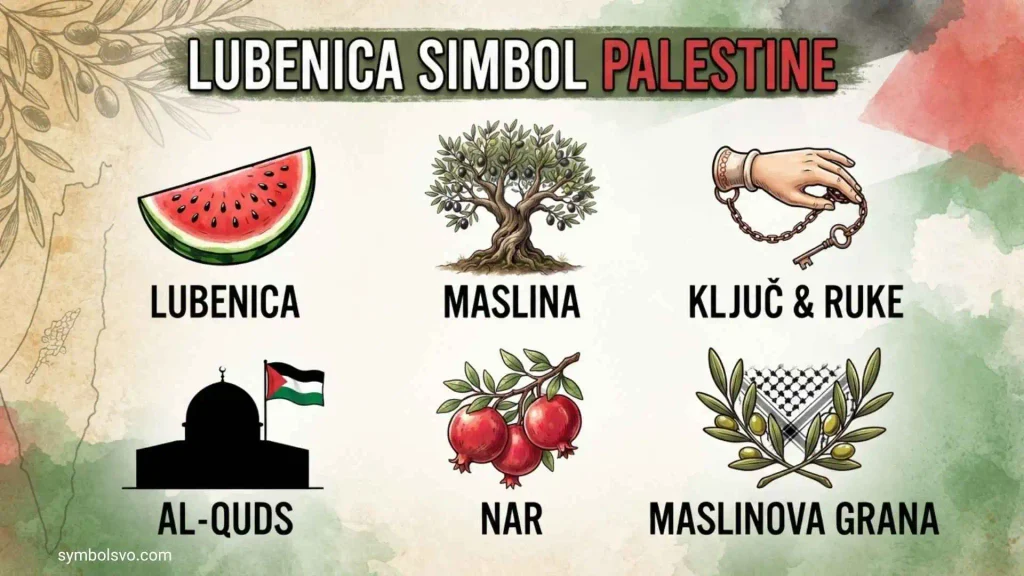
Lubenica means watermelon in several South Slavic languages, and the watermelon has become a recognizable contemporary symbol associated with Palestine and Palestinian solidarity.
Its importance comes partly from its colors. A sliced watermelon contains red, green, white, and black, matching the principal colors of the Palestinian flag. Because of this visual connection, watermelon imagery has been used in Palestinian art, social media, posters, and solidarity campaigns.
The watermelon is therefore more than a fruit in this context; it can function as a visual reference to Palestinian identity and solidarity.
Palestinian Key Symbol
The Palestinian key is an important symbol connected with Palestinian displacement and the memory of homes left behind by Palestinian refugees. Keys are often depicted in Palestinian art, photographs, monuments, and cultural expressions.
The key represents the idea of a home and the hope or claim of return. For many Palestinians, an old family key can carry personal and historical significance because it may be connected to a house or village from which a family was displaced.
As a symbol, the key therefore represents home, memory, displacement, and return.
Palestinian Cultural Symbols
Palestinian culture has a rich collection of symbols connected with clothing, embroidery, agriculture, food, architecture, and traditional arts.
Some well-known Palestinian cultural symbols include:
- Keffiyeh: Traditional headwear strongly associated with Palestinian identity.
- Tatreez: Traditional Palestinian embroidery with regional patterns and motifs.
- Olive tree: A major part of Palestinian agriculture and cultural heritage.
- Watermelon: A modern symbol of Palestinian identity and solidarity.
- Dabke: Traditional Palestinian and Levantine folk dance.
- Key: Symbol associated with displacement, home, memory, and return.
- Palestinian flag: National identity and representation.
These symbols help preserve cultural memory and communicate identity across generations.
Filistin Direniş Sembolleri
Filistin direniş sembolleri, yani Palestinian resistance symbols, can include the keffiyeh, olive tree, Palestinian flag, watermelon, and key. Each carries a different cultural or historical association.
The keffiyeh is strongly associated with Palestinian identity and has become an internationally recognized symbol of solidarity. The olive tree represents a longstanding connection with the land, while the key is connected with memories of homes and displacement.
The watermelon is a more contemporary symbol that became popular as a visual representation of Palestinian identity and solidarity.
Things That Represent Palestine
Many things can represent Palestine because Palestinian identity is expressed through national, cultural, historical, and agricultural symbols.
Some of the most recognizable are:
- Palestinian flag 🇵🇸
- Olive tree
- Keffiyeh
- Tatreez embroidery
- Watermelon 🍉
- Traditional Palestinian key
- Dabke
- Arabic calligraphy
- Palestinian traditional clothing
- Olive branches
These representations show that Palestine is associated not only with political identity but also with longstanding cultural traditions and everyday life.
Palestine Symbolism
Palestine symbolism often centers on identity, land, heritage, memory, resilience, and cultural continuity. The meaning of an individual symbol can vary according to historical and personal context.
The olive tree is commonly connected with land and agricultural heritage. The keffiyeh represents Palestinian cultural identity, while tatreez preserves traditional embroidery practices. The key represents memories of home and displacement, and the watermelon has developed into a contemporary symbol of Palestinian solidarity.
Together, these symbols create a visual language through which Palestinian history and culture can be communicated.
Gaza Symbols
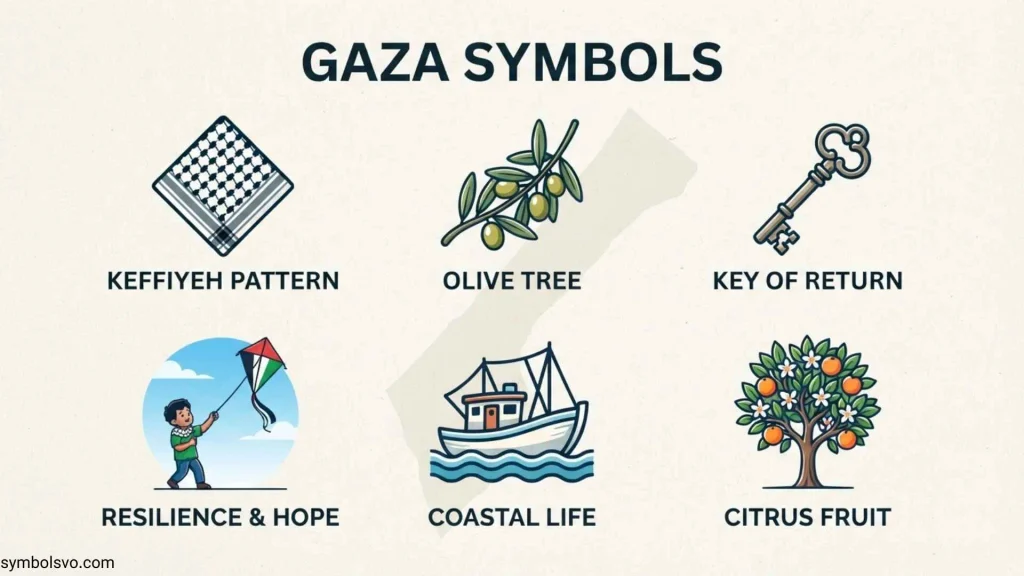
Gaza has become associated with several symbols used in cultural, humanitarian, and solidarity contexts. The Palestinian flag, olive branch, watermelon, and Arabic calligraphy are commonly used in visual representations connected with Gaza and Palestine.
The word Gaza is written in Arabic as غزة. Images of the sea, traditional Palestinian patterns, olive branches, and Palestinian colors may also appear in artwork representing Gaza.
It is important to distinguish between symbols representing Gaza specifically and symbols representing Palestine as a whole. Many symbols used in connection with Gaza are broader Palestinian symbols rather than exclusive symbols of the Gaza Strip.
Types and Variations of Palestine Symbols
1. The Palestinian Keffiyeh
- Visual Description: A square cotton scarf features a distinct black-and-white pattern composed of interlocking nets, sweeping waves, and thick borders.
- Meaning and Symbolism: It represents the working-class roots of the nation and global solidarity. The fishnet pattern honors Mediterranean fishers, the wavy lines represent trade routes, and the leaf-like shapes represent olive branches.
- Where It Appears: Worn at political rallies, featured in street art, used in contemporary fashion worldwide, and documented in traditional portrait photography.
2. The Olive Tree
- Visual Description: Gnarled, twisting silver-green trees with deep roots, capable of living for thousands of years in dry, rocky soil.
- Meaning and Symbolism: It stands for peace, longevity, unyielding strength, and an undeniable historical footprint on the land.
- Where It Appears: Central to Levantine agriculture, celebrated in Mahmoud Darwish’s poetry, depicted in wood carvings, and featured in political cartoons.
3. Handala
- Visual Description: A cartoon drawing of a ten-year-old boy in ragged clothes, with spiky hair, barefoot, and always showing his back to the viewer with his hands clasped behind him.
- Meaning and Symbolism: Created by cartoonist Naji al-Ali, Handala represents the frozen childhood of the Palestinian refugee. He turns his back to protest a world that turned its back on his people. He will only turn around when Palestine is free.
- Where It Appears: Painted on the West Bank separation wall, worn as silver jewelry, utilized in protest posters, and featured in political cartoons.
4. The Watermelon
- Visual Description: A sliced wedge of watermelon showing bright red flesh, a green rind, a thin white inner layer, and black seeds.
- Meaning and Symbolism: It is an ingenious symbol of anti-censorship resistance. Because it perfectly matches the four colors of the banned Palestinian flag, it allowed people to display their identity safely.
- Where It Appears: Digital spaces as an emoji, protest banners, graphic design, and urban murals.
5. The Return Key
- Visual Description: Heavy, old-fashioned iron or brass keys, often rusted, handed down through generations.
- Meaning and Symbolism: The literal keys to the physical homes abandoned during the 1948 Nakba. They represent the sacred Right of Return and the refusal to forget home.
- Where It Appears: Displayed in refugee camp archways, worn as necklaces, and kept safe in family treasure boxes.
Palestine Symbols Across Different Cultures
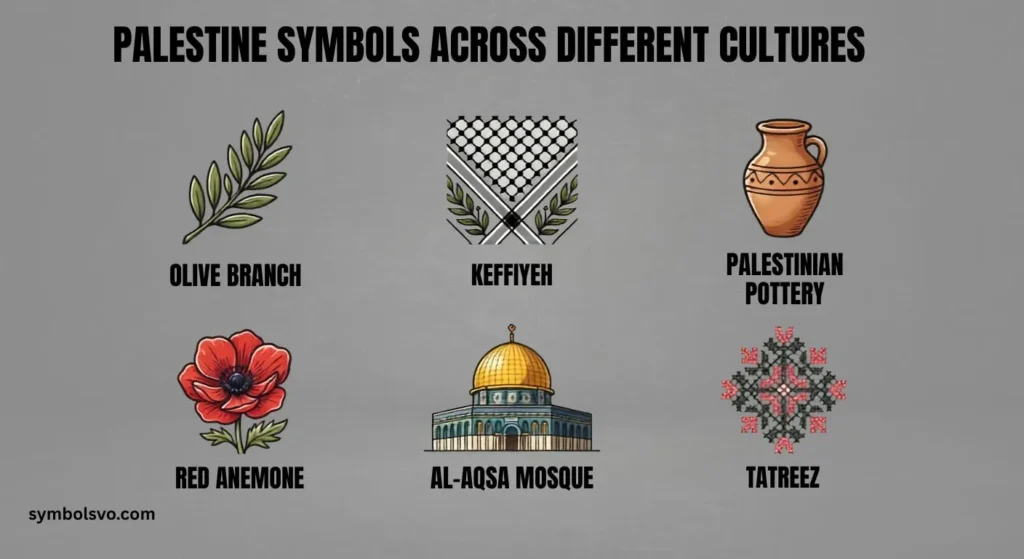
While these symbols are deeply tied to Palestine, their underlying motifs mirror icons found throughout human civilization:
- Ancient Egypt: The Egyptian reverence for the lotus flower as a symbol of rebirth and rising from the mud mirrors how Palestinians view the Poppy Flower (Anemone coronaria), which bursts from dry ground every spring.
- Ancient Greece: The Greek use of the olive branch to represent peace and civic pride aligns perfectly with the Palestinian view of the olive tree as a monument of endurance and peace.
- Roman Culture: Roman agricultural symbols celebrated the connection between the empire’s power and its wheat fields. In Palestine, the wild Cactus Pear (Sabr) functions similarly, mapping the ancient boundaries of forgotten villages.
- Eastern Traditions: In ancient Chinese and Silk Road traditions, intricate textile patterns on silk mapped a person’s region and status. This directly parallels the language of Tatreez, where different geometric stitch patterns indicate a woman’s specific Palestinian hometown.
- Indigenous Traditions: Native American and First Nations connections to ancestral land, where geographical features are treated as living relatives, directly echo the Palestinian worldview, where uprooting an olive tree is felt as deeply as losing a family member.
Similar Symbols and Their Meanings
To fully understand Palestine symbols, it helps to see how they contrast and relate to other global icons of struggle and survival.
| Symbol | Similarities | Differences | Relationship |
| Palestinian Keffiyeh vs. Scottish Tartan | Both are textiles whose specific patterns identify a wearer’s geographic roots and clan history. | Tartans represent established clans; the Keffiyeh shifted from rural wear to a unified national flag of resistance. | Both use fabric to preserve national pride against assimilation. |
| The Return Key vs. The Celtic Triskele | Both represent a long journey home and the cyclical nature of time and memory. | The Triskele is an abstract spiritual spiral; the Key is a physical, historical object tied to a specific house. | Both honor ancestral memory and continuity across generations. |
| Handala vs. The Irish Sham-Rock | Both are simple visual shorthand used to immediately evoke a specific national identity. | The Sham-rock represents luck and faith; Handala is a political witness to injustice and displacement. | Both became global icons for diasporas scattered across the world. |
Palestine Symbols in Mythology and Folklore
In Levantine folklore, the flora and fauna of Palestine are alive with mythic meaning. For example, the Sabr Cactus gets its name from the Arabic word for patience. Traditional stories tell of how the cactus acts as a silent guardian. Because it is incredibly difficult to kill and regrows from its own pads, elders tell folklore stories of how the cactus remembers the exact locations of the hundreds of Palestinian villages destroyed after 1948.
Similarly, the Anemone Poppy flower, known locally as Hannoun (the passionate one), holds a sacred place in rural poetry. Folklore states that these bright red flowers do not just grow randomly; instead, they are said to bloom wherever a martyr’s blood was spilled on the earth.
This blends ancient Canaanite myths of rebirth with modern realities of loss, turning the spring landscape into a living memorial.
Palestine Symbols in Art, Literature, and Pop Culture
In modern times, these symbols have entered the global cultural bloodstream. Famous artists like Sliman Mansour have used images of women carrying massive olive harvests or bearing the weight of Jerusalem on their backs to create iconic paintings. In literature and poetry, the legendary writer Mahmoud Darwish used the olive tree as a central character in his prose, writing lines that reminded the world that the tree’s roots predate any modern political border.
Today, you can see these symbols everywhere. They appear in high-fashion streetwear collections that incorporate the keffiyeh print, as well as in delicate silver jewelry shaped like Handala or the outline of historic Palestine. On social media, millions of people use the watermelon emoji to bypass algorithmic censorship, transforming a simple piece of fruit into a globally recognized digital icon of human rights advocacy.
Spiritual and Dream Meaning of Palestine Symbols
When these symbols appear in dreams or meditative states, they often carry deep psychological and spiritual messages:
- Dreaming of an Olive Tree: This represents a profound inner awakening, showing that you have deep, stable roots that can withstand any temporary emotional storm. It is a sign of long-term healing and inner peace.
- Dreaming of a Key: This indicates that you are about to unlock a hidden part of your own potential, or it may mean you are finally ready to find your true emotional “home” after a long period of feeling lost.
- Dreaming of Handala: This acts as a quiet, powerful message from your subconscious. It asks you to pay attention to your inner child, stand up for your values, and refuse to compromise your integrity when facing difficult situations.
Positive and Negative Meanings of Palestine Symbols
Like all powerful, enduring cultural icons, these symbols hold dual meanings depending entirely on the perspective of the observer.
| Positive Meaning (Light) | Negative Meaning (Shadow) |
| The Keffiyeh: Solidarity, human rights, survival, and pride. | The Keffiyeh: Misunderstood by some western institutions as a controversial or polarizing political statement. |
| The Olive Tree: Peace, fertility, and ancient heritage. | The Olive Tree: A painful reminder of loss when ancient groves are cut down or burned. |
| The Return Key: Hope, justice, international law, and family legacy. | The Return Key: The heavy heartbreak of ongoing exile and unfulfilled promises. |
Why Humans Are Attracted to Palestine Symbols
Our deep attraction to these symbols comes down to basic human psychology. The human brain is naturally wired for pattern recognition, and we look for visual stories to help us make sense of a chaotic world. These emblems tap directly into the collective unconscious, triggering universal archetypes that everyone understands: the archetype of the home, the struggle for freedom, and the survival of the underdog.
When you look at an ancient key or a resilient cactus, your mind immediately connects with the pure emotion behind it. These symbols allow us to look at a complex geopolitical situation and see the real human hearts involved. They turn an abstract political debate into a deeply relatable story of love, family, and home.
Modern Uses of Palestine Symbols
In today’s interconnected world, Palestine symbols have broken out of traditional cultural spaces and entered modern daily life:
- Tattoos: Many younger Palestinians and international activists choose to ink the outline of an olive branch, Handala, or intricate Tatreez patterns onto their skin as a permanent statement of identity.
- Jewelry: Elegant gold and silver necklaces shaped like the historic map of Palestine or the Return Key are worn daily by millions worldwide.
- Digital Expression: The watermelon emoji is used globally across TikTok and Instagram to show solidarity, create community, and keep discussions visible.
- Street Art: Massive murals of Handala and the keffiyeh pattern can be found on city walls from Belfast to Valparaíso, linking the Palestinian cause to global human rights struggles.
Interesting Facts About Palestine Symbols
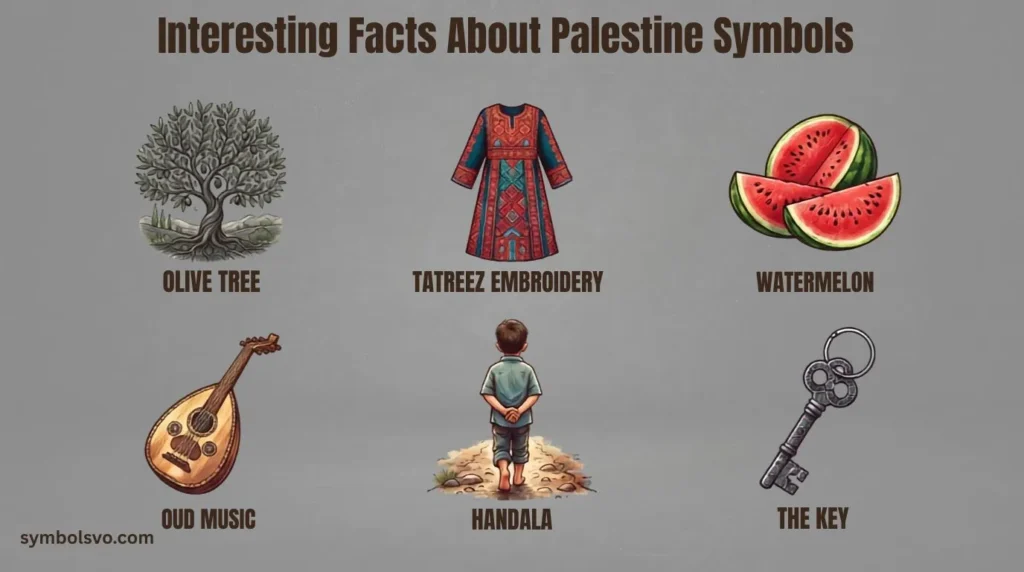
- The oldest known olive tree in Palestine, nicknamed Al-Badawi in the village of Al-Walaja, is estimated to be between 4,000 and 5,000 years old.
- The white keffiyeh was originally worn exclusively by rural farmers to wipe away sweat, while city dwellers wore the Ottoman tarboosh hat. The pattern was adopted by everyone in 1938 to protect freedom fighters’ identities.
- Handala has remained exactly ten years old since his creation in 1969, because that was the exact age his creator was when he was forced to flee his home.
- The national flower of Palestine is actually the rare Faqqua Iris, but the common red poppy is much more popular because its colors naturally match the flag.
- Hirbawi, located in Hebron, is the last remaining traditional factory weaving authentic Palestinian keffiyehs inside the country today.
Frequently Asked Questions
Why is the watermelon a symbol for Palestine?
The watermelon became a symbol after the 1967 war, when the display of the Palestinian flag was banned in public spaces. Because a sliced watermelon contains red flesh, a green skin, a white rind, and black seeds, it allowed people to safely show the national colors without getting arrested.
What do the different patterns on the keffiyeh scarf mean?
The scarf features three main patterns: the fishnet grid represents Palestinian sailors’ connection to the Mediterranean Sea, the sweeping wavy lines represent historic trade routes, and the small leaf prints along the edges represent olive leaves, symbolizing strength and resilience.
Who is the cartoon character Handala?
Handala is an iconic cartoon character created by Palestinian artist Naji al-Ali. He represents a young refugee boy who stands as a witness to the struggles of his people. He always turns his back to the viewer to protest international indifference to the occupation.
Why do Palestinians keep old keys?
Palestinians keep these keys because they are the original, physical keys to the houses and lands their families were forced to leave behind during the 1948 Nakba. They are preserved as tangible proof of ownership and as an enduring symbol of their right to return home.
Conclusion
Ultimately, Palestine symbols prove that while buildings can be destroyed and borders can be redrawn, a people’s culture cannot be erased. From the protective weave of the black-and-white keffiyeh to the deep, thousands-of-years-old roots of the olive tree, these icons keep the memory of a beautiful homeland alive. They remind us that survival is not just about existing; it is about holding onto your identity, telling your story, and refusing to let the world forget where you come from..

I’m Nathan Holloway, a passionate researcher and writer with a deep interest in symbols, signs, and their hidden meanings. I enjoy exploring how symbols have influenced different civilizations, religions, and modern communication. Through my work, I aim to make complex historical and cultural concepts easy to understand for readers of all backgrounds. Every article I write is carefully researched to provide reliable and engaging information.
Books:
- Beyond the Symbol
- The Secret Meanings of Everyday Signs
Author 2: Grace Whitmore
Description:
My name is Grace Whitmore, and I love discovering the stories behind the world’s most fascinating symbols. I spend my time researching ancient civilizations, mythology, spiritual traditions, and modern iconography to uncover the meanings people often overlook. I believe that every symbol has a history worth telling, and I enjoy sharing that knowledge in a simple and reader-friendly way.
Books:
- Echoes of Ancient Symbols
- The Symbolic World
 Mason Ellington
 Grace Whitmore
 Daniel Brooks