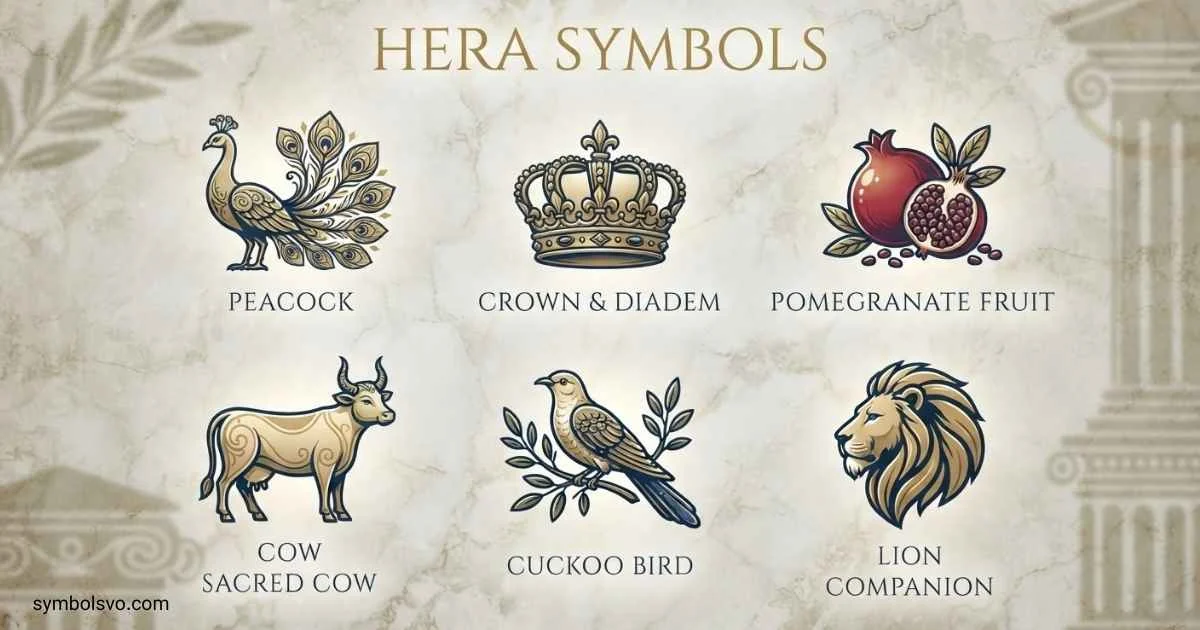
I’ve always found ancient symbols fascinating because they can tell stories without saying a single word. Hera symbols are especially interesting because they reveal important ideas connected with the Greek goddess of marriage, women, and family.
When you explore these symbols, you can see how animals, objects, and natural imagery became connected with Hera in Greek mythology. I’ll walk you through their meanings in a simple and practical way.
Whether you’re studying Greek mythology or simply curious about ancient symbols, you’ll discover what each Hera symbol represents, where it comes from, and why it still captures attention today.
What Are Hera Symbols?
Hera symbols are objects, animals, plants, and visual attributes traditionally associated with Hera in Greek mythology. They help identify the goddess in ancient art and express important parts of her divine role.
The most commonly recognized associations include:
| Hera symbol | Common association |
| 🦚 Peacock | Beauty, majesty, watchfulness, royal splendor |
| 🍎 Pomegranate | Marriage, fertility, abundance, and the mysteries of life |
| 👑 Crown or diadem | Queenship, status, divine authority |
| Scepter | Royal power and sovereignty |
| Cow | Fertility and an important sacred animal |
| Cuckoo | Connected with the myth of Zeus’s courtship of Hera |
| Lily | Sometimes associated with Hera in later traditions |
| Veil | Marriage and the role of bride |
Not every modern list gives Hera exactly the same set of symbols. The peacock, for example, became especially prominent in classical and later artistic traditions, while other associations have more specific mythological or artistic contexts.
Hera should also be distinguished from modern “goddess symbols” created for decorative or spiritual purposes. Ancient Greek evidence is the strongest basis for understanding her traditional attributes.
Hera Symbols And Meanings
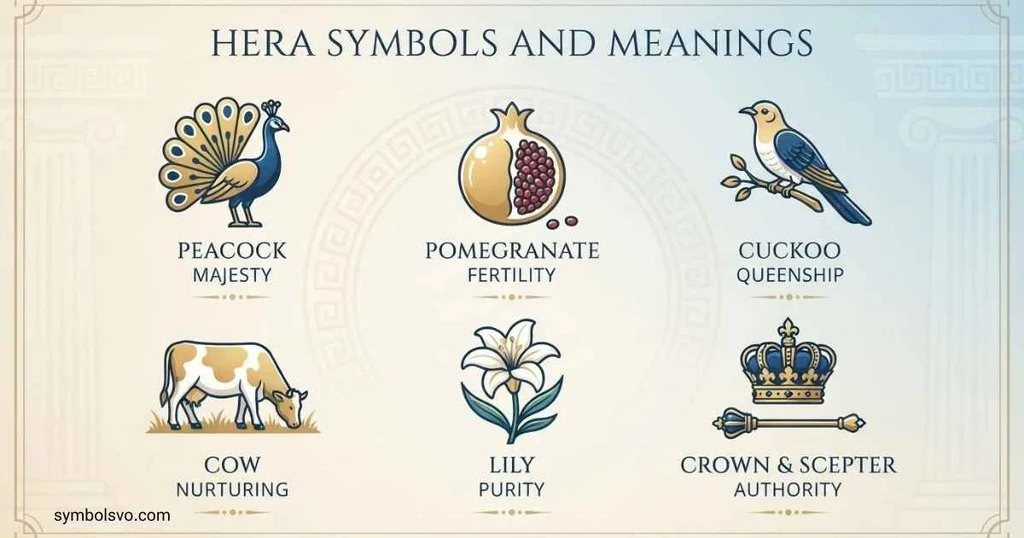
Each symbol associated with Hera can point toward a different part of her character and divine role.
Peacock
The peacock is probably the most recognizable animal associated with Hera. Its spectacular tail made it a natural image of beauty, magnificence, and royal status.
In mythology, the eyes on the peacock’s tail are commonly connected with Argus Panoptes, the hundred-eyed guardian who served Hera. After Argus died, later tradition associated his eyes with the peacock’s feathers.
Pomegranate
The pomegranate can represent fertility, abundance, marriage, and the cycle of life. Its many seeds also made it a powerful ancient symbol of fruitfulness.
However, the pomegranate is not exclusively Hera’s symbol. It is also strongly associated with other Greek deities, particularly Persephone.
Crown And Diadem
A crown or diadem emphasizes Hera’s position as queen of the gods. In ancient representations, her headgear helps distinguish her as a powerful female deity of royal status.
Scepter
The scepter represents authority and sovereignty. Hera is frequently portrayed as a majestic goddess rather than simply a domestic figure.
Cow
The cow is one of Hera’s traditional sacred animals. Ancient Greek literature and cult traditions connect Hera with cattle and bovine imagery.
These meanings are best understood as symbolic associations rather than fixed definitions. A symbol can carry different meanings depending on the story, artwork, period, and cultural context.
Hera Symbols In Greek Mythology
Hera is one of the major Olympian gods in Greek mythology. She is the daughter of Cronus and Rhea and the sister and wife of Zeus.
Her mythology often centers on marriage, divine kingship, family relationships, jealousy, conflict, and the protection of marriage. She also appears in many stories involving heroes and the children or lovers of Zeus.
Several myths help explain her symbolic imagery.
One important story involves Heracles, whom Hera opposed because he was born from Zeus’s relationship with Alcmene. Her hostility toward Heracles became a recurring feature of his mythology.
Another famous story involves Io, a mortal woman associated with Zeus. In some versions, Hera placed Io under the watch of Argus Panoptes, the many-eyed guardian. This story is one reason later traditions connect Argus and the peacock.
Hera also appears prominently in the Judgment of Paris, where Paris awards the golden apple to Aphrodite rather than Hera or Athena. The story helps explain why the apple and golden-apple imagery sometimes appear in discussions of Hera, although the pomegranate and apple should not be treated as interchangeable symbols.
Goddess Hera Symbols
Hera’s symbols reflect several aspects of her identity as a goddess.
She is often connected with:
- Marriage
- Queenship
- Women
- Family
- Royal authority
- Fertility
- Protection of marriage
- Divine status
- Commitment and social order
Her imagery is therefore more complex than the idea of Hera simply being a “goddess of marriage.”
In ancient Greek culture, marriage had social, religious, and family significance. Hera’s role reflects that wider institution.
Her visual attributes often reinforce her status. A seated female figure wearing a crown or diadem and holding a scepter can be identified as Hera when the surrounding artistic context supports the identification.
Greek Goddess Hera Symbols
The Greek goddess Hera is traditionally represented through a combination of animals, objects, clothing, and royal attributes.
Here is a quick reference:
- 🦚 Peacock — majesty, beauty, and watchfulness.
- 🐄 Cow — fertility and sacred association.
- 🍎 Pomegranate — fertility, abundance, and marriage-related symbolism.
- 👑 Crown or diadem — queenship and status.
- Scepter — authority and sovereignty.
- Veil — marriage and bridal imagery.
- Cuckoo — associated with the story of Zeus approaching Hera in disguise.
The symbols should not be treated as modern emojis representing Hera. The peacock and pomegranate emojis are simply Unicode characters that can be used today to visually reference concepts associated with her.
For example, people might write:
Hera 🦚👑
Greek goddess of marriage 🦚
Hera symbols: 🦚 🍎 👑
These are modern decorative uses rather than ancient Greek notation.
Hera Powers And Symbols
Hera’s powers in mythology are closely related to her position among the Olympian gods and her divine connection with marriage and women.
Her symbolic associations can be organized like this:
| Divine role | Related symbolism |
| Queen of the gods | Crown, diadem, scepter |
| Marriage | Veil, pomegranate, bridal imagery |
| Female power | Royal dress and divine status |
| Fertility | Cow, pomegranate |
| Watchfulness | Peacock imagery |
| Authority | Scepter and throne |
Hera’s powers should not be reduced to one modern concept. Ancient stories portray her as a powerful Olympian goddess capable of influencing gods, mortals, heroes, and divine events.
Her authority is especially visible in myths where she acts independently of Zeus or challenges people connected with him.
Hera Symbols And Powers
Hera’s symbols can also be understood as visual clues to her divine powers.
The crown and scepter communicate authority. They show her as a queen rather than an ordinary goddess.
The peacock emphasizes beauty, magnificence, and watchfulness. Its association with Argus adds another layer to the imagery.
The cow connects Hera with fertility and the natural world. Ancient epithets and artistic traditions reinforce this association.
The pomegranate can evoke fertility and marriage, although its symbolism belongs to several Greek deities and should not be assigned exclusively to Hera.
Together, these symbols create an image of Hera as a powerful, majestic, and socially significant goddess.
Hera Symbols And Animals
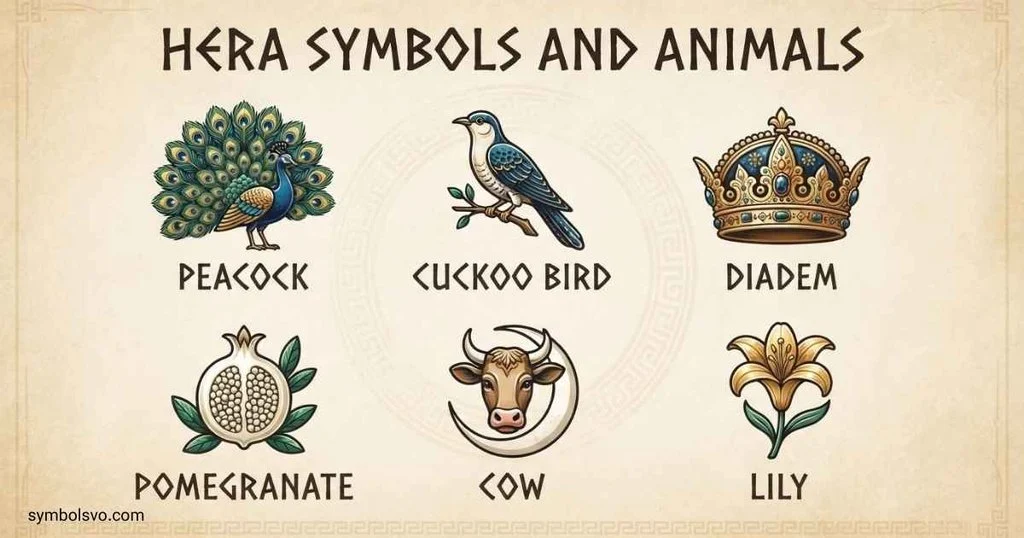
Animals play an important role in Hera’s mythology.
Peacock
The peacock is Hera’s most famous animal association. Ancient and later artistic traditions made the bird a visual marker of the goddess.
Cow
The cow has a much older connection with Hera. The goddess is associated with cattle and bovine imagery, and Homer uses the epithet boōpis, commonly translated as “ox-eyed” or “cow-eyed,” in descriptions of Hera.
The phrase is generally understood as an honorific poetic description rather than an insult.
Cuckoo
The cuckoo has a more specific mythological connection. According to a story reported by later ancient sources, Zeus transformed himself into a cuckoo and approached Hera while she was on Mount Thornax. Hera took pity on the apparently distressed bird, after which Zeus revealed himself.
The cuckoo therefore has a mythological association with Hera, but it is much less universally recognized than the peacock.
Hera Flower Symbol
There is no single flower with the same universally recognized status for Hera that the peacock has as an animal.
The lily is sometimes connected with Hera in modern symbolic lists and later artistic traditions. Ancient mythology also includes a famous story about lilies and Hera’s breast milk, although versions of the story vary.
According to one later mythological tradition, when Heracles was nursing from Hera, some of her milk spilled into the heavens and created the Milky Way, while drops that fell to earth became lilies.
The flower association should therefore be treated carefully. The lily can be used as a modern Hera-inspired symbol, but it is not as firmly established as her peacock, cow, crown, or scepter.
For a decorative Hera theme, a lily can work well alongside:
🦚 + 🌸 + 👑
Here, the flower emoji is a modern visual choice rather than an ancient Greek symbol.
Hera Colors And Symbols
Ancient Greek sources do not provide one standardized “official color palette” for Hera comparable to a modern brand guide.
However, art and later symbolic traditions commonly connect Hera with colors that suggest royalty, marriage, beauty, and divine status.
Common modern associations include:
| Color | Symbolic association |
| Purple | Royal authority and status |
| White | Marriage, purity, and ceremonial imagery |
| Gold | Divine power and magnificence |
| Blue | Majesty and connection with the heavens |
| Green | Fertility and nature |
These associations should be treated as modern interpretive choices rather than fixed ancient Greek rules.
If you are creating artwork, a tattoo, digital graphic, or social-media design inspired by Hera, purple, white, gold, and peacock-like blue-green tones can create a recognizable royal aesthetic.
Hera Symbols: Peacock, Pomegranate And Crown
The peacock, pomegranate, and crown form a popular modern combination for representing Hera.
🦚 Peacock
The peacock represents beauty, majesty, and watchfulness. Its connection with Argus gives it a particularly strong mythological link to Hera.
Pomegranate
The pomegranate represents fertility, abundance, and themes connected with marriage and the continuation of life. It has several divine associations in Greek mythology, so it should not be treated as uniquely Hera’s.
👑 Crown
The crown or diadem is the clearest visual expression of Hera’s position as queen of the gods.
Together, these three symbols can create a compact visual identity:
🦚 + 🍎 + 👑
For a more historically informed design, you could add a scepter or veil. The combination communicates beauty, fertility, marriage, royalty, and divine authority.
Hera Symbols Tattoos
Hera-inspired tattoos can use individual symbols or combine several attributes into one design.
Popular concepts include:
- 🦚 Peacock — beauty, majesty, watchfulness, and Hera’s mythology.
- Crown or diadem — queenship and authority.
- Pomegranate — fertility, abundance, and marriage-related themes.
- Scepter — power and sovereignty.
- Cow — a traditional sacred animal associated with Hera.
- Lily — a less direct, later symbolic association.
- Greek-inspired lettering — a decorative way to identify the goddess.
- Peacock feathers — a subtler alternative to a full peacock.
A tattoo does not need to include every symbol. Choosing one or two can produce a cleaner design and make the intended meaning easier to understand.
For example:
Minimal design: 👑
Nature-focused design: 🦚
Marriage-themed design: 🦚 + pomegranate
Royal design: 👑 + scepter + peacock feather
Full Hera composition: 🦚 + 👑 + pomegranate + Greek-inspired ornament
Keep in mind that the meanings of tattoos are personal. A person may choose Hera imagery to represent marriage, feminine authority, resilience, family, beauty, or simply an interest in Greek mythology.
Hera Symbols Representing God
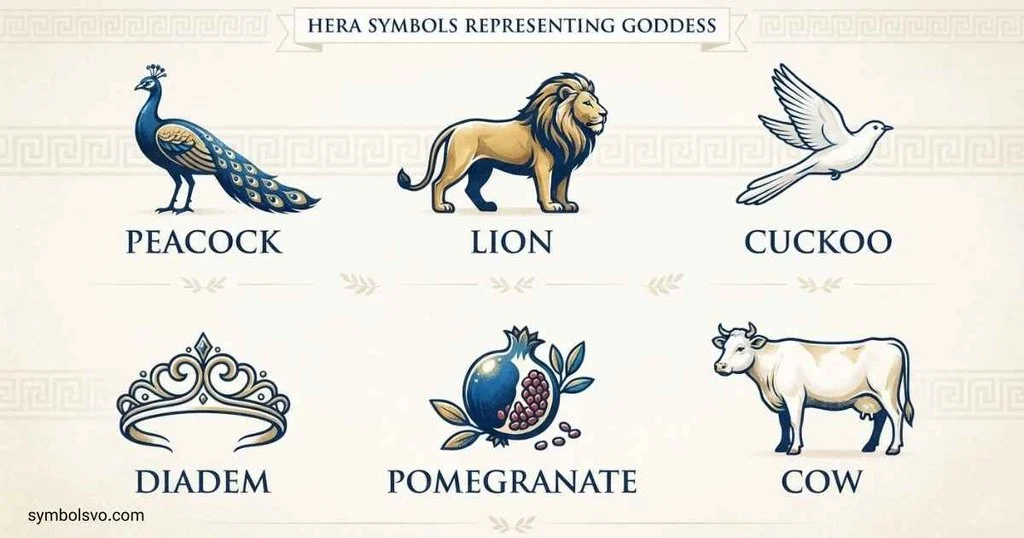
Hera is a goddess, not a male god, so the phrase “Hera symbols representing God” can be confusing.
If the intention is to ask which symbols represent Hera as a divine being, her crown, scepter, throne, peacock, and other traditional attributes can identify her divine status.
If “God” means a general symbol of divinity, there is no single ancient Greek symbol that universally means “Hera” and “God” at the same time.
In Greek mythology, individual gods and goddesses had their own identities, domains, myths, and attributes. Hera’s symbols identify her specifically.
A useful distinction is:
- 👑 Crown — Hera’s queenship.
- Scepter — divine and royal authority.
- 🦚 Peacock — her famous animal association.
- 🐄 Cow — an important sacred animal.
- 🍎 Pomegranate — a fertility and abundance association shared with other deities.
These symbols represent aspects of Hera’s divine identity rather than a universal symbol for God.
Frequently Asked Questions
What Is The Main Symbol Of Hera?
The peacock is the most recognizable animal symbol of Hera. The crown or diadem and scepter are also important visual attributes because they reflect her status as queen of the gods.
What Does The Peacock Symbolize For Hera?
The peacock is associated with Hera through the myth of Argus Panoptes and later artistic tradition. It can symbolize beauty, majesty, and watchfulness in representations of the goddess.
What Animal Represents Hera?
The peacock and cow are two important animals associated with Hera. The peacock became especially prominent in later classical and artistic traditions, while the cow has a strong connection with Hera in ancient Greek literature and religious tradition.
What Flower Is Associated With Hera?
The lily is sometimes associated with Hera, particularly through later versions of the story involving Hera’s milk and the Milky Way. However, there is no single flower with the same firmly established status for Hera as the peacock or cow.
What Do Hera Symbols Mean?
Hera’s symbols can represent different parts of her identity. The crown and scepter suggest queenship and authority, the peacock suggests majesty and watchfulness, the cow connects with fertility, and the pomegranate can suggest fertility and abundance.
Conclusion
Hera’s symbols provide a visual way to understand her role in Greek mythology. The peacock, cow, crown, scepter, pomegranate, and bridal imagery each connect with different parts of her identity, from queenship and divine authority to marriage and fertility.
The peacock remains the most recognizable animal associated with Hera, while the crown and scepter emphasize her position as queen of the gods. Other associations, such as the lily and particular colors, are less firmly established and are better understood as later or modern interpretations.
For artwork, tattoos, educational projects, or mythology-inspired designs, combining a few well-established attributes can create a clear Hera theme. The most useful approach is to understand the historical context of each symbol before assigning it a modern meaning.

I’m Daniel Brooks, a content creator and symbol enthusiast dedicated to researching the fascinating world of signs and symbols. I enjoy discovering the hidden meanings behind famous icons, emojis, historical emblems, and cultural symbols. Through my writing, I aim to provide trustworthy, well-researched, and reader-friendly information that helps people learn something new with every visit.
Books:
- The Complete Guide to World Symbols
- The Power of Universal Signs
 Mason Ellington
 Grace Whitmore