
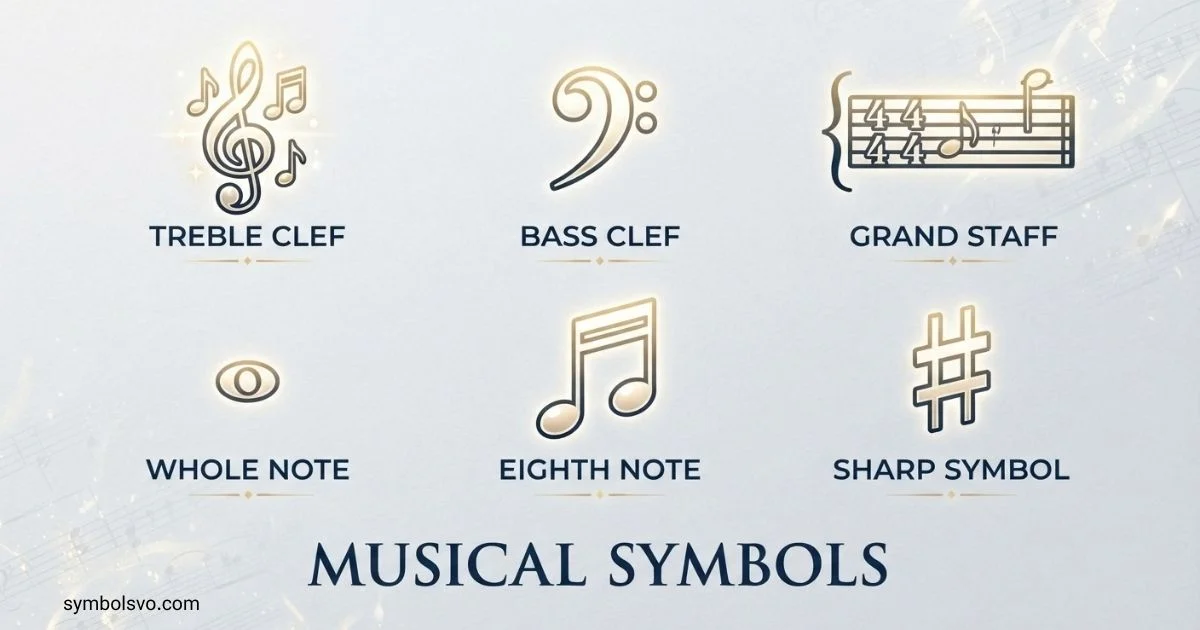
Have you ever looked at a piece of music and wondered what all those strange marks mean? Musical symbols may seem confusing at first, but once you understand their purpose, reading music becomes much easier and more enjoyable.
I created this guide to help you understand the most common musical symbols in a simple, practical way. You can use it whether you are a beginner, a student, a musician, or simply curious about music notation.
From notes and rests to clefs, accidentals, dynamics, and rhythm marks, you will discover what each symbol means and how it is used. By the end, I hope you feel more confident recognizing these important signs wherever you see them.
Musical Symbols With Names
Musical notation contains many different signs, and each has a specific job. Here are some of the most common musical symbols with their names.
| Symbol | Name | Common use |
| 𝄞 | Treble clef | Shows the pitch range for higher notes |
| 𝄢 | Bass clef | Shows the pitch range for lower notes |
| ♩ | Quarter note | One common beat in 4/4 time |
| ♪ | Eighth note | Shorter rhythmic value |
| ♫ | Beamed eighth notes | Two connected eighth notes |
| 𝅗𝅥 | Half note | A note lasting two quarter-note beats in common 4/4 notation |
| 𝅝 | Whole note | A note lasting four quarter-note beats in common 4/4 notation |
| 𝄽 | Quarter rest | Silence corresponding to a quarter note |
| 𝄼 | Eighth rest | Silence corresponding to an eighth note |
| ♯ | Sharp | Raises a note by a semitone |
| ♭ | Flat | Lowers a note by a semitone |
| ♮ | Natural | Cancels a previous sharp or flat |
| 𝄐 | Fermata | Indicates a note or rest should be held longer |
| 𝄆 | Repeat start | Marks the beginning of a repeated passage |
| 𝄇 | Repeat end | Marks the end of a repeated passage |
| 𝄀 | Common time | A traditional symbol for 4/4 time |
| 𝄁 | Cut time | A traditional symbol for 2/2 time |
Some music symbols have dedicated Unicode characters, while many notation marks are normally created by music-notation software rather than copied as ordinary text.
Musical Symbols And Meanings
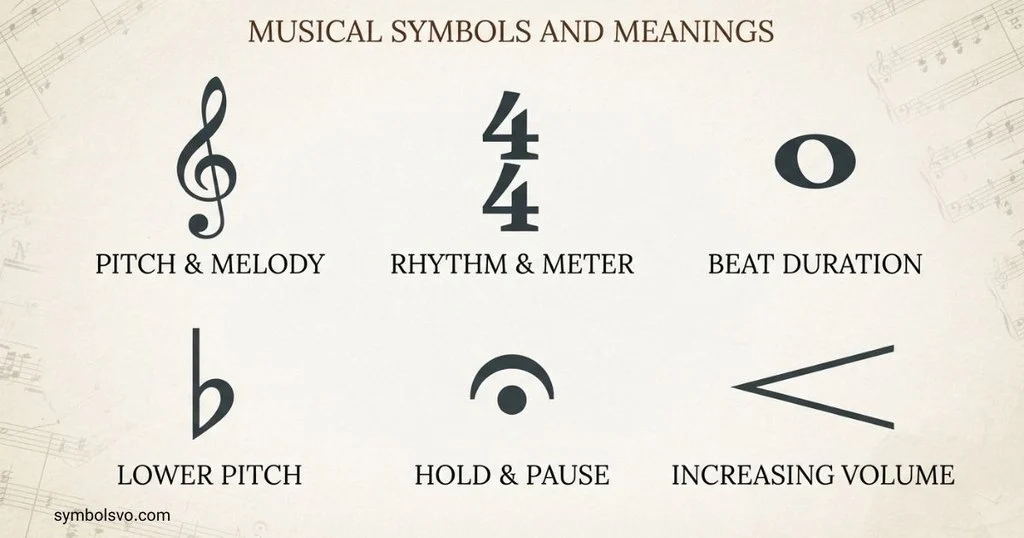
Musical symbols communicate instructions that would otherwise require written explanations. Their meanings depend on where and how they appear in a score.
Here are some important examples:
- ♯ Sharp — Raises a written pitch by a semitone.
- ♭ Flat — Lowers a written pitch by a semitone.
- ♮ Natural — Cancels the effect of a sharp or flat within the relevant notation.
- 𝄞 Treble clef — Establishes the pitch reference for the upper register.
- 𝄢 Bass clef — Establishes the pitch reference for the lower register.
- ♩ Quarter note — Represents a particular rhythmic duration.
- 𝄽 Quarter rest — Represents silence for the corresponding rhythmic value.
- 𝄐 Fermata — Tells the performer to sustain or pause longer than the written value normally indicates.
- > Accent — Indicates emphasis on a note.
- p Piano — Means soft or quiet.
- f Forte — Means loud or strong.
- mf Mezzo-forte — Means moderately loud.
- mp Mezzo-piano — Means moderately soft.
- crescendo — Gradually become louder.
- diminuendo — Gradually become softer.
The exact interpretation of a marking can depend on the musical context, period, composer, and notation system.
Musical Symbols With Examples
Seeing a symbol in context makes it easier to understand.
Pitch example
A sharp sign can appear before a note:
♯
It indicates that the affected written pitch is raised by a semitone in the applicable musical context.
A flat does the opposite:
♭
A natural sign restores the unaltered pitch:
♮
Rhythm example
Common note-value symbols include:
𝅝 𝅗𝅥 ♩ ♪
These represent progressively shorter standard note values in traditional notation:
- 𝅝 — Whole note
- 𝅗𝅥 — Half note
- ♩ — Quarter note
- ♪ — Eighth note
The actual duration depends on the meter and tempo. A quarter note does not always mean the same number of seconds.
Expression example
A score might contain:
p → cresc. → f
This indicates a musical passage that begins softly, becomes gradually louder, and reaches a louder dynamic level.
Repetition example
Repeat signs can appear as:
𝄆 … 𝄇
They tell the performer to repeat the marked section according to the score’s instructions.
List Of Musical Symbols
Here is a practical list of commonly encountered musical notation symbols and markings.
Clefs
- 𝄞 — Treble clef
- 𝄢 — Bass clef
- Alto clef — C clef centered on the middle line
- Tenor clef — C clef commonly used for higher parts of the bass-clef range
Accidentals
- ♯ — Sharp
- ♭ — Flat
- ♮ — Natural
- Double sharp — Raises a pitch by two semitones
- Double flat — Lowers a pitch by two semitones
Notes And Rests
- 𝅝 — Whole note
- 𝅗𝅥 — Half note
- ♩ — Quarter note
- ♪ — Eighth note
- 𝄽 — Quarter rest
- 𝄼 — Eighth rest
- 𝄻 — Sixteenth rest
Rhythm And Articulation
- • — Staccato dot
- — Accent
- ^ — Marcato-style emphasis in some notation
- 𝄐 — Fermata
- Tie — Connects the duration of two notes of the same pitch
- Slur — Connects notes to indicate smooth phrasing
Dynamics
- pp — Pianissimo
- p — Piano
- mp — Mezzo-piano
- mf — Mezzo-forte
- f — Forte
- ff — Fortissimo
- cresc. — Crescendo
- dim. — Diminuendo
Repetition And Navigation
- 𝄆 — Repeat start
- 𝄇 — Repeat end
- D.C. — Da capo
- D.S. — Dal segno
- Coda — Indicates a separate concluding section
Not every musical marking has a single Unicode character. In professional notation, music fonts and notation programs are often better than ordinary text characters.
Complete Musical Symbols Chart
The following chart gives a compact overview of the main categories.
| Category | Symbol or marking | Meaning |
| Clef | 𝄞 | Treble clef |
| Clef | 𝄢 | Bass clef |
| Accidental | ♯ | Sharp |
| Accidental | ♭ | Flat |
| Accidental | ♮ | Natural |
| Note | 𝅝 | Whole note |
| Note | 𝅗𝅥 | Half note |
| Note | ♩ | Quarter note |
| Note | ♪ | Eighth note |
| Rest | 𝄽 | Quarter rest |
| Rest | 𝄼 | Eighth rest |
| Expression | 𝄐 | Fermata |
| Dynamic | p | Soft |
| Dynamic | f | Loud |
| Dynamic | pp | Very soft |
| Dynamic | ff | Very loud |
| Dynamic | cresc. | Gradually louder |
| Dynamic | dim. | Gradually softer |
| Articulation | . | Staccato |
| Articulation | > | Accent |
| Repetition | 𝄆 | Repeat beginning |
| Repetition | 𝄇 | Repeat ending |
| Time | 𝄀 | Common time |
| Time | 𝄁 | Cut time |
This chart is best viewed as a quick reference rather than a complete inventory of every mark found in modern music notation. Professional scores can contain hundreds of additional signs and specialized instructions.
All Musical Symbols
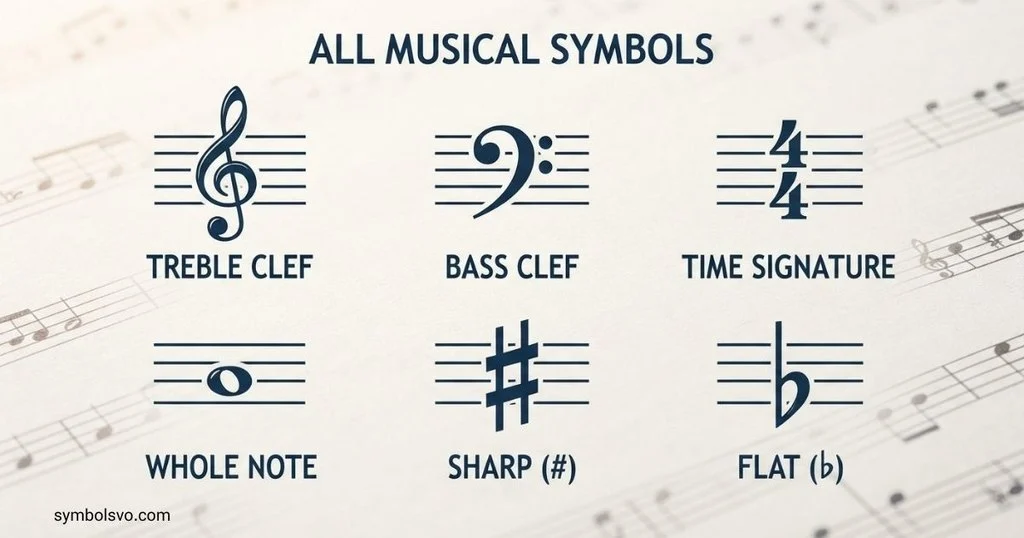
There is no short universal list that contains literally every musical symbol used in every notation tradition. Western staff notation alone includes signs for pitch, rhythm, dynamics, articulation, tempo, expression, ornaments, repetition, navigation, percussion, and special performance techniques.
Some important groups include:
Pitch symbols: clefs, noteheads, accidentals, ledger lines, key signatures.
Rhythm symbols: notes, rests, dots, ties, tuplets, beams, time signatures.
Expression symbols: dynamics, accents, fermatas, phrasing marks, tempo instructions.
Ornaments: trills, turns, mordents, grace notes and related signs.
Navigation: repeat signs, endings, segno, coda, D.C., and D.S.
Performance notation: bowing marks, pedal markings, breath marks, percussion notation, fingering, and instrument-specific instructions.
Unicode includes a dedicated Musical Symbols block containing characters used for some Western musical notation. However, Unicode is not a complete replacement for engraved music notation. A score usually needs positioning, staff lines, note relationships, fonts, and layout that plain text cannot reproduce accurately.
Musical Symbols At The Start Of Staves
At the beginning of a staff, several important signs establish how the music should be read.
The clef is one of the most important. It assigns specific pitch names to positions on the staff.
Common clefs include:
- Treble clef 𝄞 — Commonly used for higher-register instruments and voices.
- Bass clef 𝄢 — Commonly used for lower-register instruments and voices.
- Alto clef — A C clef that places middle C on the middle line.
- Tenor clef — Another C clef used in particular instrumental ranges.
A key signature may follow the clef. It tells the performer which pitches are consistently altered within the key.
The time signature normally follows the clef and key signature. It describes the meter of the passage.
A simplified beginning might therefore be represented conceptually as:
Clef → Key signature → Time signature → Music
The exact order and appearance can vary depending on the notation and score.
Type Musical Symbols
Typing musical symbols depends on the device, application, and character you need.
Some Unicode characters can simply be copied:
♪ ♫ ♩ ♬ 𝄞 𝄢 ♯ ♭ ♮ 𝄐 𝄆 𝄇
You can copy these characters directly into many text fields that support Unicode.
For symbols that are not conveniently available as ordinary text, use:
- Music-notation software
- A notation font
- An operating-system character viewer
- An application’s symbol or special-character menu
- Unicode input methods where supported
Copy And Paste Musical Symbols
For quick decorative or text use:
♪ ♫ ♬ ♩ 𝅗𝅥 𝅝 𝄞 𝄢 ♯ ♭ ♮ 𝄐
Keep in mind that a text character is not always equivalent to a properly engraved musical notation symbol. For a professional score, notation software is generally the better choice.
Musical Symbols Crossword Clue
If a crossword asks for a “musical symbol,” the answer depends on the number of letters and the crossword’s crossing letters.
Common possibilities include words such as:
- Note
- Rest
- Clef
- Sharp
- Flat
- Accent
- Tie
A crossword clue may use “symbol” loosely and expect a musical term rather than a Unicode character.
For example, a clue referring to a sign that indicates pitch could point toward clef, sharp, or flat, depending on the wording and answer length.
Musical Symbols Crossword Clue 5 Letters
For a five-letter crossword answer, clefs can be a possibility when the clue refers to musical symbols that establish pitch notation.
Other five-letter musical terms may fit different clues, but the exact answer cannot be determined from the phrase “musical symbols” alone.
Crossword solving works best when you combine:
- The exact clue.
- The number of letters.
- Known crossing letters.
- The tense or grammatical form of the answer.
- Whether the clue is asking for a symbol, object, notation mark, or musical term.
If the clue is specifically “Musical symbols” and the answer has five letters, the surrounding puzzle is needed to determine the intended solution confidently.
Epic The Musical Symbols
EPIC: The Musical is a modern musical project created by Jorge Rivera-Herrans. Searches for “Epic the Musical symbols” can refer to fan-made symbols, visual motifs, character associations, logos, artwork, or symbols connected with songs and characters.
These should not be confused with standard musical notation.
For example, a fan may use an icon or decorative character to represent a character, saga, song, or theme. Such a symbol does not automatically have an established Unicode name or official meaning.
When using fan-created symbols, check the original context before treating a graphic as an official symbol of EPIC: The Musical.
Hamilton Musical Symbols
“Hamilton musical symbols” can refer to visual symbols, motifs, logos, fan graphics, or notation associated with the stage musical Hamilton.
The musical itself does not create a separate Unicode alphabet of official “Hamilton symbols.” A symbol appearing in fan art or online discussions should therefore be distinguished from ordinary music notation.
For school projects, social posts, or decorative text, you can use standard music characters such as:
♪ ♫ ♬
For official branding, artwork, logos, or production-specific graphics, use the relevant licensed artwork rather than treating an ordinary Unicode character as an official Hamilton symbol.
Wicked Musical Symbols
“Wicked musical symbols” is another search phrase with several possible meanings. Someone might be looking for musical notation, fan-created graphics, character-related imagery, or decorative symbols connected with the musical Wicked.
There is no standard Unicode set specifically called “Wicked musical symbols.”
For general music-related decoration, characters such as these can work:
♪ ♫ ♩ ♬
If the goal is to represent the musical’s characters, themes, or branding, the specific artwork or fan convention matters more than the Unicode character itself.
High School Musical Symbols
“High School Musical symbols” can refer to visual elements associated with the High School Musical franchise, fan-made icons, character references, or general music symbols used in searches about the films.
There is no separate Unicode block containing official High School Musical symbols.
For a simple music-themed text design, you can use:
- ♪
- ♫
- ♬
- ♩
- ♯
- ♭
- ♮
These are general musical characters, so they should not be presented as official symbols of the franchise.
Frequently Asked Questions
What are the most common musical symbols?
Some of the most common are the treble clef, bass clef, sharp, flat, natural, notes, rests, time signatures, dynamics, accents, fermatas, and repeat signs.
Can I copy and paste musical symbols?
Yes. Many Unicode-supported musical characters can be copied and pasted, including ♪, ♫, ♩, ♯, ♭, and ♮. More complex notation is usually better created with music-notation software.
What symbol represents music?
There is no single universal symbol that represents all music. Characters such as ♪, ♫, and ♬ are commonly used as general music-related symbols in text and design.
What are the symbols at the beginning of a music staff?
A staff commonly begins with a clef, followed by a key signature and time signature when applicable. The clef establishes the pitch reference for the staff.
Are musical symbols part of Unicode?
Yes. Unicode contains characters for various musical notation signs, including a dedicated Musical Symbols block. However, many elements of complete engraved notation require specialized fonts or music-notation software rather than simple text characters.
Conclusion
Musical symbols form the visual language used to communicate pitch, rhythm, dynamics, expression, and structure in written music. From familiar characters such as ♪ and ♫ to clefs, rests, accidentals, and repeat signs, each marking has a specific role.
For quick text use, many music-related Unicode characters can be copied and pasted directly. For complete scores, however, specialized notation software gives much better control over staff lines, note placement, rhythm, spacing, and musical relationships.
The search term “musical symbols” can also lead to crossword clues and symbols associated with musicals such as EPIC: The Musical, Hamilton, Wicked, and High School Musical. Keeping standard notation separate from franchise-specific or fan-created imagery helps you find and use the right symbol for your purpose.

 Mason Ellington
 Daniel Brooks