If you have ever looked at a Pokémon card and wondered what those tiny rarity symbols mean, you are not alone. I know how confusing they can seem when you are just getting started.
You may see circles, diamonds, stars, or newer rarity marks and wonder which cards are common, rare, or especially difficult to find. Understanding these symbols can make collecting much easier and more enjoyable.
In this guide, I’ll break down Pokémon rarity symbols in a simple way so you can quickly understand what each mark means. Whether you are a new collector or simply curious, you’ll have a clearer way to identify card rarities.
What Are The Pokémon Rarity Symbols?
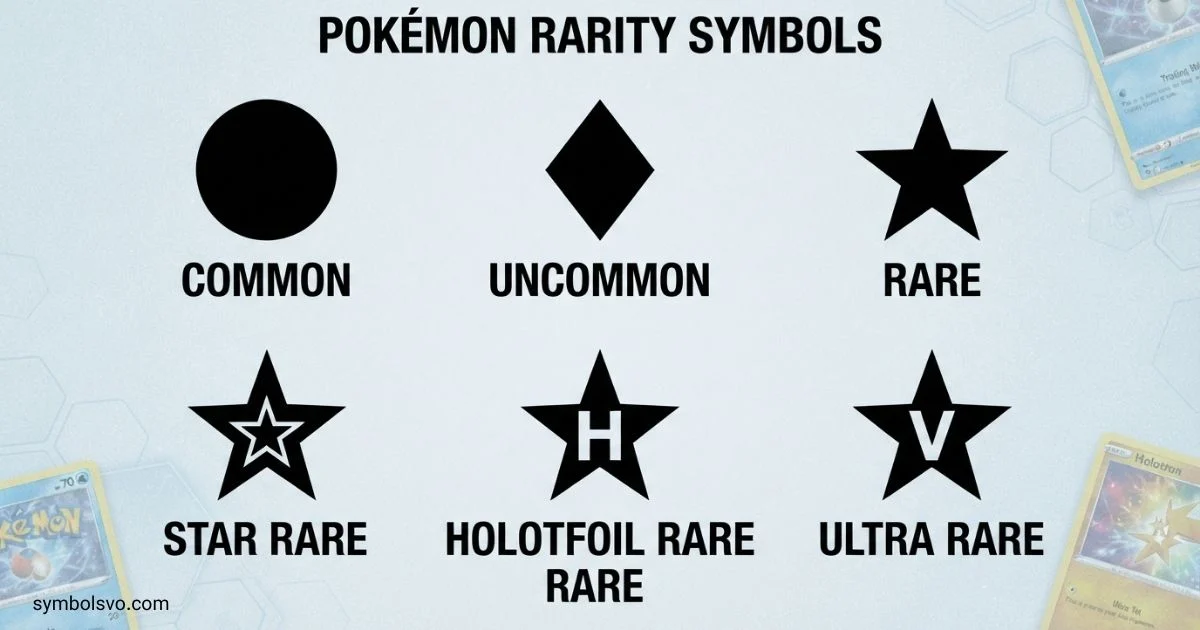
Pokémon rarity symbols are small marks printed on Pokémon Trading Card Game cards to identify their rarity. On many English cards, the mark appears near the collector number along the lower edge of the card. TCGplayer identifies the traditional three symbols as a black circle for Common, a black diamond for Uncommon, and a black star for Rare.
The three basic symbols are:
| Symbol | Rarity | Basic meaning |
| ● | Common | Common card |
| ◆ | Uncommon | Uncommon card |
| ★ | Rare | Rare card |
| ★★ | Double Rare | Modern Double Rare |
| ★★★ | Hyper Rare | Modern Hyper Rare treatment |
The appearance of the symbol alone does not tell you what a card is worth. A lower-rarity card can be highly collectible because of its age, Pokémon, artwork, condition, demand, or historical importance.
Rarity is also different from card type. A Pokémon can be a basic Pokémon, Stage 1, Stage 2, Pokémon ex, Trainer, or Energy card while also having a particular rarity classification.
Pokémon Rarity Symbols Explained
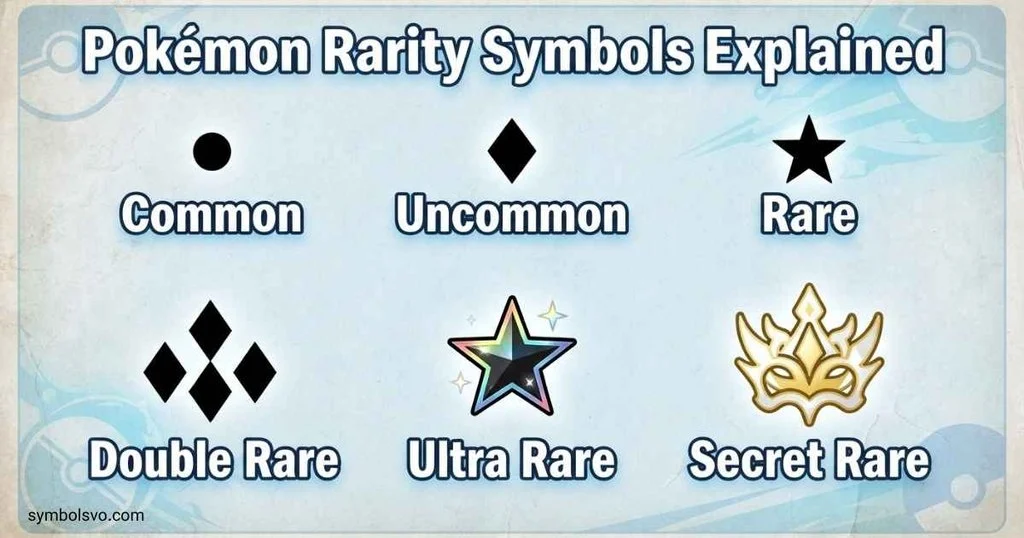
The easiest way to understand the system is to start with the traditional symbols and then move into the modern Scarlet & Violet system.
Common
● — Common
A black circle traditionally identifies a Common card. These cards generally form the largest part of a standard expansion’s regular card pool.
Uncommon
◆ — Uncommon
A black diamond identifies an Uncommon card. Uncommon cards are generally less common in a booster pack than Common cards.
Rare
★ — Rare
A black star identifies a Rare card. In the modern Scarlet & Violet era, regular Rare cards use the solid black star and are generally holofoil. Pokémon’s official explanation confirms that the circle, diamond, and star continue to represent Common, Uncommon, and Rare.
Double Rare
★★ — Double Rare
Two black stars identify Double Rare cards in the modern system. Pokémon introduced this rarity with Scarlet & Violet, where it is used for Pokémon ex cards in the new rarity structure.
Illustration Rare
★ — Gold star
A single shiny gold star represents Illustration Rare in the Scarlet & Violet-era system. These cards use full-art illustrations that focus heavily on the Pokémon and its setting.
Ultra Rare
★★ — Silver stars
Two shiny silver stars represent Ultra Rare in the modern English system. These cards include more exclusive full-art foil treatments.
Special Illustration Rare
★★ — Gold stars
Two shiny gold stars identify Special Illustration Rare cards. These cards feature elaborate full-art illustrations and are generally among the most visually distinctive cards in a modern expansion.
Hyper Rare
★★★ — Gold stars
Three shiny gold stars represent Hyper Rare in the modern English rarity system. Gold treatment is a major visual clue for this tier.
The key point is that star count alone is not enough. You should also look at the star’s color, the card’s era, language, collector number, and card design.
Pokémon Rarity Symbols List
Here is a practical reference for major Pokémon TCG rarity symbols and codes.
| Symbol or code | Rarity | Main use |
| ● | Common | Standard Common |
| ◆ | Uncommon | Standard Uncommon |
| ★ | Rare | Standard Rare |
| ★★ | Double Rare | Modern Pokémon ex |
| ★★★ | Hyper Rare | Modern gold rarity |
| Gold ★ | Illustration Rare | Modern full-art illustration |
| Gold ★★ | Special Illustration Rare | Premium full-art illustration |
| Silver ★★ | Ultra Rare | Modern full-art rarity |
| RRR | Triple Rare | Japanese/Sword & Shield-era cards |
| AR | Art Rare | Japanese and Asian-language systems |
| SR | Super Rare | Japanese and some Asian-language systems |
| SAR | Special Art Rare | Japanese and some Asian-language systems |
| UR | Ultra Rare | Japanese/Asian rarity code |
| ACE | ACE SPEC | Special card category |
The exact set of rarities depends on the era. Not every expansion contains every rarity, and older cards can use classifications that do not appear in modern expansions.
All Pokémon Rarity Symbols
There is no single short list that accurately describes every rarity ever printed on every Pokémon card. Pokémon has used different rarity systems across multiple eras and languages.
Older and discontinued rarity categories include examples such as:
- Common
- Uncommon
- Rare
- Rare Holo
- Rare Holo EX
- Rare Holo GX
- Rare Holo V
- Ultra Rare
- Secret Rare
- Shining
- Amazing Rare
- Prism Star
- Character Rare
- Character Super Rare
- Triple Rare
- Radiant Rare
- Rainbow Rare
- Illustration Rare
- Special Illustration Rare
- Hyper Rare
- ACE SPEC Rare
Some categories were tied to particular generations or products. For example, Triple Rare was used for Japanese VMAX, V-UNION, and VSTAR cards during the Sword & Shield era.
This is why a rarity guide should always consider card era and language before assigning a meaning to an unfamiliar symbol.
Pokémon Rarity Symbols In Order
For the basic modern English system, the progression is easiest to remember as:
● Common → ◆ Uncommon → ★ Rare → ★★ Double Rare → higher foil-star rarities
However, there is no universal historical “lowest to highest” sequence covering every Pokémon card ever produced. Different generations used different rarity structures.
For modern English Scarlet & Violet cards, a simplified reference is:
- ● Common
- ◆ Uncommon
- ★ Rare
- ★★ Double Rare
- ★ Gold — Illustration Rare
- ★★ Silver — Ultra Rare
- ★★ Gold — Special Illustration Rare
- ★★★ Gold — Hyper Rare
This should be treated as a reference to the modern system rather than a universal ranking of every Pokémon card. Pokémon’s own Scarlet & Violet announcement describes the new Double Rare, Ultra Rare, and Illustration Rare structure.
Also remember that rarity does not automatically equal monetary value. A Common from a famous older set may be more desirable to a collector than a modern high-rarity card with low demand.
Modern Pokémon Rarity Symbols
The modern English Pokémon TCG system changed significantly with Scarlet & Violet.
The traditional three symbols remained:
- ● Common
- ◆ Uncommon
- ★ Rare
The new structure then added visually distinct star treatments:
- ★★ black stars — Double Rare
- ★★ silver stars — Ultra Rare
- ★ gold star — Illustration Rare
- ★★ gold stars — Special Illustration Rare
- ★★★ gold stars — Hyper Rare
Pokémon specifically stated that the solid black circle, diamond, and star would remain unchanged for Common, Uncommon, and Rare cards.
One useful identification trick is to examine the color and number of stars together. Two black stars and two gold stars are not the same rarity, even though both contain two stars.
Pokémon Card Symbols List
Pokémon cards contain several kinds of symbols, and not all of them are rarity symbols.
For example:
| Symbol or marking | What it can indicate |
| ● | Common rarity |
| ◆ | Uncommon rarity |
| ★ | Rare rarity |
| ★★ | Double Rare in the modern system |
| PROMO ★ | Promotional card |
| Energy icons | Pokémon type or attack/retreat information |
| Regulation mark | Format/legal information, depending on era |
| Set logo/code | Expansion or product identification |
This distinction is important when checking a card.
A small letter such as H, I, or J on a modern card should not automatically be interpreted as rarity. Regulation marks are separate from rarity and relate to the card’s format history rather than its rarity.
Energy symbols are another completely different system. For example, Pokémon documentation identifies symbols for Grass, Fire, Water, Lightning, Psychic, Fighting, Colorless, Darkness, and Metal Energy.
Pokémon Card Rarity Symbols Chart
Use this chart as a quick reference for the most common modern and historical marks.
| Mark | Name | Era/context |
| ● | Common | Traditional and modern |
| ◆ | Uncommon | Traditional and modern |
| ★ | Rare | Traditional and modern |
| ★★ black | Double Rare | Scarlet & Violet and later modern system |
| ★ gold | Illustration Rare | Scarlet & Violet and later |
| ★★ silver | Ultra Rare | Scarlet & Violet and later |
| ★★ gold | Special Illustration Rare | Scarlet & Violet and later |
| ★★★ gold | Hyper Rare | Scarlet & Violet and later |
| RRR | Triple Rare | Mainly Japanese Sword & Shield era |
| AR | Art Rare | Japanese/Asian-language systems |
| SR | Super Rare | Japanese/Asian-language systems |
| SAR | Special Art Rare | Japanese/Asian-language systems |
| UR | Ultra Rare | Japanese/Asian-language systems |
| ACE | ACE SPEC | Special rarity/category |
The Japanese and English systems should not be translated word-for-word. For example, Japanese UR corresponds to the English Hyper Rare tier in the modern mapping, while Japanese SR corresponds to English Ultra Rare.
Pokémon Rarity Symbols Star Circle Diamond
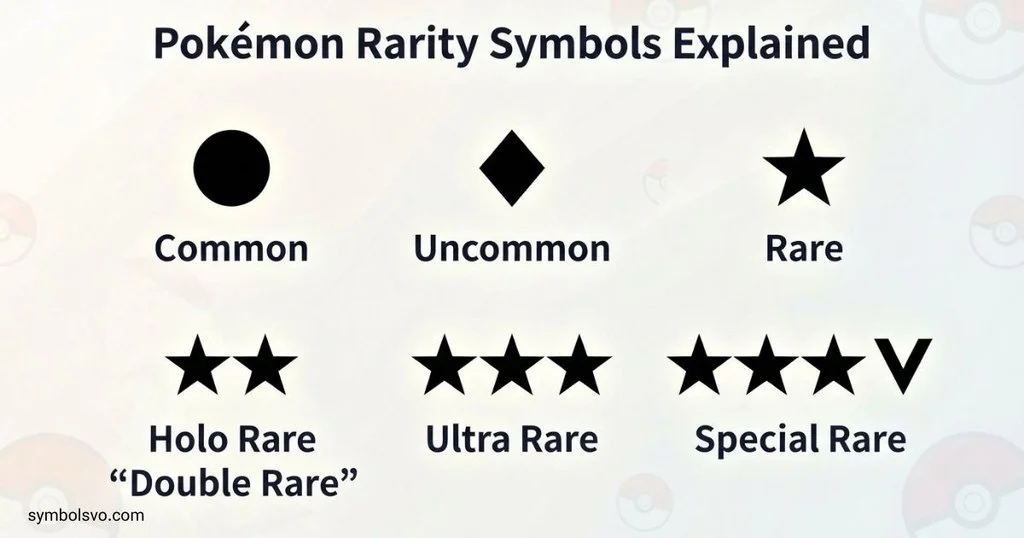
The three classic Pokémon rarity symbols are the circle, diamond, and star.
● Circle
● = Common
The circle is the easiest basic symbol to identify. It traditionally marks Common cards.
◆ Diamond
◆ = Uncommon
The diamond identifies Uncommon cards.
★ Star
★ = Rare
The black star identifies a standard Rare card.
A useful memory trick is:
Circle = Common
Diamond = Uncommon
Star = Rare
These three symbols are still used in the modern English Pokémon TCG. Pokémon officially confirmed that the basic circle, diamond, and star would remain in the Scarlet & Violet design.
Do not confuse the black Rare star with gold-star or silver-star modern rarities. The visual treatment matters.
Pokémon Rarity Symbols RRR
RRR means Triple Rare in Pokémon’s Japanese rarity system.
Triple Rare was used during the Sword & Shield era, particularly for cards such as VMAX, V-UNION, and VSTAR. Sources documenting the Japanese system identify RRR as the rarity for these higher-level Pokémon cards.
Examples of the kinds of cards associated with RRR include:
- Pokémon VMAX
- Pokémon VSTAR
- Pokémon V-UNION
RRR should not be treated as a current universal English rarity symbol. It is primarily encountered when looking at Japanese and other Asian-language cards from relevant eras.
This is also why searching for “Pokémon rarity symbols RRR” can produce confusing results. The code belongs to a particular language and era rather than replacing the entire modern English rarity system.
Pokémon Rarity Symbols White Star
A white star can be confusing because its meaning depends heavily on the card’s era and language.
Older Pokémon TCG cards used different star treatments for special rarities, and collectors may describe some of these visually as a “white star.” In older Japanese systems, star-shaped marks were also used for particular rarity categories. Historical sources document multiple older rarity conventions rather than one universal white-star meaning.
The safest identification method is to check more than the color of the star.
Look at:
- The card’s language.
- The expansion or set.
- The collector number.
- The exact rarity mark.
- The card’s artwork and foil treatment.
- The era in which the card was released.
A visual description such as “white star” is not precise enough by itself to identify every card’s rarity.
English Pokémon Rarity Symbols
English Pokémon cards traditionally use visual symbols for rarity.
The basic English system is:
- ● — Common
- ◆ — Uncommon
- ★ — Rare
Modern English cards then add different star colors and counts for higher rarities.
One major difference from Japanese cards is that modern Japanese cards generally use letter codes, such as C, U, R, RR, AR, SR, SAR, and UR, rather than relying on the same modern English star-color system.
English cards can also contain rarity terminology that differs from Japanese terminology even when the underlying card is an equivalent rarity. This becomes especially important when comparing Japanese and English versions of the same Pokémon.
Japanese Pokémon Rarity Symbols
Japanese Pokémon cards use a letter-based rarity system in many modern eras.
Common codes include:
| Japanese code | Meaning | Approximate modern English equivalent |
| C | Common | Common |
| U | Uncommon | Uncommon |
| R | Rare | Rare |
| RR | Double Rare | Double Rare |
| AR | Art Rare | Illustration Rare |
| SR | Super Rare | Ultra Rare |
| SAR | Special Art Rare | Special Illustration Rare |
| UR | Ultra Rare | Hyper Rare |
The terminology can be confusing because Japanese UR does not mean the same tier as English Ultra Rare. Japanese UR generally corresponds to the English Hyper Rare category, while Japanese SR corresponds more closely to English Ultra Rare.
Japanese cards also contain older rarity codes. RRR, for example, belongs to the Sword & Shield-era system and is not part of the current standard ladder in the same way.
Chinese Pokémon Rarity Symbols
Chinese Pokémon cards can also use letter-based rarity codes, particularly in modern Simplified Chinese releases.
Common codes found in Chinese card lists include:
- C — Common
- U — Uncommon
- R — Rare
- RR — Double Rare
- AR — Art Rare
- SR — Super Rare
- SAR — Special Art Rare
- UR — Ultra Rare
Recent Simplified Chinese set data shows cards classified with C, U, R, RR, AR, SR, SAR, and UR. Older Chinese releases can also contain additional historical categories such as RRR, HR, and K.
This means the language alone does not tell you the exact rarity. The set and release era still matter.
Chinese and Japanese cards can look similar to collectors who are unfamiliar with the scripts and rarity codes. Checking the printed language and set information is the safest approach.
Korean Pokémon Rarity Symbols
Korean Pokémon TCG cards follow their own localized printing conventions, and rarity should be identified from the actual Korean card rather than assumed from an English-language chart.
For modern cards, collectors may encounter letter-based rarity codes corresponding to familiar categories such as:
- Common
- Uncommon
- Rare
- Double Rare
- Art/Illustration Rare
- Super/Ultra Rare
- Special Art/Illustration Rare
- Ultra/Hyper Rare
The exact code set can vary by era and product.
This is one reason a Korean card should not automatically be decoded using an English card chart. Japanese, Chinese, Korean, and English releases can use different rarity notation, even when they contain related cards.
When buying or cataloging Korean cards, record the language, set, card number, and printed rarity code together.
TCG Pokémon Rarity Symbols
The term TCG Pokémon rarity symbols usually refers to the marks used to identify rarity in the Pokémon Trading Card Game.
For a quick modern reference:
| Visual mark | Meaning |
| ● | Common |
| ◆ | Uncommon |
| ★ | Rare |
| ★★ black | Double Rare |
| ★ gold | Illustration Rare |
| ★★ silver | Ultra Rare |
| ★★ gold | Special Illustration Rare |
| ★★★ gold | Hyper Rare |
Older Pokémon TCG sets can contain many additional rarity classifications. TCGplayer notes that cards from certain products may have no standard rarity symbol at all and that promotional cards can use a black star with PROMO printed across it.
The collector number is another useful clue. A card number is often written in a format such as 123/198. If the first number exceeds the advertised set total, that can indicate a card printed beyond the main numbered set, although the exact interpretation depends on the product and era.
Most importantly, rarity does not equal value. Condition, age, demand, print availability, Pokémon popularity, artwork, and set history can all affect a card’s desirability.
Pokémon Card Rarity Checker
A Pokémon card rarity checker is a tool or reference method used to identify the rarity of a card.
You do not always need a specialized checker. In many cases, you can identify the rarity manually.
Step 1: Find the rarity mark
Look near the lower edge of the card, usually close to the collector number.
Step 2: Identify the language
English cards and Japanese or Asian-language cards can use different rarity systems.
Step 3: Check the symbol or code
Look for:
●, ◆, ★, ★★, ★★★, RRR, AR, SR, SAR, UR, ACE, or another printed classification.
Step 4: Identify the set and era
The same-looking symbol can have different historical uses. An older card should not automatically be decoded using a modern chart.
Step 5: Check the collector number
Compare the card number with the advertised set total. This can help identify cards that appear beyond the standard numbered set.
Step 6: Check the card treatment
Look at:
- Foil
- Full-art design
- Gold treatment
- Silver stars
- Illustration style
- Textured finish
- Special border treatment
Step 7: Verify the result
If the card is unusual, compare it with an official card database, a reputable card database, or a set-specific checklist.
A rarity checker can help identify a card’s classification, but it should not be treated as an automatic price checker. Rarity and market value are different questions.
Guide To Pokémon Rarity Symbols
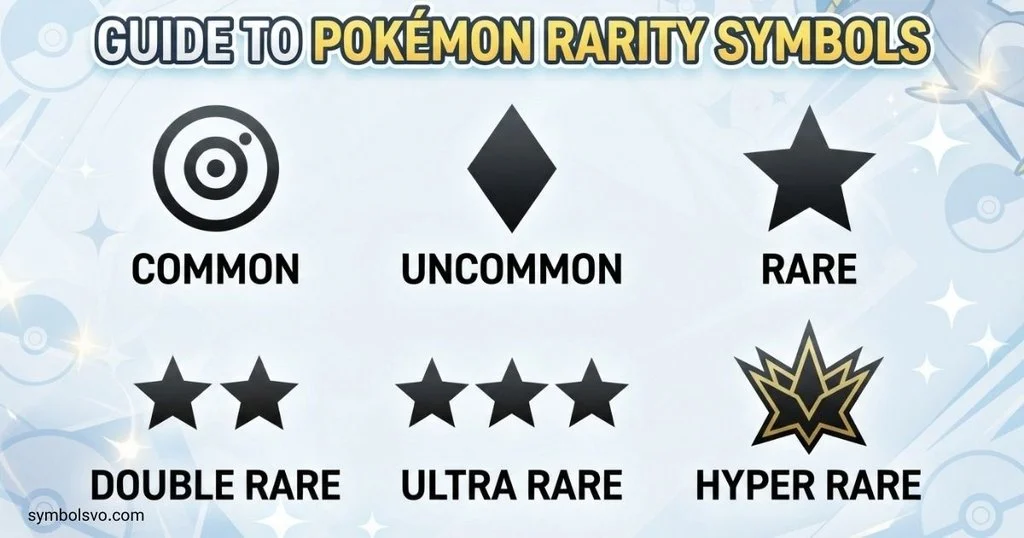
The quickest way to identify a Pokémon card’s rarity is to use a combination of symbol + language + set + number.
For modern English cards, remember:
● = Common
◆ = Uncommon
★ = Rare
★★ black = Double Rare
★ gold = Illustration Rare
★★ silver = Ultra Rare
★★ gold = Special Illustration Rare
★★★ gold = Hyper Rare
For Japanese cards, remember the basic code sequence:
C → U → R → RR
Then look for higher codes such as:
AR → SR → SAR → UR
Older Japanese cards may add codes such as RRR, HR, CHR, CSR, K, and others depending on the era.
For Chinese cards, check the actual set because historical and modern releases can contain different rarity groups. For Korean cards, use a Korean-specific set reference when the printed code is unfamiliar.
Finally, never judge a card solely from its rarity symbol. A symbol tells you about the card’s rarity classification. It does not automatically tell you the card’s condition, authenticity, market price, print population, or collector demand.
Frequently Asked Questions
What does the circle symbol mean on a Pokémon card?
A black circle ● traditionally means the card is Common. It is one of the three basic Pokémon TCG rarity symbols, alongside the diamond for Uncommon and star for Rare.
What does a star mean on a Pokémon card?
A solid black star ★ traditionally identifies a Rare card. Modern cards can also use gold or silver stars for higher rarity categories, so the star’s color and number should be checked before identifying the card.
What does RRR mean on Pokémon cards?
RRR means Triple Rare. It is a Japanese rarity classification associated mainly with the Sword & Shield era, including VMAX, VSTAR, and V-UNION cards. It is not the standard modern English rarity symbol.
Are Japanese Pokémon rarity symbols different from English ones?
Yes. Modern Japanese Pokémon cards commonly use letter codes such as C, U, R, RR, AR, SR, SAR, and UR, while modern English cards use visual symbols and star treatments. The names do not always map word-for-word between languages.
Does a higher Pokémon rarity always mean a card is worth more?
No. Rarity is only one factor. Card condition, age, popularity, artwork, demand, print availability, and the specific set can all affect market value. A rarity symbol should be used to identify the card, not as a standalone price estimate.
Conclusion
Pokémon rarity symbols provide a quick way to understand how cards are classified. The traditional circle, diamond, and star remain the foundation, while modern cards add different star colors and counts to distinguish newer rarity levels.
The system becomes more complicated when older cards and international releases are included. Japanese, Chinese, and Korean cards can use letter codes, while older eras contain classifications such as RRR, HR, CHR, and other marks that are no longer part of the same modern structure.
For the most reliable identification, never rely on the symbol alone. Check the card’s language, set, collector number, era, and visual treatment together. That simple habit makes it much easier to identify unfamiliar Pokémon cards accurately.

I’m Nathan Holloway, a passionate researcher and writer with a deep interest in symbols, signs, and their hidden meanings. I enjoy exploring how symbols have influenced different civilizations, religions, and modern communication. Through my work, I aim to make complex historical and cultural concepts easy to understand for readers of all backgrounds. Every article I write is carefully researched to provide reliable and engaging information.
Books:
- Beyond the Symbol
- The Secret Meanings of Everyday Signs
Author 2: Grace Whitmore
Description:
My name is Grace Whitmore, and I love discovering the stories behind the world’s most fascinating symbols. I spend my time researching ancient civilizations, mythology, spiritual traditions, and modern iconography to uncover the meanings people often overlook. I believe that every symbol has a history worth telling, and I enjoy sharing that knowledge in a simple and reader-friendly way.
Books:
- Echoes of Ancient Symbols
- The Symbolic World
 Mason Ellington
 Grace Whitmore
 Daniel Brooks