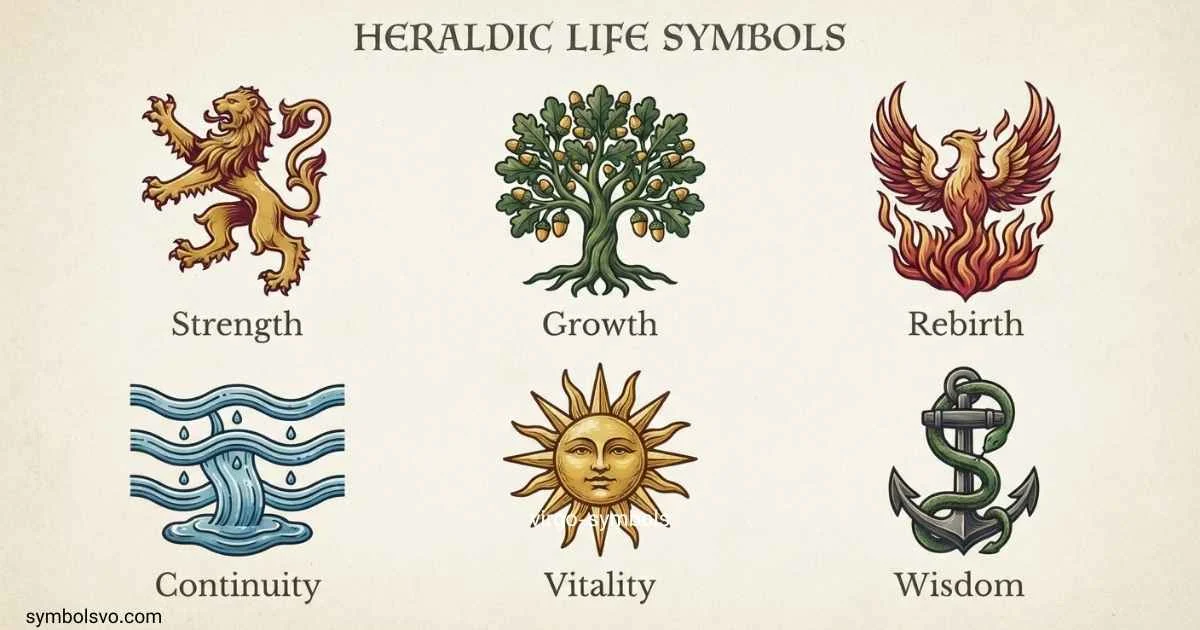
I’ve always found heraldic symbols fascinating because they can turn simple shapes, colors, animals, and objects into meaningful visual stories. When you look closely, you may discover that every detail has a purpose and connects to history, identity, family, or tradition.
If you are curious about what these symbols mean, you’re in the right place. I’ll help you explore heraldic symbols in a simple and approachable way, so you can understand the ideas behind coats of arms, shields, crests, colors, and familiar heraldic figures.
Whether you are completely new to heraldry or you simply want to understand a particular symbol, you can use this guide to uncover the meanings and traditions behind these distinctive designs. Let’s explore what makes heraldic symbols so powerful and memorable.
What Are Heraldic Symbols
Heraldic symbols are visual elements used in heraldry to identify an individual, family, organization, place, or other bearer. They are commonly displayed on a shield, but heraldic achievements can also include helmets, crests, supporters, mottos, crowns, and other components.
The main image placed on a shield is called a charge. Charges can include animals, plants, objects, geometric figures, religious imagery, and mythical creatures.
Some familiar examples include:
| Symbol | Common heraldic association |
| 🦁 Lion | Courage, strength, authority |
| 🦅 Eagle | Power, leadership, vigilance |
| 🐻 Bear | Strength and resilience |
| 🐗 Boar | Courage and determination |
| 🦄 Unicorn | Purity, strength, or Scotland |
| 🌹 Rose | Beauty, honor, or a regional association |
| ⚔ Sword | Justice, defense, or military readiness |
| 🏰 Castle | Defense, security, or a fortified place |
| ✚ Cross | Christian or religious association |
| ⭐ Star | Guidance, distinction, or aspiration |
These associations are useful for understanding symbolism, but they should not be treated as a universal dictionary. Historical heraldry often depends on the individual arms, family history, location, period, and the blazon—the formal description of the design.
Heraldic Symbols And Meanings
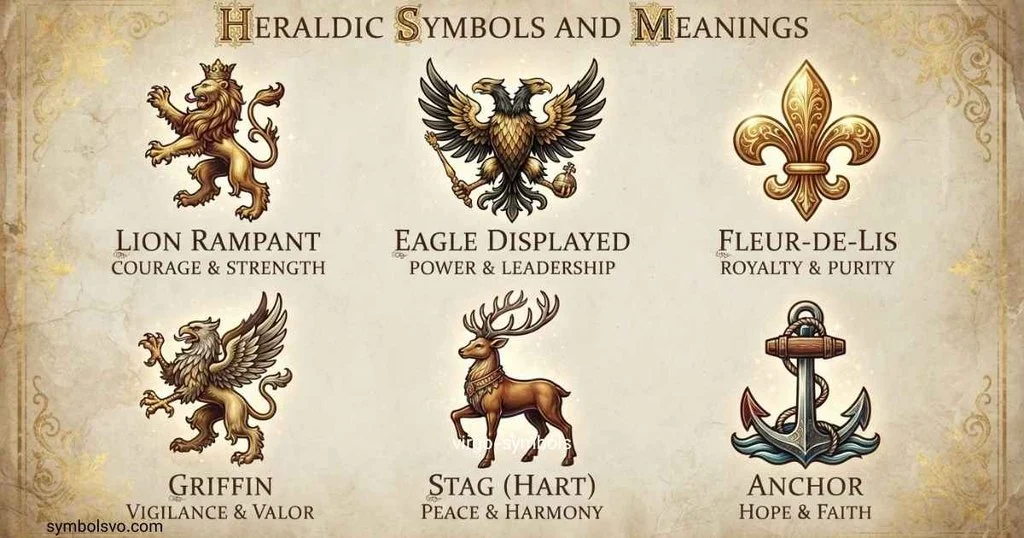
Heraldic symbols can communicate ideas through animals, objects, plants, mythical creatures, and other charges. Their meanings developed through historical use, cultural traditions, and individual heraldic grants.
Animal symbols
Animals are among the most recognizable heraldic charges.
- Lion: Often associated with courage, strength, sovereignty, and leadership.
- Eagle: Frequently associated with authority, power, and vigilance.
- Bear: Can suggest strength, endurance, or bravery.
- Boar: Commonly associated with courage and ferocity.
- Stag or deer: Often connected with peace, endurance, or woodland imagery.
- Horse: May represent speed, readiness, or noble associations.
- Wolf: Can symbolize perseverance, loyalty, or a connection with traditional warrior imagery.
- Fox: Sometimes associated with cleverness or resourcefulness.
Objects and plants
Objects can also have strong heraldic associations.
- Crown: Royal or sovereign authority.
- Sword: Defense, justice, military service, or readiness.
- Castle: Fortification, protection, or a place.
- Key: Authority, guardianship, or stewardship.
- Anchor: Maritime connections, stability, or hope.
- Rose: A common decorative and regional emblem with different historical associations.
- Oak: Strength, endurance, and longevity.
- Lily: Often associated with purity or religious symbolism.
The precise interpretation should always take the complete coat of arms into account rather than relying on a single symbolic meaning.
Heraldic Symbols And Meanings With Pictures
Pictures make heraldry easier to understand because the position, shape, color, and posture of a charge can matter. A lion facing a particular direction or standing in a particular position is not necessarily equivalent to every other lion used in heraldry.
For visual reference, common heraldic designs include:
- 🦁 Lion — a major animal charge found in European heraldry.
- 🦅 Eagle — a prominent heraldic bird.
- 🦄 Unicorn — a famous mythical charge, strongly associated with Scottish heraldry.
- 🐗 Boar — an animal charge used in various arms.
- 🌹 Rose — a plant charge appearing in many heraldic traditions.
- ⚔ Sword — an object charge connected with defense and martial imagery.
- 🏰 Castle — an architectural charge.
- ✚ Cross — a major heraldic and religious design.
When searching for heraldic pictures, look at the shield shape, tinctures, charge placement, crest, helmet, supporters, and motto as a complete design. This prevents confusion between a standalone symbol and an entire heraldic achievement.
Heraldic Colors And Symbols
Heraldic colors are known as tinctures. Traditional heraldry divides them into metals and colors, with additional tinctures appearing in some traditions and periods.
Metals
The two principal metals are:
- Or — gold or yellow
- Argent — silver or white
Principal colors
The traditional heraldic colors include:
- Gules — red
- Azure — blue
- Sable — black
- Vert — green
- Purpure — purple
Other tinctures, such as Tenné and Murrey, occur in particular heraldic systems but are less common in traditional English heraldry.
Heraldry also uses patterns and fur representations, including ermine and vair.
Why heraldic color matters
Color helps make a coat of arms visually distinctive. Traditional heraldic practice also includes the well-known rule of tincture, which generally favors placing a metal against a color and a color against a metal to maintain contrast.
Symbolic interpretations such as red for courage or blue for loyalty are often given in modern heraldry guides. However, these meanings should not automatically be assigned to every historical coat of arms.
Heraldic Symbols List
Here is a practical list of widely recognized heraldic charges and related elements:
| Symbol | Name | Common association |
| 🦁 | Lion | Courage and strength |
| 🦅 | Eagle | Authority and power |
| 🐗 | Boar | Courage and determination |
| 🐻 | Bear | Strength |
| 🦌 | Stag | Endurance and peace |
| 🐺 | Wolf | Perseverance and loyalty |
| 🦄 | Unicorn | Strength and purity |
| 🐎 | Horse | Speed and readiness |
| 🌹 | Rose | Honor, beauty, or regional identity |
| 🌳 | Oak | Strength and endurance |
| ⚔ | Sword | Defense and justice |
| 🏰 | Castle | Defense and fortification |
| 👑 | Crown | Royal authority |
| ⚓ | Anchor | Maritime connection and stability |
| ✚ | Cross | Religious association |
| ⭐ | Star | Guidance or distinction |
| ☀ | Sun | Light and vitality |
| 🌙 | Crescent | A heraldic charge with varied historical use |
| 🔥 | Flame | Fire, zeal, or religious imagery |
| 🔑 | Key | Stewardship or authority |
Some emoji shown above are only visual approximations of heraldic charges. They are not replacements for historically accurate heraldic artwork.
Common Heraldic Symbols
Several charges appear repeatedly across European heraldic traditions. The lion and eagle are especially recognizable because they have long histories in royal, noble, civic, and territorial imagery.
Popular charges
Lion: Lions appear in numerous coats of arms and can be shown in different poses. A lion rampant, for example, stands upright with raised forelegs.
Eagle: Eagles are particularly important in several European heraldic traditions. Their displayed wings create a distinctive shape that works well on shields.
Cross: Crosses appear in many forms, including simple crosses and more specialized heraldic variations.
Castle: Castles can represent a fortified location, defensive strength, or a connection with a particular place.
Rose: Roses became important charges in English heraldic history, although the meaning of a rose depends on its specific historical context.
Crescent: Crescents can occur as charges or marks of difference and should be interpreted within the complete arms.
The same symbol may therefore carry different associations in different coats of arms.
Medieval Heraldic Symbols
Medieval heraldry developed in Europe during the Middle Ages as a system for identifying individuals and groups, especially in military and tournament settings. Shields were particularly useful because their designs could be recognized from a distance.
Common medieval charges included:
- Lions
- Eagles
- Crosses
- Fleurs-de-lis
- Castles
- Swords
- Crowns
- Stars
- Crescents
- Dragons
- Griffins
- Stags
- Boars
Medieval heraldry was not simply a collection of symbols with fixed meanings. A charge could be selected because of family tradition, a place name, a personal association, a pun, an inherited design, or another reason.
The formal description of arms is called a blazon. Instead of relying only on a picture, a trained herald can reconstruct a coat of arms from its blazon.
Coat Of Arms Heraldic Symbols
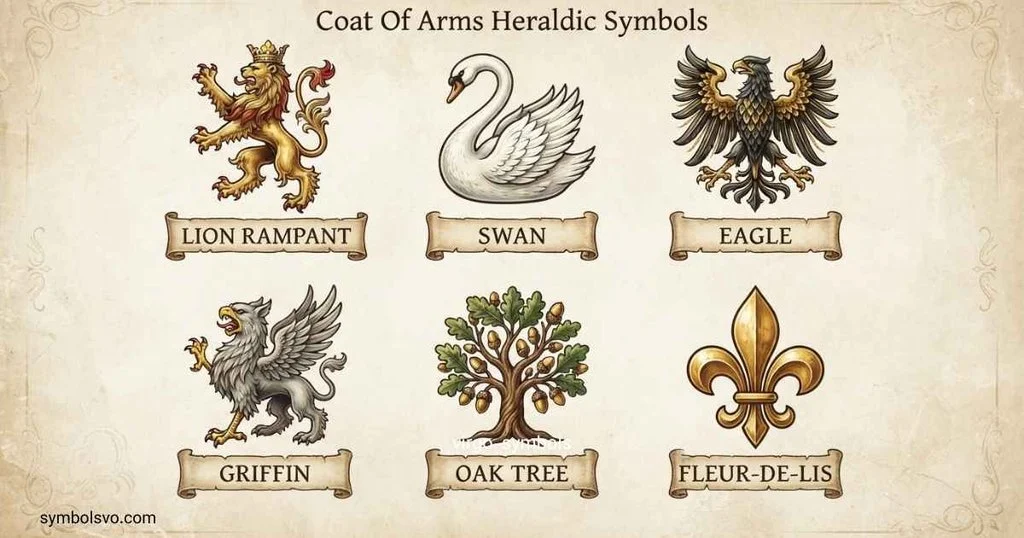
A coat of arms is a heraldic design belonging to a particular bearer. The shield is central, but a full heraldic achievement can contain several additional components.
Common elements include:
- Shield: The main field where the arms are displayed.
- Charges: Figures and objects placed on the shield.
- Helmet: Often positioned above the shield in a complete achievement.
- Crest: A separate heraldic element traditionally placed above the helmet.
- Mantling: Decorative cloth associated with the helmet.
- Supporters: Figures standing beside the shield in some arms.
- Motto: A phrase associated with the bearer.
This distinction matters because people often use “coat of arms,” “family crest,” and “crest” as if they mean the same thing. In technical heraldic terminology, they can refer to different parts of the overall achievement.
Family Crest Heraldic Symbols
A family crest is often used casually to mean a family’s entire coat of arms. In technical heraldry, however, the crest is specifically the element placed above the helmet.
This difference is important when researching ancestry. A coat of arms is generally associated with a particular armiger or legally recognized bearer rather than automatically belonging to everyone who shares a surname.
Family-related heraldic designs may contain:
- Animals
- Plants
- Weapons
- Crowns
- Religious imagery
- Geometric patterns
- Mottoes
- Regional symbols
If you are researching a historical family, a surname alone is usually not enough to establish that a particular coat of arms belonged to your branch. Genealogical records and heraldic sources are needed to connect an individual to specific arms.
Scottish Heraldic Symbols
Scottish heraldry has several highly recognizable symbols. The lion rampant is strongly associated with the Scottish royal tradition, while the unicorn is a famous supporter in the Royal Arms of Scotland.
The thistle is Scotland’s well-known national floral emblem and also appears frequently in Scottish decorative and civic symbolism. It should not automatically be treated as a component of every Scottish coat of arms.
Other Scottish heraldic imagery can include:
- Lions
- Unicorns
- Stags
- Boars
- Thistles
- Crosses
- Swords
- Castles
- Clan-related imagery
Scottish heraldry has its own legal and administrative traditions, historically associated with the Lord Lyon King of Arms. Clan symbolism should therefore be approached carefully, especially when modern commercial products claim that every person with a particular surname owns a specific “clan crest.”
German Heraldic Symbols
German heraldry includes a wide variety of regional, civic, noble, and family arms. One of the most recognizable symbols is the eagle, which has a long history in the heraldic traditions of the Holy Roman Empire and later German states.
Other recurring German heraldic charges include:
- Eagles
- Lions
- Bears
- Boars
- Griffins
- Castles
- Crowns
- Crosses
- Stars
- Regional plants
The imperial eagle and other German eagles should not be confused with every eagle appearing in German heraldry. Different arms can use different eagle forms, tinctures, positions, and historical references.
German heraldry also varies considerably by region. A municipal coat of arms can tell a story about a city’s history, geography, occupation, or local identity rather than representing one family.
Fantasy Elemental Clans Heraldic Symbols
Fantasy elemental clans use heraldic-style symbols to represent fictional groups connected with elements such as fire, water, earth, air, ice, or lightning.
Unlike historical heraldry, these designs are usually created for fictional worlds, games, novels, role-playing settings, or original artwork.
Examples of fictional concepts include:
| Element | Possible heraldic-style imagery |
| Fire | Flame, phoenix, sun |
| Water | Wave, fish, sea serpent |
| Earth | Mountain, tree, stone |
| Air | Wing, cloud, bird |
| Ice | Snowflake, crystal, white wolf |
| Lightning | Bolt, storm cloud, eagle |
These are creative associations rather than universal heraldic meanings. A fantasy clan can create its own symbolism, colors, motto, and rules without following historical heraldic practice.
For fictional designs, Unicode symbols can also provide quick text concepts such as 🔥, ❄, ⚡, and 🌊, although these are modern Unicode characters rather than medieval heraldic marks.
Heraldic Symbols Images
Heraldic images can range from a single charge to a complete coat of arms. When examining an image, identify each component separately instead of treating the entire design as one symbol.
A useful way to read a heraldic image is:
Shield → tinctures → charges → arrangement → helmet → crest → supporters → motto
Look for terms such as rampant, passant, displayed, salient, or sejant when describing animals. These words indicate the position or posture of a charge.
For example, a lion rampant is shown standing upright, while an eagle displayed is traditionally represented with its wings spread. These details can distinguish one heraldic design from another.
For copy-and-paste purposes, simple Unicode characters can represent the general idea:
★ ✚ ⚔ ☀ ☾ ♜ ♞
However, Unicode does not contain a universal set of official “heraldic symbols.” Many heraldic designs are illustrations rather than individual Unicode characters.
Heraldic Symbols Tiger
The tiger can appear as a heraldic charge, although it is less universal in European heraldry than the lion or eagle. Heraldic tigers may be represented as natural or stylized animals depending on the specific arms and heraldic tradition.
A tiger can be used in symbolic designs to suggest qualities such as:
- Courage
- Strength
- Ferocity
- Determination
- Independence
These are general symbolic associations rather than fixed meanings assigned to every tiger in heraldry.
A useful distinction is that heraldic artwork can depict a tiger in a highly stylized way, while a Unicode tiger emoji such as 🐅 is simply a modern pictographic character. The emoji is useful for texting and social media, but it is not itself a historical heraldic charge.
Heraldic Symbol Crossword Clue 6 Letters
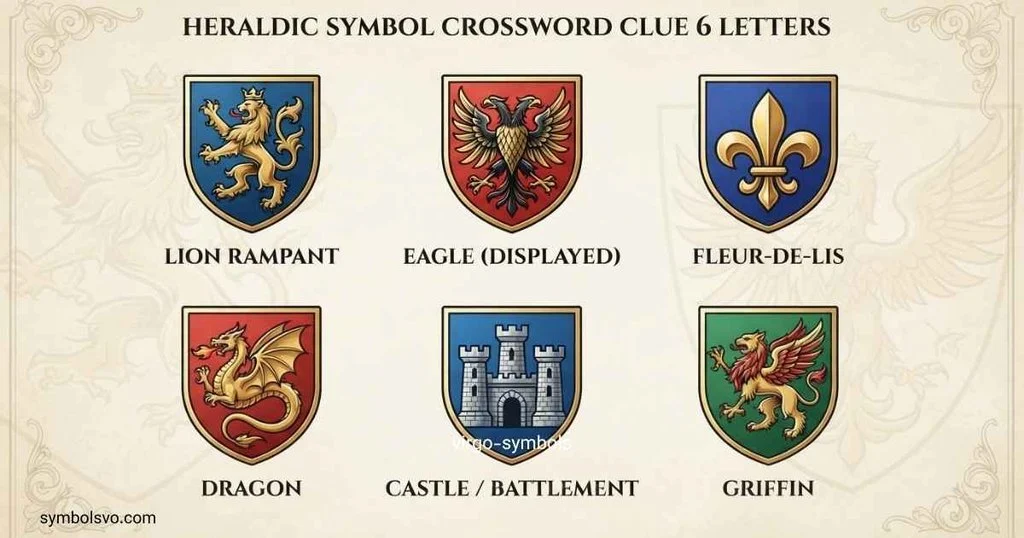
For a crossword clue such as “heraldic symbol” with six letters, CHARGE is a likely answer.
In heraldic terminology, a charge is a figure or device placed on a shield. It can be an animal, object, plant, geometric figure, or other recognizable design.
For example:
- Lion → a charge
- Eagle → a charge
- Rose → a charge
- Sword → a charge
- Star → a charge
Crossword answers always depend on the exact clue and crossing letters, so “CHARGE” should be checked against the puzzle’s other entries before being entered.
FAQ
What is the most common heraldic symbol?
There is no single symbol that is officially the most common across all heraldic traditions. Lions, eagles, crosses, stars, and other charges appear frequently in European heraldry.
What does a lion symbolize in heraldry?
A lion is commonly associated with courage, strength, authority, and leadership. Its exact significance depends on the particular arms and historical context.
Is a family crest the same as a coat of arms?
No. Technically, a crest is one component placed above the helmet, while a coat of arms centers on the shield. In everyday speech, however, “family crest” is often used loosely for an entire coat of arms.
Can heraldic symbols be copied and pasted?
Some simple Unicode characters can be copied and pasted, such as ★, ✚, ⚔, and ☀. Most historical coats of arms and detailed heraldic artwork are images or illustrations rather than individual Unicode characters.
Do heraldic symbols have fixed meanings?
Not always. Many symbols have common traditional associations, but their meaning can vary according to the bearer, historical period, country, design, and context. A complete coat of arms provides more information than one symbol alone.
Conclusion
Heraldic symbols combine visual identity with history, tradition, and design. Animals such as lions, eagles, bears, and tigers can appear alongside objects, plants, crosses, castles, and other charges to create distinctive heraldic compositions.
The details matter when interpreting these designs. Heraldic colors have specific traditional names, a crest is technically different from a coat of arms, and Scottish and German heraldry each have their own historical traditions. Fantasy clan symbols, meanwhile, can borrow the visual language of heraldry without being historical heraldry.
For quick digital use, Unicode offers a small selection of copy-and-paste characters that can suggest heraldic themes, but detailed historical arms are usually best represented through accurate artwork. Understanding the difference helps you use, research, and interpret heraldic symbols with greater confidence.

 Grace Whitmore
 Daniel Brooks