
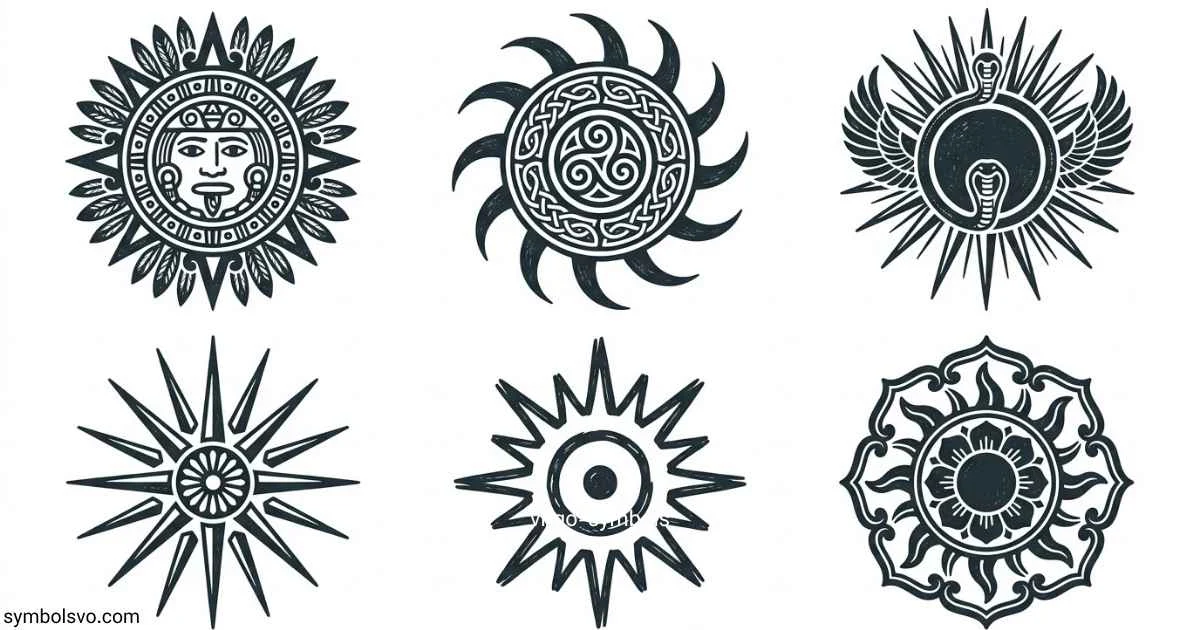
When I see a sun symbol, I immediately think of light, warmth, energy, and new beginnings. You may have seen these symbols in art, jewelry, tattoos, flags, or messages and wondered what they really represent.
I created this guide to help you explore the fascinating meanings behind sun symbols without making things complicated. You’ll discover how different cultures have used the sun to represent life, power, hope, protection, and renewal.
As you explore each symbol, I want you to look beyond its shape and notice the story behind it. Whether you’re searching for a meaningful symbol or simply curious, you’ll find plenty of ideas to explore here.
Sun Symbols Copy And Paste
If you need a sun symbol for a username, caption, message, profile, artwork, or decorative text, the following characters are easy to copy.
Popular sun symbols
- ☀ — Sun
- ☼ — White Sun With Rays
- ☉ — Sun symbol
- ◉ — Fisheye-style circular symbol
- 🌞 — Sun With Face
- 🌝 — Full Moon With Face
- 🌤 — Sun Behind Small Cloud
- 🌅 — Sunrise
- 🌄 — Sunrise Over Mountains
- 🔆 — Brightness symbol
You can copy a symbol directly from the list and paste it into a compatible app or website.
Simple decorative combinations:
- ☀︎ Good Morning ☀︎
- ☼ Sunshine ☼
- ✦ ☀ ✦
- ☀️✨
- ☀︎ Rise & Shine ☀︎
The plain characters ☀, ☼, and ☉ are text characters, while 🌞, 🌅, and 🌤 are emoji characters. Their appearance can vary between operating systems and apps.
Sun Symbols Text
Sun symbols in text are useful when you want to add a visual idea without using an image. Some are plain Unicode characters, while others are emoji.
| Symbol | Common description | Typical use |
| ☀ | Sun | Weather, sunshine, positivity |
| ☼ | Sun with rays | Decoration, symbolism |
| ☉ | Sun symbol | Astrology, astronomy, historical notation |
| 🌞 | Sun with face | Friendly messages and captions |
| 🌅 | Sunrise | New beginnings, mornings |
| 🔆 | Brightness | Light, brightness, settings |
| ☀️ | Sun emoji presentation | Messages, captions, weather |
A useful distinction is ☀ versus 🌞. The first is a text symbol depicting the sun, while the second is an emoji depicting a sun with a face.
For decorative text, symbols such as ☀︎ ☼ ✦ can work well because they can be combined with words without taking up much space.
Sun Symbols And Meanings
The meaning of a sun symbol depends heavily on context. Across many traditions, however, the sun is associated with ideas such as:
- ☀ — Light: illumination and clarity
- ☼ — Life: warmth and the conditions needed for life
- ☉ — Solar power: the sun as a celestial body
- 🌅 — Renewal: a new day or fresh beginning
- 🌞 — Happiness: warmth, friendliness, and cheerful energy
- Solar disk: divine or royal power in some historical traditions
- Sun rays: expansion, radiance, energy, or illumination
The sun can also represent time because its movement across the sky has traditionally helped people understand days, seasons, and agricultural cycles.
A sun symbol does not have one universal meaning. A design used in an ancient religious setting can have a very different meaning from the same-looking shape used as a modern decorative icon.
Different Sun Symbols
There is no single universal sun symbol. Artists, civilizations, religions, and modern designers have represented the sun in many different ways.
Common forms include:
Circle with rays
A central circle surrounded by straight or curved rays is one of the most recognizable solar designs.
Example: ☀
Plain solar circle
A simple circle can represent the sun in astronomical, astrological, or symbolic contexts.
Example: ☉
Radiant disk
A disk surrounded by numerous rays appears in many historical and artistic traditions. The number, shape, and arrangement of rays can vary considerably.
Human-faced sun
A sun with a face is a familiar artistic design and is also represented digitally by 🌞.
Spiral or geometric sun
Some traditional and modern artworks use spirals, geometric patterns, or repeated lines to communicate movement and solar energy.
When identifying an ancient symbol, it is better to consider its culture and historical source rather than assuming that every circular design with rays has the same meaning.
Sun Symbols In Different Cultures
The sun has played an important role in many societies, but its symbolism is not identical everywhere.
| Culture or tradition | Example of solar imagery | Common association |
| Ancient Egypt | Solar disk | Divine power, kingship, creation |
| Maya | Solar imagery and calendar-related representations | Time, celestial cycles |
| Aztec | Tonatiuh and solar imagery | Sun, cosmic order, ritual life |
| Taino | Sun imagery in Indigenous Caribbean traditions | Nature and spiritual symbolism |
| Nordic traditions | Solar motifs and sun imagery | Light, celestial cycles, mythology |
| Native American cultures | Many distinct solar representations | Varies by nation and tradition |
| Nepal | Sun and moon | Enduring national identity and symbolism |
| Alchemy | ☉ | Sun, gold, and solar correspondence |
These traditions should not be treated as one shared symbolic system. The same basic image—a circle, rays, or celestial body—can carry different meanings in different historical settings.
Sun Symbols Ancient
Ancient sun symbols appear in archaeological objects, religious art, calendars, architecture, coins, manuscripts, and decorative designs.
Many ancient societies depended on the sun for agriculture and timekeeping, so solar imagery naturally became connected with seasons, fertility, authority, life, and the heavens.
Ancient solar designs often include:
- Radiant circles
- Solar disks
- Circular faces
- Sun rays
- Cross-like solar forms
- Geometric patterns
- Celestial combinations involving the sun and moon
However, an ancient-looking symbol is not automatically an ancient religious symbol. Modern artists frequently create designs inspired by historical motifs. Identifying the original culture and archaeological context is essential before assigning a historical meaning.
Alchemy Sun Symbols
In Western alchemical symbolism, the sun is commonly represented by ☉.
The symbol resembles a circle with a central point and is traditionally associated with the Sun. In alchemical correspondence, the Sun was also connected with gold.
A simple way to remember the association is:
☉ → Sun → Gold
Alchemy used a network of planetary, elemental, metallic, and philosophical correspondences. The solar symbol therefore had a more specific historical role than simply representing pleasant weather or sunshine.
Today, ☉ is often used decoratively or in astrology-inspired designs, so its modern use may not have anything to do with historical alchemy.
Egyptian Sun Symbols
Ancient Egyptian religion featured several important solar deities and forms of solar imagery. One of the most recognizable is the solar disk, often shown as a disk associated with the sun god Ra and other deities.
Another important symbol is the winged sun disk, which appears in Egyptian and wider ancient Near Eastern art.
The Aten, particularly important during the reign of Akhenaten, was represented as a solar disk with rays extending downward. Some depictions show the rays ending in hands, emphasizing the Aten’s connection with the royal family.
Common Egyptian solar imagery includes:
- Solar disk — the visible disk of the sun and divine solar power
- Aten disk — associated specifically with Aten worship
- Winged solar disk — a major decorative and religious motif
- Ra’s solar imagery — connected with the sun god and his cosmic role
These symbols belong to different periods and religious contexts, so they should not all be treated as interchangeable.
Aztec Sun Symbols
Aztec solar symbolism is strongly connected with Tonatiuh, the sun deity in Aztec religion.
One of the best-known examples is the central face of the Aztec Sun Stone, a large carved stone associated with Aztec calendrical and cosmological ideas. It is often called the Aztec calendar stone in popular culture, although that simplified name does not fully describe its historical significance.
The imagery surrounding Tonatiuh includes complex forms representing Aztec ideas about cosmic time and successive eras.
For modern designs, people sometimes use stylized Aztec-inspired suns with:
- A central face
- Geometric rays
- Repeated patterns
- Angular shapes
- Circular borders
These modern versions should be distinguished from authentic archaeological representations.
Mayan Sun Symbols
Maya civilization developed sophisticated systems for observing celestial cycles and recording time. Solar imagery appears in Maya art, inscriptions, architecture, and manuscripts.
The sun could be represented through deities and celestial imagery rather than through one universal standalone character.
A commonly discussed figure is Kinich Ahau, a Maya solar deity associated with the sun. Artistic representations can include distinctive facial features and solar associations.
Maya solar symbolism is closely connected with broader themes of:
- Time
- Calendrical cycles
- Kingship
- Celestial observation
- Religious practice
- The movement of heavenly bodies
There is no single Unicode character that can accurately be called “the Mayan sun symbol.” Modern text symbols such as ☀ are useful for representing the idea of the sun, but they are not authentic Maya writing.
Taino Sun Symbols
The Taíno were Indigenous peoples of the Caribbean, and their artistic traditions include geometric and natural imagery. Taíno symbolism should be understood through the specific archaeological and cultural context rather than through a single universal “Taíno sun symbol.”
Modern designs described as Taíno sun symbols may draw inspiration from Indigenous Caribbean petroglyphs, geometric patterns, or representations associated with celestial and natural themes.
If you are using a Taíno-inspired design, it is helpful to distinguish between:
- An authentic archaeological motif
- A modern artistic reconstruction
- A contemporary design inspired by Taíno art
This distinction matters because not every circular or radiant design found online is an ancient Taíno symbol.
Native American Sun Symbols
“Native American” covers many different Indigenous nations, languages, and artistic traditions across North America. As a result, there is no single Native American sun symbol shared by every nation.
Solar imagery can appear in different forms and contexts, including artwork, ceremonial objects, stories, and representations of the natural world.
When discussing a particular symbol, identify the nation or cultural tradition whenever possible. A design associated with one Indigenous community should not automatically be presented as a symbol belonging to all Native American peoples.
For general modern use, ☀ can simply represent sunshine or the sun. It should not be presented as an authentic Indigenous symbol unless a reliable cultural or historical source supports that identification.
Nordic Ancient Sun Symbols
Ancient Nordic and Scandinavian cultures used a variety of solar and celestial motifs. One famous archaeological example is the Trundholm sun chariot, a Bronze Age object from Denmark.
The chariot features a disk that has been interpreted as a representation of the sun, with one side decorated differently from the other. It provides an important example of Bronze Age Scandinavian solar imagery.
Other Nordic and Germanic artistic traditions contain circular, wheel-like, and celestial motifs. However, modern internet collections sometimes label many different geometric designs as “Viking sun symbols” without establishing their historical origin.
For accuracy, it is better to describe a design as Nordic-inspired when its exact ancient provenance is uncertain.
Nepal Flag Moon Sun Symbols
Nepal’s national flag contains two important celestial images: the moon and the sun.
The flag is distinctive because it is made from two stacked triangular shapes rather than the rectangular form used by most national flags. The upper section contains a stylized moon, while the lower section contains a sun.
The two celestial symbols are commonly understood in connection with the enduring nature of the nation. Their presence also reflects Nepal’s long-standing use of celestial imagery in its national identity.
The simplified symbols are:
☾ — Moon-inspired shape
☀ — Sun-inspired idea
The actual figures on Nepal’s flag are stylized national emblems, so the ordinary Unicode symbols above should not be mistaken for exact reproductions of the flag’s artwork.
Sun Emoji Symbol
The most familiar sun-related emoji is 🌞, officially known as SUN WITH FACE in Unicode.
Other useful sun and weather emojis include:
- ☀️ — Sun
- 🌞 — Sun With Face
- 🌤️ — Sun Behind Small Cloud
- 🌥️ — Sun Behind Large Cloud
- 🌅 — Sunrise
- 🌄 — Sunrise Over Mountains
You can use them in messages, captions, profiles, weather updates, or decorative posts.
For example:
Good morning! ☀️
New day, fresh start 🌅
Enjoy the sunshine 🌞
Emoji appearance can differ between platforms. The underlying character is standardized, but the artwork used to display it is created by the platform or font provider.
Raisin in the Sun Symbols
A Raisin in the Sun is a play by Lorraine Hansberry. Its title itself contains an important symbolic image: the raisin in the sun.
The phrase comes from a famous poetic question about what can happen to a dream when it is delayed. In the play, the image connects to the aspirations, frustrations, and struggles of the Younger family.
Important symbols and motifs in the work include:
- The raisin — a delayed or neglected dream
- The sun — conditions that can transform or affect a dream
- Mama’s plant — hope, care, growth, and the desire for a better home
- The house — security, opportunity, and family aspirations
The raisin is therefore not simply a reference to fruit. It helps express the consequences of dreams being postponed under difficult circumstances.
FAQ
What is the most common sun symbol?
☀ is one of the most recognizable text symbols used to represent the sun. It is commonly used for sunshine, warmth, weather, and positive decorative messages.
What does the sun symbol mean spiritually?
Its meaning varies by tradition. Common associations include life, light, renewal, energy, creation, and spiritual illumination, but there is no single universal spiritual meaning.
What is the Unicode symbol for the sun?
☀ is a Unicode character named BLACK SUN WITH RAYS, while ☼ is WHITE SUN WITH RAYS. ☉ is a separate character commonly associated with the Sun.
Is there a Native American sun symbol?
There is no single symbol shared by all Native American nations. Different Indigenous cultures have their own artistic traditions, beliefs, and solar imagery.
Can I copy and paste sun emojis?
Yes. You can copy characters such as ☀️, 🌞, 🌅, and 🌤️ from this article and paste them into apps that support those Unicode characters and emoji.
Conclusion
Sun symbols give people a simple way to express ideas of light, warmth, life, renewal, and celestial power. Modern characters such as ☀, ☼, ☉, and 🌞 are useful for messages, profiles, artwork, and decorative text.
Historical solar imagery adds another layer of meaning. Egyptian, Maya, Aztec, Taíno, Nordic, Native American, and Nepalese traditions all demonstrate that the sun has been represented in many different ways, with meanings shaped by each culture.
When choosing a sun symbol, consider both its appearance and its context. For everyday copy-and-paste use, ☀️ and 🌞 are easy choices; for historical designs, research the specific culture and source before assigning a meaning.

 Mason Ellington
 Daniel Brooks