
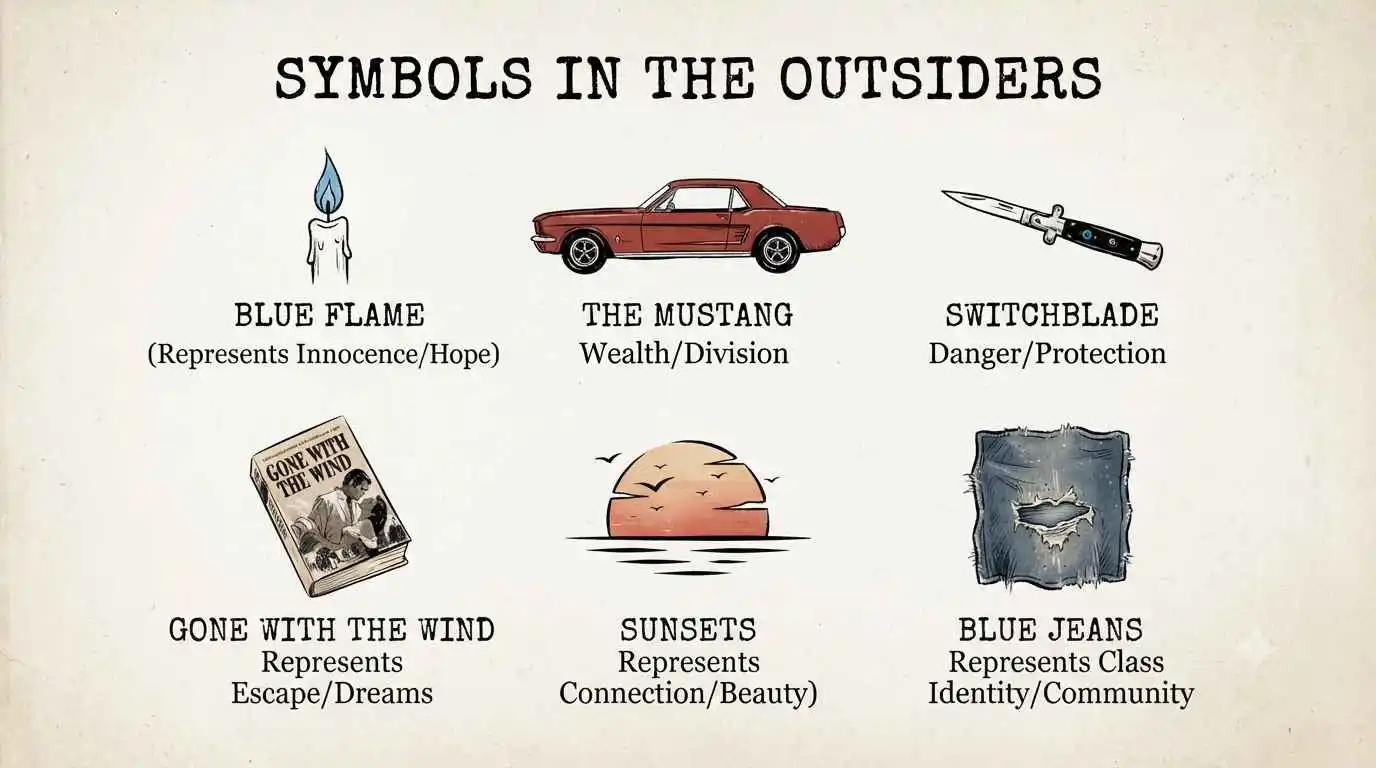
When I first read The Outsiders, I thought it was simply a story about rival gangs, friendship, and survival. But when you look closer, you begin to notice that sunsets, hair, cars, and even clothing carry powerful hidden meanings.
Every symbol reveals emotions the characters are often too hurt or afraid to express.
Once you understand these hidden meanings, you may never see Ponyboy’s story the same way again.
I will help you uncover what each symbol means, how it connects to the characters, and why it makes the novel’s message about identity, loyalty, conflict, and hope even more unforgettable.
Quick Answer
Symbols in The Outsiders are literary devices used by S.E. Hinton to represent the deeper emotional, social, and psychological struggles of the characters. Key symbols like switchblades, blue Mustangs, gold sunsets, and greasy hair visualize the invisible barriers of social class, the defensive walls of trauma, and the universal beauty that connects all human beings regardless of their background.
Quick Facts About Symbols in The Outsiders
| Aspect | Information |
| Origin | Written by S.E. Hinton in 1967 based on her real-life high school experiences in Tulsa, Oklahoma. |
| Historical Significance | Revolutionized Young Adult (YA) literature by introducing raw, realistic teenage perspectives and social critiques. |
| Main Meaning | The internal struggle for identity against social economic divides and the tragic loss of youth. |
| Spiritual Meaning | The preservation of purity, innocence, and soul consciousness in a cruel, fragmented world. |
| Cultural Importance | Shaped how generations of readers understand tribalism, empathy, empathy across class lines, and toxic masculinity. |
| Modern Usage | Frequently analyzed in academic curriculums, referenced in pop culture, and used to study social psychology. |
What Are Symbols in The Outsiders?
To truly understand symbols in The Outsiders, we must first look at the environment that birthed them. S.E. Hinton was only sixteen years old when she began writing the novel in Tulsa, Oklahoma. The book emerged during the turbulent 1960s, a time when youth culture was fracturing and traditional American ideals were being questioned.
A symbol is a physical object, character, or setting that represents a larger, abstract idea. In this novel, symbols are not just decorative poetic elements. Instead, they function as an emotional shorthand for teenagers who lack the vocabulary or safety to express their deepest traumas.
Historically, society viewed juvenile delinquents through a rigid, unsympathetic lens. Hinton used everyday objects to shatter these stereotypes. By embedding deep metaphorical weight into ordinary items, she showed that underneath the tough exteriors, these boys experienced profound psychological depth. Over time, these symbols have evolved from simple plot devices into classic literary archetypes that define the pains of growing up.
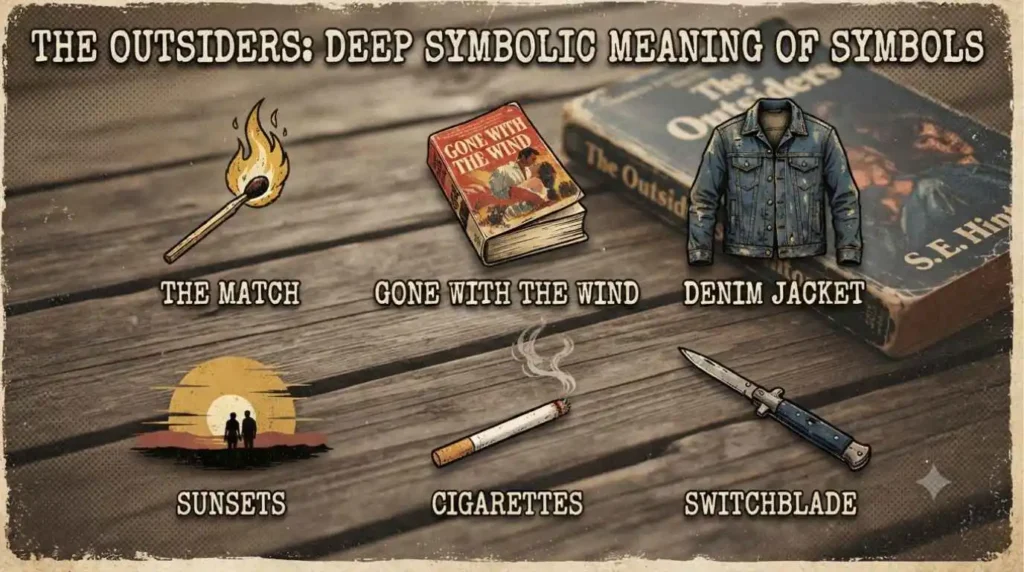
Deep Symbolic Meaning of Symbols in The Outsiders
Spiritual Level
On a spiritual level, the symbols in the novel represent the preservation of the human soul against corruption. The book mirrors a classic spiritual fall from grace. The characters live in a state of spiritual exile, locked in a hellish cycle of eye-for-an-eye violence.
Symbols of nature, such as the morning mist and the changing colors of the sky, represent moments of divine grace and inner transformation. They show that despite the dirt and blood of the streets, an uncorrupted, higher consciousness exists within the characters.
Psychological Level
Psychologically, the symbols map perfectly onto Jungian archetypes. The Greasers’ hair and the Socs’ cars function as the “Persona”, the public mask worn to hide vulnerability and fit into a tribe. The weapons, like Johnny’s switchblade, represent the “Shadow”, the manifestation of fear, repressed trauma, and defensive aggression.
Humans possess an innate emotional attraction to patterns that signal safety or danger. Hinton taps into this by showing how objects trigger psychological defense mechanisms. A simple pair of rings or a specific car model becomes a psychological trigger for Post-Traumatic Stress Disorder (PTSD) within vulnerable children.
Cultural Level
Culturally, these symbols highlight the construction of community beliefs and social divides. They illustrate how a society can weaponize material goods to establish hierarchy. The traditional interpretations of wealth and poverty are turned upside down.
Instead of associating wealth with peace, the symbols reveal that the wealthy Socs suffer from a cultural emptiness, while the impoverished Greasers share a deep, tribal loyalty. This storytelling reminds us that human communities often use arbitrary markers to separate “us” from “them.”
Types and Variations of Symbols in The Outsiders
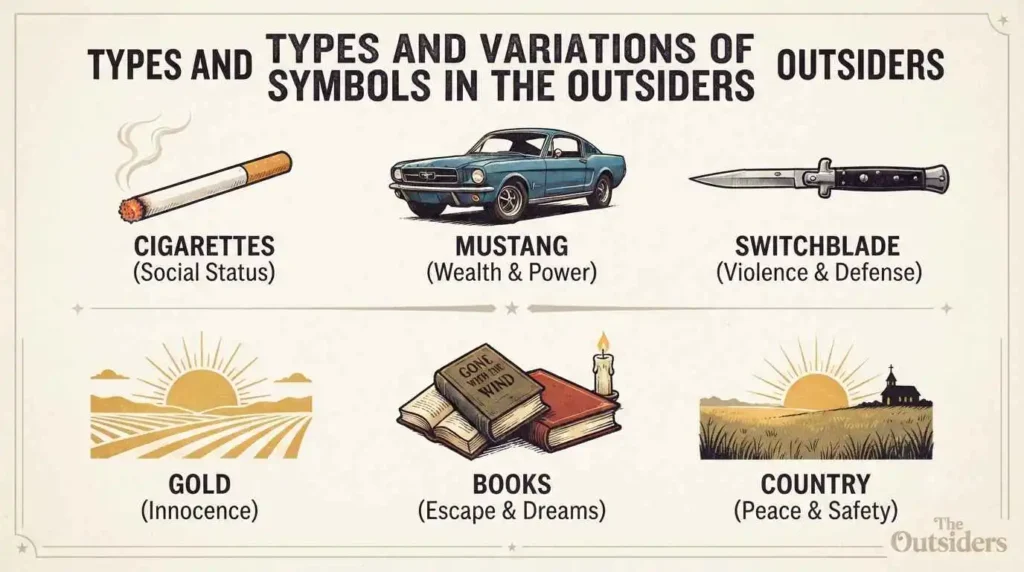
1. Two-Bit’s Switchblade
- Visual Description: A sleek, ten-inch switchblade with a pearl handle, kept razor-sharp.
- Meaning: Individual power, stolen authority, and the illusion of safety.
- Symbolism: Represents the dark potential for violence that the Greasers feel forced to carry. It is a prized possession because it provides a sense of control in a world where they have no legal or financial power.
- Cultural Connection: Traditional American rebel culture of the 1950s and 60s.
- Where It Appears: It is prominently displayed by Two-Bit in school and on the streets, and it is later handed to Dally in the hospital.
2. The Blue Mustang
- Visual Description: A sleek, expensive, high-performance sports car painted a chilling blue.
- Meaning: Wealth, mobility, and unchecked socioeconomic power.
- Symbolism: Represents the aggressive, looming threat of the Socs. It serves as a physical manifestation of class warfare, moving freely into Greaser territory to inflict terror.
- Cultural Connection: The post-WWII American dream of consumerism and status.
- Where It Appears: Cruising the streets at night, parked outside the drive-in, and present during the fateful park attack.
3. Bob’s Rings
- Visual Description: Heavy, hard, expensive silver rings worn on a Soc’s fist.
- Meaning: Weaponized wealth and physical trauma.
- Symbolism: The rings symbolize how wealth can be used as a physical and psychological weapon to scar the less fortunate. They represent the literal and figurative bruises inflicted by the upper class.
- Cultural Connection: Status symbols turned into tools of oppression.
- Where It Appears: On Bob Sheldon’s hand during Johnny’s initial brutal beating and during the confrontation in the park.
4. Greaser Hair
- Visual Description: Long, carefully combed hair held in place by large amounts of hair oil.
- Meaning: Identity, pride, and tribal belonging.
- Symbolism: It is the ultimate badge of honor for the Greasers. Because they cannot afford nice clothes or cars, their hair is the one thing they own that defines their brotherhood and rebellion against society.
- Cultural Connection: The Rockabilly and Greaser subcultures of working-class youth.
- Where It Appears: Maintained constantly by all Greasers, and dramatically cut and bleached by Ponyboy in hiding.
Symbols in The Outsiders Across Different Cultures
While The Outsiders is set in mid-century America, its core symbols mirror archetypes found throughout human history and across various global traditions:
- Ancient Egypt: In Egyptian mythology, the sun’s daily cycle was a matter of life and death. The setting sun represented the god Ra entering the underworld. This mirrors Hinton’s use of sunsets, where the transition of light symbolizes the crossing over from innocence into the dark hardships of reality.
- Ancient Greece: The blue Mustang operates much like the chariots of the gods or elite warriors in Greek epics. It represents a chariot of privilege that allows the ruling class to strike down the lower classes with impunity, echoing the structural inequalities found in classical mythology.
- Roman Culture: The strict division between the Greasers and the Socs reflects the historical divide between the Plebeians and the Patricians. The symbols of hair and rings mimic the Roman laws where specific dress codes and jewelry were legally restricted to signify political status and citizen rights.
- Eastern Traditions: The concept of “Nothing Gold Can Stay” aligns deeply with Buddhist philosophies on impermanence, known as Anicca. It teaches that clinging to youth, beauty, or temporary moments causes suffering, and true peace comes from accepting that all beautiful things must fade.
- Indigenous Traditions: The deep bond of the Greaser gang, symbolized by their shared look and hair, mirrors tribal rites of passage and communal hair traditions found in various Native American cultures. Hair is viewed as an extension of the self and a symbol of spiritual strength.
- Modern Interpretations: Today, these symbols have shifted into digital spaces. The blue Mustang and the switchblade are viewed as early representations of systemic privilege and systemic trauma, analyzed frequently in modern sociological studies.
Similar Symbols and Their Meanings
To fully appreciate the nuance of these motifs, it helps to compare how similar symbols interact within the story:
Comparison of Key Counter-Symbols
| Symbol A | Symbol B | Similarities | Differences | Symbolic Relationship |
| The Blue Mustang | Greaser Hair | Both are visual markers used to identify a specific teen gang. | The Mustang costs thousands of dollars; hair costs nothing but care. | They represent the clash between material wealth and personal identity. |
| Two-Bit’s Switchblade | Bob’s Rings | Both are physical weapons used to cause severe trauma. | The blade is an illegal tool of defense; the rings are legal luxury items used for offense. | They show how both classes weaponize their environment to survive or dominate. |
| The Church at Windrixville | The Lot | Both are locations where characters seek sanctuary. | The church is an abandoned spiritual space; the lot is an empty, cold urban space. | They highlight the contrast between a holy escape and a harsh, lonely reality. |
Common Misconceptions
A frequent misconception is that the switchblade represents malicious criminal intent. In reality, the blade symbolizes deep-seated fear and a desperate need for protection. Another misconception is that the Socs’ cars represent freedom. For characters like Cherry and Randy, the cars actually represent a gilded cage of social expectations that they cannot escape.
What Are 4 Symbols in The Outsiders?
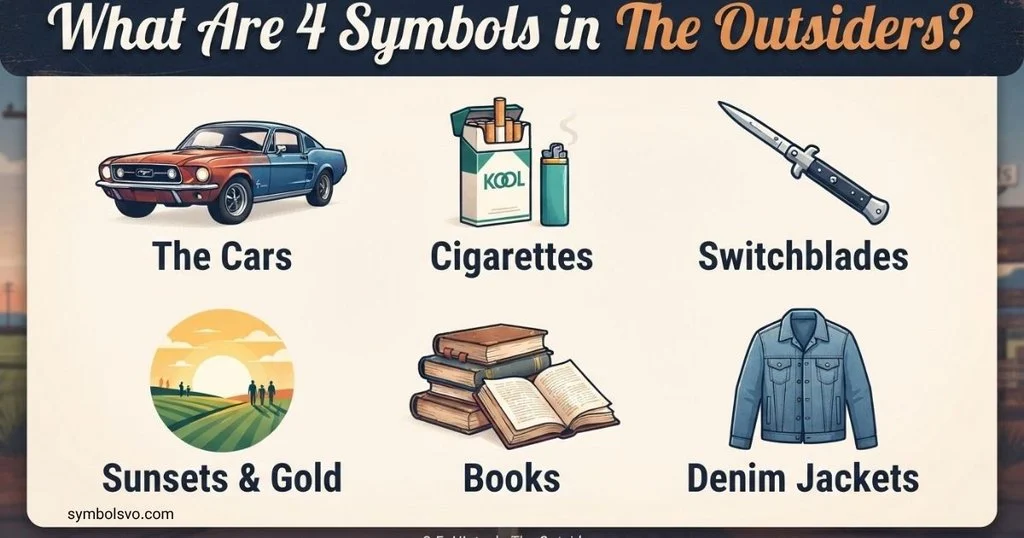
Four especially important symbols in The Outsiders are:
- Sunsets — represent shared human experiences and show that Greasers and Socs are not completely different.
- Hair — represents Greaser identity, pride, and individuality.
- The Church — represents temporary safety, transformation, and the loss of innocence.
- Gold — represents innocence, beauty, goodness, and things that do not last forever.
These symbols connect directly to the novel’s major themes. They also help readers understand Ponyboy’s changing view of the world..
What Does the Church Symbolize in The Outsiders?
The abandoned church where Ponyboy and Johnny hide symbolizes temporary safety, isolation, and transformation. At first, the church gives the boys a place to escape the conflict between the Greasers and Socs.
While staying there, Ponyboy and Johnny have time away from the violence surrounding them. They read, talk, reflect, and begin to see their situation differently.
The church therefore becomes more than a hiding place. It represents a brief period when the boys can step outside their usual identities and think about who they really are.
The church also becomes connected to the loss of innocence because the fire and its aftermath change the boys’ lives permanently.
What Does the Blue Mustang Symbolize in The Outsiders?
The blue Mustang is associated with the Socs and represents their wealth, social power, and the threat they pose to the Greasers.
For Ponyboy, the car becomes especially significant because it is connected with the people involved in the conflict that changes his life. It helps reinforce the visible difference between the two social groups.
However, the novel gradually shows that wealth does not automatically make the Socs happy or morally superior. Characters such as Cherry and Randy demonstrate that personal struggles exist on both sides.
What Does Ponyboy Symbolize in The Outsiders?
Ponyboy can symbolize innocence, self-discovery, and the possibility of understanding people beyond social labels.
Unlike some characters who accept the Greaser-versus-Soc conflict without question, Ponyboy spends much of the story trying to understand it. He enjoys reading and watching sunsets, which gives him a different perspective from the violence around him.
His development shows how a young person can begin with a narrow understanding of the world and gradually recognize the complexity of other people.
Ponyboy’s storytelling is also important because writing becomes a way for him to make sense of his experiences.
What Are Johnny’s Symbols in The Outsiders?
Johnny is strongly connected with symbols of innocence, vulnerability, courage, and hope.
Important symbols associated with Johnny include:
- The church: a place of refuge during a difficult period.
- “Stay gold”: a reminder to preserve goodness and innocence.
- The letter: Johnny’s final attempt to communicate his understanding to Ponyboy.
- Sunsets: a connection between Ponyboy, Johnny, and the idea that people from different backgrounds can share the same beautiful experiences.
Johnny’s character demonstrates that courage does not always mean being physically powerful. His choices show compassion and concern for others despite his difficult circumstances.
What Are Sodapop’s Symbols in The Outsiders?
Sodapop is associated with family, emotional warmth, and harmony.
Unlike the frequent tension between Ponyboy and Darry, Sodapop often acts as a bridge between his brothers. He represents the affection and emotional connection that helps hold the Curtis family together.
His character also shows that someone can appear cheerful while still experiencing personal struggles. Sodapop’s importance is therefore less about one physical object and more about what he represents within the Curtis family.
What Are Darry’s Symbols in The Outsiders?
Darry symbolizes responsibility, sacrifice, protection, and family duty.
After losing his parents, Darry takes on responsibilities far beyond what most teenagers would normally face. His strict behavior toward Ponyboy can initially seem harsh, but it comes from his desire to protect his younger brothers.
Darry therefore represents the difficult side of love: sometimes caring for someone means making demanding decisions and carrying responsibilities that others may not see.
What Are Two-Bit Mathews’ Symbols in The Outsiders?
Two-Bit is associated with humor, loyalty, confidence, and the Greaser group’s social identity.
His jokes and playful personality provide relief during serious moments. His switchblade also represents the tough image connected with the Greaser lifestyle.
Two-Bit shows how humor can help people cope with difficult situations while loyalty keeps the group connected.
What Does Dally Symbolize in The Outsiders?
Dally represents the hardening effects of violence, anger, and a life shaped by difficult experiences.
He has developed a tough exterior and often responds to problems through aggression. In contrast with Johnny’s vulnerability, Dally appears almost emotionally invulnerable.
However, his relationship with Johnny reveals that there is more beneath his tough personality. Johnny’s importance to Dally demonstrates that even someone who seems hardened can form powerful emotional connections.
What Do Greasers Symbolize in The Outsiders?
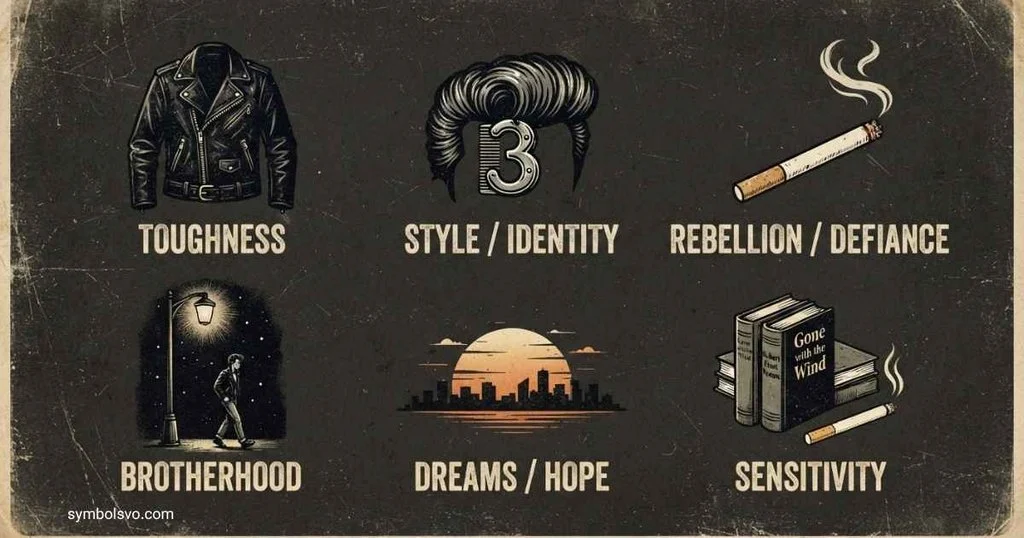
The Greasers symbolize working-class identity, loyalty, friendship, and social inequality.
Their long hair, clothing, cars, and group identity distinguish them from the Socs. But the novel does not portray every Greaser as exactly the same.
Ponyboy, Johnny, Dally, Darry, Sodapop, and Two-Bit all have different personalities and experiences. This reinforces one of the novel’s central ideas: a social label cannot completely define an individual.
What Do Socs Symbolize in The Outsiders?
The Socs symbolize privilege, social status, wealth, and the pressure that can exist behind a successful appearance.
At first, Ponyboy sees the Socs mainly as enemies. As the story develops, however, he learns that some Socs experience loneliness, pressure, guilt, and dissatisfaction.
Characters such as Cherry and Randy help challenge Ponyboy’s original assumptions. The novel ultimately suggests that the divide between the two groups is real, but their shared humanity is also real.
What Are the Key Symbols in The Outsiders?
The key symbols include:
Sunsets
Sunsets symbolize the idea that people from different backgrounds can experience the same beauty. Ponyboy’s realization about sunsets helps weaken the strict Greaser-Soc division in his mind.
Hair
Hair represents Greaser identity. The boys’ hairstyles are part of how they present themselves and distinguish themselves from the Socs.
Gold
Gold represents innocence, beauty, and goodness. The idea of staying “gold” becomes especially important to Ponyboy’s understanding of Johnny’s message.
The Church
The church represents refuge and a temporary escape from the conflict. It also becomes connected to major changes in Ponyboy and Johnny’s lives.
The Blue Mustang
The Mustang represents the Socs’ wealth and power and becomes an important visual reminder of the conflict between the groups.
Important Objects in The Outsiders
Several objects have symbolic or thematic importance in the novel.
The switchblade is associated with violence, toughness, and danger.
Hair represents identity and belonging, particularly for the Greasers.
The blue Mustang represents wealth, status, and the power associated with the Socs.
The copy of Gone with the Wind connects Ponyboy and Johnny through literature and gives them a way to think about courage and heroism.
The letter from Johnny becomes an important expression of Johnny’s beliefs and his hope that Ponyboy will understand the meaning of his experiences.
What Is the Meaning of “Stay Gold” in The Outsiders?
“Stay gold” represents the idea of holding on to goodness, innocence, sensitivity, and the ability to appreciate beauty even when life becomes difficult.
The phrase is connected to Robert Frost’s poem “Nothing Gold Can Stay,” which Ponyboy and Johnny discuss. In the novel, the concept becomes a lesson about appreciating beautiful moments rather than allowing violence and hardship to destroy one’s better qualities.
For Ponyboy, this idea becomes part of his emotional growth. He begins to understand that remaining compassionate can be a form of strength.
What Does the Sunset Symbolize in The Outsiders?
The sunset symbolizes shared humanity.
Ponyboy discovers that he and Cherry can look at the same sunset even though they belong to opposing social groups. This realization is important because it challenges the idea that Greasers and Socs are completely different.
The sunset therefore becomes a symbol of connection. It suggests that social class may separate people, but basic human experiences can still bring them together.
What Does Hair Symbolize in The Outsiders?
Hair symbolizes identity, pride, independence, and belonging.
For the Greasers, their hair is part of their recognizable appearance. It helps establish their group identity and separates them visually from the Socs.
Because the Greasers care about their hair, cutting it can feel like more than a change in appearance. It can represent losing or temporarily hiding an important part of one’s identity.
What Does the Church Symbolize in The Outsiders?
The church symbolizes escape, safety, reflection, and transformation.
It gives Ponyboy and Johnny a temporary break from the violence surrounding them. During this period, they have an opportunity to read, talk, and think about their lives.
Its symbolic importance grows because the boys eventually have to leave their temporary refuge and face the consequences of the events around them.
What Is a Premonition in The Outsiders?
A premonition is a feeling or impression that something may happen in the future, often before there is clear evidence that it will happen.
In literary analysis, a premonition can create suspense or foreshadow later events. The Outsiders contains moments where characters sense that something may go wrong, helping create tension as the story progresses.
A premonition is different from a confirmed prediction because it is usually an intuition or warning rather than certain knowledge.
Motifs in The Outsiders
A motif is a recurring element that helps develop a story’s central ideas. Important motifs in The Outsiders include belonging, violence, sunsets, innocence, family, friendship, and social division.
The repeated contrast between Greasers and Socs reinforces the motif of social class. The recurring attention to sunsets and nature develops the idea that people from opposing groups can still share common experiences.
The motif of innocence is especially important because Ponyboy and Johnny are forced to confront situations that challenge their understanding of the world.
Imagery in The Outsiders
Imagery is the use of descriptive language that helps readers imagine sights, sounds, places, and experiences.
Hinton uses imagery to make the Greasers’ world feel immediate and recognizable. Descriptions of hair, clothing, cars, sunsets, neighborhoods, and the abandoned church help establish the setting and reinforce character identity.
The contrast between peaceful natural imagery and violent situations is especially meaningful. Beautiful scenes can appear alongside conflict, reminding readers that the characters’ lives contain both hardship and moments of beauty.
Important Things in The Outsiders
The most important symbolic and thematic elements of The Outsiders include:
- Sunsets — connection and shared humanity
- Gold — innocence and goodness
- Hair — identity and belonging
- The church — refuge and transformation
- The blue Mustang — Soc wealth and power
- The switchblade — violence and toughness
- Books — reflection and emotional connection
- Letters — memory, communication, and personal meaning
- The Greasers and Socs — social class and division
- Family — responsibility, love, and protection
Symbols in The Outsiders Novel vs. Motifs
Symbols and motifs are related but not identical.
A symbol is an object, place, character, or image that represents a deeper idea. For example, the sunset can symbolize shared humanity.
A motif is a recurring element that supports a broader theme. For example, the repeated contrast between Greasers and Socs creates a motif of social division.
Understanding this difference can make a The Outsiders symbolism worksheet or literary analysis much easier.
Why Is Symbolism Important in The Outsiders?
Symbolism allows Hinton to communicate complex ideas without explaining everything directly. A sunset, a hairstyle, a car, or a building can carry emotional and thematic meaning beyond its literal purpose.
The symbols also help readers follow Ponyboy’s development. As his understanding changes, ordinary things begin to represent larger ideas about friendship, social class, innocence, and human connection.
That is why symbolism is one of the most useful areas to study when analyzing The Outsiders.
Symbols in The Outsiders in Mythology and Folklore
The symbolic framework of the novel relies heavily on classic folklore and mythic structures. The abandoned church on Jay Mountain acts as the classic “Sacred Grove” or temple in folklore. It is a liminal space outside of society where the heroes must flee to undergo a spiritual purification. Inside the church, Ponyboy and Johnny shed their old identities by cutting their hair, reading Gone with the Wind, and watching the dawn.
Furthermore, the fire at the church serves as a classic mythic cleansing ritual. The boys enter the burning building as societal outcasts and criminals, but they emerge as heroic figures. This mirrors the archetype of the Phoenix rising from the ashes. Johnny’s ultimate sacrifice inside the flames echoes the stories of ancient heroes who laid down their lives to save the innocent, transforming his narrative from a tragic street tale into a timeless myth of redemption.
Symbols in Art, Literature, Movies, and Pop Culture
The symbols from The Outsiders have left an indelible mark on global media and artistic expression:
[Sunsets / Nature] –> Inspires Art & Poetry (Impermanence)
[Blue Mustang] –> Used in Cinema (Threat of Privilege)
[Greaser Hair] –> Influences Fashion & Tattoos (Rebellion)
- Paintings and Visual Art: The imagery of the gold sunset has inspired countless visual artists to explore the theme of fleeting youth and nostalgia in contemporary landscape art.
- Literature and Poetry: Hinton’s use of Robert Frost’s poem “Nothing Gold Can Stay” popularized the practice of weaving classical poetry into youth fiction to elevate the emotional depth of adolescent characters.
- Movies and Television: Francis Ford Coppola’s 1983 film adaptation visually emphasized these symbols, using low-angle shots for the blue Mustang to make it look like a monster, and soft golden lighting for the sunset scenes. This visual style has influenced modern shows like Stranger Things.
- Tattoos and Fashion: Quotes like “Stay Gold” and illustrations of switchblades wrapped in roses are incredibly popular tattoo designs today. They represent a personal commitment to preserving one’s inner purity through hardship.
- Modern Design: The retro, greaser aesthetic continues to cycle through high fashion runways, proving that the visual markers of rebellion retain their cultural power decades later.
Spiritual and Dream Meaning of Symbols in The Outsiders
In the realm of dream analysis and spiritual reflection, the symbols in the novel carry specific psychological and metaphysical messages:
- Dreaming of a Golden Sunset: This represents a spiritual message to embrace change. It is a reminder that a beautiful phase of your life may be ending, but you must cherish the wisdom it gave you.
- Dreaming of a Hidden Blade: This serves as a cautionary message from the subconscious. It suggests that you are carrying hidden defensive walls or unresolved anger that could accidentally hurt those around you.
- Dreaming of an Uncontrollable Vehicle (The Mustang): This symbolizes a feeling of being overpowered by external societal forces, bosses, or family expectations that threaten your peace of mind.
- Meditation on “Staying Gold”: Practitioners use this phrase as a mantra to connect with the inner child, washing away the cynical, hardened layers built up by adult life.
Positive and Negative Meanings of Symbols in The Outsiders
Every major symbol in the story possesses a dual nature, containing both light and shadow depending on the context in which it is used.
| Symbol | Positive Meaning (Light) | Negative Meaning (Shadow) |
| Greaser Hair | Unity, family pride, personal dignity, and cultural brotherhood. | Societal branding, criminal stereotyping, and lack of social mobility. |
| The Sunset | Universal beauty, human connection, empathy, and spiritual peace. | The inevitability of loss, death, and the fleeting nature of happiness. |
| The Fire | Purification, redemption, courage, and saving innocent lives. | Destruction, severe physical trauma, death, and loss of the future. |
| Gone with the Wind | Romantic ideals, chivalry, loyalty, and academic curiosity. | Illusions of war, unrealistic expectations, and a dying way of life. |
Why Humans Are Attracted to Symbols in The Outsiders
Our deep psychological attraction to these symbols comes from basic human nature. The human brain is a pattern-recognition organ. We naturally use physical objects to anchor complex, overwhelming emotions. When a teenager looks at a switchblade or a sunset, they do not just see steel or light; they see their own unexpressed anxieties and quiet hopes.
These symbols tap into our collective memory. Every culture has an oral tradition or story about a young person fighting to survive in a world that does not understand them. S.E. Hinton masterfully balanced raw realism with poetic archetypes. By connecting mundane, modern objects like hair oil and cars to ancient themes of class, survival, and love, she created an emotional bridge. This allows readers of any age or background to look at the characters and see pieces of their own souls.
Modern Uses of Symbols in The Outsiders
Today, the symbols from the novel have transitioned from the pages of a book into vibrant tools for self-expression and cultural commentary:
- Social Media and Branding: The phrase “Stay Gold” is widely used across Instagram, TikTok, and Pinterest as a caption or aesthetic bio. It serves as shorthand for authenticity, mental health awareness, and self-care.
- Contemporary Spirituality: Modern youth ministries and secular meditation groups use the story’s themes to discuss mindfulness, emotional vulnerability, and breaking cycles of trauma.
- Home Decor: Literary quotes and minimalist prints featuring the Windrixville church or golden skylines are popular items for creating spaces focused on comfort and reflection.
- Personal Expression: People use these classic symbols to voice their resistance against modern economic divides, making the novel’s 1960s imagery a continuing voice for social justice.
Interesting Facts About Symbols in The Outsiders
- The Poem Was a Secondary Choice: S.E. Hinton did not write “Nothing Gold Can Stay.” She included Robert Frost’s poem because she felt it perfectly captured the exact mood she was trying to express.
- The Hair Cut Was Real Anguish: When Ponyboy and Johnny cut their hair in the church, it symbolized a literal loss of their citizenship within the Greaser community.
- The Mustang Color Matters: Hinton chose blue for the Mustang because it is a cold, detached color, emphasizing the lack of emotional warmth inside the wealthy Soc community.
- The Sunset Bridge: The sunset is the only symbol shared equally by a Greaser (Ponyboy) and a Soc (Cherry Valance), proving that the natural world does not care about human wealth.
- Dally’s Lack of Symbols: Dally Winston rarely connects with natural symbols like sunsets, highlighting his tragic status as a character who has already become completely hardened and lost his “gold.”
Frequently Asked Questions
What does “Stay Gold” mean in The Outsiders?
“Stay Gold” is a reference to Robert Frost’s poem. It means to preserve your innocence, childhood wonder, and purity. Johnny tells Ponyboy to stay gold before he dies, urging him not to let the harsh, violent world turn him cynical and cold.
Why is hair so important to the Greasers?
Hair is the primary symbol of identity and brotherhood for the Greasers. It is a visual marker that costs no money, allowing them to show pride in their group. Cutting a Greaser’s hair is equivalent to stripping away their dignity and social standing.
What do the sunsets symbolize?
Sunsets symbolize the shared humanity between the Greasers and the Socs. Even though they live on different sides of town and come from different economic worlds, Ponyboy and Cherry look at the exact same sunset, proving that their worlds are not as different as they think.
What does the blue Mustang represent?
The blue Mustang represents the wealth, privilege, and absolute social mobility of the Socs. It is a physical threat that moves freely through the city, showing that the wealthy can invade the lives of the poor whenever they choose.
What is the symbolic meaning of Two-Bit’s switchblade?
Two-Bit’s switchblade symbolizes a false sense of security and individual power. It shows how the characters use weapons as a psychological shield to hide their underlying vulnerability and fear of being overpowered by a system stacked against them.
Conclusion
Symbols in The Outsiders show us that S.E. Hinton’s masterpiece is much more than a simple story about rival high school gangs. By examining the deeper meanings behind the cars, the hair, the blades, and the sunsets, we discover a profound meditation on the human condition. These symbols remind us that while the physical walls of social class and trauma can divide us, our shared capacity for beauty and vulnerability connects us all. To live a meaningful life, we must listen to Johnny’s final words and always fight to preserve the gold within our souls.
Meta Description:
Discover the deep meaning behind the symbols in The Outsiders. From the blue Mustang to staying gold, unlock the hidden literary secrets of this classic novel.

 Mason Ellington
 Daniel Brooks