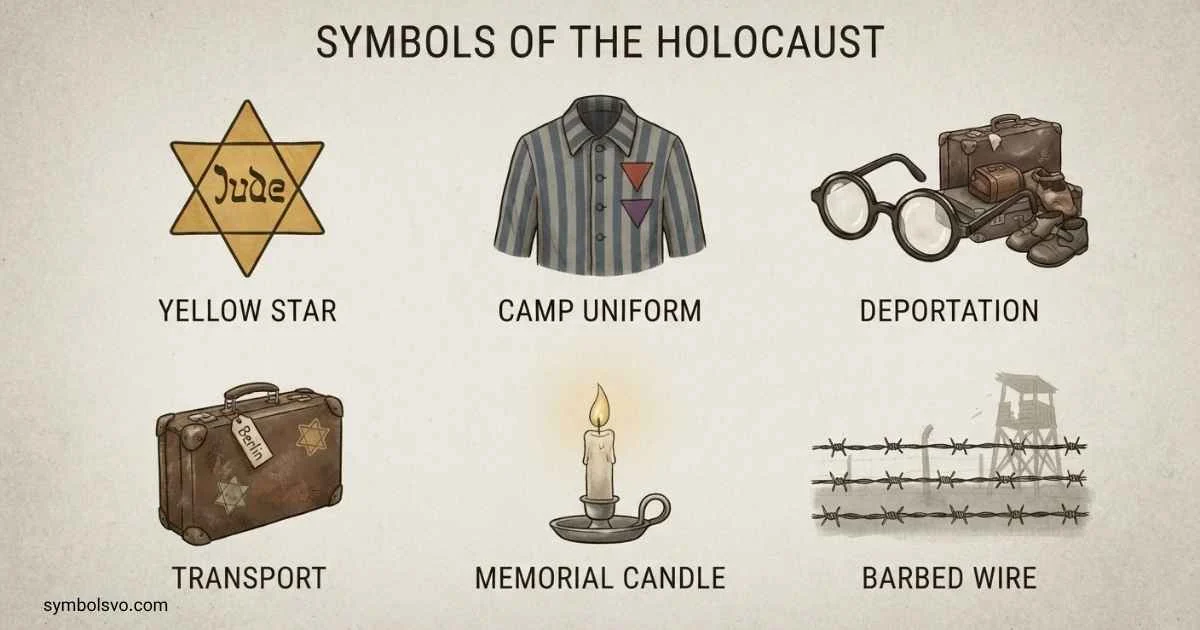
When I explore the Symbols of the Holocaust, I see more than simple images or signs—they can represent persecution, loss, resistance, remembrance, and the painful history of millions of people. Understanding their meaning helps us approach this difficult history with care and respect.
You may recognize some Holocaust-related symbols but not know the history behind them. I’ll help you understand their origins, meanings, and historical context in a clear and respectful way.
Each symbol can carry a powerful historical message that helps you understand the past. You can use this guide to explore their meanings without losing sight of the people and history they represent.
Quick Answer
Symbols of the Holocaust are visual identifiers, badges, and structural markers utilized by Nazi Germany between 1933 and 1945 to categorize, persecute, and strip targeted groups of their humanity. Today, these historical markers function as universal educational reminders against hatred, while representing memory and survival for victims worldwide.
Quick Facts About Symbols of the Holocaust
| Aspect | Information |
| Origin | Created by the Nazi bureaucratic system to systematically classify prisoners based on race, religion, and politics. |
| Historical Significance | Shifted ancient symbols of cultural identity into tools for forced segregation and mass execution. |
| Main Meaning | Represented total state control, forced isolation, and targeted dehumanization. |
| Spiritual Meaning | Commemorates the unyielding dignity of the soul and the ultimate survival of light over absolute darkness. |
| Cultural Importance | Forms the foundation of global remembrance education, museum exhibits, and human rights advocacy. |
| Modern Usage | Displayed in memorial sites, historical literature, and digital archives to prevent historical amnesia. |
What Are Symbols of the Holocaust?
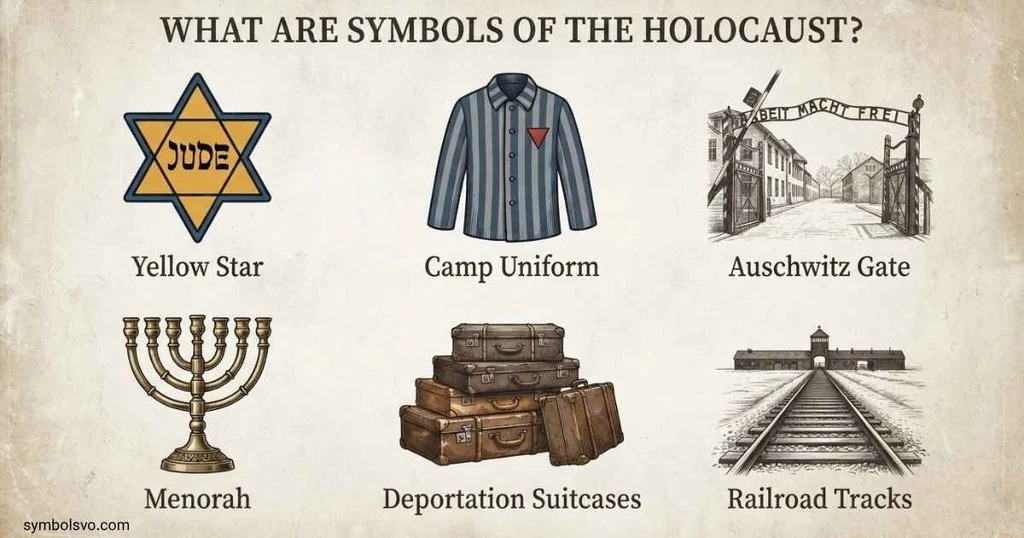
Symbols of the Holocaust refer to the distinct visual systems and objects used by the National Socialist regime to mark individuals for persecution. The origin of this system relies heavily on a desire for total bureaucratic order. In the chaotic environments of ghettos and concentration camps, Nazi guards required a fast, visual method to identify why an individual was imprisoned.
Over time, this system evolved from simple armbands into a deeply complex grid of colored fabric triangles and numerical tattoos. By forcing people to wear these marks publicly, the regime stripped victims of their personal identities, reducing unique human beings to mere categories of the state.
Deep Symbolic Meaning of Symbols of the Holocaust
Spiritual Level
On a spiritual level, these symbols reveal a deep conflict between external oppression and internal faith. Forcing a sacred emblem to become a mark of shame was an attempt at spiritual destruction. However, many victims managed an incredible inner transformation, turning these forced markings into quiet symbols of religious pride and defiance against their captors.
Psychological Level
Psychologically, the Nazi regime used these markings to trigger deep social isolation and despair. Looking at this through a psychological lens, the badges served as forced archetypes of the outcast. They warped natural human pattern recognition, training the public to view specific groups as dangerous or subhuman.
Cultural Level
Culturally, these markings forever altered community beliefs and social traditions. A historic symbol of spiritual connection was abruptly twisted into an emblem of danger, forcing families to rethink how they expressed their heritage in a hostile world.
Types and Variations of Symbols of the Holocaust
1. The Yellow Star
- Visual Description: A six-pointed star made of yellow fabric, often featuring the local word for Jew inscribed in mock-Hebraic script.
- Meaning: Forced public isolation, racial branding, and social exclusion.
- Symbolism: Represents centuries of faith twisted into an immediate target for systemic violence.
- Cultural Connection: Derived from the ancient Star of David, a long-standing symbol of Jewish identity.
- Where It Appears: Worn on the left breast or back of outer clothing in public spaces and occupied territories.
2. The Pink Triangle
- Visual Description: A downward-pointing triangle made of pink fabric.
- Meaning: Categorization of homosexual men and individuals deemed socially unacceptable by the regime.
- Symbolism: State-sanctioned criminalization of love, extreme vulnerability, and forgotten histories of persecution.
- Cultural Connection: Reclaimed in the late twentieth century as an international symbol of LGBTQ liberation and activism.
- Where It Appears: Stitched onto prisoner uniforms within major concentration camps like Dachau and Sachsenhausen.
3. The Purple Triangle
- Visual Description: A small, downward-pointing triangle of purple fabric.
- Meaning: Identification of Jehovah’s Witnesses and other unique religious dissidents.
- Symbolism: Absolute commitment to personal faith and a refusal to swear allegiance to a fascist state.
- Cultural Connection: Highlights groups who were targeted primarily for their conscious, moral choices rather than their ancestral lineage.
- Where It Appears: Visible on the camp clothing of religious objectors across the entire camp system.
Symbols of the Holocaust Across Different Cultures
Ancient Egypt
The concept of forcing distinct groups to wear unique garments has roots reaching back to antiquity. In ancient Egypt, distinct dress codes were occasionally used to visually separate foreign laborers and conquered populations from native citizens, laying a distant historical foundation for visual segregation.
Ancient Greece
While classical Greece celebrated democratic ideals, various city-states used physical markings or specific hair styles to instantly identify enslaved populations and foreign merchants, ensuring social boundaries remained completely clear.
Roman Culture
Roman society relied heavily on clothing as a visual badge of citizenship and status. Enslaved individuals were forbidden from wearing the traditional Roman toga, a visual exclusion that instantly marked them as property within the empire.
Eastern Traditions
Historically, several medieval Caliphates and dynasties implemented dynamic dress regulations, requiring non-Muslim subjects to wear distinct clothing items or colored belts to establish an immediate social hierarchy in public marketplaces.
Indigenous Traditions
In contrast to forced state markings, many indigenous cultures used voluntary clan tattoos and paint as proud symbols of belonging, territory protection, and spiritual honor, rather than tools of state oppression.
Modern Interpretations
Today, these historical markers have been globally re-examined through the lens of human rights education, warning modern societies about the danger of using visual labels to isolate minority groups.
Similar Symbols and Their Meanings
To fully comprehend how the Nazi regime utilized visual imagery, it helps to compare their classification systems with other historic markers.
| Symbol Type | Purpose | Key Focus | Long-term Impact |
| Holocaust Badge | State-enforced dehumanization | Systematic tracking and segregation | Reclaimed as a solemn symbol of historical remembrance |
| Military Insignia | Institutional rank | Authority, achievement, and structure | Remains a symbol of professional pride and honor |
| Religious Vestment | Spiritual identity | Sacred tradition and communal devotion | Continues to serve as a voluntary expression of faith |
A common misconception is that the colored triangles were purely random design choices. In reality, they were rooted in traditional German police symbols, adapted systematically to ensure camp guards could assess a prisoner’s social standing with a single glance.
Symbols of the Holocaust in Mythology and Folklore
The architects of the Holocaust frequently hijacked elements of European mythology and folklore to reinforce their propaganda. They intentionally twisted ancient runic symbols, associated for centuries with protection, harvest, and life, into modern insignias of terror and racial supremacy.
By combining historic folk tales with clinical, bureaucratic badges, the regime attempted to construct a mythic narrative that justified their actions. This manipulation shows how easily beautiful cultural stories can be weaponized when a society loses its moral compass.
Symbols of the Holocaust in Art, Pop Culture, and Design
In the decades following World War II, artists and writers began utilizing these historical symbols to process profound trauma. Graphic novels like Art Spiegelman’s Maus famously used anthropomorphic animal symbolism to depict the stark realities of the camps, rendering the historical tragedy accessible to a younger generation.
In modern memorials and architectural designs, these symbols are often integrated into public spaces. Sculptors use the harsh geometry of the triangles and the jagged lines of barbed wire to evoke an immediate emotional reaction, ensuring that the physical environment forces visitors to pause and reflect on the consequences of unchecked hatred.
Spiritual and Dream Meaning of Symbols of the Holocaust
When historical symbols of this magnitude appear in contemporary dreams or reflective states, they rarely relate to the literal past. Instead, our subconscious minds often use these highly recognizable historical markers to process deep, personal anxieties.
Dreaming of being forced to wear a restrictive badge often points to a waking fear of social rejection, public shame, or a feeling that your true identity is being hidden by external expectations. Conversely, seeing these symbols broken or removed during a dream reflects a powerful message of inner liberation, showing that you are successfully overcoming a prolonged period of personal emotional hardship.
Positive and Negative Meanings of Symbols of the Holocaust
While these objects originated from a place of absolute cruelty, their historical meanings have evolved significantly over the last several decades.
| Positive Modern Meaning | Negative Historical Meaning |
| Functions as a global warning against prejudice. | Served to isolate individuals from public life. |
| Reclaimed by communities as symbols of pride. | Designed to strip away human dignity completely. |
| Inspires deep historical empathy and study. | Created an atmosphere of intense public fear. |
| Honors the memory of those who survived. | Facilitated a systematic process of mass murder. |
Why Humans Are Drawn to Symbols of the Holocaust
Our enduring focus on these artifacts is tied directly to human psychology and our natural capacity for empathy. The human brain is naturally built for pattern recognition, constantly searching for concrete objects to help process abstract, overwhelming concepts like mass tragedy.
It is incredibly difficult for the human mind to comprehend the loss of millions of lives through statistics alone. A single fabric star or a worn leather shoe provides a tangible point of connection, allowing us to build an authentic emotional bridge to a specific human story from the past.
Modern Uses of Symbols of the Holocaust
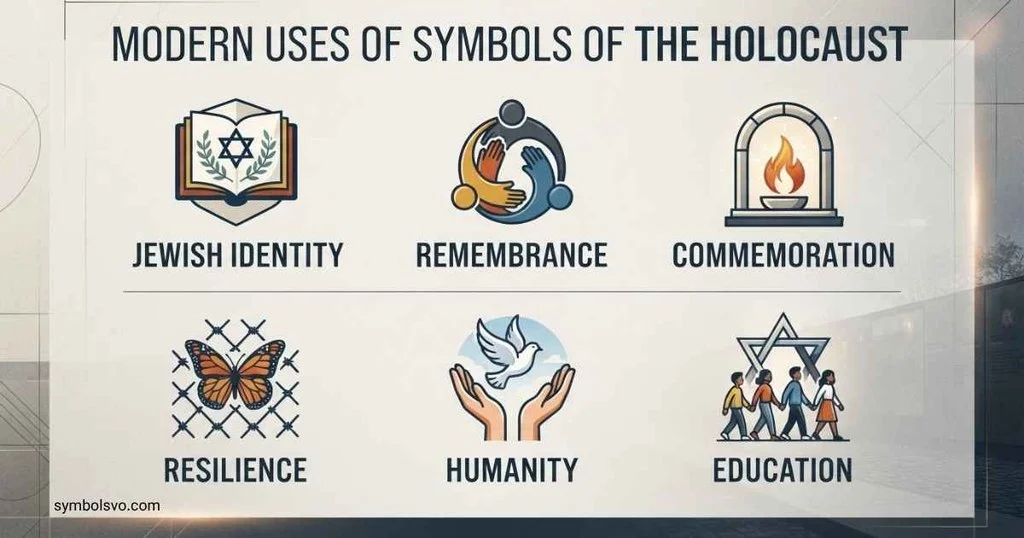
In contemporary society, these historical markings are preserved with the utmost care across several educational platforms.
- Museum Exhibits: Displayed under specialized lighting to preserve the fragile fabric and historical integrity.
- Human Rights Advocacy: Used in educational campaigns to illustrate the dangerous steps that lead to systemic discrimination.
- Memorial Architecture: Integrated into monuments worldwide to create contemplative, sacred spaces for public mourning.
- Digital Classrooms: Archived in online databases, allowing students globally to engage directly with primary source materials.
Interesting Facts About Symbols of the Holocaust
- The system of fabric triangles was so detailed that combining different colors could indicate a prisoner who fell into multiple persecuted categories.
- In some occupied countries, citizens wore replica badges as a quiet act of public solidarity with their Jewish neighbors.
- The unique identification numbers tattooed onto prisoners at Auschwitz were unique to that specific camp complex.
- The pink triangle symbol lay completely forgotten in historical archives for decades before being reclaimed by civil rights activists in the 1970s.
- Many of the fabric badges on display in modern museums were carefully hidden and preserved by survivors inside their clothing during liberation.
Frequently Asked Questions
Why did the Nazis use triangles for the camp badges?
The triangle design was adapted from standard German police tracking systems. By using a downward-pointing shape, guards could easily spot a prisoner from a distance and instantly know their classification.
What did a black triangle signify in the camps?
The black triangle was used to classify individuals labeled as asocial by the regime, a broad category that frequently included Roma individuals, non-conformists, and people with mental disabilities.
How did the symbols change across different occupied countries?
While the core concept remained identical, the specific language printed on the yellow stars changed depending on the local region, using French, Dutch, or German variants based on geography.
Why is it important to continue studying these symbols today?
Studying these marks reminds us how easily a modern state can use visual labels to dehumanize a population, prompting us to recognize and challenge early signs of systemic prejudice in our own world.
Conclusion
Symbols of the Holocaust remain some of the most profound visual warnings in human history. While they were invented to strip away human identity, their modern preservation has completely reversed their original purpose. Today, these markings do not represent shame, but rather stand as symbols of eternal memory, human dignity, and the historical truth that no regime can completely erase the strength of the human soul.

I’m Daniel Brooks, a content creator and symbol enthusiast dedicated to researching the fascinating world of signs and symbols. I enjoy discovering the hidden meanings behind famous icons, emojis, historical emblems, and cultural symbols. Through my writing, I aim to provide trustworthy, well-researched, and reader-friendly information that helps people learn something new with every visit.
Books:
- The Complete Guide to World Symbols
- The Power of Universal Signs
 Mason Ellington
 Grace Whitmore