I’ve always found Greek mythology fascinating, especially the powerful symbols connected to its gods. If you’re wondering what Poseidon’s symbols mean, you’re about to discover the stories and ideas behind them.
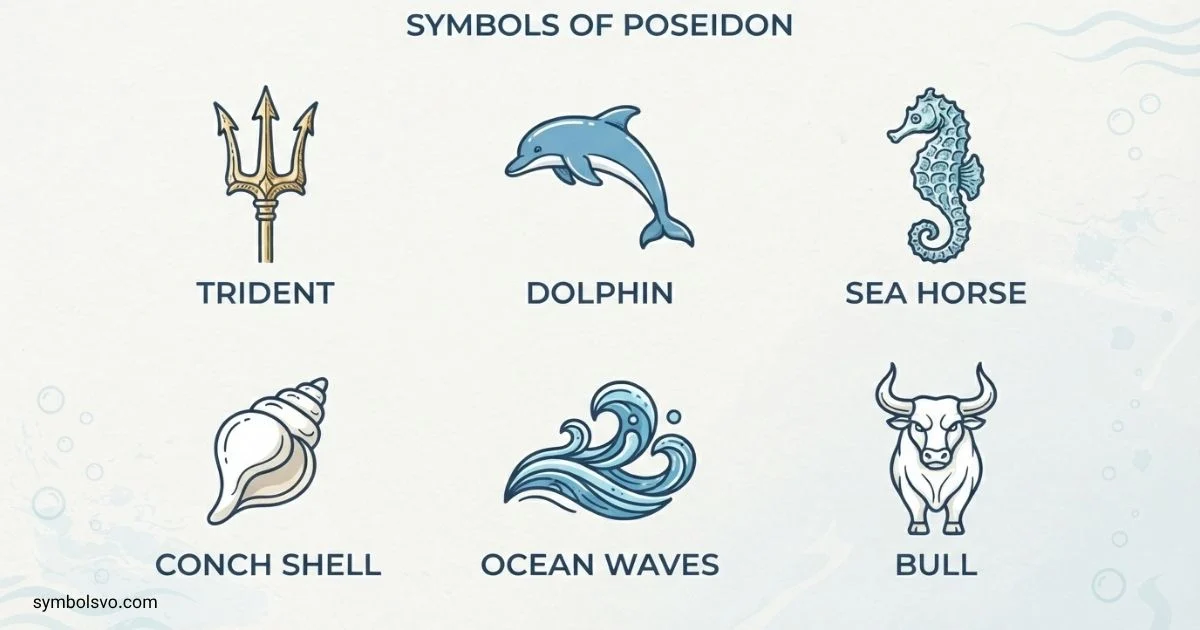
You’ll learn how the trident, horse, bull, dolphin, and sea are connected with Poseidon. I’ll also explain what these symbols represented in ancient Greek culture and why they remain recognizable today.
Whether you’re studying mythology or simply curious about Poseidon, you’ll find clear and useful answers here. By the end, you’ll understand not only what Poseidon’s symbols are, but also what each one represents.
Quick Answer
Poseidon’s symbols are traditional visual representations of the Olympian god of the sea, including the three-pronged trident, the horse, and the dolphin. These icons collectively symbolize his absolute authority over the oceans, his volatile temperament, his capacity for creation through earthquakes, and his profound, multifaceted connection to the primal forces of nature.
Quick Facts About Poseidon’s Symbols
| Aspect | Information |
| Origin | Ancient Greek mythology and maritime folklore. |
| Historical Significance | Central to naval power, seafaring safety, and seismic protection. |
| Main Meaning | Sovereignty over the seas, storms, and tectonic instability. |
| Spiritual Meaning | Represents the depths of the subconscious and fluid, changing emotions. |
| Cultural Importance | Defined the survival, trade, and worldview of Aegean civilizations. |
| Modern Usage | Popular in tattoo art, naval insignia, modern literature, and fantasy media. |
What Are Poseidon’s Symbols?
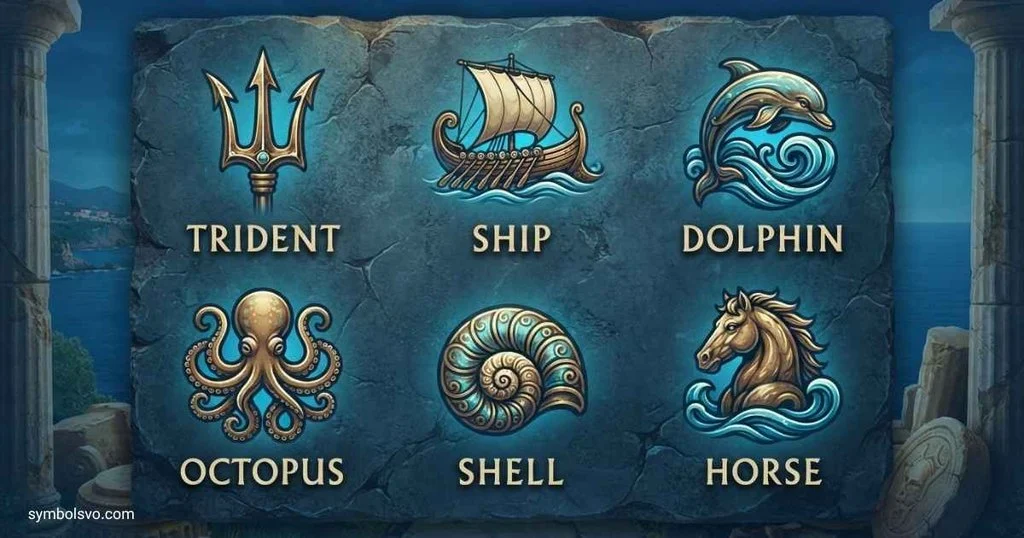
Poseidon’s symbols are the visual language of the god known as the Earth Shaker. In mythology, these objects and creatures do not just belong to him. They are extensions of his divine essence. The trident is his weapon of choice, forged by the Cyclopes, capable of splitting mountains and whipping up massive storms. The horse and dolphin are his sacred animals, reflecting his dual nature as a god who controls the wild, galloping waves and the graceful, intelligent creatures residing within them.
Understanding these symbols requires looking at the history of the Mediterranean. For the ancient Greeks, the sea was everything. It was their food source, their highway for trade, and their greatest threat. Poseidon represented this duality perfectly. His symbols were not meant to be decorative. They were warnings and blessings, used in rituals to ensure safe passage across dangerous waters.
Deep Symbolic Meaning of Poseidon’s Symbols
Spiritual Level
On a spiritual level, Poseidon’s symbols represent the vast, uncharted depths of the human soul. Just as the ocean hides mysteries far below its surface, these symbols remind us of the hidden parts of our consciousness. Working with these icons in meditation often involves exploring emotional fluidity and the need to respect the powerful, sometimes destructive, currents of our own inner lives.
Psychological Level
Psychologically, Poseidon is a classic archetype of the raw, untamed ego. He represents the masculine energy that is both generative and volatile. Jungian analysts often associate his symbols with the powerful, instinctual drives that can either build our lives or tear them down. He is the force of the deep unconscious, reminding us that we must steer our ships carefully through the storms of our own making.
Cultural Level
Culturally, these symbols have shaped how communities define themselves. In coastal cities across Greece, temples dedicated to Poseidon were the heart of social life. Fishermen and sailors wore or carried charms bearing his symbols to invoke his protection. Even today, these symbols remain a core part of our cultural memory, appearing in everything from city seals to the branding of naval institutions.
Types and Variations of Poseidon’s Symbols
The Trident
- Visual Description: A three-pronged spear.
- Meaning: Divine authority, the power to pierce through obstacles, and control over the three realms of water: seas, rivers, and groundwater.
- Symbolism: Represents the triune nature of existence and the focus of divine will.
- Where It Appears: Ancient coinage, statues, and as a primary symbol in modern naval heraldry.
The Horse
- Visual Description: A powerful, galloping steed.
- Meaning: The untamed power of the waves and seismic movement.
- Symbolism: Poseidon is known as the tamer of horses, linking his control over the sea to his role in creating landscapes.
- Where It Appears: Classical pottery, architectural friezes, and epic poetry.
The Dolphin
- Visual Description: The graceful, social marine mammal.
- Meaning: Harmony, guidance for lost souls, and the playful aspect of the sea.
- Symbolism: Represents the mercy and benevolence of the god when he is not in a rage.
- Where It Appears: Mosaic floors in Roman villas and temple art.
Poseidon’s Symbols Across Different Cultures
Ancient Egypt
While Poseidon is Greek, the Egyptians had their own sea deities like Nun. Through trade, they shared concepts of water-based authority. Egyptian artists sometimes influenced the way Poseidon’s maritime aspects were depicted in later Hellenistic art, blending Egyptian reverence for the Nile with Greek sea-god imagery.
Ancient Greece
In the heart of the Aegean, Poseidon’s symbols were omnipresent. Citizens of Athens famously competed for his favor. His trident was seen as a symbol of divine law, while his horses were featured in major festivals to honor his role in the creation of the land.
Roman Culture
The Romans adopted him as Neptune. They retained his trident and dolphins but placed even more emphasis on his role in protecting their naval fleets, which were the backbone of their empire. His symbols were frequently painted on the prows of Roman ships.
Eastern Traditions
In various Eastern maritime traditions, water deities share the trident as a weapon. This cross-cultural overlap suggests that the three-pronged spear is a universal symbol for the powerful, stabbing force of rushing water and lightning.
Indigenous Traditions
Many coastal indigenous cultures hold great reverence for whales or dolphins as spiritual guides. While not directly connected to the Greek god, these cultures view these creatures with the same respect and fear that the ancient Greeks felt for Poseidon, highlighting a shared human psychological response to the sea.
Similar Symbols and Their Meanings
| Symbol | Comparison | Symbolic Relationship |
| Trident | Similar to the lightning bolt of Zeus. | Both represent absolute power and divine weaponry. |
| Horse | Similar to the bull of the underworld. | Both symbolize raw, terrestrial, and primal strength. |
| Dolphin | Similar to the dove of Aphrodite. | Both represent peace and divine grace in nature. |
Poseidon’s Symbols in Mythology and Folklore
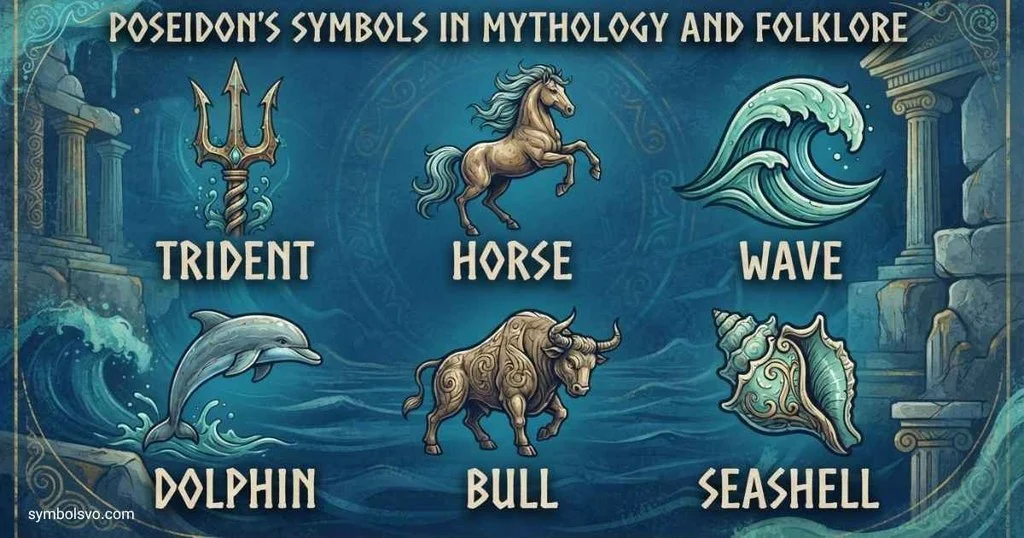
In myth, Poseidon’s symbols are central to the stories that defined the world. He used his trident to strike the earth, creating the first horse as a gift. He also famously used it to create springs of water. These stories illustrate his role as a god who is not just a destroyer, but also a creator of foundational necessities. Folklore often tells of sailors who would drop offerings of trident-shaped bread into the sea to appease the god and ensure a calm voyage.
Poseidon’s Symbols in Art, Literature, and Pop Culture
From the intricate paintings on Renaissance canvases to the gritty visuals of modern fantasy films, Poseidon’s symbols have remained relevant. In literature, authors often use the trident to symbolize a character’s sudden rise to power or their struggle against overwhelming odds. Tattoos featuring the trident are common among those who feel a deep connection to the ocean, serving as a permanent badge of respect for the power of the water.
Spiritual and Dream Meaning
Dreaming of a trident or the sea can be a profound spiritual encounter. If you dream of the ocean, it often signals an emotional breakthrough or a need to face your subconscious fears. A trident appearing in a dream may be a message to take hold of your personal power and assert your boundaries, much like the god of the sea commands the tide.
Positive and Negative Meanings
| Positive Meaning | Negative Meaning |
| Vitality and emotional renewal. | Uncontrollable rage and destruction. |
| Protection and safe passage. | Sudden, unpredictable disaster. |
| Artistic and creative inspiration. | The overwhelming nature of grief. |
Why Humans Are Attracted to Poseidon’s Symbols
We are drawn to these symbols because they represent the parts of our lives we cannot control. The ocean is the ultimate mirror for our internal states. When we feel overwhelmed, we look to the image of the trident as a way to focus our power. When we feel a need for freedom, we look to the horse. These symbols are part of our collective cultural memory, helping us process the reality of a world that is beautiful, dangerous, and constantly in motion.
Modern Uses of Poseidon’s Symbols
Today, these symbols serve as icons of adventure and resilience. You will find them in luxury watch designs, surfing brands, and environmental conservation logos. They remind us of our duty to protect the oceans and our inherent bond with the natural world, proving that even an ancient god can still teach us how to live in the modern age.
Interesting Facts About Poseidon’s Symbols
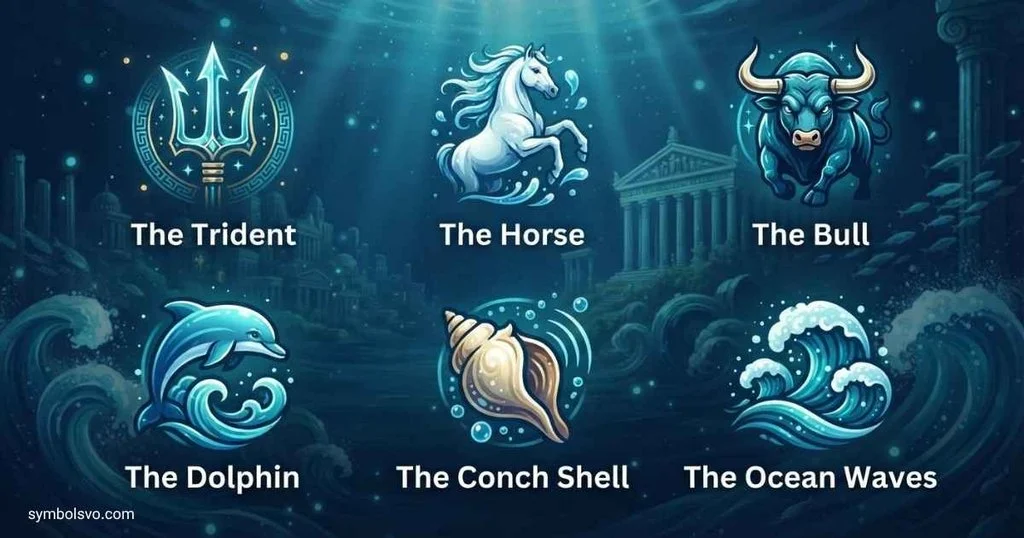
- The trident was originally intended to represent the three major water sources: sea, rivers, and springs.
- Poseidon was often called the Earth Shaker because the Greeks believed his trident caused earthquakes.
- The horse was so closely tied to him that horse races were a primary event in his festivals.
- Unlike many other gods, Poseidon’s symbols were often used as a plea for mercy rather than just a display of worship.
- The dolphin is considered his most auspicious symbol, signifying that the god is in a benevolent mood.
Frequently Asked Questions
Why does Poseidon have a trident?
The trident is his weapon for controlling the seas and the earth. Mythologically, it was crafted by the Cyclopes to give him a way to influence the forces of nature, specifically water and seismic activity.
What do the horses represent for Poseidon?
The horses represent the strength, speed, and wild nature of the crashing waves. He is often called the tamer of horses, symbolizing his authority over the violent, moving energy of the sea.
Is the trident a sign of evil?
No. While it can represent destruction, it is fundamentally a symbol of authority and sovereignty. In the ancient world, it was respected as a necessary force of nature.
Why is the dolphin a symbol of Poseidon?
The dolphin represents the calmer, more intelligent side of the sea. It serves as a contrast to the stormy nature of the trident, showing the god’s ability to be a guide and a protector to sailors.
Conclusion
Poseidon’s symbols act as a timeless connection between the volatile mystery of the ocean and our own human spirit. Whether through the strength of the horse or the focused power of the trident, they remind us to respect the untamed forces of our world. As you continue your journey, may you find the same balance that these ancient icons suggest, navigating your own tides with courage and wisdom.

 Grace Whitmore
 Daniel Brooks