Seeing a warning light on your Hyundai dashboard can make you wonder if something serious is wrong. I know how confusing those unfamiliar symbols can feel, especially when you are unsure whether you should keep driving or stop.
You do not need to panic or guess what the symbol means. I’ll help you understand Hyundai dashboard symbols and meanings in simple language, so you can quickly recognize common warning and indicator lights.
Whether you are a new Hyundai owner or have been driving one for years, you’ll learn what each important symbol means and what action you may need to take.
Hyundai Dashboard Symbols And Meanings
Hyundai dashboard lights generally fall into three useful groups: warning lights, indicator lights, and information indicators.
A red warning light usually deserves immediate attention, while yellow or amber lights commonly indicate a fault, warning, or system that needs checking. Green and blue lights generally tell you that a particular feature is active.
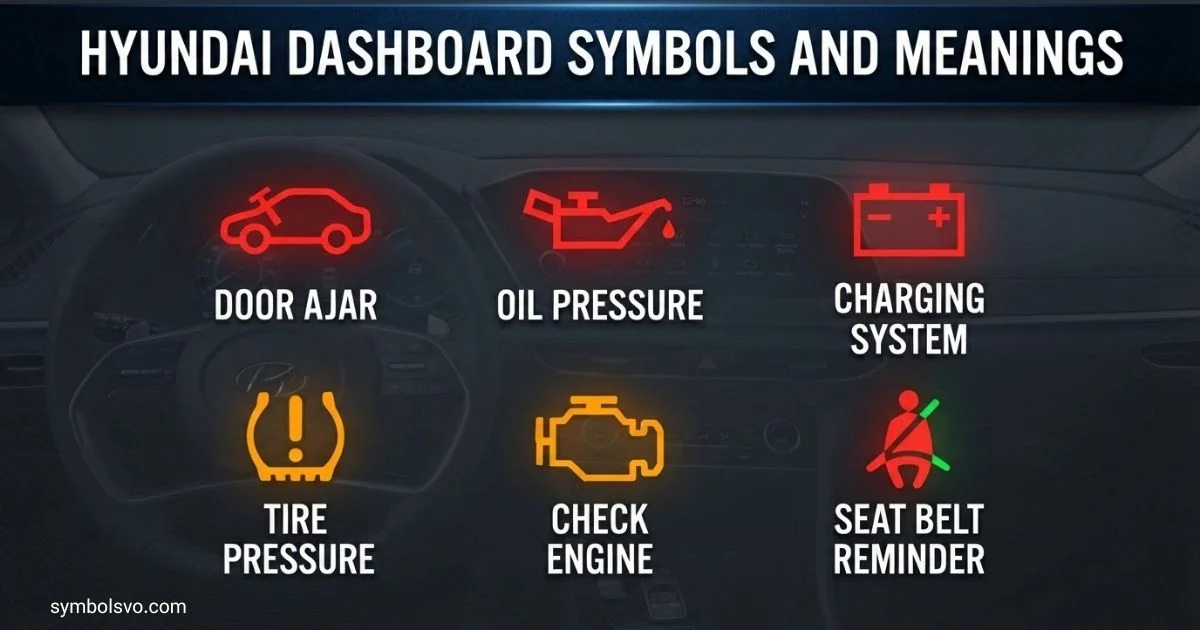
Here are some of the most common Hyundai dashboard symbols:
| Symbol or appearance | Name | General meaning |
| 🔴 Oil can | Engine oil pressure | Low oil pressure or an oil-pressure problem |
| 🔴 Battery | Charging system | Possible charging-system problem |
| 🔴 BRAKE / circle | Brake system | Parking brake, brake fluid, or brake-system warning |
| 🟡 Engine outline | Check engine / MIL | Engine or emissions-system fault |
| 🟡 ABS | ABS warning | Anti-lock braking system problem |
| 🟡 Tire with ! | Low tire pressure / TPMS | Low tire pressure or TPMS problem |
| 🔴 Person with belt | Seat belt | Seat belt is not fastened |
| 🟡 Triangle with ! | Master warning | One or more systems need attention |
| 🟢 ECO | ECO indicator | ECO-related driving/system status |
| 🔵 Headlamp | High beam | High beams are active |
| 🟢 Turn arrow | Turn signal | Turn signal is operating |
The exact appearance can differ between older analog clusters, newer digital displays, and different Hyundai models.
A light that appears briefly when the vehicle is switched on can also be part of the normal self-check. The important question is whether it goes out afterward or stays illuminated while driving.
Hyundai Dashboard Symbols And Meanings 2011
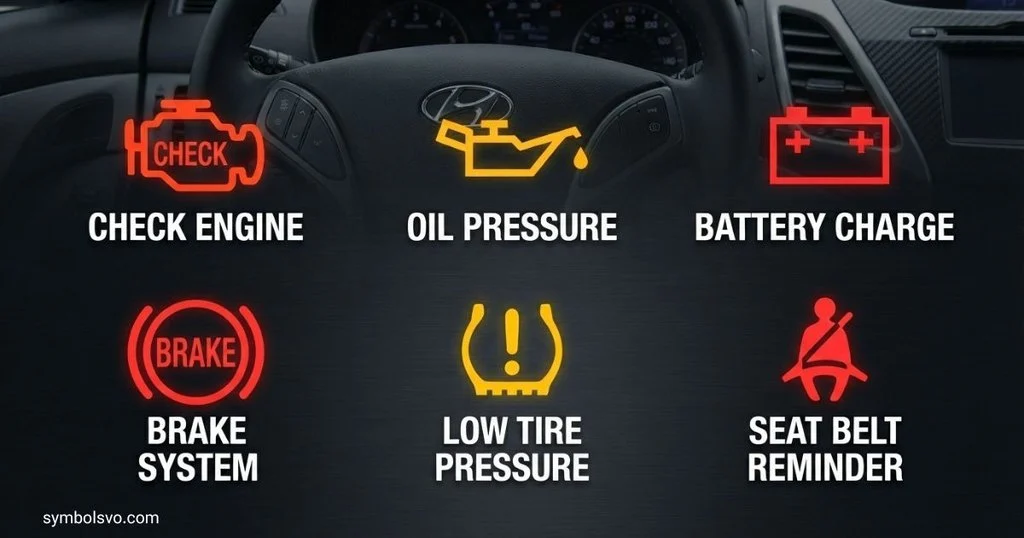
Hyundai vehicles from 2011 used many familiar warning symbols found in modern vehicles, including oil pressure, battery charging, brake, ABS, check-engine, tire-pressure, and airbag indicators.
However, the exact dashboard depends on the Hyundai model. A 2011 Sonata, Elantra, Santa Fe, Accent, and Tucson do not necessarily have identical warning-light layouts.
Common symbols include:
- Oil pressure warning — Stop and check the oil-pressure warning situation promptly.
- Battery warning — Indicates a possible charging-system fault.
- Brake warning — May relate to the parking brake or brake system.
- ABS warning — Indicates an ABS fault if it remains illuminated.
- Check engine light — Indicates a fault detected by the engine/emissions control system.
- Airbag warning — Indicates a possible problem with the supplemental restraint system.
- TPMS warning — Indicates low tire pressure or a TPMS issue, depending on equipment.
For a 2011 Hyundai, the owner’s manual for the specific model is more reliable than a generic dashboard chart.
Hyundai Dashboard Symbols And Meanings 2013
The 2013 Hyundai range continued using familiar warning and indicator lights, but the exact symbols and display layouts depended on the vehicle.
A driver seeing a warning light should first identify the symbol rather than relying only on its color. For example, two symbols may both be yellow but indicate completely different systems.
Common 2013 warnings include:
| Warning | What it generally indicates |
| Oil can | Engine oil pressure problem |
| Battery | Charging-system problem |
| ABS | Anti-lock brake system fault |
| Engine | Engine/emissions malfunction |
| Airbag | SRS/airbag system fault |
| Tire with ! | Tire pressure warning |
| Brake symbol | Brake-system or parking-brake warning |
| Seat belt | Seat belt reminder |
If a red brake, oil-pressure, or similar serious warning remains on while driving, do not treat it as an ordinary service reminder.
Hyundai Dashboard Symbols And Meanings 2016
Hyundai dashboard systems in 2016 models included many familiar warning lights, while some vehicles also offered additional electronic driver-assistance indicators.
The most useful rule is to distinguish status indicators from fault warnings.
For example, a green indicator can simply tell you that a function is active. A yellow warning generally means the vehicle has detected a condition that needs attention.
Drivers of 2016 Hyundais may encounter:
- Engine oil pressure warning
- Charging-system warning
- Brake warning
- ABS warning
- Airbag/SRS warning
- Check engine/MIL
- Tire-pressure warning
- Electronic stability control indicators
- Low fuel indicator
- High-beam indicator
- Turn-signal indicators
The symbol alone does not always tell you the severity. The owner’s manual and accompanying dashboard message provide the vehicle-specific interpretation.
Hyundai Dashboard Symbols And Meanings 2017
For 2017 Hyundai models, dashboard symbols covered both traditional vehicle systems and increasingly common electronic safety features.
Some important categories include:
Red warnings: brakes, oil pressure, charging system, and other conditions that may require prompt action.
Yellow or amber warnings: engine faults, ABS, tire pressure, stability-control faults, and other system problems.
Green or blue indicators: active lights or functions such as turn signals and high beams.
The exact warning-light set varies by model. A 2017 Tucson, for example, can have equipment that is not present on another Hyundai from the same year.
If a light appears with a written message, read the message before continuing your trip.
Hyundai Dashboard Symbols And Meanings 2018
Hyundai’s 2018 vehicles continued the familiar dashboard warning system while offering more driver-assistance technology on many models.
Depending on the model and equipment, a driver could encounter warnings related to:
- Forward collision systems
- Blind-spot monitoring
- Lane-related assistance
- Tire pressure
- ABS
- Stability control
- Engine management
- Lighting
- Braking
- Airbags
A blocked sensor can sometimes trigger a warning without meaning that a major mechanical component has failed. For example, newer Hyundai manuals specifically identify blocked radar as one possible reason for certain driver-assistance warnings.
Always check the message displayed alongside the warning.
Hyundai Dashboard Symbols And Meanings 2021
The 2021 Hyundai range included more advanced driver-assistance systems, so dashboard warnings could involve sensors and electronic safety features as well as traditional mechanical systems.
Depending on the vehicle, warnings could relate to:
- Forward Collision-Avoidance Assist
- Blind-Spot Collision-Avoidance Assist
- Rear Cross-Traffic Collision-Avoidance Assist
- Smart Cruise Control
- Lane-related systems
- TPMS
- Exterior lighting
- Braking systems
- Engine and emissions systems
A useful example is the Master Warning Light. Hyundai documentation for vehicles in this generation identifies multiple possible causes, including driver-assistance malfunctions, exterior-light problems, low washer fluid, and tire-pressure-system faults.
Hyundai Dashboard Symbols And Meanings 2022
The 2022 Hyundai dashboard symbol set depends heavily on the model and trim.
A warning light may be accompanied by a message on the cluster, making the message especially useful for identifying the cause.
Common categories include:
- Engine and oil warnings
- Brake and ABS warnings
- Tire-pressure warnings
- Airbag warnings
- Charging-system warnings
- Stability-control indicators
- Driver-assistance warnings
- Lighting warnings
- Master warning indicators
When a warning appears, check the instrument-cluster message before assuming that the symbol itself identifies one specific component.
This is particularly important for the Master Warning Light because Hyundai uses it to bring several different problems to the driver’s attention.
Hyundai Dashboard Symbols And Meanings 2023
Hyundai’s 2023 models continued the move toward digital instrument displays and integrated driver-assistance systems.
This means some warnings may appear as both an icon and a text message.
Potential warning categories include:
| Category | Examples |
| Engine | Check engine, oil pressure |
| Brakes | Brake system, ABS |
| Tires | Low tire pressure, TPMS malfunction |
| Safety | Airbag, seat belt |
| Driver assistance | Collision avoidance, blind spot, lane systems |
| Electrical | Battery/charging system |
| Lighting | Lamp or headlight malfunction |
| General | Master Warning Light |
Do not assume that a yellow light means the vehicle is safe to drive indefinitely. Yellow commonly means attention is required, but the appropriate response depends on the specific warning.
Hyundai Dashboard Symbols And Meanings 2024
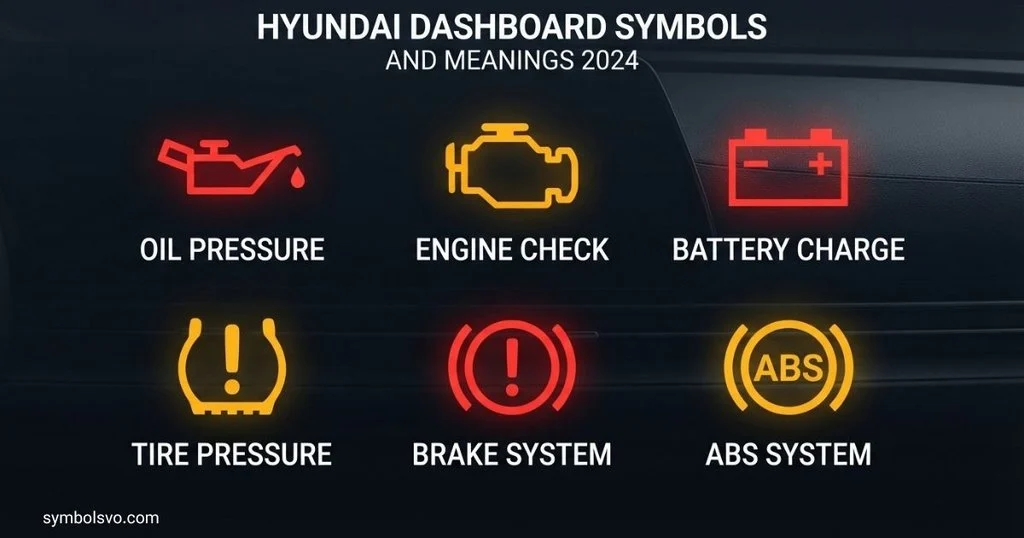
The 2024 Hyundai lineup includes increasingly sophisticated electronic systems, and the number of possible dashboard messages can therefore be larger than on older vehicles.
For example, Hyundai manuals describe Master Warning Light conditions involving systems such as Forward Collision-Avoidance Assist, Blind-Spot Collision-Avoidance Assist, Rear Cross-Traffic Collision-Avoidance Assist, Smart Cruise Control, Lane Following Assist, exterior lights, low washer fluid, and TPMS.
This illustrates why a generic “one symbol = one problem” chart can be misleading.
For a 2024 Hyundai, check:
- The warning symbol.
- Its color.
- Any accompanying text.
- Whether the light is steady or flashing.
- Your specific model’s owner’s manual.
Hyundai Dashboard Symbols And Meanings 2025
Hyundai’s 2025 manuals show that warning-light functions can vary between models. For example, the 2025 Tucson documentation lists Master Warning Light conditions involving forward collision systems, blind-spot systems, exterior lights, rear cross-traffic assistance, LED headlights, high-beam assistance, Smart Cruise Control, Lane Following Assist, low washer fluid, AWD, and TPMS.
That does not mean every 2025 Hyundai has every one of these systems.
The correct interpretation depends on the equipment installed in your vehicle.
If the Master Warning Light appears, look at the cluster display for the detailed warning. Hyundai specifically uses the display to provide more information about the condition.
Hyundai Dashboard Symbols And Meanings 2026
The latest Hyundai manuals continue to use a combination of warning lights, indicator lights, and digital cluster messages.
The 2026 Hyundai documentation identifies the Master Warning Light as a general warning that can be triggered by issues involving systems such as Forward Collision-Avoidance Assist, blind-spot assistance, exterior lights, rear cross-traffic assistance, LED headlights, High Beam Assist, Smart Cruise Control, Lane Following Assist, doors or liftgates, washer fluid, AWD, and TPMS, depending on the vehicle.
This is one reason model-specific information matters.
A 2026 Hyundai with a sophisticated digital cluster may give you a much more specific message than the symbol alone. If the warning remains after the underlying issue is resolved, follow the instructions in the applicable owner’s manual or have the vehicle inspected.
Tucson Hyundai Dashboard Symbols And Meanings
The Hyundai Tucson has its own collection of dashboard indicators and warnings, and the exact set changes across generations and trims.
Common Tucson dashboard symbols include:
- Check engine light — Engine or emissions-related fault detected.
- Oil pressure light — Possible low engine oil pressure.
- Battery light — Charging-system warning.
- ABS light — Possible anti-lock braking system fault.
- Brake warning — Brake-system or parking-brake warning.
- TPMS light — Low tire pressure or a TPMS malfunction.
- Airbag warning — Possible SRS malfunction.
- ESC indicator — Electronic Stability Control status or fault, depending on how it appears.
- Master Warning Light — A general warning requiring the driver to check the cluster message.
- Driver-assistance warnings — Possible sensor blockage or system malfunction.
The 2025 Tucson manual, for example, lists Master Warning Light conditions that include FCA, blind-spot, rear cross-traffic, lighting, Smart Cruise Control, Lane Following Assist, washer fluid, AWD, and TPMS issues.
The safest approach is to identify the Tucson model year first. A 2016 Tucson and a 2025 Tucson should not be assumed to have the same dashboard.
Master Warning Light Hyundai
The Hyundai Master Warning Light is generally shown as a triangle containing an exclamation mark.
Symbol: ⚠️
However, the actual dashboard graphic may be a vehicle-specific warning icon rather than the emoji shown here.
The Master Warning Light is a general alert, not a diagnosis of one particular fault. Hyundai’s current manuals explain that it can illuminate when one or more systems have detected a problem. Depending on the vehicle, examples include collision-avoidance systems, blind-spot systems, exterior lights, headlights, Smart Cruise Control, lane-following assistance, doors or liftgates, low washer fluid, AWD, and TPMS.
What To Do When The Master Warning Light Appears
First, look at the instrument-cluster display. Hyundai uses the display to provide additional information about the warning.
Then:
- Read the displayed warning message.
- Identify the affected system.
- Check simple causes, such as a door that is not fully closed or low washer fluid, if applicable.
- If a serious warning accompanies it, stop in a safe location.
- Follow the instructions in your specific owner’s manual.
- Arrange inspection if the warning remains or indicates a malfunction.
The Master Warning Light should not automatically be treated as an engine failure warning. It can represent a wide range of conditions.
Exclamation Point Hyundai Dashboard Symbols And Meaning
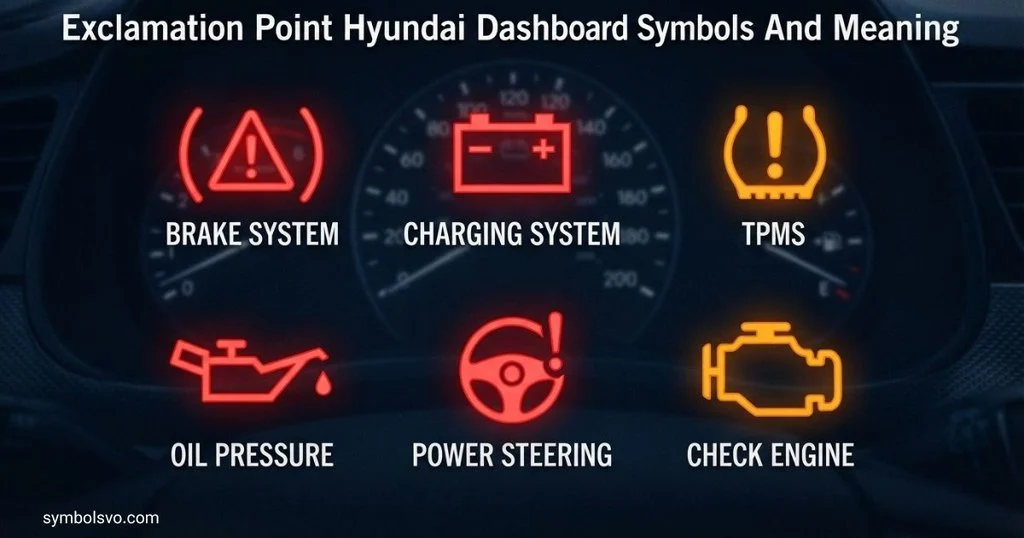
An exclamation point on a Hyundai dashboard can mean different things depending on the shape surrounding the exclamation point.
This distinction is critical.
Triangle With Exclamation Point
A triangle with an exclamation point generally indicates the Master Warning Light.
It is a general alert. The cluster display should provide more information about the underlying condition. Hyundai manuals specifically describe the Master Warning Light as a warning for multiple possible system faults.
Tire Shape With Exclamation Point
A symbol that looks like a tire with an exclamation point in the center is associated with tire pressure.
It is different from the triangular Master Warning Light.
A steady tire-pressure warning can indicate that one or more tires are significantly underinflated. A flashing or repeatedly cycling TPMS warning can indicate a TPMS malfunction, depending on the vehicle. Hyundai’s manuals describe these behaviors and recommend inspection when a TPMS malfunction is indicated.
Circle With Exclamation Point
A circular brake-related warning symbol can indicate a brake-system or parking-brake condition. Its exact meaning depends on the symbol, vehicle, and warning message.
Do not confuse these three shapes:
| Appearance | Common meaning |
| Triangle + ! | Master Warning |
| Tire-shaped outline + ! | Tire pressure / TPMS |
| Brake-circle warning | Brake system / parking brake |
The shape matters as much as the exclamation point.
Frequently Asked Questions
What does the triangle with an exclamation point mean on a Hyundai?
It is generally the Master Warning Light. It indicates that one or more vehicle systems need attention, and the cluster display should be checked for the specific warning. l
What does the exclamation point inside a tire mean?
It is generally the tire-pressure warning symbol. It can indicate that one or more tires are significantly underinflated or, in some cases, that the TPMS itself has a malfunction.
Why is my Hyundai Master Warning Light on?
The Master Warning Light can be triggered by several different conditions, including certain driver-assistance faults, blocked sensors, lighting problems, low washer fluid, TPMS issues, and other model-specific warnings. Check the message displayed on the instrument cluster.
Are Hyundai dashboard symbols the same for every model year?
No. Hyundai changes dashboard layouts, warning systems, and available equipment across model years and models. A Tucson, Sonata, Elantra, Santa Fe, and other Hyundai vehicles may have different symbols or messages.
Can I drive with a Hyundai warning light on?
It depends on the warning. Some indicators simply show that a feature is active, while others signal a condition that needs immediate attention. Red warnings and serious brake, oil-pressure, or other critical-system warnings should be treated urgently. Always follow the instructions for your specific Hyundai.
Conclusion
Hyundai dashboard symbols provide quick information about the vehicle’s systems, but the same-looking warning can have different implications depending on its shape, color, model, and accompanying message. The triangle with an exclamation point, for example, is generally a Master Warning Light, while the tire-shaped exclamation point is associated with tire pressure.
Model year also matters. Hyundai vehicles from 2011 through 2026 have gained new driver-assistance, lighting, safety, and digital-display features, so there is no single dashboard chart that perfectly describes every Hyundai. The owner’s manual for the exact vehicle remains the best source for model-specific meanings.
If a warning appears, identify the symbol first, read any cluster message, and consider the seriousness of the light before continuing to drive. When a warning involves brakes, oil pressure, steering, charging, or another critical system, use the vehicle’s manual and seek professional inspection rather than guessing at the meaning.

I’m Daniel Brooks, a content creator and symbol enthusiast dedicated to researching the fascinating world of signs and symbols. I enjoy discovering the hidden meanings behind famous icons, emojis, historical emblems, and cultural symbols. Through my writing, I aim to provide trustworthy, well-researched, and reader-friendly information that helps people learn something new with every visit.
Books:
- The Complete Guide to World Symbols
- The Power of Universal Signs
 Mason Ellington
 Grace Whitmore