
I’ve always found it fascinating how simple shapes can carry such deep meaning. Sacred geometry symbols turn circles, lines, and patterns into powerful visual ideas connected with nature, balance, harmony, and spirituality.
If you’re curious about what these symbols mean, you’re in the right place. I’ll help you explore their origins, meanings, and the ideas behind some of the most recognized sacred geometry symbols.
You don’t need to be an expert to understand them. As you explore each symbol, you’ll discover how ancient patterns can offer a fascinating way to think about connection, proportion, balance, and the world around you.
What Is Sacred Geometry Symbols
“Sacred geometry symbols” refers to geometric shapes and patterns that people have associated with spiritual, philosophical, religious, or symbolic ideas. The geometry itself is mathematical, but the word sacred refers to the meanings humans have attached to particular forms.
Examples include circles, triangles, spirals, interlocking circles, symmetrical grids, and three-dimensional geometric forms.
Some of the most recognizable examples are:
- ○ Circle — Unity, wholeness, cycles, or infinity in many symbolic traditions.
- △ Triangle — Often associated with balance, transformation, direction, or the elements depending on context.
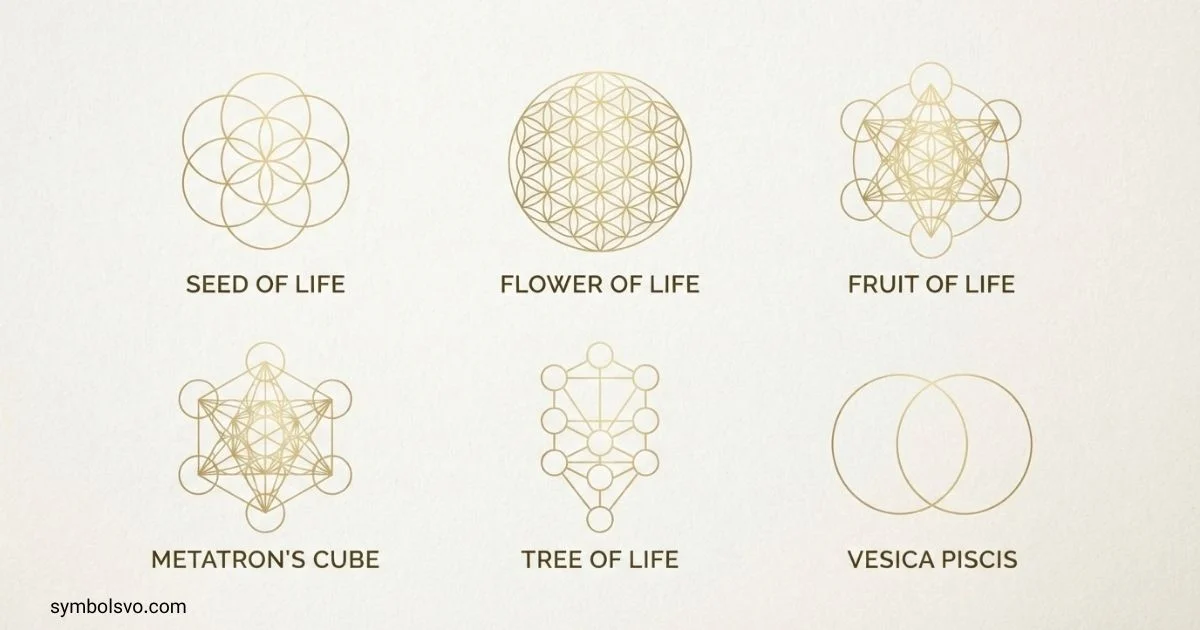
- Vesica Piscis — Two overlapping circles that create a distinctive almond-shaped center.
- Flower of Life — A pattern made from overlapping circles.
- Seed of Life — A smaller circular pattern traditionally associated with the early structure of the Flower of Life.
- Metatron’s Cube — A complex geometric figure commonly associated with the Platonic solids.
- Sri Yantra — A Hindu geometric diagram made from interlocking triangles.
- Spiral — Often used to represent growth, movement, cycles, or development.
Sacred geometry should not be confused with ordinary geometric shapes that have no spiritual association. A circle, for example, is simply a geometric shape in mathematics. Its symbolic meaning depends on how and where it is used.
Sacred Geometry Symbols Meaning
The meaning of a sacred geometry symbol depends heavily on its cultural and spiritual context. There is no single dictionary that gives one universally accepted meaning for every design.
A useful way to understand them is to look at the ideas commonly connected with each form.
| Symbol | Common symbolic associations |
| Circle | Unity, wholeness, cycles |
| Vesica Piscis | Creation, intersection, union |
| Seed of Life | Beginnings, potential, creation |
| Flower of Life | Interconnection, harmony, creation |
| Metatron’s Cube | Order, structure, balance |
| Sri Yantra | Spiritual focus, union, sacred cosmology |
| Spiral | Growth, cycles, movement |
| Platonic solids | Order, proportion, classical elements |
| Hexagram | Balance and complementary forces in several traditions |
| Labyrinth | Journey, reflection, transformation |
These associations should be treated as interpretations rather than scientific facts. For example, describing a Flower of Life as a symbol of interconnectedness is a common modern interpretation, but that does not mean every historical culture used it with exactly that meaning.
The same shape can also have different meanings in different religions and cultures.
Sacred Geometry Symbols List
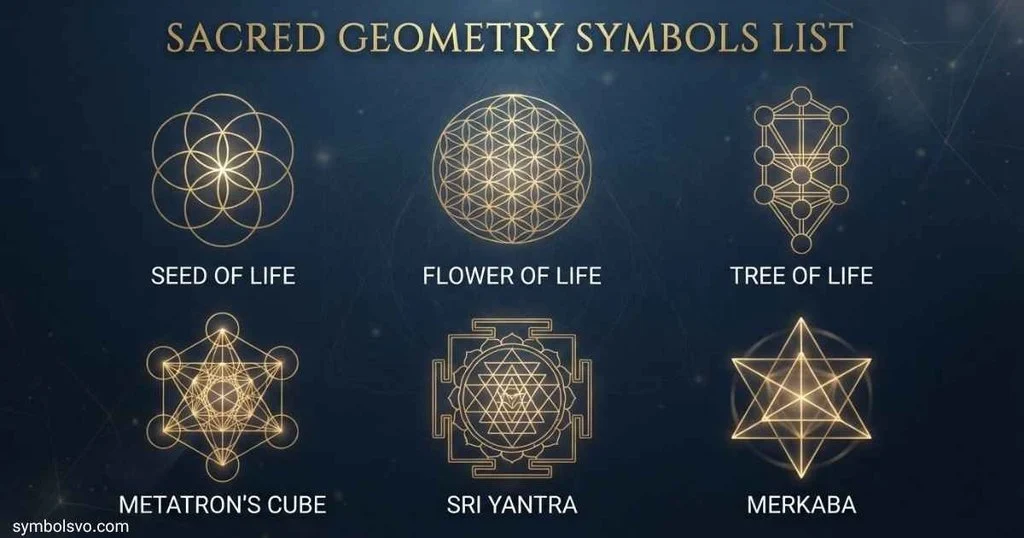
Here is a practical list of well-known sacred geometry symbols and geometric concepts.
Common Sacred Geometry Symbols
- Flower of Life — Interlocking circles arranged in a symmetrical pattern.
- Seed of Life — A smaller circular arrangement associated with the Flower of Life.
- Fruit of Life — A geometric pattern often discussed as part of the Flower of Life tradition.
- Vesica Piscis — Two overlapping circles producing an almond-shaped central area.
- Metatron’s Cube — A geometric figure containing connections between points commonly associated with the five Platonic solids.
- Sri Yantra — A sacred Hindu diagram formed from interlocking triangles.
- Platonic Solids — Five regular convex polyhedra: tetrahedron, cube, octahedron, dodecahedron, and icosahedron.
- Golden Spiral — A spiral related mathematically to the golden ratio.
- Spiral — A recurring form found in nature, art, and symbolic traditions.
- Torus — A doughnut-shaped geometric form frequently used in modern sacred geometry discussions.
- Hexagram — A six-pointed geometric figure with different meanings in different traditions.
- Pentagram — A five-pointed star that has been used in various religious, philosophical, and cultural contexts.
- Labyrinth — A structured path often used as a symbol of journey and reflection.
Some of these are historical religious symbols, while others are mathematical forms that have gained spiritual interpretations in modern sacred-geometry communities.
All Sacred Geometry Symbols
There is no universally agreed list of “all” sacred geometry symbols. Sacred geometry is a broad modern category that brings together mathematical forms, religious diagrams, architectural patterns, artistic designs, and symbols from different cultures.
A broader collection can include:
Basic forms:
Circle, triangle, square, pentagon, hexagon, spiral, sphere, cube, and tetrahedron.
Interlocking patterns:
Vesica Piscis, Seed of Life, Flower of Life, Fruit of Life, and Metatron’s Cube.
Sacred diagrams:
Sri Yantra, mandalas, yantras, and various temple or meditation diagrams.
Geometric solids:
Tetrahedron, cube, octahedron, dodecahedron, and icosahedron.
Proportional concepts:
Golden ratio, golden rectangle, Fibonacci-related patterns, and geometric spirals.
The important distinction is that not every item in these groups has the same historical status. Some have long religious traditions, while others are modern interpretations of mathematical geometry.
Healing Sacred Geometry Symbols
Sacred geometry is sometimes used in modern spiritual and wellness practices as a visual focus for meditation, relaxation, intention-setting, or personal reflection.
Commonly associated designs include:
- Flower of Life — Often used as a visual reminder of connection and harmony.
- Sri Yantra — Used in some Hindu practices as a meditation and devotional diagram.
- Mandala patterns — Often used for concentration and contemplative practice.
- Spiral — Can symbolize personal growth, cycles, and movement.
- Vesica Piscis — Sometimes interpreted as a symbol of balance and creation.
It is important to separate spiritual symbolism from medical treatment. There is no established scientific basis for claiming that a particular geometric symbol can cure disease, repair the body, or directly produce a medical healing effect.
A more practical use is to treat a geometric design as a meditation or mindfulness object. Looking at a symmetrical pattern, drawing it, or incorporating it into a reflective practice may help someone focus their attention.
Sacred Geometry Symbols For Manifestation
In modern spiritual practices, sacred geometry is sometimes used as a visual tool for manifestation. The basic idea is to connect a geometric design with an intention, goal, affirmation, or meditation practice.
Popular choices include:
- Flower of Life — For intentions involving connection, harmony, and personal growth.
- Sri Yantra — For focused meditation and spiritual intention.
- Metatron’s Cube — For structure, balance, and organized intention.
- Golden Spiral — For growth and gradual development.
- Circle — For wholeness and completion.
- Triangle — For direction, focus, and transformation.
A simple manifestation practice might involve choosing one symbol, writing down a specific goal, and spending a few minutes reflecting on it.
The symbol itself should not be treated as a guaranteed method for producing a material result. Its value in this context is primarily symbolic and psychological: it can give an intention a visual form and make it easier to keep that intention in mind.
Spiritual Awakening Sacred Geometry Symbols And Meanings
Sacred geometry is often connected with spiritual awakening because geometric patterns can provide a visual language for ideas such as unity, consciousness, balance, cycles, and interconnectedness.
Some commonly discussed symbols include:
| Symbol | Common spiritual interpretation |
| Flower of Life | Interconnection and unity |
| Seed of Life | Beginning and potential |
| Metatron’s Cube | Order and cosmic structure |
| Sri Yantra | Concentration and spiritual union |
| Vesica Piscis | Intersection and creation |
| Spiral | Growth and transformation |
| Circle | Wholeness and continuity |
| Mandala | Reflection and centered awareness |
A person exploring these symbols might use them during meditation, journaling, visualization, or contemplative art.
The phrase spiritual awakening can mean different things to different people. For one person, it may describe a religious experience. For another, it may mean increased self-awareness or a change in personal values. Sacred geometry can serve as a visual framework for that reflection, but it does not have one fixed spiritual message.
Alchemy Sacred Geometry Symbols And Meanings
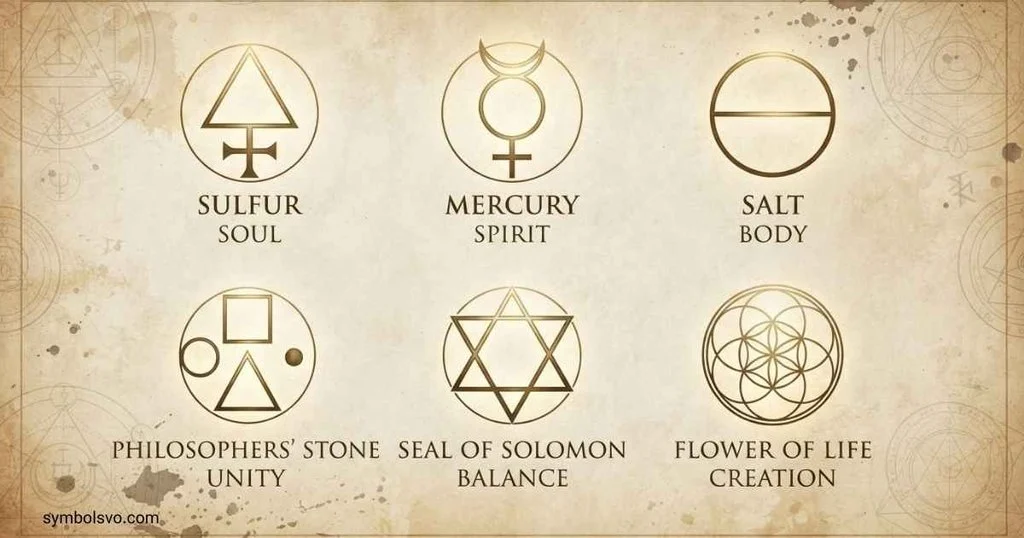
Alchemy and sacred geometry are sometimes discussed together because both traditions use symbols, proportions, shapes, and visual diagrams to represent ideas about transformation.
Classical alchemical symbolism includes recognizable signs for concepts such as the four elements and planetary or metallic associations. Some geometric forms are also used in modern interpretations of alchemical ideas.
Common examples include:
- Triangle — Used in several symbolic systems to represent elements and transformation.
- Circle — Often associated with unity, cycles, or completion.
- Square — Can represent stability, structure, or the material world.
- Triangle within a circle — Can be interpreted through different symbolic traditions.
- Four-element geometry — Fire, air, water, and earth have historically been represented through combinations of triangles.
It is worth keeping the historical record in mind. Sacred geometry is not the same thing as alchemy, and not every geometric symbol found in modern spiritual artwork is an authentic historical alchemical symbol.
Modern spiritual artists often combine these traditions creatively. Such designs can be meaningful, but they should not automatically be presented as ancient alchemical symbols.
Divine Feminine Sacred Geometry Symbols
The divine feminine is a modern spiritual concept used to describe qualities such as creation, receptivity, intuition, nurturing, cycles, embodiment, and feminine power. Sacred geometry is sometimes used to visually represent these themes.
Symbols commonly associated with this idea include:
- Vesica Piscis — Its intersecting circles are sometimes interpreted as a symbol of creation, union, and the feminine.
- Circle — Can represent cycles, wholeness, and continuity.
- Spiral — Often connected with growth, life cycles, and transformation.
- Flower of Life — Commonly used in modern spiritual art to represent creation and interconnectedness.
- Moon-related geometric designs — Frequently combined with sacred geometry in contemporary feminine spiritual artwork.
These associations are largely contextual. A geometric symbol does not have a single gendered meaning across all cultures.
For artwork or personal symbolism, the best approach is to choose the form based on the meaning you want it to communicate rather than assuming that every geometric pattern automatically represents the divine feminine.
Sacred Geometry Symbols For Protection
Protection is another common theme in modern sacred geometry artwork and spiritual practices.
Some designs frequently associated with protection include:
Metatron’s Cube
Metatron’s Cube is often used in contemporary spiritual artwork as a symbol of order, balance, and energetic protection. Its complex structure makes it popular in wall art, jewelry, meditation designs, and tattoos.
Hexagram
The hexagram has a long history across different cultures and religions. Its two interlocking triangles can be interpreted in different ways, including balance between complementary forces.
Circle
A circle can symbolize a boundary, enclosure, unity, or wholeness. In modern spiritual artwork, a circular design may therefore be used to represent a protective boundary.
Flower Of Life
The Flower of Life is sometimes used in modern spiritual communities as a protective or harmonizing symbol.
These meanings are cultural and spiritual interpretations rather than scientifically demonstrated protective effects. A symbol can represent protection personally without physically preventing harm.
Sacred Geometry Symbols For Wealth
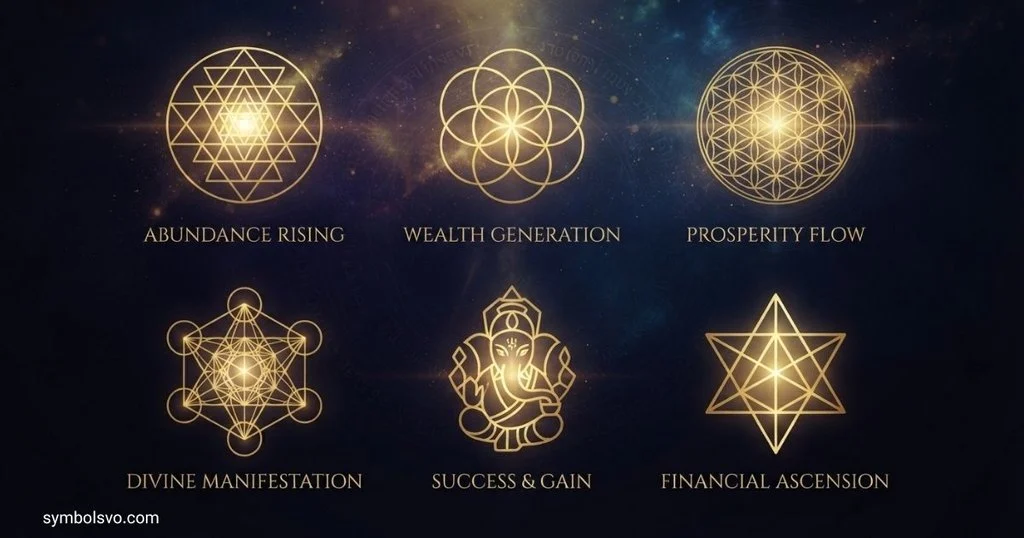
Some modern spiritual practices associate sacred geometry with abundance, prosperity, and wealth. These associations are usually based on symbolic interpretations rather than historical universal meanings.
Common choices include:
- Sri Yantra — Sometimes used in prosperity-focused spiritual practices, particularly because of its place in Hindu and tantric traditions.
- Golden ratio patterns — Associated symbolically with proportion, balance, and abundance in modern designs.
- Circle — Can represent completeness and continuity.
- Flower of Life — Sometimes used in abundance and growth artwork.
- Spiral — Can represent expansion and ongoing development.
For a wealth-focused design, you might combine a geometric pattern with words or imagery representing a financial goal.
It is better to view these symbols as visual reminders of an intention rather than magical guarantees of money. Financial results still depend on decisions, planning, skills, opportunity, and circumstances.
Sacred Geometry Symbols Tattoos
Sacred geometry tattoos are popular because geometric designs can look visually striking while carrying personal meaning.
Some common tattoo choices include:
| Tattoo design | Common symbolic theme |
| Flower of Life | Unity, connection, creation |
| Metatron’s Cube | Order, balance, structure |
| Sri Yantra | Spiritual focus and contemplation |
| Vesica Piscis | Union and creation |
| Spiral | Growth and transformation |
| Mandala | Balance and centeredness |
| Platonic solids | Geometry, order, and the classical elements in some interpretations |
| Sacred geometric circle | Wholeness and cycles |
Before getting a sacred geometry tattoo, pay attention to the design’s symmetry. Small inaccuracies can become more noticeable when a pattern relies on precise intersections and repeated shapes.
Also research the cultural origin of the symbol. A tattoo can carry religious or cultural significance that goes beyond its modern decorative use.
If you want a personal design, decide first what you want it to represent. For example:
Growth → Spiral
Connection → Flower of Life
Balance → Symmetrical geometric pattern
Spiritual focus → Sri Yantra or mandala
Structure → Metatron’s Cube
The meaning should come from a combination of the symbol’s history and your own intention rather than from a generic tattoo description.
Frequently Asked Questions
What is the most popular sacred geometry symbol?
The Flower of Life is one of the most recognizable symbols associated with modern sacred geometry. It consists of overlapping circles arranged in a symmetrical pattern and is commonly linked with ideas such as creation, unity, and interconnectedness.
What does sacred geometry symbolize?
Sacred geometry can symbolize ideas such as balance, unity, creation, proportion, cycles, transformation, and interconnectedness. The meaning changes according to the symbol and cultural or spiritual context.
Is sacred geometry scientifically proven?
The mathematical properties of geometric shapes are scientifically describable, but spiritual claims about sacred geometry do not have the same scientific status. Claims that a particular symbol automatically heals, protects, or creates wealth should not be treated as established scientific facts.
Which sacred geometry symbol is best for a tattoo?
There is no single best choice. The Flower of Life, Metatron’s Cube, Sri Yantra, mandalas, spirals, and geometric solids are popular options. The right choice depends on the meaning, visual style, cultural background, and size of the tattoo.
Can sacred geometry symbols be used for meditation?
Yes. People can use geometric patterns as visual points of focus during meditation, contemplation, drawing, or journaling. The symbol can help provide structure for attention, although its effects should not be confused with medical treatment.
Conclusion
Sacred geometry symbols bring mathematics, visual design, cultural history, and spiritual interpretation together. Popular forms such as the Flower of Life, Vesica Piscis, Metatron’s Cube, Sri Yantra, spirals, mandalas, and Platonic solids each have different histories and modern associations.
Their uses range from meditation and personal reflection to artwork, jewelry, manifestation practices, spiritual study, and tattoos. Symbols connected with healing, protection, wealth, divine feminine ideas, and spiritual awakening are especially common in modern spiritual communities.
The best way to use sacred geometry is to understand what a design actually represents before adopting it. Learn its background, distinguish historical meanings from modern interpretations, and then decide what the symbol means to you personally.

 Mason Ellington
 Daniel Brooks