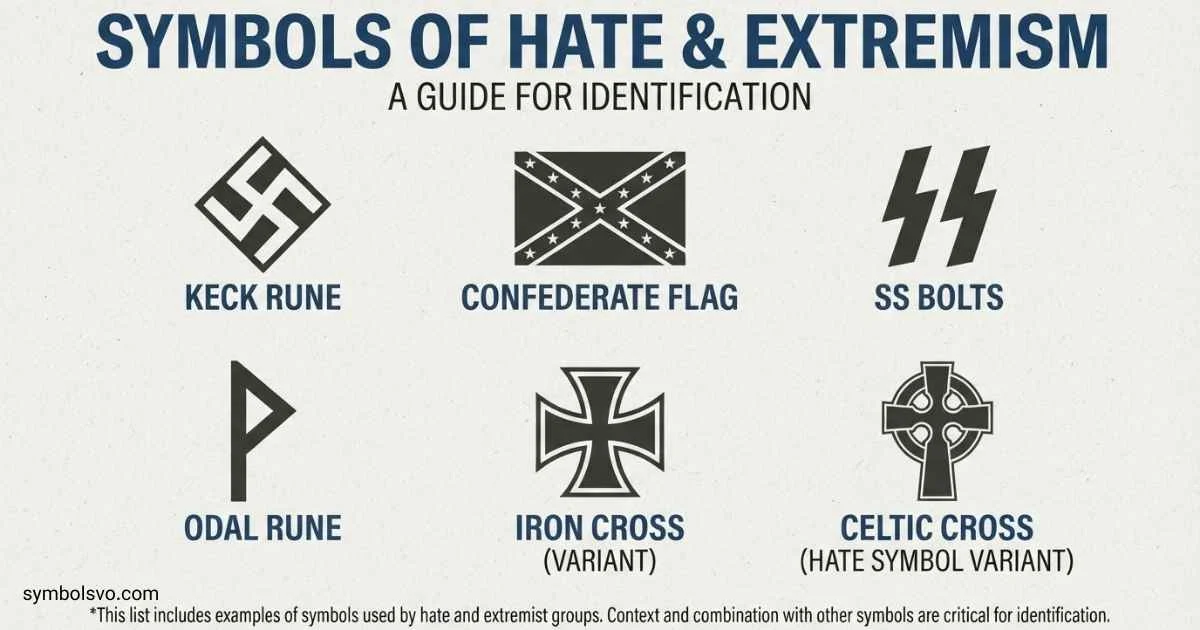
When I first explore symbols linked to hate or extremist beliefs, I know the subject can feel uncomfortable and confusing. You may wonder what certain symbols mean, where they came from, and why they matter.
I believe understanding these symbols is important because knowledge can help you recognize harmful messages without giving them more power. You can learn the history and meaning behind them while keeping the focus on awareness, safety, and context.
In this guide, I’ll explain Coast Guard hate symbols in clear, simple language and provide the context you need to understand them. You’ll also learn why recognizing these symbols matters and how their meaning can change depending on where and how they appear.
Coast Guard Hate Symbols
The U.S. Coast Guard has policies addressing discriminatory, harassing, extremist, and hate-related conduct. Under earlier Coast Guard guidance, symbols associated with oppression or hatred could constitute a potential hate incident. A 2023 policy specifically gave examples including a noose, swastika, supremacist symbols, Confederate symbols or flags, and antisemitic symbols. United States Coast Guard
The earlier policy also explained why it did not attempt to create an exhaustive list. Hate groups can adopt new symbols, alter existing ones, or use ordinary symbols in particular contexts. As a result, the meaning and circumstances surrounding a display can matter.
The policy distinguished between genuinely hateful displays and legitimate historical or operational uses. For example, the 2023 document stated that clearly historical Coast Guard artifacts or items connected with Coast Guard operations could fall outside the definition of a potential hate incident. United States Coast Guard
This context is important because a “hate symbol” policy is not simply a dictionary of images. It establishes rules for how personnel and commanders should respond to symbols, conduct, and displays in the workplace and service environment.
Coast Guard Hate Symbols Policy
The Coast Guard’s approach to hate symbols has developed through its broader anti-discrimination and anti-harassment policies.
The service’s policy framework has included rules concerning conduct based on characteristics such as race, religion, national origin, sex, and other protected categories. The Coast Guard’s official policy archive currently identifies an Anti-Discrimination and Anti-Harassment Policy updated in March 2025, alongside later statements specifically addressing divisive or hate symbols. United States Coast Guard
A key principle has remained that Coast Guard personnel are expected to maintain a professional environment free from discrimination and harassment.
The policy issue became controversial in late 2025 because changes to terminology appeared to alter how certain symbols would be classified. That led to competing headlines suggesting the Coast Guard had either relaxed or strengthened its position.
The safest way to understand the policy is to distinguish between:
- The earlier anti-harassment framework.
- The proposed or revised November 2025 language.
- The November 20, 2025 lawful order.
- The December 2025 policy developments and reversal.
Looking at one document without the others can produce an incomplete picture.
U.S. Coast Guard Hate Symbols Policy
The U.S. Coast Guard hate symbols policy is not simply a list of prohibited pictures. It operates within a larger system of military conduct, equal opportunity, anti-discrimination, harassment, and professional standards.
The Coast Guard’s official policy archive lists a November 2025 Coast Guard Policy and Lawful Order Prohibiting Divisive or Hate Symbols and a December 2025 Divisive or Hate Symbols and Flags Policy Statement and Lawful Order. United States Coast Guard
The Coast Guard also announced on November 20, 2025, that its new policy and lawful order prohibited the display, distribution, or use of hate symbols by Coast Guard personnel. The service said the order provided definitions and expectations for personnel and was intended to address misinformation surrounding the issue. US Coast Guard News
This distinction matters because some news reports focused on a workplace harassment manual, while the Coast Guard emphasized a separate lawful order prohibiting divisive or hate symbols.
In practical terms, Coast Guard personnel should not assume that a symbol is acceptable simply because a particular policy document uses different terminology. A later lawful order or command directive may impose a stricter prohibition.
U.S. Coast Guard Hate Symbols Policy 2025
The 2025 policy story developed rapidly.
Earlier Coast Guard guidance treated symbols such as swastikas and nooses as potential hate incidents. Then, during a broader review of harassment policies, language was changed so that certain symbols were described as “potentially divisive.” The Washington Post reported that the revised workplace policy was scheduled to take effect December 15, 2025. Archive.ph
That wording caused significant criticism.
On November 20, 2025, the Coast Guard issued a new policy and lawful order saying that divisive or hate symbols and flags were prohibited. The service specifically described the action as a new policy and order rather than simply an update to an existing policy. US Coast Guard News
The following day, The Washington Post reported that the Coast Guard had reversed the attempted softening and again classified swastikas and nooses as prohibited hate symbols. The Washington Post
The story did not end there. In December, the workplace harassment policy containing the “potentially divisive” language went into effect, creating a conflict with the separate prohibition. The Coast Guard then moved to remove the controversial language. The Washington Post
U.S. Coast Guard Hate Symbols Policy Change 2025
The most important point about the 2025 policy change is that there was more than one change.
A simplified timeline looks like this:
| Date | Development |
| Earlier policy | Swastikas, nooses, Confederate symbols or flags, and other examples could constitute potential hate incidents |
| 2025 policy review | Coast Guard revised its workplace harassment framework |
| Nov. 20, 2025 | Coast Guard announced a new policy and lawful order prohibiting divisive or hate symbols |
| Nov. 21, 2025 | Reporting described the service’s reversal and reaffirmation that swastikas and nooses were prohibited |
| Dec. 15, 2025 | A workplace harassment policy using “potentially divisive” terminology took effect |
| Dec. 18–19, 2025 | Coast Guard/DHS moved to remove the controversial language and the Coast Guard said the prohibition remained in effect |
The Washington Post reported that the December policy temporarily created a conflict between the workplace manual’s wording and the separate directive prohibiting swastikas and nooses. The Washington Post
The Coast Guard’s own policy archive now confirms that November and December 2025 policy statements exist, which is useful when separating the different stages of the controversy. United States Coast Guard
Coast Guard Policies
The hate-symbol controversy sits within a much larger collection of Coast Guard policies.
These policies cover areas such as:
- Equal opportunity
- Anti-discrimination
- Harassment
- Workplace conduct
- Tattoos and body markings
- Professional appearance
- Military standards
- Online conduct
- Extremist or supremacist behavior
The Coast Guard’s official policy resources show that its anti-discrimination and anti-harassment framework was updated in March 2025. United States Coast Guard
The service also issued guidance in September 2025 reminding personnel that Coast Guard members represent the service even when communicating online. That message emphasized the Coast Guard’s core values of Honor, Respect, and Devotion to Duty and condemned conduct that celebrates or promotes political violence.
This broader policy environment explains why hate symbols are treated as a personnel and workplace issue rather than merely a question of personal expression.
Coast Guard Memo
The Coast Guard memo became an important part of the 2025 controversy.
On November 20, 2025, Acting Commandant Adm. Kevin Lunday issued a memo accompanying the Coast Guard’s new lawful order. The memo stated that divisive or hate symbols and flags were prohibited. The order specifically included examples such as a noose and swastika and covered symbols adopted by hate-based groups to represent supremacy, racial or religious intolerance, antisemitism, or other improper bias. The Washington Post
The memo was significant because it provided a clear statement from Coast Guard leadership after reports had raised questions about the proposed policy language.
The Washington Post later reported that Lunday issued another directive in December that categorically prohibited swastikas and nooses and said it remained in effect even as the wording of another policy document became controversial. The Washington Post
The existence of these separate documents is one reason online summaries can appear contradictory.
Coast Guard Divisive Symbols
The term divisive symbols became central to the 2025 policy debate.
A divisive symbol can have different meanings depending on historical and social context. In the Coast Guard policy discussion, the phrase was used in connection with symbols associated with hatred, supremacy, racial or religious intolerance, antisemitism, or other forms of improper bias.
Examples discussed in the 2025 controversy included:
- Swastikas
- Nooses
- Confederate symbols or flags
- Symbols adopted by hate-based groups
The Coast Guard’s November 2025 announcement said prohibited symbols could include symbols or flags associated with supremacy, racial or religious intolerance, antisemitism, or other improper bias. US Coast Guard News
It is also important not to treat every controversial or politically charged symbol as automatically identical. Context, purpose, historical display, and the applicable policy all matter.
U.S. Coast Guard Tattoos
The U.S. Coast Guard tattoos policy is related to the broader issue of symbols and personal expression, but it is a separate policy area.
The Coast Guard’s official tattoo policy says body art must be consistent with Coast Guard standards and professional military appearance. It also states that tattoos representing racism, discrimination, indecency, extremist or supremacist ideals, lawlessness, violence, or sexually explicit material are not authorized.
The policy also addresses where tattoos may be placed and sets specific limits for areas such as the hands, fingers, and chest.
This means a tattoo can raise a policy issue even when it is not displayed as a flag, poster, workplace decoration, or digital image.
For someone considering a Coast Guard tattoo, the safest approach is to check the current official tattoo and body-marking policy rather than relying on old recruiting posts or social-media advice.
Hate Symbols in the U.S.
Hate symbols in the United States cover a much broader subject than Coast Guard policy.
Groups associated with racism, antisemitism, religious hatred, white supremacy, and other forms of extremism have used symbols, numbers, slogans, flags, and imagery to communicate affiliation or ideology. Some symbols have long histories, while others are adopted or repurposed over time.
A symbol’s meaning can also depend on context. An image displayed in a historical museum, textbook, documentary, or educational setting does not necessarily carry the same purpose as the same image displayed to intimidate a person.
This distinction was recognized in earlier Coast Guard guidance. The service stated that clearly historical Coast Guard artifacts and legitimate operational displays could be treated differently from displays intended to convey hatred or intimidation. United States Coast Guard
For people researching hate symbols, reputable sources such as government civil-rights resources and established hate-symbol databases are preferable to anonymous lists that may misidentify ordinary symbols.
Coast Guard Hate Symbols News
The Coast Guard hate-symbol story generated substantial news coverage in November and December 2025.
The central sequence was:
Policy revision → public reporting → Coast Guard clarification → reversal → renewed controversy → December policy conflict → removal of controversial language.
The Washington Post first reported on November 20 that the Coast Guard’s planned policy would classify swastikas, nooses, and the Confederate flag differently, describing them as “potentially divisive.” Archive.ph
Later that day, the Coast Guard announced its own policy and lawful order prohibiting divisive or hate symbols. US Coast Guard News
The Washington Post then reported on November 21 that the Coast Guard had reversed course and again classified swastikas and nooses as prohibited hate symbols. The Washington Post
In December, the controversy resurfaced when the revised workplace harassment policy went into effect despite the separate prohibition. The Coast Guard subsequently moved to remove the problematic language. The Washington Post
For current research, the Coast Guard’s own policy archive is particularly useful because it identifies the November and December 2025 policy statements directly. United States Coast Guard
Trump Coast Guard Hate Symbols
The Trump Coast Guard hate symbols search relates to the broader changes in Coast Guard leadership and military policy during Donald Trump’s second administration.
President Trump removed Coast Guard Commandant Adm. Linda Fagan from her position at the beginning of his second term. Acting Commandant Adm. Kevin Lunday subsequently became a central figure in the policy changes concerning harassment and divisive symbols. The Washington Post reported that Lunday later became Trump’s nominee to lead the service.
The administration’s broader approach to military policy also formed part of the context. The Coast Guard reviewed its harassment and hazing policies during a period when the Trump administration was seeking changes to military personnel standards.
However, it is too simplistic to describe the entire episode as one single “Trump hate-symbol policy.” Several Coast Guard documents, leadership decisions, and administrative actions were involved.
The Coast Guard is part of the Department of Homeland Security rather than the Department of Defense, although it can operate as a military service and a member of the joint force. The Coast Guard itself emphasized that its November 2025 policy was intended to prohibit divisive or hate symbols.
Snopes Coast Guard
The Snopes Coast Guard search became relevant because online claims about the policy spread quickly.
Snopes reported on November 22, 2025, that claims about the Coast Guard no longer classifying swastikas and nooses as hate symbols had sparked widespread discussion. Its coverage focused on the policy update and the Coast Guard’s subsequent clarification.
The important lesson from the Snopes coverage is that headlines and social-media summaries can flatten a complicated policy timeline.
A statement such as “the Coast Guard removed hate symbols” can be misleading if it ignores the separate lawful order that prohibited those symbols.
When checking a claim, look for:
- The date of the policy.
- The exact document being discussed.
- Whether it was a proposed policy, final manual, or lawful order.
- Whether a later directive superseded it.
- What the Coast Guard itself said afterward.
That method provides a much more reliable picture than relying on a single viral post.
Washington Post Coast Guard Hate Symbols
The Washington Post Coast Guard hate symbols coverage was central to the public discussion because The Post reported extensively on the policy changes as they developed.
Its November 20 report said the Coast Guard planned to classify swastikas, nooses, and the Confederate flag as “potentially divisive” rather than using the earlier hate-symbol terminology..
The following day, The Post reported that the Coast Guard had reversed the change and explicitly prohibited swastikas and nooses.
The newspaper later reported that a revised workplace harassment manual nevertheless took effect in December with language that downgraded those symbols, creating a conflict with the separate prohibition.
Finally, The Post reported in December that the Coast Guard deleted the controversial language from the policy manual and that Lunday said the separate directive prohibiting swastikas and nooses remained in full effect.
The reporting is useful for reconstructing the chronology, while the Coast Guard’s official policy archive is the better source for identifying the service’s formal policy documents.
Frequently Asked Questions
What are the main Coast Guard hate symbols discussed in the 2025 controversy?
The symbols most prominently discussed were swastikas, nooses, and Confederate symbols or flags. Earlier Coast Guard policy also referred more broadly to supremacist and antisemitic symbols.
Did the Coast Guard ban hate symbols in 2025?
Yes. The Coast Guard issued a November 2025 policy and lawful order stating that divisive or hate symbols and flags were prohibited. The service subsequently reaffirmed the prohibition after controversy over separate policy language.
What happened to the Coast Guard “potentially divisive” language?
The phrase appeared in a revised workplace harassment policy in late 2025. The language became controversial because it appeared to downgrade symbols such as swastikas and nooses from hate symbols to potentially divisive symbols. The Coast Guard later removed the controversial language, while maintaining a separate prohibition.
Are hate symbols allowed as Coast Guard tattoos?
The Coast Guard’s tattoo policy says tattoos representing racism, discrimination, extremist or supremacist ideals, lawlessness, violence, and certain other prohibited content are not authorized.
Where can I find the official Coast Guard hate-symbol policy?
The Coast Guard’s official policy archive lists the November 2025 and December 2025 policy statements concerning divisive or hate symbols and flags. This is the best starting point for checking official documents rather than relying on secondary summaries.
Conclusion
The Coast Guard hate-symbol controversy was not a single policy announcement. It involved several documents and changes during November and December 2025. The most significant issue was the treatment of symbols such as swastikas and nooses, with one workplace policy using “potentially divisive” language while separate Coast Guard orders continued to prohibit them.
The Coast Guard’s official record shows that the service issued a November 2025 policy and lawful order prohibiting divisive or hate symbols and later listed a December policy statement and lawful order in its official policy archive. United States Coast Guard The tattoo policy separately prohibits body art representing racism, discrimination, extremist or supremacist ideals, and violence.
The best way to understand claims about the 2025 changes is to check the date and document behind each claim. News coverage from The Washington Post and fact-checking from Snopes help explain the timeline, while the Coast Guard’s own policy archive provides the strongest primary-source reference for the service’s formal position.

I’m Nathan Holloway, a passionate researcher and writer with a deep interest in symbols, signs, and their hidden meanings. I enjoy exploring how symbols have influenced different civilizations, religions, and modern communication. Through my work, I aim to make complex historical and cultural concepts easy to understand for readers of all backgrounds. Every article I write is carefully researched to provide reliable and engaging information.
Books:
- Beyond the Symbol
- The Secret Meanings of Everyday Signs
Author 2: Grace Whitmore
Description:
My name is Grace Whitmore, and I love discovering the stories behind the world’s most fascinating symbols. I spend my time researching ancient civilizations, mythology, spiritual traditions, and modern iconography to uncover the meanings people often overlook. I believe that every symbol has a history worth telling, and I enjoy sharing that knowledge in a simple and reader-friendly way.
Books:
- Echoes of Ancient Symbols
- The Symbolic World
 Mason Ellington
 Grace Whitmore
 Daniel Brooks