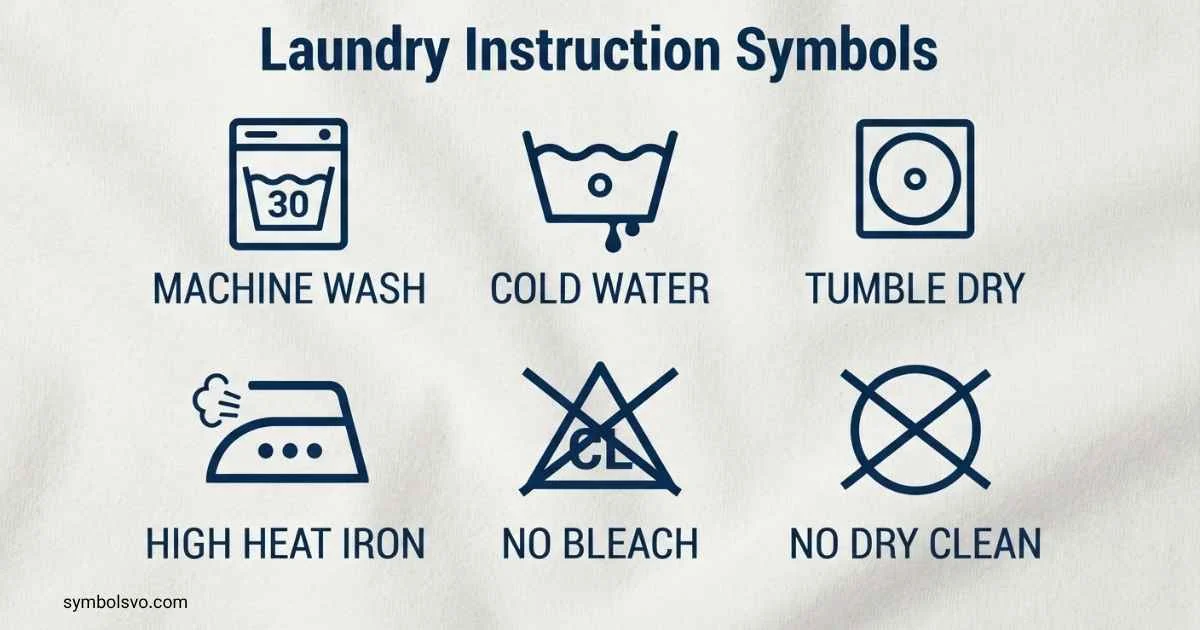
I used to think laundry labels were just a collection of confusing little pictures. Then I realized that these symbols actually give you simple instructions about how to wash, dry, bleach, iron, and care for your clothes.
If you have ever looked at a clothing tag and wondered what a strange circle, triangle, or crossed-out symbol means, you are not alone. In this guide, I’ll help you understand laundry instruction symbols in a simple way so you can confidently care for your clothes.
By the end, you’ll know what the most common laundry symbols mean and how to use them correctly. You can use this guide whenever you need a quick answer before putting your favorite clothes in the washer or dryer.
Quick Answer
Laundry instruction symbols are a standardized system of pictograms found on clothing labels that provide specific care instructions. These universal icons represent washing, bleaching, drying, ironing, and professional cleaning methods. They serve as a global communication tool, ensuring textiles are maintained correctly to prevent damage and maintain fabric integrity.
Quick Facts About Laundry Instruction Symbols
| Aspect | Information |
| Origin | Standardized by GINETEX in 1975 to harmonize global textile care. |
| Historical Significance | Replaced confusing, localized text labels with intuitive, visual guides. |
| Main Meaning | Safety protocols to ensure garment longevity through proper handling. |
| Spiritual Meaning | Represents the ritual of renewal and the mindful preservation of possessions. |
| Cultural Importance | Provides a shared, non-verbal language that transcends linguistic barriers. |
| Modern Usage | Essential on every textile label for regulatory and consumer protection. |
What Are Laundry Instruction Symbols?
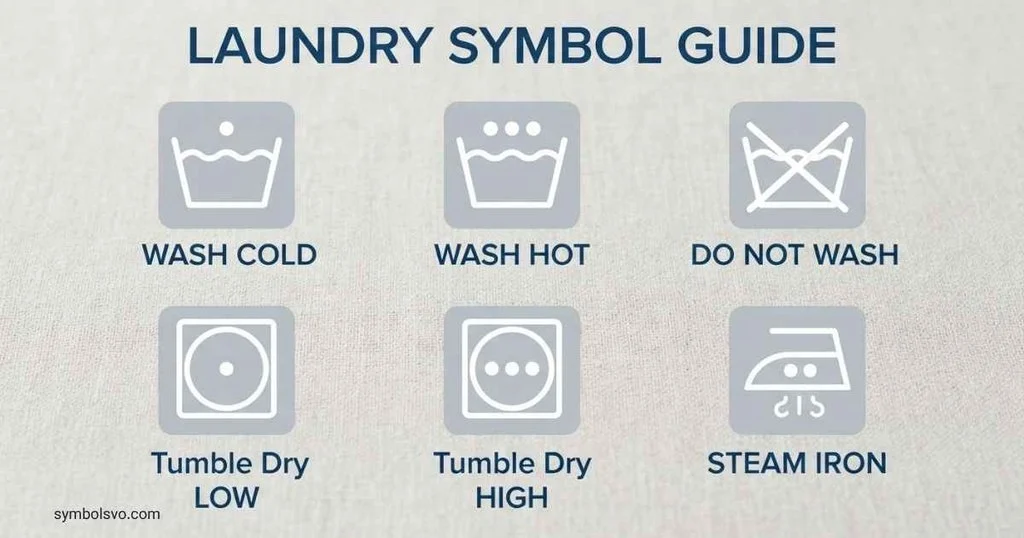
Laundry instruction symbols are a set of standardized visual icons designed to instruct consumers on how to safely clean and care for fabrics. While modern clothing labels often feature these icons, their history is rooted in the post-war industrial boom. As global trade expanded, a cotton shirt made in one country needed to be understood by a consumer speaking an entirely different language elsewhere.
The International Association for Textile Care Labeling (GINETEX) developed these symbols to create a common visual dialect. These icons are not random. They are carefully designed to represent specific actions. A bucket represents washing, a circle represents professional care, and a square represents drying. Over time, these symbols have evolved into the complex, precise system we rely on today to protect both mass-market apparel and delicate heirlooms.
Deep Symbolic Meaning of Laundry Instruction Symbols
Spiritual Level
On a spiritual level, these symbols represent the quiet ritual of renewal. In many ancient traditions, washing clothes was a meditative act of cleansing, not just of fabric but of the energy attached to the wearer. By following these symbols, you are practicing a form of mindfulness. You are honoring the labor that went into making the garment and acknowledging the connection between your physical comfort and the care you provide for your belongings.
Psychological Level
Psychologically, these symbols satisfy our human need for order and predictability. In a world that often feels chaotic, knowing exactly how to care for an item provides a sense of mastery and control. They act as archetypal guides, helping us move from a state of neglect to a state of stewardship. They remind us that everything in our lives requires a specific method of care to remain vibrant and whole.
Cultural Level
Culturally, laundry instruction symbols are a triumph of global cooperation. They demonstrate how humans can bypass language barriers to create a shared standard for utility and safety. They represent a community agreement that quality, sustainability, and responsible consumption are universal values that deserve a clear, visible language.
Types and Variations of Laundry Instruction Symbols
1. The Wash Tub
- Visual Description: A bucket shape, sometimes with numbers representing temperature.
- Meaning: How to safely wash the item in water.
- Symbolism: Rebirth and the purifying power of water.
- Cultural Connection: Relates to the ancient, shared history of washing at rivers and public wells.
- Where It Appears: Used on virtually all washable textiles from towels to denim.
2. The Bleach Triangle
- Visual Description: A simple triangle, sometimes with lines inside.
- Meaning: Whether the fabric can withstand bleaching agents.
- Symbolism: The threshold between total purity and the risk of destruction.
- Cultural Connection: Reflects the historical importance of whitening fabrics to signify status and cleanliness.
- Where It Appears: Common on white cottons and heavy-duty synthetic blends.
3. The Drying Square
- Visual Description: A square, sometimes containing a circle or lines.
- Meaning: The method of drying, such as tumble drying or line drying.
- Symbolism: Stability, structure, and the return to a dry, usable state.
- Cultural Connection: Highlights the transition from outdoor sun-drying traditions to indoor machine convenience.
- Where It Appears: Vital for delicate knits and high-tech performance gear.
Laundry Instruction Symbols Across Different Cultures
Ancient Egypt
In Egypt, the cleanliness of linen was a sign of holiness. Priests underwent rigorous washing rituals. While they lacked modern icons, they used a sophisticated system of marking fabric bundles to denote the status and cleanliness of the textile, a precursor to our modern classification systems.
Ancient Greece
The Greeks viewed washing as an art form. Laundry was often taken to public fountains where women gathered to talk. They categorized their fabrics by weight and weave, using distinct textures as their version of instruction labels to ensure their precious woolen togas were not ruined by harsh alkaline soaps.
Roman Culture
Romans utilized fullers to clean their heavy wool garments. These professionals used specific methods involving ammonia and sunlight. They developed a rudimentary system of identifying which fabrics were dyed with colors that would bleed, marking them accordingly to ensure the right cleaning process.
Eastern Traditions
In Japan, the care of silk kimonos is a tradition passed down through generations. These garments often carried physical, hand-stitched instructions or specific color-coded tags that signaled the wearer and the cleaner on the precise, gentle handling required for high-status textiles.
Indigenous Traditions
Many indigenous cultures developed complex methods for treating animal hides and natural fibers. Instructions were often passed down through oral storytelling and specific decorative patterns woven into the edge of a garment, acting as a permanent, visual guide for how to maintain the item.
Similar Symbols and Their Meanings
Laundry symbols are often confused with other abstract pictograms. Understanding these relationships is key to proper care.
| Symbol Category | Purpose | Relationship to Care |
| Laundry Icons | Instruction for maintenance | Direct action guide |
| Care Icons | General warnings | Safety guidelines |
| Material Labels | Identifying fiber content | Helps choose which icon to follow |
The most common misconception is that all bucket-shaped icons mean the same thing. In reality, the addition of a single dot or a line beneath the bucket changes the required care entirely, similar to how slight variations in ancient hieroglyphs changed the meaning of a word.
Laundry Instruction Symbols in Mythology and Folklore
While these specific icons are modern, the concept of a laundry ritual is embedded in folklore. In many Celtic and European tales, the Washerwoman is a mysterious figure associated with destiny. She washed the clothes of those about to die. Today, when we look at a laundry label, we are performing our own version of this ancient myth, deciding the fate of our garments through our chosen method of cleaning.
Laundry Instruction Symbols in Art, Literature, and Pop Culture
In modern art, laundry symbols have been used by conceptual artists to comment on domestic labor and the invisibility of household chores. Designers have also adopted these symbols in fashion, printing the icons directly onto garments as a bold, minimalist aesthetic choice that celebrates the mundane reality of daily life.
Spiritual and Dream Meaning of Laundry Instruction Symbols

Dreaming of cleaning instructions can symbolize a need for more structure in your waking life. It may suggest that you are looking for a guide to help you manage your responsibilities or that you are worried about ruining something precious in your relationships. It is a prompt to pay attention to the details and to treat your personal life with the same care you would offer to a favorite piece of silk.
Positive and Negative Meanings of Laundry Instruction Symbols
| Positive Meaning | Negative Meaning |
| Encourages sustainable clothing habits. | Can feel restrictive or confusing. |
| Protects the investment of quality goods. | May lead to fear of washing certain items. |
| Simplifies complex fabric science. | Over-reliance leads to ignoring intuition. |
Why Humans Are Attracted to Laundry Instruction Symbols
Humans crave clarity. We are attracted to these symbols because they solve a problem instantly. They satisfy our innate need to categorize the world around us. By boiling down the complex science of textile chemistry into simple, visual shapes, these symbols lower our anxiety and empower us to look after our belongings with confidence.
Modern Uses of Laundry Instruction Symbols
Beyond the label, these symbols have entered the world of home decor and design. You might see them on laundry room wallpaper, custom jewelry, or even as minimalist tattoos. They have become shorthand for a life that values organization, sustainability, and the quiet satisfaction of a well-maintained home.
Interesting Facts About Laundry Instruction Symbols

- There are over thirty recognized laundry symbols used globally today.
- The temperature numbers inside a wash tub represent degrees Celsius.
- The single dot symbol always indicates a low, gentle heat setting.
- A cross through any symbol is the universal indicator for a prohibition.
- These symbols were created to eliminate the need for translation in global trade.
Frequently Asked Questions
What does the line under the wash tub mean?
A line under the wash tub indicates a permanent press or gentle cycle. It tells you to use a slower spin speed to prevent excessive wrinkling.
Can I ignore laundry symbols?
Ignoring them risks shrinking, fading, or destroying your clothes. They are based on extensive material testing and should be followed for the best results.
What if my label has no symbols?
If a label is missing, always default to the gentlest cleaning method. Hand wash in cold water with mild detergent and lay flat to dry until you are certain of the fabric type.
Are these symbols the same in every country?
Most countries follow the GINETEX or ISO standards, but some minor variations exist. Always check your local garment regulations if you are unsure.
Conclusion
Laundry instruction symbols are far more than boring technical details found on a tag. They are a universal language of care that honors our clothing and simplifies our daily lives. By understanding these tiny icons, you gain the power to protect your wardrobe and act as a responsible steward of your belongings. Next time you wash a garment, remember that you are participating in a global ritual of preservation that spans across time and culture.

I’m Daniel Brooks, a content creator and symbol enthusiast dedicated to researching the fascinating world of signs and symbols. I enjoy discovering the hidden meanings behind famous icons, emojis, historical emblems, and cultural symbols. Through my writing, I aim to provide trustworthy, well-researched, and reader-friendly information that helps people learn something new with every visit.
Books:
- The Complete Guide to World Symbols
- The Power of Universal Signs
 Mason Ellington
 Grace Whitmore