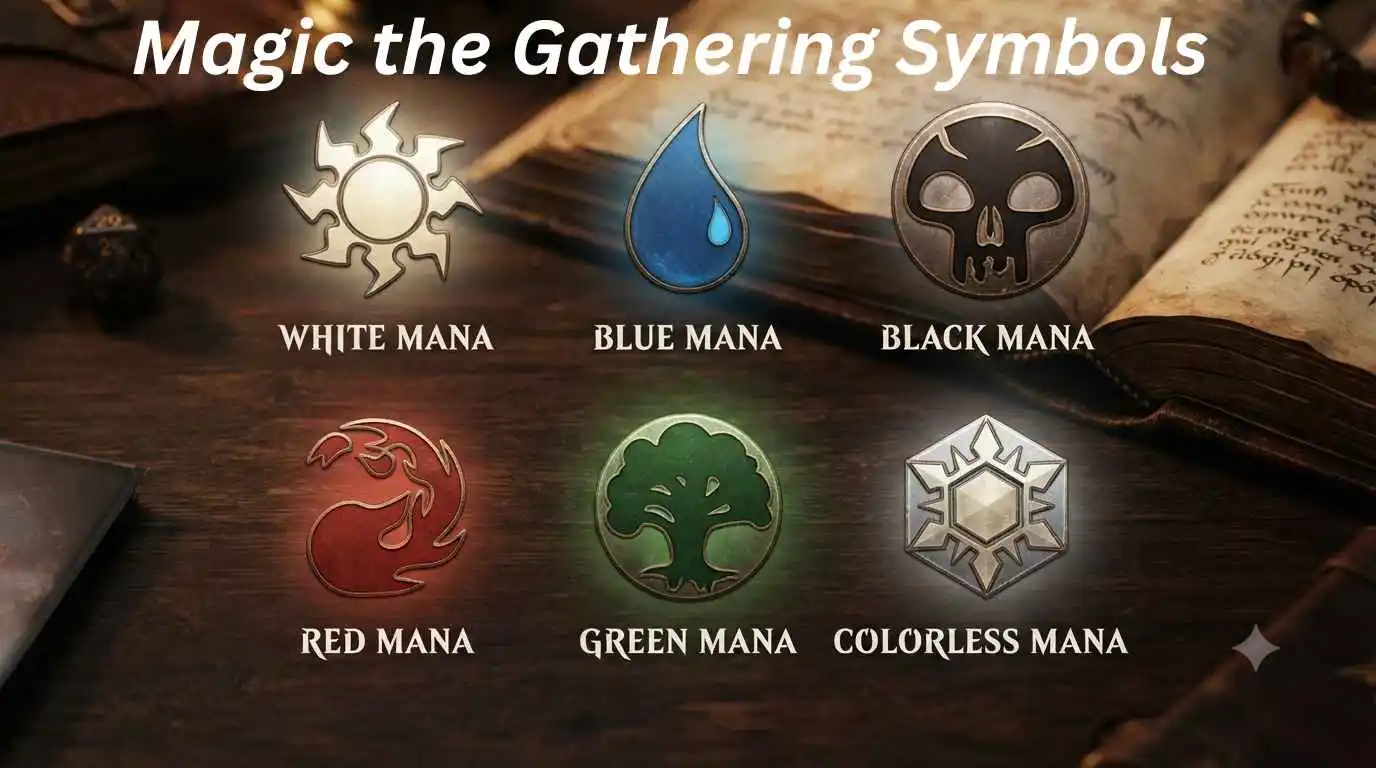
When I first looked closely at Magic the Gathering cards, the mysterious icons, mana symbols, and expansion marks felt like a secret language. You may feel the same way, especially when one small symbol can reveal a card’s color, rarity, set, ability, or special purpose.
Every symbol on a Magic card tells a story, and once you understand it, you will never look at your collection the same way again. I will help you uncover these meanings without making the information confusing or difficult to remember.
Whether you are opening your first booster pack or studying an old collection, this guide will help you recognize the symbols that truly matter. You will soon understand what each icon means, why it appears, and how it can make you a more confident Magic player.
Quick Answer
Magic the Gathering symbols are visual icons representing the core mechanics, lore, and mana colors of the game. Primarily consisting of the five mana symbols (White, Blue, Black, Red, and Green), expansion set symbols, and tap icons, they define a card’s function, color identity, and historical release within the broader MTG multiverse.
Quick Facts About Magic the Gathering Symbols
| Aspect | Information |
| Origin | Created by Richard Garfield and Jesper Myrfors in 1993 for the Alpha set. |
| Historical Significance | Revolutionized trading card games by establishing a visual system for resource management. |
| Main Meaning | Represents the five colors of mana, game actions, and specific card sets. |
| Spiritual Meaning | Mirrors classic elemental philosophy, balancing order, intellect, death, chaos, and nature. |
| Cultural Importance | Serves as a universal language for a global gaming community and pop culture icon. |
| Modern Usage | Displayed on apparel, tattoos, digital gaming interfaces, and gaming accessories. |
What Are Magic the Gathering Symbols?
At their core, Magic the Gathering symbols are the visual language of the MTG universe. When mathematician Richard Garfield designed the game in the early 1990s, he needed a way to instantly communicate complex resource systems. The game’s art director, Jesper Myrfors, helped bring this to life by designing the iconic five mana symbols.
Over the decades, these symbols have evolved from simple gameplay indicators into a highly sophisticated system of iconography. They appear on the top right corner of cards to dictate casting costs, within text boxes to signal activated abilities, and in the center right to identify the expansion set. This evolution has turned a mere card game into a rich tapestry of visual storytelling, where a single glyph can communicate an entire faction’s history or a card’s rarity at a glance.
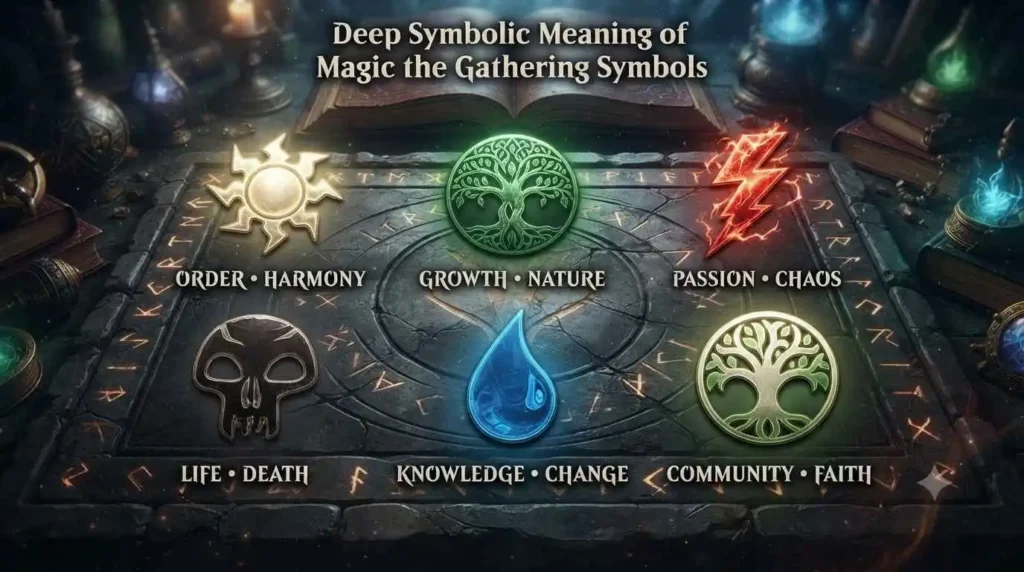
Deep Symbolic Meaning of Magic the Gathering Symbols
Spiritual Level
On a spiritual level, these symbols tap into ancient human traditions of elemental magic and cosmic balance. The five primary mana symbols form the “Color Pie,” a cyclical philosophy of life. The connection of these symbols reflects the eternal struggle for harmony, echoing real-world spiritual concepts like Taoism’s Yin and Yang or the Wiccan elements, where no single force is entirely good or evil.
Psychological Level
Psychologically, the symbols act as perfect Jungian archetypes. Players do not just choose a deck; they choose an identity. Carl Jung spoke of archetypes as universal, inherited patterns of thought. In MTG, choosing a symbol means aligning with a specific psychological profile: the protective guardian, the calculating intellectual, the ambitious individualist, the passionate rebel, or the instinctual naturalist.
Cultural Level
Culturally, these icons build a bridge of shared meaning. Within the gaming community, wearing a specific mana symbol serves as a social shorthand. It tells others how you view problem-solving and conflict. The symbols have transcended the tabletop, appearing in art galleries, street fashion, and viral internet memes, proving their deep integration into modern geek culture.
Types and Variations of Magic the Gathering Symbols
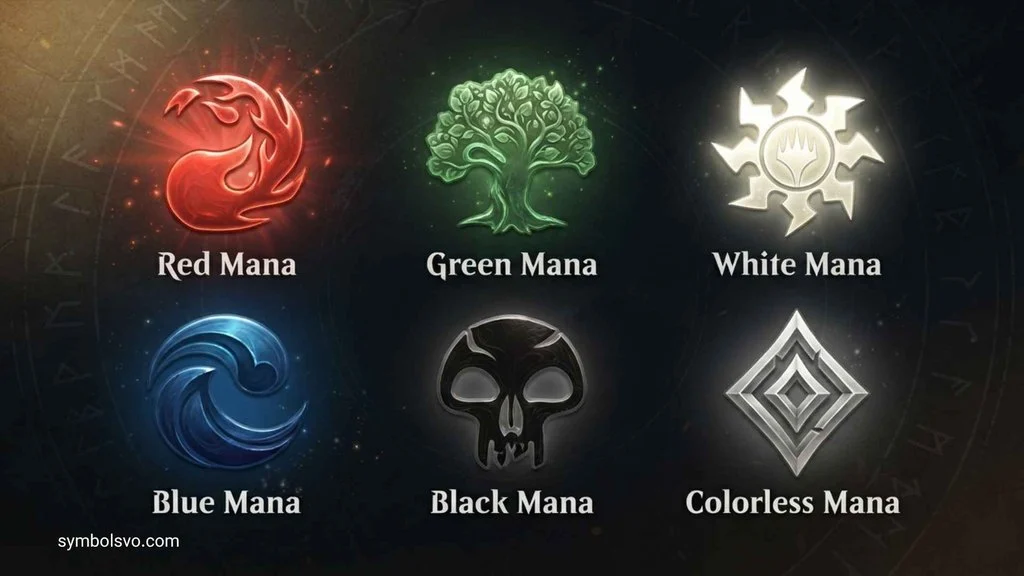
The White Mana Symbol (The Sun)
- Visual Description: A stylized, blazing yellow or white sun with clean, sharp rays.
- Meaning: Order, law, light, justice, community, and peace.
- Symbolism: Protection, selflessness, and the collective good, but also fascism and rigid dogmatism.
- Cultural Connection: Strongly mirrors the solar deities of ancient history, representing truth and absolute law.
- Where It Appears: White spell cards, plains basic lands, and the religious or military factions of MTG lore like the Boros Legion.
The Blue Mana Symbol (The Droplet)
- Visual Description: A smooth, curved, single teardrop or water droplet.
- Meaning: Knowledge, deceit, intellect, illusion, and progress.
- Symbolism: The infinite potential of the mind, the adaptability of water, and the cold pursuit of perfection.
- Cultural Connection: Aligns with classical philosophy, alchemy, and water mythology as a source of deep hidden wisdom.
- Where It Appears: Blue instant spells, island basic lands, and academic factions like the Izzet League or Tolarian Academies.
The Black Mana Symbol (The Skull)
- Visual Description: A stylized human skull, often rendered with simplified, sinister contours.
- Meaning: Ambition, death, selfishness, power, and sacrifice.
- Symbolism: Individualism, agency, and the willingness to pay any price for success, unburdened by morality.
- Cultural Connection: Rooted in memento mori art, underworld mythology, and gothic literature.
- Where It Appears: Black sorceries, swamp basic lands, necromantic factions, and characters like Liliana Vess.
The Red Mana Symbol (The Fireball)
- Visual Description: A dynamic, flickering flame or a jagged, burning fireball.
- Meaning: Chaos, passion, impulse, freedom, and fury.
- Symbolism: Creative expression, raw emotion, and destructive action that breaks down old structures.
- Cultural Connection: Directly tied to the Promethean fire of Greek myth, representing both life-giving warmth and volatile destruction.
- Where It Appears: Red burn spells, mountain basic lands, goblin factions, and impulsive planeswalkers like Chandra Nalaar.
The Green Mana Symbol (The Tree)
- Visual Description: A broad, sweeping silhouette of an oak or evergreen tree.
- Meaning: Nature, growth, instinct, interdependence, and destiny.
- Symbolism: Acceptance of the natural order, physical strength, and the interconnected web of life.
- Cultural Connection: Deeply linked to the World Tree (Yggdrasil) in Norse myth and Celtic druidism.
- Where It Appears: Green creature cards, forest basic lands, elf tribes, and massive behemoths.
Other MTG Mana Symbols
Not every mana symbol represents one of the five traditional colors.
You may also encounter symbols representing generic mana, colorless mana, hybrid mana, Phyrexian mana, snow mana, and other specialized costs.
Generic Mana
A number inside a mana symbol represents generic mana.
For example, a cost containing 3 means that three mana of any combination that can pay generic mana may be used for that portion of the cost.
Colorless Mana
The colorless mana symbol specifically represents colorless mana. This is different from generic mana.
That distinction is important: generic costs can generally be paid with appropriate mana from different sources, while a colorless mana symbol requires colorless mana.
Hybrid Mana
Hybrid symbols contain two possible colors. They allow a player to pay the cost using one of the indicated options, subject to the specific rules of that symbol.
Phyrexian Mana
Phyrexian mana symbols provide alternative ways to pay certain costs. Depending on the symbol, the alternative payment may involve life or another resource instead of the indicated mana.
Because these symbols can have rules-specific interactions, the current Comprehensive Rules are the best reference for unusual cases. Wizards of the Coast maintains the current rules document for detailed interactions.
Magic: The Gathering Set Symbols Explained
Magic: The Gathering set symbols are small icons printed on cards to identify the set or expansion associated with that printing.
They are different from mana symbols.
A set symbol is usually found around the middle-right area of a traditional Magic card, near the card’s type line. It helps players identify which set a particular printing belongs to.
Set symbols have changed throughout Magic’s history. Early Magic sets did not always use expansion symbols in the same way modern sets do. Wizards of the Coast notes that base sets historically differed in their use of expansion symbols, with Sixth Edition being an important change in this history.
What Does the MTG Set Symbol Tell You?
A set symbol can help you determine:
- Which set a card came from
- Which printing of a card you have
- Where the card fits within Magic’s release history
- In some cases, the card’s rarity through the symbol’s color
- Which set code may appear in digital databases or collector information
However, the set symbol should not be confused with the card’s rarity symbol or collector number.
All MTG Set Symbols and Set Symbol Lists
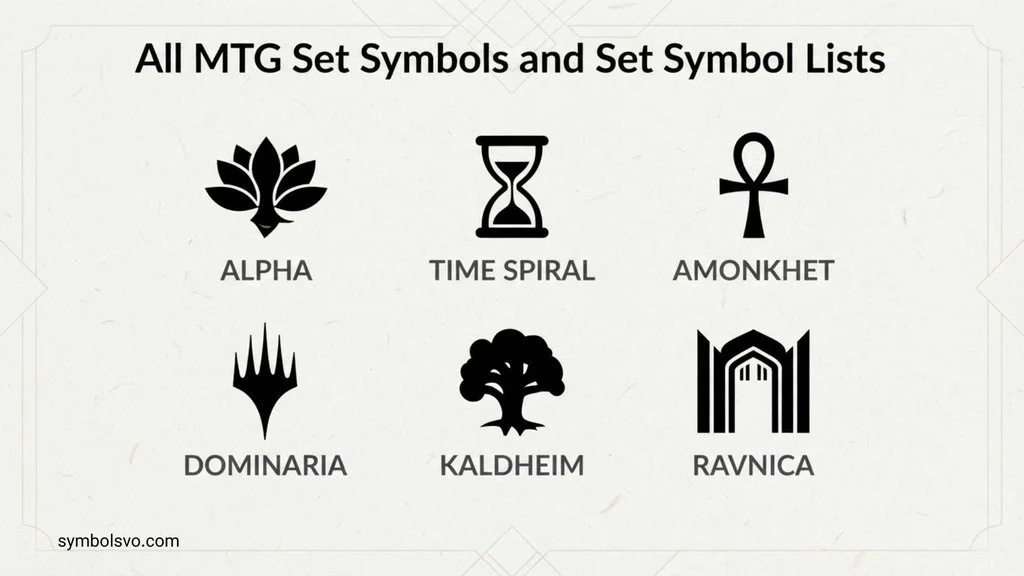
Players searching for all MTG set symbols are usually trying to identify an unfamiliar card.
There have been a very large number of Magic expansions, core sets, supplemental products, special releases, and Universes Beyond products over the game’s long history. Because new sets continue to be released, a genuinely complete list needs to be maintained over time.
For that reason, it is more useful to organize a Magic: The Gathering symbols list by set name and release rather than placing hundreds of unrelated symbols in one giant paragraph.
A useful set-symbol reference can contain these columns:
| Set | Set Code | Symbol | Release Era |
| Alpha | LEA | Original early-set identification | Early Magic |
| Beta | LEB | Original early-set identification | Early Magic |
| Revised | 3ED | Expansion identification | Early Magic |
| Fifth Edition | 5ED | V-style set identification | Classic era |
| Sixth Edition | 6ED | VI-style set identification | Classic era |
| Modern-era sets | Various | Individual expansion symbols | Modern era |
| Current sets | Various | Individual expansion symbols | Current era |
For a complete historical collection, databases should be checked against the specific card’s set code, collector information, and printing rather than relying only on the artwork or symbol.
Magic: The Gathering Symbols on Cards
When you look at a Magic card, you may see several different types of magic card symbols.
They do not all mean the same thing.
Common examples include:
- Mana symbols
- Tap symbols
- Untap symbols
- Set symbols
- Power/toughness information
- Loyalty symbols on planeswalkers
- Ability-related symbols
- Hybrid and alternative-cost symbols
- Collector and rarity information
The location of a symbol can often tell you what type of information it provides.
For example, mana symbols are commonly used in the casting cost, while the set symbol appears in a different part of the card.
Understanding the location as well as the shape of the icon makes card reading much easier.
What Does the Arrow Mean on MTG Cards?
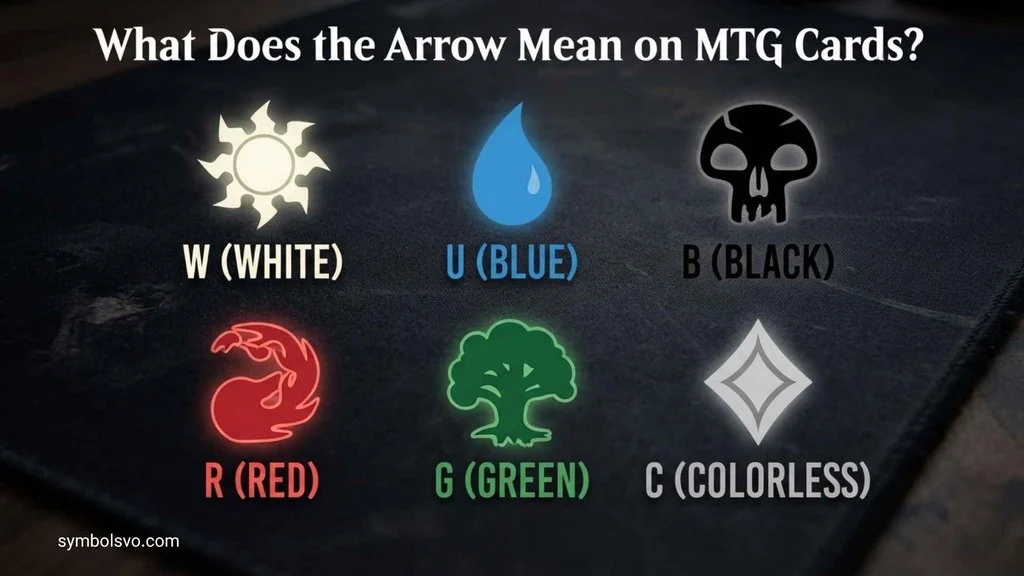
One of the most commonly searched Magic card symbols is the curved arrow.
The curved arrow is the tap symbol.
When a card’s activated ability includes the tap symbol as part of its cost, the permanent must be tapped to pay that cost. Tapping normally means turning the card sideways to show that it has been used.
Wizards of the Coast describes the tap symbol as meaning “tap this permanent” and explains that it appears in activation costs.
The tap symbol is especially common on creatures, artifacts, and lands.
For example, if an ability has a cost that includes the tap symbol followed by a colon, you must tap that permanent as part of paying the ability’s cost.
What Does the Curved Arrow Mean in MTG?
The curved arrow symbol in MTG generally refers to the tap symbol when it appears as part of an activated ability’s cost.
It does not simply mean “attack.”
A creature can have an ability requiring you to tap it even if that ability has nothing to do with combat.
The official explanation of card anatomy also identifies the curved arrow as the symbol used for tapping a permanent.
Tap vs. Attack
These are two different concepts.
When a creature attacks, it normally becomes tapped as part of the attack process unless an effect says otherwise.
But tapping a creature does not automatically mean that creature is attacking.
A creature can be tapped to activate an ability, produce mana, or perform another game action.
MTG Untap Symbol
The untap symbol is the opposite of the tap symbol.
Instead of requiring a permanent to become tapped, an untap symbol represents an instruction to untap it as part of paying an ability’s cost.
The symbol is sometimes represented in rules documents as Q.
Wizards has explained that an untap-symbol cost requires the permanent to already be tapped before the cost can be paid.
This is an important distinction because the tap and untap symbols can look like simple directional icons, but they represent specific game actions.
Magic: The Gathering Land Symbols
Magic: The Gathering land symbols are closely connected with the five basic land types.
The traditional relationships are:
| Basic Land | Mana Produced |
| Plains | White |
| Island | Blue |
| Swamp | Black |
| Mountain | Red |
| Forest | Green |
Basic lands normally have a large recognizable land illustration and a mana symbol associated with the mana they can produce.
For new players, learning these five relationships is one of the easiest ways to understand the basic mana system.
MTG Land Symbol vs. Set Symbol
These are easy to confuse.
The land’s mana symbol tells you about the mana associated with the land.
The set symbol identifies the expansion or printing.
They serve completely different purposes.
Magic: The Gathering Fire Symbol
Players sometimes search for the Magic: The Gathering fire symbol when they are looking for the red mana symbol or a red-themed icon.
Red mana is traditionally connected with Mountains and red spells.
However, there is not one universal “fire symbol” that replaces the red mana symbol throughout Magic.
Specific cards, abilities, mechanics, or products can use fire-themed artwork or symbols, but the standard mana symbol for red mana is the official red mana symbol.
White Magic: The Gathering Symbols
The phrase white Magic: The Gathering symbols can refer to several different things.
The most common interpretation is the white mana symbol.
White mana is the mana associated with Plains and the white color of Magic.
Other white-colored icons may appear because of a card’s design, rarity presentation, set treatment, or special product styling. Therefore, the color of an icon alone does not always tell you its rules meaning.
MTG Arena Symbols
Magic: The Gathering Arena uses many visual icons to represent game information in a digital interface.
Some symbols correspond closely to physical-card concepts, such as mana, tapping, attacking, or card abilities. Other interface icons exist specifically to make the digital game easier to navigate.
If you are moving between physical Magic and MTG Arena, the underlying game concepts remain closely related, but the user interface can present information differently.
Magic: The Gathering Symbols Vector, Font, and Printable Resources
Searches for Magic: The Gathering symbols vector, Magic: The Gathering symbols font, and printable Magic: The Gathering symbols usually come from people creating fan references, educational materials, crafts, spreadsheets, or other designs.
When using official logos, symbols, artwork, or fonts, check the applicable copyright, trademark, and licensing terms.
For personal reference, a simple text-based chart can be easier and safer than copying an entire collection of official artwork.
A printable reference sheet could organize symbols like this:
| Category | What It Identifies |
| Mana symbols | Mana requirements or mana types |
| Tap symbol | Tapping a permanent |
| Untap symbol | Untapping as part of a cost |
| Set symbol | Card’s set/printing |
| Collector number | Card’s position in a set |
| Rarity indicator | Card rarity information |
| Loyalty symbols | Planeswalker ability costs |
This format gives players a quick Magic: The Gathering symbols guide without making every icon look identical when its rules meaning is different.
Magic: The Gathering Symbols Names: Quick Reference
Here is a simple reference for some of the most important symbol categories:
| Symbol Type | Name | Meaning |
| White mana | White mana symbol | Represents white mana |
| Blue mana | Blue mana symbol | Represents blue mana |
| Black mana | Black mana symbol | Represents black mana |
| Red mana | Red mana symbol | Represents red mana |
| Green mana | Green mana symbol | Represents green mana |
| Number | Generic mana | Represents a generic mana requirement |
| Curved arrow | Tap symbol | Tap the permanent |
| Opposite curved arrow | Untap symbol | Untap the permanent as a cost |
| Expansion icon | Set symbol | Identifies the set/printing |
| Number near bottom | Collector number | Identifies the card’s position in the set |
Remember that specialized symbols can have additional rules meanings, so this table is a beginner-friendly reference rather than a replacement for the Comprehensive Rules.
Why Magic Symbols Matter
Magic symbols make the game easier to read.
Imagine if every card had to spell out every mana type and every action in full words. Card text would become much longer and harder to scan.
Symbols solve that problem by giving familiar concepts a compact visual form.
Once you learn the common symbols, you can quickly recognize:
- What mana a spell needs
- What a card can produce
- When an ability requires tapping
- Which set printed a card
- How a special cost works
- What information belongs to the card’s rules rather than its artwork
This is one reason experienced players can often understand a card at a glance.
Magic the Gathering Symbols Across Different Cultures
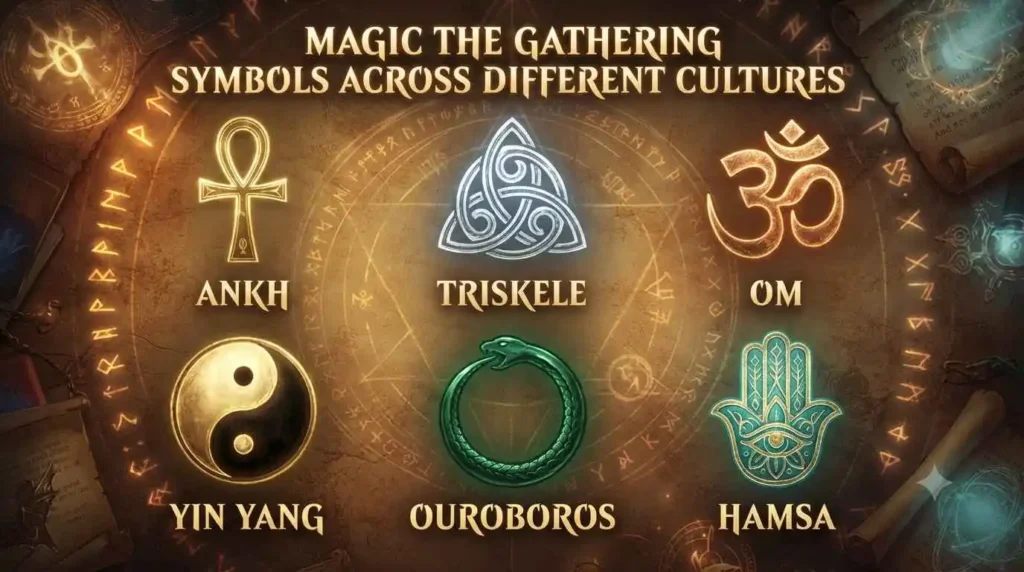
While MTG is a modern creation, its symbols pull heavily from ancient human history and global civilizations.
Ancient Egypt
The White sun symbol shares deep visual and philosophical roots with Ra and Aten, the Egyptian solar deities representing ultimate cosmic order (Ma’at). Conversely, Black mana mirrors the chaotic, transformative nature of Anubis and the underworld ceremonies.
Ancient Greece
The Red fire symbol embodies the raw, emotional chaos of Dionysus, the god of wine and ecstasy, combined with the volatile forge of Hephaestus. Blue mana closely aligns with Athena’s cold, strategic intellect and love for technological progress.
Roman Culture
Roman stoicism and their highly structured legal and military systems find a perfect home in the White mana symbol. The Roman focus on state before self perfectly captures White’s societal philosophy.
Eastern Traditions
The five-color wheel of MTG functions remarkably like the Wu Xing (the Five Elements of Chinese philosophy). Just as wood, fire, earth, metal, and water generate and overcome one another, the MTG color symbols share allied and enemy relationships.
Indigenous Traditions
The Green tree symbol honors the animistic beliefs found in many Indigenous traditions worldwide. It represents the belief that every rock, river, and creature possesses a spirit, emphasizing survival through harmony with nature rather than dominance over it.
Modern Interpretations
In our current digital age, these symbols have shifted into secular emblems of personality. People use them on digital profiles and resumes to showcase their personal philosophies, turning gaming assets into modern psychological totems.
Similar Symbols and Their Meanings
To truly understand Magic the Gathering symbols, it helps to compare them to other famous symbolic systems in pop culture and history.
| MTG Mana Symbols | Tarot Elements | Astrology Signs | Core Commonality | Main Difference |
| White (Sun) | Swords (Logic/Law) | Capricorn / Libra | Search for structure and justice. | White allows for authoritarian tyranny. |
| Blue (Droplet) | Cups (Intuition/Mind) | Scorpio / Pisces | Flow of hidden information. | Blue prioritizes logic over raw emotion. |
| Black (Skull) | Pentacles (Material) | Scorpio | Transformation and self-interest. | Black completely rejects moral taboos. |
| Red (Fire) | Wands (Passion/Action) | Aries / Leo / Sagittarius | Drive, impulse, and raw energy. | Red embraces self-destruction for freedom. |
| Green (Tree) | Coins / Disks (Earth) | Taurus / Virgo | Connection to physical reality. | Green rejects artificial technological progress. |
Magic the Gathering Symbols in Mythology and Folklore
The symbols do not just sit on cardboard; they breathe life into ancient stories. The Green tree symbol directly pulls from the folklore of the Green Man and woodland nymphs, reminding us of a time when humanity feared and revered the deep woods. The Red fire symbol is a modern retelling of Loki’s chaotic tricks or Thor’s sudden, thunderous wrath.
By weaving these mythological anchors into the card art and iconography, the creators made the game feel instantly familiar. When a player casts a spell using a Black skull symbol, they are participating in a digital and physical ritual that echoes ancient folktales of Faustian bargains and deals with the underworld.
Magic the Gathering Symbols in Art, Literature, Movies, and Pop Culture
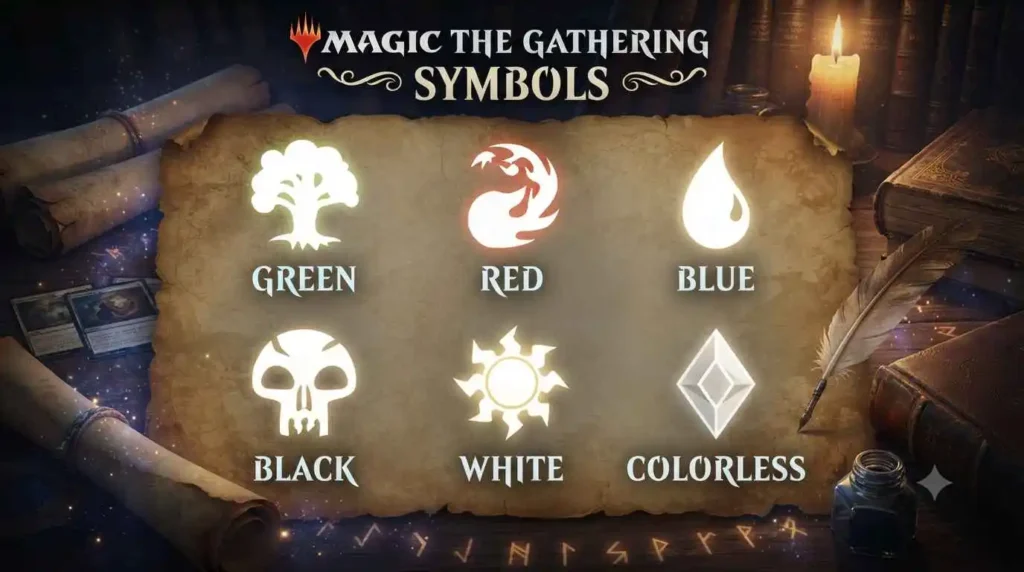
The visual design of these icons has influenced an entire generation of fantasy artists, authors, and filmmakers. You can spot the influence of the MTG color wheel philosophy in the faction designs of modern young adult literature and Hollywood blockbusters.
“The five colors of Magic are perhaps the greatest world-building tool ever created in modern fantasy.”
In the real world, these symbols are incredibly popular in tattoo culture. Thousands of players have the five-symbol wheel or their favorite color identity permanently inked onto their skin. The clean, minimalist silhouettes make them perfect for modern fashion, minimalist graphic design, and corporate branding within the gaming industry.
Spiritual and Dream Meaning of Magic the Gathering Symbols
Dreaming of these symbols can offer fascinating insights into your subconscious mind:
- Dreaming of the White Sun: You may be seeking clarity, order, or resolution to a chaotic situation in your waking life. It can also caution against being too rigid.
- Dreaming of the Blue Droplet: This often indicates a need to study, learn, or look at a problem with cold, detached logic rather than emotion.
- Dreaming of the Black Skull: A powerful sign of impending transformation, ambition, or the need to cut toxic ties, though it warns against greed.
- Dreaming of the Red Fire: This signals a burst of creative inspiration, romance, or repressed anger that needs a safe outlet.
- Dreaming of the Green Tree: A symbol of grounding, physical healing, and a reminder to trust your natural instincts.
Positive and Negative Meanings of Magic the Gathering Symbols
Every symbol in this universe contains a duality of light and shadow. No color is purely heroic or entirely villainous.
| Symbol | Positive Meaning (The Light) | Negative Meaning (The Shadow) |
| White (Sun) | Community, healing, protection, equality. | Rigid fascism, fanaticism, loss of individuality. |
| Blue (Droplet) | Wisdom, curiosity, progress, strategy. | Cold manipulation, deceit, emotional isolation. |
| Black (Skull) | Ambition, self-reliance, survival, freedom. | Cruelty, absolute selfishness, corruption, decay. |
| Red (Fire) | Passion, love, loyalty, creative freedom. | Blind rage, impulsiveness, total chaos, destruction. |
| Green (Tree) | Harmony, growth, acceptance, community. | Stagnation, savagery, rejection of progress. |
Why Humans Are Attracted to Magic the Gathering Symbols
Our brains are hardwired for pattern recognition and tribal belonging. From ancient cave paintings to modern corporate logos, humans use symbols to summarize complex emotional realities. Magic the Gathering symbols succeed because they give us a perfectly balanced system to categorize human nature.
When you align with a symbol, you join a global tribe. It fulfills our evolutionary need for ritual and collective memory. By holding a card with these icons, you are participating in a modern mythos that feels just as heavy and important as the ancient legends told around campfires thousands of years ago.
Modern Uses of Magic the Gathering Symbols
Today, these icons have broken free from the confines of the card game:
- Tattoos and Body Art: A massive trend for players celebrating milestones or personal philosophies.
- Jewelry and Accessories: High-quality silver rings, pendants, and mana-themed watches.
- Fashion and Streetwear: Minimalist hoodies and hats featuring subtle, embossed mana symbols.
- Streaming and Social Media: Streamers use custom mana emotes to foster community engagement.
- Home Decor: Custom-lit LED mana symbols, playmats, and canvas art prints for gaming rooms.
Interesting Facts About Magic the Gathering Symbols
- The original Purple mana symbol was tested in early development but dropped to keep the perfect five-element balance.
- The Tap symbol has changed visually four times throughout the game’s history to improve global user experience.
- Expansion symbols use color coding (Black, Silver, Gold, Orange-Gold) to instantly tell players the financial and mechanical rarity of a card.
- The Phyrexian mana symbol combines a Greek letter with a mechanical look to tell a story of biological corruption.
- The planeswalker symbol is inspired by a stylized pitchfork or crown, signaling a spark of cosmic power.
Frequently Asked Questions
What do the five main colors mean?
White means order, Blue means intellect, Black means ambition, Red means freedom, and Green means nature.
Why do expansion set symbols change color?
They indicate card rarity: Black is common, Silver is uncommon, Gold is rare, and Orange-Gold is mythic rare.
Who designed the original mana symbols?
They were designed by the game’s original art director, Jesper Myrfors, under the guidance of creator Richard Garfield in 1993.
What does the tipped arrow symbol mean?
It is the “Tap” symbol, which means you must turn the card sideways to activate its power or attack.
Are there colorless symbols in MTG?
Yes, a gray circle with a number indicates generic mana costs, while a diamond symbol represents true colorless mana introduced in later sets.
Conclusion
Magic the Gathering symbols are far more than simple icons printed on cardboard trading cards. They are a profound, living language that blends ancient mythology, psychological depth, and modern pop culture into a unified cosmic system. By understanding these symbols, we do not just become better players; we gain a fascinating mirror into our own minds, passions, and human nature.

I’m Nathan Holloway, a passionate researcher and writer with a deep interest in symbols, signs, and their hidden meanings. I enjoy exploring how symbols have influenced different civilizations, religions, and modern communication. Through my work, I aim to make complex historical and cultural concepts easy to understand for readers of all backgrounds. Every article I write is carefully researched to provide reliable and engaging information.
Books:
- Beyond the Symbol
- The Secret Meanings of Everyday Signs
Author 2: Grace Whitmore
Description:
My name is Grace Whitmore, and I love discovering the stories behind the world’s most fascinating symbols. I spend my time researching ancient civilizations, mythology, spiritual traditions, and modern iconography to uncover the meanings people often overlook. I believe that every symbol has a history worth telling, and I enjoy sharing that knowledge in a simple and reader-friendly way.
Books:
- Echoes of Ancient Symbols
- The Symbolic World
 Mason Ellington
 Grace Whitmore
 Daniel Brooks