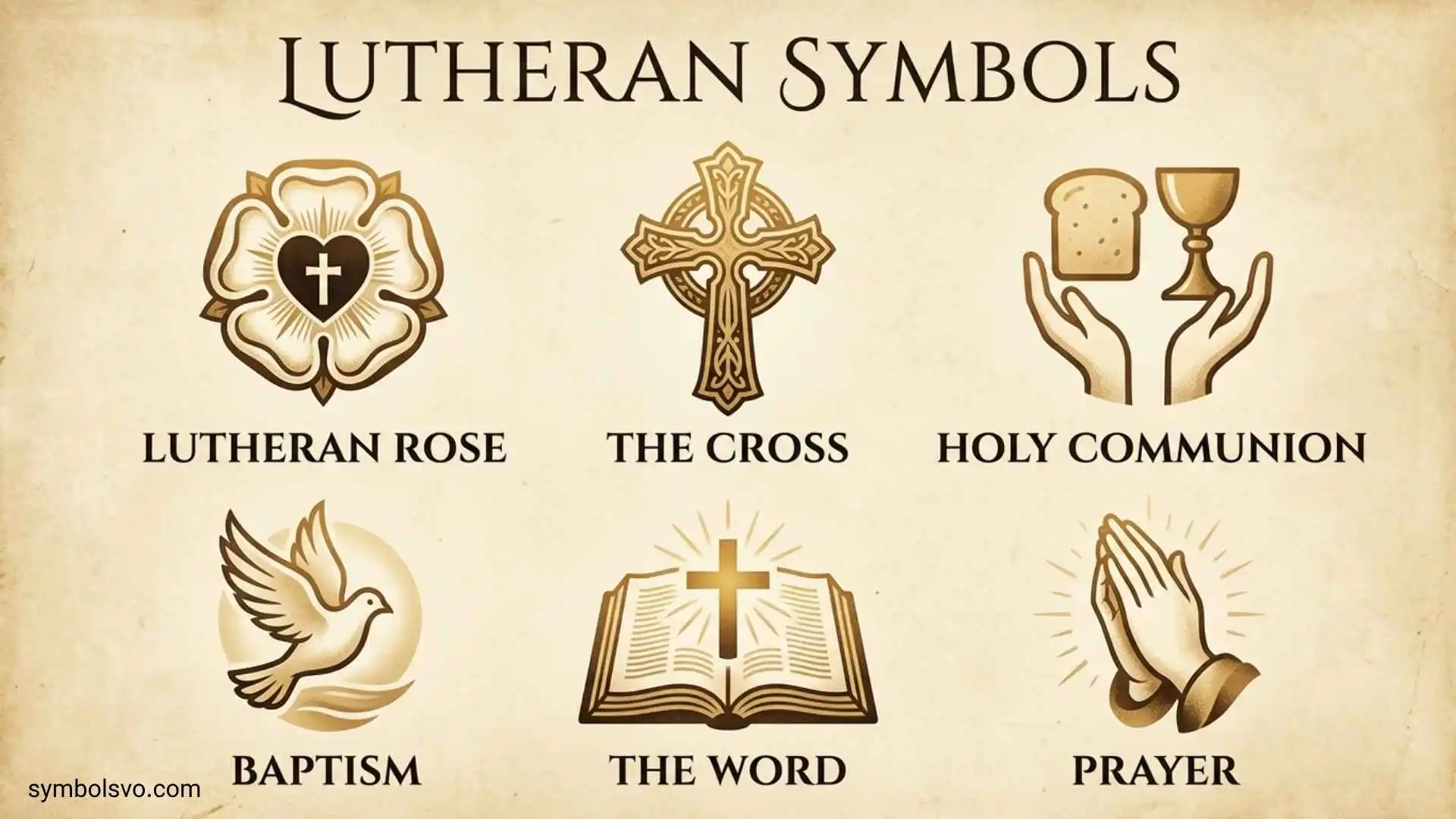
Lutheran Symbols can make Christian faith and tradition easier to understand when you know what each sign represents. I find these symbols fascinating because they often connect history, worship, and important beliefs in meaningful ways.
You may have seen crosses, fish, candles, or other Christian symbols without knowing their deeper purpose. I want to help you explore these signs in a simple way so you can understand what they mean and why they matter.
As you explore Lutheran Symbols, you’ll discover how visual signs can communicate powerful ideas about faith and worship. I’ll guide you through their meanings, history, and importance so you can recognize and understand them with confidence.
Quick Answer
Lutheran symbols are sacred visual emblems, signs, and artistic hallmarks used by the Lutheran Church to express core Protestant Reformation theology. Rooted in the biblical teachings of Martin Luther, these symbols visually communicate the concepts of salvation by grace alone, faith alone, and Christ alone, serving as vital tools for worship, education, and communal identity.
Quick Facts About Lutheran Symbols
| Aspect | Information |
| Origin | Wittenberg, Germany, during the early Protestant Reformation of the 1520s. |
| Historical Significance | Visual markers of a clean break from medieval Roman Catholic church practices. |
| Main Meaning | Salvation is a free gift from God through faith in Jesus Christ. |
| Spiritual Meaning | The deep transformation of a human heart through divine grace and peace. |
| Cultural Importance | Shaped European printing, school education, liturgical art, and church music. |
| Modern Usage | Church branding, stained glass windows, jewelry, and confirmation gifts. |
What Are Lutheran Symbols?
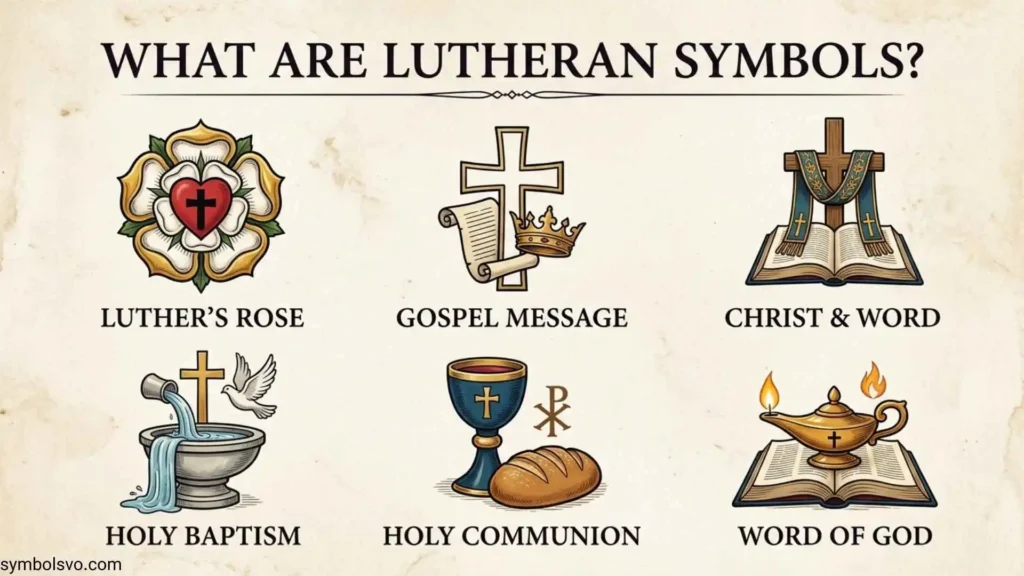
A Lutheran symbol is far more than a decorative church ornament. It is a highly intentional visual summary of a massive religious turning point. The origin of these symbols dates back to the early 1500s in Germany, when a monk named Martin Luther challenged the sale of indulgences and sparked the Protestant Reformation.
As the new movement spread rapidly, it faced a major practical challenge. Printing was in its infancy, and a massive portion of the population could not read or write. To help regular people understand complex theological ideas, the early reformers needed a visual vocabulary.
Over time, simple marks evolved into rich teaching tools. Lutheran symbols became a visual face for a community that believed the Bible should belong to everyone, not just a select few. They shifted the focus of religious art away from complicated medieval allegories toward the central promises of the gospel message, ensuring that even a quick glance at an emblem could remind a believer of God’s unconditional love.
Deep Symbolic Meaning of Lutheran Symbols
Spiritual Level
On a spiritual level, Lutheran symbols capture the breathtaking reality of inner transformation. They show that a soul does not find peace by climbing a ladder of good works or ritual performance. Instead, these visuals constantly remind the viewer that the human heart rests safely in the finished work of Christ, which brings a quiet, foundational peace that passes all understanding.
Psychological Level
Psychologically, these symbols tap into powerful, universal archetypes that touch deep human emotions.
- The Shadow and the Light: The stark contrast between suffering and joy, mapping out how humans navigate pain to find hope.
- The Centered Heart: A perfect representation of emotional integration, balancing our deepest vulnerabilities with an unshakeable sense of security.
- The Protective Circle: A universal Jungian archetype of wholeness, unity, and eternal belonging.
These visual tools speak directly to our subconscious mind, offering deep comfort and stability in times of internal or external chaos.
Cultural Level
Culturally, Lutheran symbols helped redefine European community life. In a world where your religious standing used to dictate your social value, these emblems became symbols of equality. They reminded the entire community that every legitimate profession, whether a baker, a farmer, or a mother, was a sacred calling from God, helping to build a highly collaborative, hard-working, and literate society.
Types and Variations of Lutheran Symbols
1. The Luther Rose
- Visual Description: A black cross sitting inside a red heart, surrounded by a white rose, set against a sky-blue background, all wrapped in a golden ring.
- Meaning: The ultimate summary of the Christian faith, mapping out grace, joy, comfort, and eternity.
- Symbolism: Represents that true faith must pass through the cross, which keeps the heart alive without killing our natural joy.
- Cultural Connection: Originally designed as a personal seal for Martin Luther, it became the global badge of the entire denomination.
- Where It Appears: Lutheran hymnals, church signs, confirmation rings, and classic wooden pulpits.
2. The Crucifix with an Open Bible
- Visual Description: A realistic carving of Jesus on the cross, frequently flanked by or placed directly above an open copy of the scriptures.
- Meaning: The absolute primacy of God’s Word and the central focus on Christ crucified for human sin.
- Symbolism: Highlights that the Bible is the only true source of faith, and its main purpose is to point humans to Jesus.
- Cultural Connection: A direct protest against relying on extra-biblical church traditions or papal decrees for salvation.
- Where It Appears: Sanctuary altars, processional crosses, and historic theological books.
3. The Swan
- Visual Description: A graceful white swan, often shown floating peacefully or standing next to portraits of early reformers.
- Meaning: The ultimate fulfillment of prophecy, representing courage, truth, and unyielding faith in the face of death.
- Symbolism: Symbolizes that the truth cannot be silenced by human power or execution.
- Cultural Connection: Tied directly to the final words of the early reformer Jan Hus, who was burned at the stake in 1415.
- Where It Appears: Church weather vanes in Northern Europe, historic woodcuts, and old Reformation artwork.
Lutheran Symbols Across Different Traditions and Cultures
To fully appreciate the genius of these designs, it helps to see how they adapted historic elements from older cultures while maintaining their core identity.
Ancient Egypt
Ancient Egyptian symbols focused heavily on the afterlife and earning divine favor through a balance of deeds. Lutheran iconography completely turned this concept upside down. Instead of a scale weighing your heart against a feather of truth, Lutheran art shows a heart already redeemed and resting securely within a white rose of peace.
Ancient Greece
The Greeks celebrated the concept of Kairos, or the perfect, defining moment in time. Lutheran artists adopted this idea by using dramatic lighting in their paintings. They used bright, sudden rays of light breaking through dark clouds to show the exact moment a soul receives saving faith through hearing the gospel.
Roman Culture
Imperial Rome used the laurel wreath as a powerful symbol of military victory, political power, and high social status. The Reformation took this classic circular shape and transformed it into a golden ring. This new ring did not represent earthly power, but rather the endless, priceless treasures of heaven given freely to regular believers.
Eastern Traditions
Traditional Eastern symbols frequently emphasize the concept of long-term spiritual refinement through quiet meditation and detachment. Lutheran symbols, by contrast, are intensely relational. They place a throbbing red human heart right at the center of the visual universe, showing that faith does not destroy our human emotions, but beautifully anchors them.
Indigenous Traditions
Many indigenous traditions use deep earth symbols, like roots and trees, to connect people to their ancestors. Lutheran symbols echo this deep desire for grounding by using natural elements like white rose petals and green leaves. These images remind believers that their faith is meant to grow, bloom, and bear tangible fruit right in the middle of their everyday communities.
Modern Interpretations
In our globalized world, these traditional symbols have been beautifully streamlined. You will now see the classic elements adapted into clean, geometric lines on contemporary church websites, showing that the foundational truths of the Reformation remain completely relevant in the digital age.
Lutheran Symbols and Crosses
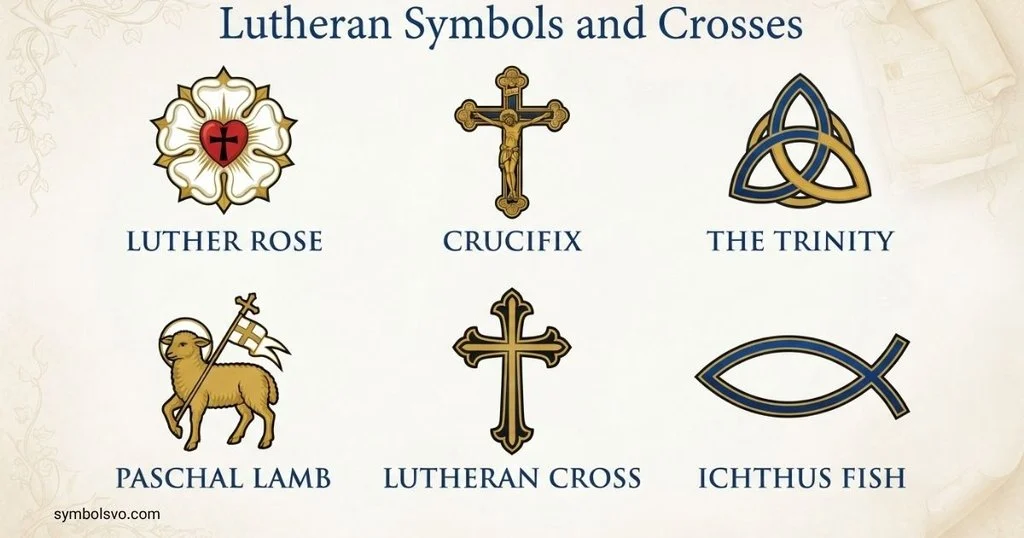
Lutheran symbols and crosses help express central themes of Christian faith, including Christ’s death, salvation, faith, baptism, and the work of the Holy Trinity. The cross is one of the most familiar symbols used in Lutheran churches, while Luther’s Rose, also called the Luther Seal, is one of the most recognizable symbols associated with Lutheranism.
Lutheran churches may use both a simple cross and a crucifix. The Lutheran Church—Missouri Synod explains that crucifixes have a long history within Lutheran worship and were used during Martin Luther’s lifetime as well as by early LCMS congregations.
Lutheran Symbols Clip Art
Lutheran symbols clip art commonly includes crosses, Luther’s Rose, church buildings, baptismal water, candles, doves, and other Christian imagery. These graphics are often used for educational materials, church publications, Sunday school resources, presentations, and religious artwork.
When using an official church logo rather than a general Christian symbol, it is important to check the organization’s usage rules. For example, LCMS states that its official cross logo has specific permissions and conditions for use, while its Luther Rose versions are available as public-domain artwork.
Evangelical Lutheran Church Logo
The term Evangelical Lutheran Church logo can refer to different visual identities because Lutheran churches and organizations do not all use one universal logo. Individual church bodies may have their own emblems, crosses, wordmarks, or combinations of traditional Lutheran imagery.
For example, the Evangelical Lutheran Church in America (ELCA) uses Lutheran worship traditions that prominently feature the cross, including the sign of the cross associated with baptism and Christian worship.
Lutheran Trinity Symbol
The Trinity is central to Lutheran Christianity, and its symbolism commonly focuses on the Father, Son, and Holy Spirit. Common Christian Trinity imagery may include three interconnected elements, a triangle, or other designs representing the unity of the three persons.
In Lutheran worship, the Trinity is explicitly present in the baptismal formula and in the sign of the cross. ELCA worship resources, for example, connect the sign of the cross with the words invoking the Father, Son, and Holy Spirit.
Lutheran Symbols PX
If “Lutheran symbols PX” refers to pixel-based, digital, or PNG-style Lutheran graphics, common designs include the Luther Rose, Christian cross, crucifix, dove, and baptismal imagery. These symbols can be adapted for digital projects while preserving their recognizable forms.
For historically important artwork, Luther’s Rose is particularly useful because its individual elements have specific theological associations and can be represented in different artistic styles. LCMS provides several versions of the Luther Rose, including color, stained-glass, woodcut, and black-and-white versions.
LCMS Lutheran Symbols
The Lutheran Church—Missouri Synod (LCMS) uses several important symbols and visual elements, including the LCMS Cross and Luther Rose. The official LCMS Brand and Logo Center distinguishes between these two resources.
The LCMS Cross is an organizational logo with usage restrictions, while the Luther Rose logos provided by LCMS are identified as public domain. This distinction matters when discussing or reproducing LCMS-related symbols.
Lutheran Symbols of Baptism
Baptism has several important symbols in Lutheran tradition. Water, the sign of the cross, the baptismal name, a white garment, and a candle can all appear in Lutheran baptismal rites or traditions.
Historical descriptions of Martin Luther’s baptismal orders include the sign of the cross, water and the Word, a white garment, and a baptismal candle. The central act of baptism, however, is water used with God’s Word and the Triune name.
The sign of the cross is also connected with baptism in Lutheran worship. ELCA explains that the cross may be traced over the body as a reminder of the mark associated with baptism.
ELCA Lutheran Symbols
ELCA stands for the Evangelical Lutheran Church in America. Its worship tradition incorporates familiar Lutheran and broader Christian symbols, including the cross, baptismal imagery, and symbols associated with the Holy Trinity.
The cross has a particularly important place in ELCA worship. Its worship resources describe the sign of the cross as connected with baptism and with invocation of the Father, Son, and Holy Spirit.
Trinity Lutheran Symbols
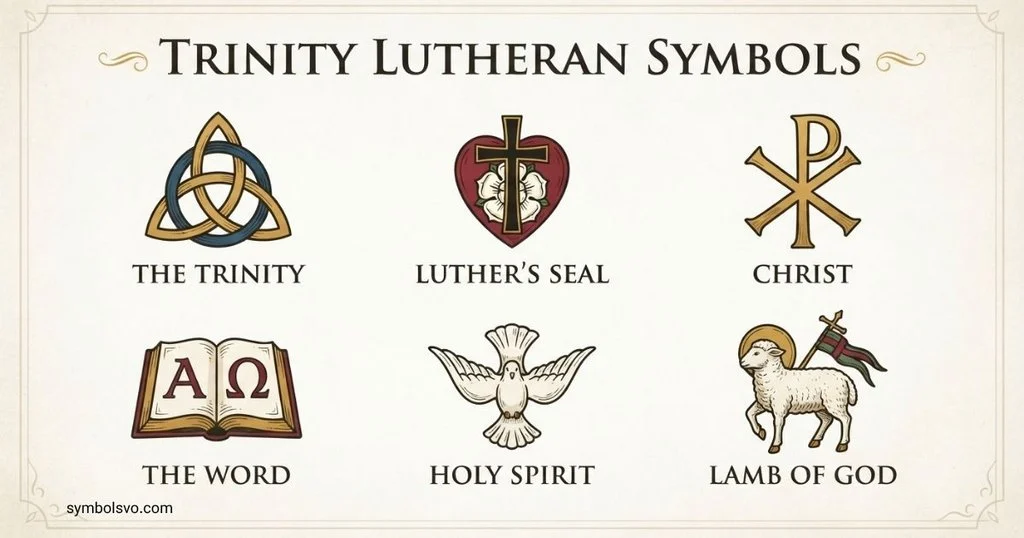
Trinity Lutheran symbols communicate the Christian teaching that God is Father, Son, and Holy Spirit. A three-part design, intertwined shapes, a triangle, or combinations of Christian symbols can visually communicate this belief.
The cross is especially significant because Lutheran worship places Christ at the center of Christian faith. Luther’s Rose also contains a cross within a heart, making it a powerful symbol for connecting Christ, faith, and salvation.
Lutheran Church Symbol
The Luther Rose is widely recognized as a Lutheran church symbol. It consists of a black cross inside a red heart, surrounded by a white rose, a blue field, and a golden ring. Martin Luther explained the theological meaning of these elements in a letter describing his seal.
The cross points to Christ crucified, the heart represents faith, the white rose represents joy and peace associated with faith, the blue field points toward heavenly joy, and the golden ring represents enduring heavenly blessedness.
Lutheran Religious Symbols
Lutheran religious symbols include the cross, crucifix, Luther Rose, baptismal water, candles, the Bible, the dove, and other Christian imagery. Their meanings can vary according to context, congregation, and tradition.
Among these, the cross and Luther Rose have especially strong connections with Lutheran identity. Lutheran churches may also use traditional Christian artwork and symbols as teaching and devotional aids. LCMS notes that the use of crucifixes has a long history within Lutheran worship.
Reformation Symbols
Reformation symbols are visual reminders of the Protestant Reformation and its historical figures, teachings, and events. For Lutheran history, the Luther Rose is especially important because it originated with Martin Luther and became closely associated with his theological identity.
Modern Reformation imagery may combine the Luther Rose with a cross, Scripture references, dates, or other historical elements. The Lutheran World Federation has also incorporated the Luther Rose and cross into Reformation-related visual identities.
Lutheran Iconography
Lutheran iconography refers to the visual symbols, artwork, images, and designs used to communicate Lutheran Christian beliefs and history. Common examples include crosses, crucifixes, Luther’s Rose, biblical scenes, baptismal imagery, candles, and representations of the Holy Spirit.
Lutheran iconography developed within the broader Christian artistic tradition. The use of religious images was not rejected universally by Lutherans; historical Lutheran worship included crosses, crucifixes, statues, and other forms of Christian art.
Lutheran Emblem
A Lutheran emblem may be a symbol representing Lutheran faith, history, or a particular Lutheran organization. The Luther Rose is one of the strongest examples because it was used as Martin Luther’s personal seal and later became widely associated with Lutheran identity.
Other Lutheran organizations may have their own official emblems. Therefore, a general Lutheran symbol should not automatically be described as the official logo of every Lutheran denomination or church body.
Symbol for Reformation
One of the most recognizable symbols for the Lutheran Reformation is Luther’s Rose. It was developed around Martin Luther’s personal seal and became a visual summary of important themes in his Christian theology. Historical evidence shows the seal appearing in Luther’s works during the 1520s.
The cross inside the heart is especially significant because it places Christ at the center of the symbol. The surrounding rose, blue field, and golden ring add additional layers of meaning related to faith, joy, heavenly hope, and eternal life.
Martin Luther Symbols
The most famous symbol associated with Martin Luther is Luther’s Rose, also known as the Luther Seal. It contains several elements: a black cross, red heart, white rose, blue background, and golden ring.
Luther himself explained the meaning of the seal, describing the cross as a reminder of Christ crucified and the heart and rose as symbols connected with faith, joy, comfort, and peace.
Because of this historical connection, the Luther Rose remains an important visual representation of Martin Luther and the Lutheran tradition.
Evangelical Lutheran Symbol
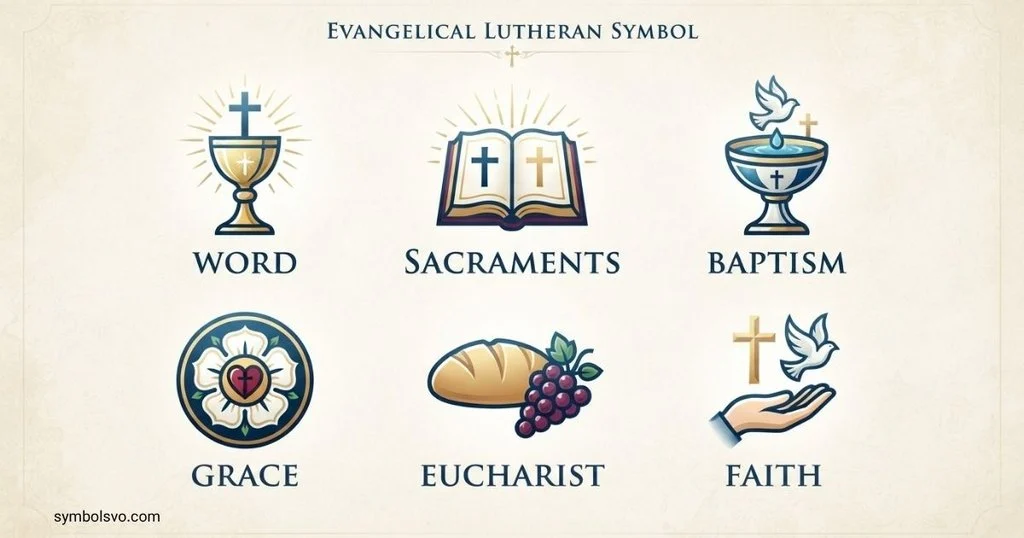
An Evangelical Lutheran symbol may refer broadly to imagery associated with evangelical Lutheran Christianity rather than one universal emblem. The cross, Luther Rose, baptismal symbols, and Trinity-related imagery are commonly associated with Lutheran worship and identity.
The exact logo depends on the particular Lutheran church body or organization. For example, the LCMS has its own official cross logo, while other Lutheran organizations use different visual identities.
Symbols of Lutheranism
The major symbols of Lutheranism include the cross, crucifix, Luther Rose, baptismal water, candles, and other Christian imagery. Among them, the Luther Rose has a particularly direct historical connection to Lutheran identity because it originated as Martin Luther’s seal.
These symbols are not simply decorative. They can communicate ideas about Christ, faith, baptism, salvation, the Trinity, Christian hope, and the history of the Reformation. Their use also varies between Lutheran denominations, congregations, and organizations.
Quick Summary
| Lutheran Symbol | Common Meaning or Association |
|---|---|
| ✝️ Cross | Christ’s crucifixion and Christian faith |
| Luther Rose | Lutheran identity and Luther’s theology |
| ❤️ Heart | Faith centered on Christ |
| 🌹 White Rose | Joy, peace, and comfort associated with faith |
| 💧 Water | Baptism |
| 🕊️ Dove | Holy Spirit and Christian symbolism |
| 🕯️ Candle | Light, faith, and baptismal tradition |
| 🔵 Blue Field | Heavenly joy and hope in Luther’s explanation |
| 🟡 Golden Ring | Eternal heavenly blessedness |
Similar Symbols and Their Meanings
It can be very helpful to compare Lutheran symbols with other prominent religious visuals to avoid confusion.
| Symbol Type | Purpose | Core Focus | Visual Style |
| Lutheran Symbols | Proclaim the free gift of grace | Christ’s sacrifice and heart peace | Blends natural elements like roses with crosses |
| Roman Catholic Symbols | Focus on church authority & saints | Sacramental grace and hierarchy | Highly ornate, featuring papal tiaras and keys |
| Calvinist / Reformed Symbols | Emphasize the total sovereignty of God | Strict simplicity and biblical law | Highly minimalist, often avoiding images entirely |
A common misconception is that Lutherans banned all classic Christian art like the Calvinists did. In reality, Lutherans kept many beautiful historic church traditions, such as altars, candles, and crucifixes. They simply re-centered the meaning of these items around the central message of grace alone, ensuring that the art served to comfort the believer rather than terrify them.
Lutheran Symbols in History, Mythology, and Folklore
One of the most fascinating stories in church history is how a majestic bird became a central Lutheran symbol. A century before Martin Luther nailed his 95 Theses to the church door, a Czech reformer named Jan Hus was condemned to die for his beliefs. As he was being tied to the stake, he famously told his executioners that they were roasting a goose, since “Hus” means goose in the Czech language.
However, he left them with a haunting prophecy. He declared that in one hundred years, a swan would rise from his ashes that they would never be able to roast or silence.
When Martin Luther came along exactly a century later and successfully stood his ground against the Holy Roman Empire, the public immediately saw him as the fulfillment of that famous prophecy. Because of this historic legend, painters began depicting Luther with a beautiful white swan by his side, and churches across Northern Europe began placing swans on their steeples instead of traditional weathervanes.
Lutheran Symbols in Art, Pop Culture, and Design
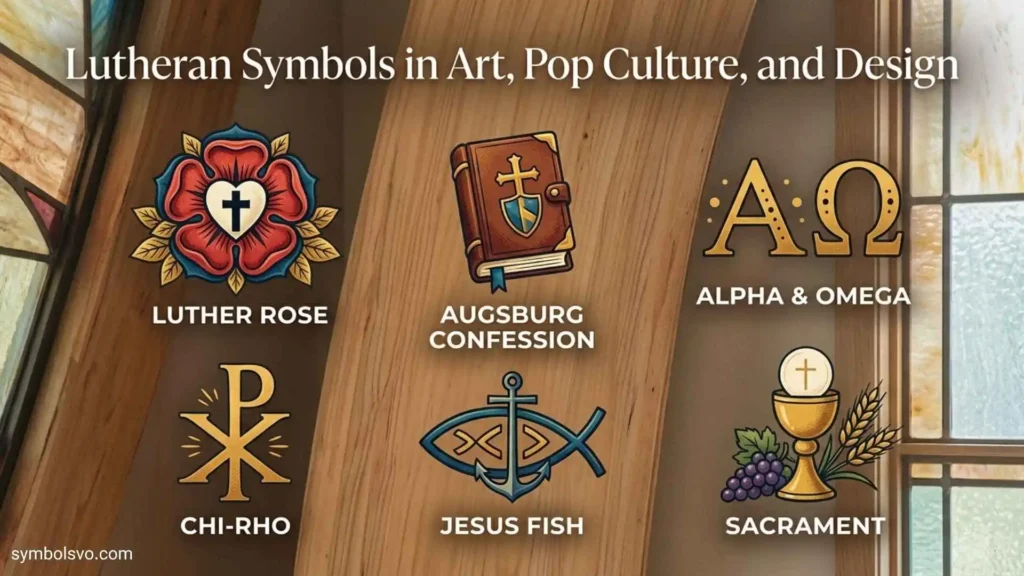
During the height of the Reformation, the famous German painter Lucas Cranach the Elder established a thriving workshop that specialized in creating art around Lutheran symbols. His masterfully crafted paintings and woodcuts helped spread the visual identity of the movement to every corner of Europe.
[ Law: Shows Human Inability ] —> [ The Cross: Deals with Sin ] —> [ Gospel: Brings Peace of Mind ]
In modern pop culture and design, these historic symbols have experienced an unexpected resurgence. You will find the distinct geometry of the Luther Rose adapted into high-end graphic design, minimal streetwear clothing lines, and stunning contemporary tattoos. When a modern person chooses to tattoo the Luther Rose onto their skin, it represents a deep, personal commitment to the concept of radical grace and an unshakeable inner peace.
Spiritual and Dream Meaning of Lutheran Symbols
When Lutheran symbols show up in your dreams or meditation experiences, they often carry profound personal messages. Because our subconscious minds communicate using timeless metaphors, seeing a classic emblem like the Luther Rose during sleep usually points to a deep internal shift.
If you dream of a black cross resting inside a bright red heart, your mind may be processing a difficult season of emotional pain or grief, reminding you that your suffering will not have the final word.
Dreaming of a clean white rose blooming in a field of blue suggests that you are entering a refreshing phase of emotional healing, spiritual clarity, and deep personal peace. These dreams serve as an inner mirror, encouraging you to let go of self-criticism and accept a deeper level of unconditional grace.
Positive and Shadow Meanings of Lutheran Symbols
Every powerful historical symbol holds a balance of light and shadow, depending heavily on how it has been used across different eras.
| Positive Meaning | Shadow Meaning |
| Brings deep emotional freedom from guilt. | Can lead to a lazy, cheap view of grace. |
| Champions widespread literacy and education. | Historically fueled intense religious wars. |
| Elevates regular daily work into a holy calling. | Can create rigid, cultural tribalism. |
| Offers a clear, comforting focus on Christ. | Sometimes leads to a fear of new ideas. |
Why Humans Are Attracted to Lutheran Symbols
Our natural attraction to these symbols is deeply hardwired into our psychology. The human brain is an advanced pattern recognition system, always searching for safety, meaning, and predictability in a chaotic world.
Psychologically, we carry an deep-seated fear of isolation and failure. A symbol like the Luther Rose acts as a visual anchor, reassuring our subconscious minds that we are fundamentally accepted, valued, and safe. Furthermore, these emblems satisfy our profound human need for authentic belonging, acting as a silent, immediate connection to a massive global community that shares our deepest values and hopes.
Modern Uses of Lutheran Symbols
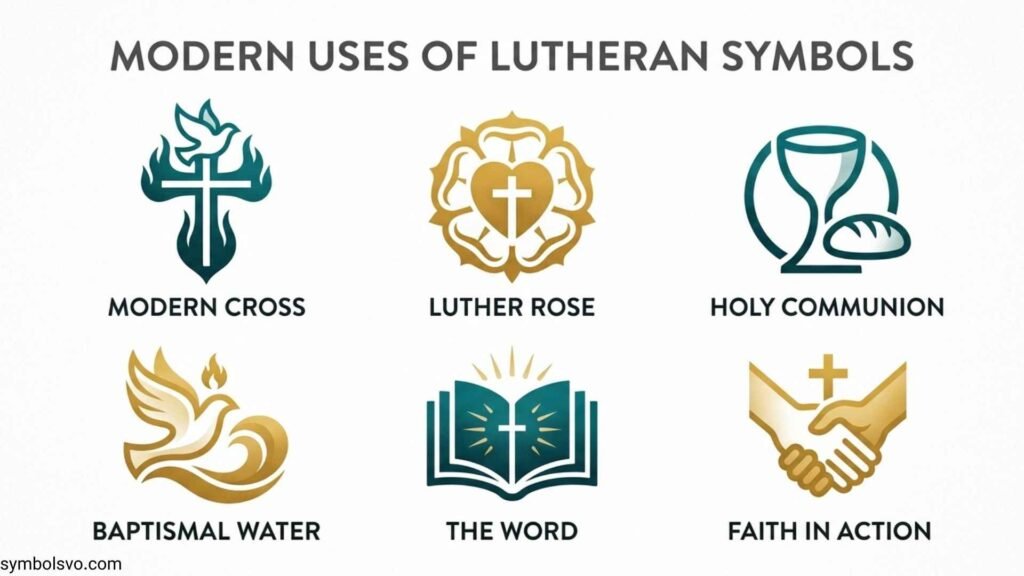
In our current cultural landscape, these historic designs have moved far beyond old church buildings.
- Custom Jewelry: Beautifully stamped silver rings and necklaces given at confirmation.
- Contemporary Branding: Streamlined, minimalist logos for modern schools and charities.
- Digital Artwork: Vibrant social media profile icons and inspirational digital wallpaper.
- Home Decor: Elegant wooden carvings and embroidered pillows that bring a sense of history into modern living spaces.
Interesting Facts About Lutheran Symbols
- The original design of the Luther Rose was personally sketched by Martin Luther using a quill pen.
- In the 1500s, Prince John Frederick of Saxony gave Luther a special signet ring featuring the rose symbol to honor his work.
- Many historic Lutheran churches in Europe display a swan on their steeples instead of a traditional rooster or cross.
- The five white petals of the Luther Rose were intentionally chosen to represent the five classic solas of the Reformation.
- The blue background of the symbol is a specific shade meant to mimic the color of the clear morning sky, representing heavenly joy.
Frequently Asked Questions
What does the black cross inside the Luther Rose represent?
The black cross sits right at the center to remind believers that Christ’s sacrifice on the cross is what saves them. It is black to show that the cross causes natural pain, though it does not kill the heart.
Why is the rose in the symbol white instead of red?
The rose is white because white is the color of angels and spirits. It represents the pure, unshakeable joy, peace, and comfort that true faith brings to the human soul.
Do Lutherans use the crucifix in their churches?
Yes. Unlike some Protestant traditions that only use an empty cross, many Lutheran churches use a crucifix. It serves as a visual reminder that Christ’s actual suffering and death are the foundation of Christian comfort.
Why is there a gold ring around the Luther Rose symbol?
The golden ring wraps around the entire design to represent the endless, priceless treasures of heaven. Gold was chosen because it does not tarnish or decay, symbolizing eternal life.
Conclusion
Lutheran symbols are a beautiful, enduring gift to the world of visual storytelling. They do not exist to pull our attention toward an institution, but rather to point our hearts toward a profound message of radical grace, freedom, and inner peace. By anchoring complex theological ideas into timeless natural images like hearts, roses, and sky-blue fields, these emblems continue to offer deep comfort and a strong sense of identity to millions of people around the globe.

I’m Daniel Brooks, a content creator and symbol enthusiast dedicated to researching the fascinating world of signs and symbols. I enjoy discovering the hidden meanings behind famous icons, emojis, historical emblems, and cultural symbols. Through my writing, I aim to provide trustworthy, well-researched, and reader-friendly information that helps people learn something new with every visit.
Books:
- The Complete Guide to World Symbols
- The Power of Universal Signs
 Mason Ellington
 Grace Whitmore