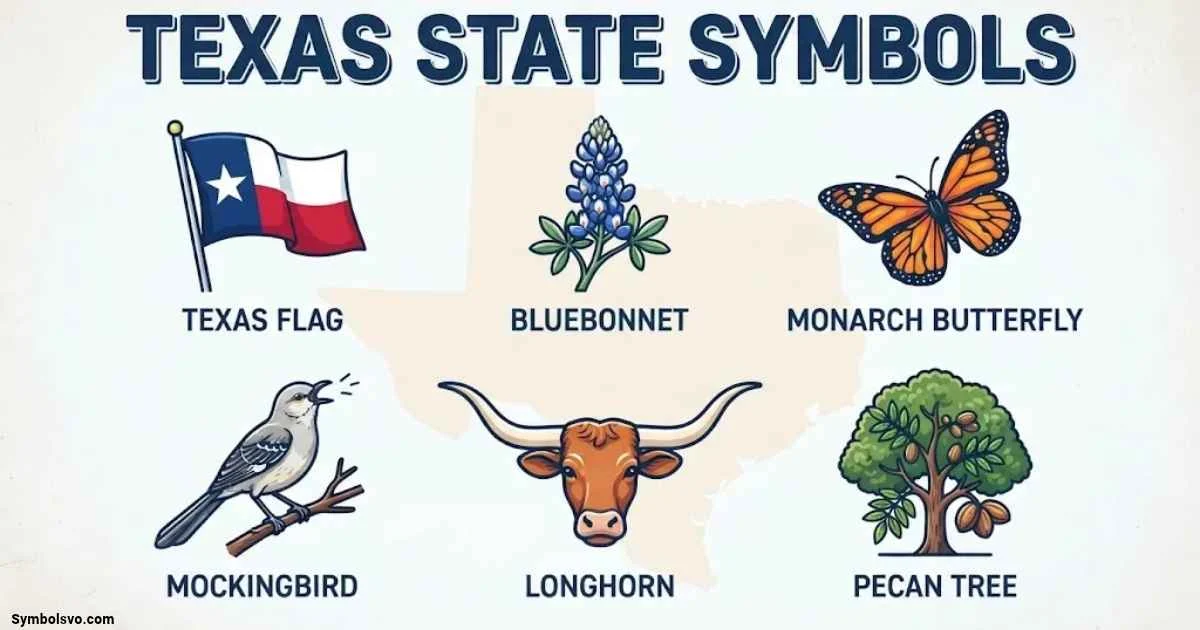
Texas is known for its Lone Star Flag, colorful bluebonnets, longhorn cattle, and proud cowboy traditions. These familiar images tell only part of the story. The Texas State Symbols also include native wildlife, agricultural products, traditional foods, music, and historical objects that reflect the state’s identity.
From the five-pointed star on the Texas flag to the Mexican free-tailed bat flying above Austin, each symbol represents a different part of Texas life. Some celebrate the state’s natural environment, while others preserve memories of its independence, ranching history, and cultural traditions.
The Texas Legislature has officially recognized symbols since 1901, when it selected the bluebonnet as the state flower. Since then, lawmakers have added dozens of designations, creating a collection that represents everything from the state bird and tree to its official dish, sport, and musical traditions. This guide explores the most important Texas State Symbols and Their Meanings, including their histories, adoption dates, and cultural significance.
Texas State Library+1
Complete List of Official Texas State Symbols
Texas has an unusually wide range of official designations. Its symbols include familiar natural features as well as less expected choices, such as a domino game, a cooking implement, and a state book.
The following table highlights major official symbols and their categories.
| Category | Official Texas symbol | Designation year |
| Nickname | The Lone Star State | 2015 |
| Motto | Friendship | 1930 |
| State song | Texas, Our Texas | 1929 |
| State flower | Bluebonnet | 1901; expanded 1971 |
| State bird | Northern Mockingbird | 1927 |
| State tree | Pecan | 1919 |
| State large mammal | Texas Longhorn | 1995 |
| State small mammal | Nine-banded Armadillo | 1995 |
| State flying mammal | Mexican Free-tailed Bat | 1995 |
| State insect | Monarch Butterfly | 1995 |
| State reptile | Texas Horned Lizard | 1993 |
| State amphibian | Texas Toad | 2009 |
| State freshwater fish | Guadalupe Bass | 1989 |
| State saltwater fish | Red Drum | 2011 |
| State crustacean | Texas Gulf Shrimp | 2015 |
| State sea turtle | Kemp’s Ridley Sea Turtle | 2013 |
| State plant | Prickly Pear Cactus | 1995 |
| State grass | Sideoats Grama | 1971 |
| State fruit | Texas Red Grapefruit | 1993 |
| State vegetable | Sweet Onion | 1997 |
| State tree nut/health nut | Pecan | 2001 |
| State dish | Chili | 1977 |
| State bread | Pan de Campo | 2005 |
| State pie | Pecan Pie | 2013 |
| State snack | Tortilla Chips and Salsa | 2003 |
| State sport | Rodeo | 1997 |
| State music | Western Swing | 2011 |
| State folk dance | Square Dance | 1991 |
| State musical instrument | Guitar | 1997 |
| State gemstone | Texas Blue Topaz | 1969 |
| State stone | Petrified Palmwood | 1969 |
| State shell | Lightning Whelk | 1987 |
| State dinosaur | Paluxysaurus jonesi | 2009 |
| State dog breed | Blue Lacy | 2005 |
| State horse | American Quarter Horse | 2009 |
| State mushroom | Texas Star Mushroom | 2021 |
Source: Texas State Library and Archives Commission’s official list of state symbols. Some categories have additional details or later legislative updates.
Texas State Library
The Texas Flag and Its Historical Meaning
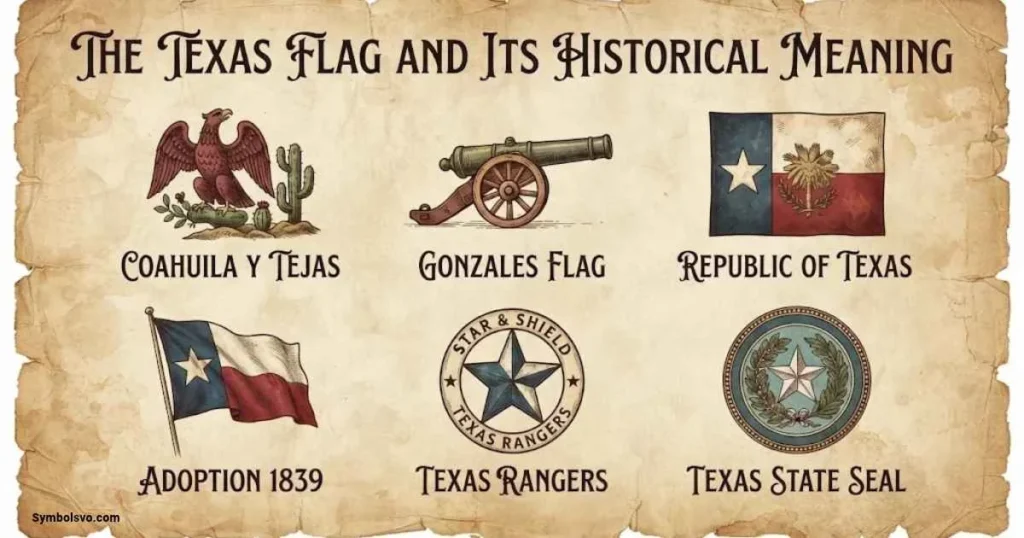
The Lone Star Flag is one of the most recognizable Texas symbols. Its simple design carries a strong connection to the state’s history, independence, and identity.
Texas adopted its current flag during the period when it existed as an independent republic. The design remains a powerful reminder of that chapter in American history.
What Is the Texas State Flag Called?
Texas’s official flag is commonly called the Lone Star Flag. It features three main sections:
- A vertical blue stripe along the left side.
- A horizontal white stripe across the upper right.
- A horizontal red stripe across the lower right.
- A single white five-pointed star in the center of the blue stripe.
The flag’s proportions and colors give it a distinctive appearance. Its design also resembles the red, white, and blue arrangement found on the American flag.
Who Designed the Texas Lone Star Flag?
Charles Bellinger Stewart is traditionally credited with designing the Lone Star Flag. He was a physician, public official, and participant in the early political history of Texas.
The flag’s design emerged during the Republic of Texas period. However, historical accounts should distinguish Stewart’s traditional design attribution from the separate question of who physically produced the original flag.
When Was the Texas Flag Adopted?
The Republic of Texas adopted the Lone Star Flag on January 25, 1839. Texas later joined the United States in 1845 and retained the flag as its state emblem.
This history explains why the design carries such a strong connection to independence. It originated when Texas governed itself as a separate republic rather than as part of the United States.
What Do the Colors of the Texas Flag Represent?
Each color has an established symbolic interpretation:
| Color | Meaning |
| Blue | Loyalty |
| White | Purity |
| Red | Courage |
The white star represents the unity of Texas as a single state. Its five points also help create the familiar Lone Star identity.
What Does the Lone Star Represent?
The five-pointed star is more than a decorative feature. It represents Texas’s independent past and its lasting sense of unity.
The star became a defining image during the Republic of Texas period. Today, it appears on government buildings, clothing, business logos, sports merchandise, and countless other items.
The Great Seal of Texas and Its Historical Significance
The Great Seal of the State of Texas is an important government emblem. While the Lone Star Flag represents Texas visually to the public, the seal serves a formal purpose in official state business.
Texas inherited the tradition of using official seals from earlier governments. The seal’s design reflects the state’s political history and natural heritage.
What Is the Great Seal of the State of Texas?
The Great Seal authenticates official government documents and represents the authority of the state.
Texas’s seal features a five-pointed star surrounded by a wreath of olive and live oak branches. The state adopted this general design from the seal used by the Republic of Texas.
The seal is closely connected to the state’s official arms, which appear in government settings and on formal documents.
What Do the Symbols on the Texas State Seal Mean?
The main design elements have recognizable historical associations:
- Five-pointed star: Represents Texas and its unity.
- Olive branch: Commonly associated with peace.
- Live oak branch: Represents the native landscape and enduring strength of Texas.
Together, these elements create a design that combines political identity with natural imagery.
What Appears on the Reverse Side of the Texas State Seal?
The reverse of the Great Seal of the Republic of Texas contains a more detailed historical scene. It features an image of the Alamo, the cannon associated with the Battle of Gonzales, Vince’s Bridge, and six flags representing the historical powers connected with Texas.
The reverse also carries two important phrases:
- “Remember the Alamo.”
- “Texas One and Indivisible.”
These words connect the seal with the Texas Revolution and the idea of a united state.
What Is the Difference Between the Republic of Texas Seal and the Current State Seal?
The Republic of Texas used official seals before joining the United States in 1845. After statehood, Texas retained the five-pointed star surrounded by olive and live oak branches as the central design.
The reverse design associated with the Republic’s seal is a separate historical emblem. It should not be confused with the standard present-day state seal.
Texas State Flower: Bluebonnet
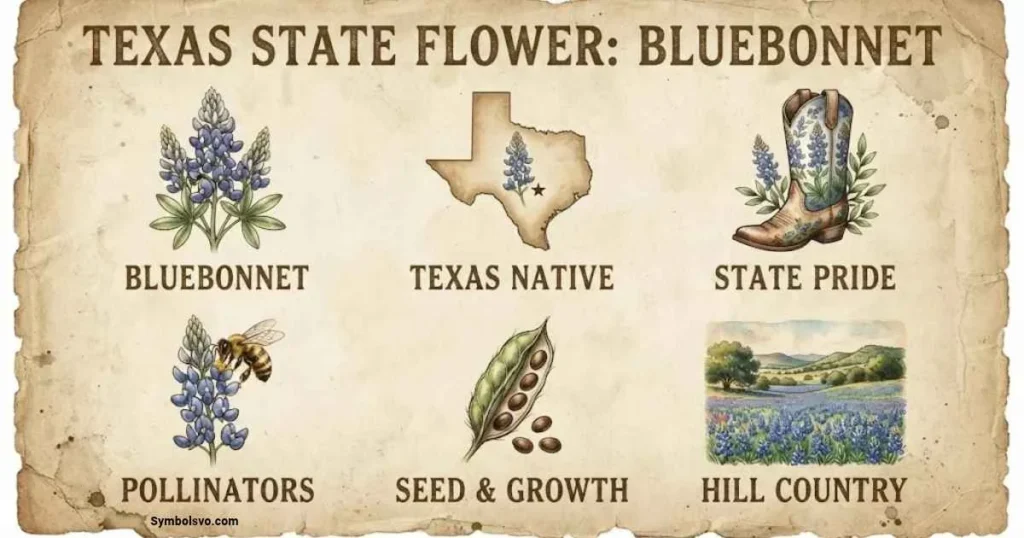
The Bluebonnet is perhaps the most beloved of all Texas State Symbols. Every spring, its blue and violet flowers cover roadsides, fields, and open spaces across much of the state.
The flower has become closely connected with Texas photography, tourism, and seasonal celebrations. For many residents, the first bluebonnets of the year signal the arrival of spring.
Why Is the Bluebonnet the State Flower of Texas?
The bluebonnet grows naturally in Texas and thrives in suitable soil and weather conditions. Its striking color makes it easy to recognize across open landscapes.
Texas selected the flower because it represents the state’s native plant life and distinctive spring scenery.
When Did the Bluebonnet Become an Official State Symbol?
The Texas Legislature selected the bluebonnet as the official state flower in 1901. In 1971, lawmakers expanded the designation to include Lupinus texensis and other varieties of bluebonnet.
This distinction matters because Texas has several native bluebonnet species. The official designation does not restrict the state flower to one variety.
What Are the Different Types of Texas Bluebonnets?
Several species of lupine grow in Texas. Two particularly familiar varieties include:
- Texas Bluebonnet (Lupinus texensis): A common variety with tall flower spikes and deep blue petals.
- Sandyland Bluebonnet (Lupinus subcarnosus): A smaller variety that grows in sandy soils, especially in parts of southern Texas.
Other recognized bluebonnet varieties also contribute to the state’s spring displays.
When Do Bluebonnets Bloom in Texas?
Bluebonnets usually bloom between March and April, although the exact timing changes with rainfall, temperature, and location.
A warm winter can encourage earlier growth. Cold weather or limited rainfall may delay flowering or reduce the number of blooms.
Popular viewing areas include:
- Ennis Bluebonnet Trails.
- Burnet County.
- Llano County.
- Texas Hill Country.
- Roadsides and open fields throughout central Texas.
Is It Illegal to Pick Bluebonnets in Texas?
Texas does not have a blanket statewide law that makes picking every bluebonnet illegal simply because it is the state flower.
However, location matters. Picking flowers on private property without permission can constitute trespassing. Removing plants from protected public areas may also violate park rules or other regulations.
The safest approach is to enjoy bluebonnets where they grow and avoid damaging plants or entering private land.
Texas State Bird: Northern Mockingbird
The Northern Mockingbird became the official Texas state bird in 1927. Its ability to imitate the songs and calls of other birds makes it one of the most recognizable songbirds in North America.
Mockingbirds live in a wide range of environments, including gardens, parks, neighborhoods, and open countryside. Their adaptability makes them a familiar part of everyday life across Texas.
Why Is the Mockingbird the State Bird of Texas?
The bird’s impressive singing ability and widespread presence helped make it a fitting state symbol.
It often sings from exposed branches, rooftops, and fence posts. During breeding season, mockingbirds can also become highly territorial when protecting their nests.
What Makes the Northern Mockingbird Unique?
Some of its most interesting characteristics include:
- Imitation: It can copy the calls of other birds and certain environmental sounds.
- Appearance: Gray feathers, pale undersides, and white wing patches.
- Habitat: It adapts to urban areas, farmland, and natural environments.
- Behavior: It uses songs and territorial displays to communicate.
The mockingbird represents the diversity and adaptability of Texas wildlife.
Texas State Mammals and Their Meanings
Texas officially recognizes three mammal categories: large, small, and flying. Each designation highlights a different part of the state’s natural environment and history.
Texas Longhorn: The State Large Mammal
The Texas Longhorn represents the state’s ranching heritage. Its long, curved horns and distinctive appearance make it one of the most recognizable cattle breeds in the United States.
Spanish settlers brought cattle to the Americas centuries ago. Over time, cattle populations adapted to local conditions, helping create the hardy Longhorn associated with Texas.
Longhorns became especially important during the nineteenth-century cattle industry. Ranchers drove large herds northward to markets and railheads, creating famous cattle trails and supporting the growth of the regional economy.
The Texas Legislature designated the Longhorn as the state large mammal in 1995.
Its significance comes from several historical connections:
- Spanish cattle-raising traditions.
- Mexican vaqueros and early cowboy culture.
- Nineteenth-century cattle drives.
- Ranching and livestock production.
- The development of Texas’s western identity.
Nine-Banded Armadillo: The State Small Mammal
The Nine-banded Armadillo became Texas’s official small mammal in 1995. Its armored body and unusual appearance make it one of the state’s most recognizable wild animals.
The armadillo uses its strong claws to dig for insects, grubs, and other food. It prefers habitats that provide suitable soil for burrowing.
Although armadillos are associated with Texas, their natural range extends beyond the state. They also live in other parts of the southern United States and Central and South America.
Its protective shell and distinctive digging behavior make it a memorable representative of Texas wildlife.
Mexican Free-Tailed Bat: The State Flying Mammal
The Mexican Free-tailed Bat received official recognition as the state flying mammal in 1995.
Texas provides important habitat for enormous bat colonies. One famous example is Bracken Cave near San Antonio, where millions of Mexican free-tailed bats gather during the warmer months.
Another well-known location is the Congress Avenue Bridge in Austin. During the warmer season, visitors often gather to watch bats emerge from beneath the bridge at sunset.
These bats provide an important ecological service by eating large numbers of insects, including agricultural pests.
Their role includes:
- Controlling insect populations.
- Supporting natural food webs.
- Reducing some agricultural pest pressure.
- Demonstrating the importance of healthy wildlife habitats.
How Do These Three Mammals Represent Texas?
| Mammal | Official category | Connection with Texas |
| Texas Longhorn | Large mammal | Ranching and cattle history |
| Nine-banded Armadillo | Small mammal | Native and regional wildlife |
| Mexican Free-tailed Bat | Flying mammal | Natural ecosystems and insect control |
Together, these animals show that Texas’s identity extends beyond ranches and cowboy traditions. Its wildlife is equally important.
Texas State Insect: Monarch Butterfly

The Monarch Butterfly became the official state insect of Texas in 1995. Its bright orange wings, black veins, and seasonal migration make it one of North America’s most familiar butterflies.
Texas plays an important role in monarch migration because it lies along a major route between northern breeding grounds and overwintering areas in Mexico.
Why Is the Monarch Butterfly the State Insect?
The monarch’s migration connects Texas with a much larger natural system. Each year, butterflies travel through the state as they move between breeding and overwintering areas.
Their presence also highlights the importance of native flowering plants and healthy ecosystems.
When Do Monarch Butterflies Migrate Through Texas?
Monarch migration takes place mainly during two seasonal movements:
- Spring migration: Butterflies move north through Texas as they return from Mexico.
- Fall migration: Butterflies travel south through Texas toward their wintering grounds in central Mexico.
The timing varies with weather and local conditions.
Why Is Monarch Butterfly Conservation Important?
Monarch populations face several environmental pressures, including habitat loss, reduced milkweed availability, pesticide exposure, and changes in weather patterns.
Milkweed is especially important because monarch caterpillars depend on it for food.
You can support monarch conservation by:
- Planting native milkweed suitable for your region.
- Growing nectar-producing native flowers.
- Avoiding unnecessary pesticide use.
- Protecting natural habitats.
- Supporting local pollinator gardens.
The monarch is a reminder that Texas wildlife conservation benefits from protecting even the smallest parts of an ecosystem.
Texas State Reptile: Horned Lizard
The Texas Horned Lizard became the official state reptile in 1993. People often call it the horny toad, although it is a lizard rather than a toad.
Its broad, flattened body, pointed scales, and crown of horns make it easy to recognize.
What Is the Texas Horned Lizard?
The Texas Horned Lizard (Phrynosoma cornutum) lives in dry and semi-arid environments. It uses its coloring to blend into the surrounding soil and vegetation.
Its diet consists largely of ants, especially harvester ants. This feeding habit makes the species closely connected with its natural habitat.
How Does the Horned Lizard Defend Itself?
The animal uses several defensive strategies:
- Camouflage: Its coloring helps it disappear against dry soil.
- Spiny body: Its horns and scales make it harder for some predators to swallow.
- Body posture: It can flatten its body against the ground.
- Blood-squirting defense: Some horned lizards can squirt blood from the corners of their eyes when threatened.
Why Are Texas Horned Lizards Becoming Less Common?
Habitat changes have affected horned lizard populations in many parts of Texas.
Important pressures include:
- Urban development and habitat fragmentation.
- Changes in native ant populations.
- Non-native fire ants.
- Pesticide use.
- Loss of suitable sandy and open habitats.
Protecting natural landscapes and reducing harmful disturbances can help support their populations.
Other Official Texas Wildlife Symbols
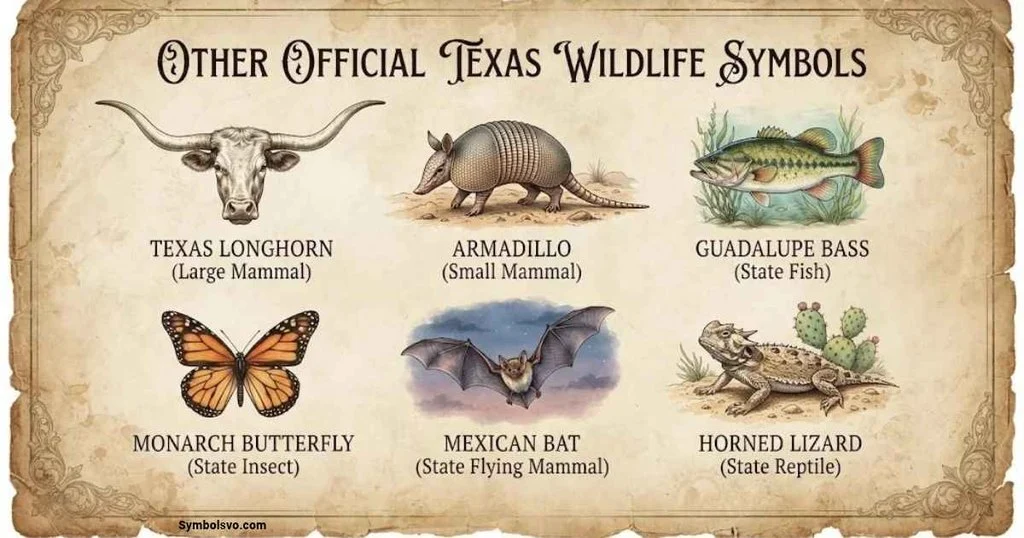
The state recognizes several additional animals that represent its freshwater habitats, Gulf Coast ecosystems, and native wildlife. These designations help highlight species that might otherwise receive less attention.
Texas Toad: State Amphibian
The Texas Toad became the official state amphibian in 2009. It is native to the southwestern United States and northern Mexico and lives in a variety of dry and semi-arid habitats.
Unlike frogs that remain closely tied to permanent water, Texas toads can survive in relatively dry environments. They usually become more active after rainfall when temporary pools provide suitable breeding conditions.
Their designation highlights the importance of amphibians in Texas ecosystems. Toads eat insects and other small invertebrates while also serving as food for larger animals.
Guadalupe Bass: State Freshwater Fish
The Guadalupe Bass became the official state freshwater fish in 1989. It is native to the Edwards Plateau region and lives in clear streams and rivers, particularly those within the Guadalupe River drainage.
This fish is important because it represents Texas’s native freshwater biodiversity. It also attracts anglers who enjoy fishing in the state’s rivers.
The Guadalupe Bass faces pressure from habitat changes and hybridization with introduced smallmouth bass. Conservation programs work to protect its native populations and maintain suitable river habitats.
Red Drum: State Saltwater Fish
The Red Drum, commonly called redfish, became the official state saltwater fish in 2011.
It lives in coastal waters, bays, estuaries, and nearshore areas along the Gulf of Mexico. Adult fish have a copper-colored body and often display a distinctive black spot near the tail.
Red drum supports recreational fishing and contributes to the ecological importance of Texas coastal waters.
Texas Gulf Shrimp: State Crustacean
The Texas Gulf Shrimp received official recognition in 2015. Shrimp are an important part of the Gulf Coast fishing industry and support coastal communities.
They also play a role in marine food webs. Young shrimp use shallow coastal habitats and estuaries as nursery areas before moving into deeper waters.
Texas shrimp are widely used in regional cooking, including seafood boils, fried shrimp dishes, and Gulf Coast seafood recipes.
Kemp’s Ridley Sea Turtle: State Sea Turtle
The Kemp’s Ridley Sea Turtle became the official state sea turtle in 2013. It is one of the world’s most endangered sea turtle species.
The species nests along the Gulf of Mexico, including important nesting areas in Texas. Padre Island National Seashore plays a major role in conservation efforts.
Protection programs monitor nesting beaches, safeguard eggs, and help young turtles reach the sea. Its designation draws attention to marine conservation and the importance of protecting Gulf Coast habitats.
Texas State Bison Herd
Texas also recognizes the Texas State Bison Herd at Caprock Canyons State Park as an official state symbol. The Legislature adopted this designation in 2011.
Bison once roamed much of the Great Plains in enormous numbers. Hunting and habitat changes caused their populations to collapse during the nineteenth century.
The herd at Caprock Canyons helps preserve the genetic and historical legacy of Texas bison. It also reminds visitors of the state’s earlier grassland ecosystems.
Texas State Plant and Agricultural Symbols
Texas has a strong agricultural history, and several official symbols reflect the plants and crops that support its landscapes and economy.
Pecan Tree: State Tree
The Pecan Tree became the official Texas state tree in 1919. It is native to North America and grows naturally in many parts of Texas, particularly along rivers and fertile bottomlands.
Its scientific name is Carya illinoinensis. The tree produces pecans, which are valued for their flavor, nutritional content, and use in cooking.
Texas has a long history of pecan production. The nuts appear in traditional desserts, candies, baked goods, and other regional recipes.
The pecan tree represents several aspects of Texas heritage:
- Native plant life.
- Agricultural production.
- Food traditions.
- Shade and landscape value.
- Long-standing connections with rural communities.
Prickly Pear Cactus: State Plant
The Prickly Pear Cactus became the official state plant in 1995. It is a familiar feature of Texas’s dry landscapes and can survive in conditions that challenge many other plants.
Its flat, fleshy pads store water. Its flowers produce colorful blooms, while its edible fruits are commonly known as tunas.
Prickly pear has traditional food and agricultural uses. People prepare its pads and fruits in several regional dishes, although proper cleaning and preparation are necessary because the plant has small spines.
Sideoats Grama: State Grass
Sideoats Grama became the official state grass in 1971. This native perennial grass grows across parts of Texas and other regions of North America.
Its seed spikes hang along one side of the flowering stem, giving the plant its distinctive appearance.
Sideoats grama supports native grassland ecosystems and provides food for grazing animals. It is also useful in land restoration because it adapts to different soil and moisture conditions.
Texas Red Grapefruit: State Fruit
The Texas Red Grapefruit became the official state fruit in 1993.
Texas has a well-known citrus-growing region in the Rio Grande Valley. Its warm climate and suitable growing conditions support grapefruit production.
Red grapefruit varieties are valued for their colorful flesh and sweet-tart flavor. They also contribute to Texas’s agricultural identity and citrus industry.
Sweet Onion: State Vegetable
The Sweet Onion received official recognition as the state vegetable in 1997.
Texas farmers grow several varieties of sweet onions. The famous 1015 onion, developed at Texas A&M University, is particularly associated with the state’s onion-growing traditions.
Sweet onions have a milder taste than many stronger onion varieties. People use them in salads, sandwiches, grilled dishes, and traditional Texas cooking.
Texas Purple Sage: State Native Shrub
Texas Purple Sage, scientifically known as Leucophyllum frutescens, became the official state native shrub in 2005.
This hardy shrub grows naturally in dry parts of Texas and northern Mexico. Its silvery leaves and purple flowers make it popular in landscaping.
The plant tolerates heat and limited rainfall. Its flowering often follows rain or changes in humidity, which explains its common nickname, barometer bush.
Western Honey Bee: State Pollinator
The Western Honey Bee became the official state pollinator in 2015.
Honey bees help pollinate many flowering plants and agricultural crops. Their work supports fruit production, seed development, and healthy ecosystems.
Although honey bees are not native to North America, they have become important to modern Texas agriculture. Their official designation recognizes the value of pollination to the state’s food production.
Texas State Food Symbols and Their Meanings

Food is an important part of Texas identity. Its official food designations reflect regional cooking, agricultural products, and traditions influenced by Mexican, Spanish, and American cultures.
Chili: Official State Dish
Chili became the official state dish of Texas in 1977. Often called chili con carne, this hearty meal has a long connection with Texas food culture.
Traditional Texas chili usually features meat, dried chilies, spices, and a rich sauce. Unlike some other American chili recipes, the traditional Texas version generally does not include beans.
However, individual recipes vary. The absence of beans is a popular culinary tradition rather than a requirement written into the state’s official designation.
Common ingredients include:
- Beef, often chuck or ground beef.
- Dried chilies or chili powder.
- Garlic and onions.
- Cumin and other seasonings.
- Tomatoes in some modern recipes.
- Broth or water.
Chili competitions and cook-offs remain popular throughout Texas. They bring together home cooks, professional chefs, and enthusiasts who debate the best ingredients and preparation methods.
Pecan Pie: Official State Pie
The Pecan Pie became the official state pie in 2013.
Pecans have a long history in Texas, making this dessert a natural choice for the designation. Traditional pecan pie combines pecans with eggs, sugar, butter, and a sweet filling baked inside a pastry crust.
You can find many variations, including recipes with chocolate, bourbon flavoring, or maple syrup.
Pan de Campo: Official State Bread
Pan de Campo became the official state bread in 2005. Its name means country bread in Spanish.
The bread has strong connections with South Texas ranching culture. Ranch cooks traditionally prepared it outdoors using simple ingredients and cast-iron cooking equipment.
Its history reflects the influence of Mexican and vaquero traditions on Texas cuisine.
Tortilla Chips and Salsa: Official State Snack
Texas designated Tortilla Chips and Salsa as its official state snack in 2003.
The combination reflects the state’s strong Mexican and Tex-Mex food traditions. Restaurants across Texas commonly serve tortilla chips with tomato-based salsa before meals.
The snack is simple, but its cultural influence is substantial. It appears at family gatherings, restaurants, celebrations, and sporting events.
Jalapeño and Chiltepin: Texas Pepper Symbols
Texas recognizes two different pepper symbols:
- Jalapeño: The official state pepper, designated in 1995.
- Chiltepin: The official state native pepper, designated in 1997.
Jalapeños are common in Tex-Mex dishes, salsas, and grilled foods. Chiltepin peppers are much smaller and have a strong heat level.
These peppers demonstrate how native plants and regional food traditions influence Texas cuisine.
Peach Cobbler: Official State Cobbler
Peach Cobbler became the official state cobbler in 2013.
Texas produces peaches in several regions, especially around the eastern part of the state. The dessert combines cooked peaches with a biscuit-style or pastry topping.
It is often served warm with ice cream and remains a popular choice at family gatherings and community events.
Texas State Music, Dance, Sport, and Cultural Symbols
Texas culture is closely connected with music, ranching, community celebrations, and traditional entertainment. Several official designations recognize these cultural contributions.
Rodeo: Official State Sport
Rodeo became the official state sport of Texas in 1997.
Its roots reach back to cattle handling and livestock skills developed by Spanish and Mexican vaqueros. Ranch workers needed to ride horses, rope cattle, and manage large herds across open land.
Over time, these practical skills became organized competitions. Modern rodeos feature events such as:
- Bull riding.
- Bareback bronc riding.
- Saddle bronc riding.
- Tie-down roping.
- Team roping.
- Barrel racing.
Rodeo continues to connect Texas with its ranching history. Events attract professional competitors, local families, and visitors interested in western traditions.
Western Swing: Official State Music
Western Swing became the official state music in 2011.
This musical style developed in the American Southwest and became strongly associated with Texas dance halls and bands. It blends country music with elements of jazz, blues, and swing.
The style often features fiddles, steel guitars, guitars, and rhythm sections. Its lively sound made it popular for dancing and social gatherings.
Square Dance: Official State Folk Dance
The Square Dance became the official state folk dance in 1991.
The dance involves groups of four couples arranged in a square. A caller gives instructions that guide the dancers through coordinated movements.
Square dancing reflects community traditions and remains part of cultural festivals and social events in different parts of Texas.
Cowboy Boot and Cowboy Hat
Texas officially recognizes both the Cowboy Boot and the Cowboy Hat.
- Cowboy boot: Official state footwear, designated in 2007.
- Cowboy hat: Official state hat, designated in 2015.
Both items developed from practical needs associated with riding, ranching, and outdoor work. Their designs have changed over time, but they remain recognizable features of western clothing.
Guitar: Official State Musical Instrument
The Guitar became the official state musical instrument in 1997.
Guitars have played an important role in Texas country, blues, folk, and Western Swing music. They remain central to the state’s live music culture.
Other Official Cultural Designations
| Category | Official symbol | Year |
| Vehicle | Chuck Wagon | 2005 |
| Domino game | 42 | 2011 |
| Tartan | Texas Bluebonnet | 1989 |
| Epic poem | Legend of Old Stone Ranch | 1969 |
| Dog breed | Blue Lacy | 2005 |
| Horse | American Quarter Horse | 2009 |
| Book | Texas Almanac | 2025 |
| Plays | The Lone Star, Texas, Beyond the Sundown, and Fandangle | 1979 |
These symbols show how Texas recognizes more than its natural resources and historical landmarks. It also celebrates everyday traditions and cultural achievements.
Other Official Texas Symbols You Should Know
Some official Texas emblems are less familiar than the Lone Star Flag or bluebonnet. However, they add interesting details to the state’s cultural and natural history.
Here are additional designations worth knowing.
| Category | Official symbol | Significance |
| State gemstone | Texas Blue Topaz | Mineral heritage |
| Gemstone cut | Lone Star Cut | Texas identity |
| State stone | Petrified Palmwood | Geological history |
| State shell | Lightning Whelk | Gulf Coast wildlife |
| State precious metal | Silver | Mineral resources |
| State mushroom | Texas Star Mushroom | Native fungi |
| State dinosaur | Paluxysaurus jonesi | Prehistoric Texas |
| State dog breed | Blue Lacy | Texas working-dog heritage |
| State horse | American Quarter Horse | Ranching and equestrian traditions |
| State vehicle | Chuck Wagon | Cattle-drive history |
| State cooking implement | Cast Iron Dutch Oven | Traditional outdoor cooking |
| State handgun | 1847 Colt Walker Pistol | Firearms history |
| State knife | Bowie Knife | Frontier history |
| State gun | Cannon | Historical military heritage |
| State ship | USS Texas | Naval history |
| State tall ship | Elissa | Maritime heritage |
| State railroad | Texas State Railroad | Transportation history |
| State aquarium | Texas State Aquarium | Marine education |
| State botanical garden | Lady Bird Johnson Wildflower Center | Native plant conservation |
The Texas Legislature has also designated the Commemorative Air Force, Texas Maritime Museum, Texas State Bison Herd, and other organizations or institutions as official symbols.
One especially interesting addition is the Texas Almanac, which became the official state book in 2025. It documents the state’s geography, population, economy, history, and other important information.
The Texas State Motto, Nickname, and State Song
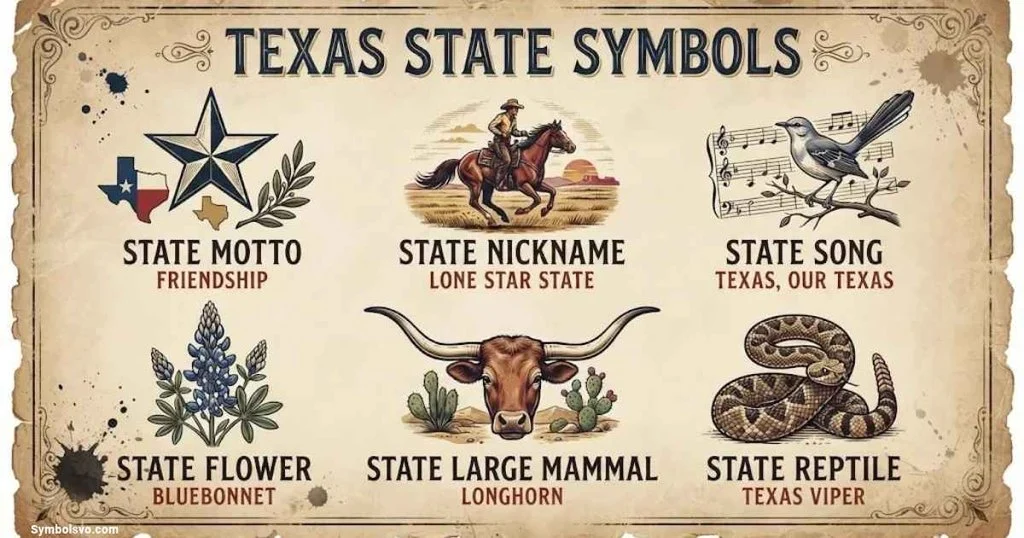
Texas has several official designations that express its identity through words and music. These symbols connect modern residents with the state’s historical beginnings.
Why Is Texas Called the Lone Star State?
Texas is called The Lone Star State because of the single star associated with its flag and independent history.
The nickname reflects the period when Texas existed as the Republic of Texas between 1836 and 1845. During those years, the republic used a single-star design as an important national emblem.
The star continued to represent Texas after it joined the United States. Today, the nickname appears on license plates, official publications, businesses, clothing, and tourism materials.
The Texas Legislature officially designated “The Lone Star State” as the state nickname in 2015.
What Is the Official State Motto of Texas?
The official Texas motto is “Friendship.”
The word connects with the historical meaning of Texas’s name. The name is commonly traced to the Caddo word taysha, meaning friends or allies.
Spanish explorers adopted a related form of the word when referring to Indigenous people in the region. Over time, the name became associated with the territory and eventually the modern state.
Texas officially adopted “Friendship” as its state motto in 1930.
What Is the Official State Song of Texas?
“Texas, Our Texas” is the official state song. William J. Marsh composed the music, while Marsh and Gladys Yoakum Wright wrote the lyrics.
The Texas Legislature adopted it in 1929. The song celebrates the state’s history, landscape, and identity.
It is performed during official ceremonies and other events that recognize Texas heritage.
What Is the Texas State Flag Pledge?
Texas also has an official pledge to the state flag:
Honor the Texas flag; I pledge allegiance to thee, Texas, one state under God, one and indivisible.
The pledge reflects loyalty to Texas and the unity represented by the state flag. It is separate from the United States Pledge of Allegiance.
Historical Symbols That Represent Texas Heritage
Not every famous Texas emblem has an official state-symbol designation. Some historical images are popular because they represent major events, political changes, and traditions.
Understanding this difference helps explain Texas history without confusing cultural icons with legislative designations.
Six Flags Over Texas
The phrase Six Flags Over Texas describes six national governments or political powers that have exercised sovereignty over the territory at different times.
The six flags represent:
| Flag | Historical period or association |
| Spain | Spanish colonial rule |
| France | French exploration and the short-lived Fort Saint Louis settlement |
| Mexico | Mexican independence and government |
| Republic of Texas | Independent Texas, 1836–1845 |
| Confederate States of America | Civil War era, 1861–1865 |
| United States of America | United States sovereignty, including before and after the Civil War |
The French connection is especially interesting. French explorer René-Robert Cavelier, Sieur de La Salle, established Fort Saint Louis near Matagorda Bay in 1685. The settlement was short-lived, but it became part of the region’s historical story.
These six flags illustrate how Texas developed through different periods of exploration, colonization, independence, and statehood.
The Alamo
The Alamo is one of the most recognizable historical landmarks in Texas.
Originally established as a Spanish mission, it became the site of a major battle during the Texas Revolution in 1836.
Mexican forces under General Antonio López de Santa Anna attacked the Alamo, where Texian defenders resisted for approximately 13 days. The battle ended on March 6, 1836, with the defeat of the defenders.
The phrase “Remember the Alamo” later became an important rallying cry for Texian forces.
Today, the Alamo represents a major chapter in Texas history and appears in the historical imagery associated with the reverse of the Republic’s Great Seal.
The Battle of Gonzales and the Come and Take It Flag
The Battle of Gonzales took place on October 2, 1835, and is widely recognized as the opening military engagement of the Texas Revolution.
The confrontation began over a small cannon that Mexican authorities had previously provided to settlers for local defense.
When Mexican soldiers attempted to retrieve it, Texian residents resisted. They displayed a flag showing a cannon with the words “Come and Take It.”
The event became an important symbol of resistance and the growing conflict between Texian settlers and Mexican authorities.
Texas Cattle Drives and Cowboy Heritage
Cattle drives helped shape Texas’s economic and cultural development during the nineteenth century.
After the Civil War, Texas had large cattle herds and growing demand for beef in other parts of the country. Ranchers moved cattle northward along routes such as the Chisholm Trail to reach railheads and markets.
The work required skilled riders, roping abilities, and knowledge of livestock behavior.
Mexican vaqueros had already developed many of the techniques that later became central to American cowboy culture. These included saddle design, cattle handling, rope work, and distinctive clothing.
Texas’s Longhorn, cowboy boot, cowboy hat, and chuck wagon all connect with this history.
The Republic of Texas
The Republic of Texas existed from 1836 until 1845. It emerged after the Texas Revolution and operated as an independent country before joining the United States.
During this period, Texas developed its own government, military, national flag, currency, and official seals.
The republic’s history explains why modern Texas symbols place such importance on independence and the Lone Star.
Although Texas became a U.S. state in 1845, the republic’s legacy remains visible throughout its official emblems and cultural traditions.
How Texas State Symbols Reflect the State’s Identity

The different symbols that represent Texas reveal a connection between history, nature, agriculture, and everyday life.
Looking at them in groups makes their broader significance easier to understand.
Symbols of Independence and Freedom
The Lone Star Flag, Great Seal, and Alamo represent important parts of Texas’s political history.
They connect modern Texas with the Texas Revolution, the Republic of Texas, and the transition to statehood.
The star remains the most recognizable visual reminder of that independent past.
Symbols of Nature and Wildlife
The bluebonnet, mockingbird, monarch butterfly, Longhorn, armadillo, and horned lizard represent the state’s natural environment.
They also highlight the diversity of Texas habitats, from grasslands and dry plains to rivers and coastal areas.
These symbols help encourage interest in wildlife conservation and native plant protection.
Symbols of Agriculture and Ranching
The pecan tree, Texas Longhorn, sweet onion, cowboy boot, and chuck wagon connect with the state’s agricultural development.
Ranching and farming have influenced Texas communities for generations. These designations preserve that history while recognizing products and traditions that remain important today.
Symbols of Food and Cultural Traditions
Chili, pecan pie, Pan de Campo, and tortilla chips and salsa show how different cultural influences shaped Texas cuisine.
Mexican, Spanish, Indigenous, and American traditions all contributed to the state’s regional food culture.
These dishes and ingredients remain popular at family gatherings, restaurants, festivals, and community celebrations.
Why Do Official Texas Symbols Matter Today?
Official designations do more than create a collection of interesting facts. They help preserve the state’s identity and historical record.
Their importance includes:
- Education: Students can learn about Texas history, wildlife, agriculture, and culture.
- Conservation: Wildlife and plant symbols encourage awareness of native species.
- Heritage: Historical designations keep important traditions visible.
- Tourism: Symbols such as bluebonnets and the Alamo attract visitors.
- Community identity: Shared emblems create a sense of connection among Texans.
Frequently Asked Questions About Texas State Symbols
What Are the Official State Symbols of Texas?
Texas has official symbols representing its history, wildlife, plants, agriculture, food, music, and traditions. Major examples include the Lone Star Flag, bluebonnet, northern mockingbird, pecan tree, Texas Longhorn, monarch butterfly, rodeo, and chili.
How Many Official State Symbols Does Texas Have?
The number depends on the date and which categories are counted. The Texas State Library and Archives Commission maintains the official register and adds newer legislative designations. Its list includes categories ranging from animals and plants to books, sports, food, and cultural traditions.
What Is the Most Famous Symbol of Texas?
The Lone Star Flag is arguably the most recognizable symbol of Texas. Its single white star represents the state’s independent history and identity. Other famous symbols include the bluebonnet, Texas Longhorn, and Alamo.
Why Is Texas Called the Lone Star State?
Texas received its nickname from the single star associated with its flag during its independent republic period from 1836 to 1845. The star remained an important symbol after Texas joined the United States.
What Is the State Flower of Texas?
The bluebonnet is the official state flower of Texas. The original designation dates to 1901, and the Legislature expanded recognition in 1971 to include Lupinus texensis and other bluebonnet varieties.
What Is the State Bird of Texas?
The northern mockingbird is the official state bird. Texas adopted the designation in 1927. The bird is known for its ability to imitate the songs and calls of other birds.
What Is the State Animal of Texas?
Texas does not have just one official state mammal. It recognizes the Texas Longhorn as its large mammal, the nine-banded armadillo as its small mammal, and the Mexican free-tailed bat as its flying mammal.
Does Texas Have More Than One State Mammal?
Yes. Texas has three official mammal categories: large, small, and flying. They are represented by the Longhorn, nine-banded armadillo, and Mexican free-tailed bat.
What Is the State Tree of Texas?
The pecan tree is the official state tree. Texas adopted it in 1919. It is native to North America and produces pecans, which are widely used in desserts and other foods.
What Is the State Reptile of Texas?
The Texas Horned Lizard is the official state reptile. It became a state symbol in 1993 and is commonly called the horny toad because of its flattened body and rounded appearance.
What Is the State Insect of Texas?
The monarch butterfly is the official state insect. Texas designated it in 1995 because of its connection with the state’s wildlife and seasonal migration routes.
What Is the Official State Dish of Texas?
Chili is the official state dish of Texas. The Legislature adopted it in 1977. Traditional Texas chili often contains beef, dried chilies, and spices without beans.
What Is the State Sport of Texas?
Rodeo is the official state sport. It became an official designation in 1997 and reflects the state’s long history of cattle ranching and cowboy traditions.
What Is the Texas State Motto?
The official Texas state motto is “Friendship.” The Legislature adopted it in 1930. The motto connects with the commonly accepted Caddo origin of the name Texas.
What Does the Lone Star on the Texas Flag Mean?
The single white star represents Texas and its unity. It also recalls the state’s independent history as the Republic of Texas before joining the United States in 1845.
What Are the Six Flags That Have Flown Over Texas?
The six flags represent Spain, France, Mexico, the Republic of Texas, the Confederate States of America, and the United States. They reflect the different governments and historical powers connected with Texas.
When Did Texas Start Adopting Official State Symbols?
Texas began adopting official state symbols in 1901 when the Legislature selected the bluebonnet as the state flower. Additional designations followed throughout the twentieth and twenty-first centuries.
Is the Bluebonnet Protected by Texas Law?
The bluebonnet does not have a blanket statewide legal protection that makes every instance of picking it illegal. However, trespassing, damaging protected plants, and violating park regulations can result in legal consequences. Always respect property rights and local rules.
What Is the Difference Between the Texas State Seal and Flag?
The Lone Star Flag is the state’s official flag and public emblem. The Great Seal is a formal government emblem used to authenticate official documents and represent the authority of Texas.
Where Can You Find the Complete Official List of Texas State Symbols?
The Texas State Library and Archives Commission publishes the official list of state symbols and their legislative resolutions. Visit its Texas State Symbols page to check official categories, names, and designation years.
Conclusion: The Meaning Behind Texas State Symbols
The Texas State Symbols tell a story that reaches far beyond the Lone Star Flag. They reflect the state’s independent past, natural environment, agricultural traditions, and cultural influences.
The bluebonnet represents native springtime landscapes. The Texas Longhorn recalls the cattle industry and ranching heritage. The mockingbird and monarch butterfly celebrate wildlife, while chili, rodeo, and Western Swing highlight the traditions that make Texas distinctive.
Some symbols preserve important historical events, while others recognize everyday parts of Texas life. Together, they create a picture of a state shaped by independence, hard work, natural resources, and diverse cultural traditions.
If you’re studying Texas history, preparing a school project, or simply exploring the state’s heritage, these official designations offer a fascinating way to understand what makes Texas unique.

I’m Nathan Holloway, a passionate researcher and writer with a deep interest in symbols, signs, and their hidden meanings. I enjoy exploring how symbols have influenced different civilizations, religions, and modern communication. Through my work, I aim to make complex historical and cultural concepts easy to understand for readers of all backgrounds. Every article I write is carefully researched to provide reliable and engaging information.
Books:
- Beyond the Symbol
- The Secret Meanings of Everyday Signs
Author 2: Grace Whitmore
Description:
My name is Grace Whitmore, and I love discovering the stories behind the world’s most fascinating symbols. I spend my time researching ancient civilizations, mythology, spiritual traditions, and modern iconography to uncover the meanings people often overlook. I believe that every symbol has a history worth telling, and I enjoy sharing that knowledge in a simple and reader-friendly way.
Books:
- Echoes of Ancient Symbols
- The Symbolic World
 Mason Ellington
 Daniel Brooks