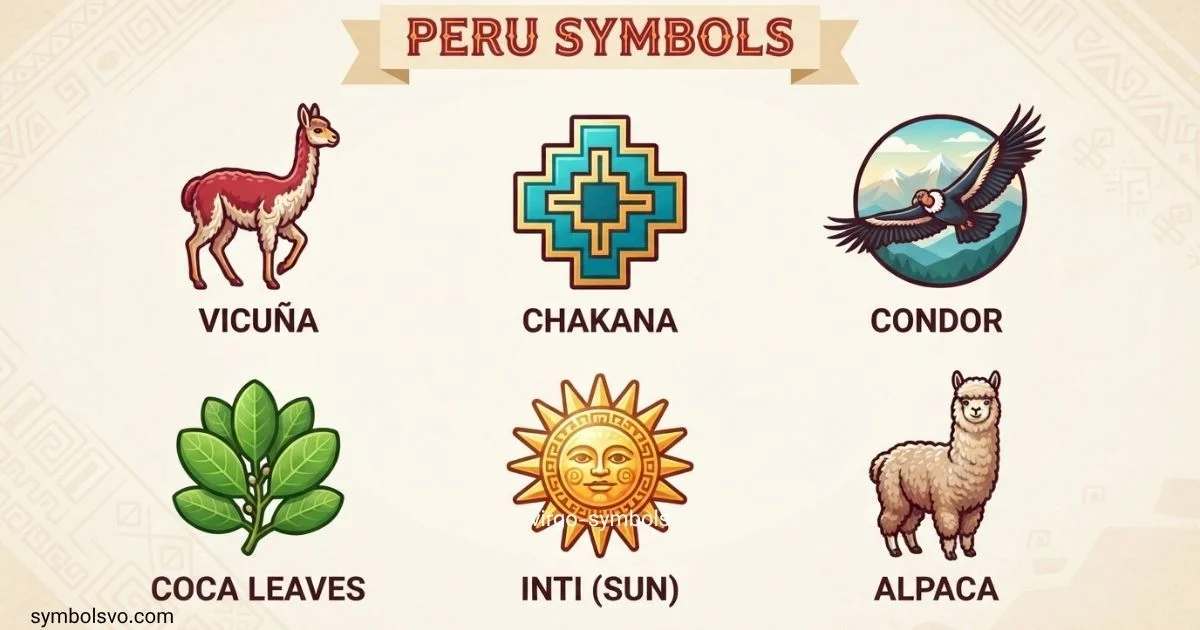
Peru is a country filled with powerful symbols that tell stories of history, culture, identity, and tradition. When I explore Peru symbols, I discover how each one can reveal something meaningful about the people and places behind it.
You may already recognize Peru’s flag or coat of arms, but there is much more to explore. From ancient Inca traditions to modern national emblems, these symbols help you understand Peru in a deeper and more personal way.
In this guide, I’ll take you through the most important Peru symbols, their meanings, origins, and cultural significance. You’ll also discover why these symbols continue to matter today.
Peru Symbols And Meanings
Peru has official national symbols as well as a much broader collection of cultural and archaeological symbols. Under Peru’s Constitution, the national symbols are the national flag, coat of arms, and national anthem.
Modern national symbols
| Symbol | Meaning or association |
| 🇵🇪 Red and white flag | National identity and the Peruvian state |
| 🛡️ Coat of arms | Peru’s natural and material wealth |
| 🎵 National anthem | National identity and patriotic tradition |
| Vicuña | A native Andean animal represented on the coat of arms |
| Quina tree | A plant historically associated with Peru and represented on the coat of arms |
| Cornucopia | Abundance and material wealth |
The Peruvian coat of arms contains three important images: a vicuña, a quina tree, and a cornucopia filled with coins. Historical documentation describes these elements as representing Peru’s riches through its natural kingdoms and resources.
Ancient symbols are different. A Nazca hummingbird, spider, monkey, or geometric figure should not automatically be treated as an official Peruvian national symbol. These are archaeological designs associated with ancient societies and have their own historical context.
Common Peruvian-inspired symbols
For cultural or decorative purposes, people may encounter:
- Vicuña — Andean wildlife and Peruvian heritage.
- Quina tree — a historic botanical symbol appearing on the coat of arms.
- Cornucopia — abundance and wealth.
- Sun imagery — an important motif across several Andean traditions, although its meaning varies by culture and period.
- Nazca hummingbird — one of the best-known ancient geoglyph figures.
- Nazca monkey — a large-scale desert figure associated with the Nasca geoglyph tradition.
- Spiral and geometric forms — recurring shapes within the broader Nazca landscape.
Meanings should always be treated in context. An ancient image does not necessarily have one universally accepted symbolic definition.
Ancient Peruvian Symbols
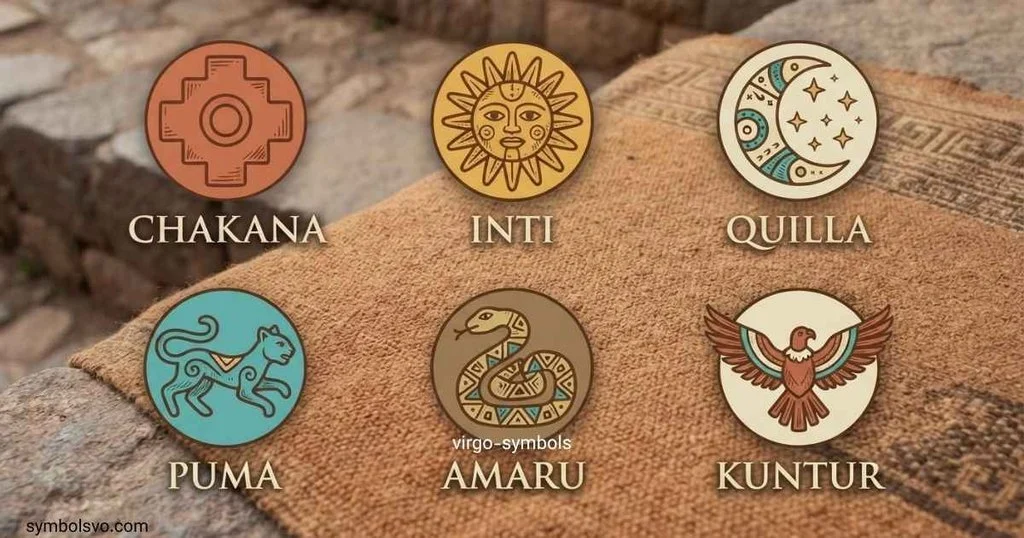
Ancient Peru was home to many cultures, including societies that developed sophisticated visual traditions long before the Inca Empire. Their symbols appeared on ceramics, textiles, architecture, metalwork, carved objects, and landscapes.
The Nazca tradition is particularly famous for its large geoglyphs. UNESCO describes the Nasca and Palpa landscape as containing zoomorphic and anthropomorphic figures, plants, imaginary beings, and geometric forms.
Some recognizable examples include:
- Hummingbird — a highly recognizable bird-shaped geoglyph.
- Monkey — a large figure with a distinctive curled tail.
- Spider — one of the famous animal forms in the Nazca landscape.
- Condor-like bird figures — large bird representations found among the geoglyphs.
- Tree and plant forms — designs representing natural imagery.
- Human-like figures — less common than animal and geometric designs.
- Trapezoids — large geometric ground designs.
- Straight lines — some extend for several kilometers.
- Spirals — curved geometric designs found within the wider landscape.
These designs are not simply isolated “symbols” in the modern sense. They form part of a larger cultural landscape created by ancient communities over a long period.
Peru Symbols Ancient
The word “ancient” is important because Peru’s archaeological symbols do not all come from the same civilization or period. A design associated with the Nasca culture should not automatically be assigned to the Inca, Moche, Paracas, or another culture.
The Nazca geoglyph tradition developed on Peru’s southern coast. UNESCO dates the principal lines and figures broadly from around 500 B.C. to A.D. 500, while identifying both Paracas and Nasca phases within the development of the landscape.
Why ancient symbols are difficult to interpret
Ancient images can be understood through archaeology, comparisons with contemporary artwork, settlement patterns, and the physical landscape. However, not every individual figure has a surviving written explanation.
For that reason, it is safer to distinguish between:
- What archaeologists can observe — the figure’s shape, location, construction method, and archaeological context.
- Interpretations — proposed religious, social, ceremonial, or astronomical purposes.
- Modern interpretations — meanings assigned to the figures in tattoos, artwork, tourism, or popular culture.
This distinction matters when discussing Peru symbols because modern websites and social media sometimes present a speculative interpretation as if it were an established ancient meaning.
Peru Symbols in The Ground
Some of the most extraordinary Peru symbols are literally made in the ground. The Nazca and Palpa geoglyphs were created by modifying the desert surface, exposing lighter-colored material beneath the darker surface stones.
The landscape contains two broad kinds of designs:
- Representational figures — including animals, plants, human-like forms, fantastic beings, and objects.
- Geometric designs and lines — including straight lines, triangles, rectangles, spirals, trapezoids, and other large forms.
Some lines travel for several kilometers. Others form large geometric shapes or connect different parts of the desert landscape.
How the ground symbols were made
The basic technique was relatively simple compared with the enormous scale of the finished designs. Ancient people removed the darker surface stones to expose the lighter ground underneath.
The extremely dry environment helped preserve the resulting designs for centuries. UNESCO notes that the region’s aridity has contributed greatly to their survival.
The remarkable achievement is therefore not based on complicated machinery. It comes from planning, surveying, coordinated labor, and maintaining enormous designs across a difficult desert environment.
Peru Symbol on Mountain
Some people use the phrase “Peru symbol on mountain” when looking for giant figures or unusual markings that become easier to recognize from elevated viewpoints. The Nazca landscape includes designs spread across desert plains, nearby slopes, and elevated terrain, so photographs taken from the air can make them appear very different from ground level.
However, not every large shape seen on a Peruvian mountain is an ancient symbol. Natural erosion, roads, modern construction, agricultural activity, and archaeological features can create shapes that look intentional from a distance.
The safest approach is to identify a claimed mountain symbol by its exact archaeological site and documented evidence rather than assuming that an unusual shape is an ancient message.
Mountain imagery and perspective
Ancient Andean cultures frequently worked within landscapes rather than treating nature as separate from cultural life. This makes location important when interpreting a symbol.
A figure’s position, nearby settlements, pathways, water sources, ceremonial areas, and surrounding landscape can all provide useful archaeological context.
That is one reason the Nazca geoglyphs are better understood as a large cultural landscape than as a collection of isolated drawings.
Peru Symbols From Sky
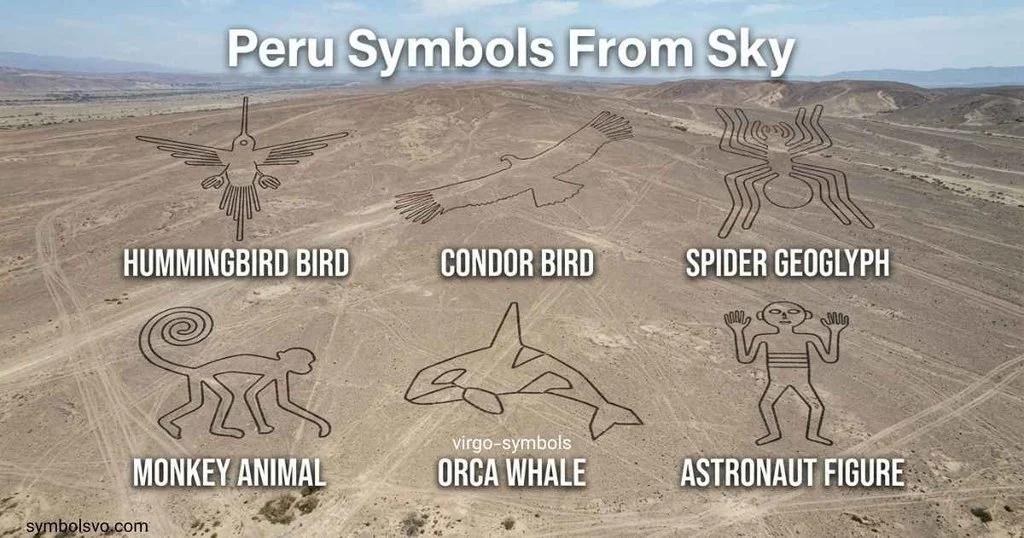
The phrase “symbols from sky” most commonly brings the Nazca Lines to mind because many of their largest figures are difficult to appreciate fully from ground level. From above, animals and geometric patterns become much easier to recognize.
UNESCO describes the Nazca landscape as containing figures ranging from natural forms to geometric designs several kilometers long.
Some well-known examples include:
- 🐒 Monkey — a large stylized animal figure.
- 🐦 Hummingbird — a famous bird-shaped geoglyph.
- 🕷️ Spider — a recognizable animal design.
- Geometric lines — long straight paths crossing the desert.
- Trapezoids — broad geometric forms.
- Spirals — curved designs incorporated into the landscape.
Seeing these designs from above does not mean they were necessarily created specifically for aircraft or extraterrestrial observers. Their construction and cultural context are archaeological questions, and several interpretations have been proposed.
UNESCO states that research suggests ritual and astronomical functions, while other archaeological interpretations emphasize ceremonial pathways and pilgrimage activity.
Peru Symbols Tattoos
Peruvian-inspired tattoos often draw on recognizable elements from ancient Andean art, national identity, or the Nazca Lines. A tattoo can be visually inspired by an archaeological figure without claiming that its original ancient meaning is known with certainty.
Popular design ideas include:
| Tattoo idea | Visual association |
| Nazca hummingbird | Ancient Peruvian geoglyph |
| Nazca monkey | Ancient desert figure |
| Nazca spider | Animal imagery |
| Vicuña | Andean wildlife and national heritage |
| Peruvian flag | Modern national identity |
| Geometric Nazca lines | Ancient landscape art |
| Sun-inspired motif | Broad Andean visual tradition |
| Andean geometric pattern | Indigenous textile and decorative traditions |
If accuracy matters, use the documented name and archaeological context of a design rather than assigning a dramatic meaning that has no reliable source.
For example, calling a particular Nazca figure a “symbol of eternal freedom” may sound appealing for a tattoo, but that does not make it an established ancient interpretation.
Copy-and-paste Peru-inspired symbols
There is no single official Unicode character representing “Peru” or “ancient Peru symbols.” However, these Unicode characters can be used in text alongside Peru-related content:
- 🇵🇪 — Flag: Peru
- ☀ — Sun
- ◇ — Diamond shape
- ◌ — Dotted circle
- ◇◇ — Decorative geometric combination
The Nazca hummingbird, monkey, spider, and other geoglyphs are images, not individual Unicode characters. You cannot copy a genuine Nazca geoglyph as a single Unicode symbol in the same way you can copy 🇵🇪.
Peru Symbols Aliens
The connection between Peru symbols and aliens is one of the most popular modern theories surrounding the Nazca Lines. Some people have suggested that the enormous designs were created for extraterrestrial visitors or were evidence of contact with beings from another world.
There is currently no established archaeological evidence that the Nazca geoglyphs were made by aliens.
The designs can be explained as human-made geoglyphs using techniques consistent with ancient societies. Archaeological research connects them with pre-Hispanic communities in the region, and UNESCO describes them as a highly symbolic cultural landscape with ritual and social significance.
Why the alien theory became popular
The theory is partly fueled by the enormous scale of the designs. Some figures are difficult to understand completely when standing on the ground, while aerial views reveal their full shapes.
That unusual perspective encouraged speculation about why ancient people would create such large images.
But size alone does not demonstrate an extraterrestrial origin. The archaeological record provides evidence of human construction methods and long-term cultural activity in the region.
What archaeology actually supports
Researchers continue to debate the precise purposes of individual lines and figures. UNESCO describes evidence for ritual and astronomical functions, while archaeological interpretations have also considered ceremonial routes and pilgrimage practices.
So the useful distinction is simple:
Alien theory: a modern speculative interpretation.
Archaeological evidence: ancient human communities created the geoglyphs as part of a complex cultural landscape.
The mystery lies mainly in understanding the exact meanings and purposes of all the designs, not in evidence that extraterrestrials created them.
FAQ
What Are The Most Famous Peru Symbols?
The most famous include Peru’s red-and-white flag, coat of arms, and national anthem, along with ancient Nazca geoglyphs such as the hummingbird, monkey, spider, and large geometric designs.
What Do The Nazca Lines Represent?
The Nazca Lines include animals, plants, human-like figures, imaginary beings, and geometric shapes. Their precise meanings vary by design, while archaeological research connects the landscape with ritual, social, and possibly astronomical practices.
Are The Nazca Lines Ancient Peruvian Symbols?
Yes, the geoglyphs are archaeological creations of ancient societies on Peru’s southern coast. They belong to a broader cultural tradition rather than being modern national symbols.
Were The Nazca Lines Made By Aliens?
There is no established archaeological evidence that aliens created the Nazca Lines. Evidence instead supports their creation by ancient human societies using techniques involving the desert surface.
Can I Copy And Paste A Nazca Symbol?
Not as a genuine single Unicode character. Nazca figures are large archaeological images rather than standardized Unicode symbols. You can use 🇵🇪 for the Peru flag or ordinary geometric Unicode characters for decorative text.
Conclusion
Peru symbols cover a wide range of meanings, from modern national identity to ancient archaeological imagery. The country’s official symbols include the flag, coat of arms, and national anthem, while the Nazca geoglyphs provide some of the most recognizable examples of ancient Peruvian visual culture.
The Nazca figures are especially interesting because they combine enormous scale with relatively simple construction techniques. Animals, plants, geometric forms, and long lines were created directly on the desert surface, where the exceptionally dry environment helped preserve them for centuries.
For anyone exploring Peru symbols for education, artwork, tattoos, or copy-and-paste text, context is the key. A modern decorative interpretation can be meaningful, but it should not automatically be presented as the original meaning of an ancient design.

I’m Daniel Brooks, a content creator and symbol enthusiast dedicated to researching the fascinating world of signs and symbols. I enjoy discovering the hidden meanings behind famous icons, emojis, historical emblems, and cultural symbols. Through my writing, I aim to provide trustworthy, well-researched, and reader-friendly information that helps people learn something new with every visit.
Books:
- The Complete Guide to World Symbols
- The Power of Universal Signs
 Mason Ellington
 Grace Whitmore