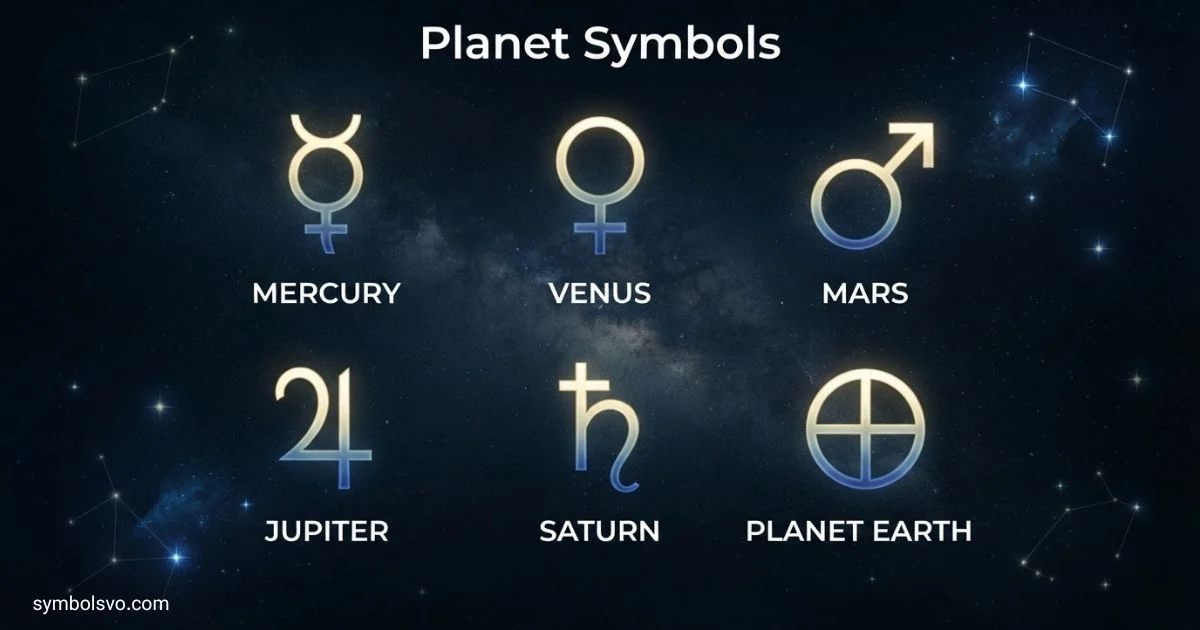
When I first explored planet symbols, I was surprised by how much meaning could be packed into a simple sign. Each symbol has its own history, connection, and story worth discovering.
You may recognize symbols for the Sun, Moon, or planets, but do you know what they actually represent? I’ll help you understand their meanings in a simple and interesting way.
Whether you are a beginner, a student, or simply curious about astronomy and symbolism, you’ll find useful answers here. Let’s explore the fascinating world of planet symbols together.
Planet Symbols And Meanings
Planet symbols are shorthand characters that let you identify celestial bodies without writing their full names. Many traditional planetary glyphs are also used in astrology.
| Planet | Symbol | Common astrological association |
| Sun | ☉ | Identity, vitality, self-expression |
| Moon | ☽ | Emotions, instincts, habits |
| Mercury | ☿ | Communication, thought, learning |
| Venus | ♀ | Love, attraction, values |
| Mars | ♂ | Action, drive, assertion |
| Jupiter | ♃ | Growth, expansion, opportunity |
| Saturn | ♄ | Structure, limits, responsibility |
| Uranus | ♅ | Change, innovation, disruption |
| Neptune | ♆ | Imagination, ideals, spirituality |
| Pluto | ♇ | Transformation, power, regeneration |
These meanings belong primarily to astrological interpretation. They are not universal meanings for the symbols in every context.
Some of the characters have established Unicode identities. For example, ☉ is U+2609 SUN, while ♀ is U+2640 FEMALE SIGN and ♂ is U+2642 MALE SIGN. The traditional planetary glyphs are therefore useful as both astrological signs and Unicode characters.
Planet Symbols Astrology
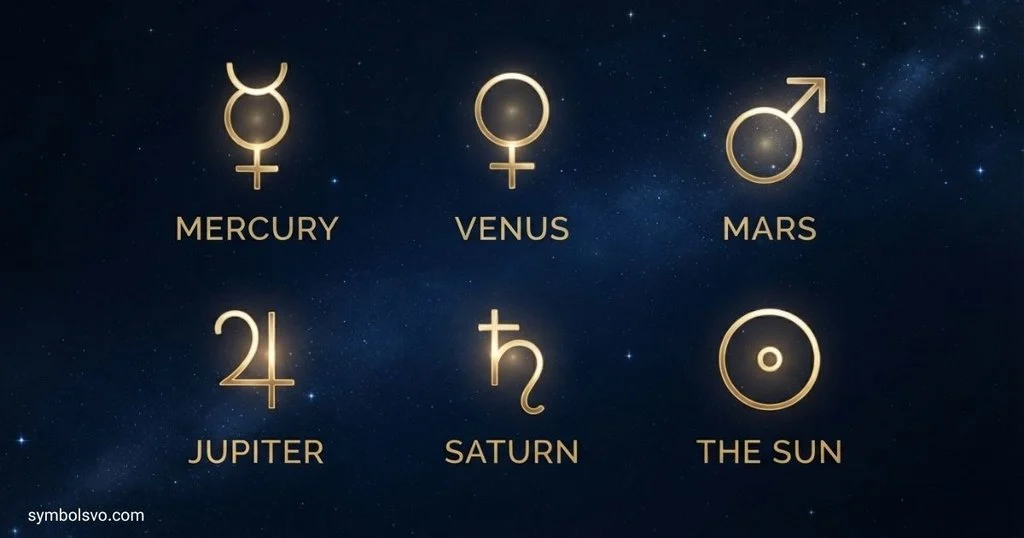
In astrology, planet symbols appear throughout birth charts, transit charts, ephemerides, and other astrological material.
A chart might show:
- ☉ Sun
- ☽ Moon
- ☿ Mercury
- ♀ Venus
- ♂ Mars
- ♃ Jupiter
- ♄ Saturn
- ♅ Uranus
- ♆ Neptune
- ♇ Pluto
The symbol tells you which planet or luminary is being discussed. The sign and degree then tell you where that body is positioned in the zodiac.
For example, a chart might show ♀ 15° Taurus. The ♀ identifies Venus, while Taurus and 15° provide its zodiac position.
Astrological symbols can also appear next to aspects. A chart may use symbols for conjunctions, oppositions, squares, trines, and sextiles to show angular relationships between planets.
Zodiac And Planet Symbols
Zodiac and planet symbols work together but represent different parts of an astrology chart.
The zodiac has 12 signs:
| Zodiac sign | Symbol |
| Aries | ♈ |
| Taurus | ♉ |
| Gemini | ♊ |
| Cancer | ♋ |
| Leo | ♌ |
| Virgo | ♍ |
| Libra | ♎ |
| Scorpio | ♏ |
| Sagittarius | ♐ |
| Capricorn | ♑ |
| Aquarius | ♒ |
| Pisces | ♓ |
Planet symbols identify the celestial bodies, while zodiac symbols identify the signs.
For example:
♂ ♈
means Mars in Aries when used as a combined astrological notation.
This distinction makes astrology charts much easier to read. The first symbol tells you what is being interpreted, and the second tells you where it is located in the zodiac.
Zodiac Planet Symbols
The phrase “zodiac planet symbols” commonly refers to the planetary glyphs used within zodiac astrology.
Here is a quick reference:
☉ ☽ ☿ ♀ ♂ ♃ ♄ ♅ ♆ ♇
These symbols represent the Sun, Moon, Mercury, Venus, Mars, Jupiter, Saturn, Uranus, Neptune, and Pluto.
It is worth remembering that the Sun and Moon are technically a star and Earth’s natural satellite rather than planets. Astrology traditionally groups them with the planets as major chart bodies.
The Earth symbol, ⊕, can also appear in astronomical or astrological contexts, although it is not normally one of the seven classical planetary glyphs.
Planet Symbols In Order
There is more than one useful way to put planet symbols “in order.” A common approach is to list the traditional seven visible planets/luminaries first, followed by the modern outer planets.
Traditional Order
| Name | Symbol |
| Sun | ☉ |
| Moon | ☽ |
| Mercury | ☿ |
| Venus | ♀ |
| Mars | ♂ |
| Jupiter | ♃ |
| Saturn | ♄ |
These are the seven classical planetary bodies used in traditional astrology.
Modern Astrological Order
| Name | Symbol |
| Sun | ☉ |
| Moon | ☽ |
| Mercury | ☿ |
| Venus | ♀ |
| Mars | ♂ |
| Jupiter | ♃ |
| Saturn | ♄ |
| Uranus | ♅ |
| Neptune | ♆ |
| Pluto | ♇ |
The order here is a practical reference rather than a universal rule for every astrological tradition.
All Planet Symbols
Here is a copy-friendly collection of the most commonly encountered traditional and modern planetary glyphs:
☉ ☽ ☿ ♀ ♂ ♃ ♄ ♅ ♆ ♇
Quick Reference
- ☉ — Sun
- ☽ — Moon
- ☿ — Mercury
- ♀ — Venus
- ♂ — Mars
- ♃ — Jupiter
- ♄ — Saturn
- ♅ — Uranus
- ♆ — Neptune
- ♇ — Pluto
The symbols can be copied directly from this list. Their appearance can vary slightly depending on the font and operating system.
Some symbols also have non-astrological uses. For example, ♀ and ♂ are commonly used as gender signs, while ☉ can be used as a sun symbol.
Planet Symbols Numbers
Planet symbols are sometimes connected with numbers in astrology, especially when people search for planetary numbers, traditional planetary sequences, or numeric associations.
There is no single universal numbering system for the planets. The meaning of a “planet number” depends on the tradition being used.
For example, a chart may number planets simply for reference:
| Number | Planet | Symbol |
| 1 | Sun | ☉ |
| 2 | Moon | ☽ |
| 3 | Mercury | ☿ |
| 4 | Venus | ♀ |
| 5 | Mars | ♂ |
| 6 | Jupiter | ♃ |
| 7 | Saturn | ♄ |
This is a convenient reference order, not a universal astrological rule.
In other systems, planetary numbers can come from astrology, numerology, traditional magic, astronomy, or historical planetary tables. Always check the specific system before treating a number as an official meaning.
Planet Symbols Copy And Paste
If you simply need planet symbols to copy and paste, use this collection:
Classical And Modern Planet Symbols
☉ ☽ ☿ ♀ ♂ ♃ ♄ ♅ ♆ ♇
| Symbol | Copy |
| Sun | ☉ |
| Moon | ☽ |
| Mercury | ☿ |
| Venus | ♀ |
| Mars | ♂ |
| Jupiter | ♃ |
| Saturn | ♄ |
| Uranus | ♅ |
| Neptune | ♆ |
| Pluto | ♇ |
You can copy these symbols into social media bios, posts, usernames, notes, astrology content, messages, documents, or decorative designs.
For example:
☉ Sun ♈ Aries
☽ Moon ♋ Cancer
♀ Venus ♎ Libra
♂ Mars ♈ Aries
♄ Saturn ♑ Capricorn
If a symbol looks different on your device, the underlying character may still be the same. Font support controls much of its visual appearance.
Saturn Symbol
The Saturn symbol is ♄.
It is traditionally used in astrology and is also associated historically with Saturn in alchemy. The glyph resembles a stylized form of the planet’s traditional sign.
Copy and paste: ♄
In astrology, Saturn is commonly associated with themes such as:
- Structure
- Responsibility
- Discipline
- Boundaries
- Time
- Authority
- Limitations
- Long-term development
The Saturn symbol is also a Unicode character: U+2644 SATURN.
Do not confuse ♄ with visually similar decorative characters. If you need the actual Saturn Unicode character, copy ♄ directly.
Astro Planet Symbols
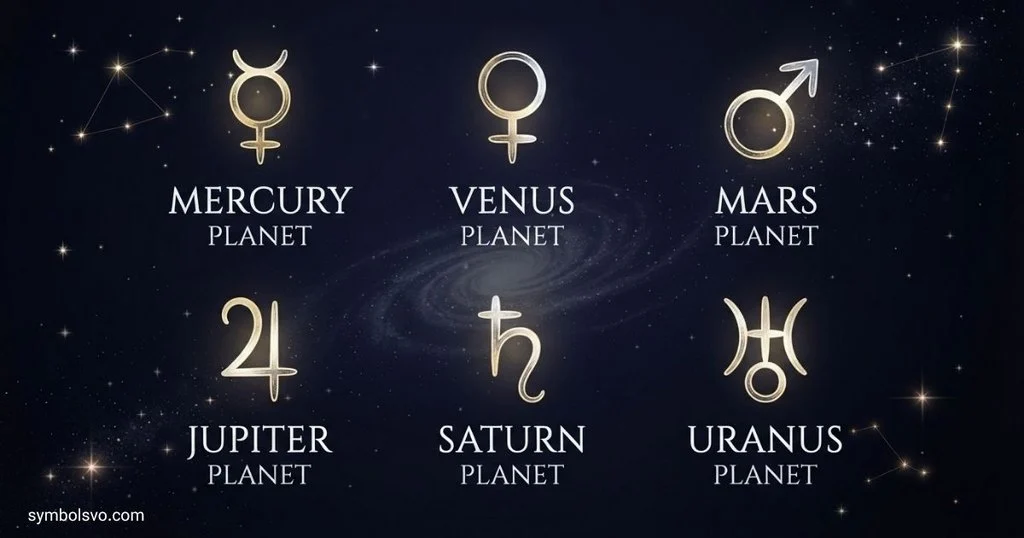
“Astro planet symbols” usually refers to the glyphs used in astrology charts and astrological writing.
A compact reference is:
☉ ☽ ☿ ♀ ♂ ♃ ♄ ♅ ♆ ♇
These can be combined with zodiac signs:
- ☉ ♌ — Sun in Leo
- ☽ ♓ — Moon in Pisces
- ☿ ♊ — Mercury in Gemini
- ♀ ♎ — Venus in Libra
- ♂ ♈ — Mars in Aries
- ♃ ♐ — Jupiter in Sagittarius
- ♄ ♑ — Saturn in Capricorn
The exact interpretation comes from the combination of planet, sign, house, degree, and aspects. The glyph by itself is mainly a visual abbreviation.
Alchemy Planet Symbols
Planetary symbols have a long historical relationship with Western alchemy.
In traditional alchemical symbolism, the seven classical planets were associated with seven metals. The associations commonly appear as follows:
| Planet | Symbol | Traditional metal association |
| Sun | ☉ | Gold |
| Moon | ☽ | Silver |
| Mercury | ☿ | Quicksilver/mercury |
| Venus | ♀ | Copper |
| Mars | ♂ | Iron |
| Jupiter | ♃ | Tin |
| Saturn | ♄ | Lead |
These associations belong to historical alchemical traditions. They should not be treated as modern scientific classifications.
The symbols are especially interesting because several of them remain recognizable today in astrology, while their historical meanings extended into medicine, metallurgy, mythology, and alchemical philosophy.
Alchemical Planet Symbols
Alchemical planet symbols are closely connected with the seven classical planets.
The seven planetary-metal associations are often shown as:
☉ — Sun — Gold
☽ — Moon — Silver
☿ — Mercury — Mercury
♀ — Venus — Copper
♂ — Mars — Iron
♃ — Jupiter — Tin
♄ — Saturn — Lead
These symbols were useful in historical manuscripts because a single glyph could represent both a planetary body and its associated metal.
The same glyphs later became familiar in astrological notation, which is why astrology and alchemy can appear to share the same planetary symbols.
Seven Alchemical Planet Symbols
The seven classical planetary symbols used in alchemical traditions are:
- ☉ — Sun
- ☽ — Moon
- ☿ — Mercury
- ♀ — Venus
- ♂ — Mars
- ♃ — Jupiter
- ♄ — Saturn
The number seven is significant because these were the seven classical celestial bodies visible to the unaided eye that moved against the background of fixed stars: Sun, Moon, Mercury, Venus, Mars, Jupiter, and Saturn.
Each was traditionally linked with a metal, creating a symbolic system that connected the heavens with material substances.
Human Design Planet Symbols
Human Design charts also use familiar planetary and zodiac glyphs. A Human Design bodygraph includes planetary activations alongside gates, lines, centers, channels, and other elements.
Planetary symbols identify the celestial body associated with an activation. For example, a chart may show a Sun or Earth activation and a specific gate and line.
Common planetary glyphs include:
- ☉ — Sun
- ⊕ — Earth
- ☽ — Moon
- ☿ — Mercury
- ♀ — Venus
- ♂ — Mars
- ♃ — Jupiter
- ♄ — Saturn
- ♅ — Uranus
- ♆ — Neptune
- ♇ — Pluto
Human Design uses these symbols as part of its own chart system. Their presence does not mean that their interpretation is identical to conventional Western astrology.
Sailor Moon Planet Symbols
Sailor Moon uses planets, celestial bodies, and planetary themes as important parts of its character and visual design.
The Sailor Guardians are strongly associated with celestial bodies. Examples include:
| Character | Celestial association |
| Sailor Mercury | Mercury |
| Sailor Mars | Mars |
| Sailor Jupiter | Jupiter |
| Sailor Venus | Venus |
| Sailor Uranus | Uranus |
| Sailor Neptune | Neptune |
| Sailor Pluto | Pluto |
| Sailor Saturn | Saturn |
The symbols used in fan art, merchandise, wikis, and character references may be stylized rather than being exact Unicode planetary glyphs.
For copy-and-paste purposes, the standard planetary characters remain useful:
☿ ♀ ♂ ♃ ♄ ♅ ♆ ♇
These can represent the corresponding planets when a plain-text reference is needed, but they are not necessarily the official graphic emblems from the franchise.
Treasure Planet Symbols
Treasure Planet is Disney’s science-fiction adaptation of Robert Louis Stevenson’s Treasure Island. Its visual language combines traditional adventure imagery with futuristic space design.
Unlike astrology, the film does not use one universal set of Unicode planet symbols as a formal planetary writing system.
If you are searching for “Treasure Planet symbols,” the term may refer to:
- Symbols seen in the film’s artwork
- Treasure-map imagery
- Decorative typography
- Fan-created graphics
- Planetary or navigation motifs
- Symbols associated with the film’s futuristic setting
These should not automatically be identified as traditional astronomical or astrological glyphs.
For ordinary planet references, the standard copy-and-paste characters such as ☉, ☽, and ♄ are separate from the film’s fictional visual designs.
Outer Wilds Planet Symbols
Outer Wilds has its own fictional solar system, planets, locations, cultures, and visual motifs.
The game’s fictional bodies include:
- Timber Hearth
- Attlerock
- Brittle Hollow
- Hollow’s Lantern
- Giant’s Deep
- Dark Bramble
- Ash Twin
- Ember Twin
- The Interloper
- The Eye of the Universe
The game uses distinctive visual designs to represent its fictional world. These should not be confused with Unicode planetary glyphs such as ♃ or ♄.
If you are looking for “Outer Wilds planet symbols,” you may actually be searching for game-specific icons, Nomai symbols, planetary imagery, or fan-made representations. Those are different from the traditional planetary characters used in astrology and alchemy.
Cosmere Planet Symbols
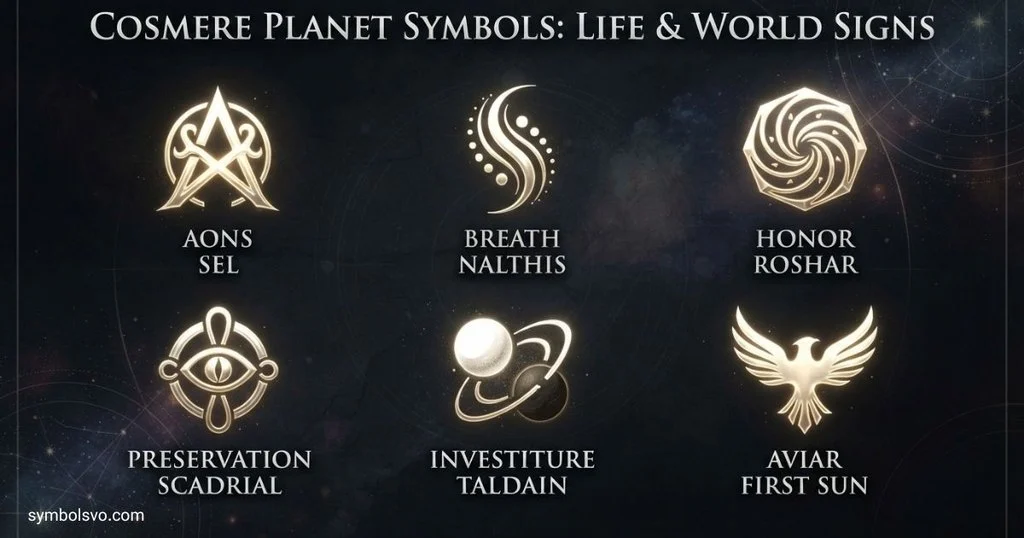
The Cosmere is the interconnected fictional universe created by Brandon Sanderson. Its books contain different worlds, planetary systems, cultures, magic systems, and fictional symbols.
Because the Cosmere contains many fictional settings, “Cosmere planet symbols” can refer to different kinds of symbols, including world-specific imagery, astronomical references, fictional writing systems, or fan-created graphics.
Some major Cosmere worlds include:
- Roshar
- Scadrial
- Sel
- Nalthis
- Taldain
These fictional worlds should not be assigned standard astronomical symbols simply because they are planets or planetary settings in the story.
For example, ♄ is the traditional Unicode Saturn glyph; it is not a Cosmere symbol. Likewise, fictional symbols from a Cosmere work should not be presented as Unicode planet characters unless they actually have a corresponding Unicode encoding.
Frequently Asked Questions
What are the main planet symbols?
The commonly used planetary glyphs are ☉ ☽ ☿ ♀ ♂ ♃ ♄ ♅ ♆ ♇, representing the Sun, Moon, Mercury, Venus, Mars, Jupiter, Saturn, Uranus, Neptune, and Pluto.
What is the symbol for Saturn?
The Saturn symbol is ♄. It is used in astrology and has historical connections with alchemy. Its Unicode code point is U+2644.
Can I copy and paste planet symbols?
Yes. You can copy symbols such as ☉ ☽ ☿ ♀ ♂ ♃ ♄ ♅ ♆ ♇ directly into messages, posts, documents, and other text fields that support these characters.
Are planet symbols the same as zodiac symbols?
No. Planet symbols identify celestial bodies, while zodiac symbols identify the 12 astrological signs. For example, ♂ represents Mars, while ♈ represents Aries.
Are planetary symbols used outside astrology?
Yes. Traditional planetary glyphs have also been used in historical alchemy and related traditions. In modern culture, planetary symbols may also appear in fiction, games, artwork, and decorative text.
Conclusion
Planet symbols are compact visual characters with a surprisingly wide range of uses. The familiar glyphs can identify planets in astrology, represent historical planetary-metal relationships in alchemy, or serve as simple copy-and-paste characters in digital text.
The most useful symbols to remember are ☉ ☽ ☿ ♀ ♂ ♃ ♄ ♅ ♆ ♇. They provide a quick reference for the major traditional and modern planetary bodies commonly encountered in astrology and related subjects.
Context matters when reading these symbols. A planetary glyph in an astrology chart has a different role from a fictional emblem in Sailor Moon, Outer Wilds, Treasure Planet, or the Cosmere. Keeping those contexts separate helps you use each symbol accurately.

 Grace Whitmore
 Daniel Brooks